
Note: This article contains affiliate links. If you click on these links and make a purchase, we may earn a small commission at no extra cost to you. This helps support our research and content. Read our full affiliate disclosure here.
Picking the right energy-efficient water heater can significantly reduce monthly utility bills while ensuring steady hot-water delivery for showers, laundry, and dishes. Whether you are replacing an old tank or upgrading to a higher-efficiency option, the right heater improves comfort and trims long-term operating costs. This guide shortlists the top energy-efficient water heaters across common home use cases and evaluates them on efficiency, installation needs, recovery rate, and durability. Read on for concise, practical guidance to help you choose the best unit for your household and installation constraints.
Top Picks at a Glance
| Best Overall The best all-around choice for most situations | Rinnai RXP199iN Tankless Water Heater |  |
| Best Quality Built to a higher standard if you want something more solid | Senville SENWH-HP50US 50-Gallon Heat Pump |  |
| Best Value The sweet spot between price and what you get | SIVUATEK V7B-140B 14kW Tankless Water Heater |  |
| Best Budget The cheapest option that still gets the job done reliably | xwdzswgs Tankless Water Heater 3000W |  |
| Top Rated A top-rated pick with lots of positive feedback | Bosch Tronic 3000T ES2.5 Mini-Tank |  |
| Most Popular A crowd favorite that many people choose with confidence | EcoSmart ECO 11 Tankless Water Heater |  |
| Best Seller A high-volume bestseller chosen again and again | Rheem RTEX-18 Tankless Electric Water Heater |  |
Rinnai RXP199iN Tankless Water Heater

| Power Source | Natural Gas or Propane |
|---|---|
| Flow Rate | 11 gpm |
| Maximum Temperature | 140 °F |
| Heat Output | 199000 british thermal units |
| Wattage | 98 watts |
The Rinnai RXP199iN is a compact condensing tankless water heater designed to supply continuous hot water for a large household while minimizing energy waste. It runs on natural gas or propane and delivers up to 11.1 gallons per minute, enough to support multiple fixtures simultaneously, and includes an internal pump with Smart-Circ recirculation to reduce hot-water wait times. The unit is Energy Star qualified with a UEF of 0.98 and offers Wi-Fi capability through a separately sold Control-R module for remote diagnostics and setup. Practical touches include a Quick Flush service mode to simplify maintenance and a Versa Vent option that allows indoor or outdoor installation. Because it is a high-capacity, commercial-grade appliance, professional installation is recommended and the compact form factor still requires proper venting and gas sizing. The long heat-exchanger warranty and stainless steel construction speak to durability, but buyers should plan for higher up-front cost and installation complexity compared with tank models.
Best for: Buyers who prioritize long-term energy savings and continuous high-flow hot water for larger households and who are comfortable investing in professional installation.
Less Ideal for: People who want the simplest, lowest-cost replacement or who have very small hot-water demands that do not justify a high-capacity tankless unit.
- Very high energy efficiency (UEF 0.98) reduces operating cost compared with conventional tank heaters
- Delivers up to 11.1 GPM to support several fixtures at once
- Built-in Smart-Circ recirculation pump shortens hot-water wait times by learning usage patterns
- Convertible design supports natural gas or propane and indoor or outdoor venting with Versa Vent
- Quick Flush feature and stainless steel construction simplify maintenance and improve longevity
- Requires professional installation and proper venting which raises total installation cost
- Wi‑Fi control requires a separately sold Control-R module
- Higher upfront price compared with standard tank water heaters
Verdict: Choose the Rinnai RXP199iN if you want a compact, super-efficient tankless heater that delivers high continuous flow and smart recirculation for large households.
Senville SENWH-HP50US 50-Gallon Heat Pump

| Capacity | 50 gallons |
|---|---|
| Uniform Energy Factor (UEF) | 3.75 |
| First Hour Rating (FHR) | 69 gallons |
| Power Source | dc |
| Special Features | Heat Pump System |
The Senville SENWH-HP50US is a hybrid heat pump water heater that uses ambient air to preheat water, then finishes heating electrically when needed. Typical use is household domestic hot water for showers, laundry, and dishes where steady supply and lower operating costs matter. Notable features include ENERGY STAR certification, a 3.75 UEF for strong efficiency, a 69-gallon first hour rating that supports medium to large households, and UL/AHRI certification for verified performance. The hybrid design can cut electricity use substantially compared with standard electric resistive tanks, which translates to lower monthly bills especially in climates where the heater can draw warm air. The unit includes factory-backed compressor and parts warranties and is sized to replace conventional 50-gallon tanks. Limitations to consider are the taller installation profile and heavier weight compared with basic electric tanks, and the need for adequate surrounding airspace and moderate ambient temperatures for the heat pump to reach peak efficiency; it will rely more on electric elements in cold, enclosed locations.
Best for: Buyers focused on cutting ongoing energy costs and responsible for a medium to large household hot-water load who can install the unit in a location with adequate airflow and moderate ambient temperatures.
Less Ideal for: Those who need a compact or lightweight replacement for tight closets or unheated mechanical spaces, or buyers in very cold climates where heat pump performance would be limited.
- High energy efficiency with a 3.75 UEF and ENERGY STAR certification
- 69-gallon first hour rating suitable for multiple simultaneous hot-water demands
- Hybrid heat pump design substantially reduces electric consumption compared with standard electric tanks
- UL and AHRI certifications indicate verified safety and performance
- Requires sufficient ambient air and space to achieve best efficiency
- Heavier and taller than basic electric water heaters, which can complicate installation
Verdict: Choose the Senville 50-gallon hybrid if you want a factory-certified, energy-saving water heater that cuts electricity use while delivering reliable hot water for a medium to large household.
SIVUATEK V7B-140B 14kW Tankless Water Heater

| Wattage | 14 KW |
|---|---|
| Voltage | 240 volts |
| Flow Rate | 2.3 gpm |
| Maximum Temperature | 110 °F |
| Mount Type | Wall mounted |
The SIVUATEK V7B-140B is a wall-mounted, point-of-use electric tankless heater that provides near-instant hot water for a sink or single shower using a 14 kW heating element and 240V supply. It senses flow and self-modulates power to hold temperature as flow changes, and the touch-panel digital display makes setting and monitoring output straightforward. The unit advertises a flow rate of about 2.3 gpm and a maximum outlet around 110 to 131 degrees Fahrenheit depending on conditions, which is useful for tempering small fixtures without a storage tank. Built-in protections such as leak detection, overheating protection, and auto-stop improve safety, and standard 1/2" NPT plumbing connections simplify installation for someone comfortable with basic DIY work. The compact footprint is ideal when space is tight, but the modest flow rate and requirement for a 240V, 14 kW circuit mean it is not suitable for whole-house demand or simultaneous multi-fixture use. For a single point of use where energy efficiency and instant hot water matter, it performs well; buyers should verify electrical capacity before purchase.
Best for: Buyers who want a compact, energy-conscious solution to provide instant hot water at a single fixture and who prioritize controlled temperature and low standby energy use.
Less Ideal for: Homes needing whole-house hot water or multiple simultaneous hot outlets should choose a higher-capacity or tank-style system instead.
- Self-modulating 14 kW element maintains stable temperature as flow changes
- Compact wall-mounted design fits tight point-of-use locations
- Digital touch display simplifies temperature control and status monitoring
- Multiple safety protections including leakage and overheat shutdown
- Standard 1/2" NPT fittings and included hardware ease installation
- Rated flow around 2.3 gpm limits use to a single sink or shower
- Requires a dedicated 240V, 14 kW electrical circuit which may need professional wiring
Verdict: A space-saving, energy-efficient point-of-use tankless heater that delivers reliable instant hot water for a single fixture when you have a 240V circuit available.
xwdzswgs Tankless Water Heater 3000W

| Power | 3000W |
|---|---|
| Power Source | AC 110V |
| Maximum Temperature | 122 °F |
| Mount Type | Wall |
| Connection | 1/2 inch NPT |
This compact tankless unit is a point-of-use electric water heater designed to deliver instant hot water for sinks and small fixtures. It mounts vertically under a sink or on a wall and uses a 3000W heating element to raise outlet temperature quickly at low flow rates, with a digital LED display for monitoring in Celsius or Fahrenheit. Built-in protections include dry-boil cutoff, leakage isolation, IPX4 splash resistance, and automatic shutdown for overheating, which reduce safety risks in tight installations. The small footprint and quick warm-up make it practical for kitchens, RVs, apartments, and offices where space and energy use matter. Important limitations are flow-dependent output and modest power: higher flows will produce lower outlet temperatures and the unit is not suitable for showers. Installation requires vertical mounting, a 1/2 inch NPT connection, and a recommended 32A trip switch and heavier wiring for reliable operation. For buyers on a budget seeking instant hot water at a single fixture, this is an efficient, no-frills solution with useful safety features.
Best for: Buyers who need an affordable, energy-efficient point-of-use heater to supply a single sink or small fixture and prefer a compact, safety-minded unit that saves space and avoids tank standby losses.
Less Ideal for: Homes that need whole-house hot water or reliable hot water at shower flow rates should choose a higher-capacity or dedicated shower-rated unit instead.
- On-demand heating delivers hot water quickly at low-flow fixtures
- Compact, wall-mounted design saves space under sinks
- Digital display with C/F select lets you monitor outlet temperature
- Multiple built-in safety protections including dry-boil and overheating shutdown
- IPX4 splash resistance suitable for wet locations like under-sink areas
- Not suitable for showering due to low recommended flow capacity
- Requires vertical installation and specific wiring/trip switch recommendations which may need an electrician
Verdict: A budget-friendly, energy-efficient point-of-use tankless heater that reliably supplies instant hot water to a single sink while minimizing space and standby loss.
Bosch Tronic 3000T ES2.5 Mini-Tank
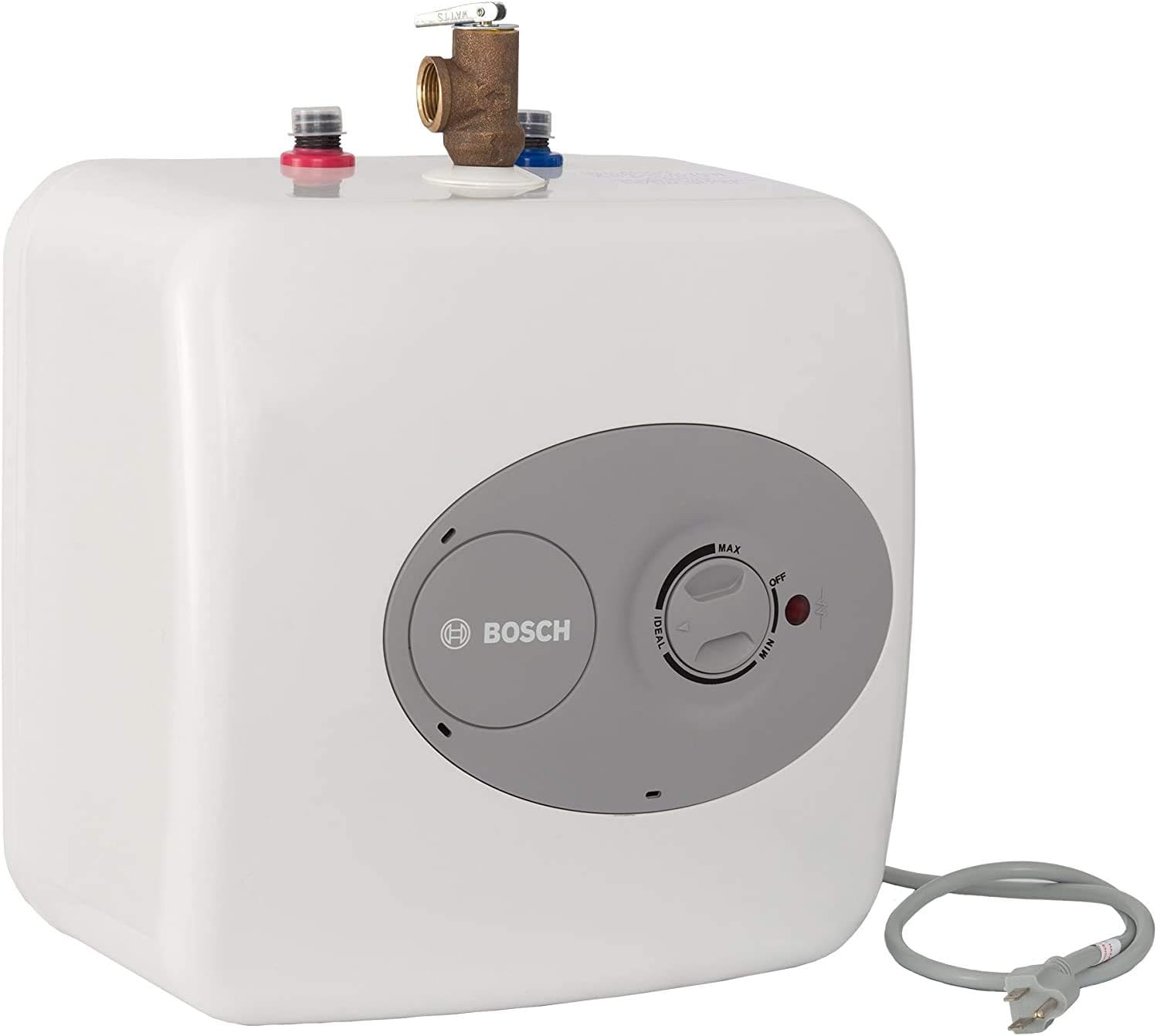
| Capacity | 2.5 gallons |
|---|---|
| Wattage | 1440 watts |
| Voltage | 120 volts |
| Maximum Temperature | 140 °F |
| Efficiency | 98% |
The Bosch Tronic 3000T ES2.5 is a compact point-of-use electric mini-tank that provides near-instant hot water where you need it most. It is typically mounted under a sink, on a shelf, or wall-mounted and can be plugged into a standard 120V outlet for independent installation or piped inline with a larger water heater. The glass-lined 2.5-gallon tank and 1440-watt heating element offer fast recovery and high thermal efficiency, so you get usable hot water for one or two fixture draws without long waits. A simple external dial makes temperature adjustment straightforward, and the included temperature-and-pressure relief valve adds a layer of safety. Because it is small and lightweight it is easy to service or replace, and the attractive exterior lets it stay in visible areas. Limitations are its small capacity, which is intended for point-of-use rather than whole-house service, and the 120V/1440W power means it is not as fast to recharge as higher-voltage commercial units.
Best for: Buyers who prioritize a reliable, low-maintenance solution to eliminate wait time for hot water at a single sink or fixture and want a durable, energy-efficient mini-tank.
Less Ideal for: Homes that need hot water for multiple bathrooms, large tubs, or whole-house demand should look at larger or tankless options instead.
- Compact point-of-use design fits under sinks or on walls for immediate hot water
- Glass-lined tank for corrosion resistance and longer service life
- Plugs into a standard 120V outlet for easy, independent installation
- High thermal efficiency (98%) reduces standby energy loss compared with uninsulated tanks
- Small 2.5-gallon capacity limits run time and is unsuitable for whole-house hot water needs
- Lower 120V power means slower recovery versus higher-voltage water heaters
Verdict: Choose the Bosch Tronic 3000T ES2.5 when you want a dependable, energy-efficient mini-tank to reliably deliver near-instant hot water at a single fixture.
EcoSmart ECO 11 Tankless Water Heater

| Heat Output | 11 KW |
|---|---|
| Wattage | 13000 watts |
| Voltage | 220 volts |
| Flow Rate | 3.1 gpm |
| Maximum Temperature | 140 °F |
The EcoSmart ECO 11 is a wall-mounted, 13 kW electric tankless water heater built for point-of-use jobs like a single bathroom or a small sink. It heats water on demand using self-modulating technology, so it only draws power when hot water is needed and maintains temperature within about 1 degree of the set point via digital control. Typical uses are supplying one shower or a sink in warmer climates, or providing a reliable low-flow source for an office breakroom or utility sink. Notable features include an LED display, a compact 11.5 x 8 x 3.75 inch footprint that saves space, and a flow rate up to about 3.1 gpm depending on inlet temperature. Practical benefits are near-instant hot water at the point of use, high thermal efficiency, and lower standby energy waste compared with tank heaters. Important limitations are its modest flow capacity and electrical requirement — it is sized for single-fixture use in many climates and needs appropriate 240 V wiring and breaker capacity, so verify sizing and electrical compatibility before installation.
Best for: Buyers who prioritize energy efficiency and compact point-of-use hot water solutions and who want a reliable, on-demand unit for a single bathroom, sink, or small office setting.
Less Ideal for: Households needing simultaneous hot water for multiple full bathrooms or anyone without the required 240 V electrical capacity and breaker availability should consider larger or differently configured units.
- Self-modulating heating that uses only the energy required for the current demand
- Compact wall-mounted design frees floor space and suits point-of-use installation
- Digital temperature control with LED display for precise temperature setting
- High thermal efficiency that reduces standby energy loss compared with tank heaters
- Limited flow rate makes it unsuitable for simultaneous high-demand fixtures
- Requires substantial 240 V electrical capacity and proper breaker sizing
Verdict: Choose the ECO 11 if you want a compact, energy-efficient electric tankless heater that delivers precise on-demand hot water for single-fixture or low-flow point-of-use needs.
Rheem RTEX-18 Tankless Electric Water Heater
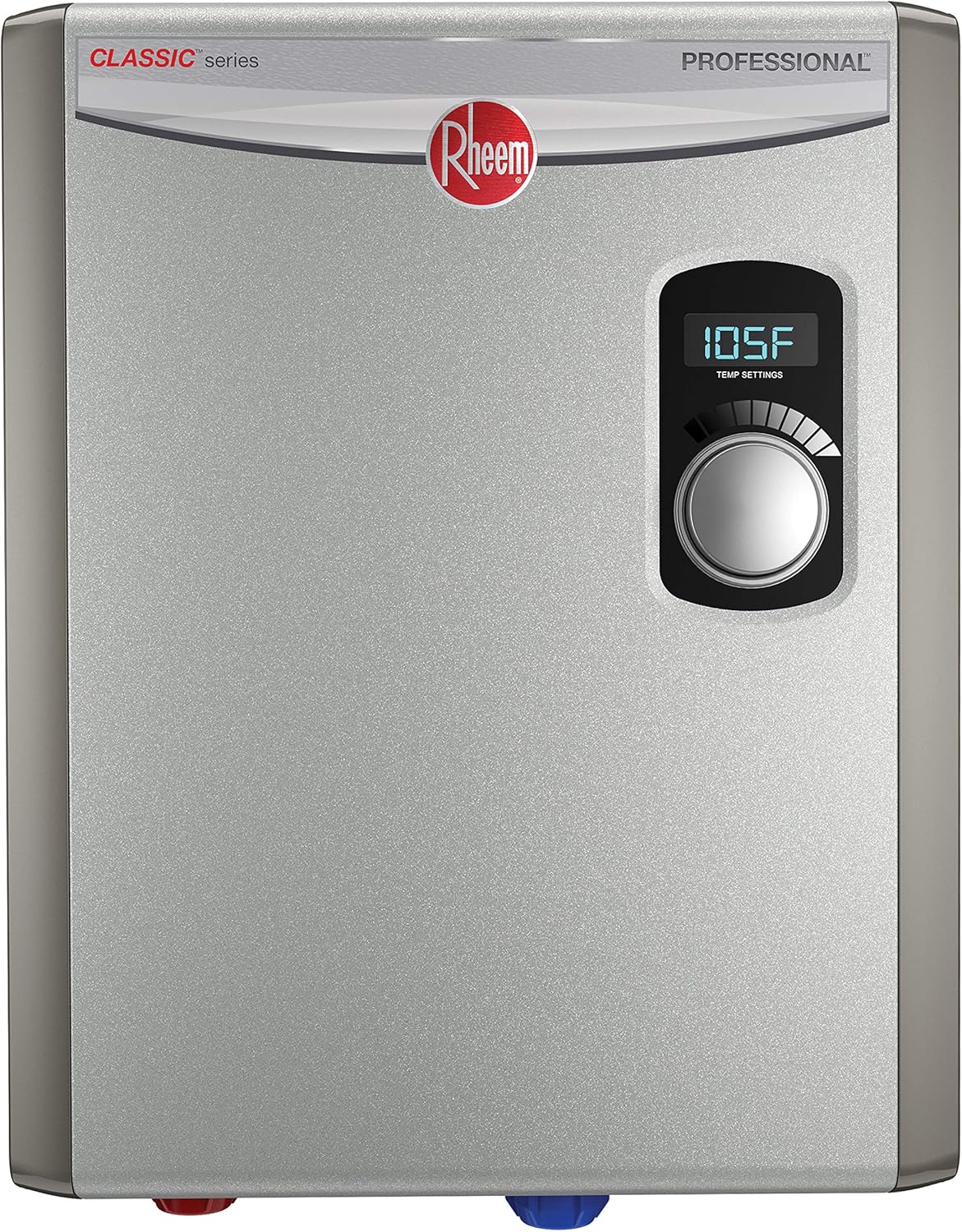
| Wattage | 18000 watts |
|---|---|
| Voltage | 240 volts |
| Flow Rate | 4.4 gpm |
| Heat Output | 18 KW |
| Maximum Temperature | 140 °F |
The Rheem RTEX-18 is a whole-home tankless electric unit designed to provide continuous hot water for mid-sized households. It uses 18 kW of heating power with self-modulating electronics to match energy use to demand, and a front LED temperature display for precise setpoint control. Typical use is wall-mounted near a central plumbing location to supply one or two simultaneous fixtures such as a shower and sinks depending on inlet water temperature and flow. Practical benefits include reduced standby energy because it heats only when needed, compact wall mounting that frees up space compared with a tank, and field-serviceable copper heating elements for easier maintenance. Important limitations are the high electrical demand requiring multiple dedicated breakers and appropriate panel capacity, and a maximum flow rate of about 4.4 gpm which may limit simultaneous high-flow uses in colder climates. Installation requires compatible 240V wiring and a plumber or electrician familiar with tankless electric hookups.
Best for: Buyers who prioritize energy efficiency, predictable performance, and lower operating costs over a compact, reliable whole-home hot water solution and prefer a conservative, low-risk choice with established brand support.
Less Ideal for: Homes without adequate 240V electrical service or large households that regularly run multiple high-flow showers and appliances at the same time should consider higher-capacity solutions or gas alternatives.
- On-demand heating with self-modulation to reduce energy use
- Digital LED temperature control for precise setpoint adjustments
- Compact wall-mounted design saves space compared with tanks
- Field-serviceable copper heating elements for easier maintenance
- Up to 4.4 gallons per minute suitable for single-shower or modest whole-home use
- Requires substantial 240V electrical capacity and multiple breakers
- Flow rate may be insufficient for simultaneous high-demand fixtures in cold inlet conditions
Verdict: Choose the RTEX-18 if you want a compact, energy-efficient electric tankless heater that delivers dependable on-demand hot water for modest whole-home use.
Choosing the Right Energy-Efficient Water Heater: Key Factors to Consider
Efficiency Rating and Real-World Savings
A unit's published efficiency rating, such as Energy Factor or Uniform Energy Factor, indicates how much of the fuel or electricity is converted into usable hot water. Higher ratings usually translate into lower operating costs, but the actual savings depend on household hot-water patterns and local energy prices.
When comparing options, consider typical daily hot-water use in your home and how much standby loss is present for tank models. For heat-pump and condensing designs, seasonal performance matters because efficiency can vary with ambient temperature. Estimating annual energy consumption for your usage profile helps determine payback timelines and whether the higher upfront cost of a more efficient model is justified.
Hot-Water Output and Recovery Speed
Recovery rate determines how quickly a water heater replenishes hot water after heavy use. For tank-style units, look at the first-hour rating and tank capacity; for tankless units, focus on gallons per minute at realistic inlet temperatures.
Households with multiple simultaneous hot-water uses should prioritize higher recovery or greater flow capacity. Undersized units may cause temperature drops during showers or when appliances run concurrently. Matching the heater's output to peak demand avoids discomfort and reduces the temptation to run inefficient supplemental systems.
Installation Requirements and Site Fit
Installation complexity affects total project cost and feasibility. Some high-efficiency technologies require extra space, specific clearances, or dedicated electrical circuits and higher amperage. Venting needs vary from simple atmospheric vents to sealed or condensing venting that must terminate outdoors.
Assess available space, existing fuel type, and the ability to modify electrical service or vent pathways. If major changes are needed, factor those into your decision because installation constraints can outweigh nominal efficiency gains.
Durability, Materials, and Warranty
Materials such as tank lining, heat exchanger type, and corrosion protection influence a water heater's lifespan. Robust construction reduces the frequency of repairs and the risk of premature failure.
Warranty terms reveal manufacturer confidence and can shift expected ownership cost. Longer or more comprehensive warranties often indicate better protection against common failure modes. Consider both the length and coverage details when estimating long-term value.
Maintenance and Serviceability
Different technologies require different maintenance routines. Tank models benefit from periodic flushing to remove sediment, while heat pumps or condensing units may need filter cleaning and condensate management. Ease of access to components affects how costly and simple routine upkeep will be.
Factor in the local availability of qualified technicians for the chosen technology. A technically complex unit with limited local service options may have higher lifecycle costs despite excellent efficiency numbers.
Noise, Space, and Household Impact
Operational characteristics such as noise and footprint matter for where the heater is installed. Heat-pump units may emit fan noise and need more clearance for airflow, while tankless systems may produce operational sounds and demand dedicated venting.
Consider placement relative to living areas and whether additional insulation or noise mitigation is necessary. A well-sited installation reduces household disruption and improves overall satisfaction with the unit.
Types of Energy-Efficient Water Heaters
Several technologies deliver improved efficiency compared with conventional electric-resistance or older gas tank models. Common high-efficiency options include heat-pump water heaters, condensing gas units, high-efficiency tankless systems, and well-insulated storage tanks with low standby loss.
Each type has tradeoffs. Heat pumps can offer the highest electricity-to-heat efficiency in moderate climates but require space and may perform less well in very cold basements. Condensing gas units recover heat from exhaust gases for higher fuel efficiency but need compatible venting. Tankless models eliminate standby loss but must be sized correctly to meet simultaneous demand.
- Heat-pump: high COP but needs space and specific airflow.
- Condensing gas: greater fuel efficiency with specialized venting.
- Tankless: no standby loss but must match peak flow.
- High-efficiency tank: improved insulation and reduced standby loss.
Sizing Your New Heater
Accurate sizing balances capacity with efficiency. For storage tanks, choose a capacity that covers morning or evening peak periods and consider first-hour ratings. For tankless systems, calculate total simultaneous flow from showers, faucets, and appliances and then match the unit's flow rate at realistic inlet temperatures.
Undersizing leads to cold-water sandwiches and user frustration. Oversizing tank units increases standby loss and could reduce overall system efficiency. Use a conservative estimate of peak demand and consult installation constraints to pick the right size.
- Estimate peak simultaneous fixtures.
- Compare first-hour rating for tanks.
- Match flow rate and temperature rise for tankless.
Installation Considerations and Permits
High-efficiency models often require specific venting, electrical capacity, or condensate drainage. Confirm local code requirements and whether permits are needed for fuel conversions or major electrical work. Improper installation can negate efficiency gains and create safety issues.
Plan for clearances, condensate disposal, and access for future service. If you are replacing an older unit, check whether existing hookups are compatible or if modifications will be necessary.
- Verify venting and condensate pathways.
- Check electrical service and breaker capacity.
- Confirm local permit and inspection requirements.
Running Costs and Payback Timeline
Estimate annual energy consumption based on your household's hot-water use and local fuel or electricity rates. More efficient units often have higher upfront costs but lower operating expenses. Calculating annual savings helps project payback time versus replacement cost.
Consider maintenance costs and potential service needs in your total cost estimate. A unit with slightly lower efficiency but cheaper maintenance and longer warranty may be more economical over its lifetime.
- Calculate expected annual consumption and cost.
- Include maintenance and potential repair expenses.
- Estimate simple payback period for higher-efficiency upgrades.
Common Retrofitting Scenarios
Retrofitting an existing installation imposes constraints that influence the best choice. When converting from one fuel type to another or upgrading to a heat-pump unit in a tight mechanical room, evaluate whether infrastructure changes are feasible. In many cases, a high-efficiency storage model that fits existing hookups offers the best blend of performance and simplicity.
Document current venting, gas lines, and electrical capacity before shopping. Understanding the limits of your space saves time during installation and prevents unexpected modification costs.
- Map current hookups and vent routes.
- Assess structural space for larger or taller units.
- Plan for condensate disposal for condensing models.
How We Chose the Best Energy-Efficient Water Heater
We selected units that demonstrably prioritize energy efficiency and practical home use performance. Primary evaluation criteria included energy factor or uniform energy factor ratings, standby heat loss for tank models, and comparative efficiency gains for heat pump or condensing designs. Installation and complexity were assessed by typical venting or electrical requirements and compatibility with standard plumbing layouts. Recovery rate and output were measured by gallons-per-minute or first-hour rating to reflect real-world hot-water demand. Durability and warranty coverage were considered to estimate expected service life and maintenance burden. We excluded specialized commercial models and products requiring uncommon fuel sources or proprietary installation components. The final list balances measured energy savings against installation practicality and sustained hot-water delivery.
Our full evaluation process is outlined in our review methodology.
FAQ
How much can I expect to save with an energy-efficient water heater?
Savings vary widely depending on your current unit, hot-water use, and local energy costs. Upgrading from an older, inefficient tank to a heat-pump or condensing design can cut operating costs substantially in many cases, but calculating expected annual consumption is the best way to estimate savings.
Are heat-pump water heaters suitable for all homes?
Heat-pump units work best in moderate climates and where there is enough space and airflow for the unit to operate. They may be less effective in very cold locations or cramped mechanical rooms. Consider ambient conditions and available space before choosing this technology.
Do tankless water heaters truly eliminate standby losses?
Yes. Because they heat water on demand, tankless systems avoid standby losses inherent to storage tanks. However, they must be sized correctly for peak simultaneous demand, and in some installations, added complexity or longer vent runs can affect overall efficiency.
What maintenance does a high-efficiency storage tank need?
Routine maintenance typically includes periodic flushing to remove sediment, checking anode rods for corrosion protection, and inspecting pressure-relief valves. Regular upkeep helps sustain efficiency and extends the unit's useful life.
Will upgrading the water heater require changing my electrical service?
Possibly. Some high-efficiency electric models or tankless systems require higher amperage and dedicated circuits. Verify your electrical panel capacity and consult with an electrician during planning to determine if upgrades are necessary.
Final Verdict
When choosing an energy-efficient water heater, prioritize the combination of real-world efficiency and the ability to meet your household's peak hot-water demand. Balance efficiency ratings with installation realities such as space, venting, and electrical capacity, and factor in maintenance expectations and warranty coverage. By matching the technology to your site constraints and usage pattern, you can confidently select a unit that reduces operating costs while delivering reliable hot water for years.