
Note: This article contains affiliate links. If you click on these links and make a purchase, we may earn a small commission at no extra cost to you. This helps support our research and content. Read our full affiliate disclosure here.
If your home draws from a private well, choosing the right water heater affects comfort and long-term maintenance. Well water often has different mineral content, sediment levels, and chemistry than municipal supplies, and those factors influence component wear, heat-exchange efficiency, and the need for routine care. This guide covers seven shortlisted water heaters that are appropriate for well-water conditions, focusing on capacity, corrosion resistance, and serviceability. You will find practical guidance on features that matter for well systems and a clear set of evaluation criteria used to compare the top options. Read on to find the heater type and specifications that match your household demand and well-water characteristics.
Top Picks at a Glance
| Best Overall The best all-around choice for most situations | SIVUATEK 27kW Tankless Water Heater |  |
| Best Quality Built to a higher standard if you want something more solid | Rheem RTEX-18 Tankless Electric |  |
| Best Value The sweet spot between price and what you get | VEVOR 10-Gallon Electric Water Heater |  |
| Best Budget The cheapest option that still gets the job done reliably | Generic Tankless Water Heater XY-FC |  |
| Top Rated A top-rated pick with lots of positive feedback | Bosch Tronic 3000 T ES2.5 |  |
| Most Popular A crowd favorite that many people choose with confidence | EcoSmart ECO 11 Tankless Water Heater |  |
| Best Seller A high-volume bestseller chosen again and again | Orbek 60000 BTU RV Tankless Water Heater |  |
SIVUATEK 27kW Tankless Water Heater

| Wattage | 27 KW |
|---|---|
| Voltage | 240 volts |
| Maximum Temperature | 131 °F |
| Mount Type | Wall |
This 27kW SIVUATEK tankless electric heater supplies on-demand hot water without a storage tank, using 27 kW of power and a digital LED to set temperatures from 86°F to 131°F in 1°F increments. It mounts on the wall or under a sink and is intended to serve multiple outlets at once, with the listing claiming capacity for roughly 4–5 simultaneous usage points. The unit emphasizes energy efficiency and reduced standby loss, and includes protections such as overheating, leakage detection, and scale-reduction design to improve longevity. Installation requires three 40-amp breakers on a 240V supply and standard 3/4" NPT plumbing connections, so professional electrical and plumbing work is typical. Practical benefits include compact footprint, precise temperature control, and rapid recovery for continuous hot water; limitations are the high electrical demand and the need to verify flow rates on well systems for consistent activation and temperature stability. For well water use, water quality and pressure will affect performance and may require pre-filters or pressure regulation.
Best for: Buyers who want a compact, energy-efficient whole-house electric tankless heater that delivers steady hot water to several fixtures and who prioritize precise temperature control and built-in safety.
Less Ideal for: Homes without the required 240V electrical service capacity or users who prefer low-electrical-demand solutions like gas or small-point-of-use heaters.
- High 27 kW output suitable for multiple simultaneous hot water points
- Precise LED temperature control with 1°F increments for consistent setpoints
- Compact wall-mount design saves space and fits under-sink or on-wall installations
- Built-in safety features including overheating and leakage protection
- Requires substantial electrical capacity (three 40-amp breakers) and professional installation
- Performance depends on inlet water flow and quality, which can vary on well systems
Verdict: Choose this unit if you need a powerful, space-saving electric tankless heater that delivers continuous hot water with precise digital temperature control.
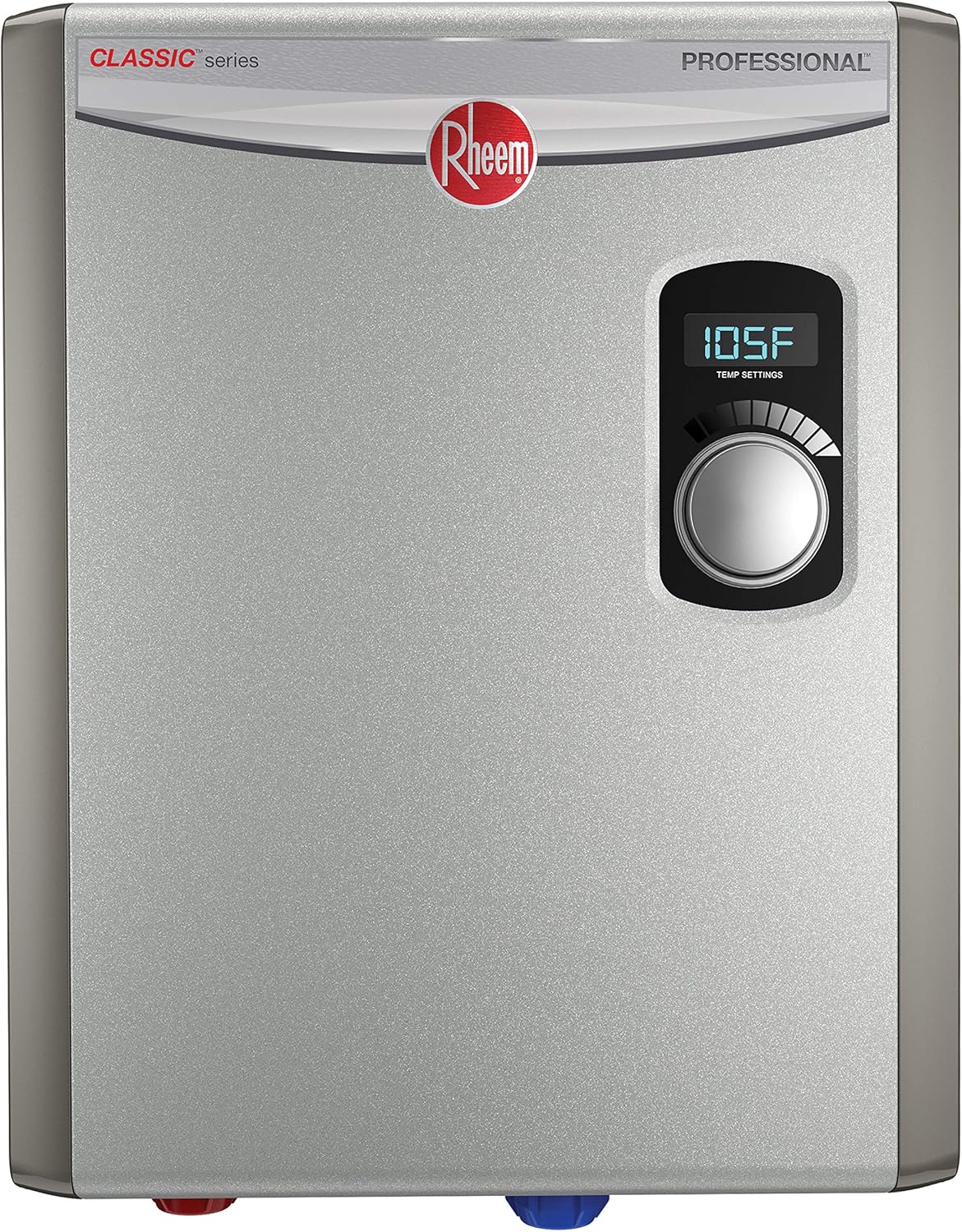
Rheem RTEX-18 Tankless Electric
| Wattage | 18000 watts |
|---|---|
| Voltage | 240 volts |
| Flow Rate | 4.4 gpm |
| Maximum Temperature | 140 °F |
| Efficiency | 99.8% |
The Rheem RTEX-18 is a wall-mounted tankless electric heater built for continuous hot water in mid-size homes and single shower applications in cooler climates. It uses self-modulating electronics and two field-serviceable copper heating elements to vary power to match demand, which improves efficiency and reduces standby energy use. The front LED digital thermostat provides precise temperature control, and the unit requires no venting, making placement flexible near point-of-use or in a central location. With a max flow rate of 4.4 gpm and an 18 kW rating at 240V, it can support typical well-water households with moderate simultaneous use, though its performance depends on incoming groundwater temperature and available breaker capacity. Installation uses 3/4 inch NPT water connections and the compact stainless steel body saves space compared with tank heaters. Limitations include the need for substantial electrical service (multiple 40A breakers recommended) and reduced flow/temperature rise in very cold inlet conditions, so larger homes or heavy concurrent demand may need a higher-kW model or a secondary unit.
Best for: Buyers who prioritize efficient, on-demand hot water for a mid-size home or point-of-use near well water fixtures and who can provide the necessary electrical service.
Less Ideal for: Large households with heavy simultaneous hot water use or homes with very cold well water where a higher-kW unit or multiple units would be needed.
- Self-modulating control adjusts power to actual hot water demand for improved efficiency
- Digital LED thermostat offers precise temperature setpoint control
- Compact wall-mounted design requires no venting and saves space
- Field-serviceable copper heating elements for easier maintenance
- Requires high electrical capacity and multiple large breakers for installation
- Max flow rate (4.4 gpm) can limit simultaneous fixtures in very cold inlet temperatures
Verdict: Choose the RTEX-18 if you want a compact, energy-smart tankless electric unit that delivers dependable on-demand hot water for mid-size homes with adequate electrical capacity.
VEVOR 10-Gallon Electric Water Heater

| Capacity | 10 gallons |
|---|---|
| Wattage | 1600 watts |
| Maximum Temperature | 167 °F |
| Power Source | ac |
This compact 10-gallon electric storage heater provides a steady supply of hot water for small households or point-of-use needs. It uses a 1600W immersion heating element and foam-insulated tank to heat water up to 167°F, and the LED display plus rotary knob make temperature monitoring and adjustment straightforward. The enamel-coated inner tank and multiple protections such as dry-heat, overheat, and high-pressure protection offer added safety for everyday use. Because it is a floor-mounted storage tank, it supplies ready hot water without the flow limitations of some tankless units, which is handy for sinks, small bathrooms, or a laundry area. Trade-offs include modest capacity compared with whole-house heaters and a 1600W element that will take time to recover after heavy draw, so it is best used where intermittent hot water is acceptable. Installation requires standard plumbing and appropriate electrical supply, and siting should avoid outdoor exposure to the elements.
Best for: Buyers who prioritize a reliable, compact storage heater to optimize hot-water availability at a single sink or small bathroom and value safety features and easy temperature control.
Less Ideal for: Large households or users needing continuous high-flow hot water for multiple fixtures simultaneously should consider larger-capacity or higher-power options.
- Compact 10-gallon tank suited for point-of-use or small households
- 1600W immersion heating element that reaches up to 167°F
- LED display and rotary temperature control for easy monitoring and adjustment
- Multiple safety features including dry-heat, overheat, and high-pressure protection
- Enamel-coated inner tank and foam insulation for improved durability and heat retention
- 10-gallon capacity can run out quickly under heavy use and has slower recovery due to 1600W power
- Floor-mounted storage design is not ideal where space is very limited or a wall-mounted tankless unit is preferred
Verdict: A practical, safety-focused 10-gallon electric storage heater that delivers ready hot water at a single point of use for buyers optimizing compact domestic setups.
Generic Tankless Water Heater XY-FC

| Heat Output | 3000 watts |
|---|---|
| Maximum Temperature | 122 °F |
| Maximum Pressure | 1200 kilopascal |
| Voltage | AC 110V |
| Temperature Regulation Range | 68-122 °F |
This small tankless unit heats water on demand for a single outlet under a sink, using a 3000W element at 110V and a simple one-touch control. It is typically mounted vertically under a kitchen or RV sink and is operated by adjusting flow to reach the desired outlet temperature; lower flow yields hotter water. The unit includes safety features such as dry combustion protection, leakage protection, overheating protection and IPX4 splash resistance, and it has stainless steel and brass wetted parts for corrosion resistance. Practical benefits include near-instant hot water for handwashing and dish tasks in compact spaces and automatic standby to keep it ready. Important limitations are the high current draw (up to 27A at 110V), the need for a heavy gauge feed and appropriate circuit capacity, and a low recommended flow that makes it unsuitable for showers or multiple fixtures at once. Installation must be vertical and use proper Teflon sealing on fittings to avoid leaks and electrical faults.
Best for: Buyers needing a low-cost, compact point-of-use heater for a single sink or RV who prioritize instant hot water and simple installation in tight spaces.
Less Ideal for: Homes that need whole-house hot water or reliable shower supply should choose a higher-capacity or multi-fixture system instead.
- Compact under-sink form factor for tight spaces
- 3000W element provides fast temperature rise at low flow
- Multiple built-in safety protections (dry combustion, leakage, overheat)
- Stainless steel and brass wetted components resist corrosion
- Draws high current (up to 27A) requiring heavy gauge wiring and proper circuit capacity
- Not suitable for showering or supplying multiple fixtures due to low flow/heating profile
Verdict: A budget-friendly compact tankless unit that supplies fast on-demand hot water for a single sink when you can provide the required heavy-gauge wiring and circuit capacity.
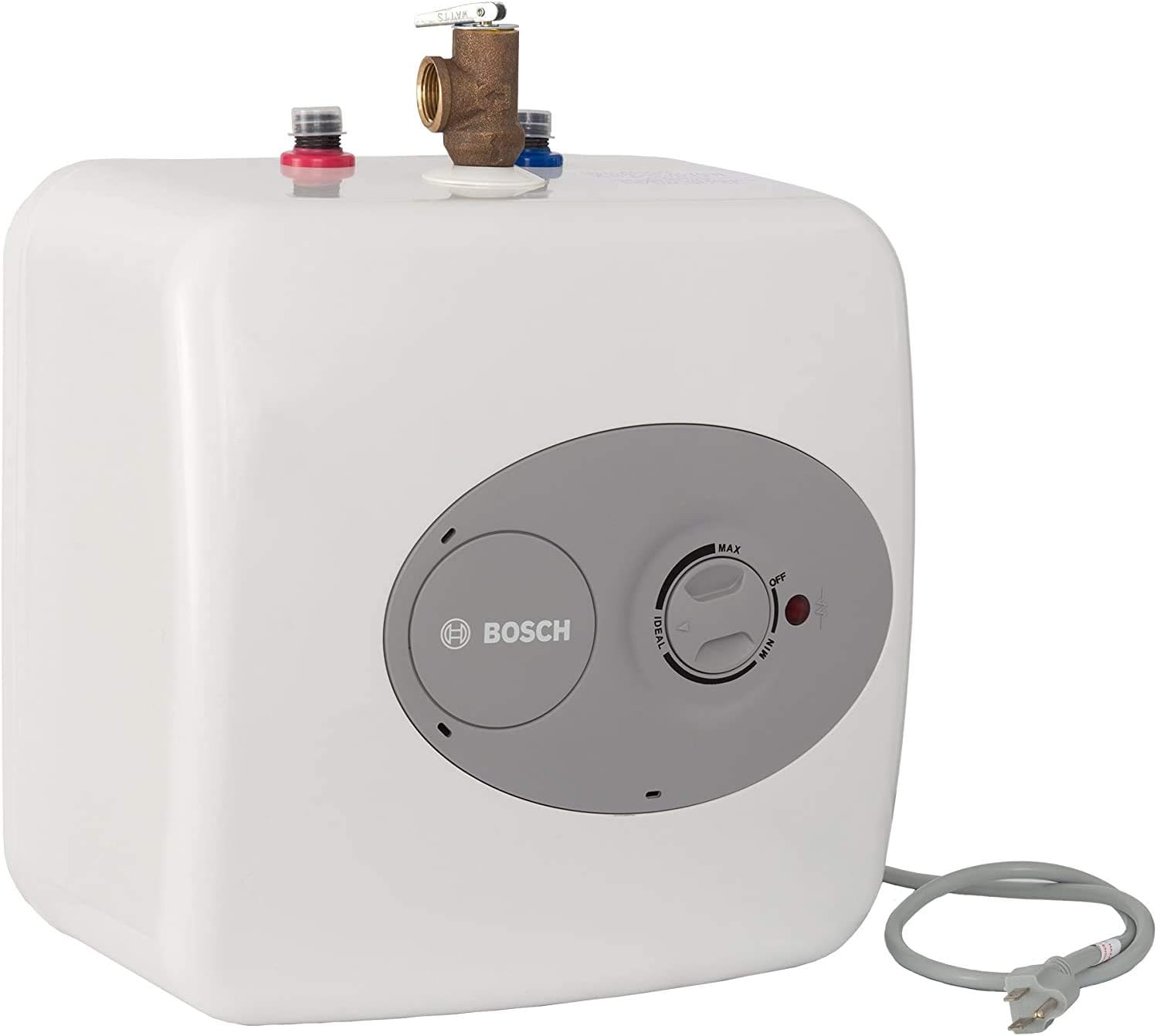
Bosch Tronic 3000 T ES2.5
| Capacity | 2.5 gallons |
|---|---|
| Wattage | 1440 watts |
| Voltage | 120 volts |
| Maximum Temperature | 140 °F |
| Efficiency | 98% |
The Bosch Tronic 3000 T ES2.5 is a compact electric mini-tank that provides readily available hot water where space is limited. Designed to plug into a standard 120V outlet, the 2.5-gallon glass-lined tank installs under a sink or on a wall or shelf and can serve a single fixture or up to two sinks in short bursts. At 1440 watts and with a 98% thermal efficiency rating, it heats quickly and the external temperature dial makes it easy to adjust output for dishes or handwashing. The glass-lined interior improves durability and corrosion resistance compared with bare metal tanks, and the included pressure-temperature relief valve adds safety. Practical limits are the small capacity and modest recovery rate, so it is not intended as a whole-house solution and will run out during extended showers or heavy simultaneous use. For point-of-use applications and as a buffer on well systems to reduce wait time for hot water, it offers a reliable, space-saving option with straightforward installation and simple controls.
Best for: Buyers who prioritize dependable, low-maintenance point-of-use hot water for a sink or appliance and want a compact unit that installs without specialized wiring.
Less Ideal for: Homes needing whole-house hot water, frequent long showers, or high simultaneous hot-water demand should choose a larger tank or tankless system instead.
- Compact point-of-use design fits under sinks or mounts on wall or shelf
- Glass-lined tank for improved durability and corrosion resistance
- Plugs into a 120V outlet for independent installation without special wiring
- External dial for simple temperature control
- Included temperature-and-pressure relief valve for safety
- Small 2.5-gallon capacity limits continuous hot water supply
- Not suitable as a whole-house heater or for long showers
Verdict: A compact, reliable point-of-use mini-tank that delivers quick, durable hot water for sinks or small well-system buffering.
EcoSmart ECO 11 Tankless Water Heater

| Wattage | 13000 watts |
|---|---|
| Voltage | 220 volts |
| Flow Rate | 3.1 gpm |
| Maximum Temperature | 140 °F |
| Mount Type | Wall |
The EcoSmart ECO 11 is a 13 kW, 240 V electric tankless unit built for point-of-use or low-flow applications such as a single bathroom or sink. It heats water on demand using self-modulating electronics and an LED temperature display, so it only draws power when water flows and maintains set temperature within about 1 degree. In warmer climates it can support up to about 3.1 gallons per minute, while colder inlet temperatures reduce output, so sizing to your local groundwater temperature is essential. Wall-mounted and compact, it frees floor space and is straightforward to install where the electrical capacity exists, though it requires a dedicated breaker and appropriate gauge wiring. Practical benefits include endless hot water at the tap, precise digital control, and strong thermal efficiency, while limitations are its modest flow rate for full baths and the need to confirm sufficient electrical service for safe operation.
Best for: Buyers who prioritize compact, energy-efficient on-demand hot water for a single bathroom, sink, or other low-flow point-of-use and who will check local inlet water temperature before sizing.
Less Ideal for: Homes relying on very cold well water or buyers who need whole-house high-flow output for multiple simultaneous showers without upsizing to a higher-capacity model.
- Compact wall-mounted design saves floor space and fits at point-of-use locations.
- Self-modulating control adjusts power use to demand for better energy efficiency.
- Digital LED temperature control allows 1-degree setpoint precision.
- Capable of up to ~3.1 gpm in favorable inlet temperatures, enough for a shower and a sink in warmer climates.
- Lifetime warranty on electronics, heat exchanger, and element (covers cost of heater).
- Maximum flow and heat output decline with cold inlet water, limiting use in cold-well situations.
- Requires a dedicated high-amperage 240 V circuit and correct wire gauge for safe installation.
Verdict: Choose the ECO 11 when you want a compact, energy-efficient point-of-use tankless heater that reliably delivers on-demand hot water for a single sink or shower when sized to your inlet water temperature.
Orbek 60000 BTU RV Tankless Water Heater

| Power Source | Liquid Propane |
|---|---|
| Voltage | 12 volts DC |
| Flow Rate | 3.5 gpm |
| Maximum Temperature | 123 °F |
| Maximum Pressure | 150 psi |
The Orbek 60000 BTU RV tankless water heater provides continuous on-demand hot water for RV showers, dishwashing, and handwashing while running from a 12V DC supply and liquid propane. It uses an oxygen-free copper heat exchanger and a brushless DC fan plus staged combustion to maintain steady outlet temperatures and reduce propane use because the burner only fires when water is demanded. A remote control lets you set temperature between 95°F and 123°F and view error codes for easier troubleshooting, and built-in protections include anti-freeze, dry-combustion, and flame-failure shutoff. The unit is explicitly tuned for high-altitude operation and includes a factory-installed 150 PSI pressure-reducing valve to simplify installation. Important practical limits are standard RV electrical requirements—this is a 12V device so an AC-to-DC converter is needed if you only have 110V supply—and it requires proper propane and water connections and correct wiring polarity to avoid fuse damage. For typical RV use it offers reliable continuous hot water with useful safety and diagnostic features, but installation care is necessary.
Best for: Buyers who prioritize dependable, on-demand hot water in an RV and want a unit with altitude tuning, diagnostic controls, and multiple built-in safety protections.
Less Ideal for: People who need a simple portable or non-RV hot water solution or who cannot provide a 12V DC supply and proper propane/water hookups in their installation location.
- Continuous on-demand hot water with a 60,000 BTU burner for simultaneous RV tasks
- High-altitude capable design using oxygen-free copper heat exchanger and brushless DC fan
- Remote temperature control with 95°F–123°F range and onboard error codes for troubleshooting
- Multiple safety protections including anti-freeze, dry-combustion, and flame-failure shutdown
- Includes built-in 150 PSI pressure-reducing valve to simplify hookup
- Requires a 12V DC supply so an AC-to-DC converter is needed if only 110V AC is available
- Door-mount form factor and RV connections mean installation is more involved than plug-and-play units
Verdict: Choose this unit if you want a factory-ready RV tankless heater that delivers reliable continuous hot water with altitude-aware components and built-in safety features.
Choosing the Right Water Heater for Well Water: Key Factors to Consider
Corrosion Resistance and Tank Lining
Well water often contains minerals or has pH variations that speed up tank corrosion. Tanks with high-quality glass lining, enamel coatings, or advanced sacrificial anode designs resist rust longer. Some models include impressed-current corrosion protection or replaceable anode technologies that extend service life.
When you choose a heater, verify the type of lining and whether the anode is easily replaceable. A robust lining and a sacrificial or powered anode will reduce the frequency of tank failure in aggressive water conditions and lower long-term maintenance costs.
Sediment and Mineral Management
Sediment from well water settles at the bottom of storage tanks and can insulate the heating element, reduce efficiency, and lead to overheating or early failure. Look for heaters with accessible drain valves, low-element placement, or models that facilitate periodic flushing.
Regularly scheduled flushing removes buildup and preserves capacity and heat-transfer efficiency. Some designs make flushing safer and simpler, which is particularly important if your well yields high sand or silt content.
Recovery Rate and Usable Capacity
Recovery rate determines how quickly a tank can reheat water after use, while usable capacity defines how much hot water you can count on for showers and appliances. Households with multiple simultaneous hot-water demands need higher recovery or larger tanks to avoid cold-water interruptions.
Match tank gallonage and recovery ratings to your peak usage patterns. Consider the number of bathrooms, frequency of loads, and whether you run high-demand appliances concurrently when selecting a capacity and recovery combination.
Serviceability and Access to Replaceable Parts
Well-water users typically require more frequent element replacements, anode servicing, and occasional repairs. Heaters with clearly accessible panels, standard-sized heating elements, and widely available replacement parts simplify maintenance and reduce downtime.
Choose models that allow easy element access without major disassembly and that use common part sizes. Local technician familiarity and the presence of service-friendly features can reduce repair time and labor costs.
Water Treatment Compatibility
If your well water has hard minerals, iron, or hydrogen sulfide, pairing the water heater with appropriate pretreatment can prevent accelerated wear. Scale buildup from hard water reduces heat-transfer efficiency and increases energy use, while iron deposits can stain fixtures and coat internal surfaces.
Assess whether you will need sediment filters, softeners, or iron-removal systems upstream of the heater. Some heater choices tolerate untreated well water better than others, but long-term reliability improves with appropriate pretreatment.
Insulation and Energy Efficiency
Tanks with thicker insulation and lower standby heat loss save energy and maintain higher outlet temperatures between uses. For well-water homes that may run pumps and heaters continuously, reducing standby loss lowers utility load and improves comfort.
Examine the tank's insulation R-value, the presence of factory-applied jackets, and any efficiency ratings provided. Better-insulated units often deliver tangible savings over the lifetime of the heater, particularly in cooler basements or unheated utility spaces.
How Well Water Affects Heater Lifespan
Private well chemistry varies widely and directly influences component wear in a water heater. High mineral content leads to scale that reduces heat-transfer efficiency and stresses heating elements. Slightly acidic water accelerates corrosion of the tank lining and fittings.
Understanding your well's water profile helps you select a heater with the right protections and informs how aggressively you should plan maintenance. Periodic water testing is a small investment that guides the choice of tank lining, anode strategy, and pretreatment requirements.
- Mineral scale increases energy use and shortens element life
- Sediment can clog drains and reduce usable capacity
- Corrosive water shortens tank life without proper lining or anode protection
Installation Tips for Well-Water Homes
Locate the heater where it is easy to access for flushing, anode replacement, and element service. Avoid cramped corners that make routine maintenance difficult. Ensure a full-bore drain valve is installed for effective annual flushing.
Install a sediment filter and a pressure-reducing valve if your well pump produces pressure spikes. Properly size supply piping and consider adding an expansion tank if your system includes a check valve or pressure switch that isolates the water column.
- Use a full-port shutoff to simplify tank draining
- Position the heater above expected sediment lines if possible
- Label service valves and provide clearance for element removal
Pretreatment Options That Protect the Heater
Simple pretreatment like a sediment filter and particulate trap prevents large particles from entering the tank. For hardness or iron issues, consider a softener or iron-removal system upstream of the heater to reduce scale and staining.
Water testing will reveal which pretreatment combination is most effective. In many cases, a moderate softening approach reduces maintenance needs and preserves efficiency without complicating the plumbing layout.
- Sediment filters reduce abrasive wear on valves and elements
- Softening lowers scale formation and improves heat transfer
- Iron-removal prevents staining and internal deposit buildup
Routine Maintenance Checklist
Set a regular maintenance schedule that includes flushing the tank, inspecting and replacing anodes, checking heating elements, and verifying relief-valve operation. Frequency depends on your water's sediment load and chemistry, but annual checks are a practical starting point.
Keep a log of maintenance dates, parts replaced, and any performance changes. This history helps you spot accelerating wear and provides a clearer timeline for future replacements or upgrades.
- Flush tank at least once a year or more if sediment-heavy
- Inspect anodes annually and replace when significantly depleted
- Test pressure-relief valve and inspect heating elements for buildup
Sizing a Heater for Peak Demand
To avoid short showers and cold-water intrusion during busy periods, calculate peak hour demand by totaling likely simultaneous uses. Typical factors include showers, dishwasher cycles, and laundry loads. Choose a tank and recovery rate that match or exceed that peak estimate.
If space constraints limit tank size, consider a higher recovery model to replenish hot water faster, or stagger appliance use through timers and scheduling to reduce simultaneous draw.
- Estimate peak hourly usage to determine required first-hour rating
- A higher recovery compensates for smaller tank capacity
- Consider household routines when selecting capacity and recovery
How We Chose the Best Water Heater for Well Water
We evaluated candidates based on factors that directly affect performance and longevity when used with private well supplies. Key criteria included corrosion resistance and lining type, because mineral-rich or slightly acidic well water accelerates tank and heating-element degradation. We checked recovery rate and usable capacity to ensure adequate hot-water delivery for typical household loads. Serviceability and access to replaceable parts were prioritized, since well-water installations often need more frequent maintenance. We also weighted sediment management features, such as bottom drains and element placement, to reduce clogging and heat-transfer loss. Finally, we considered energy efficiency and insulation because sustained operating cost and standby losses matter for continuously used systems. We excluded units intended only for closed-loop hydronic systems, non-domestic commercial boilers, and tankless designs that require water treatment beyond basic filtration. The shortlisted models had to demonstrate clear specifications for corrosion protection, accessible service points, and rated recovery or flow performance suitable for the stated tank size.
Our full evaluation process is outlined in our review methodology.
FAQ
How often should I flush a water heater that uses well water?
Flush frequency depends on sediment content, but an annual flush is a reasonable baseline. If your well produces visible sand or silt, flush every three to six months until conditions improve.
Do I need a water softener with my well water heater?
It often depends on hardness test results. A softener reduces scale and prolongs element and tank life in hard-water conditions, but it is not always necessary if hardness is low.
Can I install a water heater myself on a well system?
Basic installations are possible for experienced DIYers, but well systems introduce components like pumps, pressure controls, and check valves that affect safety. Local codes may require licensed installation, so check regulations and consider professional help.
What signs indicate the tank is corroding from well water?
Common signs include rusty or discolored water, metallic taste, visible leaks at seams or fittings, and rapid depletion of the anode rod. Regular inspections help detect corrosion early.
Will sediment shorten the heater's warranty?
Warranties vary, but excessive sediment and lack of maintenance can void coverage. Follow manufacturer maintenance recommendations and document service to preserve warranty rights.
Final Verdict
Homes on private wells face specific challenges that influence heater selection and upkeep. Prioritize corrosion protection, accessible service points, and sediment-management features to maximize longevity. Match capacity and recovery to your household's peak demand, and pair the heater with appropriate pretreatment when tests reveal hardness or iron issues. With the right combination of tank features and a consistent maintenance routine, you can maintain reliable hot water and reduce the likelihood of premature failure.