
Note: This article contains affiliate links. If you click on these links and make a purchase, we may earn a small commission at no extra cost to you. This helps support our research and content. Read our full affiliate disclosure here.
If you run a busy cafe, coffee cart, or office beverage program, the right espresso machine determines both speed of service and the consistency of every shot. Choosing an espresso machine for business means prioritizing durability, easy maintenance, and the capacity to deliver steady extraction during peak hours. This guide shortlists the top commercial-grade options across common workflows and explains the tradeoffs between throughput, maintenance, and drink quality. Below we outline what we tested for reliability, uptime, and ease of use, then present the top picks that match different daily volumes and staffing levels.
Top Picks at a Glance
| Best Quality Built to a higher standard if you want something more solid | Breville Barista Touch BES880BSS |  |
| Best Value The sweet spot between price and what you get | CASABREWS 3700 Essential |  |
| Best Budget The cheapest option that still gets the job done reliably | IMUSA Espresso Maker GAU-18202AMZ |  |
| Top Rated A top-rated pick with lots of positive feedback | Breville Barista Express BES870XL |  |
| Most Popular A crowd favorite that many people choose with confidence | CASABREWS CM5418 Espresso Machine |  |
| Best Seller A high-volume bestseller chosen again and again | Ninja Luxe Café ES601 |  |
Breville Barista Touch BES880BSS

| Operation Mode | Fully Automatic |
|---|---|
| Wattage | 1680 watts |
| Human Interface Input | Touchscreen |
| Coffee Input Type | whole_beans |
| Filter Type | Reusable |
The Breville Barista Touch combines a built-in conical burr grinder, touchscreen guided controls, and an automated steam wand to deliver cafe-style espresso, lattes, and cappuccinos with minimal fuss. It grinds whole beans to dose and tamp automatically, then extracts at nine-bar pressure after a low-pressure pre-infusion for fuller flavor, while the Auto Milk function textures silky microfoam suitable for latte art and consistent milk drinks. The touchscreen simplifies setup and drink selection, and the included stainless steel jug and dosing tools make routine use straightforward. Practical benefits include fast heat with the ThermoJet system, repeatable shot profiles via programmable settings, and a reusable portafilter and water filter for ongoing cost savings. Important limitations are its weight and footprint for cramped counters and a learning curve if you want to manually dial in shots beyond the presets, plus routine cleaning of grinder and steam wand to maintain performance. For small commercial or high-performance home use that prioritizes control and beverage quality, it balances automation with barista-level results.
Best for: Buyers who need cafe-quality espresso drinks reliably and want a machine that blends automatic convenience with performance-focused controls for consistent service in a small business or serious home setup.
Less Ideal for: People who need an ultra-compact, lightweight brewer for very limited counters or those who prefer a fully manual, low-maintenance espresso setup.
- Integrated conical burr grinder with 30 grind settings and dose control for consistent extraction
- Touchscreen interface with programmable drink profiles for repeatable results
- Auto Milk steam wand that textures microfoam suitable for latte art
- ThermoJet heating system for quick heat-up and fast workflow
- Includes useful accessories such as stainless steel jug and razor dosing tool
- Relatively heavy and takes significant counter space
- Requires regular cleaning and maintenance of grinder and steam wand to keep performance optimal
Verdict: If you need a performance-oriented machine that delivers consistent, café-quality espresso and steamed milk with automated controls, the Barista Touch is built to handle that reliably.
CASABREWS 3700 Essential

| Output Pressure | 20 bar |
|---|---|
| Wattage | 1350 watts |
| Operation Mode | Semi-Automatic |
| Coffee Input Type | Ground |
| Capacity | 43.9 fluid ounces |
The CASABREWS 3700 Essential is a compact semi-automatic espresso machine that brings café-style extraction and milk steaming to a small kitchen or office. It uses a 20-bar Italian pump and PID temperature control to deliver consistent pressure and stable brew temperature, while low-pressure pre-infusion and programmable 1- and 2-cup buttons let you dial volume and extraction for repeatable shots. A powerful steam wand produces microfoam for lattes and cappuccinos and the removable 43.9 oz tank reduces refill frequency and is easy to clean. The stainless-steel housing and 51mm portafilter give the unit a durable, pro-looking feel, though it is a single-boiler design so switching immediately between brewing and steaming requires a short wait. Controls are button-based and straightforward, but the machine lacks a pressure gauge for visual monitoring. For a small office wanting reliable espresso and basic milk drinks without a steep learning curve, the 3700 balances performance and footprint effectively.
Best for: Buyers who need a compact, dependable machine that produces consistent espresso and café-style milk drinks for a small office or shared workspace and prioritize repeatable performance and ease of use.
Less Ideal for: Large cafés or high-volume commercial settings that require back-to-back steaming and brewing or advanced monitoring features should consider commercial-grade machines instead.
- 20-bar pump with PID temperature control for consistent extraction
- Powerful steam wand that can produce creamy microfoam for milk drinks
- Removable 43.9 oz water tank reduces refill interruptions and is easy to clean
- 51mm portafilter and stainless-steel housing give a durable, professional feel
- Single-boiler design requires waiting between brewing and steaming for optimal temperature
- No built-in pressure gauge for real-time shot pressure feedback
Verdict: A compact, user-friendly semi-automatic that delivers consistent espresso and reliable milk steaming for small offices seeking pro-style shots without a large footprint.
IMUSA Espresso Maker GAU-18202AMZ

| Coffee Maker Type | Espresso Machine |
|---|---|
| Operation Mode | Semi-Automatic |
| Wattage | 800 watts |
| Capacity | 4 cups |
The IMUSA 4-cup espresso and cappuccino maker is a small countertop semi-automatic machine designed for simple home-style espresso and milk drinks. It brews up to four servings using a permanent filter and 5-bar pressure, and a steam nozzle froths milk for cappuccinos and lattes; controls are a three-position selector knob that keeps operation straightforward. Practical touches include a removable drip tray, a cool-touch glass carafe handle, and a matte plastic exterior that is easy to wipe down. At 800 watts the unit heats quickly, but the modest pressure and compact boiler mean extraction and steaming are best for casual use rather than professional-level shots. The permanent filter saves ongoing cost compared with disposable paper filters, but it can require more frequent cleaning to avoid buildup. This model is a good fit where counter space is limited and simple, budget-friendly espresso and milk drinks are the priority, but it is not aimed at high-volume commercial use or barista-grade performance.
Best for: Buyers on a tight budget who need a small, easy-to-use machine for making espresso-based drinks and occasional cappuccinos in a low-volume setting.
Less Ideal for: Businesses that require consistent commercial-grade extraction, rapid back-to-back steaming, or high daily throughput should look at true commercial or prosumer machines.
- Compact 4-cup capacity fits small countertops
- Built-in steam nozzle and milk frother for cappuccinos and lattes
- Permanent filter reduces ongoing consumable costs
- Removable drip tray and cool-touch handle simplify cleaning and pouring
- 800-watt heater reaches operating temperature quickly
- 5-bar pressure and small boiler limit extraction quality compared with commercial machines
- Not intended for continuous high-volume or heavy commercial use
Verdict: A compact, budget-friendly espresso machine that makes simple espresso and frothed-milk drinks for low-volume use.
Breville Barista Express BES870XL

| Wattage | 1600 watts |
|---|---|
| Power Source | AC adapter |
| Coffee Input Type | whole_beans |
| Capacity | 1 cups |
| Filter Type | Reusable |
The Breville Barista Express BES870XL is a hands‑on semi‑automatic espresso machine that grinds, doses, and brews fresh espresso from whole beans with a built‑in conical burr grinder and 54mm portafilter. It is typically used by a single operator who wants café‑style shots and manual milk texturing; the digital temperature control (PID) and low‑pressure pre‑infusion help deliver balanced extractions while the steam wand produces microfoam suitable for lattes and cappuccinos. Notable features include 16 grind settings on the integrated grinder, single and double wall filter baskets, a 67 oz water tank, and a thermocoil heating system for stable temps. The included tools such as the integrated tamper, razor dose trimming tool, and stainless steel portafilter make dosing more consistent. Practical benefits are fresher shots without a separate grinder and precise temperature control for repeatable results. Limitations are its manual workflow and single boiler/thermocoil design, which means it is not optimized for heavy continuous commercial throughput and requires an experienced operator for best results.
Best for: Buyers who prioritize reliable, repeatable espresso quality and want an integrated grinder and temperature control in a single machine while accepting a manual workflow and operator skill.
Less Ideal for: Businesses that need high‑volume, continuous espresso service or multiple simultaneous steam/shot operations should choose a commercial or dual‑boiler machine instead.
- Integrated conical burr grinder with adjustable grind settings for fresh dosing
- PID temperature control and thermocoil for more consistent extraction
- Powerful steam wand capable of producing microfoam for latte art
- Comprehensive included accessories (tamper, razor dose tool, filter baskets) for consistent dosing
- Reusable filter and 54mm portafilter built to café standards
- Manual operation requires practice to dial in shots and texture milk consistently
- Single boiler/thermocoil limits back‑to‑back extraction speed compared with commercial machines
Verdict: A dependable, grinder‑integrated semi‑automatic that delivers café‑quality shots and temperature stability for operators focused on consistent results.
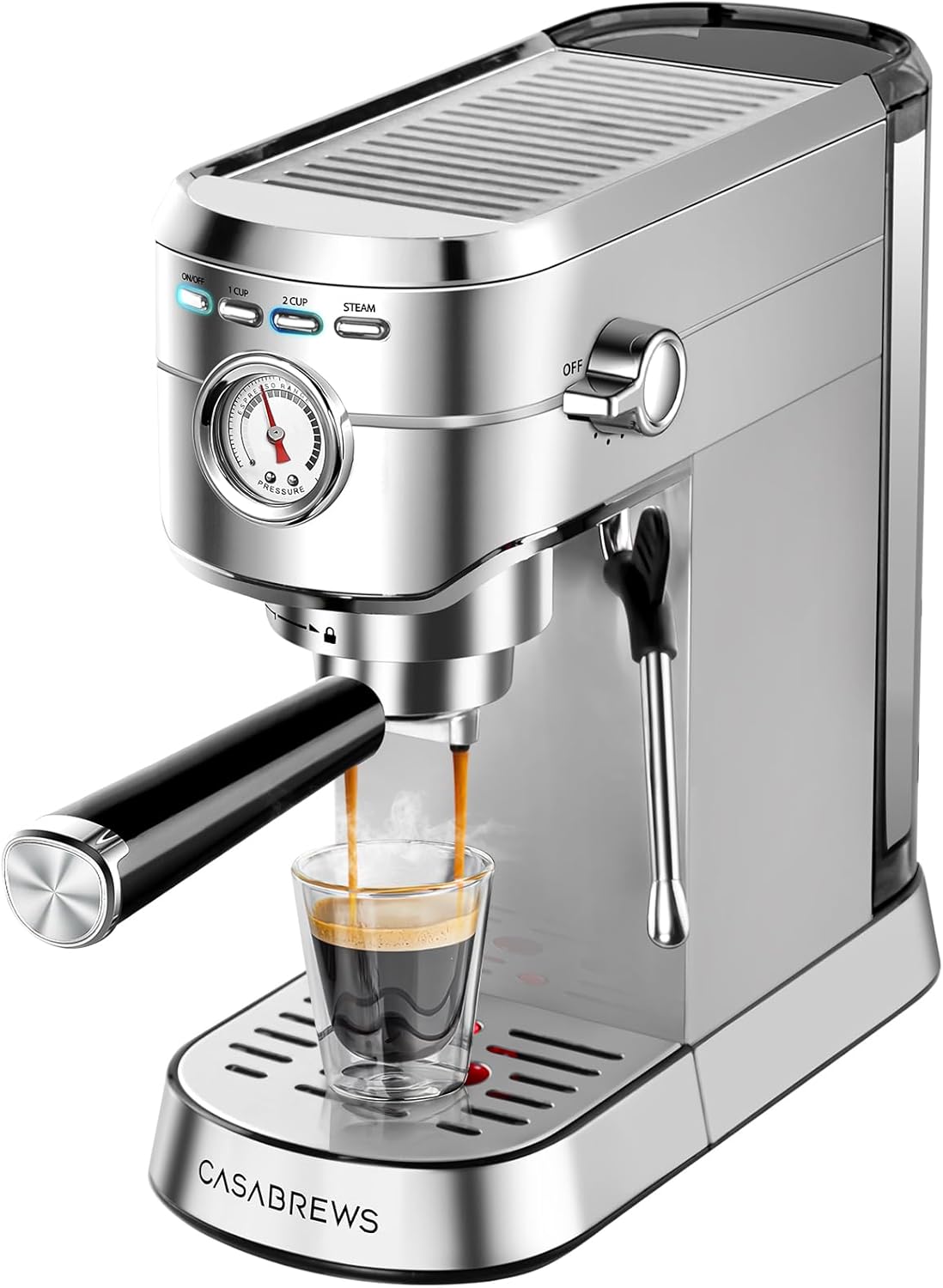
CASABREWS CM5418 Espresso Machine
| Output Pressure | 20 bar |
|---|---|
| Operation Mode | Semi-Automatic |
| Wattage | 1350 watts |
| Coffee Input Type | ground_coffee |
| Filter Type | Reusable |
The CASABREWS CM5418 is a compact semi-automatic espresso machine aimed at users who want café-style drinks without a large footprint. It uses a 20-bar Italian pump and built-in pressure gauge to help dial in extraction, and a low-pressure pre-infusion feature to promote more even flavor. The steam wand produces microfoam suitable for lattes and cappuccinos, while the removable 34 oz tank lets you brew multiple drinks before refilling. Controls are button-based and volume can be set for single or double shots, and a cup warmer and removable drip tray add everyday convenience. Expect short warm-up times and a stainless steel exterior that cleans easily, but note this is a single-boiler machine so brewing immediately after steaming requires a cooldown step to avoid overheat protection. For small business use, it delivers strong extraction control and milk-texturing capability in a slim package, though its capacity and single boiler design limit back-to-back high-volume service.
Best for: Buyers who prioritize visible extraction control and good milk-steaming capabilities in a compact machine and who value social proof and reliability indicators when choosing equipment for a small office or boutique service setting.
Less Ideal for: High-volume cafes or busy foodservice environments that need continuous back-to-back shots and larger water capacity should consider more robust commercial machines instead.
- 20-bar Italian pump and built-in pressure gauge for visible extraction control
- Powerful steam wand that textures milk into microfoam for lattes and cappuccinos
- Removable 34 oz water tank allows multiple brews before refilling and is easy to clean
- Compact stainless steel body with cup warmer and removable drip tray for countertop convenience
- Single-boiler design requires cooldown between steaming and brewing, limiting continuous throughput
- Smaller water tank and capacity make it less suited for sustained high-volume commercial use
Verdict: Choose the CM5418 when you need a compact, gauge-equipped espresso machine that can produce café-quality shots and great milk texture for a small business or office with moderate demand.
Ninja Luxe Café ES601

| Operation Mode | Fully Automatic |
|---|---|
| Wattage | 1650 watts |
| Coffee Input Type | Ground, Whole Bean |
| Filter Type | Reusable |
The Ninja Luxe Café ES601 combines an integrated conical burr grinder, assisted tamping, and an automated dual froth system to deliver café-style drinks with minimal effort. It offers two espresso shot sizes, multiple drip brew sizes, and cold-pressed espresso or rapid cold brew options, so a single machine covers lattes, cappuccinos, iced drinks, and regular coffee. Barista Assist guides users through grinding, weight-based dosing, and tamping while the self-cleaning steam wand and hands-free frother reduce routine maintenance and simplify milk texturing. The 25-setting grinder gives control over grind size, and the 70 oz removable water reservoir makes back-to-back drinks easier during busy periods. At 1650 watts it has the power to steam and brew quickly, but its size and weight make it more suited to a dedicated counter area rather than a mobile cart. This is a feature-rich, user-friendly machine that prioritizes consistency and convenience, though businesses needing industrial duty cycles or commercial service plans should consider professional-grade units instead.
Best for: Buyers who want a reliable, easy-to-use all-in-one espresso and coffee solution that delivers consistent café-style drinks with minimal training and maintenance.
Less Ideal for: High-volume commercial operations that require industrial-grade machines, service contracts, or rapid successive shots all day long.
- Integrated conical burr grinder with 25 grind settings for consistent dosing
- Barista Assist technology with weight-based automatic dosing and assisted tamper
- Hands-free dual froth system plus a self-purging steam wand for easy milk preparation
- Removable 70 oz water reservoir and multi-size drip and cold brew options for varied drink demands
- Designed for home or light commercial use rather than continuous heavy-duty commercial service
- Relatively large and heavy footprint that requires dedicated countertop space
Verdict: Choose the ES601 when you need a guided, all-in-one espresso and coffee maker that produces consistent café-style drinks with minimal user skill or fuss.
Choosing the Right Espresso Machine for Business: Key Factors to Consider
Throughput Needs
Estimate peak hourly shot demand before picking a machine. Throughput influences boiler size, number of group heads, and heat-recovery design. A two-group machine with a large heat-exchange boiler handles steady espresso flow better than a single-group unit in a rush.
Underestimating throughput leads to long waits, under-extracted shots, and stressed equipment. Conversely, oversizing raises capital and operating costs and may complicate maintenance. Match machine capacity to realistic service peaks including spillover from busy promotions or events.
Brew Consistency Under Load
Consistent temperature and stable pressure through consecutive pulls are critical for repeatable flavor across service. Look for machines with proven boiler control, stable pressure profiling, or electronic temperature management that maintain extraction parameters during high-volume runs.
Consistency reduces drink variability between baristas and shifts, lowering waste from failed shots and complaints. Features that assist consistency, like volumetric dosing or programmable preinfusion, help maintain quality when pace and staff experience vary.
Serviceability and Spare Parts
Commercial uptime depends heavily on how quickly a machine can be repaired. Machines designed with accessible internals, modular components, and widely available spare parts minimize downtime. Consider how easy it is to replace gaskets, steam valves, and controllers, and whether common wear items are user-serviceable.
Routine servicing intervals should be predictable and not require specialized tools or lengthy bench time. Also confirm local technician support and parts distribution because lead times on replacements can significantly affect operation during failures.
Daily Cleaning and Staff Workflow
Cleaning routines directly affect labor costs and shot quality. Machines with straightforward group head cleaning, removable drip trays, and clearly separated steam and brew circuits reduce the time staff spend on upkeep. Automated or guided cleaning cycles can help ensure consistent sanitation without adding complexity.
Simplicity here also reduces training time and the chance that shortcuts will be taken during busy shifts. Evaluate how cleaning needs integrate into your workflow and whether the machine's layout supports efficient movement behind the bar.
Water and Energy Infrastructure
Commercial machines often require dedicated water filtration, softening, and stable electrical supply. Water quality affects scaling and extraction, so budget for proper filtration and periodic maintenance. Energy draw determines circuit requirements and contributes to operating cost, especially for machines that keep large boilers heated all day.
Assess your space for required plumbing hookups, drainage, and electrical capacity. Choosing a machine without confirming infrastructure can lead to costly retrofits and delays before the equipment can be commissioned.
Controls and Usability
Interface design influences speed, consistency, and training needs. Machines with clear programmable dosing, intuitive switchgear, and visible status indicators help staff make adjustments quickly. Touchscreens or advanced profiling tools can be useful but may add complexity and service points.
Select control systems that match your staff's technical comfort level and the level of drink customization you plan to offer. For high-turnover or short-staff environments, simple, robust controls often outperform feature-rich interfaces.
Sizing Your Espresso Machine For Service Volume
Match machine size and configuration to average and peak service volumes rather than just daily totals. Consider how many simultaneous drinks your busiest station must produce, including milk-based beverages that require steam time between shots.
If you expect frequent rushes, prioritize machines with extra group heads or heat-recovery systems that restore temperature quickly between pulls. Also plan for future growth so you do not outgrow capacity in a season or two.
- Estimate peak shots per hour, not just daily totals
- Factor in milk drinks that add steam time
- Allow margin for promotions and events
Installing and Preparing Your Space
Commercial espresso machines need proper water filtration, drainage, and electrical supply. Before purchasing, verify dedicated circuits, incoming water pressure, and room for service access behind the machine. Improper installation can cause failures, scaling, or insufficient power for simultaneous heating and pumping.
Plan the counter layout so grinders, knock boxes, and milk fridges are within easy reach. A compact, ergonomic setup reduces steps per drink and lowers the risk of errors during busy periods.
- Confirm electrical and plumbing specs early
- Reserve clearance space for technician access
- Arrange workflow to minimize barista movement
Training Staff for Speed and Consistency
Invest in a standardized puck preparation and dosing routine that every barista follows. Train on shot timing, tamp consistency, and milk texturing with emphasis on repeatable technique rather than individual improvisation.
Use the machine's programmable features to reduce variability. Establish simple checklists for daily warm-up and cleaning so machines perform predictably at the start of each shift.
- Standardize dosing and tamping procedures
- Use checklists for warm-up and cleaning
- Schedule periodic calibration of grinders and scales
Maintenance Scheduling and Preventive Care
A planned maintenance schedule prolongs life and keeps service reliable. Routine tasks include group head backflushing, descaling where water chemistry requires it, steam tip checks, and gasket inspection. Track service intervals and keep a small stock of common wear parts on site.
Consider a service contract or local technician relationship to ensure fast response when failures arise. Preventive care is usually less disruptive and cheaper than emergency repairs that take equipment out of service.
- Log maintenance tasks and intervals
- Keep spare gaskets and steam tips on hand
- Agree on SLA expectations with a technician
Optimizing Energy and Water Use
Commercial espresso machines can consume substantial energy keeping boilers hot and pumps ready. Look for machines with economy or scheduled sleep modes when downtime is predictable. Water filtration and softening reduce scaling and prolong intervals between descaling.
Small investments in filtration and efficient operation reduce long-term utility and servicing costs, improving total cost of ownership for busy outlets.
- Use filtration to minimize scaling
- Employ energy-save modes when possible
- Monitor water and electricity use over time
How We Chose the Best Espresso Machine for Business
We focused on attributes that affect daily operations in commercial settings rather than home-use features. Selection began by filtering for machines built for continuous high-volume use, commercial-grade boilers, proven serviceability, and accessible parts. We excluded home or prosumer models that lack replaceable components or commercial electrical and water fittings. Key evaluation dimensions included brew consistency under sustained pulls, machine throughput measured as consecutive shots per hour, and reliability which covered build materials and common failure points. We also scored serviceability and maintenance needs, looking at how easily technicians can replace wear items and how simple routine tasks are for staff. Energy and water efficiency were considered where they clearly influenced operational costs for high-volume outlets. Finally, user-facing features such as intuitive controls, dosing flexibility, and integrated grinders or dosing aids were weighed for how they reduce training time and errors. Products were removed if they lacked documented commercial electrical or plumbing specifications, required frequent unscheduled service, or did not support readily available spare parts. The final list reflects machines that balance throughput, uptime, and manageable upkeep for real-world businesses.
Our full evaluation process is outlined in our review methodology.
FAQ
How many group heads do I need for my cafe?
It depends on peak shots per hour. Small cafes with steady traffic may manage with one group head plus a fast steam approach, while locations with high simultaneous orders often need two or three groups to avoid bottlenecks.
Do I need a commercial water filter for an espresso machine?
Usually yes. Water quality affects scaling and extraction, so a proper filtration and softening setup extends service intervals and preserves flavor. The exact filter depends on local water chemistry.
How often should a commercial machine be serviced?
Routine daily and weekly cleaning is essential, with professional servicing intervals typically every 3 to 12 months depending on usage and water hardness. High-volume operations trend toward more frequent preventive maintenance.
Can staff without barista experience run a commercial espresso machine?
With targeted training and simplified machine settings, less-experienced staff can operate commercial machines reliably. Programmable dosing and clear workflows reduce dependency on advanced skill for consistent output.
What should I stock as spare parts on site?
Keep common wear items such as group gaskets, shower screens, steam tips, and basic seals. Having these parts on hand shortens downtime for routine failures and scheduled replacements.
Final Verdict
Choosing an espresso machine for business is about balancing capacity, reliability, and manageable maintenance. Prioritize machines that meet your peak throughput, offer stable extraction under continuous use, and have accessible service paths and spare parts. Factor in water treatment and staff training to protect flavor and reduce downtime. Focus on the operational tradeoffs that matter most to your location: invest in higher throughput and serviceability for busy outlets, or choose compact, easy-to-clean options for lower-volume sites. With clear priorities and a maintenance plan, you can select a machine that keeps drinks consistent and service steady.