
Note: This article contains affiliate links. If you click on these links and make a purchase, we may earn a small commission at no extra cost to you. This helps support our research and content. Read our full affiliate disclosure here.
Running a coffee cart means maximizing throughput, maintaining consistent shot quality, and minimizing downtime during busy service. Choosing the right espresso machine for a coffee cart changes how efficiently you can serve customers and how much effort maintenance demands between shifts. This guide shortlists the top espresso machines suited to mobile cart operation. We evaluated units for shot consistency, ease of use, and serviceability so you can pick a machine that keeps lines moving and simplifies daily upkeep. Read on for the key tradeoffs and what to prioritize for cart work.
Top Picks at a Glance
| Best Overall The best all-around choice for most situations | De'Longhi All-in-One COM532M |  |
| Best Quality Built to a higher standard if you want something more solid | Breville Barista Express BES870XL |  |
| Best Value The sweet spot between price and what you get | AERCANA ST-699B Espresso Machine |  |
| Best Budget The cheapest option that still gets the job done reliably | Mr. Coffee 4-Shot Steam Espresso Maker |  |
| Top Rated A top-rated pick with lots of positive feedback | Gevi 20-Bar Espresso Machine |  |
| Most Popular A crowd favorite that many people choose with confidence | CASABREWS CM5418 Espresso Machine |  |
| Best Seller A high-volume bestseller chosen again and again | atatix EM3111 Espresso Machine |  |
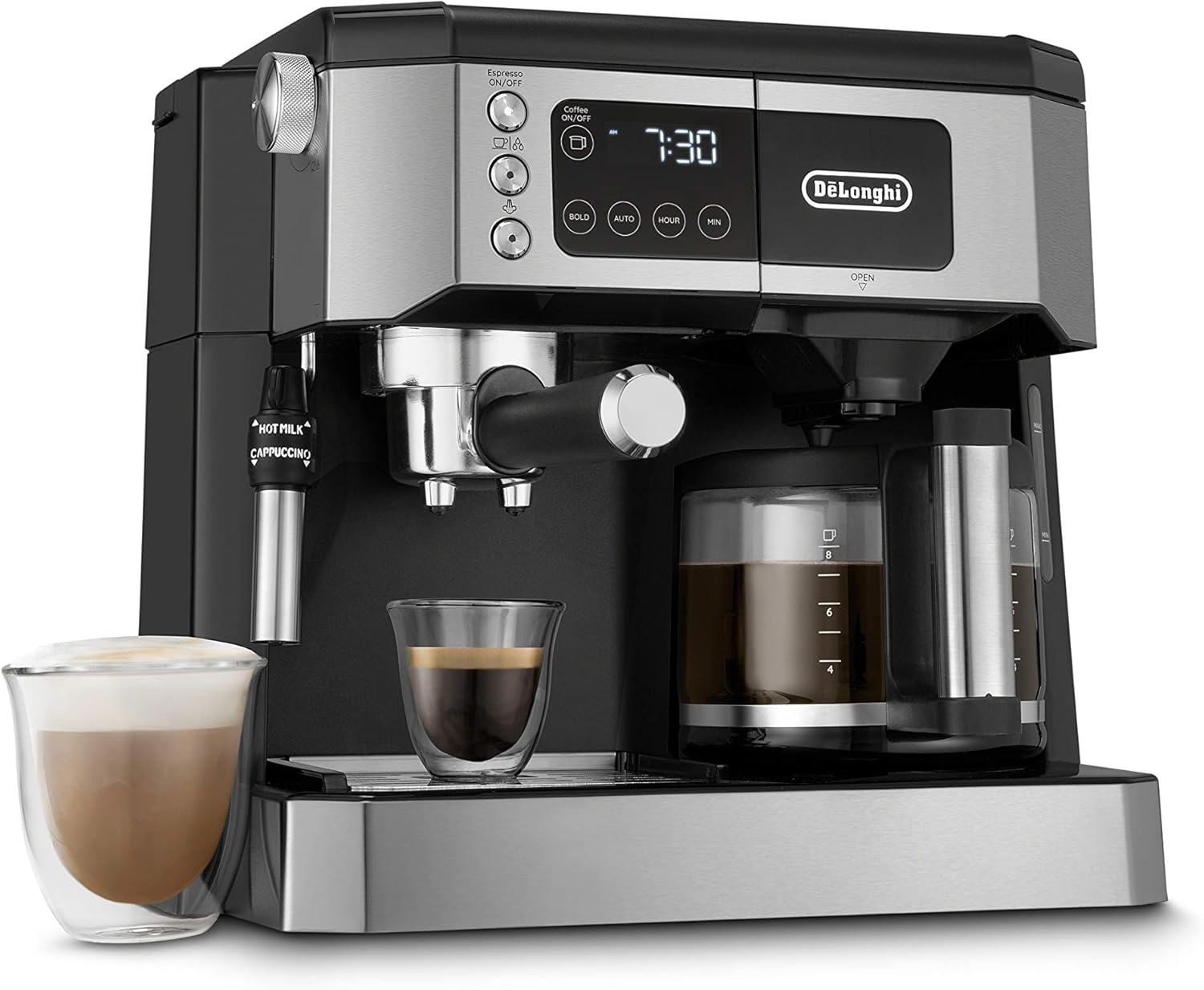
De'Longhi All-in-One COM532M
| Output Pressure | 15 bar |
|---|---|
| Capacity | 47 fluid ounces |
| Operation Mode | Fully Automatic |
| Coffee Input Type | pods_and_ground_coffee |
| Filter Type | Reusable |
This De'Longhi All-in-One COM532M combines a 15-bar pump espresso system with a 10-cup drip carafe so you can make espresso-based drinks and full-pot coffee from one footprint. It uses a dual heating system so you can prepare espresso and drip coffee concurrently, and the 2-in-1 portafilter accepts both ground coffee and pods for flexible brewing. The advanced steam wand gives adjustable microfoam and a cappuccino setting for milk-based drinks, while the digital touchscreen and 24-hour programmable timer simplify scheduling. Practical touches include a spill-proof carafe, gold-tone permanent filter, and a 47 fl oz reservoir that reduces refills when serving multiple people. For a coffee cart setting the machine offers versatility and reasonable throughput, but it is not a commercial-grade group head unit so it may struggle under heavy continuous use and it lacks built-in temperature profiling or larger water lines. Expect solid home-to-light-commercial performance when you need both espresso and drip options without two separate machines.
Best for: Buyers who want one machine that reliably handles both espresso drinks and full-pot drip coffee during moderate service and value flexible brewing options and milk steaming.
Less Ideal for: Operators needing a high-throughput, commercial-grade espresso machine or a plumbed-in unit for continuous heavy-volume cart service should look elsewhere.
- Dual heating system lets you brew espresso and drip coffee at the same time
- 15-bar Italian pump delivers concentrated espresso extraction
- 2-in-1 portafilter works with ground coffee and pods for flexibility
- Advanced steam wand produces microfoam for cappuccinos and lattes
- Large 47 fl oz water reservoir and 10-cup carafe reduce refill frequency
- Designed for home or light commercial use rather than continuous high-volume service
- No commercial group head or plumb-in water option for heavy cart operations
Verdict: This all-in-one machine is a practical choice for a coffee cart needing both espresso-based drinks and full-pot coffee without two separate machines.
Breville Barista Express BES870XL

| Wattage | 1600 watts |
|---|---|
| Voltage | 120 |
| Coffee Input Type | whole_beans |
| Filter Type | Reusable |
| Capacity | 1 cups |
The Breville Barista Express BES870XL combines a built‑in conical burr grinder, a 54mm portafilter and a thermocoil heating system to let users go from whole beans to espresso quickly. It grinds on demand with 16 grind settings and dose control so you can adjust extraction without a separate grinder, and low‑pressure pre‑infusion followed by stable PID temperature control helps produce balanced shots. The steam wand delivers enough power to texture milk for cappuccinos and lattes, though it requires some practice to get consistent microfoam. Practical benefits include an intuitive dial interface, included tools (tamper, dose‑trimming razor, stainless portafilter) and a removable water tank for refill. Expect a learning curve for dialing in grind and tamp to hit ideal extraction, and the machine is fairly large and heavy for mobile use on a busy cart. It is built for hands‑on operation rather than push‑button automation, so it rewards users who prioritize control over one‑touch convenience.
Best for: Buyers who want hands‑on control and high shot quality from fresh beans and are willing to learn grinding, dosing and milk texturing techniques for café‑level espresso.
Less Ideal for: Operators needing fully automated, one‑touch workflow or a lightweight, ultra‑compact machine for tight mobile setups should consider other options.
- Integrated conical burr grinder with 16 grind settings for fresh, on‑demand grinding
- Thermocoil PID temperature control for more consistent extraction
- Powerful steam wand capable of manual microfoam for latte art
- Includes 54mm stainless steel portafilter and useful barista tools out of the box
- Manual workflow requires skill to consistently dial in shots
- Relatively heavy and bulky for use on a compact coffee cart
Verdict: Choose the Barista Express when you want an all‑in‑one, hands‑on machine that grinds fresh beans and delivers café‑quality shots for performance‑focused operators.
AERCANA ST-699B Espresso Machine

| Output Pressure | 20 bar |
|---|---|
| Wattage | 1450 watts |
| Coffee Input Type | Ground |
| Capacity | 1 liters |
The AERCANA ST-699B is a compact semi-automatic espresso maker that uses a 20-bar pump and a visible pressure gauge to pull concentrated shots and a milk wand to steam and texture milk for lattes and cappuccinos. It heats quickly thanks to a 1450-watt rapid-heating system and includes a removable 34 oz water tank and removable drip tray for easier refills and cleaning. Typical use is single- or double-shot espresso followed by milk steaming for milk-based drinks; the unit also dispenses hot water and has a cup warmer and auto shut-off. Practical benefits include a small A4-like footprint that fits tight counters, fast warm-up for quick service, and a steam wand capable of producing dense microfoam for latte art. Limitations are that it is sized for low-volume settings so it will need more frequent refills and cooldowns between heavy steam cycles, and users must follow the preheat and purge steps to get hotter shots and reliable steaming. For a coffee cart needing compact, fast recovery performance for occasional milk drinks, this machine provides bar-style functions in a small package.
Best for: Buyers who need a space-efficient, café-style machine that delivers rapid warm-up and capable milk steaming for light-duty service and mobile setups.
Less Ideal for: Operators planning high-volume continuous service or large coffee-cart events should consider larger commercial or prosumer machines with bigger boilers and reservoirs.
- 20-bar pump with visible pressure gauge for consistent extraction
- Powerful steam wand that produces microfoam for latte art
- Rapid 1450W heating system for quick warm-up (about 20 seconds)
- Compact countertop footprint with removable 34 oz water tank for easy refills and cleaning
- Small water capacity and compact design limit throughput for busy service
- Requires preheating and occasional purging to maintain ideal brew temperature
Verdict: If you want a compact, fast-heating espresso maker with a strong steam wand for quality milk drinks on a small cart or low-volume setup, the AERCANA ST-699B is a practical choice.
Mr. Coffee 4-Shot Steam Espresso Maker

| Operation Mode | Semi-Automatic |
|---|---|
| Wattage | 1200 watts |
| Coffee Input Type | ground |
| Power Source | AC adapter |
| Filter Type | Reusable |
The Mr. Coffee 4-Shot Steam Espresso Maker uses steam-brewing and an extra-large portafilter to produce dark, rich espresso and can brew up to four shots in one cycle, which is handy when you need multiple servings. It includes an integrated frothing wand and a stainless steel frothing pitcher for steaming milk into lattes and cappuccinos, plus a water pitcher with measurement markings and a measuring scoop for repeatable dosing. The machine runs on 1200 watts and operates via simple button controls, and it comes with a reusable filter instead of paper pods. Practical benefits include quick single-group output and easy milk frothing without needing a separate device. Limitations to note are that steam machines generally give different extraction characteristics than pump-driven machines, so shot consistency and crema may not match commercial pump units, and the unit is geared toward basic café-style drinks rather than precision espresso profiling. For a coffee cart focused on affordable, walk-up milk drinks, this model balances capacity and simplicity, but it is not a commercial-grade pump espresso machine.
Best for: Small coffee carts wanting a low-cost, compact espresso option that can deliver multiple shots and steamed milk quickly for walk-up orders.
Less Ideal for: High-volume or specialty espresso carts that require pump-driven machines with precise extraction control and commercial durability.
- Extra-large portafilter brews up to four shots at once, speeding service for multiple drinks
- Integrated frothing wand and included stainless steel pitcher let you steam milk without extra equipment
- Simple button controls and measurement-marked water pitcher make repeated shots easy for staff
- Reusable filter and included scoop reduce ongoing consumable costs
- Steam-brewing extraction differs from commercial pump machines and may produce less crema and shot consistency
- Designed as a consumer/home machine rather than a commercial-grade unit for heavy continuous use
Verdict: A budget-friendly, compact steam espresso maker that delivers multiple shots and on-board milk steaming for small coffee carts needing an affordable, ready-to-serve solution.
Gevi 20-Bar Espresso Machine

| Output Pressure | 20 bar |
|---|---|
| Capacity | 2.3 liters |
| Wattage | 1450 watts |
| Operation Mode | Semi-Automatic |
| Coffee Input Type | GROUND_COFFEE |
The Gevi 20-Bar Espresso Machine pairs a built-in conical burr grinder with a 20-bar pump and an adjustable steam wand to produce café-style espresso, lattes, and cappuccinos in a compact stainless steel body. Typical use is grind-and-brew for single or double shots using the 58mm commercial-style portafilter and dual-wall filters, with a 0–30 gear bean box for grind adjustment and programmable shot volume for repeatable dosing. The PID/NTC temperature control and pre-infusion help stabilize extraction so shots are more consistent between pulls, and the steam wand delivers microfoam for milk drinks while also providing hot water for Americanos and cleaning. Practical benefits include integrated grinding that cuts prep time, a cup warmer and removable 2.3 L tank for extended service periods, and a user-friendly button panel. Limitations are that it is semi-automatic, so a trained operator is still needed for best results, and the unit size and 1450 W power draw require adequate counter space and electrical capacity on a busy coffee cart.
Best for: Operators who prioritize consistent, café-quality espresso and need an integrated grinder to speed service on a busy cart while maintaining repeatable extraction.
Less Ideal for: Mobile setups with very limited counter space, limited electrical capacity, or operators who want fully automatic, push-button one-touch brewing without manual technique.
- Built-in conical burr grinder with 30 grind settings for fresh, repeatable shots
- 20-bar pump plus PID/NTC temperature control for stable extraction
- 58mm commercial-style portafilter and dual-wall filters for consistent dosing
- Steam wand that produces microfoam and supplies hot water for drink variety
- Removable 2.3 L water tank and cup warmer reduce interruptions during service
- Semi-automatic operation requires skill for optimal results
- Higher wattage and size may demand suitable cart power and space
Verdict: A compact, grinder-equipped semi-automatic that delivers consistent, barista-level espresso for coffee cart operators who need integrated grinding and temperature-stable extraction.
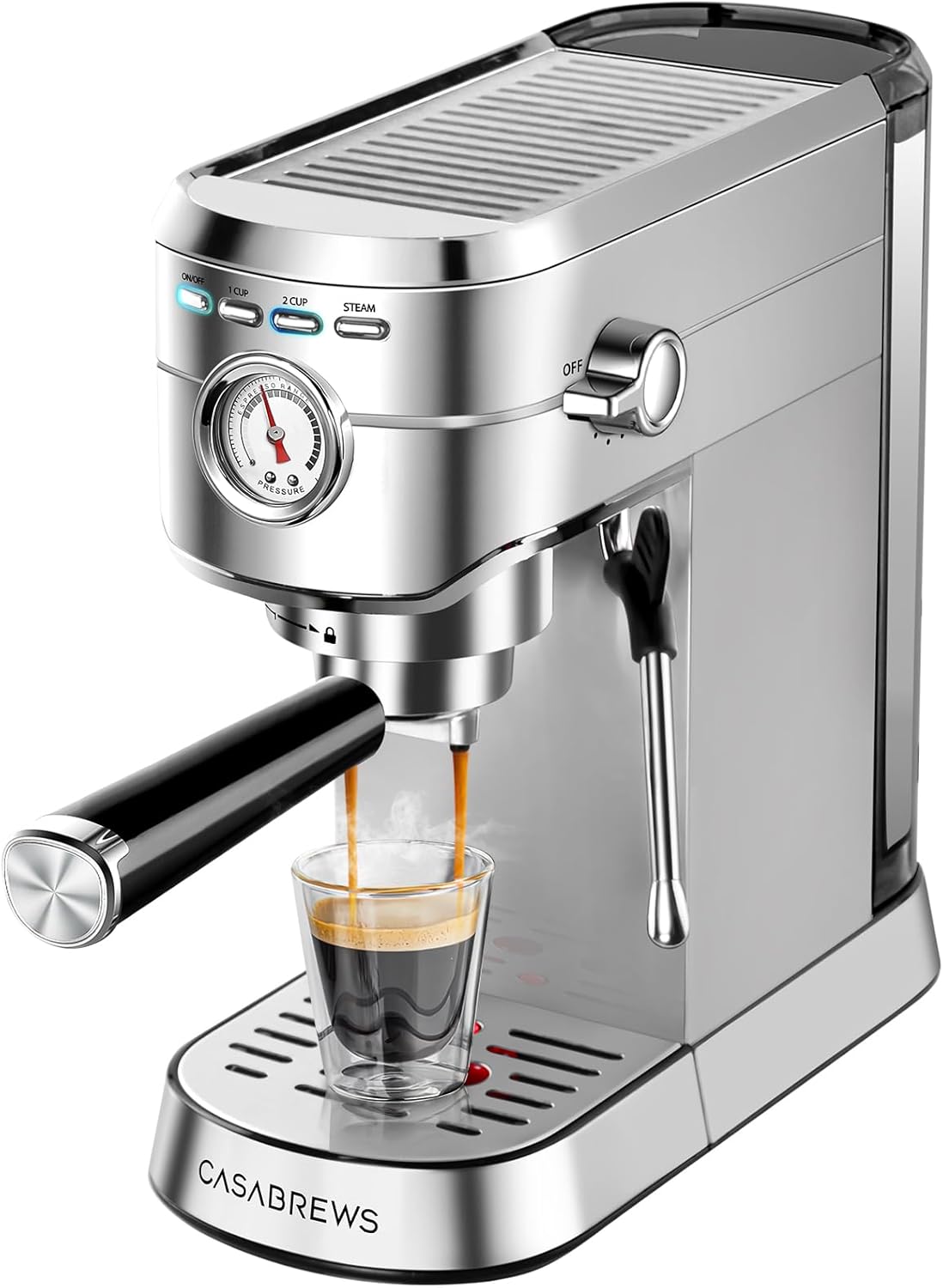
CASABREWS CM5418 Espresso Machine
| Output Pressure | 20 bar |
|---|---|
| Wattage | 1350 watts |
| Operation Mode | Semi-Automatic |
| Coffee Input Type | ground_coffee |
| Filter Type | Reusable |
The CASABREWS CM5418 is a compact semi-automatic espresso machine aimed at home and small-office use that combines a 20-bar pump, built-in pressure gauge, and a steam wand for milk texturing. It uses ground coffee with 51mm filter baskets and offers single- and double-shot buttons plus a visible pressure gauge to help dial in grind and tamping for consistent shots. A low-pressure pre-infusion and stable pump support fuller extraction and crema, while the steam wand produces microfoam suitable for lattes and cappuccinos; the top cup warmer and removable 34 oz tank add practical convenience. The machine warms up quickly and includes reusable filters, a tamper, and a portafilter out of the box, but it is a single-boiler design so you should pause between steaming and brewing to avoid overheating and activation of safety cutouts. Expect some learning curve around grind size and dosing to avoid slow or under-extracted shots, and the unit's compact footprint means it is better suited to light commercial or back-of-cart use rather than continuous high-volume cafe service.
Best for: Buyers who want café-style espresso and milk drinks from a compact machine and who value visible pressure feedback and hands-on control while relying on social proof and practical reliability when choosing gear.
Less Ideal for: Operators needing continuous, high-volume espresso output for a busy commercial cart should choose a heat-exchange or dual-boiler machine instead.
- 20-bar Italian pump with built-in pressure gauge for repeatable extractions
- Low-pressure pre-infusion to improve flavor balance and crema
- Powerful steam wand capable of producing microfoam for latte art
- Compact stainless steel body with removable 34 oz water tank for easy refills
- Includes portafilter, single and double baskets, tamper, and reusable filters out of the box
- Single-boiler design requires cooling between steaming and brewing which slows throughput
- Requires careful grind and dosing adjustments to avoid slow or under-extracted shots
Verdict: The CM5418 delivers café-style shots and textured milk in a compact, confidence-inspiring package ideal for low-volume cart setups seeking repeatable pressure control.
atatix EM3111 Espresso Machine

| Operation Mode | Semi-Automatic |
|---|---|
| Wattage | 1350 watts |
| Voltage | 120 volts |
| Output Pressure | 20 bar |
| Filter Type | Reusable |
The atatix EM3111 is a compact semi-automatic espresso machine built for home or small office use and can serve coffee cart settings where space is limited. It uses a 20-bar pump combined with a PID-controlled NTC sensor to stabilize extraction temperature and aims to deliver consistent shots quickly, with a 30-second heat-up time. The machine includes a 51mm portafilter with dual-wall filters for easier extraction, an adjustable manual extraction mode plus an automatic shot option, and a powerful steam wand capable of producing microfoam for lattes and cappuccinos. Its stainless steel top and detachable 45 oz water tank make routine cleaning and tamping straightforward, and the rubber suction feet reduce vibration during operation. Expect cafe-style results when used with fresh ground coffee and some technique, but note the unit is oriented to single-station service and uses reusable filters rather than a commercial brew group, so you will need to manage dosing and steam recovery pace during busy service. Overall it balances compact footprint and temperature control for reliable, repeatable shots in small-scale service environments.
Best for: Buyers who want a compact, reliable machine that delivers consistent espresso shots and textured milk for a small coffee cart or low-to-moderate volume stall without needing commercial installation.
Less Ideal for: High-volume or multi-station coffee carts that require rapid back-to-back steaming and a commercial brew group should consider professional machines instead.
- PID-controlled NTC temperature sensor for stable extraction
- 20-bar pump with dual-wall 51mm portafilter for consistent crema
- Powerful steam wand able to produce silky microfoam for milk drinks
- Detachable 45 oz water tank and removable drip tray for easy cleaning
- Compact stainless steel body with anti-slip feet reduces counter vibration
- Designed for single-station use so throughput is limited during sustained high-volume service
- Uses reusable filters and a consumer-grade portafilter rather than commercial group components
Verdict: A compact, temperature-stable semi-automatic that gives consistent cafe-style shots and microfoam for small coffee cart setups.
Choosing the Right Espresso Machine for Coffee Cart: Key Factors to Consider
Shot Consistency and Temperature Stability
Consistent extraction is critical on a cart where customers expect uniform drinks. Machines that hold brew temperature steady and manage heat delivery evenly produce repeatable shot times and flavor. Temperature control affects crema, balance, and the need to adjust grind or dose between rushes.
On a cart, the machine may run many consecutive shots without long cool-down periods. Look for equipment with stable boilers or heat-exchange designs that are proven to sustain temperature under continuous use. Inconsistent temperatures force frequent adjustment and slow service.
Shot Cadence and Recovery Time
High foot traffic means you need a machine that can pull successive shots quickly without long recovery gaps. Cadence depends on boiler size, heating system design, and pump performance. Faster recovery reduces wait times and keeps lines moving during peak service.
Consider tradeoffs: very fast recovery often requires larger boilers or more energy draw, which can be harder to manage on limited cart power. Choose a machine whose cadence matches typical daily order patterns while fitting your power and space constraints.
Serviceability and Field Repairs
A coffee cart rarely has immediate access to a technician. Machines with easy access panels, commonly available replaceable parts, and straightforward diagnostics reduce downtime. Features like removable group heads, external fill panels, and modular components let baristas perform basic maintenance on-site.
Evaluate how simple routine tasks are, such as backflushing, replacing gaskets, or descaling. Machines that are complicated to disassemble or that hide wear items behind difficult panels will cause longer interruptions during busy periods.
Footprint, Weight, and Mobility
Cart space is limited, so footprint and weight matter. A narrower machine leaves room for workflow, tamping stations, and milk refrigeration. Lighter units are easier to install and reposition, but make sure reduced size does not compromise volume capacity or serviceability.
Also consider mounting and ventilation needs. Some machines require extra clearance for steam wands or hot surfaces. Assess whether the unit fits your cart layout with room for baristas to work safely and efficiently.
Power and Water Options
Coffee carts often face constraints around available electrical circuits and water supply. Machines that can run on standard cart power or offer flexible electrical configurations are easier to integrate. Look for options with internal water reservoirs or straightforward direct-plumb kits depending on your service model.
Water handling also influences taste and maintenance. Built-in filtration or easy-to-access filtration housings help protect internal components and keep flavor consistent. Consider how you will refill or plumb the machine during service and how that fits into daily operations.
Establish Your Service Profile Before You Buy
Map a typical rush period to understand peak shot demand. Count average shots per hour, peak consecutive shots, and whether you will be pulling multiple milk drinks simultaneously. This usage profile directs you to machines optimized for either sustained high-volume output or compact, moderate-volume service.
Also factor in crew skill level. If your baristas need to train quickly, prioritize machines with simple controls and repeatable dosing aids rather than units that require advanced tuning to deliver consistent results.
- Estimate peak shots per hour and average interval between shots
- Decide if simultaneous milk steaming and shot pulling is common
- Match machine complexity to barista experience
Managing Water and Filtration on a Cart
Water quality affects both taste and machine longevity. Installing a compact filtration system prevents scale and mineral buildup while improving flavor stability. Choose a filter size that fits the cart and is simple to replace during routine maintenance.
If your cart runs on an internal reservoir, plan the refill workflow: where you will source clean water and how often refills are needed during a shift. For plumbed setups, ensure that any quick-connect fittings are secure and accessible for maintenance.
- Use filtration rated for low-flow coffee equipment
- Place replacement filters where staff can access them without tools
- Label reservoir fill points to prevent contamination
Power Planning and Electrical Considerations
Understand your cart's electrical capacity before selecting a machine. Some espresso machines require dedicated circuits or higher amperage to maintain fast recovery. Confirm the voltage and breaker availability and choose a machine that matches your on-site power profile.
For mobile events where mains power is limited, explore machines with flexible power settings or the ability to run from an on-board generator. Always plan for surge behavior during simultaneous steam and brew cycles to avoid tripped breakers.
- Check required voltage and recommended breaker size
- Account for peak power draw during steaming
- Plan for power upgrades if you anticipate higher-volume operations
Routine Maintenance Workflow for Minimal Downtime
Design maintenance tasks around service windows. Daily checks should include group head seals, steam wand cleanliness, and quick backflushing. Weekly or shift-based checklists keep small issues from becoming service-stopping failures.
Train staff on basic troubleshooting steps and keep a small toolkit and common spare parts on the cart. Having typical wear items on hand reduces the need for external service calls and keeps service interruptions brief.
- Create a short daily and weekly maintenance checklist
- Keep spare gaskets, screens, and seals on the cart
- Train at least two staff members on basic repairs
Workflow Layout and Countertop Ergonomics
Place the machine to minimize movement between grinder, group head, and milk area. A logical layout reduces service time per drink and lowers the risk of spills or cross-traffic bottlenecks. Ensure there is a clear drainage path for spit-back and routine cleaning.
Consider sightlines and customer interaction. Positioning that allows baristas to engage with customers while working promotes speed and friendly service without compromising extract quality.
- Set grinder, machine, and milk station within arm's reach
- Provide clear access to water and power connections
- Allow space for tamping and cup staging
How We Chose the Best Espresso Machine for Coffee Cart
We prioritized characteristics that matter in a coffee cart environment: shot cadence and consistency, compact footprint and power flexibility, serviceability and parts access, build quality for mobile use, and water handling options. Each candidate had to demonstrate reliable extraction across repeated shots and maintain stable brew temperature under continuous use. We also favored machines with intuitive controls so baristas can work quickly and consistently, and with accessible internal layouts or modular components to speed routine maintenance and repairs. Units were excluded if they required complex plumbing or oversized footprints unsuitable for a typical cart, or if they lacked straightforward service parts access. We filtered out machines built primarily for stationary commercial installations that assume dedicated back-of-house support. The final shortlist balances continuous-use performance, durability for mobile operation, and realistic maintenance demands for small crews.
Our full evaluation process is outlined in our review methodology.
FAQ
What boiler type is best for a busy coffee cart?
It depends on your service profile. Single-boiler heat-exchange designs can be compact and maintain reasonable cadence, while dual-boiler systems usually provide faster simultaneous brewing and steaming. Choose based on whether milk-based drinks and continuous steaming are common during peak periods.
Can I use a machine with an internal water reservoir on long shifts?
Yes, but only if the reservoir capacity matches your expected hourly volume. For long or high-volume shifts, plan for quick refill access or consider a plumbed setup. Keep filters and a clean refill protocol to avoid contamination.
How often should I schedule professional servicing for a cart machine?
Frequency depends on usage, but a professional inspection every 6 to 12 months is typical for moderate use. High-volume carts should schedule service more frequently and perform daily cleaning and weekly checks in between professional visits.
What spare parts should I carry on the cart?
Carry commonly worn consumables such as group gaskets, portafilter baskets, shower screens, and a small set of tools. Having these items on hand lets you handle quick fixes and reduces service interruptions during busy periods.
Will a compact machine sacrifice shot quality?
Not necessarily. Compact machines can still deliver high-quality shots if they have stable temperature control and a good heating system. The tradeoff is often in capacity and recovery speed rather than extraction quality for single shots.
Final Verdict
For a coffee cart, prioritize consistent shot delivery, fast enough cadence for peak periods, and machines that are simple to service on-site. Balance footprint and power requirements with the volume you expect to serve and the skill level of your staff. Focus on machines that offer easy access to wear items, reliable water handling, and controls that help baristas pull repeatable shots. With those priorities in mind, you can choose an espresso machine that keeps lines moving and minimizes downtime during long shifts.