
Note: This article contains affiliate links. If you click on these links and make a purchase, we may earn a small commission at no extra cost to you. This helps support our research and content. Read our full affiliate disclosure here.
If you want cafe-style lattes and cappuccinos at home, an espresso machine with milk frother makes the difference between thin steamed milk and silky microfoam. Choosing the right machine affects beverage texture, steam speed, and daily cleanup, so it pays to match features to how you plan to use it. This guide shortlists the top options so you can quickly compare steaming power, frothing consistency, and maintenance needs. Below you will find our curated selection of seven top picks, followed by clear buying factors and practical guidance to help you pick the machine that fits your routine and skill level.
Top Picks at a Glance
| Best Overall The best all-around choice for most situations | Breville Barista Touch BES880BSS |  |
| Best Quality Built to a higher standard if you want something more solid | Breville Barista Express BES870XL |  |
| Best Value The sweet spot between price and what you get | Gevi 20 Bar Espresso Machine | 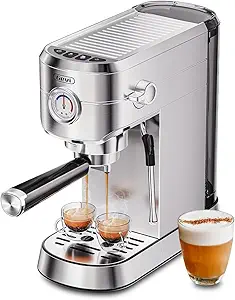 |
| Best Budget The cheapest option that still gets the job done reliably | SHARDOR 3.5 Bar Espresso Machine |  |
| Top Rated A top-rated pick with lots of positive feedback | Mooye CM5519 Espresso Machine |  |
| Most Popular A crowd favorite that many people choose with confidence | CASABREWS CM5418 Espresso Machine |  |
| Best Seller A high-volume bestseller chosen again and again | atatix EM3111 Espresso Machine |  |
Breville Barista Touch BES880BSS

| Operation Mode | Fully Automatic |
|---|---|
| Wattage | 1680 watts |
| Voltage | 120 |
| Human Interface Input | Touchscreen |
| Coffee Input Type | whole_beans |
The Breville Barista Touch is designed to bridge manual espresso and super-automatic convenience by combining a built-in conical burr grinder, touchscreen controls, and an automatic milk texturing system. You load whole beans, set one of the preset drink profiles or customize grind and shot parameters on the touchscreen, and the machine grinds, doses, and extracts with a 9-bar pump and low-pressure pre-infusion for fuller flavor. The Auto MilQ milk system textures milk to a silky microfoam suitable for lattes and cappuccinos and frees you from manual steaming for consistent results. Practical benefits include on-board grind adjustment with 30 settings, a fast ThermoJet heating system, and included stainless steel milk jug and dosing tool. Trade-offs are the machine footprint and weight compared with simpler machines, and users who want full manual control over tamping and steaming may still prefer a traditional prosumer setup. For everyday home baristas who want reliable espresso and café-style milk drinks without mastering every manual step, the Barista Touch delivers a polished balance of automation and quality.
Best for: Buyers who want café-quality espresso and consistent milk-based drinks at home but prefer a mostly automated workflow with room to customize settings.
Less Ideal for: Minimalists who need a compact, lightweight single-purpose espresso maker or users who prefer full manual control and hands-on steaming.
- Built-in conical burr grinder with 30 grind settings and dose control for fresh, consistent shots
- Touchscreen presets and customization simplify setup and repeated drink preparation
- Auto MilQ milk texturing delivers consistent silky microfoam without manual steaming
- Fast ThermoJet heating system reduces warm-up time for quicker pull-to-pour cycles
- Larger and heavier than simpler home espresso machines, requiring more counter space
- Higher complexity means more maintenance and learning compared with basic single-function machines
Verdict: Choose the Barista Touch if you want a single machine that grinds, pulls consistent espresso, and automatically textures milk for café-style lattes with minimal manual effort.
Breville Barista Express BES870XL

| Wattage | 1600 watts |
|---|---|
| Voltage | 120 |
| Coffee Input Type | whole_beans |
| Power Source | AC adapter |
| Capacity | 1 cups |
The Breville Barista Express is a performance‑focused semi‑automatic espresso machine that grinds, doses and extracts espresso in a single integrated workflow. Its conical burr grinder with 16 grind settings feeds freshly ground beans into a 54mm portafilter while dose control and the Razor trimming tool help get consistent puck sizes. The thermocoil heating system and PID temperature control aim for stable extraction, and the steam wand produces manual microfoam suitable for latte art when you learn the technique. Typical use is hands‑on: measuring, grinding, tamping and adjusting grind/dose to dial in shots, then steaming milk for lattes or cappuccinos. Practical benefits include faster workflow from beans to cup and the ability to shape espresso taste with grind and temperature control. Limitations are that it requires practice to master tamping and steaming, the daily cleaning and maintenance are more involved than pod or fully automatic machines, and it is built for single‑cup brewing rather than large batch service.
Best for: Home users who prioritize café‑quality espresso and are willing to learn manual tamping, dialing grind and steaming to extract the best flavor and milk texture.
Less Ideal for: Buyers who want fully automatic, no‑learn or low‑maintenance espresso options or need high‑volume commercial brewing for many cups in quick succession.
- Integrated conical burr grinder with adjustable grind settings for fresh dosing
- 54mm stainless steel portafilter and dual/single wall filters for consistent extraction
- PID thermocoil temperature control for stable brewing temperature
- Powerful steam wand capable of producing microfoam for latte art
- Includes practical accessories like razor dose trimming tool and integrated tamper
- Requires hands‑on skill and tuning to get consistent shots and milk texture
- Regular cleaning and maintenance are necessary to keep performance optimal
Verdict: Buy this if you want a single machine that grinds and steams to deliver café‑quality espresso and milk drinks at home when you are prepared to learn barista technique.
Gevi 20 Bar Espresso Machine
| Output Pressure | 20 bar |
|---|---|
| Operation Mode | Semi-Automatic |
| Wattage | 1350 watts |
| Coffee Input Type | ground_coffee |
| Capacity | 1 liters |
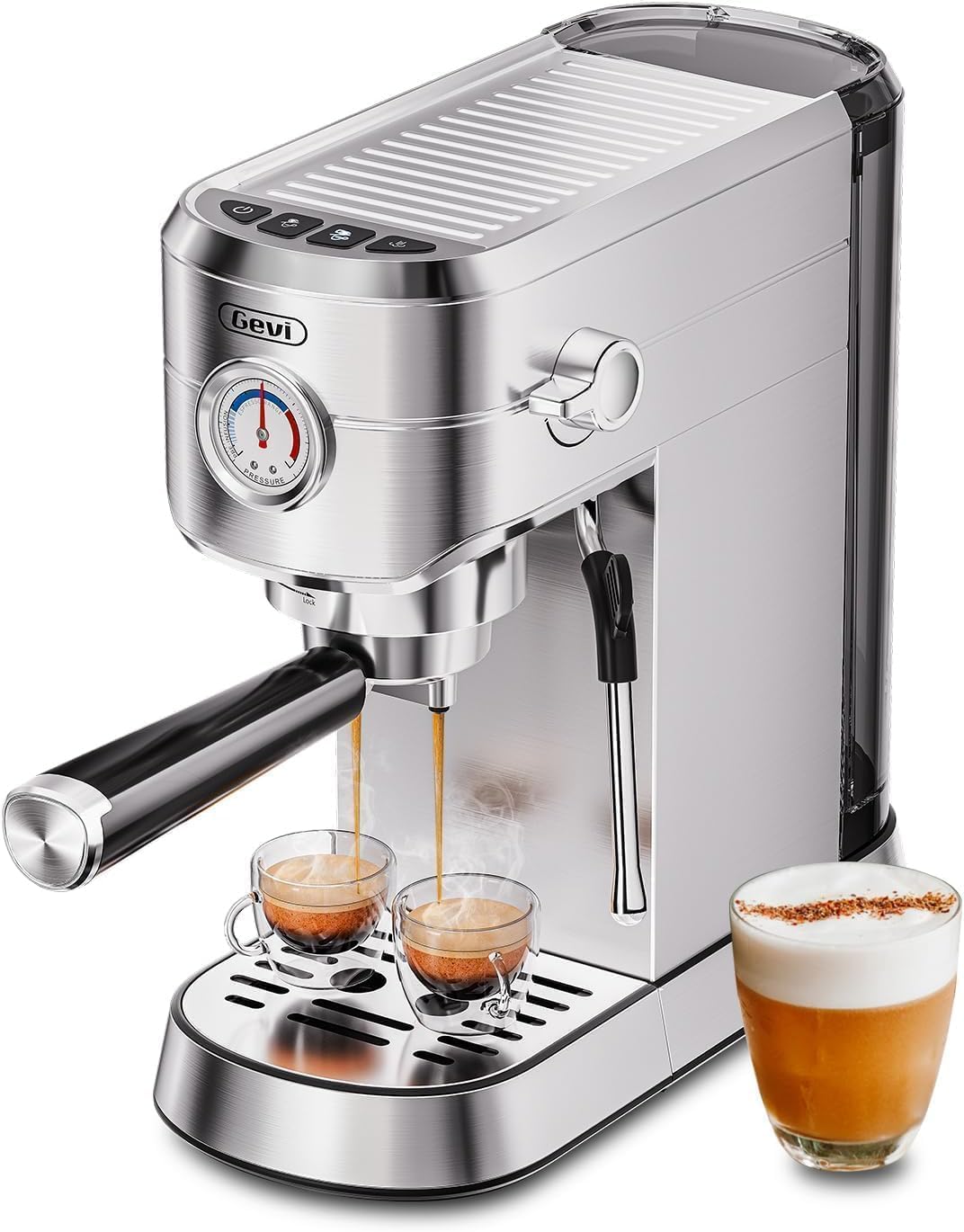
The Gevi 20 Bar Espresso Machine is a countertop semi-automatic unit aimed at making espresso-based drinks and Americanos with a milk frothing option. It uses a 20-bar pump, NTC temperature control and pre-infusion to extract espresso and includes a steam wand plus a removable froth nozzle for steaming milk into microfoam. A built-in pressure gauge and adjustable shot volume let you fine tune extractions, while the removable 34 oz water tank and cup warmer make daily use convenient. The stainless steel housing feels sturdy and the reusable filter and included 51 mm portafilter accessories mean you can pull double or single shots with ground coffee. Expect some pump noise and light vibration during operation and plan to manually clean the portafilter and wand after each milk drink since those parts are not dishwasher-safe. For at-home barista practice, it balances useful controls and compact footprint without requiring commercial installation.
Best for: Buyers who want a compact, hands-on espresso machine that provides adjustable extraction controls and a capable steam wand for regular milk-based drinks without needing a commercial setup.
Less Ideal for: People who want a fully automatic, quiet machine that requires minimal cleaning or those who need an integrated grinder or programmable temperature profiles.
- 20-bar pump with pre-infusion and pressure gauge for better extraction control
- Powerful steam wand with removable nozzle for producing microfoam
- Removable water tank and cup warmer improve day-to-day convenience
- Stainless steel construction and reusable filter for durability and lower waste
- Can be noisy and cause slight vibration during operation
- Portafilter and filter baskets are not dishwasher-safe and require manual cleaning
Verdict: A compact, feature-rich semi-automatic espresso machine that gives hands-on control and a strong steam wand for making reliable milk-based café drinks at home.
SHARDOR 3.5 Bar Espresso Machine

| Output Pressure | 3.5 bar |
|---|---|
| Wattage | 800 watts |
| Operation Mode | Semi-Automatic |
| Coffee Input Type | Ground |
| Capacity | 4 cups |
The SHARDOR 3.5 Bar Espresso Machine is a budget-friendly, compact semi-automatic unit designed for everyday espresso and milk-based drinks. It uses an 800W heating system and a die-cast aluminum boiler to reach brewing temperature quickly, while the 3.5-bar output produces a lighter espresso-style shot with some crema. Controls are simplified to a single intuitive knob that switches between brewing and steaming, and the adjustable steam wand lets you texture milk from light foam to creamier froth for cappuccinos and lattes. The machine accepts ground coffee and includes a reusable filter, a small carafe, and a frother in the box. Practical benefits are its small footprint, fast warm-up, and easy operation—useful for kitchens, offices, or dorms where space and cost matter. Trade-offs to expect are lower pump pressure than prosumer machines and mostly plastic construction, so the espresso body will be milder and long-term durability may not match higher-end models. Safety features include overheat and overpressure protection.
Best for: Buyers prioritizing a low-cost, space-saving espresso machine that still froths milk and delivers simple, café-style drinks at home or at work.
Less Ideal for: Serious espresso enthusiasts who want high-pressure extractions, metal-heavy construction, or features for precision temperature and pressure control should consider higher-end models.
- Fast 800W heating with die-cast aluminum boiler for quick warm-up
- Adjustable steam wand for flexible milk frothing from light foam to creamy texture
- Compact footprint that fits small kitchens, dorms, or office counters
- Includes reusable filter, carafe, and milk frother for out-of-the-box use
- 3.5-bar output yields lighter espresso-style shots compared with higher-pressure machines
- Predominantly plastic construction may feel less durable over time
Verdict: A compact, affordable espresso machine that warms up fast and froths milk well, making it a practical choice for budget-minded buyers who want cappuccinos and lattes at home.
Mooye CM5519 Espresso Machine

| Operation Mode | Semi-Automatic |
|---|---|
| Wattage | 1350 watts |
| Power Source | ac |
| Capacity | 1.8 liters |
| Human Interface Input | Touchscreen |
The Mooye CM5519 is a compact bean-to-cup semi-automatic espresso maker that combines a 20-bar pump, a built-in conical grinder with multiple grind settings, and a professional-style steam wand to produce espresso, cappuccinos, and lattes at home. Typical use is straightforward: fill the removable water tank, dose beans into the grinder, select grind and shot options on the LED touchscreen, and brew single or double shots while using the steam wand to texture milk. Notable features include a 1350W heating system and thermoblock that reach brewing temperature quickly, a 61 oz removable reservoir for longer runs between refills, and a detachable steam wand and drip tray for easier cleaning. Practical benefits are consistent extraction from the 20-bar pump, flexible grind adjustments for different roast profiles, and one-touch convenience via the touchscreen. Limitations are that it is semi-automatic so achieving perfectly repeatable shots requires some user skill and tamping technique, and the plastic-stainless construction may not feel as heavy-duty as pro-grade metal machines. For buyers who prize reliable daily performance and integrated grinding and steaming, this model delivers strong capabilities in a compact footprint.
Best for: Home users who want a reliable all-in-one machine that grinds beans and steams milk for daily espresso-based drinks and value quick heat-up and easy maintenance.
Less Ideal for: Commercial settings or buyers seeking a fully automated push-button system for completely hands-off drinks should look elsewhere.
- Integrated conical grinder with multiple grind settings for consistent dosing
- 20-bar pump and 1350W heating system for fast extraction and quick heat-up
- Professional-style steam wand that detaches for easier cleaning and milk texturing
- 61 oz removable water tank and removable drip tray for convenient maintenance
- Full LED touchscreen simplifies one-touch brewing and shot selection
- Semi-automatic operation requires user tamping and technique for consistent results
- Construction uses plastic elements that may feel less durable than higher-end metal machines
Verdict: A dependable compact bean-to-cup espresso machine that combines integrated grinding and a steam wand for consistent café-style drinks at home.
CASABREWS CM5418 Espresso Machine
| Operation Mode | Semi-Automatic |
|---|---|
| Wattage | 1350 watts |
| Output Pressure | 20 bar |
| Coffee Input Type | ground_coffee |
| Filter Type | Reusable |
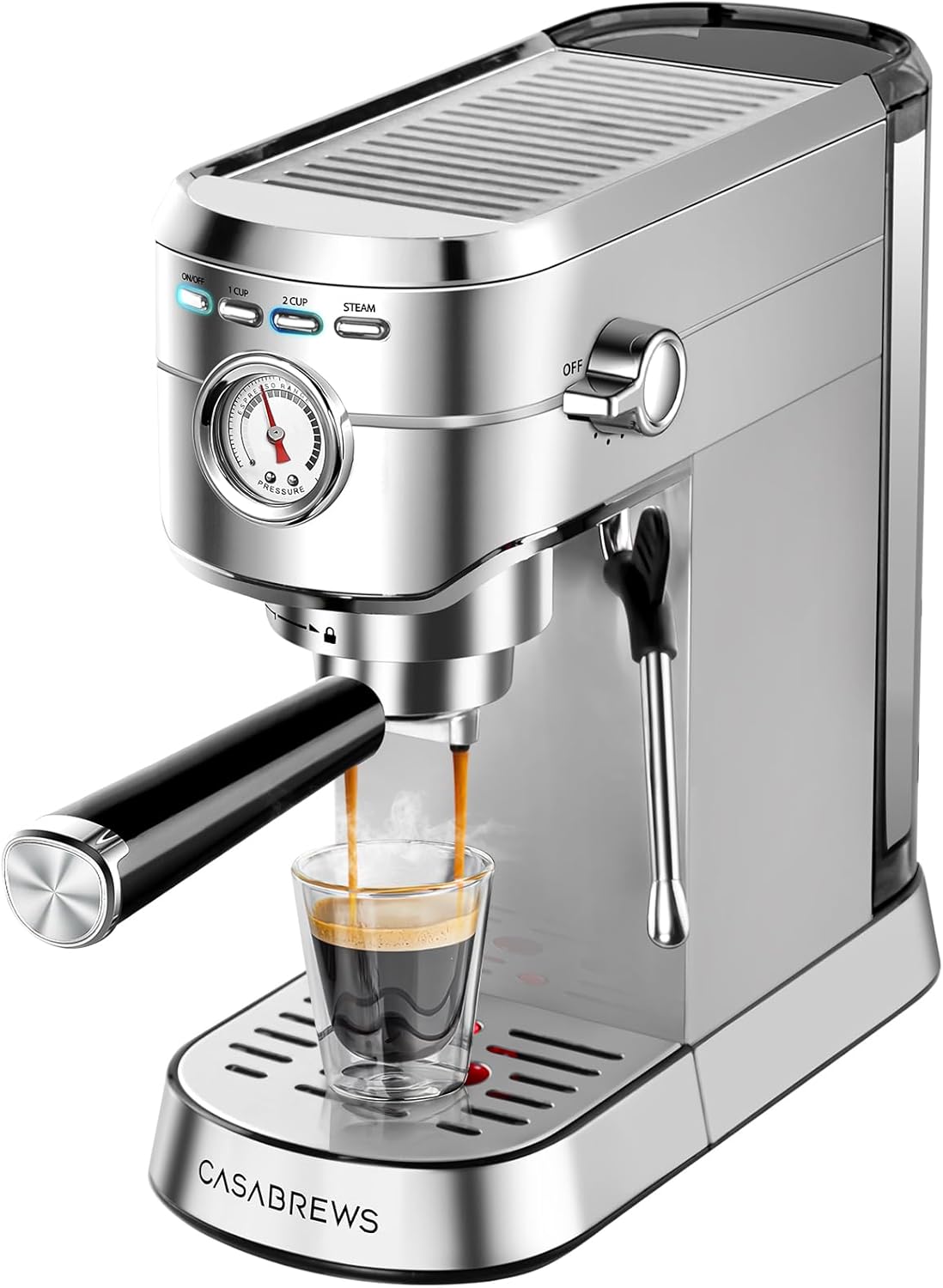
The CASABREWS CM5418 is a compact semi-automatic espresso machine aimed at home use that combines a 20-bar Italian pump, pre-infusion, and a manual steam wand for milk texturing. It brews single or double shots using ground coffee through a 51mm portafilter and shows extraction pressure on a built-in gauge so you can dial grind and tamp to taste. The steam wand creates microfoam suitable for lattes and cappuccinos, and the top warming tray plus removable 34 oz water tank add everyday convenience. Practical benefits include rapid warm-up, reusable filter baskets, and a stainless steel exterior that cleans easily. Expect some learning curve: consistent shots require proper grind size, tamping, and occasional descaling, and the machine may enter an over-temperature protection state if you brew immediately after steaming. For buyers who value visual pressure feedback and a hands-on barista experience, this machine delivers café-style features in a small footprint, but it is not a push-button super-automatic and performs best when the user is willing to tweak technique.
Best for: Buyers who want a hands-on, café-style home machine with visual pressure control and a capable steam wand and who prefer models validated by many other users before purchasing.
Less Ideal for: Users who want fully automatic, one-touch brewing or need rapid consecutive milk drinks in a high-volume setting should consider other machine types.
- 20-bar Italian pump with built-in pressure gauge for visible extraction feedback
- Powerful steam wand that produces microfoam suitable for latte art
- Removable 34 oz water tank for easier refills and up to several cups between fills
- Compact stainless steel body with cup warmer and removable drip tray for taller mugs
- Includes portafilter, single and double baskets, tamper, and reusable filters out of the box
- Single-boiler design requires cooling between steaming and brewing which slows back-to-back drink prep
- Requires attention to grind size and tamping for consistent shots, so beginners may face a learning curve
Verdict: A compact, feature-rich semi-automatic that gives visible pressure control and a powerful steam wand for buyers who want café-style shots and textured milk at home.
atatix EM3111 Espresso Machine

| Operation Mode | Semi-Automatic |
|---|---|
| Wattage | 1350 watts |
| Voltage | 120 volts |
| Output Pressure | 20 bar |
| Filter Type | Reusable |
The atatix EM3111 is a compact semi-automatic espresso machine designed to deliver cafe-style drinks at home. It uses a 20 bar pump with a 51mm portafilter and dual-wall filters to stabilize extraction, while NTC sensor plus PID control keeps brew temperature in the 90–96°C range for consistent shots. A powerful steam wand produces dense microfoam for lattes and cappuccinos, and the stainless steel top doubles as a cup warmer. The machine supports both automatic timed shots and a manual extraction mode for more control over concentration. Practical touches include a 44 oz removable water tank, reusable filter baskets, and suction-cup feet for reduced vibration. Trade-offs are its compact footprint and semi-automatic operation, which require some learning and tamping skill for reliable results, and the construction mixes ABS with stainless elements rather than all-metal internals. For buyers seeking reliable daily espresso and milk drinks without a large prosumer machine, the EM3111 balances features, temperature stability, and a small counter presence.
Best for: Buyers who want a reliable countertop espresso machine that consistently produces espresso and milk-based drinks with temperature stability, but prefer a lower-risk, easy-to-maintain home-friendly model.
Less Ideal for: Users who want a fully automatic, push-button cafe-style experience or who need a heavy-duty all-metal commercial machine for high-volume use.
- PID temperature control for consistent extraction
- Powerful steam wand that creates dense microfoam suitable for latte art
- 51mm portafilter with dual-wall filters for steadier pressure and crema
- Removable 44 oz water tank and reusable filters simplify daily use and cleaning
- Semi-automatic design requires practice to pull consistently good shots
- Build mixes ABS and stainless steel rather than fully metal commercial-grade construction
Verdict: The EM3111 is a compact, temperature-stable home espresso machine that delivers consistent shots and barista-quality milk foam without the complexity of a pro-grade unit.
Choosing the Right Espresso Machine with Milk Frother: Key Factors to Consider
Steam Performance
Steam pressure and the rate of steam delivery determine how quickly you can texture milk and how much control you have during the frothing process. Higher sustained steam power reduces steaming time and helps you reach the right milk temperature without long wait times between drinks.
For home use, consider whether the machine holds pressure well when pulling a shot and immediately switching to steam. Machines with undersized boilers or weak pumps typically struggle to produce dense microfoam and may require long recovery times between drinks, which is important if you plan to make multiple beverages in one session.
Froth Consistency
Froth consistency covers how uniformly a machine incorporates air into milk and the size of the resulting bubbles. Consistent microfoam gives milk drinks a smooth, velvety texture and improves latte art potential.
Different frothing systems—manual steam wands, automatic frothers, and integrated milk frothing chambers—produce different foam textures. Manual wands usually offer the most control for skilled users, while automatic systems deliver repeatable results with less technique required.
Temperature Stability
Temperature stability affects both espresso extraction and steam performance. If the boiler or heat system fluctuates, shot quality and milk steaming can suffer, producing bitter or under-extracted espresso and inconsistent milk texture.
Look for features that support thermal stability, such as adequate boiler capacity, PID or thermostat regulation, and designs that separate brewing and steaming duties. For multi-drink sessions, thermal recovery time is also a relevant part of stability and workflow.
Ease of Cleaning
Milk proteins are prone to buildup and bacterial growth, so cleaning access and procedure matter for safety and flavor. Machines with removable frothing components, easily accessible steam wands, and clear cleaning cycles make maintenance faster and more reliable.
Consider how often parts need disassembly, whether the frother has dishwasher-safe pieces, and whether the machine offers rinse or purge functions that reduce manual cleaning. Time spent cleaning affects how often you will actually perform recommended maintenance.
Control & Usability
Control features determine how much technique and intervention are required. Manual steam wands need more user skill but allow fine adjustments. Automatic frothers or one-touch milk systems simplify operation, producing consistent results with minimal training.
Usability also includes interface clarity, placement of controls, and ergonomics of the frothing wand or milk attachment. Consider how intuitive the controls are and whether the machine's workflow matches your preference for speed or customization.
Build Quality & Serviceability
A well-built machine resists wear in high-stress areas like pumps, boilers, and steam valves. Metal steam wands, sturdy drip trays, and robust housing all contribute to longevity. Serviceability includes access to replaceable components and straightforward descaling or part replacement procedures.
For buyers planning frequent use, prioritize units with durable materials and clear maintenance paths to avoid premature failures. Machines that allow simple component replacement or have user-accessible service points reduce downtime and repair complexity.
Manual Steam Wand Vs Automatic Frother
Deciding between a manual steam wand and an automatic frother is a core choice. Manual wands give you tactile control over aeration and temperature, enabling finer microfoam and better latte art for users willing to practice. Automatic frothers remove technique from the equation and produce consistent milk texture with the push of a button, which is ideal for busy routines or beginners.
Consider how much time you want to spend learning technique versus how much you value repeatable results. Manual systems can scale with skill, while automated systems prioritize convenience and speed.
- Manual wand: greater control, requires technique and cleanup
- Automatic frother: repeatable texture, simpler operation
- Hybrid systems: offer both wand and auto mode for flexibility
Milk Types and Texturing Tips
Different milks foam differently. Whole milk tends to produce denser, creamier foam, while skim or low-fat milk creates larger, airier foam. Plant-based alternatives vary widely: oat and barista-formulated almond milks usually froth better than plain almond or rice milks.
When steaming, start with cold milk in a chilled pitcher, position the steam tip just below the surface to introduce air, and then lower the pitcher to heat the milk through. Watch for a glossy, paint-like texture to indicate proper microfoam.
- Use chilled milk and a chilled pitcher for more control
- Purge the wand before and after steaming to avoid clogging
- Practice stretching and rolling techniques for latte art
Maintenance Routines That Save Time
A few daily and weekly habits greatly reduce the effort of deep cleaning. Wiping and purging the steam wand immediately after each use prevents milk residue from baking on. Empty and rinse any detachable milk components after every session.
Schedule regular descaling and deep-clean cycles per the machine's guidelines. Keeping a short maintenance checklist and completing small tasks immediately reduces the chance that more intensive cleaning will be required.
- Daily: purge and wipe steam wand, rinse milk parts
- Weekly: clean drip tray and portafilter basket
- Monthly or as-needed: run descaling or backflush cycles
Workflow for Multi-Drink Serving
If you frequently make multiple milk drinks in a row, look for machines with fast thermal recovery and generous boiler capacity. Prepare milk jugs in advance and keep a second pitcher on hand to streamline steaming while one drink extracts.
Plan the sequence: start with grinding and dosing, then pull shots while the machine is hot, steam milk right after each shot, and combine swiftly to preserve crema and milk texture.
- Organize tools: pitcher, thermometer, towel, and shot glasses
- Pull shots in sequence that minimizes boiler downtime
- Use dual boilers or larger single boilers for repeated steaming
Safety and Practical Kitchen Considerations
Steam and hot milk can cause burns, so ensure the steam wand and surrounding areas are easy to reach without awkward angles. Stable footing for milk pitchers and heat-resistant surfaces reduce accident risk.
Consider the machine's footprint and water source options. Machines with plumb-in capabilities or larger reservoirs suit heavy use, while compact units work better for limited counter space. Noise level during pump and steam operation is also a consideration for open-plan kitchens.
- Place machine on a stable, heat-resistant surface
- Allow adequate clearance above and behind for steam wand and hoses
- Check reservoir size versus expected daily drink volume
How We Chose the Best Espresso Machine with Milk Frother
We focused on attributes that directly affect milk-textured espresso drinks and everyday ownership. Key evaluation criteria included steam performance and frothing consistency, which determine how quickly and reliably a machine produces microfoam for lattes and cappuccinos. We also measured ease of cleaning and maintenance because milk residue builds up quickly and cleaning complexity influences long-term usability. Other important filters were boiler design and temperature stability, which affect shot consistency and steaming speed, and user controls for steam and milk—manual steam wands versus automatic or one-touch frothers change the skill required and the repeatability of results. We prioritized durable materials and accessible service points because long-term reliability matters for appliances that see daily use. Excluded from consideration were machines that do not include an integrated milk frothing solution or those designed exclusively for single-serve capsules without manual or automated frothing capability. We also de-emphasized models that sacrificed steam power or cleaning access in favor of novelty features. The resulting picks reflect machines that balance steaming capability, hygienic design, temperature control, and user-focused controls.
Our full evaluation process is outlined in our review methodology.
FAQ
How often should I clean the milk frothing components?
Clean frothing components after every use by purging and wiping the wand, and rinse removable parts immediately. Perform a more thorough cleaning weekly and follow descaling schedules as recommended for your machine.
Can plant-based milks produce the same foam as dairy?
Some plant-based milks foam well, particularly barista-formulated oat and almond milks. Results vary across brands and types, so test a few options to find one that produces the texture you prefer.
Is a manual steam wand better than an automatic frother?
A manual wand offers greater control and can produce superior microfoam with practice, while an automatic frother provides consistent results with less effort. The best choice depends on whether you prioritize customization or convenience.
How important is boiler size for milk steaming?
Boiler size affects thermal recovery and the ability to steam multiple drinks consecutively. Larger or dual-boiler systems recover faster and maintain steam pressure during multi-drink sessions, which matters for frequent entertaining.
What milk temperature should I aim for when steaming?
Aim for 140 to 150 degrees Fahrenheit for most milk drinks. Higher temperatures can scald milk and reduce sweetness, while lower temperatures may feel lukewarm and not integrate as well with espresso.
Final Verdict
Focus on the steaming system and cleaning convenience when choosing an espresso machine with milk frother. If you want maximum control and the option to develop technique, a manual steam wand is preferable. For fast, repeatable results with minimal training, an automatic frothing system is the better fit. Balance steam performance, maintenance effort, and control features against your daily routine. Prioritize machines that deliver stable steam, accessible cleaning, and the usability you will actually use to ensure consistently satisfying milk drinks at home.