
Note: This article contains affiliate links. If you click on these links and make a purchase, we may earn a small commission at no extra cost to you. This helps support our research and content. Read our full affiliate disclosure here.
Picking the right espresso machine for a small business affects drink consistency, staff efficiency, and maintenance burden every day. You need equipment that reliably handles morning rushes, delivers repeatable shots, and stays serviceable with reasonable upkeep. This guide presents seven shortlisted espresso machines for small business use, chosen for their build quality, workflow, and suitability for commercial or high-volume light-commercial environments. We outline the evaluation criteria used, what matters for installation and staffing, and how each pick fits different business needs. Read on to match machine features to your service model and expected volume.
Top Picks at a Glance
| Best Overall The best all-around choice for most situations | Breville Barista Touch BES880BSS |  |
| Best Quality Built to a higher standard if you want something more solid | La Pavoni PUB 1M-B 1-Group |  |
| Best Value The sweet spot between price and what you get | Neretva Espresso Machine PE3670U |  |
| Best Budget The cheapest option that still gets the job done reliably | CASABREWS CM5418 Espresso Machine |  |
| Top Rated A top-rated pick with lots of positive feedback | HIBREW H10 Espresso Machine |  |
| Most Popular A crowd favorite that many people choose with confidence | Breville Barista Express BES870XL |  |
| Best Seller A high-volume bestseller chosen again and again | Gevi 20 Bar Espresso Machine ECMG0 | 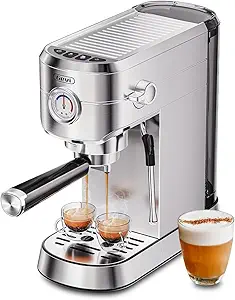 |
Breville Barista Touch BES880BSS

| Operation Mode | Fully Automatic |
|---|---|
| Wattage | 1680 watts |
| Human Interface Input | Touchscreen |
| Coffee Input Type | whole_beans |
| Filter Type | Reusable |
The Breville Barista Touch combines an integrated conical burr grinder, touchscreen interface, and an automatic steam wand to streamline espresso and milk-based drinks. Users load whole beans into the grinder, select strength and milk settings on the touchscreen, and the machine auto-grinds, doses, and extracts at 9 bar pressure with pre-infusion for a fuller flavor. The ThermoJet heating system brings the unit to ready temperature quickly, and the Auto Milk or manual texturing options produce consistent microfoam for lattes and cappuccinos. Practical benefits include precise grind control with 30 grind settings, a programmable dose trimming tool for consistent puck weight, and a reusable filter that reduces ongoing cost. Limitations are its size and weight for cramped counters and that it is designed around single-group, single-boiler workflow rather than heavy continuous commercial throughput, so it can be slower under sustained high-volume use. Setup and occasional cleaning of the grinder and milk system require some regular maintenance like any high-quality espresso machine.
Best for: Small business owners who need cafe-quality espresso and milk drinks with consistent results but do not require continuous commercial-level throughput.
Less Ideal for: High-volume cafes or operators who need multi-group commercial machines designed for nonstop service and rapid recovery.
- Integrated conical burr grinder with 30 grind settings for precise dosing
- Touchscreen controls and programmable settings simplify drink preparation
- Auto steam wand produces consistent microfoam for latte art
- ThermoJet heating system delivers fast heat-up time
- Single-group design limits continuous high-volume output compared with commercial machines
- Relatively heavy and sizable, which may strain small counter spaces
Verdict: Choose the Barista Touch if you want an all-in-one countertop machine that delivers cafe-style espresso and consistent milk texturing with easy touchscreen controls for a small business setting.
La Pavoni PUB 1M-B 1-Group

| Operation Mode | Fully Automatic |
|---|---|
| Wattage | 1500 |
| Voltage | 110 |
| Capacity | 6.5 liters |
The La Pavoni PUB 1M-B is a one-group commercial espresso/cappuccino machine built for steady, high-volume service in small cafés, catering, or restaurant settings. It uses a press-forged brass grouphead with chrome plating, a 6.5-liter boiler, one steam wand and a hot water tap, and is operated via a manual rocker switch for coffee delivery. The machine supports direct water line hookup but remains portable for off-site catering, and a built-in water softener helps protect internal components. With a 1500 W, 110 V electrical rating and a reported capacity in the 150–200 drinks per day range, it suits busy single-group workflows where consistent steam and extraction are required. Expect hands-on operation rather than automated dosing or grind integration, so a trained operator is essential to get repeatable shots. The stainless steel construction and Italian manufacturing give a durable, serviceable feel, while the single group limits simultaneous extraction to one shot at a time, so peak throughput depends on operator speed.
Best for: Buyers who prioritize durable, café-grade performance and need a workhorse single-group machine for a small commercial operation or catering service.
Less Ideal for: Businesses that need multi-group throughput, unattended automation, or integrated grinders should consider larger or more automated machines instead.
- Commercial-grade brass grouphead with chrome plating for consistent extraction
- 6.5 liter boiler and 1500 W power deliver steady steam for milk work
- Direct water line hookup and built-in water softener suitable for busy service
- Stainless steel construction offers durability for commercial use
- Single group limits simultaneous extraction to one drink at a time
- Manual rocker control requires skilled operator for consistent dosing
Verdict: Choose the La Pavoni PUB 1M-B if you need a rugged, café-grade single-group machine that delivers reliable steam and extraction for a small commercial operation.
Neretva Espresso Machine PE3670U

| Output Pressure | 20 bar |
|---|---|
| Wattage | 1350 watts |
| Operation Mode | Semi-Automatic |
| Capacity | 1.31 liters |
| Coffee Input Type | Ground |
The Neretva PE3670U is a compact semi-automatic espresso maker aimed at producing espresso and milk drinks in small settings. It uses a 20-bar pump and a 1350W boiler to deliver consistent extraction and has a visible temperature display with pre-infusion to help stabilize shots. The machine includes a 51mm portafilter, pressurized single/double filters, and a powerful steam wand for frothing, so you can make espresso, cappuccino, and lattes without separate equipment. Practical features include a removable 1.31L water tank, cup warmer, and reusable filter that reduce running costs and simplify daily use. Trade-offs are its smaller water capacity and compact footprint, which mean more frequent refills under continuous use, and some learning is required to dial in grind, dose, and tamp for best results with the pressurized baskets. The stainless steel build looks durable for a small-business backbar and the controls are button-based for straightforward operation, making it a sensible pick where space and budget matter more than full commercial workflow or high-volume throughput.
Best for: Small business owners who need a space-saving, budget-conscious espresso machine that can produce consistent espresso and milk drinks without a full commercial setup.
Less Ideal for: High-volume coffee shops or operations that require continuous back-to-back pulls and larger water capacity should choose a commercial-grade machine instead.
- 20-bar pump and 1350W boiler for strong extraction and quick heat-up
- Pre-infusion and visible temperature display for more consistent shots
- Powerful steam wand capable of producing milk foam for lattes and cappuccinos
- Removable 1.31L water tank and cup warmer improve convenience and workflow
- Includes 51mm portafilter and several filter options so you can brew single or double shots
- 1.31L tank requires frequent refilling in higher-volume use
- Pressurized filters limit full manual extraction control compared with commercial baskets
Verdict: A compact, practical espresso machine that delivers barista-style drinks for small-business settings where space and budget are primary constraints.
CASABREWS CM5418 Espresso Machine
| Operation Mode | Semi-Automatic |
|---|---|
| Wattage | 1350 watts |
| Voltage | 120 volts |
| Output Pressure | 20 bar |
| Coffee Input Type | ground_coffee |
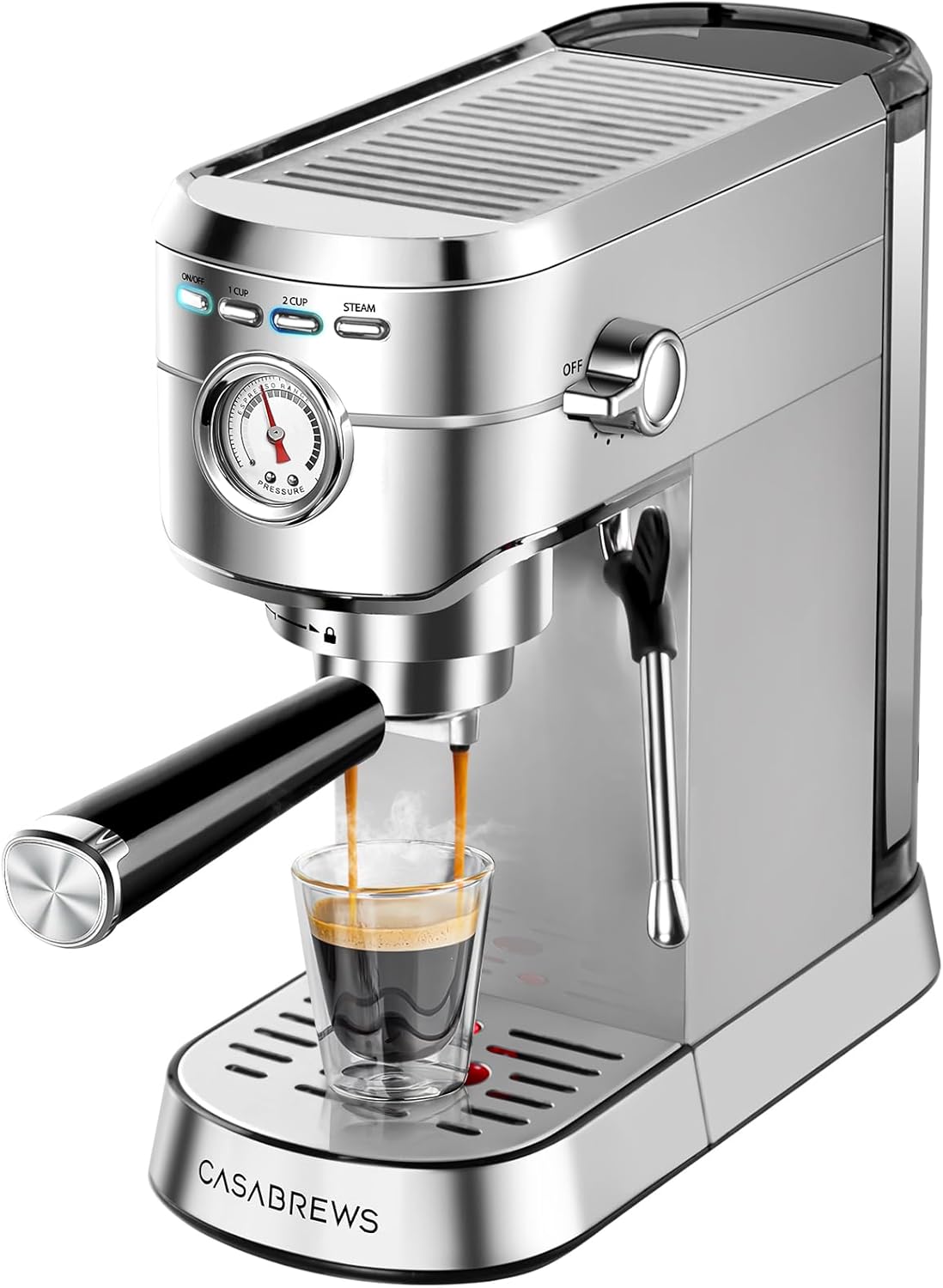
The CASABREWS CM5418 is a compact semi-automatic espresso machine intended to deliver café-style shots and frothed milk on a modest footprint. It uses a 20-bar Italian pump and built-in pressure gauge to help dial in extraction, and a low-pressure pre-infusion feature to improve flavor balance. The stainless steel steam wand produces microfoam suitable for lattes and cappuccinos, and the removable 34 oz water tank lets you make multiple drinks before refilling. Controls are button-based and the machine includes single- and double-shot filter baskets plus a tamper. Practical benefits include a cup-warming tray, a removable drip tray that accepts taller mugs, and a durable brushed stainless exterior that suits a small counter. Limitations are the single boiler design, which requires short waits or careful sequencing when steaming immediately after brewing, and the machine is geared toward ground coffee rather than integrated grinders or commercial throughput. For a budget-focused small business wanting decent espresso and milk drinks without a large commercial machine, the CM5418 balances performance and compact size but will not match the speed or consistency of dedicated commercial machines.
Best for: Small-business owners on a budget who need a compact, capable machine that can produce espresso-based drinks and textured milk without the cost and space requirements of commercial equipment.
Less Ideal for: High-volume cafes or businesses that require back-to-back steaming and continuous commercial throughput should choose a true commercial-grade dual-boiler or prosumer espresso machine instead.
- 20-bar pump with built-in pressure gauge for visible extraction feedback
- Powerful steam wand capable of producing microfoam for lattes and cappuccinos
- Compact stainless steel body with removable 34 oz water tank for easy refills
- Includes portafilter, single and double filters, and tamper for immediate use
- Single boiler design requires cooling time between brewing and steaming
- No integrated grinder so consistent shot quality depends on external grinder and technique
Verdict: A compact, budget-friendly semi-automatic machine that produces café-style espresso and microfoam for small businesses that need capability without commercial size or cost.
HIBREW H10 Espresso Machine

| Output Pressure | 20 bar |
|---|---|
| Wattage | 1350 watts |
| Capacity | 1800 ml |
| Operation Mode | Semi-Automatic |
The HIBREW H10 is a compact, café-style semi-automatic espresso maker designed to bring consistent, customizable shots to a small business or busy home setup. It offers precise control over extraction temperature (190°F–205°F in 1.8°F steps), adjustable extraction time up to 100 seconds, and selectable pre-infusion to tune flavor across roasts. A genuine 58mm commercial group head with auto pressure release and backflush capability helps produce repeatable, café-grade extraction, while the separate hot water outlet and one-touch continuous brewing let you pull multiple drinks without long waits. The dual-function one-touch steam and extraction system reaches steam-ready temps quickly and the steam wand creates microfoam in about 40 seconds, useful for lattes and cappuccinos during service. Practical touches include a 1.8L flip-top water tank, removable drip tray with a level indicator, low-water detection, and a stainless steel body for durability and easier cleaning. Limitations are its semi-automatic workflow which still requires skill and timing from staff, and its footprint and 1.8L tank may need more frequent refills under heavy commercial volume compared with larger prosumer machines.
Best for: Small businesses or cafés needing a reliable, compact espresso machine that delivers consistent, adjustable shots and quick steam for drinks served throughout the day.
Less Ideal for: High-volume coffee shops that require large-capacity commercial machines with bigger boilers and hands-off automated workflows.
- 58mm metal commercial group head with backflush and auto pressure release for consistent extraction
- Precise temperature control in 1.8°F increments and programmable extraction time for repeatable shots
- Fast dual-function steam system that froths microfoam in about 40 seconds and switches modes quickly
- Separate hot water outlet and one-touch continuous brewing for making multiple drinks without downtime
- Stainless steel body and removable drip tray with low-water detection for durable, low-maintenance operation
- 1.8L water tank and compact footprint may require frequent refills in a busy small-business environment
- Semi-automatic operation still demands barista skill and hands-on timing for best results
Verdict: Choose the HIBREW H10 when you want a durable, café-grade semi-automatic machine that delivers precise, repeatable espresso and fast steam in a compact footprint.
Breville Barista Express BES870XL

| Wattage | 1600 watts |
|---|---|
| Voltage | 120 |
| Coffee Input Type | whole_beans |
| Filter Type | Reusable |
| Capacity | 1 cups |
The Barista Express combines a built-in conical burr grinder, 54mm portafilter, PID temperature control, and a powerful steam wand to let users grind, dose, extract, and texture milk on one countertop unit. Typical use is single-station café-style beverage prep where an operator grinds beans directly into the portafilter, trims the dose with the included razor, and steams milk manually to produce lattes or cappuccinos. The thermocoil heating system and low-pressure pre-infusion help stabilize extraction for more consistent shots, while the dual and single-wall filter baskets give flexibility for single or double shots. Practical benefits include fresh-ground flavor from the integrated grinder, precise temperature control for balanced espresso, and a steam wand capable of microfoam for latte art. Limitations are that it remains a manual workflow requiring operator skill and time between shots, and its one-cup capacity and domestic water tank make it less suited to continuous high-volume service without frequent refilling and tamping cycles.
Best for: Buyers who prioritize café-quality shots and fresh grinding in a small commercial or busy kiosk setting but expect to operate a manual workflow and train staff to use the machine properly.
Less Ideal for: Locations that need continuous, unattended high-volume output or a fully automated, multi-cup commercial espresso system should consider larger commercial machines instead.
- Integrated conical burr grinder with dose control for fresh-ground espresso
- PID temperature control for more consistent extractions
- 54mm stainless steel portafilter and included dosing tools for pro-style shots
- Powerful steam wand that produces microfoam suitable for latte art
- Comprehensive accessory set included (tamper, razor, cleaning tools)
- Single boiler/thermocoil and manual workflow limit throughput for busy service periods
- Water tank and 1-cup capacity require frequent refilling in high-volume use
Verdict: Choose the Barista Express when you want café-quality, freshly ground espresso and milk-texturing on a countertop machine for a small business that can manage a manual workflow.
Gevi 20 Bar Espresso Machine ECMG0
| Output Pressure | 20 bar |
|---|---|
| Wattage | 1350 watts |
| Operation Mode | Semi-Automatic |
| Capacity | 1 liters |
| Power Source | AC adapter |
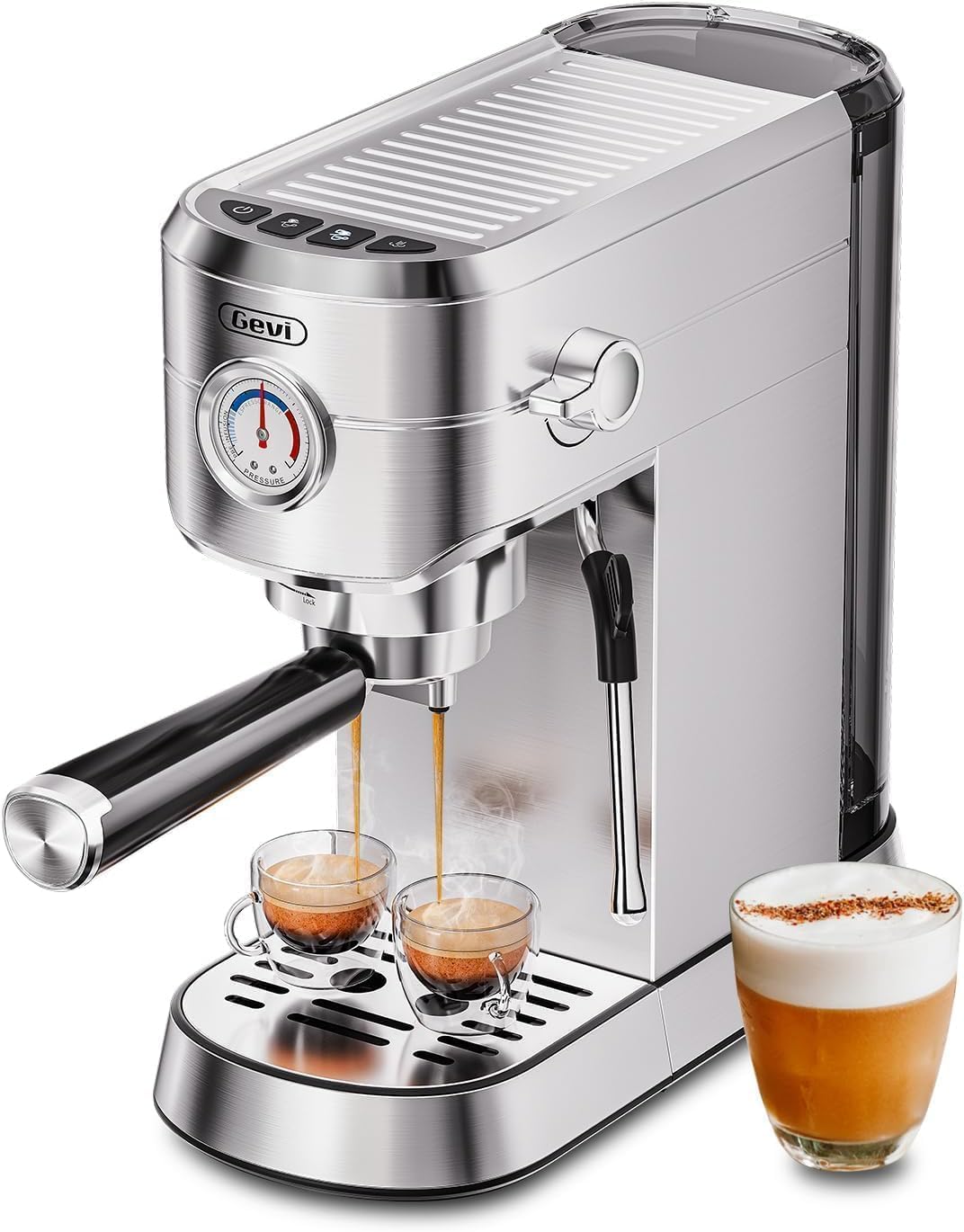
The Gevi 20 Bar Espresso Machine is a compact, semi-automatic unit built to deliver espresso-based drinks for small commercial or busy home settings. It uses a 20‑bar pump, NTC temperature control, pre-infusion, and an adjustable shot volume to help produce consistent extractions, while a built-in pressure gauge lets you monitor shot pressure. The machine includes a powerful steam wand and removable froth nozzle for faster milk texturing and easier cleaning, plus a removable 34 oz water tank and cup warmer for convenience. Controls are button-driven and the stainless steel housing feels durable on a countertop. At 1,350 watts it heats and recovers quickly, but expect some pump noise and vibration during operation. The portafilter and filter baskets require hand cleaning and should not be soaked in acidic cleaners or placed in a dishwasher. For small-business use this model balances compact footprint and useful café features, though it lacks an integrated grinder and some higher-end temperature programmability found on pricier commercial machines.
Best for: Buyers who prioritize reliable, repeatable espresso shots in a compact machine and want recognizable café features like pressure monitoring and a steam wand without a large footprint or complex controls.
Less Ideal for: Operators who need an all-in-one commercial setup with an integrated grinder or those who require advanced temperature profiling and ultra-quiet operation.
- 20‑bar pump with pre‑infusion and adjustable shot volume for more consistent extractions
- Built-in pressure gauge and cup warmer help monitor and stabilize shot quality
- Powerful steam wand with removable froth nozzle for quick milk texturing and easier cleaning
- Removable water tank and reusable filter support straightforward daily maintenance
- Stainless steel body offers a compact but durable countertop presence
- No built-in grinder so you'll need a separate grinder for fresh dosing
- Some vibration and pump noise during operation which can shift lightweight cups
- Portafilter parts are not dishwasher-safe and require careful hand cleaning
Verdict: A compact, feature-rich semi-automatic espresso machine that delivers café-style shots and steam power in a durable countertop package ideal for cautious small-business buyers.
Choosing the Right Espresso Machine for Small Business: Key Factors to Consider
Throughput and Recovery Rate
Throughput and recovery determine how many quality espresso shots a machine can produce in peak periods. Businesses with steady customer flow need machines with boilers, heat exchangers, or dual-boiler designs that recover temperature quickly so shot timing and extraction are stable between consecutive pulls.
Assess expected peak hourly drink counts and choose a machine whose rated or experience-based throughput matches or exceeds that demand. Machines with slow recovery will force longer waits, reduce drink consistency during rushes, and increase staff time per drink.
Temperature Control and Consistency
Consistent brew temperature is critical for repeatable extraction and flavor stability. Look for machines with reliable thermostats, PID control, or robust heat-exchange geometry that keep grouphead and boiler temperatures steady under load.
Temperature drift leads to uneven shots across a service period, making quality control harder and increasing waste from re-pulls. For small businesses, prioritize systems with proven stability over longer service cycles rather than experimental or purely consumer-level control schemes.
Build Quality and Materials
Machines built from heavier-gauge metals, brass or stainless boiler components, and serviceable mechanical parts typically last longer in commercial use. Durable portafilters, group solenoids, and reinforced plumbing reduce the frequency of failures that interrupt service.
High initial build quality often costs more up front but lowers lifetime downtime and replacement-part needs. Consider the environment—fast-paced shops expose machines to more wear, so choose equipment with robust construction and commercial-rated internals.
Steam Power and Milk Workflow
For businesses offering milk-based beverages, steam pressure, wand reach, and heat-up time are decisive. Powerful steam delivery shortens milk texturing time and allows a single operator to steam multiple milk pitchers in quick succession while maintaining microfoam quality.
Evaluate wand ergonomics and control responsiveness as part of the workflow. Inefficient steam systems slow service and produce inconsistent milk, which affects throughput and customer experience.
Serviceability and Parts Accessibility
Ease of servicing affects uptime and long-term cost. Machines designed with accessible panels, modular components, and widely available replacement parts reduce technician time and complexity for routine repairs.
Consider local service support availability and whether the machine's consumables are common. A design that simplifies descaling, gasket changes, and grouphead servicing will minimize outages and keep daily operations smoother.
Installation, Water, and Energy Requirements
Small businesses must plan for plumbing, drainage, and electrical needs. Hardwired or high-current machines may require upgraded circuits while some units benefit from direct plumb-in water lines and external water treatment to protect boilers.
Water quality affects taste and maintenance frequency, so include filtration or softening in your installation plan. Energy consumption and heat output can influence utility costs and kitchen layout, especially in small spaces where ventilation and heat load matter.
Sizing a Machine to Your Service Model
Estimate peak hourly drink counts, average ticket composition, and whether a single barista will operate the machine. A shop with many milk drinks needs different capabilities than one focused on straight espresso. Match the machine's rated or practical throughput to your busiest hour to avoid underpowered equipment.
Also consider future growth. If you expect menu expansion or higher traffic, choose a model with a bit more capacity or modular options so you avoid an early replacement.
- Estimate peak hourly shots and steamed milk orders
- Decide single-operator versus multi-operator workflows
- Allow headroom for future demand increases
Water Treatment and Maintenance Planning
Water hardness and mineral content directly affect boiler lifespan and performance. Implementing a water treatment strategy prevents scale buildup and extends intervals between service visits.
Set a maintenance schedule that includes daily backflushing, periodic grouphead gasket checks, and scheduled descaling. Training staff to perform routine tasks reduces technician callouts and keeps the machine running predictably.
- Install filtration or softeners based on local water reports
- Create a simple daily and weekly maintenance checklist
- Log servicing and part replacements for warranty and uptime tracking
Workflow and Counter Layout Considerations
Place the machine, grinder, knock box, and milk station to minimize operator movement. A compact, well-planned counter increases throughput and reduces training time for new staff.
Check grouphead orientation, wand placement, and cup rail height so baristas can work ergonomically. Small businesses often benefit more from a smooth workflow than the absolute highest-spec machine.
- Keep grinders close to the machine and within easy reach
- Allow clearance for steam wands and pitchers
- Provide dedicated space for routine cleaning supplies
Energy Use and Ventilation
Commercial espresso machines produce heat and draw significant electrical power. Confirm that the electrical service, breaker capacity, and available outlets meet the machine's requirements before purchase.
In small spaces, consider the machine's heat output and how it affects staff comfort and HVAC load. Proper ventilation and placement can reduce heat-related issues and improve the working environment.
- Verify electrical specifications and breaker requirements
- Account for heat dissipation in small service areas
- Plan for ventilation and clearance per local codes
Staff Training and Consistency
Invest in concise training that covers dosing, tamping, wand technique, and basic troubleshooting. Consistent technique matters more than minor equipment differences when maintaining taste across multiple operators.
Create simple calibration references for grind setting, dose, and extraction time so staff can quickly restore consistent results after shift changes or when switching beans.
- Provide short, role-focused training sessions
- Use visual cues and checklists for extraction targets
- Rotate employees through tasks to build redundancy
How We Chose the Best Espresso Machine for Small Business
We prioritized machines that are proven to work in small commercial settings where consistent shot quality and uptime matter. Evaluation focused on measurable, category-specific criteria that affect daily operations rather than marketing claims. Key dimensions included the machine's sustained throughput and temperature stability, which determine how many quality shots can be produced per hour. We examined build durability and serviceability, including materials, accessible components, and the likely maintenance cadence for routine parts. Boiler and heating system design was another filter: we favored systems that recover quickly between shots and maintain temperature under load. Ergonomics and workflow were assessed by checking group layout, steam wand performance, and ease of single-operator use. Energy and water handling were considered for businesses that need efficient, code-compliant installations. We excluded consumer-grade home machines and hobbyist portafilters that lack commercial-rated components or specified duty cycles. The result is a focused list of options suitable for small businesses balancing throughput, reliability, and manageable upkeep.
Our full evaluation process is outlined in our review methodology.
FAQ
What machine size is right for a single-barista coffee shop?
For a single-barista operation, choose a machine with sufficient throughput for your peak hour plus some headroom. A compact dual-boiler or robust heat-exchanger unit often balances capacity and counter footprint for one operator.
How often should a small business descale or service its espresso machine?
Service intervals depend on water quality and volume. With proper filtration, many small businesses can schedule professional servicing annually and perform routine descaling or maintenance tasks every few months. Monitor performance and scale indicators to adjust frequency.
Is a direct-plumb water connection necessary?
Direct plumb-in simplifies water management for high-volume shops and reduces manual refilling. For lower-volume operations, a refillable reservoir may be acceptable, but plumbing and filtration reduce maintenance and ensure consistent water pressure and quality.
Can a small business run a commercial machine without a trained technician?
Staff can handle daily cleaning and simple troubleshooting with training. However, scheduled preventive maintenance and repairs that involve boilers or electrical systems should be done by qualified technicians to preserve safety and warranty coverage.
How important is steam wand power for milk-based menus?
Steam power directly affects milk texturing speed and consistency. Shops with many lattes and cappuccinos should prioritize machines with strong steam delivery and ergonomically placed wands to keep service times down and foam quality high.
Final Verdict
Choose an espresso machine that matches your busiest service periods and menu composition rather than chasing the highest specifications. Prioritize throughput and temperature stability if you expect sustained peak hours, and emphasize steam performance when milk drinks dominate sales. Factor in installation needs, water treatment, and a realistic maintenance plan so the machine stays dependable over time. Balancing capacity, durability, and serviceability will help you select equipment that supports consistent drink quality and manageable operating costs for a small business. Focus on the features that directly affect daily workflow and uptime to make a confident purchase.