
Note: This article contains affiliate links. If you click on these links and make a purchase, we may earn a small commission at no extra cost to you. This helps support our research and content. Read our full affiliate disclosure here.
If you want café-style shots at home without spending a fortune, choosing the right espresso machine matters. Under $400 you can find machines that pull consistent single or double shots, steam milk acceptably, and hold up to regular use in a small kitchen. This guide shortlists seven machines that represent the best balance of extraction performance, durability, and user-friendly features in this price tier. We evaluate ease of use, cleaning, and shot quality so you can pick a machine that matches how you make coffee day to day. Read on for a breakdown of what to expect from each style and the factors that should steer your decision.
Top Picks at a Glance
| Best Overall The best all-around choice for most situations | De'Longhi Dedica EC680M |  |
| Best Quality Built to a higher standard if you want something more solid | Breville Bambino BES450BSS | 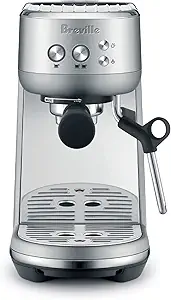 |
| Best Value The sweet spot between price and what you get | atatix EM3111 Espresso Machine |  |
| Best Budget The cheapest option that still gets the job done reliably | IMUSA Espresso Maker GAU-18202AMZ |  |
| Top Rated A top-rated pick with lots of positive feedback | CASABREWS 5418 PRO Espresso Machine |  |
| Most Popular A crowd favorite that many people choose with confidence | CASABREWS CM5418 Espresso Machine |  |
| Best Seller A high-volume bestseller chosen again and again | Gevi 20 Bar Espresso Machine ECMG0 | 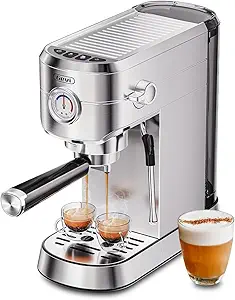 |
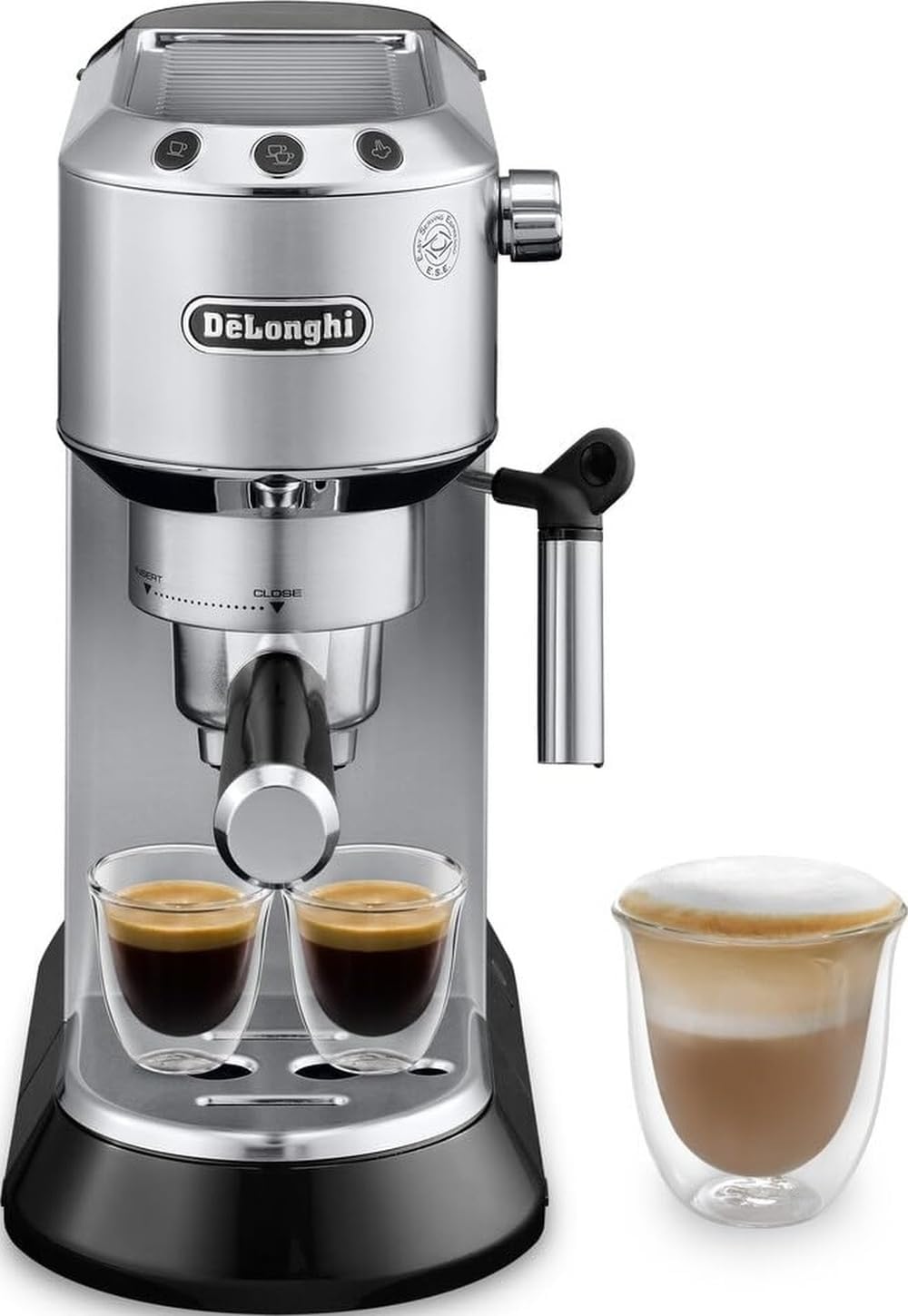
De'Longhi Dedica EC680M
| Output Pressure | 15 bar |
|---|---|
| Wattage | 1450 watts |
| Coffee Input Type | ground, pod |
| Capacity | 1 liters |
| Power Source | electric |
The De'Longhi Dedica EC680M is a compact, manually operated espresso machine designed to fit on crowded countertops while delivering café-style espressos and milk drinks. It uses a 15-bar pump and thermoblock heating to reach brewing temperature in about 40 seconds and accepts ground coffee or ESE pods via a 3-in-1 filter holder for single or double shots. A manual steam wand produces rich froth for cappuccinos and lattes, and the adjustable drip tray accommodates cups up to 5 inches high. The removable water tank and drip tray simplify cleanup and many parts are dishwasher safe. Because it is a manual machine, it requires basic tamping and some hands-on control to get consistent shots, and the steam wand is not automatic so milk texturing takes practice. Its narrow 6-inch footprint is ideal for small kitchens, but users wanting one-touch programmability or fully automatic milk delivery should consider other styles.
Best for: Buyers who want a small, dependable manual espresso machine that delivers authentic espresso and milk drinks with hands-on control and minimal countertop footprint.
Less Ideal for: Those seeking fully automatic one-touch brewing or hands-free milk steaming should consider automatic or super-automatic machines instead.
- Very compact 6-inch wide design saves counter space
- Fast thermoblock heat-up so the machine is ready in about 40 seconds
- 15-bar pump and 3-in-1 filter holder support single/double shots and ESE pods
- Manual steam wand produces rich milk froth for cappuccinos and lattes
- Removable water tank and drip tray make cleaning straightforward
- Manual operation requires tamping and practice to pull consistent shots
- Steam wand is manual so textured milk depends on user skill
Verdict: Choose the Dedica EC680M if you want a slim, fast-heating manual espresso machine that delivers barista-style shots and milk drinks while saving counter space.
Breville Bambino BES450BSS

| Operation Mode | Semi-Automatic |
|---|---|
| Wattage | 1560 watts |
| Voltage | 120 volts |
| Coffee Input Type | Ground |
| Filter Type | Reusable |
The Breville Bambino is a compact semi-automatic espresso machine aimed at delivering café-style shots and milk drinks from a small countertop footprint. It uses a ThermoJet heating system with PID temperature control to reach extraction temperature in about three seconds, and a 54mm portafilter accepts 18–19 g doses for full-bodied espresso. Low-pressure pre-infusion followed by 9-bar extraction helps produce balanced shots, while the manual steam wand (with automatic steam functionality for microfoam) textures milk for lattes and cappuccinos. Setup and daily use are straightforward: grind and dose, tamp into the included single- or double-wall baskets, pull a shot, then steam. The machine is powerful enough for performance-focused home users but remains compact for tight kitchens. Trade-offs include a mostly manual workflow compared with integrated grinder or fully automatic models and a modest water capacity, so frequent refills are expected in heavier use. Accessories provided—tamper, milk jug, and filter baskets—make it a ready-to-use option for someone upgrading from pod or drip coffee.
Best for: Serious home baristas who prioritize shot quality and milk steaming performance in a compact machine and are comfortable with a semi-manual workflow.
Less Ideal for: Buyers seeking an all-in-one solution with a built-in grinder or fully automatic push-button drink programs should consider other models.
- ThermoJet heating with PID delivers near-instant heat-up and stable extraction temperature
- 54mm portafilter and 18–19 g dosing capability produce fuller, barista-style espresso
- Low-pressure pre-infusion and 9-bar extraction promote balanced flavor development
- Manual steam wand creates microfoam suitable for latte art and textured milk drinks
- Compact footprint that fits small countertops without sacrificing performance features
- No built-in grinder so you must buy or already own a separate grinder
- Smaller water reservoir requires more frequent refilling during high-volume use
Verdict: Buy this if you want near-professional espresso extraction and milk-texturing performance in a compact, performance-focused home machine under $400.
atatix EM3111 Espresso Machine

| Operation Mode | Semi-Automatic |
|---|---|
| Output Pressure | 20 bar |
| Wattage | 1350 watts |
| Filter Type | Reusable |
The atatix EM3111 is a compact semi-automatic espresso machine aimed at home or small-office use. It uses a 20-bar pump and a 51mm portafilter with dual-wall filters to stabilize extraction and produce crema, while an NTC + PID temperature control lets the unit hit and hold the 90-96°C range quickly. The powerful steam wand creates dense microfoam for lattes and cappuccinos, and a removable 45 oz water tank and detachable drip tray make refill and cleaning straightforward. Controls are a simple mix of buttons and a dial, and the stainless steel build with silicone suction feet keeps the unit stable on the counter. Expect good single- and double-shot performance for everyday espresso and milk drinks, though it is a semi-automatic machine so consistent results require some dialing-in of grind, dose, and tamp. The machine is compact but has a primarily plastic/ABS body with stainless accents, so it balances looks with an economy build.
Best for: Buyers who want a compact, feature-rich home espresso machine that balances temperature control and milk steaming performance while optimizing for daily convenience and countertop footprint.
Less Ideal for: Those seeking a fully automatic, hands-off espresso experience or a heavy-duty commercial-grade metal machine for continuous high-volume use should look elsewhere.
- 20-bar pump with dual-wall 51mm portafilter to help produce consistent crema
- NTC + PID temperature control for stable extraction and rapid heat-up
- Powerful steam wand capable of producing dense microfoam for latte art
- Removable 45 oz water tank and detachable drip tray for easier refills and cleaning
- Semi-automatic operation requires practice to achieve repeatable shots
- Construction mixes ABS plastic with stainless components rather than full metal body
Verdict: A compact, temperature-stable semi-automatic espresso machine that delivers good milk steaming and crema for home users who want a practical, countertop-friendly brewer.
IMUSA Espresso Maker GAU-18202AMZ

| Capacity | 4 cups |
|---|---|
| Operation Mode | Semi-Automatic |
| Wattage | 800 watts |
| Other Special Features | Milk Frother, Permanent Filter |
The IMUSA 4-cup espresso and cappuccino maker is a compact semi-automatic machine aimed at home use, letting you brew up to four servings of espresso and steam milk for cappuccinos or lattes. It uses a permanent filter and a three-position selector knob, and its steam nozzle produces thick froth for milk-based drinks. The removable drip tray and cool-touch carafe handle make daily cleanup and pouring straightforward, and the 800-watt heater provides quick heat-up for short routines. Because it is small and lightweight with a matte plastic exterior, it fits easily on crowded counters and is simple to operate for beginner home baristas. Limitations include modest 5-bar pressure, which will not match commercial espresso machines for crema or high-extraction shots, and the plastic construction means it is less durable than metal-bodied models. The machine is best when you want an easy, inexpensive way to make espresso-style drinks and froth milk at home without a steep learning curve or large footprint.
Best for: Buyers seeking an affordable, easy-to-use countertop espresso maker for everyday home use who prioritize simplicity and compact size over high-end extraction performance.
Less Ideal for: Users who want cafe-level crema, commercial-grade reliability, or advanced temperature and pressure control should consider higher-end machines.
- Brews up to four espresso servings at once for small households or entertaining
- Built-in steam nozzle and frother produce thick froth for cappuccinos and lattes
- Permanent filter and removable drip tray simplify everyday cleanup
- Compact, lightweight countertop design fits small kitchens and dorm rooms
- 800-watt heater delivers quick heat-up for faster brewing cycles
- 5-bar pressure is lower than prosumer machines and limits extraction and crema quality
- Plastic exterior and lightweight construction are less durable than metal-bodied alternatives
Verdict: A compact, budget-friendly home espresso machine that makes espresso and froths milk for cafe-style drinks without complicating setup or use.
CASABREWS 5418 PRO Espresso Machine

| Operation Mode | Semi-Automatic |
|---|---|
| Wattage | 1550 watts |
| Voltage | 120 volts |
| Output Pressure | 20 bar |
| Coffee Input Type | Ground |
The CASABREWS 5418 PRO is a compact semi-automatic espresso machine built for fast, everyday use. It uses a flashheat single-boiler system to reach brew temperature in about five seconds and claims a three-second steam switch, letting you move quickly from pulling shots to frothing milk for lattes. A 20-bar pump calibrated for extraction, pre-infusion, and a built-in pressure gauge give you control over shot quality, while PID temperature control helps stabilize brewing temperature. The machine comes with a 51mm portafilter, single and double shot filters, tamper, and a removable 34 oz water tank, and the detachable drip tray accommodates taller cups for easy cleaning. Practical limitations include a single boiler design, which still requires some sequencing for heavy back-to-back steaming, and the unit accepts only ground coffee so it will not work with pods. For buyers who want fast heat-up, approachable controls, and a stainless steel build for durability, this model balances speed and performance in a small footprint.
Best for: Buyers who prioritize a dependable, fast-starting machine that delivers café-style shots and reliable steam performance for regular at-home milk drinks.
Less Ideal for: Those who need true dual-boiler simultaneous brew-and-steam capability or require pod compatibility should consider different models.
- Extremely fast warm-up with flashheat system for near-instant brewing readiness
- 20-bar pump with pre-infusion and pressure gauge supports consistent extraction
- Quick steam switching and strong steam performance for smooth milk frothing
- Stainless steel construction and removable water tank simplify cleaning and durability
- Single-boiler design can limit continuous simultaneous brewing and steaming during heavy use
- Does not accept espresso pods and requires ground coffee only
Verdict: A fast-heating, stainless-steel semi-automatic machine that reliably produces café-quality shots and strong steam for home milk drinks.
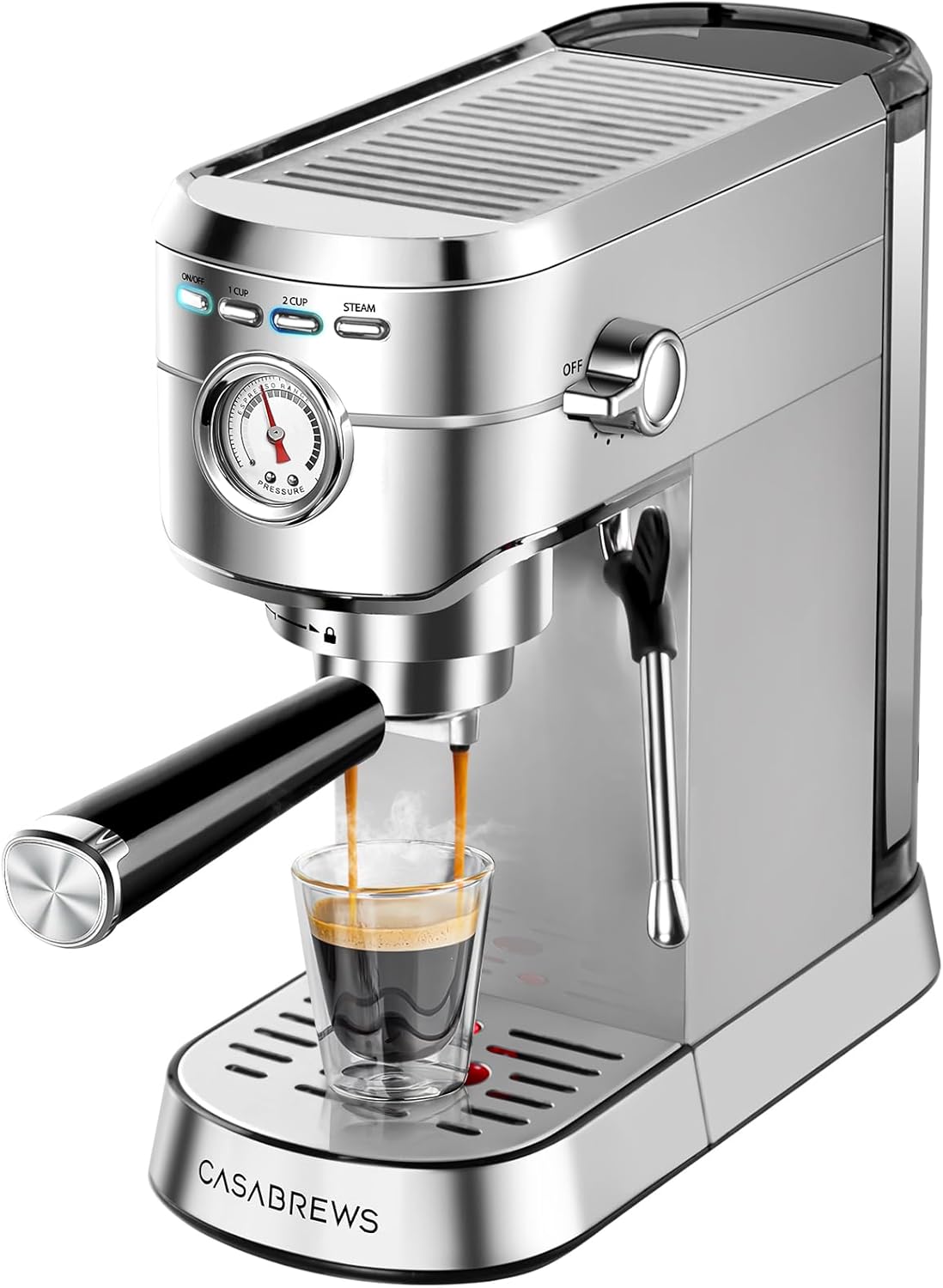
CASABREWS CM5418 Espresso Machine
| Operation Mode | Semi-Automatic |
|---|---|
| Wattage | 1350 watts |
| Voltage | 120 volts |
| Output Pressure | 20 bar |
| Coffee Input Type | ground_coffee |
The CASABREWS CM5418 is a compact, stainless steel semi-automatic espresso machine aimed at home users who want café-style drinks without a large footprint. It uses a stable 20-bar Italian pump and built-in pressure gauge to help dial in extraction, plus a low-pressure pre-infusion to smooth flavor. The removable 34 oz water tank and two cup filter baskets make it easy to brew single or double shots, and the powerful steam wand textures milk into creamy microfoam suitable for lattes and cappuccinos. Controls are button-based and straightforward, and the top cup warmer plus removable drip tray add practical touches for daily use. Expect a short warm-up time and follow the cooling guidance after steaming to avoid the machine's over-temperature protection. This model delivers strong value in its price range, though achieving consistent barista-level results requires a good grinder, proper tamping, and routine maintenance like descaling and cleaning filter baskets.
Best for: Buyers who want a compact, influencer-backed home espresso machine that offers pressure control and milk steaming capability while still being approachable for newcomers willing to learn basic barista techniques.
Less Ideal for: People who need rapid back-to-back drink production or fully automatic dosing and grinding should consider higher-end prosumer machines or integrated grinder models.
- 20-bar Italian pump with built-in pressure gauge for visual extraction feedback
- Powerful steam wand capable of producing microfoam for lattes and cappuccinos
- Compact stainless steel body with removable 34 oz water tank for easy refills
- Comes with one- and two-cup filter baskets, portafilter, and tamper for ready-to-use setup
- Single boiler design requires cooling between steaming and brewing which slows multi-drink service
- Consistent results depend on a separate quality grinder and user technique rather than automatic dosing
Verdict: If you want a compact, feature-rich home espresso machine that gives visual pressure feedback and capable milk steaming without taking much counter space, the CM5418 is a strong choice under $400.
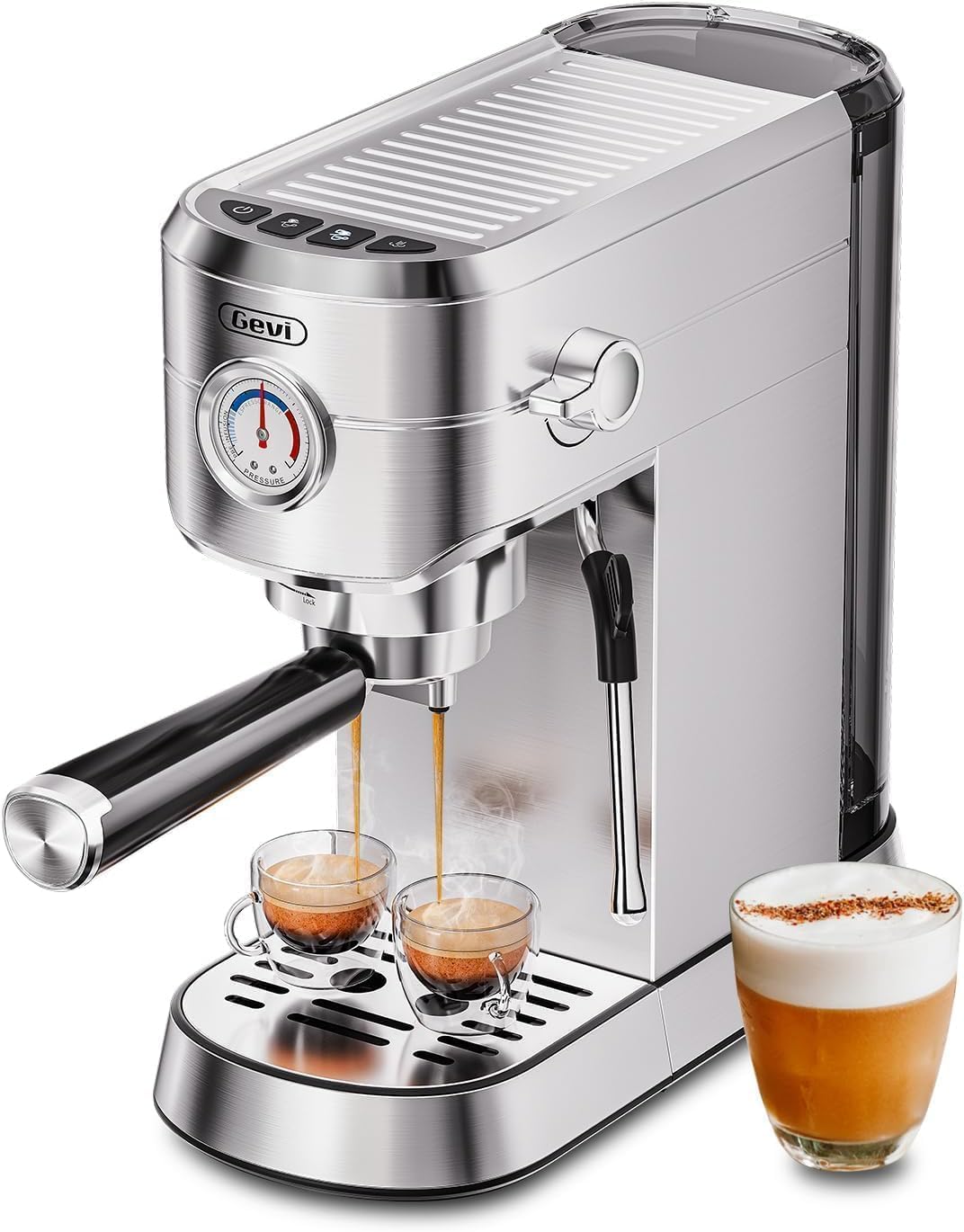
Gevi 20 Bar Espresso Machine ECMG0
| Output Pressure | 20 bar |
|---|---|
| Wattage | 1350 watts |
| Operation Mode | Semi-Automatic |
| Capacity | 1 liters |
| Power Source | AC adapter |
The Gevi 20 Bar Espresso Machine is a countertop semi-automatic espresso maker aimed at home and small-office use that combines a 20-bar pump, NTC temperature control, pre-infusion and a built-in pressure gauge to help dial in extraction. Typical use covers single or double shots from ground coffee and basic milk drinks using the steam wand or the automatic milk frother attachment; the removable 34 oz water tank and cup warmer make daily operation straightforward. Notable features include shot volume adjustment, a reusable filter, and a powerful steam wand that steams milk quickly for lattes and cappuccinos, while the stainless steel housing feels durable and wipes clean easily. Practical benefits are consistent pressure, visual feedback from the gauge for troubleshooting, and a compact footprint that fits most counters. Limitations to expect are some pump noise and vibration during extraction, manual cleaning steps for the portafilter and wand, and fewer advanced temperature controls compared with higher-end machines, so it requires basic hands-on brewing technique to get the best results.
Best for: Buyers who prioritize a sturdy, feature-rich machine that reliably produces espresso and basic milk drinks without needing pro-level skills or space, and who prefer a straightforward, factory-quality build.
Less Ideal for: Those who want a near-silent, fully automatic bean-to-cup experience or fine-grained digital temperature control for advanced dialing-in should consider higher-end or more automated models.
- 20-bar pump with pre-infusion and built-in pressure gauge for more consistent extractions
- Powerful steam wand and removable froth nozzle for quick milk texturing
- Compact stainless steel body with removable 34 oz water tank for counter-friendly placement and easy refills
- Includes portafilter, single and double baskets, tamper and cleaning tools so you can start brewing right away
- Produces noticeable pump noise and some vibration during operation
- Limited temperature adjustment compared with more expensive prosumer machines
- Portafilter and filter baskets are not dishwasher-safe and need manual cleaning
Verdict: A compact, stainless-steel semi-automatic that gives mainstream buyers factory-quality pressure control and a strong steam wand for reliably good espresso and milk drinks under $400.
Choosing the Right Espresso Machine: Key Factors to Consider
Extraction Performance
Extraction determines the flavor, body, and crema in a shot. Machines that maintain stable pressure and temperature produce more consistent results from shot to shot.
For home users on a budget, look for pressure gauges, PID temperature control, or pre-infusion features that help even out extraction. If you plan to dial in grind and dose, extraction performance will reveal those adjustments more clearly, making it easier to improve your espresso over time.
Steam Capability
A capable steam wand matters if you make milk drinks. Power and steam control affect how quickly you can texture milk and whether you can produce microfoam for lattes or cappuccinos.
Consider wand reach, tip design, and whether the machine has adequate boiler capacity or heat exchange to support back-to-back steaming. Less powerful wands are fine for occasional drinks but add time and effort for daily milk-based beverages.
Ease of Cleaning and Maintenance
Regular cleaning preserves flavor and prevents scale-related failures. Machines with removable drip trays, accessible water tanks, and easy-to-remove portafilters reduce friction for upkeep.
Also check how simple it is to perform routine tasks like backflushing, descaling, and replacing gaskets. If a machine is difficult to clean, it will underperform and require more frequent servicing over time.
User Interface and Controls
Controls shape your daily workflow. Simple, tactile dials and clear indicators help you reproduce shots reliably, while overly complex menus can slow you down.
Look for straightforward dosing options, clear steam controls, and indicators for water level or temperature readiness. For many home users, manual control with clear feedback beats a crowded digital interface.
Size and Counter Fit
Kitchen counter space and the machine footprint influence where and how you use the unit. Tall wands or large drip trays may limit placement under cabinets.
Consider water tank capacity relative to how often you want to refill, and whether the machine's height allows using taller mugs. A compact machine with good ergonomics can be more practical than a larger machine with nominally better specs.
Durability and Parts Availability
Durability affects long-term value. Machines with metal components in high-wear areas typically last longer than mostly plastic interiors.
Confirm that common wear parts like gaskets, filters, and replacement portafilters are available. Warranty length and clear service options are helpful signals of manufacturer support and repairability.
Pros and Cons of Pump Types
Most consumer espresso machines use either vibratory pumps or rotary-style pumps adapted for home units. Vibratory pumps are compact and affordable, which is why they are common in machines under $400. They provide adequate pressure for proper extraction but can be louder and deliver slightly less steady pressure than higher-end rotary systems.
Understanding the tradeoffs helps set expectations. A dependable vibratory pump paired with good temperature control will still produce excellent espresso for daily home use. Focus your decision on the combination of pump type with temperature regulation rather than pump type alone.
- Vibratory pumps: compact, cost-effective, slightly louder.
- Rotary-style pumps: smoother pressure, typically found in higher-end units.
- Match pump capability to your extraction goals rather than choosing on pump type alone.
Single Boiler Vs. Thermoblock Considerations
Many machines in the sub-$400 range use single boilers or thermoblock heating to control water temperature. Single boilers generally provide more stable brewing temperature but require a short wait between brewing and steaming. Thermoblocks heat water on demand and can speed up recovery time but sometimes lack the thermal mass for perfectly consistent shots.
If you make espresso and milk drinks in quick succession, consider a machine with faster steam recovery or a larger boiler capacity. For mostly espresso-only drinkers, a stable single-boiler setup will often deliver the most consistent flavor.
- Single boiler: better thermal stability, slower steam recovery.
- Thermoblock: quick heat-up, variable temperature consistency.
- Choose based on drink patterns: espresso-only versus milk-based routines.
Grind and Dose: Your Impact on Results
An espresso machine cannot fix a bad grind. A consistent, fine grind and correct dose are essential to achieving the crema, balance, and extraction you want. Investing time in dialing in grind size and dose often yields bigger improvements than choosing between two similar machines.
If you are on a budget, pair your machine choice with a reliable grinder or preset grinder settings. Pay attention to portafilter size and basket capacity because they dictate how easily you can change dose without over- or underfilling.
- Match basket size to your target dose for easier dialing.
- Expect to adjust grind in small steps to improve shot consistency.
- A stable machine makes grind adjustments more predictable.
Setting Up for Best Results
Placement and setup affect performance. A level surface, clean water source, and good-quality filtered water reduce scale and help maintain consistent extraction. Preheat the group head and portafilter before pulling shots to avoid temperature loss on the puck.
Also calibrate your grinder with the chosen machine and use small test shots to refine dose and tamping pressure. Routine checks of seals and group head cleanliness will keep extraction steady over time.
- Use filtered water and descale per the schedule.
- Preheat equipment to stabilize temperature.
- Test small dose adjustments when dialing in.
Milk Texturing Tips for Home Baristas
Achieving good microfoam is primarily technique plus wand capability. Begin with cold milk, purge the wand, and position the tip just below the surface to introduce air, then submerge slightly to heat without large bubbles. Practice with short steam bursts and experiment with pitcher angle.
Wand design and available steam power determine how easy it is to reach a velvety texture. If you plan to make many milk drinks, prioritize machines with a slightly stronger wand and a steam tip that supports both aeration and stretching.
- Start with cold milk and a chilled pitcher.
- Purge the wand before and after steaming.
- Work on consistent pitcher angle and tip placement.
How We Chose the Best Espresso Machine
We focused on machines that deliver repeatable espresso extraction and useful steam capability within the under $400 budget. Our evaluation filtered for build quality, consistent temperature control or stable pressure delivery, and reasonable serviceability for home use. We prioritized models with straightforward cleaning procedures and accessible water/portafilter layouts since upkeep impacts long-term satisfaction. Usability was another major factor: clear controls, reliable shot indicators, and straightforward steam wand performance matter when brewing daily. We excluded compact single-serve capsule-only units and toy-grade machines that lack a true portafilter or adequate boiler capacity. Final consideration included warranty terms and availability of replacement parts, because repairability affects lifetime cost and performance. These filters produced a list that balances shot quality, milk steaming, and ownership practicality for cooks and coffee enthusiasts working with a modest budget.
Our full evaluation process is outlined in our review methodology.
FAQ
Can you make good espresso with an under-$400 machine?
Yes, many machines in this range can produce very good espresso if paired with a consistent grind and proper dosing. Expect tradeoffs in steam power and long-term durability compared with higher-end machines.
How often should I descale an espresso machine?
Descale frequency depends on water hardness and usage. For average home use with filtered water, descaling every 3 to 6 months is common. Hard water areas may require more frequent attention.
Do budget machines need professional servicing?
Routine maintenance like replacing gaskets and cleaning the group head is typically user-serviceable. Professional servicing may be needed for pump or boiler issues, but regular upkeep reduces the likelihood of needing paid repairs.
Is a separate grinder necessary?
A separate, consistent grinder substantially improves espresso quality. Built-in or blade grinders usually do not offer the grind uniformity needed for consistent shots.
What type of milk works best for texture?
Whole milk is easiest for creating stable microfoam due to its fat and protein content. Lower-fat alternatives can still steam but may require slightly different technique to achieve the same texture.
Final Verdict
For home espresso on a modest budget, prioritize machines that deliver stable extraction and offer straightforward cleaning and maintenance. If you make milk drinks regularly, give extra weight to steam wand power and recovery time. Expect some compromises on materials and continuous heavy use, but a well-chosen machine combined with a consistent grind and disciplined routine will deliver satisfying shots. Focus on the criteria that match your daily brewing habits to pick a machine you will use and maintain confidently.