
Note: This article contains affiliate links. If you click on these links and make a purchase, we may earn a small commission at no extra cost to you. This helps support our research and content. Read our full affiliate disclosure here.
If you want café-caliber espresso at home without entering commercial pricing, choosing the right machine matters. The right espresso machine affects shot consistency, steam power for milk drinks, and day-to-day reliability. This guide presents seven carefully shortlisted espresso machines under $3,000 that suit home baristas who prioritize extraction control and lasting performance. We evaluated key operational traits like temperature stability, steam capability, and ease of maintenance so you can pick a machine that fits your workflow and beverage goals. Read on to see the top contenders and the criteria we used to judge them.
Top Picks at a Glance
| Best Overall The best all-around choice for most situations | Rancilio Silvia Pro X |  |
| Best Quality Built to a higher standard if you want something more solid | Breville Oracle Touch BES990BSS |  |
| Best Value The sweet spot between price and what you get | Ninja Luxe Café Premier ES601 |  |
| Best Budget The cheapest option that still gets the job done reliably | IMUSA Espresso Maker 4-Cup |  |
| Top Rated A top-rated pick with lots of positive feedback | Breville Barista Express BES870XL |  |
| Most Popular A crowd favorite that many people choose with confidence | Nespresso Essenza Mini EN85B |  |
| Best Seller A high-volume bestseller chosen again and again | CASABREWS CM5418 Espresso Machine |  |
Rancilio Silvia Pro X

| Operation Mode | Semi-Automatic |
|---|---|
| Wattage | 1000 watts |
| Voltage | 120 volts |
| Coffee Input Type | ground_coffee |
| Capacity | 2 liters |
The Rancilio Silvia Pro X is a cafe-style home espresso machine that pairs a 300 ml brew boiler with a 1 L steam boiler so you can pull shots and froth milk at the same time. It uses dual PID controllers and a front-facing digital display to show and let you tweak brew temperature in real time, and an adjustable low-pressure preinfusion plus a programmable shot timer helps dial in extraction. Practical touches include a 2-liter removable water tank, programmable wake-up mode, water level alerts, and a larger steam boiler for stronger steaming power than earlier Silvia models. The machine is built in stainless steel and comes with a premium portafilter and multiple baskets, tamper, and cleaning accessories. Downsides are its larger countertop footprint and fairly heavy build, and it requires some learning and hands-on adjustment to get repeatable shots like a prosumer setup. For someone who wants precise temperature control and the ability to steam and brew without waiting, this is a strong choice under $3,000.
Best for: Home buyers who prioritize precise temperature control and the ability to steam and brew simultaneously and who are willing to learn tuning to get café-quality shots.
Less Ideal for: Casual users who want a simple grab-and-go espresso maker or those with very limited countertop space should consider smaller, simpler machines.
- True dual boilers allow brewing and steaming at once for back-to-back drinks
- Dual PID temperature control with real-time display for precise temperature tuning
- Adjustable preinfusion and shot timer for better extraction control
- Removable 2 L water tank and water level alerts for easier daily use
- Includes premium portafilter and a full set of accessories for setup and maintenance
- Larger and heavier than prior Silvia models, so it takes significant counter space
- Requires manual tuning and learning to fully exploit PID and preinfusion features
Verdict: Buy this if you want a prosumer-grade home espresso machine that delivers precise PID temperature control and true dual-boiler performance for steaming and brewing at the same time.
Breville Oracle Touch BES990BSS

| Operation Mode | Fully Automatic |
|---|---|
| Wattage | 1650 watts |
| Human Interface Input | Touchscreen |
| Coffee Input Type | Ground Coffee |
| Filter Type | Reusable |
The Breville Oracle Touch automates key barista steps to deliver café-style espresso, lattes, and cappuccinos at home. It grinds, doses, tamps and extracts with an integrated conical burr grinder with 45 settings and auto dosing, while a dual boiler system gives simultaneous extraction and steam with PID temperature control for consistent shots. The touchscreen menu makes selecting and customizing drinks simple and you can save up to eight personalized recipes. The Auto MilQ steam wand textures milk automatically to produce microfoam suitable for latte art without manual steaming. Practical benefits include fast, repeatable performance, strong build quality with stainless steel construction, and a reusable filter to reduce waste. Important limitations are the machine's large footprint and weight, and its complexity means occasional maintenance and cleaning of multiple parts. The Oracle Touch is a high-performance home super-automatic aimed at users who want hands-off consistency and advanced customization in one machine.
Best for: Buyers who prioritize café-quality, repeatable espresso and milk drinks at home and want an automated machine that still offers granular customization and saved recipes.
Less Ideal for: Casual coffee drinkers who want a compact, low-maintenance machine or those who prefer manual control with a simple portafilter-only setup.
- Integrated conical burr grinder with 45 grind settings and automatic dosing for consistent extraction
- Dual boiler system with PID temperature control allows simultaneous brewing and steaming
- Touchscreen interface with customizable recipes and ability to save favorites
- Automatic steam wand textures milk into fine microfoam suitable for latte art
- Stainless steel construction and comprehensive included accessories support durability and complete setup
- Large, heavy unit that requires significant counter space
- More complex maintenance and cleaning compared with simpler machines
Verdict: For performance-focused home baristas who want automated, café-quality shots and milk texturing with customizable presets, the Oracle Touch delivers consistent, high-end results.
Ninja Luxe Café Premier ES601

| Operation Mode | Fully Automatic |
|---|---|
| Wattage | 1650 watts |
| Coffee Input Type | Ground, Whole Bean |
| Filter Type | Reusable |
The Ninja Luxe Café Premier ES601 is a guided, fully automatic 3-in-1 coffee maker that handles espresso, drip coffee, and rapid cold brew in one countertop unit. It grinds whole beans with a 25-setting conical burr grinder, uses weight-based automatic dosing and an assisted tamper to simplify consistent puck preparation, and offers a hands-free dual froth system that produces steamed milk, thin froth, thick froth, or cold foam without manual steaming. Typical use is straightforward: select a drink style, let the machine grind, dose, tamp, and pull the shot, then walk away while the steam wand self-cleans. Practical features include a large removable water reservoir, built-in accessory storage, reusable filter, and several preset drink sizes for drip and cold brew. The machine is power-hungry at 1650 watts and takes up counter space, and advanced users who prefer full manual control over pressure or tamping detail may find the guided workflow limiting. For buyers who want café-style variety and automation in one appliance, it delivers consistent, low-hassle results; for purist home baristas wanting full manual tinkering, it is less adjustable.
Best for: Buyers who want an all-in-one, low-effort home café setup that produces consistent espresso, drip, and cold-brew drinks without requiring barista skills.
Less Ideal for: Enthusiasts who prioritize complete manual control over pressure and tamping or who prefer a compact single-function machine for minimal counter space.
- Combines espresso, drip coffee, and rapid cold brew in one machine for maximum drink versatility
- Built-in conical burr grinder with 25 settings and weight-based dosing for consistent extraction
- Assisted tamper and guided Barista Assist Technology reduce setup guesswork for repeatable shots
- Hands-free dual froth system with automatic steaming and a self-cleaning steam wand simplifies milk drinks
- Large removable water reservoir and built-in accessory storage improve daily convenience
- High power draw which may limit placement near weak circuits
- Less suited to users who want fully manual control over every brewing parameter
Verdict: Choose the Ninja Luxe Café Premier ES601 if you want a single machine that reliably makes espresso, drip coffee, and cold brew with automated grinding and frothing for a low-hassle home café experience.
IMUSA Espresso Maker 4-Cup

| Capacity | 4 cups |
|---|---|
| Wattage | 800 watts |
| Operation Mode | Semi-Automatic |
| Filter Type | Permanent |
The IMUSA 4-cup espresso maker is a small, countertop semi-automatic machine designed for home use and light entertaining. It brews up to four servings of espresso into a glass carafe using 5 bar pressure and an 800-watt heater, and its steam nozzle / milk frother creates thick froth for cappuccinos and lattes. Controls are simple via a three-position selector knob, and cleanup is easier than many machines thanks to a removable drip tray and a permanent filter basket. The compact matte-plastic housing keeps the unit lightweight and counter-friendly, though the materials and single boiler design mean it is aimed at casual daily use rather than continuous cafe-level output. Practical benefits include straightforward operation, integrated frothing for milk drinks, and a small footprint that fits tight kitchens. Limitations are modest pressure and build materials compared with higher-end machines, and it lacks advanced temperature or shot-timing controls favored by experienced home baristas.
Best for: Buyers seeking an affordable, compact espresso maker that makes basic espresso and milk drinks at home without a steep learning curve.
Less Ideal for: People who want professional-level temperature control, higher pressure performance, or heavy commercial-style use should choose a more robust machine.
- Compact 4-cup capacity suitable for small households or guests
- Built-in steam nozzle produces creamy milk froth for cappuccinos and lattes
- Permanent filter and removable drip tray simplify daily cleaning
- Simple three-position selector knob makes operation straightforward
- 5 bar pressure and basic controls limit precision for advanced espresso techniques
- Plastic exterior and single-boiler design are less durable than higher-end machines
Verdict: A budget-friendly, compact espresso maker that delivers simple espresso and frothy milk drinks for everyday home use.
Breville Barista Express BES870XL

| Wattage | 1600 watts |
|---|---|
| Voltage | 120 |
| Coffee Input Type | whole_beans |
| Filter Type | Reusable |
| Capacity | 1 cups |
The Breville Barista Express BES870XL combines an integrated conical burr grinder, 54mm portafilter, and powerful steam wand to take beans to espresso in under a minute. You grind directly into the portafilter with 16 grind settings and an adjustable dose to control extraction, while the Thermocoil heating system and digital temperature control help keep brew temperature stable for balanced shots. The steam wand produces manual microfoam suited to lattes and cappuccinos, though it requires some practice to texture milk well. The machine is built from stainless steel and includes useful accessories such as a razor dose trimming tool, tamper and cleaning kit, making it straightforward to maintain. It is a manual workflow so it rewards users who want control over grind, dose and tamping rather than one‑touch convenience. The 1600W power and reusable filters mean fast heatup and lower running costs, but the single boiler design limits simultaneous steaming and brewing without a short wait between operations.
Best for: Home brewers who prioritize a reliable, hands‑on espresso workflow and want integrated grinding and temperature control to produce consistent café‑style shots and milk drinks.
Less Ideal for: If you want fully automatic one‑touch drinks or rapid commercial throughput, choose a programmable or dual‑boiler machine instead.
- Integrated conical burr grinder with 16 grind settings for fresh dose control
- Thermocoil PID temperature control for consistent extraction
- Powerful steam wand capable of producing microfoam for latte art
- Robust stainless steel construction with included cleaning and tamping accessories
- Manual operation requires learning tamping and milk‑texturing technique
- Single boiler means you cannot brew and steam at exactly the same time
Verdict: Buy this if you want a reliable, semi‑automatic home espresso machine that pairs a built‑in grinder with precise temperature control for consistent café‑quality shots.
Nespresso Essenza Mini EN85B

| Wattage | 1150 watts |
|---|---|
| Output Pressure | 19 bar |
| Coffee Input Type | Capsule |
| Compatible Coffee Pods | Nespresso Original |
| Capacity | 0.6 liters |
The Nespresso Essenza Mini is a compact capsule espresso machine aimed at users who want quick, consistent shots without a complicated setup. It runs on 1150 watts, reaches operating temperature in about 25 seconds, and extracts capsule coffee at 19 bar pressure; two programmable buttons let you choose espresso or lungo volumes. The small removable water tank and simple button interface make it easy to use and maintain on a kitchen counter or small office station, and the reusable filter supports capsule compatibility practices. The trade-offs are its limited tank capacity and compact drip tray, which mean more frequent refills and less space for taller cups or milk frothing attachments; it also lacks built-in milk frother and advanced settings for temperature or pressure profiling. For buyers focused on fast daily single-serve espresso and reliable consistency, the Essenza Mini delivers a strong, predictable cup in a very small footprint.
Best for: Buyers who prioritize a compact, fuss-free espresso solution and want predictable, cafe-style results from Nespresso Original capsules with minimal setup or learning curve.
Less Ideal for: People who want integrated milk steaming, larger water capacity, or advanced customization of extraction parameters should consider machines with built-in frothers or larger reservoirs.
- Very compact footprint for small kitchens or offices
- Fast heat-up time for near-instant brewing
- Two programmable cup sizes for consistent espresso and lungo
- 19 bar pump pressure for reliable capsule extraction
- Small water tank requires frequent refilling during heavy use
- No built-in milk frother or steam wand for milk-based drinks
Verdict: Choose the Essenza Mini when you need a tiny, reliable capsule espresso maker that delivers fast, consistent espresso and saves counter space.
CASABREWS CM5418 Espresso Machine
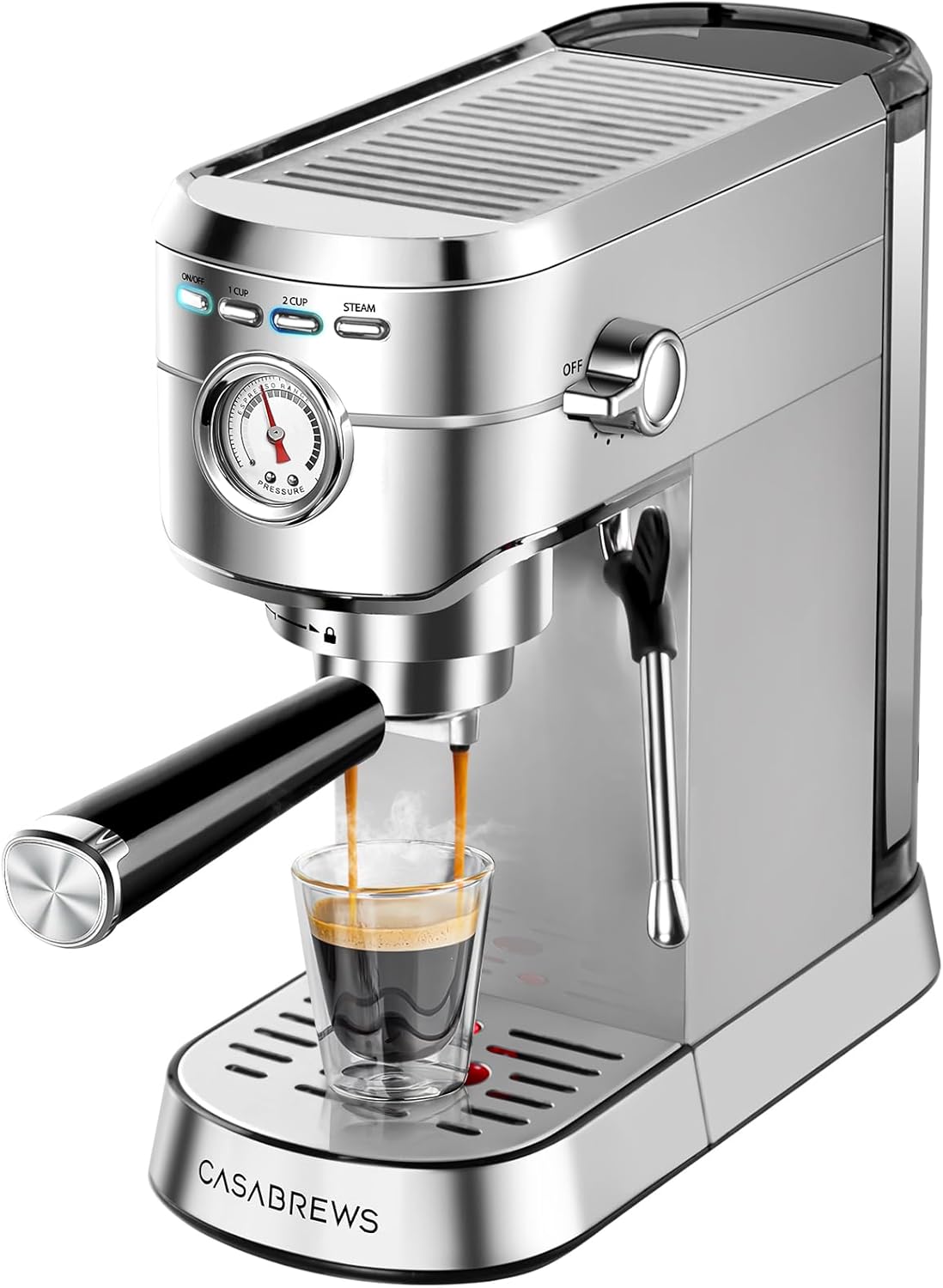
| Output Pressure | 20 bar |
|---|---|
| Operation Mode | Semi-Automatic |
| Wattage | 1350 watts |
| Coffee Input Type | ground_coffee |
| Filter Type | Reusable |
The CASABREWS CM5418 is a compact semi-automatic espresso machine aimed at home users who want café-style drinks without a large footprint. It uses a 20-bar Italian pump and pre-infusion to produce rich crema and allows single or double-shot volume control via buttons, while a built-in pressure gauge gives visual feedback to fine-tune grind and tamp. The powerful steam wand textures milk into microfoam suitable for lattes and cappuccinos, and the removable 34 oz tank holds several cups between refills. Practical touches include a cup-warming tray and a removable drip tray that accommodates taller cups for easy cleaning. Expect a short cool-down period after steaming before brewing again and occasional troubleshooting steps like running the hot-water function if over-temperature protection activates. The machine is stainless steel and reasonably finished for the price, but it is a single-boiler design so you cannot steam and pull shots simultaneously, and consistent results rely on proper grind, dosing, and routine descaling.
Best for: Home buyers who prioritize reliable, café-style espresso and want a compact, user-friendly machine that offers visual pressure feedback and milk-steaming capability without pro-level complexity.
Less Ideal for: Those who need simultaneous brewing and steaming for back-to-back drink service or professional café throughput should consider dual-boiler or heat-exchange machines instead.
- 20-bar pump with built-in pressure gauge for visible extraction control
- Pre-infusion and adjustable shot volume help improve flavor and customization
- Powerful steam wand capable of producing microfoam for latte art
- Removable 34 oz water tank and removable drip tray for easier refills and cleaning
- Compact stainless steel body with cup warmer fits small kitchens
- Single boiler design prevents steaming and brewing at the same time
- Requires attention to grind, dose, and maintenance for consistent results
Verdict: A compact, beginner-friendly semi-automatic that delivers café-style extraction and strong milk steaming for home users who want visible control without pro-level complexity.
Choosing the Right Espresso Machine: Key Factors to Consider
Temperature Stability and Boiler Design
Temperature stability affects extraction yield and consistency. Machines with robust boiler architecture or heat-exchange systems maintain stable water temperature across back-to-back shots and under steaming load. If you regularly pull multiple shots or multitask steaming and brewing, a machine with better thermal mass or an independent steam boiler reduces temperature sag.
When evaluating this factor, consider whether the machine has PID control or a dedicated steam boiler. PID controllers let you fine-tune brew water temperature and compensate for ambient changes, while larger boilers recover heat faster between uses. For home setups, balance the desire for stability with acceptable warm-up time and footprint.
Steam Power and Milk Texture
Steam capability determines how quickly you can heat milk and how easily you can create microfoam for lattes and cappuccinos. Look at boiler pressure, wand design, and steam tip options because these influence steaming speed, control, and accessibility for pitcher positioning. Machines with higher steam output and good wand ergonomics make steaming shorter and more consistent.
Also think about boiler capacity relative to how many milk drinks you plan to make in a session. Smaller boilers may require pauses between larger steamed batches, which affects service rhythm during social occasions. Ease of wiping the wand and tip access for cleaning are practical considerations that affect long-term performance.
Extraction Control and Programming
How much control the machine gives you over dosing, pre-infusion, and shot timing shapes how well you can dial in different beans. Machines with programmable dose settings, manual pre-infusion, or adjustable flow allow finer tuning of extraction. If you are experimenting with single-origin or freshly roasted beans, these controls help achieve consistent results.
Consider whether the interface is intuitive for making adjustments and if the machine supports easy changes during a session. More advanced programming is useful for experienced home baristas, while simpler dose presets can be preferable for newcomers who want repeatable results without constant tweaking.
Build Quality and Serviceability
Durable materials, solid construction, and accessible components reduce failure risk and simplify repairs. Machines built with brass or stainless-steel boilers, quality portafilters, and replaceable wear parts have longer useful lives. Serviceability matters because parts wear over time; machines with straightforward access to the pump, valves, and group components are easier and less costly to maintain.
Check whether common wear parts are user-replaceable and whether the machine's design allows routine service tasks like descaling, gasket replacement, and group head cleaning without specialized tools. A machine that is easier to service will stay in good working order longer.
Daily Convenience and Footprint
Practical daily factors affect whether a machine fits your counter and your routine. Consider the physical footprint, water reservoir or plumb-in options, drip tray size, and how easy it is to fill and clean the machine. A compact machine with an accessible tank is better for small kitchens, while a plumbable machine suits a dedicated coffee station.
Also evaluate how intuitive the controls are for everyday use. Features like quick heat-up, easy-access water tanks, and straightforward cleaning cycles reduce friction and make consistent brewing easier for nontechnical users.
Home Setup: Counter Space and Plumbing
Plan where the machine will live before you buy. Measure counter depth and height to ensure the machine and steam pitcher fit comfortably under cabinets. Think about clearance for lifting the portafilter and for maneuvering milk pitchers during steaming.
Decide whether you need a plumb-in option or a removable reservoir. A plumbed-in machine removes the chore of refilling during frequent use but requires a water line and installation space. For most home users, an accessible reservoir provides flexibility and easier maintenance.
- Measure footprint and clearance for steam pitchers
- Check reservoir access and fill direction
- Consider plumb-in only if you routinely make many drinks
Beans, Grinder Pairing, and Dose Consistency
The espresso machine is only one part of the chain. A consistent grinder and stable dose are essential to realize a machine's potential. Match a machine that offers extraction control with a grinder capable of fine, repeatable adjustment.
Pay attention to the portafilter size and whether it matches common basket sizes. Some machines perform better with specific dose ranges. A grinder that allows small, precise step adjustments simplifies dialing in extraction and reduces wasted coffee.
- Aim for a grinder that can produce a fine, even grind
- Confirm portafilter diameter and basket compatibility
- Use consistent dosing practices to speed dialing in
Routine Maintenance and Cleaning
Regular cleaning keeps performance reliable and flavors clean. Backflushing, descaling based on water hardness, and daily wand purging are minimal maintenance tasks that protect performance. Machines that offer easy access for these tasks reduce the chance of skipped maintenance.
Establish a maintenance schedule that matches your usage. Heavy daily use requires more frequent descaling checks and part inspection than occasional weekend-only use.
- Backflush with detergent at manufacturer-recommended intervals
- Purge and wipe the steam wand after every milk use
- Descale as needed based on local water hardness
Noise, Heat, and Placement Considerations
Espresso machines produce heat and noise; consider how these factors affect placement. If the machine will sit near living spaces or a home office, look for models with lower pump noise and moderate heat exhaust.
Allow for ventilation around the machine to keep internal components cooler and to prevent heat buildup in tight cabinetry. Machines with metal casings and good airflow resist overheating during frequent use.
- Provide clearance for ventilation
- Expect moderate pump noise during extraction and steaming
- Avoid enclosed cabinetry without ventilation
Accessory Choices That Improve Results
A few well-chosen accessories raise consistency and ease. A quality tamper sized for the portafilter, a reliable dosing scale, and a steam thermometer for training your wrist on temperature targets all deliver faster improvements than chasing machine specs alone.
Consider a dedicated cleaning kit and spare gaskets or screens if you plan heavy use. Useful accessories are small investments that keep the machine operating smoothly and speed up maintenance.
- Use a properly sized tamper for even puck compression
- A scale helps dial in dose and yield precisely
- Keep cleaning brushes and backflush detergent on hand
How We Chose the Best Espresso Machine
We focused on criteria that actually affect at-home espresso quality and daily usability. First, we prioritized temperature stability and boiler/thermal system design because consistent extraction depends on precise water temperature and recovery between shots. Second, steam power and boiler capacity were weighted heavily for anyone making milk-based drinks; adequate steam pressure and wand ergonomics determine texture and speed. Third, build quality and serviceability were considered to ensure machines stay dependable over years of regular use. Fourth, dosing and extraction control options—such as programmable dosing, PID control, and pre-infusion—were evaluated because they shape how repeatable shots are for different beans. Finally, user experience factors like reservoir/tank access, portafilter ergonomics, and maintenance simplicity influenced selections. We excluded prosumer or commercial machines whose footprint and plumbing needs exceed typical home setups, and we did not include lower-end consumer machines that lack basic temperature or steam control. The shortlist reflects products that balance home-appropriate size and plumbing with the technical features that drive espresso quality and user satisfaction.
Our full evaluation process is outlined in our review methodology.
FAQ
How important is a PID controller for home espresso?
PID control improves temperature accuracy and repeatability, which benefits extraction consistency. For home baristas who dial in shots regularly, a PID can make dialing easier. For casual users, stable factory temperature control may be adequate.
Can I use a machine under $3,000 for multiple milk drinks in a row?
Many machines in this price range can steam multiple milk drinks consecutively, but boiler capacity and steam power determine how quickly. If you host frequently, prioritize stronger steam performance and larger boiler capacity.
Is it worth plumbing a home machine into the water line?
Plumbing in removes the need to refill a reservoir and is convenient for heavy use. However, it adds installation complexity and requires filtration. For occasional users, a refillable reservoir is simpler and more flexible.
How often should I descale and backflush my machine?
Descale frequency depends on local water hardness and usage, ranging from every few months to yearly with filtered water. Backflushing with detergent is recommended regularly for machines with a three-way valve, often every one to four weeks depending on use.
Will a larger boiler make shots taste better?
A larger boiler mainly improves temperature stability and recovery, which supports more consistent shots under load. It does not directly change flavor, but it reduces temperature fluctuation that can cause extraction variability.
Final Verdict
Prioritize temperature stability and steam performance when choosing an espresso machine under $3,000. Those two factors most directly affect the quality and consistency of shots and milk-based drinks in a home setting. Balance extraction control features against daily convenience items like reservoir access, footprint, and ease of maintenance to match your routine. Decide whether you need the extra steam capacity of a dual-boiler design or whether a heat-exchange or PID-equipped single boiler suits your workflow. With clear priorities around stability, steam, and serviceability, you can confidently pick a machine that delivers café-quality results at home.