
Note: This article contains affiliate links. If you click on these links and make a purchase, we may earn a small commission at no extra cost to you. This helps support our research and content. Read our full affiliate disclosure here.
If you want cafe-style espresso at home without spending a small fortune, the right machine makes all the difference. A well-chosen espresso machine under $500 can produce rich shots, steady steam for milk, and reliable performance for daily use while fitting limited kitchen budgets and space. This guide shortlists seven machines that balance extraction consistency, frothing capability, and maintainability. We evaluated options by how they perform in real-world home routines and how easy they are to keep running. Read on to see the top picks and which features matter most for your setup.
Top Picks at a Glance
| Best Overall The best all-around choice for most situations | Breville Bambino Plus BES500BSS |  |
| Best Quality Built to a higher standard if you want something more solid | Breville Barista Express BES870XL |  |
| Best Value The sweet spot between price and what you get | De'Longhi Dedica EC680M |  |
| Best Budget The cheapest option that still gets the job done reliably | Imusa 4-Cup Espresso Maker |  |
| Top Rated A top-rated pick with lots of positive feedback | Gaggia Classic Evo Pro RI9380/46 |  |
| Most Popular A crowd favorite that many people choose with confidence | CASABREWS CM5418 Espresso Machine |  |
| Best Seller A high-volume bestseller chosen again and again | Gevi 20-Bar Espresso Machine ECMG0 | 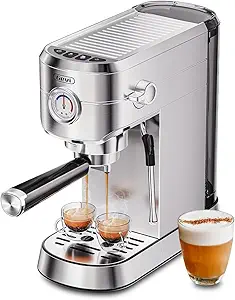 |
Breville Bambino Plus BES500BSS

| Operation Mode | Semi-Automatic |
|---|---|
| Wattage | 1560 watts |
| Coffee Input Type | ground coffee |
| Filter Type | Reusable |
The Breville Bambino Plus is a compact semi-automatic espresso machine designed to deliver café-style espresso and consistent milk drinks in a small footprint. It uses a ThermoJet heating system with PID temperature control and low-pressure pre-infusion followed by a 9-bar extraction to produce balanced, full-bodied shots quickly. The automatic steam wand textures milk to barista-level microfoam with adjustable temperature and texture settings, which makes latte and cappuccino preparation fast and repeatable without manual steaming skill. A 54mm portafilter and dual/single-wall filters let you dose up to 18g of grounds for fuller flavor, and one-touch buttons support single or double shots for everyday convenience. Practical downsides are that it is a semi-automatic unit that still requires grinding and dosing separately and the compact design limits water reservoir and serviceability compared with larger prosumer machines. For buyers wanting cafe-quality drinks at home without needing a large countertop appliance, the Bambino Plus strikes a strong balance between performance and size.
Best for: Buyers who want near-café espresso and reliable milk-based drinks from a compact, easy-to-use machine without upgrading to a full prosumer system.
Less Ideal for: Those who want an all-in-one bean-to-cup machine with built-in grinder or users who need a heavy-duty commercial-level machine for high-volume service.
- Fast ThermoJet heating with PID for quick warm-up and stable extraction temperature
- Automatic steam wand that textures milk to microfoam for latte art without manual skill
- 54mm portafilter and dual/single-wall filters support fuller shots using 18g dosing
- Compact footprint that fits small kitchens while still producing café-style drinks
- Requires separate grinder and manual dosing since it is semi-automatic
- Smaller reservoir and compact internals can mean more frequent refills and less serviceability
Verdict: If you want fast, café-quality espresso and repeatable milk texturing in a compact machine under $500, the Bambino Plus delivers.
Breville Barista Express BES870XL

| Wattage | 1600 watts |
|---|---|
| Power Source | AC adapter |
| Coffee Input Type | whole bean |
| Capacity | 4.2 pounds |
| Water Tank Capacity | 67 fl.oz (2L) |
The Breville Barista Express BES870XL combines a built-in conical burr grinder, 54mm portafilter, and thermocoil heating into a single countertop unit aimed at home baristas who want control over the espresso process. You grind beans on demand with 16 grind settings and dose directly into the portafilter using the adjustable grind amount or manual override, which speeds the workflow and reduces stale grounds. PID temperature control and a low‑pressure preinfusion step help extract balanced shots, and the powerful steam wand produces microfoam suitable for latte art. Included accessories like single and dual wall baskets, an integrated tamper, and a removable 67 oz water tank make setup and daily use straightforward. Limitations are that it is a manual workflow requiring some skill to dial in grind and tamp for consistent results, and remanufactured units may show minor cosmetic wear compared with new machines. For buyers focused on shot quality and hands‑on control, it delivers features often found on higher‑end machines in a package that fits most kitchens.
Best for: Buyers who prioritize shot quality and control and want an all‑in‑one machine that lets them learn and refine espresso technique at home.
Less Ideal for: If you want fully automatic, hands‑off brewing or the absolute newest factory‑fresh cosmetic condition, consider a superautomatic or a new-unit alternative instead.
- Integrated conical burr grinder with 16 grind settings for fresh on‑demand grinding
- PID temperature control and low‑pressure preinfusion for more consistent extraction
- Powerful steam wand that textures milk into silky microfoam for latte art
- Includes full accessory kit (54mm portafilter, tamper, filter baskets, water filter) for immediate use
- Manual operation requires time and practice to consistently dial in shots
- Remanufactured condition may include minor cosmetic wear
Verdict: A feature-packed semi‑automatic espresso machine that brings near‑professional shot control and fresh grinding into a home kitchen for buyers who want to learn barista skills.
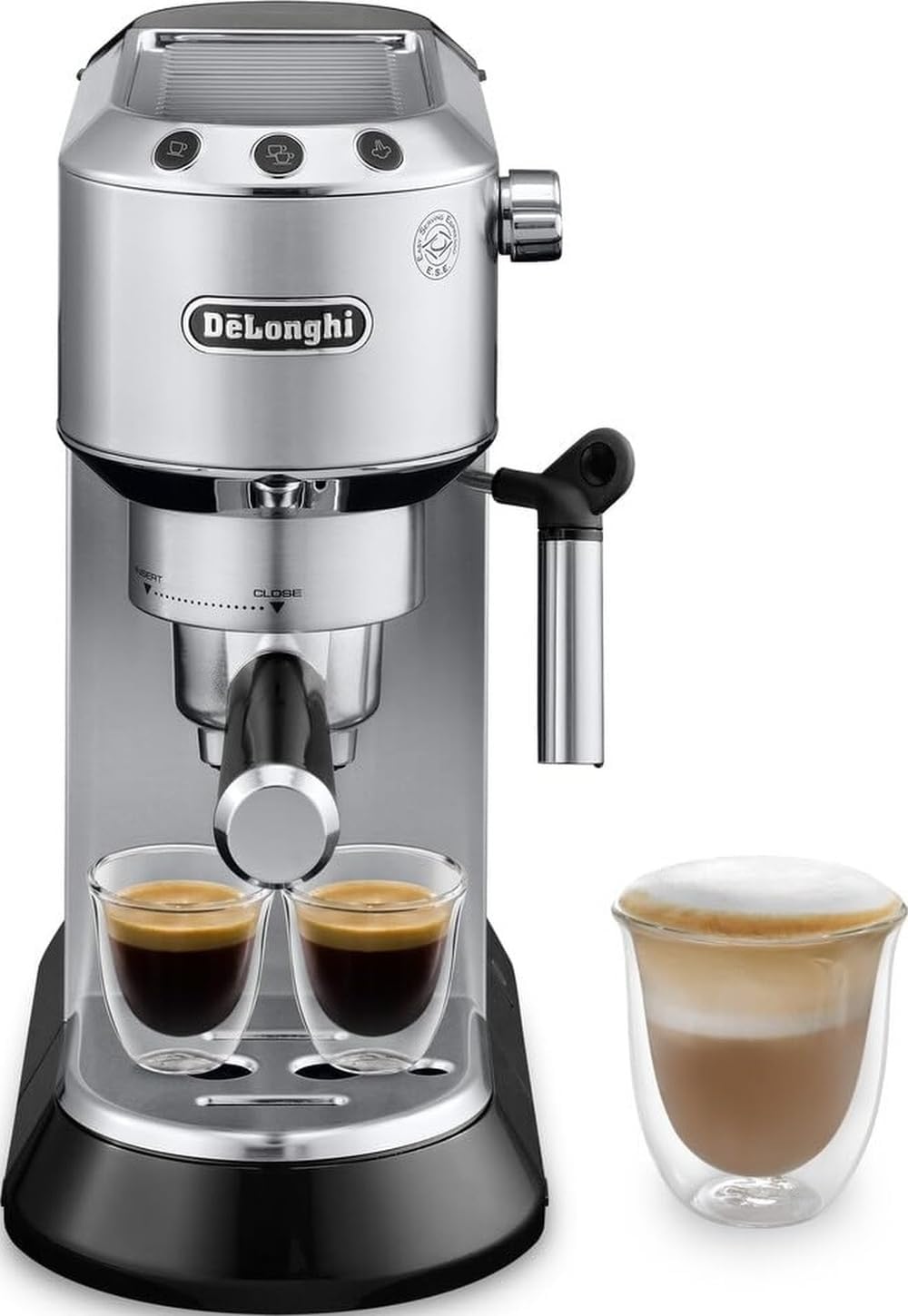
De'Longhi Dedica EC680M
| Output Pressure | 15 bar |
|---|---|
| Wattage | 1450 watts |
| Capacity | 1 liters |
| Coffee Input Type | ground, pod |
| Filter Type | Reusable |
The De'Longhi Dedica EC680M is a space-saving manual espresso machine aimed at home users who want control over extraction without a large footprint. It uses a 15-bar pump and thermoblock heating to reach brewing temperature in about 40 seconds and accepts ground coffee or ESE pods with a 3-in-1 filter holder for single, double, or pod servings. The adjustable drip tray lets you fit taller cups and the manual steam wand produces rich milk froth for cappuccinos and lattes, while removable tank and drip tray components make cleanup straightforward. Practical features include illuminated controls, a reusable filter, and included tamper/scoop so you can start brewing right away. Limits to expect are that it is a manual machine so achieving consistent shots requires some learning, and the steam wand is not automatic so frothing technique affects results. For buyers focused on compact size and hands-on espresso, the Dedica balances performance and counter-friendly design effectively.
Best for: Buyers who want a compact, no-frills espresso machine that delivers café-style drinks with hands-on control and minimal counter impact.
Less Ideal for: People who want fully automatic one-touch brewing and frothing or those who prefer a machine that guarantees perfectly consistent shots without learning technique.
- Very compact 6-inch-wide design saves counter space
- Thermoblock heats up quickly so the machine is ready in about 40 seconds
- Accepts ground coffee and ESE pods with a 3-in-1 filter holder
- Manual steam wand produces rich, textured milk foam for cappuccinos
- Removable water tank and drip tray make cleaning and maintenance easy
- Manual operation requires practice to pull consistent shots
- Steam wand is not automatic so frothing takes hands-on effort
Verdict: If you need a true compact manual espresso machine under $500 that heats fast and makes real milk-based drinks, the Dedica EC680M is a practical, space-saving choice.
Imusa 4-Cup Espresso Maker

| Capacity | 4 cups |
|---|---|
| Wattage | 800 watts |
| Operation Mode | Semi-Automatic |
| Filter Type | Permanent |
The Imusa 4-Cup Espresso Maker is a compact countertop machine that brews small-batch espresso and adds steamed milk foam for cappuccinos and lattes. It uses a 3-position selector and claims 5 bar pressure to extract espresso into a glass carafe while a steam nozzle froths milk for creamy foam. Practical touches include a removable drip tray, permanent filter basket and a cool-touch carafe handle for safer pouring and easier cleanup. At 800 watts it reaches brew and steam temperatures quickly, and the matte black plastic housing keeps the unit lightweight and easy to move. Expectations should be tempered: the 5 bar pressure is lower than commercial machines, so extraction and crema will be modest compared with higher-pressure or pump-driven units, and the plastic construction limits longevity under heavy daily use. For its size and price it delivers café-style drinks at home with minimal counter space and simple controls, making it a sensible option for casual espresso and milk-based drinks without a steep learning curve.
Best for: Buyers seeking an affordable, compact espresso machine that makes espresso and simple milk drinks at home without complicated controls or large footprint.
Less Ideal for: Serious espresso enthusiasts who want commercial-style pressure, advanced temperature control, or heavy daily use should consider higher-end pump machines instead.
- Brews up to four servings—good for small households or entertaining a few guests
- Built-in steam nozzle produces milk froth for cappuccinos and lattes
- Permanent filter and removable drip tray simplify cleanup
- Compact, lightweight design fits small countertops and is easy to store
- 5 bar pressure is lower than pump-driven machines, so crema and extraction are limited
- Plastic exterior may feel less durable than metal-bodied models
Verdict: A budget-friendly, compact espresso maker that reliably produces small batches and frothy milk drinks for casual home use.
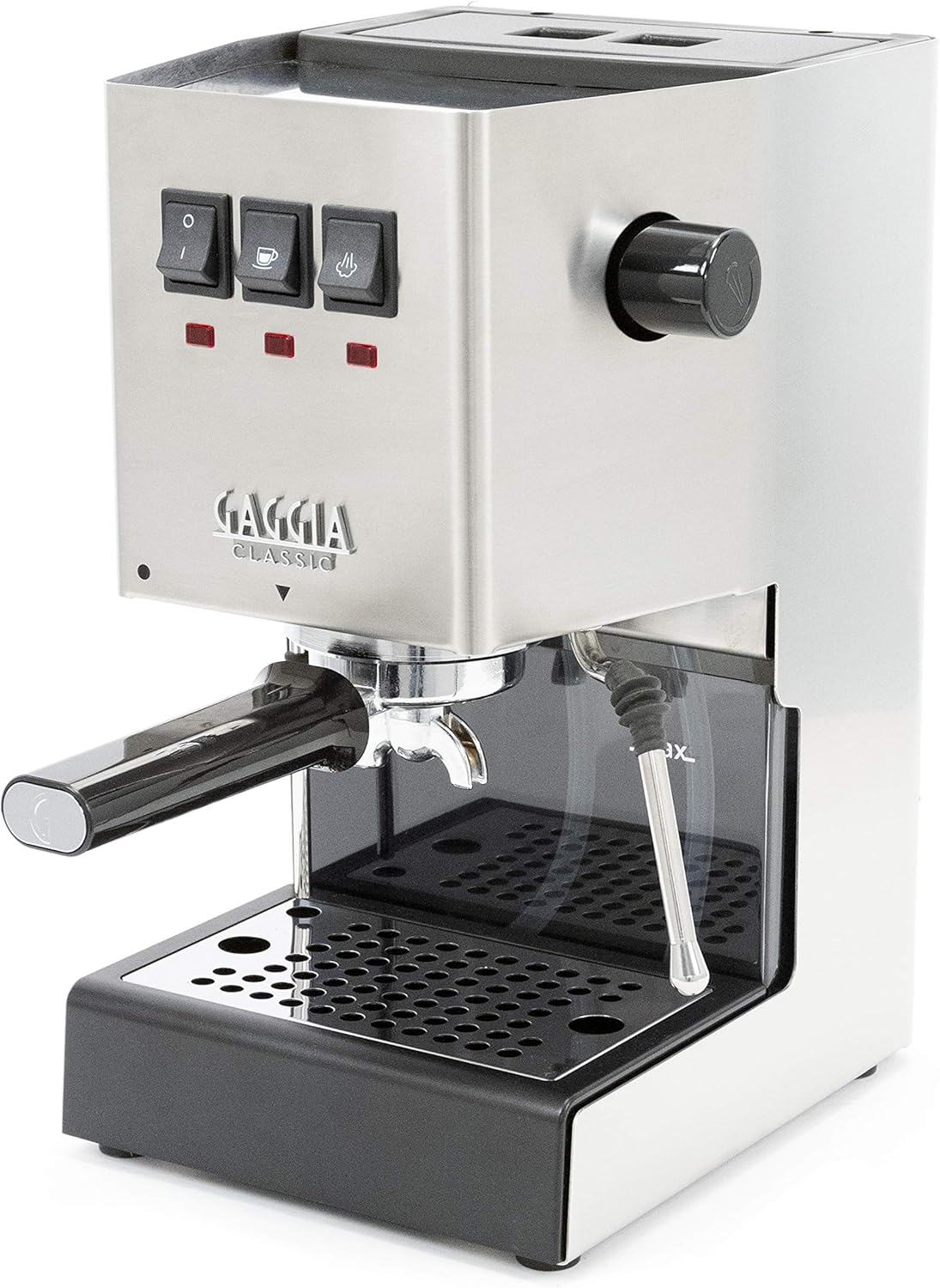
Gaggia Classic Evo Pro RI9380/46
| Operation Mode | Semi-Automatic |
|---|---|
| Output Pressure | 9 bar |
| Wattage | 1200 watts |
| Coffee Input Type | ground, pod |
| Capacity | 2.1 liters |
The Gaggia Classic Evo Pro is a prosumer semi-automatic espresso machine designed to deliver café-quality shots at home. It uses a 9-bar pump and a commercial 58 mm stainless steel portafilter with single and double baskets, plus a pressurized basket for convenience with preground coffee or ESE pods. A commercial steam wand provides strong steaming power for textured microfoam and latte art, and the stainless steel housing and brass components aim for long-term durability. Practical updates include quieter pump mounting and a boiler revised to resist scale and corrosion, which helps reliability for regular use. The 2.1 liter reservoir and reusable filter make it suitable for daily brewing and entertaining, though it requires some learning and routine maintenance like descaling and dosing to get the best shots. Size and weight mean it is not the most compact option, and it lacks automatic temperature profiling or integrated grinders, so plan on buying a separate grinder for consistent results.
Best for: Buyers who prioritize a reliable, build-quality machine that will deliver consistent café-style shots and robust steaming for milk-based drinks and who are comfortable with hands-on setup and maintenance.
Less Ideal for: People who want a compact, fully automatic machine with an integrated grinder or those seeking a zero-maintenance plug-and-play espresso solution.
- Commercial 58 mm portafilter and multiple baskets for authentic shots
- 9-bar pump delivers café-style extraction pressure
- Commercial steam wand for strong milk texturing and latte art
- Stainless steel housing and brass components intended for long-term durability
- Updated boiler and pump mounting to reduce noise and resist scale build-up
- No built-in grinder so a separate grinder is needed for best espresso
- Relatively heavy and large compared with compact home machines
- Requires hands-on maintenance and tuning to achieve optimal shots
Verdict: A durable, commercial-component semi-automatic that gives reliable café-quality shots and powerful steaming for home baristas focused on long-term performance.
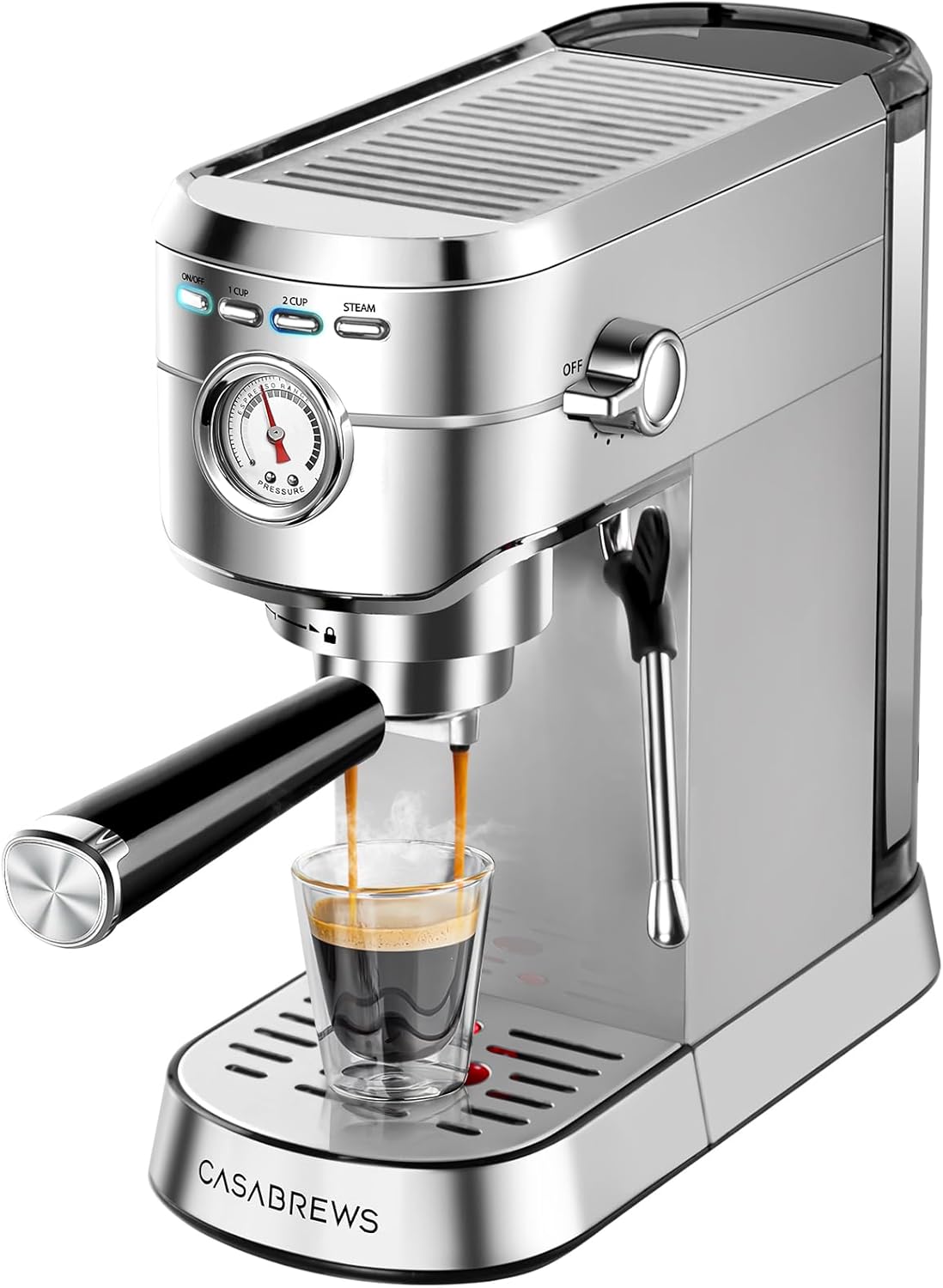
CASABREWS CM5418 Espresso Machine
| Operation Mode | Semi-Automatic |
|---|---|
| Wattage | 1350 watts |
| Output Pressure | 20 bar |
| Coffee Input Type | ground_coffee |
| Filter Type | Reusable |
The CASABREWS CM5418 is a compact semi-automatic espresso maker aimed at home baristas who want café-style drinks without a large machine. It uses a 20-bar Italian pump with a built-in pressure gauge and a pre-infusion stage to help produce fuller crema and more consistent extractions, while buttons let you select single or double volumes. The stainless steel steam wand textures milk into microfoam suitable for lattes and cappuccinos, and the 34 oz removable water tank lets you brew several cups before refilling. The machine warms cups on the top tray and has a removable drip tray to accommodate taller mugs. Practical benefits include visual pressure feedback to tune grind and tamp, a reusable filter, and relatively fast warm-up times for shots and steam. Limitations to note are the single boiler design, which requires short cool-down cycles after steaming before brewing, and that consistent results depend on using properly ground coffee and correct tamping; novices may need some trial and error. For its size and feature set it delivers café-style capability in a small footprint.
Best for: Buyers who want a compact, café-capable espresso machine that offers pressure feedback and a steam wand for milk drinks and who value social proof and tested features when choosing a reliable home unit.
Less Ideal for: People who need rapid consecutive drinks for a large household or those who want a fully automatic, push-button brewing experience with little setup or technique.
- 20-bar Italian pump with built-in pressure gauge for visual extraction feedback
- Powerful steam wand that produces creamy microfoam for latte and cappuccino
- Compact stainless steel body with removable 34 oz water tank for easy refills
- Reusable filter and included portafilter/tamper let you use ground coffee immediately
- Single boiler requires cooling between steaming and brewing, slowing back-to-back drinks
- Consistent shots require careful grinding and tamping, so beginners will have a learning curve
Verdict: A compact, feature-rich semi-automatic machine that gives home baristas pressure control and a strong steam wand for café-style espresso drinks under $500.
Gevi 20-Bar Espresso Machine ECMG0
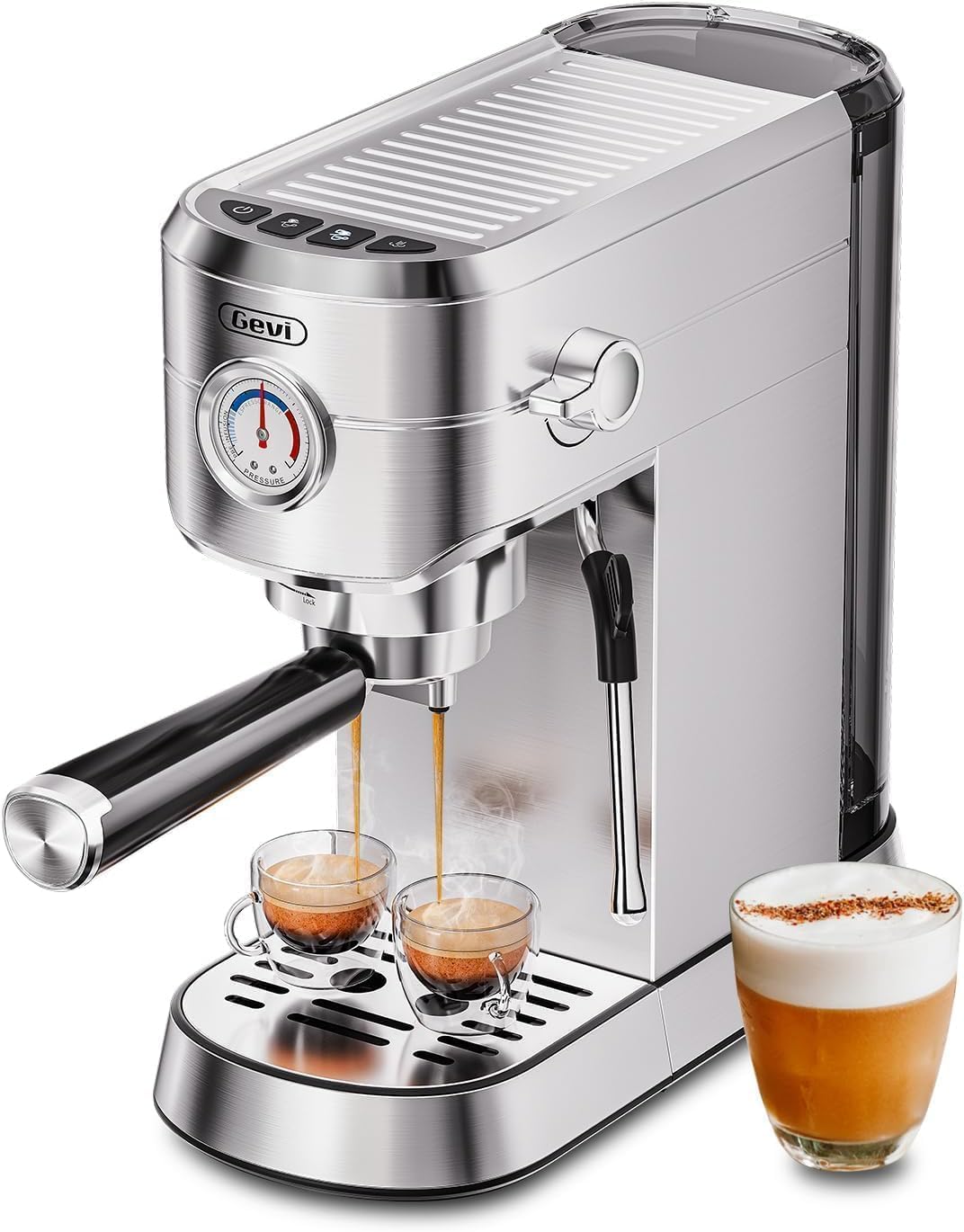
| Output Pressure | 20 bar |
|---|---|
| Wattage | 1350 watts |
| Power Source | AC adapter |
| Coffee Input Type | ground_coffee |
| Filter Type | Reusable |
The Gevi ECMG0 is a compact stainless steel semi-automatic espresso machine designed for home use that brings several café-style controls into a small footprint. It uses a 20-bar pump, NTC temperature control, and a pre-infusion function to help stabilize extraction, and the built-in pressure gauge and adjustable shot volume let you dial in shots without extra tools. Daily use looks like filling the removable 34 oz tank, tamping ground coffee into the provided 51 mm portafilter, and choosing single or double baskets for espresso or americano; the hot water function also lets you make americanos or preheat cups. The steam wand produces strong steam and the removable froth nozzle makes cleaning easier, although the machine can vibrate and is a bit noisy under load. It is sturdy with stainless steel housing and includes useful accessories like a tamper and cleaning pin, but some parts are not dishwasher-safe and careful cleaning of the wand is required. For buyers wanting more automation or integrated grinders, this is a hands-on option rather than a push-button bean-to-cup solution.
Best for: Buyers who prioritize a compact, durable machine that offers manual control over extraction and steaming and want reliable, repeatable shots without professional-level complexity.
Less Ideal for: People who want a quiet, fully automatic bean-to-cup machine or an integrated grinder and those who prefer near-zero maintenance convenience.
- 20-bar pump with NTC temperature control and pre-infusion for more consistent extraction.
- Built-in pressure gauge and adjustable shot volume for on-the-fly dialing of espresso shots.
- Powerful steam wand with removable froth nozzle for effective milk texturing and easier cleaning.
- Removable 34 oz water tank and stainless steel body suited to countertop use and durability.
- Includes key accessories: 51 mm portafilter with single and double baskets, tamper, spoon, and cleaning pin.
- Produces noticeable vibration and noise during operation due to the high-pressure pump.
- Some metal parts and filter baskets are not dishwasher-safe and require manual cleaning.
- No built-in grinder, so users must supply a separate grinder for best results.
Verdict: A compact, stainless-steel semi-automatic that delivers café-style control and strong steaming performance for buyers seeking manual dialing under $500.
Choosing the Right Espresso Machine: Key Factors to Consider
Extraction Consistency
Extraction consistency determines how reliably an espresso machine produces similar shots from one pull to the next. Stable boiler or thermoblock temperature, a steady pump pressure profile, and a well-designed portafilter all reduce shot-to-shot variation. For home users that rely on a consistent morning routine, machines that hold temperature and pressure steady matter more than flashy extras. Consistency reduces wasted coffee and helps you dial in grind size and dose once rather than constantly chasing different results.
Steam Power and Milk Texturing
Steam performance affects the quality of milk drinks from lattes to microfoam for latte art. Higher steam pressure and a well-shaped steam wand let you stretch and whirl milk to create silky microfoam quickly. For many homes, a machine that can deliver strong, controllable steam shortens prep time and improves results with milk-based drinks. Consider also wand reach and tip design, since ergonomics influence how easy it is to position the milk pitcher and maintain consistent technique.
Ease of Cleaning and Maintenance
How easy a machine is to clean determines how often owners will actually perform routine care. Accessible water reservoirs, removable drip trays, and simple access to group heads and portafilters make daily wipe-downs and backflush cycles practical. Descaling frequency and how straightforward that process is should factor into ownership cost and time. Machines that are straightforward to maintain tend to have longer useful lifespans and fewer service issues.
Size, Footprint, and Water Capacity
Counter space is often limited, so physical size and water reservoir capacity are key practical considerations. A compact machine with a smaller reservoir might be fine for a single person or occasional use, while a larger tank reduces refill frequency for multi-person households. Also think about clearance for tall cups or pitchers when steaming. Balance footprint against the machine's capabilities to ensure it fits both your kitchen and your daily workflow.
Controls and User Interface
The control layout influences how quickly you can produce a shot and how precise adjustments can be. Manual switches and single-lever operation offer tactile simplicity and fast access, while machines with programmable dosing let you store preferred shot volumes. Consider whether you prefer a straightforward mechanical workflow or programmable features that reduce manual timing. Intuitive controls shorten the learning curve for new home baristas.
Accessories and Compatibility
Accessory compatibility impacts the utility and upgrade path of your machine. Look for standard-sized portafilters and common thread sizes for tampers and milk pitchers. Machines that work with third-party burr grinders, tampers, and shot glasses make it easier to improve performance over time. Consider whether included accessories meet your needs or whether you will need to invest in a better tamper or grinder to get consistent results.
Why Under $500 Is a Practical Threshold
Setting a $500 cap targets machines that provide a meaningful step up from entry-level single-serve devices while keeping the total outlay reasonable for most home users. At this price you can typically expect a real pump-driven machine with a pressurized or non-pressurized portafilter, a steam wand, and durable exterior components.
This price range forces realistic tradeoffs: you may not get a commercial-grade heat-exchange boiler or dual boilers, but you can find units that balance temperature stability and steam power well enough for daily milk drinks. For buyers prioritizing reliable shots and milk texturing for home use, the under $500 group hits the sweet spot between capability and value.
- Includes pump-driven espresso machines with steam wands
- Focuses on long-term usability rather than premium bells and whistles
- Targets practical features that matter for daily home use
Home Setup Tips for Better Shots
A consistent grinder and dose are as important as the machine itself. Even the best sub-$500 machines need a stable grind and consistent tamp to reach their potential. Invest time in dialing grind size and dose, and use a small kitchen scale for repeatable dosing.
Water quality matters. Hard water accelerates scale buildup and affects taste. Use filtered water or a water softening cartridge if your area has hard water. Regular backflushing and descaling based on manufacturer guidance will keep extraction consistent.
- Use a burr grinder and adjust grind in small steps
- Weigh doses to within a gram or two for repeatability
- Flush the steam wand immediately after texturing milk
Milk Techniques Without a Barista Background
Start with cold milk and a clean pitcher. Introduce the steam wand tip just below the milk surface to incorporate air, then lower the pitcher slightly to heat and create microfoam. Practice with short bursts until you feel confident; technique improves quickly with a few sessions.
If you do not plan to steam often, consider practicing with smaller batches so milk does not go to waste. Also check for wand articulation and reach when evaluating machines, since easier positioning shortens the learning curve.
- Begin texturing with tip near surface for 2–3 seconds to add air
- Swirl the pitcher to integrate foam and eliminate large bubbles
- Wipe and purge the wand after each use to avoid milk buildup
Routine Care Schedule
Daily care should include wiping the group head and portafilter, rinsing the basket, and purging the steam wand after each use. These simple habits prevent residue buildup and off-flavors.
Weekly tasks typically include backflushing with a detergent designed for espresso machines if the unit supports it, and removing the drip tray and water tank for cleaning. Follow the machine's recommended descaling interval based on your water hardness, but expect to descale a few times per year in hard-water areas.
- Daily: wipe, purge, and rinse portafilter
- Weekly: remove trays and backflush if applicable
- Periodic: descale based on water hardness and usage
When to Prioritize Steam Over Automation
If you mostly drink milk-based beverages, prioritize steam power and wand control over programmable shot counts. Stronger steam and a responsive wand materially improve texture and speed, and they let you create better microfoam even with modest equipment.
Conversely, if you want very repeatable straight shots with minimal technique, machines with programmable dosing can help, but be aware that steamliness may be compromised at this price point. Decide whether your typical drinks are lattes and cappuccinos or espresso-forward beverages and choose accordingly.
- Milk-focused drinkers should test wand power and tip design
- Automation helps beginners achieve repeatable shot volume
- Balance features based on your habitual drink preferences
How We Chose the Best Espresso Machine
We focused on machines that deliver a strong combination of extraction quality, steam capability, and long-term reliability within the under $500 price constraint. Our evaluation prioritized concrete, measurable characteristics that matter to home baristas: consistent shot extraction and temperature stability; steam pressure and frothing control; ease of cleaning and frequency of routine maintenance; build quality and component durability; and available accessory compatibility for routine tamping and dosing. To assemble the shortlist we filtered out machines that lacked a traditional 15–19 bar pump configuration or that offered no steam or cappuccino capability, since the goal is full espresso workflow at home. We also excluded units with poor serviceability or with nonstandard maintenance intervals that make long-term ownership impractical. The final selection balances shot performance, milk-texturing capability, and daily usability, with extra weight given to machines that are straightforward to descale, access for cleaning, and integrate with common portafilter and tamper accessories.
Our full evaluation process is outlined in our review methodology.
FAQ
Can I get cafe-quality espresso from a machine under $500?
You can achieve very good home espresso with a machine under $500, especially if you pair it with a consistent grinder and proper technique. Expect solid crema and flavorful shots, though extreme consistency and commercial-level steam may require higher-end equipment.
How often should I descale an espresso machine under $500?
Descaling frequency depends on water hardness and usage. In hard-water areas you may need to descale every 2 to 3 months; in softer-water areas, every 6 months is common. Regular visual checks and following the manufacturer's guidance will help you decide.
Do cheaper machines require special parts or service?
Many home machines use standard components, but serviceability varies. Look for models with accessible water tanks, removable drip trays, and user-serviceable components. Avoid units with sealed assemblies if you want easier long-term maintenance.
Is a built-in grinder necessary with an under-$500 machine?
A built-in grinder can be convenient, but standalone burr grinders generally offer better control and consistency for the same money. If your budget allows only one upgrade, prioritize a quality grinder over integrated convenience.
What water should I use for the best taste and longevity?
Filtered water with balanced mineral content is best. Very soft or distilled water can cause corrosion or poor extraction, while very hard water speeds up scale buildup. Using a simple water filter or a machine-compatible cartridge balances taste and maintenance needs.
Final Verdict
Choosing an espresso machine under $500 means balancing extraction reliability, steam capability, and ease of upkeep. Focus on models that hold temperature steadily, deliver usable steam for milk drinks, and are straightforward to clean and service. Prioritize a consistent grinder and simple daily routines, since those choices have the biggest impact on shot quality. With the tradeoffs clear, you can confidently pick a machine that fits your counter space, brewing habits, and desire for daily cafe-style drinks at home.