
Note: This article contains affiliate links. If you click on these links and make a purchase, we may earn a small commission at no extra cost to you. This helps support our research and content. Read our full affiliate disclosure here.
If you want cafe-style espresso at home, choosing an espresso machine with a grinder reduces steps and keeps beans fresher, which directly improves shot quality. The right integrated grinder helps you dial in dose and grind size so shots pull with better crema and balanced flavors. This guide shortlists top-performing machines with built-in grinders across different user needs, and evaluates each option on grind consistency, extraction control, and everyday usability. Read on for clear buying criteria and practical tips to match a machine to how you brew.
Top Picks at a Glance
| Best Overall The best all-around choice for most situations | De'Longhi La Specialista Arte Evo |  |
| Best Quality Built to a higher standard if you want something more solid | Breville Barista Pro BES878BSS |  |
| Best Value The sweet spot between price and what you get | Gevi Espresso Machine with Grinder |  |
| Top Rated A top-rated pick with lots of positive feedback | Breville Barista Express BES870XL |  |
| Best Seller A high-volume bestseller chosen again and again | Ninja Luxe Café Premier ES601 |  |
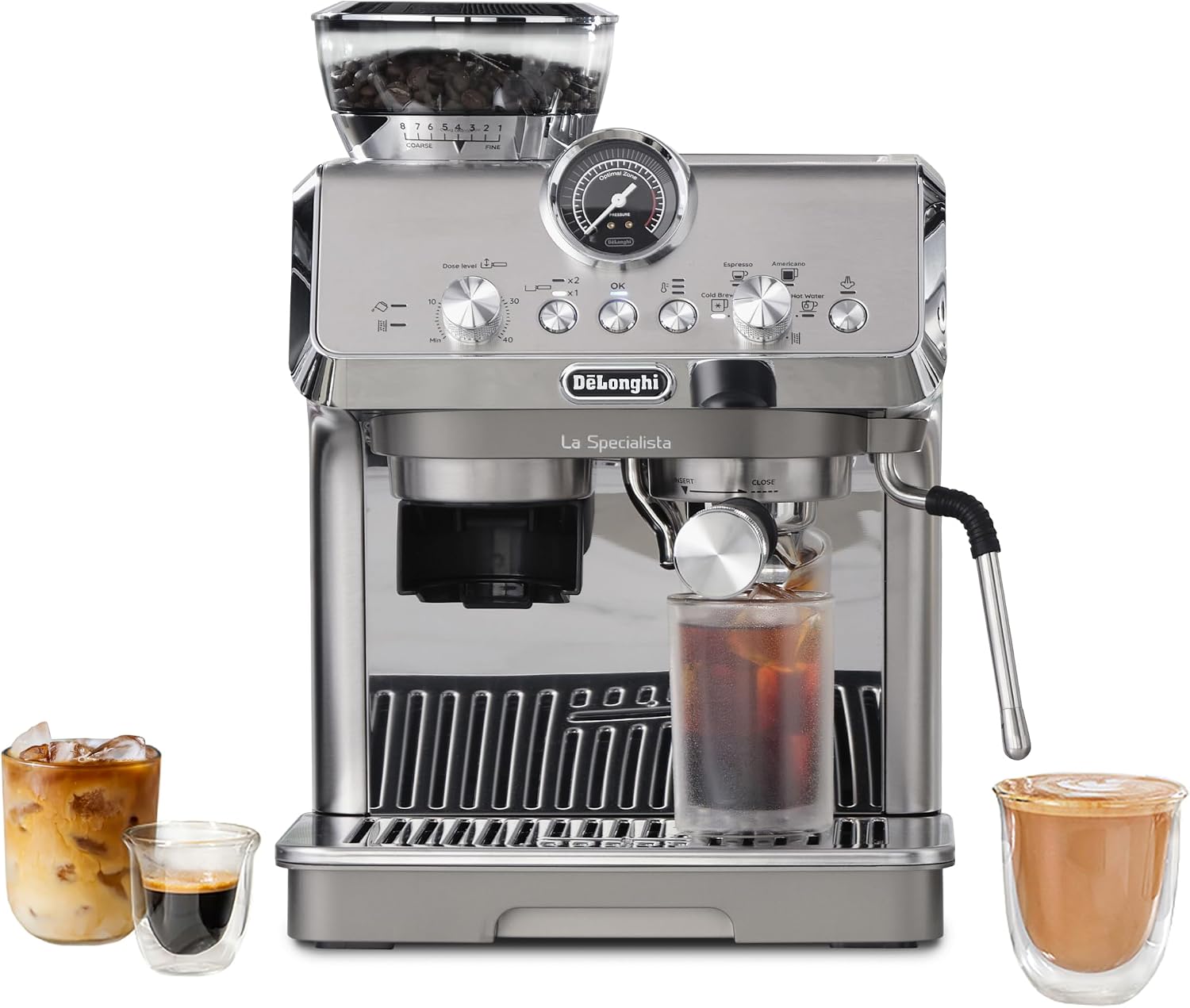
De'Longhi La Specialista Arte Evo
| Operation Mode | Semi-Automatic |
|---|---|
| Wattage | 1550 watts |
| Output Pressure | 9 bar |
| Coffee Input Type | Whole Bean |
| Filter Type | Reusable |
The La Specialista Arte Evo is a hands-on home espresso machine that pairs a conical burr grinder and dosing tools with a powerful steam wand and De'Longhi's cold extraction system. It grinds whole beans to a single or double dose using eight grind settings, then brews with an Italian 15 bar pump and active temperature control to stabilize extraction. Four preset recipes cover espresso, Americano, cold brew, and hot water while the included barista kit and integrated tamper streamline dosing and tamping. The steam wand performs well for textured microfoam, so making lattes and cappuccinos is straightforward once you dial in grind and dose. Practical benefits include compact styling, dishwasher-safe detachable parts for easier cleanup, and a fast cold-brew option that yields a ready cold extraction in under five minutes. Expect a learning curve to consistently dial in grind, dose, and temperature for best results, and the semi-automatic workflow requires hands-on tamping and steaming compared with fully automatic machines.
Best for: Home buyers who want a capable, grinder-equipped machine that rewards hands-on adjustment and values temperature control and milk texturing for cafe-style drinks.
Less Ideal for: People seeking a fully automatic, push-button workflow or a plug-and-play machine with minimal setup and dialing.
- Built-in conical burr grinder with 8 grind settings for consistent fresh dosing
- Commercial-style steam wand that produces smooth micro-foam suitable for latte art
- Cold Extraction Technology produces a cold-brew style drink in under five minutes
- Active Temperature Control and 15 bar pump support stable extraction and flavor tuning
- Includes barista kit and integrated tamper to simplify dosing and tamping
- Semi-automatic operation requires manual tamping and steaming, which adds hands-on time
- Output pressure listed at 9 bar during extraction may require tuning to achieve ideal shots
Verdict: Choose this if you want a grinder-equipped, temperature-stable semi-automatic that delivers cafe-style milk drinks and a fast cold-brew option while allowing hands-on control.
Breville Barista Pro BES878BSS

| Wattage | 1680 watts |
|---|---|
| Voltage | 120 |
| Coffee Input Type | whole bean, ground |
| Capacity | 2 liters |
| Filter Type | Reusable |
The Breville Barista Pro combines a fast ThermoJet heating system with a built-in conical burr grinder and dose control to deliver café-style espresso shots at home. Users grind directly into the portafilter, use the 54mm portafilter and dual/single-wall filter baskets to pull shots, and texture milk with the manual steam wand to make lattes and cappuccinos. The digital PID temperature control and the LCD interface provide quick feedback during grinding and extraction, which helps dial in shots more consistently. Practical benefits include rapid warm-up, one-step grinding and dosing for fewer steps between bean and brew, and a powerful steam wand capable of producing pourable microfoam. Limitations are the manual tamping and the learning curve for newcomers who want fully automatic dosing and tamping, plus the machine's footprint and weight require stable counter space. Regular cleaning and practice are needed to get repeatable shot quality and milk texture.
Best for: Home users focused on extraction quality who want a grinder-equipped machine that lets them control dosing, temperature, and milk texturing to improve shot consistency and flavor.
Less Ideal for: Casual users who prefer push-button fully automatic operation or minimal hands-on maintenance should consider simpler super-automatic or pod machines instead.
- Integrated conical burr grinder with dose control for on-demand grinding
- ThermoJet heating and PID control for fast, stable extraction temperature
- 54mm portafilter and dual/single-wall filters support 18g dosing for fuller shots
- Powerful steam wand capable of producing smooth microfoam for latte art
- Intuitive LCD with grind and extraction feedback to help dialing in shots
- Requires manual tamping and hands-on technique rather than automated dosing/tamping
- Relatively heavy and sizable requiring dedicated counter space
Verdict: Choose this for a fast, grinder-integrated semi‑automatic that gives hands-on control over grinding, temperature, and milk texturing for higher-performance home espresso.
Gevi Espresso Machine with Grinder

| Output Pressure | 20 bar |
|---|---|
| Wattage | 1350 watts |
| Operation Mode | Fully Automatic |
| Capacity | 1 liters |
| Human Interface Input | Touchscreen |
This Gevi unit pairs a 20-bar semi-automatic espresso machine with a built-in conical burr grinder to deliver café-style drinks from whole beans. It grinds beans with 35 grind settings, doses into a 51mm portafilter, and brews under 20 bar pressure while a steam wand and removable froth nozzle let you texture milk for cappuccinos and lattes. Practical touches include a removable water tank and drip tray, a cup-warming plate, touchscreen controls, and a sizable accessory kit with filters, tamper, and milk pitcher that make setup and basic maintenance straightforward. At 1350 watts the machine heats quickly, and stainless steel surfaces resist rust, though the unit is not as large or feature-rich as commercial machines and requires some learning to dial grind and tamp for best shots. Noise during grinding is moderate but acceptable for home use. For buyers who want an all-in-one home setup that covers grinding, dosing, brewing, and milk steaming, this unit is a capable value proposition; those seeking a purely automatic bean-to-cup convenience or commercial-grade durability should consider higher-end models instead.
Best for: Home brewers who want a single compact machine that handles grinding, dosing, brewing, and milk steaming and who prioritize practical features and included accessories for easy startup.
Less Ideal for: Users who need fully automatic bean-to-cup convenience or commercial-grade machines built for heavy daily use should look elsewhere.
- Integrated conical burr grinder with 35 grind settings for flexible extraction control
- Powerful 20 bar output and 1350W heater for quick warm-up and stable extraction
- Steam wand and removable froth nozzle for making textured milk drinks
- Removable water tank and drip tray plus included accessories simplify use and cleaning
- Not a commercial-grade machine so longevity under heavy daily use may be limited
- Learning curve to dial grind size, dose, and tamp for consistently optimal shots
Verdict: A practical all-in-one home espresso setup that combines a burr grinder, 20-bar brewing, and a steam wand to let you make café-style drinks without assembling separate components.
Breville Barista Express BES870XL

| Wattage | 1600 watts |
|---|---|
| Voltage | 120 |
| Coffee Input Type | whole_beans |
| Power Source | AC adapter |
| Capacity | 1 cups |
The Breville Barista Express BES870XL combines an integrated conical burr grinder, 54mm portafilter, and thermocoil temperature control to deliver café-style espresso from fresh beans. You grind directly into the portafilter with 16 grind settings and dose control, then use low-pressure pre-infusion and PID temperature regulation to extract balanced shots. The stainless steel steam wand produces microfoam for lattes and cappuccinos, and the machine includes single and double-wall filter baskets plus a manual tamper and razor dosing tool for repeatable results. Daily use is straightforward once you learn dosing and tamping; water tank access and a reusable filter make upkeep reasonable, though regular cleaning and descaling are required to keep grind and steam performance consistent. This is a manual workflow that rewards hands-on users with control over grind, dose, and milk texture, but it is not an automated push-button solution and takes practice to master.
Best for: Buyers who prioritize reliable, factory-quality espresso extraction and want an integrated grinder in a single machine for consistent, repeatable home brewing.
Less Ideal for: Those seeking a fully automatic, hands-off espresso maker or users unwilling to learn manual dosing, tamping, and milk texturing techniques should consider an alternative.
- Integrated conical burr grinder with 16 grind settings for fresh dosing
- PID thermocoil temperature control for consistent extraction
- Powerful steam wand capable of manual microfoam for latte art
- 54mm stainless steel portafilter and included dosing/tamping tools for precise shots
- Reusable filter baskets and accessible water tank simplify day-to-day use
- Manual tamping and dosing require practice to achieve consistent results
- Requires regular cleaning and descaling to maintain performance
Verdict: Choose the Barista Express if you want a durable, grinder-integrated semi‑automatic machine that gives tight control over grind, dose, temperature, and milk texture for café-quality shots at home.
Ninja Luxe Café Premier ES601

| Operation Mode | Fully Automatic |
|---|---|
| Wattage | 1650 watts |
| Coffee Input Type | Ground, Whole Bean |
| Filter Type | Reusable |
The Ninja Luxe Café Premier ES601 is a guided, fully automatic 3-in-1 coffee machine designed to simplify café-style drinks at home. It grinds whole beans with a built-in conical burr grinder (25 settings) and uses weight-based automatic dosing plus an assisted tamper to produce consistent espresso shots, while also offering single-cup to 18 oz drip coffee and a rapid cold brew function. The hands-free Dual Froth System combines an automated steamer and spinning whisk for preset foam textures or manual frothing, and the self-cleaning steam wand purges after each shot for easier maintenance. Barista Assist Technology walks users through grind, dose, tamp, and brew steps, which lowers the learning curve for beginners. Practical downsides include a relatively large footprint and 1650W power draw, and the many automated systems mean fewer manual controls for advanced baristas who want full customization. Accessories and built-in storage help keep the counter tidy, and the included cleaning tools and water testing kit support maintenance.
Best for: Buyers who want a low-friction, guided espresso and coffee experience that covers espresso, drip, and cold brew in one machine and value consistency and easy maintenance.
Less Ideal for: Experienced baristas who want full manual control over every brew parameter or buyers with very small countertops should consider alternatives.
- Integrated conical burr grinder with 25 grind settings for consistent dosing
- Weight-based automatic dosing and assisted tamper for repeatable shots
- Hands-free dual froth system with preset programs and self-cleaning steam wand
- 3-in-1 capability: espresso, drip coffee, and rapid cold brew in one machine
- Includes cleaning tools and accessory storage to simplify upkeep
- Large and relatively heavy countertop unit that requires significant counter space
- Limited manual control compared with semi‑automatic machines for advanced users
- High power draw may be noticeable on older circuits
Verdict: If you want café-style espresso, drip, and cold-brew with step-by-step guidance and an integrated grinder for reliable, low-effort results, this machine delivers.
Choosing the Right Espresso Machine with a Grinder: Key Factors to Consider
Grinder Type and Burr Quality
A conical or flat burr grinder with high-quality materials delivers more uniform particle size, which directly affects extraction evenness and crema. Finer control over grind size matters when dialing in different beans and roast levels.
Durability and whether the burrs are replaceable also matter. Cheaper grinders may clog, produce inconsistent fines, or wear quickly, all of which force frequent recalibration and reduce longevity.
Dose Control and Portafilter Compatibility
Look for explicit dose controls, stepless or stepped grind adjustments, and clear markings that let you reproduce a setting. Machines that let you set and lock dose reduce guesswork and waste.
Also consider how the grinder meters coffee into the portafilter or a grounds container. A well-aligned chute prevents clumping and makes tamping more consistent, which improves shot-to-shot repeatability.
Boiler and Temperature Stability
Consistent water temperature and stable boiler pressure are essential for predictable extraction. Temperature swings lead to sour or bitter shots even when the grind is correct.
For integrated units, the interplay between grinder demand and boiler recovery matters. Machines with good heat recovery and PID or well-regulated thermostats keep extraction consistent during multi-shot routines.
Maintenance and Access
Integrated systems require periodic cleaning of both grinder and brew group. Easy access to the bean hopper, burrs, and grounds path shortens maintenance time and reduces the chance of stale coffee contaminating fresh grounds.
Also consider how easy it is to backflush, remove and clean the portafilter, and replace seals or screens. Units designed for straightforward upkeep will perform better over time and cost less in service interruptions.
Footprint and Kitchen Fit
Combined grinder-brewer units save counter clutter but can be taller or deeper than separate components. Check measured clearance for your cabinets and whether the hopper blocks overhead storage.
Noise level during grinding is also relevant if you brew early or in shared spaces. A compact footprint with an accessible cup clearance makes daily routines more pleasant and practical.
Steam Performance and Milk Texturing
If you make milk drinks, the steam wand must produce sufficient steam pressure and tip design to texturize milk consistently. A strong steam system that maintains pressure during consecutive steam cycles speeds workflow and yields stable microfoam.
Consider wand reach, ease of purging, and whether wand knobs or levers allow quick, precise control. These features affect real-world latte and cappuccino quality.
Why an Integrated Grinder Changes the Brewing Workflow
An integrated grinder shortens the path from bean to portafilter, reducing exposure to air and preserving volatile aromatics. That shorter workflow often means better tasting shots and less fiddling when you want a quick espresso.
Beyond freshness, integrated units encourage consistency. Because the grinder is designed to feed the machine, alignment and dosing tend to be more repeatable than transferring grounds between separate devices. That makes daily dialing simpler once you find the right grind-and-dose combination.
- Fewer steps between grinding and extraction reduces heat and aroma loss
- Aligned grounds chute minimizes mess and clumping
- Built-in dosing features reduce the need for separate weighing
Common Grind Adjustment Approaches
Manufacturers use stepped or stepless adjustment systems. Stepped systems click between preset positions and can be easier for casual users to return to known settings. Stepless systems allow infinitely variable adjustment, which benefits fine tuning for different beans and roast levels.
Some grinders include macro and micro adjustment rings for coarse changes and fine dialing. Pay attention to how accessibly those controls are positioned; grinders that require removing the hopper to make an adjustment add friction to the dialing process.
- Stepped: repeatable, beginner-friendly
- Stepless: more precise, better for advanced dialing
- Macro/micro rings combine quick shifts with fine tuning
Troubleshooting Common Issues
If shots are under-extracted after switching beans, first check grind size and dose. Moving one step finer or increasing dose slightly usually corrects sourness. Also confirm the tamp is even and the portafilter is clean.
If you get channeling or inconsistent flow, inspect the grinder for excessive fines or clumps, and check that the grounds are distributing evenly in the basket. Regular cleaning and occasional burr replacement help avoid these issues long-term.
- Sour shots: finer grind, higher dose, check temperature
- Bitter shots: coarser grind, reduce dose, check extraction time
- Channeling: check distribution, tamp technique, and burr condition
Setting Up Your Machine for Reliable Results
Start with a baseline recipe: target total extraction time and dose, then dial grind until you reach the timing goal. Use a scale and a timer for the most repeatable results. Note setting numbers so you can return to them for the same bean.
Routine maintenance also affects setup. Clean the grinder chute and backflush the brew group as recommended to keep extraction consistent. Small, regular tasks prevent the need for major recalibration down the line.
- Use a scale to measure dose and yield
- Record grind and time for each bean
- Schedule weekly cleaning and monthly burr inspection
Milk Drinks and Steam Strategy
For milk-based drinks, practice stretching and texturing in short bursts to get microfoam without overheating. Machines with quick steam recovery will save time when making multiple drinks in a row.
Position pitchers to use the wand tip effectively and purge briefly before and after steaming to clear condensate. Consistent wand technique and machine readiness are as important as grind and dose for latte quality.
- Purge wand before steaming
- Use a chilled pitcher and thermometer for consistency
- Practice microfoam technique to achieve glossy texture
How We Chose the Best Espresso Machine with a Grinder
We focused on machines that integrate commercial-style dosing and adjustable grinding with reliable extraction controls. Our selection filters emphasized consistent grind distribution, accurate dose settings, and stable brew temperatures because those three dimensions have the biggest impact on shot quality when the grinder and brewer are part of the same unit. We also prioritized user-facing features that matter in regular use: easy access to the bean hopper and grounds chute, straightforward grinder adjustments, serviceable burrs, and straightforward maintenance procedures. Excluded from the list were machines that lack a true adjustable burr grinder or that rely solely on pre-ground dosing. We did not consider single-use capsule or pod systems, nor machines with non-replaceable or inaccessible burrs. Final selections balanced grind performance with extraction control, build quality, ease of cleaning, and intuitive daily operation so readers can pick a machine that performs well and stays practical for regular home use.
Our full evaluation process is outlined in our review methodology.
FAQ
Do built-in grinders produce as good a grind as standalone grinders?
Built-in grinders vary. Many integrated units use quality burrs that deliver excellent results for home use, though high-end standalone grinders can offer more advanced adjustment and heavier-duty burr sets. For most home baristas, a well-designed integrated grinder provides a strong balance of convenience and performance.
How often should I clean the grinder and replace the burrs?
Clean the hopper and chute weekly and remove trapped grounds monthly or as needed. Burr replacement depends on usage and grind material but often falls in the 1,500 to 3,000 pound range for common home use. Inspect for wear and degraded consistency and replace burrs when grind quality declines.
Can I use pre-ground coffee with an integrated machine?
Yes. Most integrated machines allow you to fill a grounds chute or bypass the grinder, but you should use a fresh, properly sized grind. Pre-ground coffee exposes more surface area to oxygen, so it will stale faster than whole beans.
Will the grinder noise damage my kitchen environment?
Grinder noise is normal, and integrated units can be quieter or louder depending on burr size and motor design. Expect audible grinding during dose cycles; if noise is a concern, look for machines that specify quieter operation or smaller-diameter burrs, and place the unit away from shared living spaces.
How do I dial in a new bean on an integrated machine?
Start with a known benchmark recipe for dose and extraction time, then adjust grind size incrementally to hit the target shot duration. Record the settings once you achieve balanced flavor. Small, one-step changes are easier to evaluate than large jumps.
Final Verdict
Choosing an espresso machine with a grinder means balancing grind quality, extraction control, and everyday usability. Prioritize consistent burrs and accessible adjustment mechanisms if you plan to experiment with different beans. If you make milk drinks frequently, give extra weight to steam performance and recovery. Accept tradeoffs between footprint and integrated convenience: integrated systems reduce counter clutter and streamline workflow but require attention to maintenance. Focus on the criteria that affect the flavors you care about most so you can pick a machine that stays reliable and enjoyable over time.