
Note: This article contains affiliate links. If you click on these links and make a purchase, we may earn a small commission at no extra cost to you. This helps support our research and content. Read our full affiliate disclosure here.
Choosing an espresso machine is about more than groupheads and gauges. For buyers working with budgets up to $5,000, the right machine affects shot consistency, maintenance time, and the cost of ownership over years of daily use. You want gear that pulls repeatable shots, lasts through regular use, and is serviceable without constant technician visits. This guide shortlists seven top espresso machines under $5,000 that meet those needs. We evaluate each pick on durability, extraction performance, temperature stability, and ease of upkeep so you can match features to how you will actually use the machine at home or in a small-scale setting. Read on for the criteria we used and practical notes to help you choose.
Top Picks at a Glance
| Best Overall The best all-around choice for most situations | Rancilio Silvia Pro X |  |
| Best Quality Built to a higher standard if you want something more solid | Breville Oracle Touch BES990BSS |  |
| Best Value The sweet spot between price and what you get | Gevi 20 Bar Espresso Machine |  |
| Best Budget The cheapest option that still gets the job done reliably | IMUSA 4-Cup Espresso Maker |  |
| Top Rated A top-rated pick with lots of positive feedback | Breville Barista Express BES870XL |  |
| Most Popular A crowd favorite that many people choose with confidence | Mr. Coffee Cafe Barista |  |
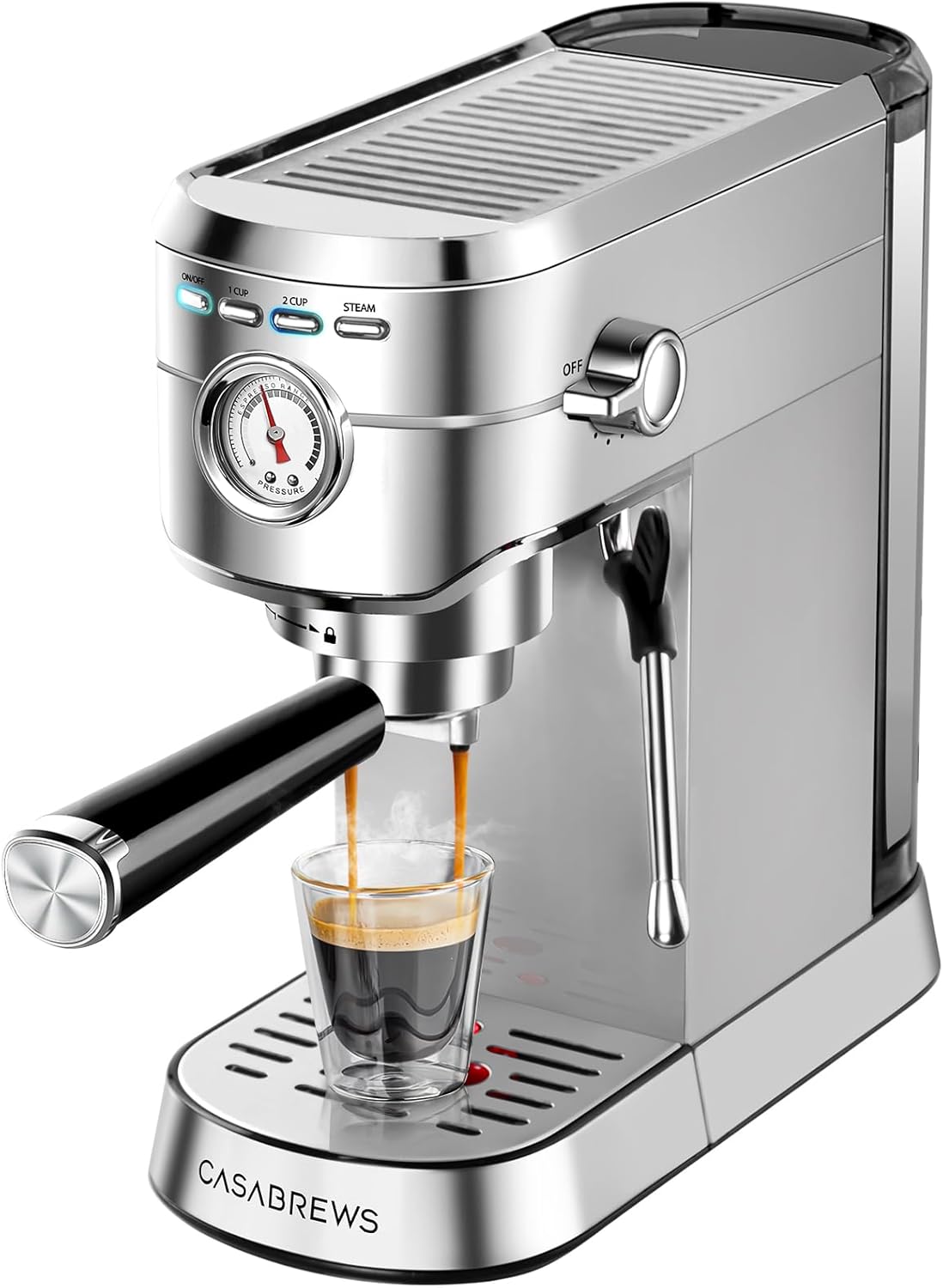
| Best Seller A high-volume bestseller chosen again and again | CASABREWS CM5418 Espresso Machine |  |
Rancilio Silvia Pro X

| Operation Mode | Semi-Automatic |
|---|---|
| Wattage | 1000 watts |
| Voltage | 120 volts |
| Coffee Input Type | ground_coffee |
| Capacity | 2 liters |
The Rancilio Silvia Pro X is a prosumer-grade semi-automatic espresso machine built around a dual-boiler layout and dual PID control for precise temperature management. It lets you brew and steam at the same time thanks to a 300 ml brew boiler and a 1 L steam boiler, so you can pull shots back-to-back and texturize milk without waiting. The front-facing digital display shows brew temperature and doubles as a shot timer, and programmable features include wake-up time and shot timing. Included accessories such as single and double baskets, a stainless portafilter, tamper, and backflushing basket make it ready for home barista use. Practical benefits are strong: excellent temperature stability for consistent shots, professional-level steaming power, and a removable 2 L reservoir for easy refills and cleaning. Trade-offs are a larger countertop footprint and a heavier, more workshop-style machine that requires some learning to dial in PID settings and routine maintenance compared with simpler consumer machines.
Best for: Buyers who want a stable, workshop-style home espresso machine that delivers professional steaming and precise temperature control for consistent, café-quality shots.
Less Ideal for: People who need a compact, fuss-free appliance or who prefer fully automatic machines with minimal setup and maintenance.
- Dual boiler design lets you brew and steam simultaneously for faster workflow
- Separate PID controls provide precise and adjustable brew and steam temperatures
- Front-facing digital display with real-time brew temp and shot timer
- Includes pro accessories: stainless portafilter, single/double baskets, tamper, and cleaning tools
- Large and heavy footprint requires substantial counter space and is less portable
- More complex controls and maintenance needs compared with entry-level machines
Verdict: Choose the Silvia Pro X if you want a durable, dual-boiler home machine that delivers precise temperature control and professional steaming for serious home baristas.
Breville Oracle Touch BES990BSS

| Operation Mode | Fully Automatic |
|---|---|
| Wattage | 1650 watts |
| Human Interface Input | Touchscreen |
| Coffee Input Type | Ground Coffee |
| Capacity | 4.2 pounds |
The Breville Oracle Touch automates the full espresso workflow: it grinds, doses, tamps and extracts, and then textures milk with an automatic steam wand so you can prepare lattes and cappuccinos with minimal manual steps. The integrated conical burr grinder offers 45 grind settings and doses up to 22 g automatically, while the dual boiler system plus PID temperature control and a heated group head enable simultaneous steam and brew for consistent extractions. The touchscreen menu makes drink selection and personalization straightforward, and you can save up to eight customized recipes. Practical benefits include reliably full-bodied shots from low-pressure pre-infusion and an over-pressure valve to limit bitterness, plus hands-free microfoam for latte art. Trade-offs are machine size and weight that require ample counter space and a higher learning curve to fully exploit customization; maintenance of the grinder and steam system also requires regular cleaning. For buyers prioritizing repeatable, high-quality beverages with automation, the Oracle Touch delivers near-barista results at home.
Best for: Buyers who want near-commercial espresso quality at home without manual dosing and steaming, and who value repeatable results and drink customization through automation.
Less Ideal for: If you need a compact travel-friendly machine or prefer hands-on, manual espresso workflows, this fully automatic, feature-rich unit is not the best fit.
- Integrated conical burr grinder with 45 grind settings and automatic dosing and tamping
- Dual boiler heating with PID temperature control for simultaneous brewing and steaming
- Touchscreen interface with programmable drink presets and saveable custom profiles
- Automatic steam wand that textures milk to barista-quality microfoam
- Built-in safety features like over-pressure valve and low-pressure pre-infusion for balanced extraction
- Large and heavy footprint that needs significant counter space
- Requires routine maintenance and cleaning of grinder and milk system to preserve performance
Verdict: Choose the Oracle Touch when you want near-barista, repeatable espresso and milk drinks at home with minimal manual effort.
Gevi 20 Bar Espresso Machine

| Output Pressure | 20 bar |
|---|---|
| Capacity | 2.3 liters |
| Wattage | 1450 watts |
| Operation Mode | Semi-Automatic |
| Coffee Input Type | GROUND_COFFEE |
The Gevi 20 Bar Espresso Machine pairs a 20-bar pump and an integrated conical burr grinder to produce espresso and milk-based drinks without needing separate equipment. You load beans into the adjustable bean box (0–30 gears), choose grind and shot volume, and the unit grinds and brews through a 58mm portafilter; the PID and NTC temperature controls aim to keep extraction and steaming temperatures stable. A professional-style steam wand and automatic frothing function let you texture milk for lattes and cappuccinos, and the removable 2.3 L water tank and cup warmer make daily use convenient. At 1450 watts and with reusable filters and multiple included portafilter baskets, it is set up for routine home barista work and short milk prep sessions. Expect a learning curve to dial grind and dose for best crema, and the machine's size and button controls mean it is not fully hands-off like high-end automatic or dual-boiler commercial units. Still, for the price it combines grinder, brewing, and steaming into one compact, near-pro setup for serious home coffee makers.
Best for: Buyers who want an all-in-one, near-professional home espresso setup that replaces a separate grinder and steam tool and who enjoy dialing grind and shot parameters to improve results.
Less Ideal for: Those seeking fully automatic, hands-free operation or commercial-grade dual-boiler throughput should consider different machines built for high-volume or single-button convenience.
- Built-in conical burr grinder with 30 adjustable settings for fresh espresso grounds
- 20 bar pump plus PID/NTC temperature control for consistent extraction
- Professional 58mm portafilter and multiple single/dual wall filters included
- Steam wand and auto milk frother for textured milk and latte/cappuccino making
- Removable 2.3 L water tank and cup warmer for everyday convenience
- Semi-automatic controls require manual dosing and tamping to get optimal shots
- Not a true dual-boiler system so simultaneous steaming and extraction may be limited
Verdict: If you want a compact, single-unit home espresso rig with a built-in grinder and professional features for hands-on brewing, this Gevi model delivers strong value.
IMUSA 4-Cup Espresso Maker

| Coffee Maker Type | Espresso Machine |
|---|---|
| Operation Mode | Semi-Automatic |
| Wattage | 800 watts |
| Capacity | 4 cups |
| Other Special Features of the Product | Milk Frother, Permanent Filter |
The IMUSA 4-Cup Espresso Maker is a compact countertop espresso machine meant to brew small batches of strong coffee and produce frothed milk for cappuccinos and lattes. It uses a semi-automatic operation with a three-position selector and a 5-bar pressure system to extract espresso into a glass carafe, while the steam nozzle froths milk for creamy foam. The unit includes a permanent filter basket, removable drip tray for easier cleaning, and a cool-touch carafe handle for safer pouring. At 800 watts it heats consistently on standard household power and its matte black plastic exterior keeps it lightweight and easy to move. Limitations include the modest 5-bar pressure, which is lower than commercial machines, and the 4-cup capacity that suits small households but not heavy entertaining. The machine is straightforward to use for daily espresso and milk-based drinks and gives good value for buyers seeking a simple, space-saving home espresso solution without professional-level complexity.
Best for: Buyers seeking an affordable, space-saving home espresso maker that makes espresso and frothed milk for daily use and occasional guests.
Less Ideal for: People who want commercial-level pressure, large batch brewing, or advanced programmability should consider higher-end machines.
- Compact 4-cup capacity fits small kitchens and multiple daily servings
- Built-in steam nozzle produces milk foam for cappuccinos and lattes
- Permanent filter and removable drip tray simplify cleanup
- 800-watt heating delivers consistent brewing on household power
- 5-bar pressure is lower than professional espresso machines, limiting extraction intensity
- Small capacity is not ideal for large gatherings
Verdict: A budget-friendly, compact espresso maker that delivers basic espresso and milk frothing for home users who want simple cafe-style drinks without pro-level cost or complexity.
Breville Barista Express BES870XL

| Wattage | 1600 watts |
|---|---|
| Voltage | 120 |
| Coffee Input Type | whole_beans |
| Filter Type | Reusable |
| Capacity | 1 cups |
The Breville Barista Express BES870XL combines a built‑in conical burr grinder, 54mm portafilter, and thermocoil heating to take whole beans to espresso in under a minute. Typical use is hands‑on: you grind directly into the portafilter, tamp, and pull a shot with low‑pressure pre‑infusion and PID temperature control, then texture milk with the steam wand for lattes or cappuccinos. Notable features are the 16 grind settings, single and dual wall filter baskets for dosing control, and a powerful steam wand for manual microfoam. In practice it delivers consistent, balanced shots when dialed in and rewards users who learn basic dosing and tamping technique. The machine is stainless steel and includes useful tools such as a razor dose trimming tool and integrated tamper, which make routine setup and maintenance easier. Limitations are its manual workflow — there is a learning curve compared with fully automatic machines — and its footprint and weight mean it is best suited to a dedicated countertop space rather than small kitchens.
Best for: Buyers who prioritize a reliable, durable home machine that produces café‑quality espresso and are willing to learn manual dosing and milk texturing to get consistent results.
Less Ideal for: People who want a hands‑off, push‑button espresso experience or need an ultra‑compact unit for very small counters.
- Integrated conical burr grinder with adjustable grind settings for fresh dosing
- PID temperature control and thermocoil system for more stable extraction temperature
- 54mm stainless steel portafilter and dual/single wall baskets for consistent dosing
- Powerful steam wand capable of producing microfoam for latte art
- Includes practical accessories (razor dosing tool, tamper, cleaning tools)
- Manual operation requires practice to consistently dial in shots
- Relatively large and heavy for small or minimalist kitchens
Verdict: A durable, semi‑automatic machine that delivers reliable, café‑quality shots for home baristas who value control and consistency.
Mr. Coffee Cafe Barista

| Operation Mode | Semi-Automatic |
|---|---|
| Output Pressure | 15 bar |
| Power Source | electric |
| Human Interface Input | Buttons |
| Filter Type | Reusable |
The Mr. Coffee Cafe Barista is a compact semi-automatic espresso machine that brings basic coffeehouse drinks into a home kitchen with minimal fuss. It uses a 15-bar electric pump and single- or double-shot filters to extract espresso while a removable milk reservoir and automatic frother produce cappuccinos and lattes without manual steaming. One-touch controls simplify drink selection and the removable water tank makes filling and cleaning straightforward. For everyday use it handles ground coffee, offers a reusable filter, and includes a small recipe booklet to get started. Practical benefits include reliable pressure for fuller flavor, hands-off milk frothing, and an easy interface that suits casual users and beginners. Limitations are its beginner-focused feature set and modest build compared with prosumer machines, so users seeking advanced temperature control, a commercial steam wand, or heavy-duty durability may find it too basic. Still, for making consistent single- or double-shot drinks at home with quick milk frothing, it is a convenient, time-saving choice.
Best for: Buyers who want a reliable, easy-to-use home espresso setup that produces consistent single or double shots and ready-to-serve milk drinks without barista training and who value social proof and dependable performance.
Less Ideal for: Serious home baristas who demand advanced temperature tuning, a commercial-style steam wand, or heavy daily throughput should look at higher-end prosumer machines instead.
- 15-bar pump delivers strong extraction for richer espresso flavor
- Automatic milk frother with removable reservoir simplifies cappuccinos and lattes
- One-touch controls for single or double shots make operation easy for beginners
- Removable water tank and reusable filter reduce ongoing accessory costs
- Not as durable or feature-rich as prosumer or commercial espresso machines
- Limited temperature and steam control compared with machines with manual steam wands
Verdict: A straightforward, beginner-friendly espresso maker that reliably produces espresso, cappuccino, and lattes with one-touch controls and automatic milk frothing.
CASABREWS CM5418 Espresso Machine
| Operation Mode | Semi-Automatic |
|---|---|
| Wattage | 1350 watts |
| Output Pressure | 20 bar |
| Coffee Input Type | ground_coffee |
| Filter Type | Reusable |
The CASABREWS CM5418 is a compact semi-automatic espresso machine aimed at home users who want cafe-style shots and steamed milk without a complicated setup. It uses a 20-bar Italian pump and a built-in pressure gauge to help dial in extraction, while a low-pressure pre-infusion step smooths flavor. The 51mm portafilter, one- and two-cup filters, and adjustable shot volume let you pull single or double shots, and the powerful steam wand produces microfoam for lattes and cappuccinos. Practical touches include a removable 34 oz water tank, cup warmer, and a stainless steel drip tray that lifts out for cleaning. Expect a short warm-up time and clear troubleshooting steps in the manual for issues like overheating or low pressure. Limitations to note are that it is a single-boiler design, so you should wait between steaming and brewing to avoid over-temperature protection, and getting consistent results requires attention to grind, dose, and tamping since the machine is best paired with a good grinder and some basic barista technique.
Best for: Buyers who prioritize straightforward, café-style espresso and milk drinks at home but want a reliable, easy-to-use machine with visible pressure control and practical serviceability.
Less Ideal for: People who need continuous high-volume service or simultaneous brewing and steaming for multiple drinks in quick succession should consider higher-end dual-boiler machines.
- 20-bar Italian pump with built-in pressure gauge for visible extraction feedback
- Low-pressure pre-infusion and adjustable shot volume for improved flavor control
- Powerful steam wand capable of creating microfoam for latte art
- Compact stainless steel design with removable 34 oz water tank for easy refills
- Includes portafilter, single- and double-shot baskets, and tamper for out-of-box brewing
- Single-boiler system requires cooling time between steaming and brewing which slows drink throughput
- Delivers best results when paired with a separate quality grinder and proper tamping technique
Verdict: A compact, user-friendly semi-automatic that gives home baristas visible pressure control and strong steam power for café-style espresso and milk drinks.
Choosing the Right Espresso Machine: Key Factors to Consider
Extraction Consistency
Consistent extraction determines shot-to-shot flavor stability. Machines that maintain steady pressure and temperature across a brew help reproduce the same flavors when you replicate dose, grind, and tamp settings.
Pay attention to how the machine handles pre-infusion, pressure profiling, or volumetric dosing if you plan to dial in recipes. Inconsistent flow or pressure spikes will force you to adjust technique constantly and make repeatable results harder to achieve.
Temperature And Pressure Control
Precise control of brew temperature and group pressure is essential for balanced espresso. Small changes in temperature or a weak pump can shift acidity and sweetness in the cup, so machines with proven stability make dialing easier.
For multi-shot mornings or light commercial use, evaluate recovery time between shots and whether a machine uses heat exchange or dual-boiler architecture. Faster thermal recovery reduces wait time and keeps extraction parameters consistent during consecutive pulls.
Steam Power And Milk Texture
If you plan to steam milk frequently, steaming performance matters more than a single-shot extraction metric. Look for powerful steam output, a responsive steam wand, and good boiler capacity so milk texturing is quick and consistent.
A wand that allows both microfoam and larger volume steaming will expand drink options. Consider how easy the wand is to maneuver and clean, because daily milk work increases maintenance demands.
Build Quality And Materials
High-quality components extend service intervals and keep calibration stable. Metal groupheads, commercial-style portafilters, and sturdy chassis reduce vibration and heat loss, which improves both durability and shot repeatability.
Evaluate the machine's water path materials and gasket quality since those experience the most wear. Machines built with repairability in mind tend to save time and money across their lifespan.
Serviceability And Parts Availability
Access to replacement parts and straightforward service procedures reduce downtime. Machines with modular components or widely available parts are easier for technicians to fix, and some routine tasks can be handled by a knowledgeable owner.
Check whether commonly replaced items like group gaskets, shower screens, and seals are standard sizes. Also consider whether the machine has accessible internal layout for routine maintenance tasks like descaling and boiler servicing.
Ease Of Use And Controls
Control layout and feature set affect how quickly you can produce consistent shots. Clear dosing controls, intuitive gauges, and logical switches reduce the learning curve for newcomers and help experienced users focus on technique.
Programmable options are useful but not essential for every buyer; evaluate whether the machine's control scheme matches how you will use it day to day rather than relying solely on feature lists.
Single Boiler Vs Dual Boiler And Heat Exchange
Understanding boiler architecture helps match a machine to your routine. Single-boiler machines are simpler and can be compact, but they require a pause between brewing and steaming. Dual-boiler units let you brew and steam simultaneously with minimal compromise on temperature control. Heat exchange systems offer a middle ground by using a single large boiler with a thermally isolated brew circuit.
Think about how many consecutive milk drinks you will pull and whether speed or compactness is more important. For frequent milk-based drinks, systems designed for simultaneous brew and steam reduce wait time and workflow interruptions.
- Single boiler: simpler, lower cost, requires transition time between functions
- Dual boiler: simultaneous brew and steam, strong temperature stability
- Heat exchange: single boiler with a dedicated brew path, fast recovery
Sizing For Your Use Case
Machine size is more than footprint. Boiler capacity, reservoir volume, and the duty cycle determine whether a machine suits occasional home use or higher-volume mornings. Smaller machines can be ideal for single-brewer households, while larger boilers and plumb-in options benefit heavier usage.
Also consider counter space, access to water lines if you plan to plumb in, and how often you are willing to refill a reservoir. The right-size machine minimizes user frustration and keeps maintenance predictable.
- Reservoir vs plumb-in: plumb-in supports continuous use, reservoirs are more flexible
- Boiler capacity affects steam endurance and recovery between shots
- Footprint affects placement and ventilation needs
Routine Maintenance And Daily Upkeep
Regular cleaning and periodic maintenance preserve performance and flavor. Daily tasks typically include backflushing where applicable, wiping the grouphead and portafilter, and purging the steam wand after each use. Weekly or monthly tasks may include deeper backflushing and descaling depending on water hardness.
Design features that simplify maintenance, such as accessible panels, removable drip trays, and clear service documentation, reduce friction. Consider whether you are comfortable performing routine checks or prefer a machine that minimizes owner maintenance.
- Daily: purge steam wand, wipe grouphead, clean portafilter
- Weekly/monthly: backflush, check seals, descale as needed
- Look for easy-access service panels and clear maintenance guides
Water Quality And Filtration
Water chemistry plays a major role in extraction and long-term machine health. Hard water accelerates scale buildup and can degrade performance. A simple inline filter or a tailored filtration system reduces the need for frequent descaling and protects internal components.
When choosing filtration, balance mineral content to preserve flavor while preventing scale. Some filtration systems also impact pH and total dissolved solids, which in turn affect extraction and taste, so choose a solution that fits your local water profile.
- Hard water increases scaling and maintenance needs
- Use filtration that preserves desirable minerals for flavor
- Consider professional water testing for optimal filter selection
Programming, Automation, And User Interface
Programmable dose controls and volumetric shot options streamline consistent brewing for repeated recipes. Simpler mechanical controls can be more reliable and easier to troubleshoot, while digital interfaces add convenience for multiple users or complex recipes.
Consider who will operate the machine and how comfortable they are with digital controls. Machines that balance tactile feedback with clear readouts tend to be the most user-friendly for mixed-skill environments.
- Volumetric controls reduce human variance in shot volume
- Manual paddle or lever systems give tactile control for experienced users
- Digital displays help with temperature and shot monitoring
How We Chose the Best Espresso Machine
We focused on criteria that matter for long-term satisfaction at the under-$5,000 price tier. Primary filters included extraction consistency under real brewing conditions, temperature and pressure stability during back-to-back shots, and build quality of key components such as boilers, groupheads, and portafilters. Serviceability and parts availability were required for inclusion, because machines that are hard to service quickly become expensive to maintain. We also prioritized machines with straightforward controls and predictable shot timing so users can learn and repeat recipes. Heat-up time, recovery between shots, and the quality of the steam system were included as objective performance metrics. Machines that relied on proprietary, hard-to-source consumables or that had known reliability concerns were excluded. The final shortlist balances commercial-grade components and user-oriented features that fit a home or light commercial workflow.
Our full evaluation process is outlined in our review methodology.
FAQ
Do I need a commercial-style machine for home use if I want high-quality espresso?
Not necessarily. Many machines under $5,000 offer commercial components like robust boilers and large portafilters while still being designed for home settings. Choose based on how many drinks you plan to make and whether you need simultaneous brew and steam capability.
How often should I descale an espresso machine?
Descaling frequency depends on water hardness and usage. For hard water, you may need to descale every few months, while softened or well-filtered water can stretch that interval. Regular checks and following the manufacturer's maintenance schedule help prevent buildup.
Is a plumb-in water connection necessary?
A plumb-in connection is useful for heavy use because it eliminates frequent refilling and supports continuous operation. For occasional or home users, a refillable reservoir provides flexibility and is often sufficient.
How important is the steam wand for latte art?
Very important. A powerful, responsive steam wand that delivers dry steam and fine control over flow will make texturing milk easier. Wand ergonomics and tip design also affect how smoothly you can create microfoam for latte art.
Can I perform basic servicing myself?
Many routine tasks like gasket replacement, grouphead cleaning, and basic descaling can be done by owners who follow clear instructions. More complex repairs, especially those involving boilers or electrical components, should be handled by qualified technicians.
Final Verdict
Selecting an espresso machine under $5,000 is a balance between extraction performance, steam capability, and long-term serviceability. Prioritize temperature and pressure stability if your goal is consistent flavor, and choose a boiler architecture that matches your milk workflow to avoid frustrating downtime. Also consider build quality and parts access because those factors determine total ownership hassle. Use the tactical criteria in this guide to match a machine to your daily routine, and you will end up with equipment that delivers reliable shots and manageable upkeep for years.