
Note: This article contains affiliate links. If you click on these links and make a purchase, we may earn a small commission at no extra cost to you. This helps support our research and content. Read our full affiliate disclosure here.
Sleeping comfortably often depends on consistent, gentle airflow and low noise. An evaporative cooler for bedroom use offers a simple way to lower perceived temperature and improve air circulation without heavy refrigeration. The right unit balances cooling power, quiet operation, and easy upkeep so you get restful nights rather than constant tinkering. This guide shortlists the top options for bedrooms and explains the features that matter most, including airflow capacity, noise output, energy use, and maintenance. Below you will find the picks that fit different room sizes and preferences along with the criteria we used to evaluate them.
Top Picks at a Glance
| Best Overall The best all-around choice for most situations | CENSTECH L242Y Evaporative Cooler |  |
| Best Quality Built to a higher standard if you want something more solid | SYUDTY GDS-820 Evaporative Cooler |  |
| Best Value The sweet spot between price and what you get | DREO TurboCool Misting Fan 516 |  |
| Best Budget The cheapest option that still gets the job done reliably | SOLEEY F001 Portable Air Cooler |  |
| Top Rated A top-rated pick with lots of positive feedback | Hessaire MC37M Evaporative Cooler |  |
| Most Popular A crowd favorite that many people choose with confidence | Arctic Air Pure Chill 2.0 |  |
CENSTECH L242Y Evaporative Cooler
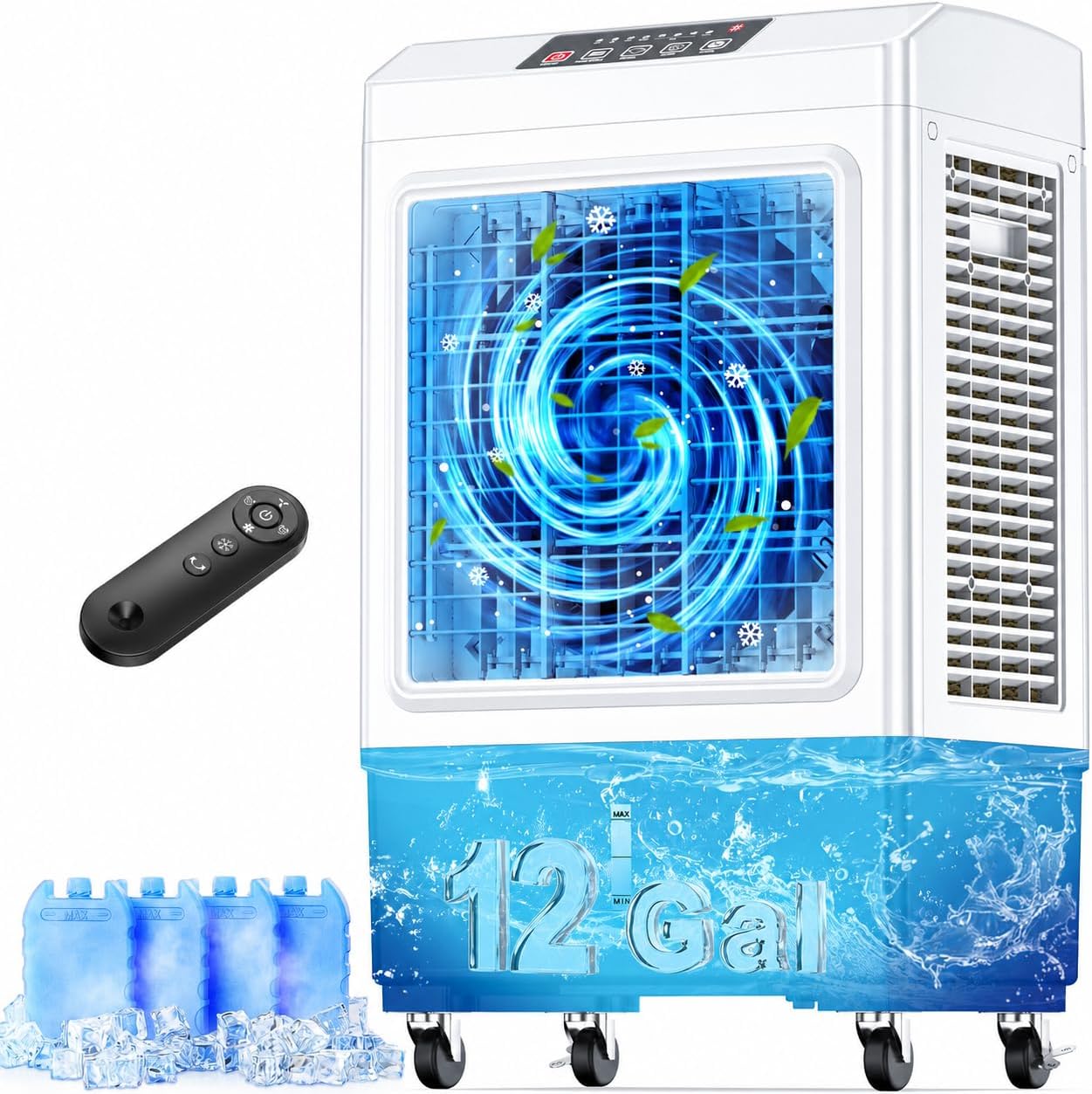
| Wattage | 100 watts |
|---|---|
| Noise | 45 db |
| Voltage | 120 volts |
| Included Components | 4 x Ice Packs; Remote Control |
The CENSTECH L242Y is a plug-and-play evaporative cooler built for easy indoor cooling without a hose or window kit. It draws air through three high-density honeycomb meshes and pushes up to 3600 CFM with 120-degree horizontal sweep and 70-degree vertical oscillation to spread airflow across large rooms. Operation is simple: fill the top tank or the larger bottom tank, add the included ice packs for stronger cooling, then choose among three speeds and four modes from the touch panel or the remote. Practical touches include a clear water-level indicator, bottom drainage port for cleaning, 7-hour timer, and caster wheels for repositioning. At 100 watts and under 45 dB it is energy efficient and quiet enough for bedroom use, though performance depends on ambient humidity because this is an evaporative cooler rather than refrigerated air conditioning. Setup and maintenance are straightforward, but users in very humid climates will see less temperature drop than in dry regions. The bladeless, UL-listed design and safety plug make it family friendly for bedrooms and shared spaces.
Best for: Buyers who want a no-install, energy-efficient bedroom cooler that prioritizes long run time, wide airflow coverage, and quiet operation in predominantly dry climates.
Less Ideal for: People who need air conditioning-level temperature drops in very humid climates or those seeking a compact, lightweight desktop cooler.
- Large 12-gallon dual-tank system supports long run times and top-fill convenience
- High airflow with wide oscillation spreads cooling across bigger rooms
- Multiple modes, three speeds, timer and remote allow easy, flexible control
- Low power draw (100W) and sub-45 dB noise level suitable for bedrooms
- Cooling effectiveness decreases in high-humidity environments since it is an evaporative cooler
- Large water capacity and tanks add bulk compared with compact portable fans
Verdict: For bedroom buyers in dry climates who want a quiet, energy-efficient, long-run evaporative cooler with easy top-fill and wide airflow, the CENSTECH L242Y is a strong choice.
SYUDTY GDS-820 Evaporative Cooler

| Air Flow Capacity | 3000 cfm |
|---|---|
| Reservoir Capacity | 6.87 gallons |
| Wattage | 150 watts |
| Noise | 52 db |
| Number of Speeds | 3 |
The SYUDTY GDS-820 is a windowless evaporative cooler intended to deliver fast, portable cooling in dry indoor spaces. It uses a high-density cooling pad, a large 6.87 gallon reservoir and a 2026-upgraded motor to push up to 3000 CFM of air, and it offers three fan speeds plus four modes (Normal, Natural, Sleep, Cooling). Controls are available on a top touch panel or via the included remote, and a 1–15 hour timer and 120° oscillation help distribute airflow across a room. Setup is simple: add water or ice packs to the tank, snap on the four 360° casters and plug it in, then adjust fan speed or mode. Practical benefits include added humidity in dry climates, lower energy draw compared with standard portable ACs, and easy mobility between rooms. Important limitations are that this is an evaporative cooler, so performance drops in high-humidity environments and it will not dehumidify or match the low temperatures of compressor-based air conditioners; it also produces noticeable noise at higher fan speeds.
Best for: Buyers who want an energy-efficient, mobile cooling option for dry climates and value easy setup and proven user feedback when choosing cooling gear.
Less Ideal for: People in humid regions or anyone who needs true refrigerated air conditioning or room dehumidification should consider compressor-based ACs instead.
- Very high airflow (3000 CFM) for fast air movement
- Large 6.87 gallon reservoir reduces refill frequency
- Multiple modes, 3 speeds and 120° oscillation improve distribution and comfort
- Remote and touch controls plus 1–15 hour timer add convenience
- Effectiveness decreases in high-humidity climates because it relies on evaporation
- Does not cool to same low temperatures as refrigerated portable air conditioners
- Noise can reach around 52 dB on higher settings
Verdict: Pick the SYUDTY GDS-820 if you need a high-airflow, energy-efficient windowless cooler that moves a lot of air and is easy to set up and move around in dry indoor spaces.
DREO TurboCool Misting Fan 516

| Air Flow Capacity | 512 cfm |
|---|---|
| Reservoir Capacity | 1.3 liters |
| Wattage | 50 watts |
| Noise | 20 db |
| Number of Speeds | 6 |
The DREO TurboCool Misting Fan 516 combines a 1.3 L visible water tank, ultrasonic ultrafine misting, and a focused airflow design to provide localized evaporative cooling for small rooms and bedrooms. It produces up to 512 CFM and roughly 26 ft/s wind while claiming a 5°F drop in perceived temperature; adjustable oscillation angles and a 30° vertical tilt let you aim the airflow where you need it. Controls include six speeds, a remote, timer, and two operating modes so you can run it quietly at night—noise is rated at about 20 dB. Practical features like the visible reservoir, portable tabletop form, and a 12-hour runtime per fill make it easy to use for overnight cooling without frequent refills. Expect the best results in dry, well-ventilated bedrooms because evaporative cooling is less effective in high humidity, and the unit is designed for spot cooling rather than whole-room air conditioning. The plastic construction keeps weight low but limits ruggedness compared with heavier appliances.
Best for: Buyers who prioritize quiet, low-maintenance spot cooling for a bedroom and want an easy-to-use misting fan that runs all night without frequent refills.
Less Ideal for: People needing whole-room air conditioning or effective cooling in high-humidity climates should consider other cooling technologies.
- Ultrafine ultrasonic mist provides cooling without noticeable wetness
- Large visible 1.3 L reservoir supports long runtimes between refills
- Remote control, timer, and six speeds enable convenient, quiet bedroom use
- Adjustable omni-directional oscillation and tilt let you target airflow
- Low noise operation (~20 dB) suitable for sleep or work environments
- Evaporative cooling performance drops in very humid environments
- Plastic build is lightweight but less durable than metal alternatives
Verdict: A quiet, easy-to-use misting fan that delivers targeted overnight evaporative cooling for bedrooms with low to moderate humidity.
SOLEEY F001 Portable Air Cooler
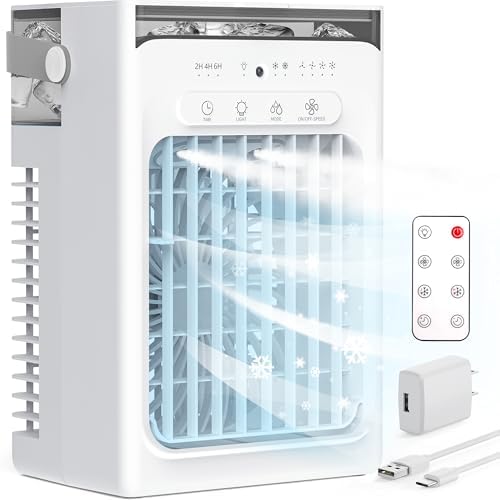
| Power Source | Corded Electric / USB |
|---|---|
| Water Tank Capacity | 1100 ml |
| Noise Level | ~50 dB |
| Timer | 2/4/6 hours |
The SOLEEY F001 is a small evaporative air cooler built for personal spaces like bedrooms, desks, or tents. It uses a water tank and dual ultrasonic nebulizers with a fan-driven evaporative system to lower local temperature and direct airflow with an adjustable shutter. Controls include a remote, four fan speeds, three cooling modes, a 2/4/6 hour auto timer, and a seven-color night light for bedside use. Practical benefits are its very low power draw (about 8W), light weight and USB or adapter power options, and a roughly 10-hour run time on the 1100 ml upper tank in dry conditions. Expect quiet operation suitable for sleep and simple maintenance since the lower anti-drip reservoir handles condensation. Important limitations are inherent to evaporative coolers: it cools a small area rather than a whole room and performs best in dry climates, and it will not reach the temperatures or dehumidifying effect of a compressor air conditioner.
Best for: Buyers on a tight budget who need a quiet, low-power personal cooler for a bedroom, dorm, or small workspace and prioritize portability and simple controls.
Less Ideal for: People who need whole-room or high-performance cooling, live in very humid climates, or want dehumidification and refrigeration-level temperature drops.
- Very low power draw for overnight use
- 1100 ml tank with up to ~10 hours runtime in dry conditions
- Remote control with multiple speeds, modes and timer for convenient bedside use
- Lightweight and portable for bedroom, office or camping use
- Effective cooling limited to a small personal area and best in low-humidity environments
- Not a replacement for a compressor air conditioner for whole-room cooling
Verdict: A very affordable, energy-sipping personal evaporative cooler well suited to quiet bedroom use and light-duty spot cooling.
Hessaire MC37M Evaporative Cooler

| Air Flow Capacity | 3100 cfm |
|---|---|
| Reservoir Capacity | 10.3 gallons |
| Floor Area | 950 square_feet |
| Wattage | 250 watts |
| Noise | 59 db |
The Hessaire MC37M is a freestanding evaporative cooler built to move a lot of air for its size, delivering up to 3,100 CFM through three high-density media panels and a winged propeller design. It is typically used in hot, dry bedrooms or small living spaces where evaporative cooling is effective; you fill the 10.3-gallon reservoir for roughly 3–4 hours of run time or hook up a garden hose for continuous operation. Controls are intentionally simple—a knob and three speeds—while oscillating louvers spread airflow across the room. At 250 watts and about 59 dB it provides strong, energy-efficient cooling with comparatively low noise. Practical limits are inherent to evaporative technology: performance drops in high humidity and the unit requires periodic refills, media maintenance, and occasional drying before storage. The polypropylene housing and caster wheels make it durable and easy to move, but it is not a sealed air conditioner and will not dehumidify or provide consistent set-point temperature control in humid climates.
Best for: Buyers who prioritize a dependable, high-airflow cooler that is easy to operate and built to last for bedroom or small-space use in dry climates.
Less Ideal for: People in humid climates or anyone needing precise temperature control and dehumidification should choose a refrigerated air conditioner instead.
- Very high airflow at 3,100 CFM for quick cooling in dry rooms
- Large 10.3-gallon tank with float valve and garden-hose hookup for extended runtime
- Simple manual knob controls and oscillating louvers for easy operation and wide coverage
- Relatively low power draw (250 watts) compared with refrigerated air conditioning
- Cooling effectiveness falls off in high-humidity environments where evaporative cooling is less efficient
- Requires water refills, periodic media maintenance, and drying before storage
Verdict: Choose the Hessaire MC37M when you want a reliable, high-airflow evaporative cooler that delivers strong, energy-efficient cooling for dry bedrooms and small spaces.
Arctic Air Pure Chill 2.0

| Form Factor | Personal |
|---|---|
| Voltage | 120 volts |
| Power Consumption | 8-10 watts |
| Speeds | 4 speed settings |
The Arctic Air Pure Chill 2.0 is a small, lightweight evaporative cooler intended for personal spot cooling in bedrooms, offices, or on a desk. You fill the top reservoir with water, plug it in, and choose one of four fan speeds using the touch controls; the unit uses Hydro-Chill technology and dual vents to direct airflow and adds a seven-color LED night light. It runs on about 8–10 watts, so it uses very little electricity and can operate for several hours between fills depending on settings and room humidity. The design is easy to move and the adjustable vents help aim the airflow, but its cooling effect is limited to a small area and performance depends heavily on ambient humidity and ventilation. There is no refrigerant-based cooling, so it will not lower whole-room temperature like a portable air conditioner, and the water tank needs periodic refills and cleaning to avoid odors. For a low-cost, energy-efficient personal cooler it is simple and straightforward to use, but expect modest results in hot, humid spaces.
Best for: Buyers who want an inexpensive, energy-frugal way to cool a personal workspace or bedside area and prioritize portability and simple operation over whole-room cooling.
Less Ideal for: People who need consistent whole-room temperature reduction or reliable cooling in hot, humid environments should consider a refrigerant-based portable air conditioner instead.
- Very low power consumption (8–10 watts) for long run times
- Top-fill water tank for simple refilling
- Four fan speeds and adjustable vents for directed airflow
- Lightweight, compact design makes it easy to move and place on a desk
- Effective cooling is limited to a small personal zone and depends on ambient humidity
- Requires regular refilling and occasional cleaning to prevent odors
Verdict: A very affordable, ultra-low-power personal cooler that delivers simple spot cooling and humidification for desks and bedside use.
Choosing the Right Evaporative Cooler for Bedroom: Key Factors to Consider
Room Size and Airflow Requirements
Matching the cooler's airflow to bedroom square footage is essential. A unit rated for a larger room may overwork in a small bedroom, causing unnecessary noise and dryness, while an undersized unit will struggle to move enough cooled air for comfort.
Look for spec sheets that list CFM or recommended room size and consider ceiling height. For open-plan sleeping areas or lofted ceilings you will need higher airflow. Also factor in how the unit is positioned; placing it near a window or doorway affects circulation and real-world performance.
Noise Output and Fan Speeds
Noise level is a top concern for bedrooms. Look for models with low decibel ratings at the speeds you expect to use overnight. Variable fan speeds and a dedicated quiet or sleep mode let you trade a little cooling capacity for much lower noise.
Consider the frequency of the sound as well as its loudness. Low-frequency hums can be less disruptive than high-pitched fans. Also check whether the unit's controls or indicator lights can be dimmed or turned off to avoid sleep disruption.
Water Tank Capacity and Runtime
Tank capacity determines how long the cooler can run between refills. For overnight use you want enough volume to operate through the night on the settings you prefer. Larger tanks reduce the need to wake up and refill but increase the unit's footprint and weight.
Also assess whether the unit supports continuous drain or external water hookup for longer-term unattended use. Easy-to-remove tanks and clear level indicators make routine refills less of a hassle.
Energy Use and Operating Cost
One reason many buyers choose evaporative coolers for bedrooms is their low electricity draw compared with refrigerated air conditioning. Still, power consumption varies by fan motor size and additional features like pumps or lights.
Check wattage and estimate nightly energy use based on typical run hours. If you run the unit every night, small differences in wattage add up over a season. Look for efficient motors and programmable timers to cut unnecessary runtime.
Maintenance and Filter or Pad Replacement
Evaporative cooling relies on pads or filters that wick water and should be cleaned or replaced periodically. Easy access to these components reduces the time and effort required to keep the unit performing well.
Find models with washable pads, clear replacement intervals, and widely available parts. Consider how easy it is to flush the water reservoir and whether there are anti-microbial treatments or washable covers that reduce odor and buildup.
Sizing Your Evaporative Cooler for Bedroom Use
Calculate the square footage of your bedroom and compare it to the cooler's recommended coverage. Most manufacturers list CFM or suggested room sizes; use those as a baseline but adjust for ceiling height, open floor plans, and how airtight the space is.
Small bedrooms often need a compact unit with focused airflow, while larger master bedrooms will benefit from higher CFM and wider louvers. Also think about where you will place the cooler so airflow reaches the sleeping area without creating direct drafts on the bed unless you prefer that.
- Measure floor area and ceiling height before choosing capacity
- Place unit near a window or doorway for best airflow exchange
- Use oscillation or directional louvers to distribute air evenly
Managing Humidity and Climate Suitability
Evaporative coolers work best in dry climates where adding moisture to the air increases comfort. In humid environments they are less effective and can raise indoor humidity to uncomfortable levels.
If you live in a moderately humid area, choose a unit with adjustable water flow or variable fan speeds so you can limit humidity build-up. Monitor indoor humidity levels after installing a cooler and use it strategically during the driest parts of the day and night.
- Ideal for arid to semi-arid climates
- Avoid continuous use in high-humidity conditions
- Consider a hygrometer to monitor indoor humidity changes
Quiet Control Options and Sleep-Friendly Features
Look for models that explicitly list a low-decibel sleep mode and offer multiple speed settings. Timer features let you run the unit while falling asleep and shut off after a set period, reducing noise later in the night.
Remote controls, dimmable displays, and low-vibration fan mounts are small features that improve nighttime comfort. If you are sensitive to light, check whether indicators can be silenced or covered.
- Choose models with sleep or low-noise modes
- Prefer units with timers and remote control
- Check for dimmable or turn-off-able display lights
Placement, Ventilation, and Window Use
Proper placement affects both cooling effectiveness and noise. Position the cooler to create a cross-breeze when possible, and ensure the intake and exhaust are not blocked by furniture or curtains.
Many bedroom setups work best with the cooler near a window or an open interior door to allow fresh air exchange. Avoid corners or tight spaces that restrict airflow and raise operating noise.
- Keep intake and exhaust clear of obstructions
- Use near a window or open doorway for best ventilation
- Avoid placing directly beside the bed if you prefer indirect airflow
Cleaning and Winter Storage
Routine cleaning extends the life of pads and prevents odor. Empty and dry the water tank if you will store the unit during the off-season to avoid mildew. Many units benefit from an end-of-season deep clean and full pad drying.
If winter storage is required, remove and dry pads, run a rinse cycle, and store the unit in a dry place. Labeling parts and keeping the manual can make reassembly easier next season.
- Rinse pads and allow full dry between uses to prevent mold
- Empty and dry tank before storage
- Follow manufacturer guidance for pad replacement intervals
How We Chose the Best Evaporative Cooler for Bedroom
We focused on features and performance that matter specifically for bedroom use. Our selection criteria prioritized measurable, user-facing dimensions that affect comfort and convenience at night. Key evaluation points included airflow capacity relative to bedroom square footage, continuous runtime and tank capacity, measured noise levels at typical fan speeds, energy consumption for overnight use, and maintenance needs such as pad replacement and cleaning access. We also considered control options and timer features that support sleep routines, and safety elements like tip-over protection and child-lock settings. Units with vague spec sheets, poor user-serviceability, or lacking basic safety features were excluded. We favored products that demonstrate a clear balance between quiet operation and effective evaporative cooling rather than extreme performance in one area with major tradeoffs in others. Editorially, we compared published specifications, user-oriented features, and common maintenance realities to create a list that helps bedroom buyers choose confidently.
Our full evaluation process is outlined in our review methodology.
FAQ
Are evaporative coolers effective for all bedrooms?
They are most effective in dry climates. In humid bedrooms they provide limited cooling and can raise indoor humidity, so effectiveness depends on local climate and room ventilation.
How loud are bedroom-focused evaporative coolers at night?
Noise varies by model and fan speed. Look for units with low-decibel sleep modes and multiple fan settings to reduce noise while you sleep.
How often do I need to refill the water tank?
Refill frequency depends on tank capacity and operating settings. Larger tanks and lower fan speeds extend runtime, while continuous high-speed use shortens it.
Do evaporative coolers add humidity to the bedroom?
Yes. They work by adding moisture to the air, which helps cooling in dry climates but can be problematic in already humid rooms.
What maintenance should I expect?
You should clean or replace pads per the manufacturer's guidance, rinse the tank regularly, and dry components before storage to prevent mildew and maintain performance.
Final Verdict
For bedroom use, prioritize noise level, appropriate airflow for your room size, and sufficient tank capacity to avoid frequent refills. Balance those with energy efficiency and easy maintenance to keep nighttime operation hassle-free. Choose the unit that matches your climate and sleep preferences, and you will get the most comfortable, quiet cooling for a good night's rest.