
Note: This article contains affiliate links. If you click on these links and make a purchase, we may earn a small commission at no extra cost to you. This helps support our research and content. Read our full affiliate disclosure here.
Garages and workshops are different from living rooms. You need cooling that moves large volumes of air, tolerates dust and tools, and fits limited power and ventilation scenarios. Selecting the right evaporative cooler for your garage affects how comfortable and productive you can be during hot months, and it can reduce the need to run heavy air conditioning. This guide shortlists the top evaporative coolers for garage use and explains the practical tradeoffs. We evaluated airflow, water use, build and filter durability, and portability so you can pick a unit suited to your garage layout and workload. Read on for our top picks and the criteria we used to choose them.
Top Picks at a Glance
| Best Overall The best all-around choice for most situations | YougetTech 3000CFM Evaporative Cooler | 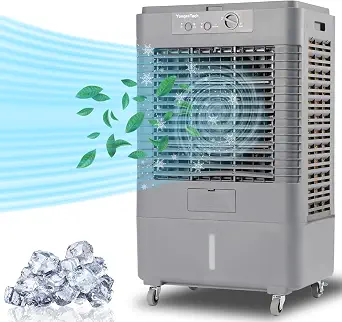 |
| Best Quality Built to a higher standard if you want something more solid | Uthfy 41" Swamp Cooler |  |
| Best Value The sweet spot between price and what you get | Auertech 8.5 Gal Swamp Cooler |  |
| Best Budget The cheapest option that still gets the job done reliably | Tehanld Evaporative Cooler 100l3 |  |
| Top Rated A top-rated pick with lots of positive feedback | Hessaire MC37M Evaporative Cooler |  |
| Most Popular A crowd favorite that many people choose with confidence | Hessaire MC18M Evaporative Cooler |  |
| Best Seller A high-volume bestseller chosen again and again | Ylkf TT-20 Portable Evaporative Cooler |  |
YougetTech 3000CFM Evaporative Cooler

| Airflow | 3000 CFM |
|---|---|
| Water Tank Capacity | 8 gallons |
| Wattage | 160 watts |
| Number of Power Levels | 3 |
| Noise | 55 db |
The YougetTech 3000CFM is a portable evaporative cooler built to move a lot of air across open spaces such as garages, patios, and workshops. It uses a three‑sided 3D honeycomb cooling pad and water evaporation to lower air temperature without refrigerants, and the 3000 CFM fan combined with 120° oscillation helps spread cooled air across a wide area. Controls are simple push‑button and dial style with three speeds and both horizontal and vertical swing for even circulation. The built‑in 8‑gallon tank can run many hours on low and supports automatic refill via a garden hose adapter, so it is convenient for long outdoor jobs or events. Mobility is good thanks to four caster wheels, two of which lock, and the top toolbox and dust bag add practical storage and protection. Keep in mind this is an evaporative unit, so performance drops in high humidity and it humidifies the space rather than dehumidifying it, and it will not reach the same low temperatures as a refrigerated air conditioner.
Best for: A buyer who wants a low‑energy, high‑airflow cooler for ventilated garages, patios, or workshops and values long unattended run time and easy mobility.
Less Ideal for: People who need reliable cooling in small, sealed rooms or in humid climates should choose a refrigerated air conditioner instead.
- High airflow for large open areas with 3000 CFM and 120° oscillation
- Large 8‑gallon water tank with optional auto fill via garden hose adapter
- 3D honeycomb cooling pads for improved evaporative efficiency
- Easy mobility with four caster wheels and two lockable brakes
- Simple mechanical controls and built‑in toolbox for straightforward outdoor use
- Not effective in high humidity since it relies on evaporative cooling
- Does not cool like a compressor AC and will not lower temperature in enclosed, sealed spaces
Verdict: Choose this unit if you need a portable, energy‑efficient evaporative cooler that moves large volumes of air and can run long hours in ventilated garage or patio settings.
Uthfy 41" Swamp Cooler

| Air Flow Capacity | 4800 cfm |
|---|---|
| Reservoir Capacity | 10.6 gallons |
| Floor Area | 1200 square_feet |
| Wattage | 200 watts |
| Noise | 45 db |
The Uthfy 41" swamp cooler is a power-focused evaporative cooler built to move a lot of air across big spaces such as garages, workshops, and patios. It uses a metal sheet-body and a copper motor to drive a large fan that delivers up to 4800 CFM through three-sided cooling pads, and it offers three manual speeds plus automatic 120° side-to-side oscillation for broad coverage. The 10.6-gallon reservoir supports long runtime and can be refilled by top fill or hooked to a hose for automatic filling, while included ice boxes give an extra short-term temperature drop in drier conditions. Mobility is straightforward thanks to four 360° caster wheels, two with brakes for secure placement. Important practical limits: as an evaporative cooler it raises humidity and works best in dry climates or with open ventilation, and it will not match a refrigerant AC for low absolute temperatures in humid environments. Noise is moderate at about 45 dB and controls are basic buttons rather than a digital interface. For garages that need high airflow and energy-efficient spot cooling in dry heat, this is a strong performer.
Best for: Buyers who prioritize high airflow and reliable, energy-efficient spot cooling for large, dry garages or workspaces and who value durable, easy-to-move equipment.
Less Ideal for: People in humid climates or users needing HVAC-level temperature drops inside fully enclosed spaces should consider refrigerant-based air conditioning instead.
- High airflow capacity at 4800 CFM suitable for large garages and workshops.
- Large 10.6-gallon tank with top-fill and hose hookup for long unattended runtime.
- Durable sheet metal body and copper motor designed for outdoor or garage use.
- Wide 120° oscillation and three-sided cooling pads provide broad, even air distribution.
- Easy mobility with four heavy-duty caster wheels and two brake locks.
- Performance declines in high-humidity environments since it is an evaporative cooler.
- Controls are simple mechanical buttons without advanced scheduling or digital display.
- Not a replacement for a refrigerant air conditioner when low absolute temperatures are required.
Verdict: If you need powerful, energy-efficient spot cooling for a large, dry garage or workshop, this 4800 CFM swamp cooler delivers strong airflow and long runtime with durable construction.
Auertech 8.5 Gal Swamp Cooler

| Air Flow Capacity | 2800 cfm |
|---|---|
| Reservoir Capacity | 8.5 gallons |
| Wattage | 150 watts |
| Number of Speeds | 3 |
| Floor Area | 650 square_feet |
This Auertech swamp cooler moves a lot of air for its size, using a 150W motor to produce up to 2800 CFM and a 120° oscillation to spread airflow across a garage or workshop. It uses evaporative cooling from an 8.5 gallon reservoir with top-fill access and includes six ice packs for extra cooling on hot days, which is handy for temporary boosts. Controls are straightforward: a touch panel plus a handheld remote, three fan speeds and a 12-hour timer let you run it on a schedule without climbing up to adjust settings. The unit ships mostly assembled and rolls on four casters, two of which lock, so you can reposition it easily on concrete or sealed garage floors. Because it is an evaporative cooler, performance depends on low ambient humidity and it will add some moisture to the space, so it is best for dry climates or ventilated garages rather than sealed, humid environments. The plastic construction keeps weight down but may not be as rugged as metal-bodied outdoor models. For spot cooling in a dry garage, this delivers strong airflow and simple, practical controls.
Best for: Buyers who prioritize practical, high-airflow spot cooling for a dry garage or workshop and want simple, low-effort operation and mobility.
Less Ideal for: Those in high-humidity areas or looking for a sealed air conditioner for enclosed, moisture-sensitive spaces should consider alternative cooling types.
- High airflow output (2800 CFM) suitable for spot-cooling garages and workshops
- Large 8.5 gallon top-fill reservoir for longer runtimes and easy refills
- Remote and touch controls with 12-hour timer for convenient operation from across the room
- Included ice packs and 3 speed settings allow extra cooling flexibility
- Built-in casters with two locks make it easy to move and secure on hard floors
- Evaporative cooling adds humidity and works best only in dry climates
- Polypropylene body may be less durable for heavy outdoor use compared with metal housings
Verdict: Auertech 8.5 Gal Swamp Cooler is a no-nonsense, high-airflow evaporative cooler that’s ideal for practical spot cooling in dry garages and workshops.
Tehanld Evaporative Cooler 100l3

| Cooling Power | 1 KW |
|---|---|
| Capacity | 5.3 gallons |
| Noise | 39 db |
| Wattage | 60 watts |
This portable evaporative cooler is built for large, dry spaces like garages and workshops, using a 5.3-gallon tank and strong 1700 CFM airflow to move cool, humidified air across wide areas. It operates as a 3-in-1 cooler, fan, and humidifier with 120 degree horizontal oscillation and adjustable vertical louvers to reduce hot spots, and it includes four ice packs for extra cooling when needed. Controls are simple via a top touch panel or a long-range remote, and practical features like top-fill access, a clear water-level window, caster wheels with brakes, and an automatic low-water shutoff make daily use straightforward. The unit is energy efficient at 60 watts and runs quietly under 40 dB, which helps for overnight or long-run use. Its performance is best in dry climates and it will not match a refrigerant-based air conditioner in humidity or temperature drop, so it is a budget-minded way to cool large, arid spaces rather than replace a traditional AC.
Best for: People wanting an affordable, low-energy cooler for garages, workshops, or other large dry spaces who prioritize wide airflow and easy mobility over refrigerated cooling performance.
Less Ideal for: Those in humid climates or anyone needing strong temperature drops like a conventional air conditioner should look at refrigerant-based AC solutions instead.
- High airflow (1700 CFM) and 120° oscillation for broad coverage across large spaces
- Large 5.3-gallon tank with top-fill design and clear water-level window for fewer refills
- Low power draw (60W) for energy-efficient operation compared with portable AC
- Quiet operation under 40 dB and sleep mode for overnight use
- Remote and touch controls plus caster wheels with brakes for easy placement and control
- Effective cooling relies on dry climates and will not lower temperatures as much as a refrigerated air conditioner
- No mention of built-in filtration for dust or allergens
Verdict: A budget-friendly, low-energy evaporative cooler that moves a lot of air and is well suited to cooling large, dry garages and workshops.
Hessaire MC37M Evaporative Cooler

| Air Flow Capacity | 3100 cfm |
|---|---|
| Reservoir Capacity | 10.3 gallons |
| Floor Area | 950 square_feet |
| Wattage | 250 watts |
| Noise | 59 db |
The Hessaire MC37M is a freestanding evaporative cooler built to move a lot of air for its size, using three high-density media panels and a winged propeller to deliver up to 3,100 CFM. It is typically used in hot, dry spaces like garages or covered outdoor areas where evaporative cooling is effective; fill the 10.3 gallon tank for several hours of run time or attach a garden hose for continuous operation. Controls are simple knob-style settings with three speeds and oscillating louvers to spread airflow across a wide area, and caster wheels make repositioning straightforward. At 250 watts and about 59 dB reported noise, it is noticeably more energy efficient and quieter than many refrigerated systems of similar output, but like all swamp coolers it performs poorly in high-humidity environments. The construction uses polypropylene for weather resistance and the unit is serviceable with replacement media and parts available, though operation is manual without smart controls or automatic climate sensing.
Best for: Buyers who prioritize a dependable, heavy-duty cooler for large, dry garages or open workspaces and who value simple, serviceable equipment over smart features.
Less Ideal for: People in humid climates or buyers who need precise temperature control or automated scheduling should consider other cooling methods.
- Very high airflow at 3,100 CFM suitable for large garages and workshops
- Large 10.3 gallon reservoir with garden-hose hookup for extended continuous use
- Simple, durable construction with caster wheels for easy mobility
- Energy efficient 250 watt motor compared with refrigerated air conditioning
- Effectiveness drops significantly in high-humidity conditions
- Manual controls only, no timers or smart features
Verdict: Choose the Hessaire MC37M when you need a reliable, high‑CFM evaporative cooler to move lots of air across a garage or workshop in dry conditions.
Hessaire MC18M Evaporative Cooler
| Air Flow Capacity | 1300 cfm |
|---|---|
| Reservoir Capacity | 4.8 gallons |
| Floor Area | 500 square_feet |
| Wattage | 85 watts |
| Noise | 53.4 db |
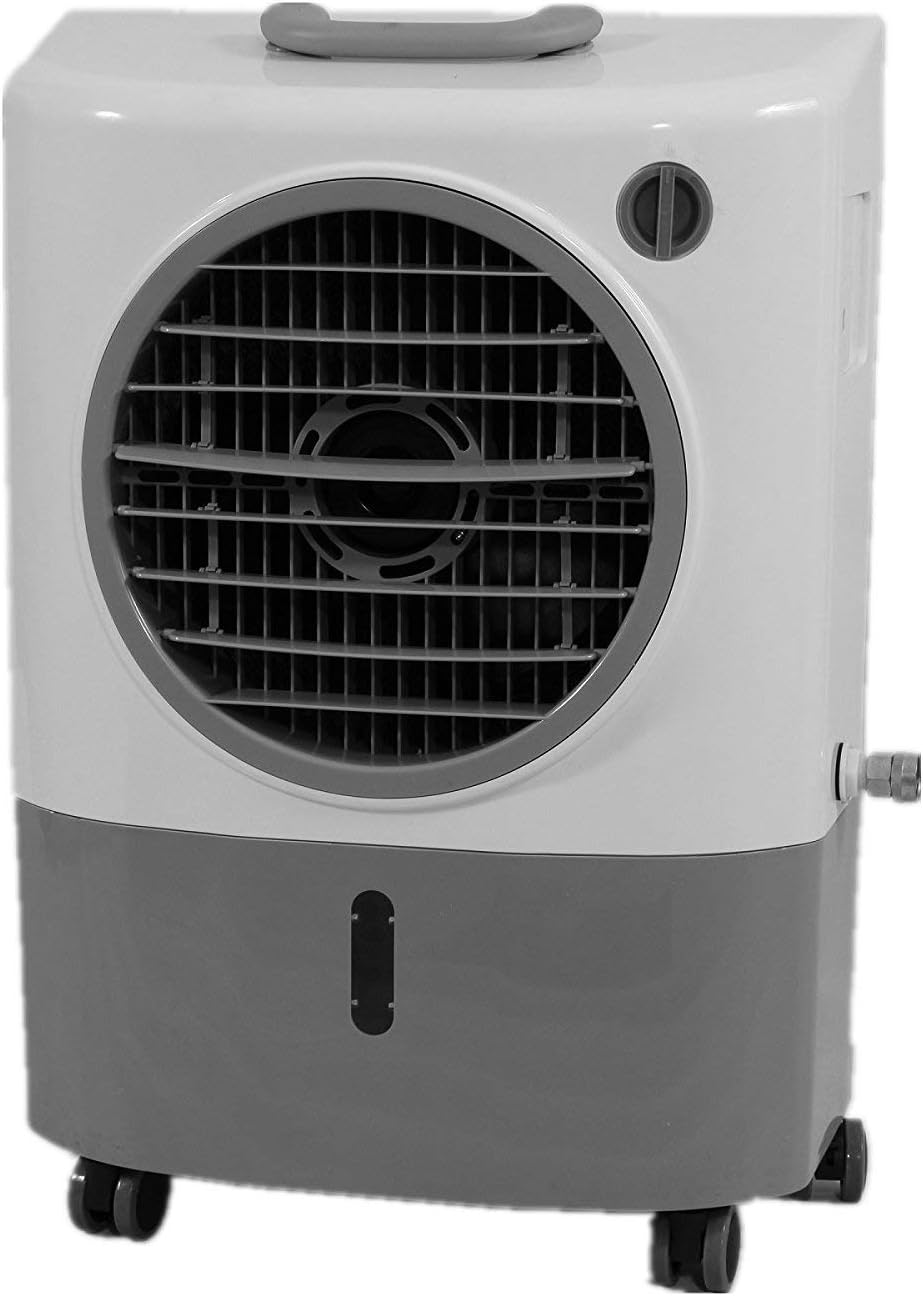
The Hessaire MC18M is a freestanding evaporative cooler designed to move a lot of air for its size, making it suited to garages, patios, and other open or well-ventilated spaces. It pulls air through high-density XeL50 media and uses a 4.8-gallon tank with an optional garden-hose fill to provide roughly 3 to 4 hours of wet-media cooling between refills, and it also has a fan-only mode for circulation without evaporation. Controls are simple rotary knobs and two main fan speed settings, and the unit rolls on casters for easy placement. Practical benefits include low power draw around 82 to 85 watts, quieter operation relative to many high-velocity fans, and durable polypropylene construction for occasional outdoor use. Limitations to note: evaporative coolers work best in dry, ventilated environments and lose effectiveness in high humidity or fully enclosed garages without adequate exhaust, and the basic two-speed/manual controls offer less precision than variable-speed electric fans or air conditioners.
Best for: Someone who needs an inexpensive, low-power way to move cooling air through a garage or open workshop in a hot, dry climate and values easy setup and visible user feedback from other buyers.
Less Ideal for: People who need precise temperature control or who plan to cool tightly sealed, high-humidity garages should consider refrigeration-based air conditioners instead.
- High airflow at 1300 CFM suitable for cooling large open garage spaces
- 4.8-gallon tank with garden-hose adapter for extended run time and easy refill
- Low energy use around 82–85 watts for continuous operation
- Portable design with caster wheels and a handle for simple repositioning
- Performance drops significantly in humid conditions or sealed rooms
- Only two main fan speeds and manual controls limit fine-tuning
- Requires regular filter/media maintenance and tank draining after use
Verdict: A budget-friendly, low-energy evaporative cooler that delivers strong airflow for vented garages and dry climates.
Ylkf TT-20 Portable Evaporative Cooler

| Water tank | 1200 ml |
|---|---|
| Wattage | 7 watts |
| Noise | 45 db |
| Voltage | 5 volts |
The Ylkf TT-20 is a compact evaporative cooler meant to deliver a chilled mist to a small personal area such as a desk, bedside table, or tight vehicle cabin. It uses a 1200ml top-fill water tank that can accept ice for extra cooling and runs on 5V USB power at about 7 watts, so it is very energy efficient and portable. Controls include multiple fan speeds, a 2/4/8 hour timer, and modest ambient lighting, while the unit advertises automatic shutoff when the tank runs dry and quiet operation around 45 dB. In practice this model creates a focused cooling bubble rather than lowering whole-room temperature, so it is best for close-range relief during heat spells; it will not replace a garage-grade evaporative cooler for large open spaces. The compact footprint and USB power make it easy to move and run off a power bank or USB outlet, but expect limited airflow range and the need to refill the tank for extended use.
Best for: Buyers who want a low-risk, low-power personal cooler for a specific spot in a garage or workshop—someone who values portability, quiet operation, and simple plug-and-play use.
Less Ideal for: People seeking to cool an entire garage, large workshop, or multiple occupants should choose a purpose-built garage evaporative cooler instead.
- Large 1200ml tank supports up to about 7 hours of misting per fill
- USB 5V / 7W power makes it energy efficient and easy to run from USB outlets or power banks
- Quiet operation around 45 dB suitable for bedside or desk use
- Top-fill design accepts ice for an immediate cooling boost and has auto-off when empty
- Designed for close-range personal cooling and cannot cool large or open garage spaces
- Limited airflow strength compared with full-size evaporative coolers
Verdict: A compact, energy-efficient personal evaporative cooler that delivers quiet, close-range cooling and easy USB-powered portability for spot cooling in a garage or workspace.
Choosing the Right Evaporative Cooler for Garage: Key Factors to Consider
Airflow Capacity
Airflow capacity is the single most important factor for garage cooling because garages are larger and less insulated than living spaces. Higher CFM values indicate the unit can move more air, which helps displace hot pockets and increase evaporative cooling effectiveness. Consider both peak CFM and how many distinct speed settings the unit offers; flexible speed control helps you balance cooling power with noise.
Also think about directional airflow. Units with louvers or oscillation can distribute cooler air across a wider area in an open bay, whereas fixed high-velocity fans are better for targeted spot cooling near workbenches.
Water Reservoir Size and Efficiency
Water reservoir size determines how often you need to refill the cooler, which matters in a garage where access to a tap or hose may be limited. Larger tanks extend runtime but add weight and require stable placement. Evaluate stated run times at typical fan speeds rather than just tank capacity, because pump and pad efficiency affects actual duration between refills.
Water efficiency also affects operating costs and maintenance. Systems that recycle water within the housing or use thicker, more effective pads can provide longer continuous cooling for the same tank size.
Cooling Pad Material and Serviceability
Cooling pads are the heart of evaporative systems. For garages, choose durable pad materials that resist collapse or clogging from dust and workshop debris. Rigid or honeycomb pads typically last longer than thin fiber pads under dusty conditions.
Serviceability matters because pads will need periodic cleaning or replacement. Look for units with accessible panels and simple pad-removal procedures so you can flush debris and swap pads without specialized tools.
Durability and Build Quality
Garages expose equipment to dust, temperature swings, and physical knocks. Robust housings, reinforced corners, and corrosion-resistant components prolong service life. Check for sealed electronics or raised control panels to reduce exposure to splashes and grime.
Also consider how the unit handles vibration and prolonged duty cycles. Heavy-duty motors and well-supported fan assemblies are less likely to develop wobble or bearing failure in a workshop environment.
Noise and Fan Control
Noise is a practical concern when you are working near a cooler. High airflow often comes with higher noise, so assess available speed steps and any low-noise mode for prolonged tasks. Some units include variable-speed motors, which let you run quieter at reduced power while still achieving useful airflow.
Pay attention to how noise is measured. Manufacturer decibel figures can vary by testing conditions, so prefer units with multiple speeds and the option to direct airflow away from hearing-sensitive areas.
Placement, Portability, and Mounting Options
Garage layouts vary, so choose a cooler that fits where you need it. Portable units with sturdy caster wheels offer flexibility if you move between work zones. Slim or wall-mountable units may be preferable in cramped garages where floor space is limited.
Consider weight when filled with water, handle placement for moving, and whether the unit can be secured or anchored. Some coolers offer hanging or window-mount options that can improve cross-ventilation when used with open doors or windows.
Sizing Your Garage and Matching CFM
Estimate your garage volume by multiplying floor area by ceiling height, then target an evaporative cooler that can cycle that volume several times per hour. For open or semi-open garages, aim higher since outdoor heat gain increases demand. For enclosed single-car garages, a more modest rated CFM may suffice, but higher airflow remains useful for dispersing heat from tools and vehicles.
If you plan to use the cooler while running heat-generating tools, add an extra margin to your CFM target to account for localized heat sources. Also consider direct spot cooling for workbenches if full-space circulation is impractical.
- Calculate volume: length x width x height.
- Factor in open doors or bays that reduce effective cooling.
- Add margin for heat-producing equipment.
Installation and Ventilation Tips
Evaporative coolers work best with some airflow exchange. In a garage, position the unit to promote cross ventilation toward an open door or window. Avoid sealing the garage completely, as the evaporative process needs a steady supply of drier outside air to deliver meaningful cooling.
If you must use a cooler in a mostly enclosed garage, run it intermittently and rely on exhaust fans or partially opened doors to prevent humidity buildup. Proper placement also keeps the unit away from dust-producing activities and reduces clogging.
- Point airflow toward an exit or open bay to encourage cross flow.
- Avoid placing the unit directly in sawdust or grinding debris.
- Use a drip tray or mat under the unit to protect the floor from spills.
Maintenance Routines for Garage Use
Establish a simple maintenance schedule: check and clean pads monthly during heavy use, inspect the water reservoir for sediment, and clean intake grills or prefilters to maintain airflow. Replace pads as soon as you notice reduced evaporative action or degraded material.
Keep the pump and float assembly free of scale by flushing with clean water occasionally. In winter or prolonged storage, drain the tank and dry pads to prevent mold and odor formation.
- Monthly pad inspection and cleaning during peak season.
- Flush reservoir and pump every few weeks if water is hard or dirty.
- Store dry and drained when not used for extended periods.
Power Requirements and Circuit Considerations
Check the cooler's rated power draw and motor starting current before plugging into garage circuits that may already serve compressors, battery chargers, or power tools. Some larger units have higher startup amps and may trip weak circuits if other heavy loads are running.
If you plan to run multiple devices at once, distribute loads across different circuits or avoid high-startup appliances running simultaneously. Hardwiring or dedicated circuits are usually unnecessary, but be mindful of extension cord gauge and length to avoid voltage drop.
- Compare rated watts and note startup current if available.
- Avoid sharing a circuit with large power tools during peak use.
- Use heavy-gauge extension cords if required and keep runs short.
Humidity and Local Climate Effects
Evaporative coolers perform best in dry climates and lose effectiveness as ambient humidity rises. In humid regions, an evaporative cooler can still move air and provide comfort from increased airflow, but do not expect the same temperature drop seen in arid conditions.
Monitor garage humidity during operation. If humidity accumulates, run ventilation or supplemental exhaust to maintain evaporative performance and reduce the risk of condensation on tools and metal surfaces.
- Best results in low-humidity environments.
- Use ventilation to manage indoor humidity buildup.
- Consider portable dehumidifiers only if condensation becomes problematic.
How We Chose the Best Evaporative Cooler for Garage
We focused on features that directly affect real-world garage cooling performance and durability. Primary evaluation criteria included sustained airflow capacity measured by rated CFM or manufacturer specs, as garages need high-volume air movement to displace heat. Water efficiency and reservoir size were examined because garages often lack convenient refill points; units with larger tanks or higher evaporative efficiency run longer between refills. Build quality and filter/pad durability were prioritized to ensure the cooler tolerates dust, debris, and occasional tool impacts common in workshop environments. Noise level and fan speed control were considered since garages double as workspaces where hearing protection or conversation may be necessary. Portability and mounting flexibility were also weighed to match typical garage configurations and limited floor space. We excluded units intended only for enclosed, climate-controlled living spaces or those that rely on delicate components unsuitable for dusty or dirty environments. We did not consider units that require special plumbing or permanent installation that is impractical for most garage users. Final selections balanced airflow, run time between refills, ruggedness of cooling pads and housing, noise, and ease of maintenance.
Our full evaluation process is outlined in our review methodology.
FAQ
Can I use an evaporative cooler in a closed garage?
You can, but performance will be limited unless you provide ventilation. Evaporative coolers need a supply of drier outside air to evaporate water efficiently. Without cross ventilation, humidity will build up and cooling effectiveness decreases.
How often will I need to refill the water tank?
Refill frequency depends on tank size, fan speed, and ambient conditions. Expect shorter intervals on high fan settings and in dry, hot weather. Choose a unit with a larger reservoir or easy refill access if frequent refilling would be inconvenient.
Are cooling pads hard to replace in a garage environment?
Pads can be replaced, but durability matters. Sturdier pad materials resist clogging and collapse in dusty garages and are often designed for tool-free removal. Plan on periodic replacement based on wear and local dust levels.
Will an evaporative cooler make the garage too humid?
Some humidity increase is normal while the unit is running. With adequate ventilation toward an open door or window, humidity will disperse. In fully enclosed garages, humidity can rise enough to reduce cooling effectiveness and may require intermittent ventilation.
Can I run an evaporative cooler while using power tools?
Yes, but be mindful of circuit load and dust. High-draw tools on the same circuit can trip breakers if currents add up. Also avoid directing the cooler intake at areas producing heavy dust to reduce filter and pad fouling.
Final Verdict
For garage cooling, prioritize airflow, durable pads, and a water capacity that fits how you plan to use the space. Expect tradeoffs between raw CFM and noise, and choose a unit that lets you control fan speed to match tasks. Durable construction and easy maintenance will extend service life in a dusty workshop environment. Focus on matching the cooler's airflow to your garage volume, ensuring you have ventilation for evaporative performance, and planning for simple pad and reservoir care. That approach will help you select an evaporative cooler that keeps your garage comfortable and productive through the heat.