
Note: This article contains affiliate links. If you click on these links and make a purchase, we may earn a small commission at no extra cost to you. This helps support our research and content. Read our full affiliate disclosure here.
Living in an apartment changes what matters in a fan. You likely need something that cools effectively without taking up much floor space, runs quietly at night, and uses modest electricity. This guide walks you through a curated shortlist of the six best fans for apartments selected for those constraints. We evaluated options for their footprint, sound output, airflow distribution, and convenience features so you can pick a model that fits your layout and lifestyle. Read on for practical buying guidance and the full set of top picks.
Top Picks at a Glance
| Best Overall The best all-around choice for most situations | Levoit Classic 36-inch Tower Fan |  |
| Best Quality Built to a higher standard if you want something more solid | Shark TurboBlade TF202S |  |
| Best Value The sweet spot between price and what you get | Amazon Basics 28" Tower Fan DC1663 |  |
| Best Budget The cheapest option that still gets the job done reliably | Honeywell TurboForce HT-900 |  |
| Top Rated A top-rated pick with lots of positive feedback | DREO TurboPoly Fan 513S |  |
| Most Popular A crowd favorite that many people choose with confidence | DREO Tower Fan 307 |  |
Levoit Classic 36-inch Tower Fan

| Number of Speeds | 5 |
|---|---|
| Noise Level | 28 db |
| Wattage | 39 watts |
| Air Flow Capacity | 1044 cfm |
| Control Method | Remote |
The Levoit Classic 36-inch tower fan is a slim floor fan designed for bedroom or apartment use, offering 5 speeds, 4 modes (Normal, Turbo, Sleep, Auto) and a 90 degree oscillation for whole-room air circulation. It uses an AC motor and produces up to 28 ft/s airflow with a reported 1044 cfm capacity while keeping noise down to about 28 dB on low, making it suitable for night use. The built-in temperature sensor lets the fan auto-adjust speed based on room temperature, and Turbo mode temporarily forces higher output for quick cooling. Controls are available on a touchpad and with the included remote, and a 12-hour timer plus an Advanced Sleep mode that silences the display are helpful for overnight comfort. The fan is lightweight and easy to clean thanks to a removable back grille, though it is a plastic housing unit and lacks smart-home connectivity. For apartment living it balances quiet operation, solid airflow, and simple remote control, while those wanting app control or a metal build may need to look elsewhere.
Best for: Apartment dwellers who want a quiet, easy-to-use tower fan that fills small to medium rooms and automatically adjusts to room temperature for comfortable overnight use.
Less Ideal for: Buyers who need smart-home integration, premium metal construction, or industrial-strength airflow for large open spaces should consider other options.
- Quiet low-speed operation around 28 dB suitable for bedrooms
- Built-in temperature sensor with Auto mode that adapts fan speed automatically
- Five speeds, Turbo and Sleep modes plus 90° oscillation for whole-room coverage
- Remote control and touchpad provide convenient bedside operation
- Removable back grille for straightforward cleaning
- No smart home or Wi‑Fi connectivity for remote scheduling or voice control
- Plastic construction may feel less durable than metal-bodied fans
Verdict: A quiet, easy-to-clean tower fan with adaptive temperature-based airflow that fits apartment bedrooms and small living spaces well.
Shark TurboBlade TF202S

| Number of Speeds | 10 |
|---|---|
| Noise Level | 53 db |
| Wattage | 192 watts |
| Air Flow Capacity | 85 cfm |
| Control Method | Remote |
The Shark TurboBlade TF202S is a high-performance bladeless tower fan designed to move air across a room with flexible directionality and quiet operation. It pulls air through a bladeless enclosure and can pivot between vertical and horizontal orientations, twist its vents, and oscillate up to 180 degrees to deliver broad coverage or a focused breeze. The unit offers 10 speeds paired with 10 noise levels so you can dial output from whisper-quiet to strong airflow, and a brushless motor and 85 cfm airflow rating point to efficient, sustained performance. Practical touches include DustDefense for easier cleaning and a magnetic remote for convenient control. On the downside it draws up to 192 watts at high settings and the listed noise benchmark (53 dB) means the highest speeds are audible; the fan is also a fairly large floor unit so it needs clear floor space. For apartment living it excels at moving air into corners and down long rooms, but expect some sound and power use at top output.
Best for: Buyers who prioritize strong, customizable airflow in an apartment and want a versatile fan that can target different room layouts while offering quiet low-speed options.
Less Ideal for: Those seeking an ultra-compact, closetable fan or the lowest possible energy draw for continuous 24/7 operation should consider smaller or lower-wattage alternatives.
- Bladeless design with pivoting vents and 180° oscillation for wide directional control
- Ten-speed and ten-noise-level settings let you balance airflow and quiet operation
- Brushless motor for efficient, durable performance
- DustDefense feature and easy-to-clean tower design reduce maintenance
- Includes a magnetic remote for convenient adjustments from across the room
- Maximum power draw is relatively high at 192 watts on top settings
- Largest speeds are noticeable in noise despite low-noise modes
- Floor-mounted tower requires dedicated space and may not fit tight corners
Verdict: A powerful, highly adjustable bladeless tower fan that delivers wide, apartment-ready cooling and precise speed/noise control.
Amazon Basics 28" Tower Fan DC1663

| Power Source | Corded Electric |
|---|---|
| Number of Speeds | 3 |
| Wattage | 35 watts |
| Special Features | Oscillating |
The Amazon Basics 28" Tower Fan is a no-frills oscillating tower designed to move air in small to medium rooms. It offers three straightforward speed settings controlled by mechanical push buttons on the top, and the fan head oscillates to spread airflow across a room rather than a single spot. With a 35-watt motor and three plastic blades, it runs efficiently without complicated menus or remote controls, making it easy to use for bedroom, living room, or home office cooling. The compact footprint and lightweight design let you place it in corners or next to furniture, and the painted finish keeps the look unobtrusive. Expect steady, audible airflow rather than whisper-quiet operation, and the basic plastic construction means it is functional but not premium-feeling. There are no timers, remote, or app features, so if you want automated schedules or quieter performance you will need a higher-end model. For buyers seeking a straightforward, affordable tower fan that circulates air reliably, this covers the essentials well.
Best for: Buyers looking for an inexpensive, easy-to-use tower fan to provide straightforward room circulation without extra features or complexity.
Less Ideal for: Users who want silent operation, smart controls, timers, or a premium build should consider higher-end models instead.
- Three simple speed settings for easy adjustments
- Oscillating head provides wide airflow coverage across a room
- Low power draw at 35 watts for economical operation
- Compact, lightweight design fits small spaces and is easy to move
- Basic plastic construction feels inexpensive compared with premium fans
- No remote, timer, or advanced quiet mode for overnight use
Verdict: A budget-friendly, easy-to-use oscillating tower fan that delivers reliable room circulation with minimal fuss.
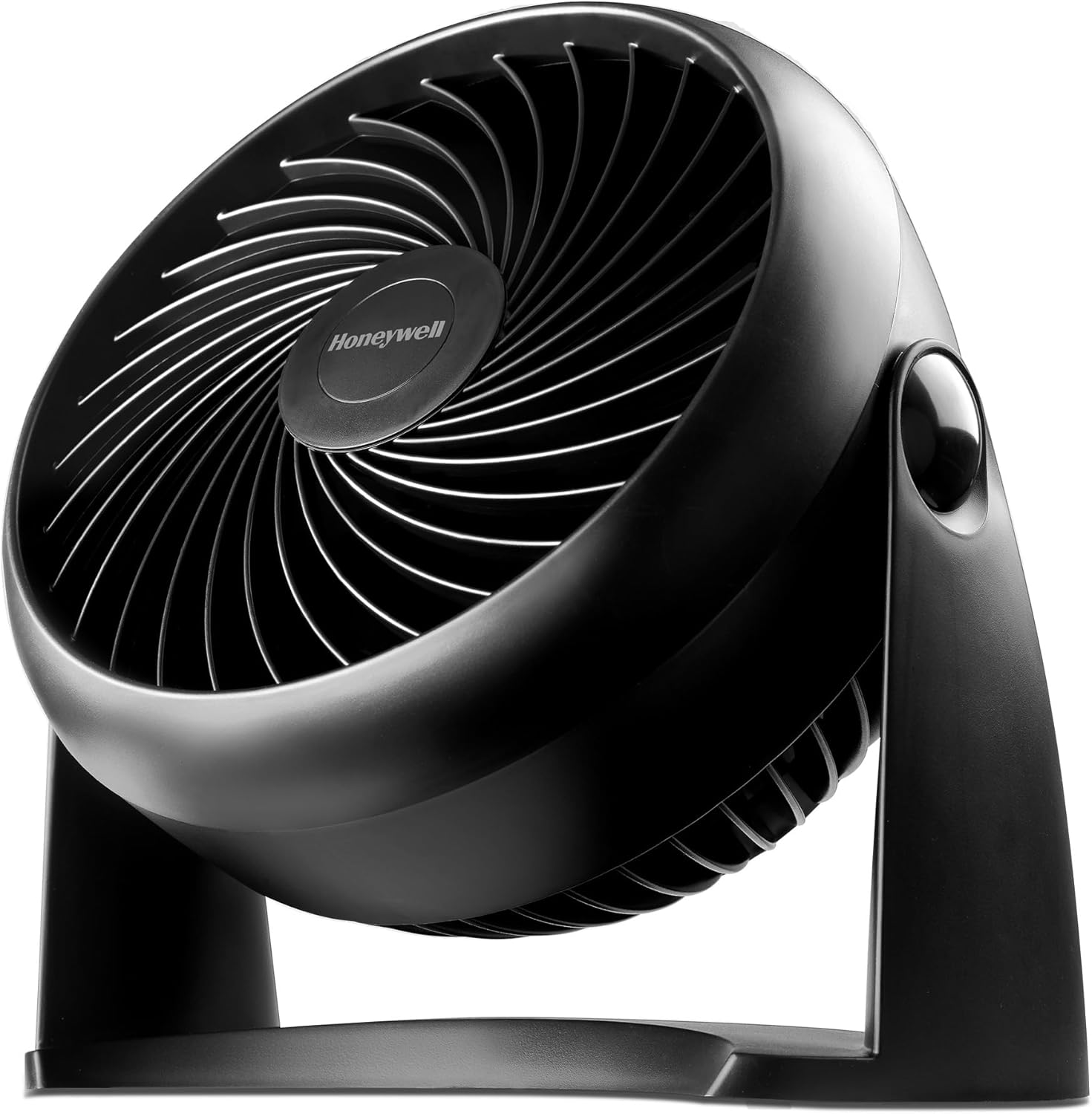
Honeywell TurboForce HT-900
| Power Source | Corded Electric |
|---|---|
| Number of Speeds | 3 |
| Air Flow Capacity | 185 cfm |
| Wattage | 35 watts |
| Motor Type | brushless |
The Honeywell TurboForce HT-900 is a small, plug-in table fan built to move a surprising amount of air for its size. It has an aerodynamic turbo design and a 3-blade plastic prop that delivers up to 185 cfm, so it works well as a desk fan, bedside unit, or mounted on a wall to boost circulation in a small apartment room. Controls are simple push-button speed settings and the head pivots 90 degrees to aim airflow precisely. Honeywell advertises it as quieter than similar fans and the brushless motor and modest 35-watt draw make it efficient for continuous use. The lightweight plastic construction keeps the unit portable but also feels basic compared with heavier metal fans, and there is no oscillation or timer on this model. For apartment living it excels at targeted cooling and circulating air from an open window or a nearby AC vent, but it will not replace a larger oscillating fan for whole-room coverage.
Best for: Apartment dwellers who want an inexpensive, portable fan for targeted cooling at a desk, bedside, or near a window and prioritize low running cost and simplicity.
Less Ideal for: People who need wide-area oscillation, whole-room cooling, or premium materials and controls should choose a larger or more feature-rich fan instead.
- Compact and highly portable for moving between desk, bedside, or wall mount locations
- Turbo-style design produces strong airflow (185 cfm) for its size
- Three simple push-button speeds and 90-degree pivot let you aim cooling where you need it
- Low power draw (35 watts) with a brushless motor for quieter, efficient operation
- No oscillation or timer functions for broader room coverage or scheduling
- All-plastic construction is lightweight but less durable-feeling than metal designs
Verdict: A compact, energy-efficient table fan that delivers strong targeted airflow for small apartment spaces at a budget-friendly value.
DREO TurboPoly Fan 513S

| Number of Speeds | 8 |
|---|---|
| Air Flow Capacity | 1100 cfm |
| Noise Level | 25 db |
| Wattage | 36 watts |
| Control Method | App, Remote, Touch, Voice |
The DREO TurboPoly Fan 513S is a pedestal air circulator designed to move a lot of air quietly and give flexible control for apartment rooms. It uses a brushless DC motor and a five-blade head to deliver up to about 1100 CFM while running at a claimed 25 dB on low settings, and the head supports wide horizontal and vertical oscillation to spread airflow across a living room or bedroom. You can change between eight speed levels and six preprogrammed modes using the touchpad, included remote, DREO phone app, or voice assistants, which is handy when the fan sits across the room. The unit is energy efficient at 36 watts and has a height-adjustable stand, a timer, and an LED status display. Assembly is simple and the parts list is standard for a pedestal fan. The main compromises are typical of high‑output fans: the fan is a freestanding plastic pedestal so it takes floor space and produces stronger concentrated airflow on higher speeds, which may be more than needed in very small rooms. For apartment use it balances strong, directional cooling with quiet operation and smart controls.
Best for: Buyers who want a reliable, low-noise fan that can circulate air across an entire apartment room and prefer flexible smart and manual controls for daily use.
Less Ideal for: People seeking an ultra-compact or wall-mounted solution for micro-studio spaces should consider smaller or wall-mounted fans instead.
- High airflow (1100 CFM) for effective whole-room circulation
- Quiet brushless DC motor enabling low-noise operation (~25 dB)
- Multiple control options: app, remote, touchpad, and voice
- Wide omni-directional oscillation for improved air distribution
- Low power draw (36 watts) and built-in timer for energy-conscious use
- Freestanding pedestal design requires floor space and may block small walkways
- Strong focused airflow on high speeds can be too intense in very small rooms
Verdict: If you need a dependable, quiet pedestal fan that delivers strong whole-room airflow with smart controls, the DREO TurboPoly 513S is an excellent apartment-ready choice.
DREO Tower Fan 307

| Number of Speeds | 8 |
|---|---|
| Modes | Normal, Natural, Sleep, Auto |
| Oscillation | 90° |
| Wattage | 36 watts |
| Motor Type | brushless DC motor |
The DREO Tower Fan 307 is a compact 36-inch oscillating floor fan built around an upgraded brushless DC motor that pushes strong airflow while keeping noise low. It offers eight speed settings and four modes including Normal, Natural, Sleep, and Auto, so you can dial in anything from a gentle bedroom breeze to a higher-velocity boost; the unit supports remote and touchpad control for easy adjustments. With 90 degree oscillation and a claimed airflow capacity for broad room coverage, it pairs well with an air conditioner to circulate cool air more effectively. Practical touches include a timer, removable rear grille and impeller for easier cleaning, and ETL safety certification. On the downside the fan runs on standard corded power and lists voltage at 240 volts which may matter for some regions, and the plastic construction means it is lightweight but less premium-feeling than metal alternatives. For buyers focused on quiet, adjustable oscillating cooling in bedrooms or living rooms, this model balances airflow and low noise in a small footprint.
Best for: Buyers who want a quiet, adjustable tower fan that delivers wide oscillating coverage and easy remote control for bedrooms and living spaces backed by strong customer feedback.
Less Ideal for: People seeking a heavy-duty, industrial-strength fan or a premium metal build should consider sturdier floor or bladeless alternatives.
- Brushless DC motor for efficient, high-velocity airflow with lower noise
- Eight speed levels and four modes for flexible comfort settings
- 90° oscillation spreads air across a wide area for better room coverage
- Includes remote and touch controls plus a timer for convenient operation
- Removable rear grille and impeller simplify cleaning and maintenance
- Plastic construction feels less durable compared with metal fans
- Corded operation and listed voltage may limit regional compatibility
Verdict: A feature-rich, quiet oscillating tower fan that gives flexible speeds and modes for effective bedroom and living-room cooling.
Choosing the Right Fan for Apartments: Key Factors to Consider
Noise Level
Fans in apartments should be quiet enough to run while you sleep or while neighbors are in adjacent rooms. Lower dBA ratings are preferable, and models with multiple low-speed settings or a dedicated sleep mode help minimize audible distraction.
Sound matters both for comfort and for considerate living in shared buildings. A fan that is whisper-quiet on low but still moves air effectively is often better than a louder high-powered unit you cannot run at night.
Footprint and Placement Options
Space is often limited in apartments, so the fan's physical size and mounting options determine how well it fits your home. Compact floor fans, slim tower designs, or clip/desk fans can save space and allow placement on shelves or against walls.
Consider height and depth as well as whether the unit is easy to move between rooms. Lighter models with integrated handles or small caster bases give you flexibility without needing permanent installation.
Airflow Coverage and Directionality
Effective cooling depends on the fan's ability to move air where you need it. Look for adjustable tilt, oscillation range, and airflow profiles that let you direct a stream across a bed or toward a seating area.
A fan with broader coverage can help circulate air through a studio or between rooms, while a more focused jet is better for personal cooling at a desk. Measure your typical seating and sleeping layouts to match a fan's coverage to your apartment.
Energy Use and Efficiency
Because fans may run for many hours, power draw affects utility bills and sustainability. Compare wattage at typical operating speeds and favor models that move more air per watt.
Features such as ECO or low-power modes and efficient motor designs contribute to lower running costs. If you rely on a fan as your primary cooling source, efficiency becomes a decisive factor.
Controls, Timer, and Smart Features
Convenient controls improve daily use. Timers let you schedule shutoff for overnight use, remotes prevent repeated trips to adjust settings, and simple LED indicators make status clear at a glance.
Some apartment-friendly fans offer basic smart-home integration for voice or app control. Consider whether you want those extras or prefer straightforward mechanical dials that are intuitive and durable.
Maintenance and Cleanability
Dust buildup reduces airflow and can increase noise over time. Choose designs with easy-to-remove grills or blade-free housings that wipe clean without tools.
Also consider filter presence and how often components must be cleaned. Accessible parts and a simple user manual reduce the effort to keep the fan running efficiently in the long term.
Types of Fans That Fit Apartments
Several form factors work well in apartments, each with tradeoffs. Tower fans are slim and offer good vertical airflow and oscillation while taking up minimal floor space. Compact floor fans provide strong directed airflow for cooling a specific area but need a little elbow room on the floor.
Clip and desk fans are ideal for renters who need portability and surface mounting, while bladeless and low-profile models focus on quiet operation and easy cleaning. Consider the apartment layout and where you will place the fan before choosing a form factor.
- Tower: Slim footprint, good oscillation and styling.
- Floor/Box: Strong directed airflow for cooling specific spots.
- Clip/Desk: Highly portable, mounts to furniture or shelves.
- Bladeless: Quiet with easy surface cleaning and modern looks.
Where to Place a Fan in a Small Apartment
Placement can make as much difference as fan selection. For whole-room circulation, position the fan near a doorway or opposite a window to create a cross-breeze. To cool a sleeping area, aim the airflow across the bed from a low angle so the breeze covers the mattress.
Avoid blocking intake or exhaust with curtains and furniture. If the apartment has multiple rooms with open sightlines, place the fan in a central spot with oscillation enabled to move air between spaces.
- Near windows or doors to promote cross-ventilation.
- Elevated on a shelf for broad circulation in studios.
- Low angle for targeting beds or seating areas.
- Keep intake clear of curtains and clutter.
Balancing Power and Quiet
High-power fans move more air but typically generate more noise. For apartments, choose models that provide usable low-speed airflow and that keep noise below typical conversational levels when set to quieter modes. Look for silencers, insulated housings, or descriptions of low-vibration motors.
Testing or reviews that report dBA measurements at different speeds are helpful when available. If you need both strong airflow and nighttime quiet, consider a fan with multiple performance modes and a timer so you can run higher settings only when needed.
- Prefer models with strong low-speed output.
- Look for low vibration and solid housing to reduce rattles.
- Use timers to avoid running loud modes overnight.
Energy Tips for Running Fans in Apartments
Fans consume far less electricity than air conditioners, but usage patterns still affect bills. Run fans only in occupied rooms and use timers or smart controls to limit unnecessary runtime. Combining a ceiling or portable fan with targeted cooling can reduce reliance on higher-energy systems.
Also consider the fan's motor efficiency and use lower settings when possible. Regular cleaning preserves airflow efficiency so the fan does not need to run at higher speeds to achieve the same comfort level.
- Use timers and occupancy-aware placement.
- Combine fans with window shading to reduce heat gain.
- Maintain clean blades or housings for efficient operation.
Noise Etiquette and Apartment Living
Being mindful of neighbors helps avoid conflicts. Choose quieter models for overnight use and set timers to stop operation during sleeping hours if you will be away. If you are in a multiunit building, avoid placing high-speed fans against shared walls where they can transmit vibration and sound.
Soft furnishings, rugs, and curtains absorb sound and can reduce perceived noise from a fan. Positioning the unit away from thin partition walls and on soft surfaces can also cut down on noise transmission.
- Run low-speed modes at night to minimize disturbance.
- Place fans away from shared walls when possible.
- Use soft furnishings to dampen noise transmission.
How We Chose the Best Fan for Apartments
We focused on attributes that matter most for apartment living. First, noise level was a primary filter because thin walls and close neighbors make quiet operation essential. We prioritized models with measured or manufacturer-rated dBA levels and steady low-speed performance. Second, footprint and placement flexibility guided selection. Compact footprint, vertical or bladeless designs, and multi-mount options earned higher consideration since many apartments lack spare floor space. Third, airflow coverage and directional control were assessed to ensure the fan could cool typical one- and two-room layouts efficiently. Energy efficiency and power draw were evaluated to avoid units that raise monthly electricity use. We also considered user convenience features such as timers, remote control, sleep modes, and easy cleaning. Durability and build quality rounded out the criteria to favor dependable daily use. Excluded from the list were industrial or outdoor fans unsuitable for enclosed apartments, and any units that relied on obscure proprietary parts that make maintenance difficult. The final picks balance quiet operation, compact size, controllable airflow, and sensible energy use.
Our full evaluation process is outlined in our review methodology.
FAQ
Can a fan cool an entire apartment?
Fans do not lower air temperature but improve comfort by increasing evaporation and air movement. A strategically placed fan can circulate air through an apartment to make it feel cooler, but effectiveness depends on layout, ventilation, and how many rooms need airflow.
How loud is too loud for apartment use?
Noise tolerance varies, but many people find levels under 40 dBA acceptable for sleeping. Look for models with low-speed noise ratings and try to avoid fans that produce rattles or high-frequency hums that are more noticeable in quiet rooms.
Are bladeless fans better for small apartments?
Bladeless designs are often easier to clean and can be quieter, which is appealing in apartments. However, they may be bulkier or deliver different airflow profiles than traditional blade fans. Consider your priorities for sound, style, and space when deciding.
Do I need a fan with a timer or remote for apartment living?
Timers and remotes add convenience, especially if you run the fan overnight or move it between rooms. A timer helps conserve energy and prevents the fan from running when you are not home, while a remote saves trips across small spaces.
How often should I clean a fan in an apartment?
Cleaning frequency depends on dust levels, but a light cleaning every 2 to 4 weeks keeps airflow efficient. For heavier dust or pet hair, clean more often and follow the manufacturer instructions for disassembly and safe cleaning.
Final Verdict
For apartment living, prioritize quiet operation, a compact footprint, and adjustable airflow. Those three factors usually determine whether a fan will be practical day to day. Energy efficiency and convenient controls are important secondary considerations if you expect long run times or want automated schedules. Balance the tradeoffs between raw airflow and low-noise performance according to how you use the space. Focus on placement and maintenance to get the most from whichever fan you choose, and pick a model that fits your apartment layout and lifestyle to ensure comfortable, neighbor-friendly cooling.