
Note: This article contains affiliate links. If you click on these links and make a purchase, we may earn a small commission at no extra cost to you. This helps support our research and content. Read our full affiliate disclosure here.
Hot rooms upstairs can make the rest of the house uncomfortable and drive up cooling costs. Choosing the right fan for cooling upstairs matters because airflow patterns, noise, and mounting options all affect comfort in bedrooms and hall spaces. This guide shortlists the top options suitable for moving air through stairwells, across ceilings, and out of second-floor rooms. We evaluated models that balance strong, targeted airflow with low noise and flexible installation. Below are our top picks and the practical criteria we used to narrow them down.
Top Picks at a Glance
| Best Overall The best all-around choice for most situations | Honeywell QuietSet HYF260 |  |
| Best Quality Built to a higher standard if you want something more solid | DREO Tower Fan 307S |  |
| Best Value The sweet spot between price and what you get | Amazon Basics 16" Pedestal Fan |  |
| Best Budget The cheapest option that still gets the job done reliably | Honeywell TurboForce HT-900 |  |
| Top Rated A top-rated pick with lots of positive feedback | DREO DR-HPF013 Pedestal Fan |  |
| Most Popular A crowd favorite that many people choose with confidence | Levoit Classic 36-inch Tower Fan |  |
| Best Seller A high-volume bestseller chosen again and again | Lasko Pivoting Pro 12" Fan U12104 |  |
Honeywell QuietSet HYF260

| Number of Speeds | 5 |
|---|---|
| Noise Level | 46 db |
| Wattage | 1500 watts |
| Air Flow Capacity | 253 cubic meter per hour |
| Control Method | Remote, Touch |
The Honeywell QuietSet HYF260 is a freestanding oscillating tower fan built for steady whole-room cooling and flexible control. It offers five distinct speed settings accessed via touch panel or the included remote, plus oscillation to move air across a room and auto-dim panel lights for nighttime use. The unit is lightweight plastic and designed for indoor use in bedrooms and living rooms; its motorized airflow rating and 1500-watt electrical spec deliver noticeable circulation while the QuietSet tuning keeps sound low enough for sleeping. Typical use is as a supplement to A/C or as a primary circulation fan in spaces where focused, adjustable airflow is needed. Practical benefits include easy placement, simple controls, and an effective blend of power and quiet for overnight use. Important limitations are the plastic construction which is basic compared with higher-end metal or aero-designed towers and the fan relies on a conventional corded power connection rather than battery or smart home integration.
Best for: Buyers who prioritize strong, quiet airflow and straightforward controls for regular room cooling and improved air circulation will appreciate this fan.
Less Ideal for: If you need smart home integration, battery portability, or a premium metal build, this model is not the best choice.
- Five speed settings and oscillation provide flexible whole-room airflow.
- Remote and touch controls make adjustments convenient from across the room.
- Auto-dim panel lights reduce nighttime disturbance.
- Designed for bedrooms and living rooms with straightforward freestanding setup.
- Plastic construction feels basic compared with premium tower fans.
- No smart home connectivity or battery operation for portable use.
Verdict: Choose the QuietSet HYF260 when you want a dependable, quiet tower fan that delivers strong adjustable whole-room airflow with easy remote control.
DREO Tower Fan 307S

| Power Source | Corded Electric |
|---|---|
| Wattage | 42 watts |
| Air Flow Capacity | 978 cfm |
| Control Method | App, Remote, Touch, Voice |
| Oscillation | 90° |
The DREO Tower Fan 307S is a freestanding bladeless tower fan designed to move a lot of air quietly across a room. It delivers high reported airflow (978 cfm) using a 42 W AC motor with 90° oscillation and multiple control options including app, remote, touch panel, and voice. You can pick between Normal, Natural, Sleep and Auto modes plus four speed levels and an 8-hour timer to match bedroom or upstairs living spaces, and Auto mode uses ambient temperature to adjust output. Practical touches include a removable rear grille and impeller for easier cleaning, fingertip-safe grills, and an LED display. The fan is marketed as whisper-quiet at low settings, making it suitable for night use, while higher settings produce stronger airflow for circulation on upper floors. Limitations: the spec sheet lists four speeds despite marketing text mentioning eight speeds in some places, so available granularity may be lower than some competitors, and the unit is a corded indoor fan with plastic construction rather than a heavy-duty metal build.
Best for: A buyer who needs a powerful, quiet tower fan to improve airflow upstairs and values smart controls and programmable modes for hands-off temperature management.
Less Ideal for: If you want a heavy-duty metal fan or precise high-resolution speed control for industrial or workshop use, this consumer-grade tower fan is not the best fit.
- High reported airflow (978 cfm) for effective cooling and cross-room circulation
- Multiple control methods: app, remote, touch and voice for convenient adjustments
- 90° oscillation and Auto mode that adjusts to ambient temperature for even coverage
- Removable rear grille and impeller wheel for easier cleaning and maintenance
- Specification inconsistencies between listed speed counts could confuse buyers about exact control granularity
- Plastic construction may feel less durable than metal alternatives
Verdict: Choose this smart tower fan when you want strong, remotely controllable airflow and quiet night-friendly operation to cool upstairs rooms effectively.
Amazon Basics 16" Pedestal Fan

| Wattage | 60 watts |
|---|---|
| Number of Speeds | 3 |
| Number of Blades | 6 |
| Motor Type | AC |
| Control Method | Remote |
This Amazon Basics 16" pedestal fan is a straightforward air circulator designed for medium to large rooms upstairs like bedrooms and landing areas. It uses a 60W AC motor and dual-layered 6-blade design to move a solid amount of air while staying relatively quiet, and the head tilts and oscillates to spread airflow across a room. Controls are simple: three speeds, three breeze modes (normal, nature, sleep), and a timer that are all accessible from the included remote, which makes it easy to adjust from bed or a couch. The adjustable height helps aim airflow where you need it and the powder-coated metal stand feels stable. It is a basic, no-frills unit so you will not get app connectivity or variable-speed precision beyond the three settings, and the plastic blades mean it is not a high-end designer fan. For upstairs use it provides dependable, energy-efficient circulation without complicated setup.
Best for: Buyers who want a reliable, easy-to-use fan to improve upstairs air circulation without extra tech complexity or a high price, and who value straightforward remote control and adjustable placement.
Less Ideal for: If you need smart home integration, precise variable-speed control, or a designer appearance, this basic pedestal fan is not the best fit.
- Powerful yet quiet AC motor for effective airflow with modest energy draw (60W)
- Oscillation plus adjustable tilt and height for room-wide coverage and targeted cooling
- Included remote and timer for convenient control from across the room
- Three breeze modes provide simple preset options for sleep or natural-feel airflow
- Only three fixed speed levels so fine-grained airflow control is limited
- Plastic blades rather than higher-end materials may feel less premium
Verdict: A dependable, energy-efficient pedestal fan that delivers simple, room-filling airflow and remote convenience for cooling upstairs spaces.
Honeywell TurboForce HT-900
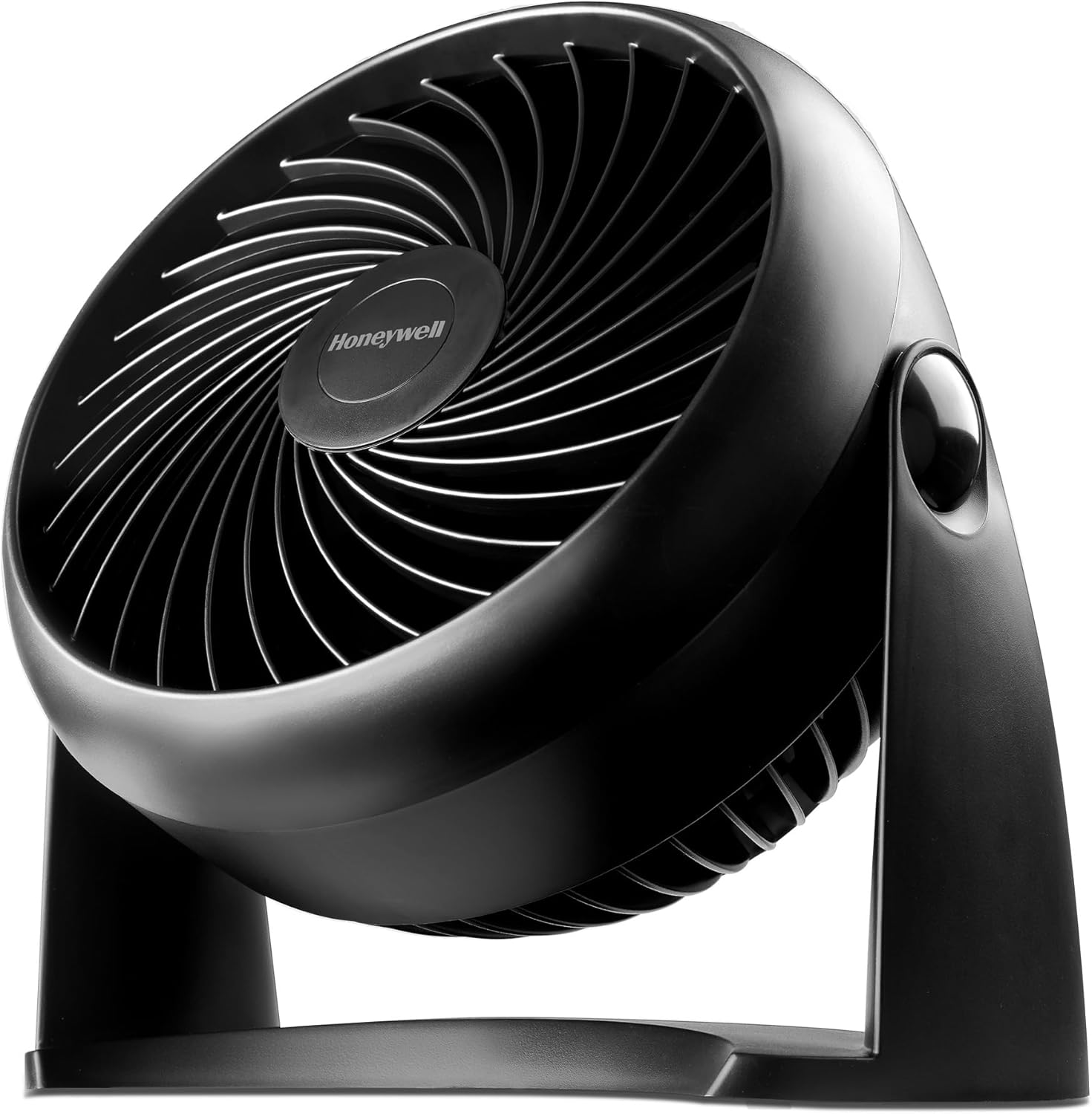
| Power Source | Corded Electric |
|---|---|
| Number of Speeds | 3 |
| Air Flow Capacity | 185 cfm |
| Motor Type | brushless |
| Installation Type | Tabletop or Wall Mount |
The Honeywell TurboForce HT-900 is a small tabletop air circulator designed to move air efficiently in bedrooms, home offices, or upstairs landing areas. Its aerodynamic turbo design and brushless motor deliver strong airflow for its size, and the unit offers three speeds plus a 90 degree pivoting head so you can aim the breeze where you need it most. The fan can be used on a desk, bedside table, or mounted on a wall to boost circulation and help circulate cooler air from a second-story hallway or room. It is notably quiet compared with similar small circulators, making it suitable for sleeping or focused work. The plastic construction keeps the unit lightweight and portable, and the simple push-button controls are easy to use but offer no advanced timer or remote features. If you want a straightforward, effective small fan that maximizes airflow without complexity, this model performs well, though it lacks extra controls and premium materials found on higher-end fans.
Best for: Buyers wanting an inexpensive, no-frills fan to boost upstairs airflow or cool small rooms, especially where quiet operation during sleep or work matters.
Less Ideal for: People seeking smart controls, timers, or a premium metal build should consider higher-end models with more features.
- Aerodynamic turbo design produces strong airflow for a compact fan
- Three speed settings and 90 degree pivoting head for targeted cooling
- Brushless motor for efficient operation and lower noise
- Lightweight plastic body that is easy to move or wall-mount
- Basic push-button controls with no timer, remote, or digital display
- Plastic construction feels less premium than metal-bodied fans
Verdict: A budget-friendly, quiet tabletop circulator that delivers strong, directed airflow to help cool upstairs rooms without fuss.
DREO DR-HPF013 Pedestal Fan

| Power Source | Corded Electric |
|---|---|
| Number of Speeds | 8 |
| Noise Level | 28.2 db |
| Air Flow Capacity | 1000 cfm |
| Motor Type | Brushless |
The DREO DR-HPF013 is a freestanding pedestal air circulator built to move a lot of air quietly across a whole room. It uses a brushless DC motor and a three-blade TurboPoly design to deliver up to 1000 CFM and a claimed 90 ft throw, with 8 speed settings, an auto mode that adjusts with temperature changes, and 90° horizontal oscillation plus 105° vertical tilt. Controls are available on a top touch panel and an included remote, and an 8-hour timer and muteable beeps make it convenient for nightly use. The fan disassembles for cleaning and includes an aroma pad for light fragrance if wanted. On the downside the unit is plastic and taller adjustment ranges mean it can be a little top-heavy on uneven floors, and real-world noise will vary by speed even though the spec lists a low 28.2 dB. For upstairs bedrooms and landing areas this model balances strong airflow, quiet low-speed operation, and practical controls, but expect to ramp speed up for maximum reach and to secure it on sloped surfaces.
Best for: Buyers who prioritize a dependable, high‑airflow room fan for upstairs bedrooms or hallways and want quiet low‑speed operation plus convenient remote and timer controls.
Less Ideal for: Those seeking a heavy-duty metal industrial fan or an ultra-compact travel fan should consider different form factors better suited to those needs.
- High claimed airflow up to 1000 CFM for whole-room circulation
- Brushless DC motor for smoother, more efficient operation
- Multiple control options including top touch panel and included remote with auto mode
- Detachable grills and blade for easier cleaning
- Adjustable height, wide vertical tilt and 90° oscillation for targeted airflow distribution
- Plastic construction may feel less durable than metal alternatives
- Maximum airflow and throw are best achieved at higher speeds which increase noise
Verdict: Choose the DREO DR-HPF013 when you need a reliable, quiet pedestal fan that pushes strong whole‑room airflow for cooling upstairs spaces.
Levoit Classic 36-inch Tower Fan

| Number of Speeds | 5 |
|---|---|
| Noise Level | 28 db |
| Wattage | 39 watts |
| Air Flow Capacity | 1044 cfm |
| Control Method | Remote |
The Levoit Classic 36-inch tower fan is built to move room air quietly and with some automation for everyday comfort. It offers five speeds, a wide oscillation sweep, and four modes—Normal, Turbo, Sleep, and Auto—so you can use it for steady background airflow, quick boost cooling, or near-silent nighttime use. The built-in temperature sensor in Auto and Turbo modes adjusts fan speed as the room temperature changes, which is helpful if you want steady comfort without constant manual changes. Controls are available on a touchpad and with the included remote, and the back grille is removable for basic cleaning. Practical benefits include low reported noise on lower speeds for bedrooms and a compact, slim footprint that fits in narrow upstairs hallways or bedrooms. Limitations are typical of tower fans: it relies on air circulation rather than lowering room temperature, and peak airflow is not the same as an open-blade high-velocity fan, so it may take longer to affect larger upstairs spaces or very hot rooms.
Best for: Buyers who want a quiet, flexible bedroom or upstairs fan with automatic temperature-based speed adjustments and easy remote control for nightly or daily use.
Less Ideal for: People needing rapid cooling for very large or extremely hot upstairs rooms or anyone who expects the fan to replace an air conditioner.
- Auto mode with built-in temperature sensor adjusts fan speed to room temperature
- Five speeds and four distinct modes (Normal, Turbo, Sleep, Auto) for flexible use
- Near-silent operation on low settings suitable for bedrooms and light sleepers
- Wide oscillation and 28 ft/s airflow for whole-room circulation
- Includes remote and touchpad controls plus a 12-hour timer
- Air circulation only; will not cool air like an air conditioner
- Maximum airflow less forceful than dedicated high-velocity fans in large or very hot rooms
Verdict: A quiet, feature-rich tower fan that automatically adjusts speed to room temperature and suits upstairs bedrooms or hallways needing steady, low-noise air circulation.
Lasko Pivoting Pro 12" Fan U12104

| Number of Speeds | 3 |
|---|---|
| Air Flow Capacity | 289 cfm |
| Wattage | 100 watts |
| Motor Type | Brushless |
| Power Source | Corded Electric |
The Lasko Pivoting Pro 12" utility fan is a small but powerful air mover built to push concentrated airflow where you need it most. It is typically used on floors, benches, or raised surfaces to cool people or speed drying in rooms like upstairs hallways, bedrooms, or basements. The fan offers three rotary-controlled speeds and a 270-degree pivoting head so you can aim airflow up, down, or at an angle, and it delivers up to 289 CFM from a brushless motor while drawing about 100 watts. Practical touches include a 10-foot cord and two built-in grounded outlets so you can power tools or a lamp nearby, plus a carry handle for moving between rooms. The housing and blades are plastic, which keeps the unit lightweight but means it is not as rugged as metal fans. Noise is noticeable at higher speeds, making the lowest setting preferable for overnight use. Overall it is a straightforward, dependable choice when you want focused, portable cooling or quicker drying on an upstairs landing or in a small bedroom.
Best for: Buyers who prioritize a safe, reliable fan for targeted cooling or drying upstairs and want a simple, easy-to-move unit rather than a decorative or ultra-quiet option.
Less Ideal for: People seeking a near-silent bedroom fan or a heavy-duty, metal construction fan for rough job-site use should consider other options.
- High-velocity airflow (up to 289 CFM) for strong targeted cooling
- 270-degree pivoting head lets you direct air precisely
- Two built-in grounded outlets eliminate extra extension cords
- Lightweight with a carry handle and 10-foot cord for easy placement
- Plastic construction is less durable than metal-bodied utility fans
- Noticeable noise on higher speed settings
Verdict: A compact, dependable high-velocity blower that delivers focused airflow and easy portability for cooling and drying upstairs spaces.
Choosing the Right Fan for Cooling Upstairs: Key Factors to Consider
Airflow Coverage and Pattern
Effective upstairs cooling depends on how a fan moves air through and between rooms. Look for fans that push air along the ceiling plane and down stairwells when the goal is to transfer heat off the upper floor. A fan that creates broad, laminar flow will reduce hot pockets and distribute conditioned air from vents more evenly across the space.
Consider the size of the room and whether you need directional airflow. Bedrooms and long hallways benefit from fans that can be angled or have oscillation, while a fan intended to circulate air between floors should prioritize vertical throw and steady, low-turbulence flow.
Noise At Night
Upstairs fans are often used in sleeping areas, so sound signature matters. Evaluate not only maximum decibel ratings but how the fan's tone and frequency feel in a bedroom. A lower pitch at the same dB can be less distracting than a high-frequency whine.
Fans with multiple speed steps and a quiet low-speed mode allow overnight use without disturbing sleep. Also look for features that reduce vibration transmission to floors and mounting points, since rattles and resonance amplify perceived noise on upper levels.
Mounting and Placement Options
Upstairs spaces vary—sloped ceilings, low attic access, central hallways, and stairwells all require different mounting solutions. Choose fans that offer multiple mounting methods, such as ceiling, wall, or portable stand options, to fit the specific layout.
The ability to tilt or adjust fan direction helps when targeting stairwells or directing flow across a landing. For rooms with limited ceiling clearance, wall-mounted or slim-profile designs may be safer and more effective.
Energy Use For Continuous Operation
Fans intended to run for hours should consume minimal power while still delivering useful airflow. Energy-efficient motors and multi-speed control help balance comfort and operating cost. Look for clear wattage specs at each speed so you can estimate daily energy use for overnight or all-day circulation.
Lower energy draw also generally means less heat added to the upstairs environment, which is important when the goal is to keep rooms cooler rather than simply moving warm air around.
Control and Automation
Convenient controls and scheduling can make upstairs cooling both more effective and less intrusive. Features like remote control, timers, or smart-home integration let you run a fan during peak warm hours and reduce speed at night without going upstairs.
Automation that pairs fan operation with temperature or humidity sensors helps target cooling only when needed, extending fan life and saving energy. Simple manual controls remain useful when automation is unnecessary or unwanted.
Build Quality and Maintenance
Upstairs fans are subject to continuous use and can be harder to service depending on where they are mounted. Durable construction, corrosion-resistant finishes, and easily removable grills or blades make periodic cleaning and upkeep simpler and safer.
Consider filter accessibility if the fan includes any filtration, and the availability of replacement parts for bearings or motor mounts. A fan that is easy to disassemble for cleaning will perform better long term and generate less noise as it ages.
Best Mounting Strategies for Upper Floors
Placement determines performance. Position ceiling fans to push air toward stairwells or across doorways so cooler air from lower floors can mix with warmer upstairs air. In rooms with peaked ceilings, mount hardware that allows the fan to sit level and direct flow along the ceiling plane.
Wall-mounted fans work well when ceiling clearance is limited or when you want to direct airflow down a hallway or across a landing. Portable fans provide flexibility for temporary cooling but prioritize models with stable bases and variable speed control so you can fine-tune circulation.
- Mount near stairwells to encourage vertical airflow between floors
- Aim fans along the ceiling rather than directly at occupants for whole-room circulation
- Use wall mounts in low-clearance rooms or to direct flow across landings
Using Fans To Complement Air Conditioning
Fans do not lower air temperature but improve perceived comfort by increasing air movement and enhancing evaporative cooling on skin. When combined with central AC, a fan can help distribute cooled air more evenly across upstairs rooms, reducing the need to lower thermostat settings.
Run fans on low to medium speeds to balance comfort and energy use. Use directional control to move conditioned air from vents into distant corners or to pull cooler air from lower floors up into the living spaces.
- Use fans to spread conditioned air rather than as a substitute in very hot conditions
- Coordinate fan direction with vent locations to even out temperature differences
Quiet Operation Tips for Bedrooms
To preserve sleep, choose fans with documented low-noise modes and smooth motor operation. Soft-start electronics and brushless motors often yield quieter performance and reduce mechanical noise over time.
Mounting isolation pads or using rubber grommets at connection points can eliminate resonance that travels through ceiling joists. If possible, test a fan in the intended room at night to evaluate its real-world sound signature before committing to continuous use.
- Prefer lower Hz, even-sounding fans over high-pitched tones
- Install vibration isolators to reduce structure-borne noise
- Use timers or automatic night modes to drop speed after bedtime
Safety and Code Considerations
Ensure any ceiling or wall mounting follows local building codes for fixture support and clearance. Installations near stairwells and landings should maintain headroom and avoid introducing trip hazards with cords or remote receivers.
For DIY installations, turn off power at the breaker and use the recommended fasteners for the ceiling or wall substrate. When in doubt about wiring or structural support, consult a qualified installer to avoid safety risks.
- Verify mounting anchors are rated for the fan weight
- Keep controls and cords out of walking paths on landings
- Follow electrical codes for wiring and switch locations
Maintaining Performance Over Time
Regular cleaning of blades and housings preserves airflow and prevents imbalance that increases noise. Check mounting hardware periodically for looseness, and lubricate or service bearings if the design allows.
Replace worn mounting components and address any unusual vibration early to prevent accelerated wear. For fans with washable filters, establish a cleaning schedule based on household dust levels to maintain airflow efficiency.
- Dust blades every few months and deep-clean grills annually
- Tighten fasteners and check balance after long-term use
- Monitor energy use and noise to detect declining performance
How We Chose the Best Fan for Cooling Upstairs
We focused on products that solve common upstairs cooling challenges: moving air vertically between floors, delivering even room circulation, and running quietly at night. Selection began with fans designed for whole-room airflow rather than short-range breeze. Key evaluation criteria included measured airflow distribution, noise at common operating speeds, installation versatility for bedrooms and hallways, and energy use during continuous operation. We prioritized fans with adjustable speed ranges and directional control so users can tailor circulation for sleeping hours or daytime cooling. Durability and ease of maintenance were also weighed, since upstairs fans are often left running for extended periods. Models lacking clear airflow specifications, insufficient mounting options for typical upper-floor layouts, or poor noise documentation were excluded. The final shortlist emphasizes real-world usability across upstairs scenarios rather than raw peak airflow alone.
Our full evaluation process is outlined in our review methodology.
FAQ
Can a fan alone cool an upstairs room?
A fan does not lower air temperature but increases perceived comfort by moving air across skin and helping evaporative cooling. For persistent high temperatures, a fan works best when combined with a cooling system or by improving airflow between upstairs and lower floors.
Is a ceiling fan better than a portable fan upstairs?
Ceiling fans typically produce broader room circulation and are less obtrusive, while portable fans add flexibility and targeted airflow. The best choice depends on room layout, ceiling height, and whether you need temporary or permanent airflow solutions.
How loud is too loud for a bedroom fan?
Acceptable noise levels depend on personal tolerance, but generally a quiet bedroom fan should be low and even-sounding at night. Fans that create high-frequency tones or rattle are more likely to disturb sleep than those with steady, low-frequency airflow noise.
Should I run the fan all night to cool upstairs?
Running a fan overnight is common to maintain comfort, especially on lower speeds that consume less energy. Use timers or nighttime modes to reduce speed after fall-asleep time and to avoid unnecessary energy use if the temperature drops.
Can fans help move cool air from downstairs to upstairs?
Yes. Positioning a fan to direct lower-floor cool air upward through stairwells or across doorways can help equalize temperatures between floors. Aim for sustained circulation rather than short bursts for the best effect.
Final Verdict
When choosing a fan for cooling upstairs, prioritize airflow coverage, low noise, and mounting adaptability to your specific floor plan. Tradeoffs include stronger airflow versus higher noise and limited mounting types versus portability. Focus on models that offer targeted directional control, efficient motors for continuous operation, and quiet low-speed modes for nighttime use. With those priorities, you can pick a fan that meaningfully evens out upstairs temperatures and runs comfortably over long periods.