
Note: This article contains affiliate links. If you click on these links and make a purchase, we may earn a small commission at no extra cost to you. This helps support our research and content. Read our full affiliate disclosure here.
Choosing the right fan for room cooling matters because airflow pattern, noise, and energy use directly affect daily comfort. The wrong fan can leave hot spots, create disruptive noise, or run up energy use without improving perceived temperature. This guide shortlists the best fans for room cooling and explains why each style works in different spaces. Below we evaluate the top picks against practical criteria like airflow delivery, noise output, ease of placement, and energy use to help you match a fan to your room size and habits.
Top Picks at a Glance
| Best Overall The best all-around choice for most situations | Lasko Wind Machine 3300 |  |
| Best Quality Built to a higher standard if you want something more solid | DREO TurboPoly Fan DR-HPF013 |  |
| Best Value The sweet spot between price and what you get | Honeywell QuietSet HYF260 |  |
| Best Budget The cheapest option that still gets the job done reliably | KopBeau Tower Fan DFT04-1 |  |
| Top Rated A top-rated pick with lots of positive feedback | Honeywell TurboForce HT-900 |  |
| Most Popular A crowd favorite that many people choose with confidence | Levoit Classic 36-inch Tower Fan |  |
| Best Seller A high-volume bestseller chosen again and again | DREO Tower Fan DR-HTF018 |  |
Lasko Wind Machine 3300

| Blade Length | 20 inches |
|---|---|
| Number of Speeds | 3 |
| Air Flow Capacity | 1985 cfm |
| Wattage | 107 watts |
| Motor Type | brushless |
The Lasko Wind Machine 3300 is a straight‑forward high-velocity floor circulator designed to move a lot of air in rooms, garages, and workspaces. It delivers up to 1,985 CFM through a 20-inch blade and offers three manual speeds and a pivoting head so you can aim airflow where you need it for cooling, drying paint or carpets, or adding ventilation. The fan is corded and portable with a built-in carry handle and a durable metal/plastic build meant to withstand heavier use. Its brushless motor provides strong airflow with a steady hum that can double as ambient white noise. Safety is addressed with ETL listing and Lasko's fused plug. On the downside, controls are basic rotary/manual only and there is no oscillation or timer, so it is best for direct, stationary airflow rather than gentle whole-room circulation or quiet night use. The unit comes fully assembled and is simple to move and operate for quick cooling tasks.
Best for: Buyers who want a simple, powerful portable fan that moves maximum air for fast cooling, drying, or ventilating in rooms, garages, or work areas and value reliability over smart features.
Less Ideal for: People seeking a near-silent bedroom fan, multi-speed precision controls, or an oscillating unit to gently circulate air throughout an entire room should consider other styles.
- Very high airflow capacity (up to 1,985 CFM) for quickly cooling or ventilating large spaces
- Pivoting head provides aimed directional airflow for spot cooling or drying
- Portable with a large built-in carry handle and arrives fully assembled
- Durable, serviceable construction suitable for garages, workshops, and heavy use
- ETL listed and fused plug adds an extra layer of electrical safety
- Only three manual speed settings and basic rotary controls limit fine tuning
- No oscillation or timer functions so it provides fixed directional airflow rather than room-wide circulation
- Plastic blades and mainly plastic construction are less premium than metal-blade high-velocity fans
Verdict: Choose the Lasko Wind Machine 3300 when you need a rugged, no‑frills fan that delivers very high directed airflow for fast cooling or drying.
DREO TurboPoly Fan DR-HPF013

| Number of Speeds | 8 |
|---|---|
| Noise Level | 28.2 db |
| Wattage | 36 |
| Air Flow Capacity | 1000 cfm |
| Control Method | Remote, Touch |
The DREO TurboPoly DR-HPF013 is a freestanding pedestal air circulator built to push a lot of air quietly across a whole room. It uses a brushless DC motor and a three‑blade aero design to deliver up to 1000 CFM and claimed 90 ft throw while offering 8 speed settings, an auto mode that adjusts speed with temperature, 90° horizontal oscillation and a large manual vertical tilt range. Controls are available on the top touch panel and with the included remote, and an 8‑hour timer and muteable button tones make night use convenient. The fan is easy to clean thanks to a detachable front/rear grill and blade assembly, and a small aroma pad is included if you want scent with airflow. Practical limits include a plastic construction that keeps weight down but is less premium than metal alternatives, and the 8‑hour timer and control set are basic compared with app or voice‑enabled smart fans. For buyers who prioritize strong, quiet whole‑room airflow, this model delivers high volume performance in a compact pedestal package.
Best for: Buyers who want a performance‑focused room fan that prioritizes strong, quiet airflow and simple hands‑on controls for cooling bedrooms or living spaces.
Less Ideal for: If you need integrated smart home control, advanced scheduling, or a metal, heavy‑duty industrial fan, look elsewhere.
- High airflow capacity rated at 1000 CFM for rapid whole‑room circulation
- Brushless DC motor for quieter operation and energy efficiency
- Eight speed levels plus auto mode for fine control of output
- Remote and top touch controls with an 8‑hour timer for convenient operation
- Detachable grille and blades for easier cleaning
- Plastic construction may feel less durable than metal pedestal fans
- No smart app or voice control for remote scheduling or remote access
Verdict: Choose this DREO pedestal fan when you want powerful, quiet whole‑room airflow with straightforward controls and easy cleaning.
Honeywell QuietSet HYF260

| Number of Speeds | 5 |
|---|---|
| Noise Level | 46 db |
| Wattage | 1500 watts |
| Air Flow Capacity | 253 cubic meter per hour |
| Control Method | Remote, Touch |
The Honeywell QuietSet HYF260 is a freestanding oscillating tower fan built for steady whole-room cooling and flexible control. It offers five distinct speed settings accessed via touch panel or the included remote, plus oscillation to move air across a room and auto-dim panel lights for nighttime use. The unit is lightweight plastic and designed for indoor use in bedrooms and living rooms; its motorized airflow rating and 1500-watt electrical spec deliver noticeable circulation while the QuietSet tuning keeps sound low enough for sleeping. Typical use is as a supplement to A/C or as a primary circulation fan in spaces where focused, adjustable airflow is needed. Practical benefits include easy placement, simple controls, and an effective blend of power and quiet for overnight use. Important limitations are the plastic construction which is basic compared with higher-end metal or aero-designed towers and the fan relies on a conventional corded power connection rather than battery or smart home integration.
Best for: Buyers who prioritize strong, quiet airflow and straightforward controls for regular room cooling and improved air circulation will appreciate this fan.
Less Ideal for: If you need smart home integration, battery portability, or a premium metal build, this model is not the best choice.
- Five speed settings and oscillation provide flexible whole-room airflow.
- Remote and touch controls make adjustments convenient from across the room.
- Auto-dim panel lights reduce nighttime disturbance.
- Designed for bedrooms and living rooms with straightforward freestanding setup.
- Plastic construction feels basic compared with premium tower fans.
- No smart home connectivity or battery operation for portable use.
Verdict: Choose the QuietSet HYF260 when you want a dependable, quiet tower fan that delivers strong adjustable whole-room airflow with easy remote control.
KopBeau Tower Fan DFT04-1
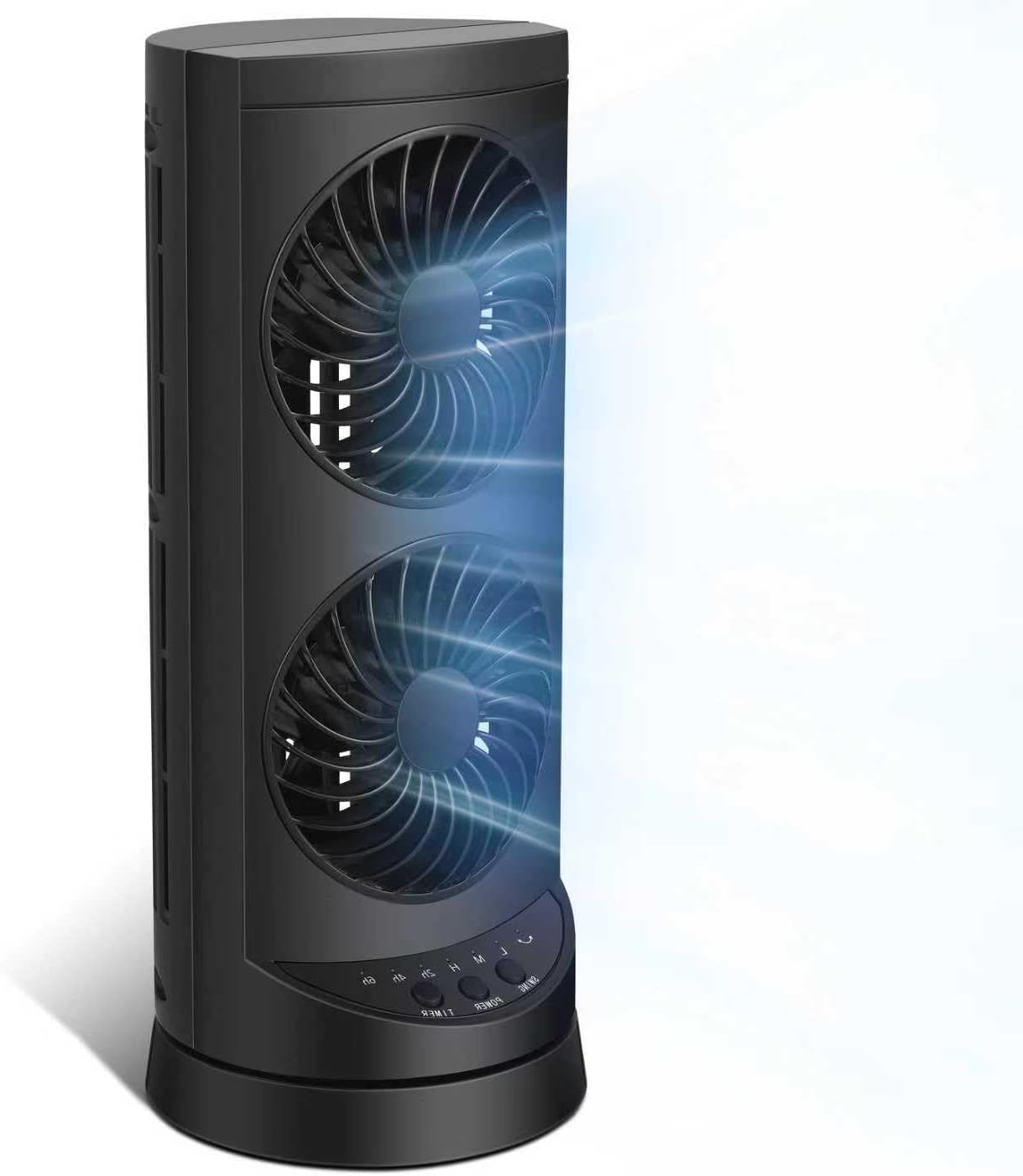
| Power Source | Corded Electric |
|---|---|
| Number of Speeds | 3 |
| Noise Level | 25 db |
| Wattage | 40 watts |
| Special Features | 12H Timer, 60° & 110° oscillating |
The KopBeau Tower Fan DFT04-1 is a lightweight, plug-in tower fan designed to deliver directed airflow for small to medium rooms. It offers three speed settings and a reported airflow up to 24 ft/s driven by a 3600 rpm motor, and you can choose between 60° focused oscillation or 110° wider circulation to move air across a bedroom or home office. Controls are simple push-button/touch inputs and a 12-hour on/off timer lets you run the fan overnight or on a schedule. Noise levels sit in the low 20s decibels at quieter settings, so it is suitable for sleep or focused work. The unit is plastic-bodied and very compact, making it easy to carry between rooms and store when not in use. Important limitations are basic feature set and simple mechanical controls rather than smart connectivity, and the plastic construction means it is best for light residential use rather than heavy-duty continuous operation.
Best for: Buyers looking for a low-cost, no-frills fan to cool bedrooms, dorms, or small home offices who prioritize quiet operation and portability over advanced features.
Less Ideal for: People who want app control, remote operation, metal construction, or a high-power fan for large open-plan areas should consider more feature-rich or heavy-duty models.
- Three speed settings for quick adjustment between gentle and strong airflow
- Dual oscillation angles (60° and 110°) for focused or whole-room coverage
- 12-hour timer and energy-efficient standby for scheduled use and lower running cost
- Very low noise at quiet settings suitable for bedrooms and offices
- Compact and lightweight design with a built-in handle for easy portability
- No smart or remote control features, only physical buttons and touch control
- All-plastic construction may feel less durable than heavier fans
Verdict: A quiet, budget-friendly tower fan that delivers adjustable airflow and timed operation for bedrooms and small rooms.
Honeywell TurboForce HT-900
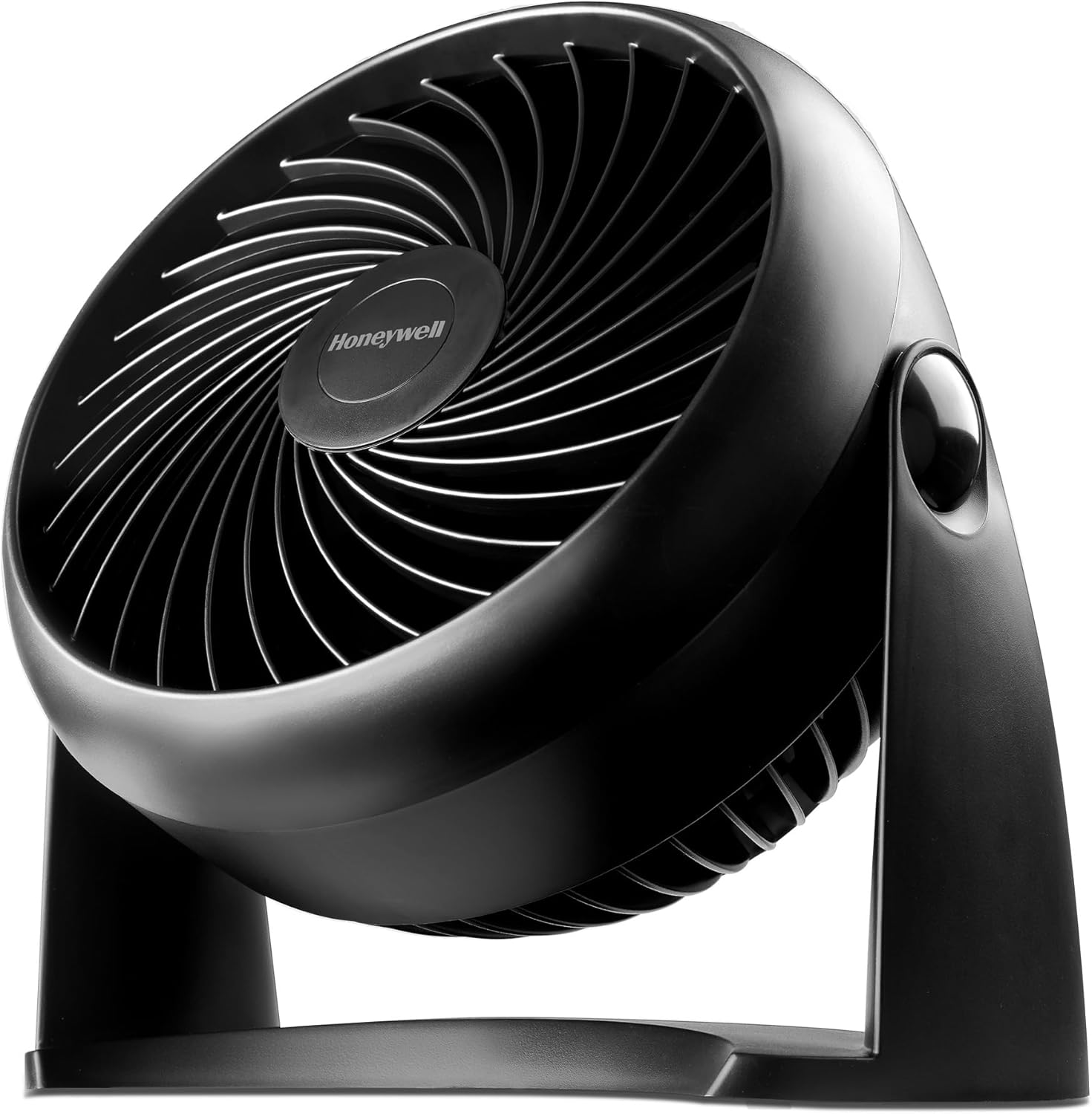
| Power Source | Corded Electric |
|---|---|
| Number of Speeds | 3 |
| Air Flow Capacity | 185 cfm |
| Wattage | 35 watts |
| Motor Type | brushless |
The Honeywell TurboForce HT-900 is a small tabletop air circulator designed to move air efficiently in bedrooms, home offices, or other small to medium rooms. It uses an aerodynamic turbo blade design and a brushless motor to produce strong airflow (listed at 185 cfm) while remaining relatively quiet. Three push-button speed settings and a 90-degree pivoting head make it easy to direct a focused breeze where you need it, and the unit can be mounted on a wall or placed on a desk or floor. At 35 watts it runs economically compared with high-power fans, and the simple plastic construction keeps it lightweight and portable. Limitations include basic manual controls with no timer or remote and a small footprint that is best for targeted cooling rather than circulating air across very large spaces. The HT-900 is a sensible, no-frills choice when you want a durable, effective personal fan to supplement cooling or improve airflow in a single room.
Best for: Buyers who prioritize a reliable, straightforward fan to provide consistent directed cooling in a bedroom, desk area, or small living space without extra bells and whistles.
Less Ideal for: People needing whole-room circulation for large open areas, smart features like app or voice control, or advanced scheduling and remote operation.
- Strong airflow for its size rated at 185 cfm
- Quiet operation relative to similar small fans
- 90-degree pivoting head for precise directional cooling
- Lightweight and portable with tabletop or wall-mount options
- Manual push-button controls only, no timer or remote
- Compact size limits effective coverage to small or medium rooms
Verdict: A dependable, compact personal fan that delivers strong, quiet airflow for targeted room cooling.
Levoit Classic 36-inch Tower Fan

| Number of Speeds | 5 |
|---|---|
| Noise Level | 28 db |
| Wattage | 39 watts |
| Air Flow Capacity | 1044 cfm |
| Timer | 12-hour timer |
The Levoit Classic 36-inch tower fan delivers versatile room cooling with a slim footprint and quiet operation suitable for bedrooms and living areas. It offers five speeds and four modes—Normal, Turbo, Sleep, and Auto—with a built-in temperature sensor that adjusts fan speed automatically to match room conditions. Turbo mode provides strong airflow for rapid cooling and wide oscillation spreads air across a room, while Sleep and Low settings keep noise down for overnight use. Controls are available on a touchpad and via the included remote, and the LED display and sound can be muted for night use. At 39 watts and with 1044 cfm airflow, it balances performance with reasonable power draw. The plastic housing and removable back grille make cleaning straightforward, but the unit is not a cooling system and will only circulate air rather than lower humidity or actively cool like an A/C. The fan ships with two base pieces to assemble and lacks smart-home integration, so scheduling and control are limited to the timer and remote functions.
Best for: Buyers who prioritize quiet, adjustable whole-room airflow with easy remote control and automatic temperature-responsive operation for bedrooms or living spaces.
Less Ideal for: People who need active cooling, dehumidification, or smart-home integration should look at air conditioners, dehumidifiers, or connected fans instead.
- Multiple modes including Auto with built-in temp sensor for hands-off speed adjustment
- Five speeds plus wide 90° oscillation for whole-room air circulation
- Quiet low-end performance and an advanced sleep mode that silences display and sounds
- Remote control and touchpad offer convenient operation from bed or couch
- Removable back grille simplifies cleaning and maintenance
- No smart-home connectivity or app control
- Plastic construction may feel less premium than metal alternatives
Verdict: Choose this tower fan if you want a quiet, easy-to-use bedroom fan that automatically adjusts airflow by temperature and covers a whole room with wide oscillation.
DREO Tower Fan DR-HTF018

| Power Source | Corded Electric |
|---|---|
| Number of Speeds | 9 |
| Special Features | 9 Speeds 4 Modes, Oscillating, Timer |
| Wattage | 35 watts |
| Air Flow Capacity | 1473 cfm |
The DREO Tower Fan DR-HTF018 is a freestanding 42-inch tower fan built around a brushless DC motor that produces strong airflow while keeping noise low. It offers nine speeds and four modes (Standard, Natural, Sleep, Turbo), plus 90° oscillation and a remote for hands-off control, making it useful for bedrooms, living rooms, and home offices. The fan claims up to 1473 CFM and a top speed of 28 ft/s, so it moves plenty of air across medium to large rooms; the 12-hour timer and an auto-dimming display help it run overnight without disturbing sleep. Practical touches include electronic touch controls, a removable rear grille for easy cleaning, and a standard AC plug for simple setup. Trade-offs are that it is plastic-bodied and lacks smart-home integration, so you will not get app control or voice commands, and it does not include advanced filtering or humidifying features. For buyers who want quiet, high airflow and simple operation, this is a competent room-cooling choice.
Best for: Buyers who prioritize reliable, quiet room cooling and straightforward controls and who prefer a low-risk, easy-to-use appliance that performs consistently night and day.
Less Ideal for: People seeking integrated smart-home features, air filtration, or a premium metal build should consider other products better tailored to those needs.
- Powerful airflow from a 1580 RPM DC motor with up to 1473 CFM for effective room cooling.
- Very quiet operation and a dimming display suited for overnight use.
- Nine speed settings and four modes give precise control from gentle breeze to turbo boost.
- Remote control plus a 12-hour timer make hands-free, scheduled use easy.
- Removable rear grille simplifies cleaning and maintenance.
- No smart-home or Wi-Fi connectivity for app or voice control.
- Plastic construction means less durable feel compared with metal-bodied fans.
Verdict: A quiet, reliable tower fan that delivers strong airflow and simple remote/timer controls for risk-averse buyers who want straightforward room cooling.
Choosing the Right Fan for Room Cooling: Key Factors to Consider
Airflow Volume and Pattern
Airflow volume, usually measured in cubic feet per minute, determines how much air the fan moves and directly affects how quickly a room feels cooler. Higher CFM is useful for larger rooms or when you want fast air exchange, while lower CFM can be fine for small bedrooms where a gentle breeze is sufficient.
Equally important is the airflow pattern. Some fans concentrate flow into a narrow, long-throw jet that reaches across a room, while others provide a wide, diffused circulation that mixes room air more evenly. Match the pattern to the room layout: long-throw for open plans or distant seating, broad circulation for compact rooms and sleeping areas.
Noise Output
Noise level influences where and when you can run a fan. Bedrooms and home offices require lower sound levels to avoid sleep disruption or distraction, so check published decibel ratings at typical speeds and consider the fan's tonal character. A fan with slightly higher dB but a smooth, low-frequency sound may be less intrusive than a quieter unit that produces high-pitched whine.
Also consider variable-speed controls and sleep modes that reduce noise at night. Fans designed with aerodynamic blades or specially engineered housings often deliver better airflow per noise increment, which matters if you plan to run the fan for long periods.
Energy Use and Running Cost
Because fans are often used for hours at a time, energy consumption matters for operating cost and for pairing with household power limits. Look at wattage across speed settings to estimate typical daily use. Lower-power fans with efficient motors can provide surprisingly good perceived cooling at a fraction of the energy of larger units.
If you plan to run a fan continuously through warm months, prioritize models with efficient motor designs and the ability to run comfortably at lower speeds. Energy use also affects suitability for use with battery backups or in rooms fed by limited circuits.
Coverage, Oscillation, and Directional Control
Coverage describes how much of a room benefits from the fan's airflow. Oscillation and adjustable tilt let you sweep airflow across a wider area, improving perceived cooling without moving furniture. Fans with wide-angle oscillation or multiple directional modes can substitute for multiple fixed fans in many rooms.
Consider whether you need vertical angle adjustment for targeted cooling, such as directing air down onto a bed or up toward the ceiling to enhance whole-room circulation. Control granularity—such as multiple speeds and timed run modes—also increases the fan's usefulness across different situations.
Placement and Installation Options
Placement affects both performance and convenience. Table fans and desktop models are easy to move but may not provide whole-room circulation, while tower and pedestal fans offer greater coverage but require floor space. Wall-mountable and ceiling-compatible designs free floor area and can create more effective room-level circulation if mounted correctly.
Think about where you will place the fan relative to windows, doors, and seating. A fan placed near a window can help push cooler outside air inward in the evening, while placing a fan to create cross-breezes between openings can be more effective than higher raw airflow.
Durability and Maintenance
Fans that are easy to clean and service stay effective longer. Removable grills, user-serviceable blades, and accessible motors simplify dust removal and reduce strain on the fan, preserving airflow performance. Build quality also affects wobble and noise over time, which in turn impacts how long a fan remains comfortable to use.
Consider the expected lifespan and whether common wear items, such as bearings or remote batteries, are easy to replace. A slightly more robust design up front often saves time and frustration compared with models that require frequent maintenance or replacement.
Which Fan Types Work Best for Different Room Sizes
Small bedrooms and home offices often benefit from compact table or personal fans that deliver enough airflow for a localized cooling effect without taking up floor space. These are easy to reposition and can be pointed directly at a bed or desk for targeted comfort.
Medium rooms typically do well with pedestal or tower fans that combine higher airflow with adjustable height and wider oscillation. These units balance coverage and footprint and are versatile for living rooms or larger sleeping areas.
Large open-plan areas usually require high-CFM fans or multiple units to avoid hot spots. Consider fans with strong long-throw performance or the ability to direct air along common seating lines to maintain a consistent feel across the space.
- Table fans: best for targeted, personal cooling
- Pedestal/tower: good for medium rooms and flexible placement
- High-CFM long-throw: suited to open-plan or large rooms
Placement Strategies to Maximize Cooling Effect
Where you place a fan changes how it cools. Pointing a fan directly at a person increases perceived cooling, while placing it to push air along a wall or toward the ceiling helps mix and lower overall room temperature perception.
Use fans to create cross-ventilation by aiming one fan toward a window or door to pull cooler outside air into the room and another to push warm air out. In the evening, this strategy can be especially effective when outdoor temperatures drop.
Avoid blocking intake or exhaust paths with furniture. For tower and pedestal fans, give them a clear path for oscillation so the airflow pattern is not interrupted.
- Direct airflow at occupants for immediate cooling
- Use paired fans to create cross-breezes
- Keep oscillation paths clear for even coverage
Noise Management and Sleep-Friendly Settings
If you plan to run a fan overnight, look for models with quiet low-speed operation and an unobtrusive sound profile. Some fans offer white-noise-like output that helps mask other sounds without being distracting.
Timed modes and gradual speed ramps are useful for bedtime routines, allowing you to fall asleep with stronger airflow and reduce output later. Check control options like remote operation or app control for convenient nighttime adjustments.
Mounting and placement also influence perceived noise. A fan placed on a solid surface with a rubberized base will transmit less vibration than one on a hollow shelf.
- Choose low dB ratings for bedroom use
- Look for sleep modes and timers
- Minimize vibration with stable placement
Maintaining Air Quality While Cooling
Fans do not lower room temperature but improve comfort by increasing evaporation and air movement. To maintain good indoor air quality, keep fan intake areas clean so dust is not recirculated. Regularly wipe blades and grills and vacuum nearby surfaces to reduce airborne particulates.
In rooms with allergy concerns, pair fans with appropriate filtration strategies. While most fans do not include true air filters, using them in conjunction with an air purifier or placing a basic filter on an intake can decrease dust circulation.
Position fans to avoid blowing directly across dusty surfaces or pet areas to limit redistribution of allergens.
- Clean grills and blades regularly
- Combine fans with air purifiers if needed
- Avoid directing airflow over dusty areas
Controls, Features, and Smart Integration
Controls matter for everyday convenience. Dial and button interfaces are simple and reliable, while remotes and app controls offer convenient adjustment from across a room. Some models include scheduling, quiet-night modes, and variable oscillation presets that improve usability.
Smart integration can be helpful if you want to coordinate fan operation with thermostats or home automation scenes. However, it is not necessary for core cooling performance. Prioritize control types that you will use regularly rather than opt for features that add cost or complexity without meaningful benefit.
- Basic controls: reliable and easy to use
- Remote or app control: convenient for wide rooms
- Smart features: useful only if you will integrate them
How We Chose the Best Fan for Room Cooling
We assembled this list by focusing on attributes that matter most for effective room cooling. Primary evaluation criteria included measurable airflow delivery, consistent circulation patterns, and noise level at typical operating speeds. We also weighed energy efficiency and power draw to reflect ongoing operating cost and suitability for extended use. Physical factors such as installation or placement flexibility, oscillation range, and control precision were included because they affect how well a fan actually cools an occupied space. Durability and ease of maintenance rounded out the selection filters to ensure long-term reliability. Excluded from consideration were specialty or single-purpose fans that only work in one narrow scenario, such as industrial extractors or decorative novelty units. We focused on general-purpose room fans across common form factors that homeowners realistically use for cooling bedrooms, living rooms, and home offices. The result is a curated set of options that meet the same practical standards buyers can verify in product specifications and user feedback.
Our full evaluation process is outlined in our review methodology.
FAQ
Will a fan lower the actual room temperature?
A fan does not reduce the room air temperature significantly. It increases airflow across skin and surfaces, which speeds evaporation and makes you feel cooler. For actual temperature reduction, fans work best when used with ventilation or air-conditioning strategies.
How loud is too loud for a bedroom fan?
Bedroom-appropriate fans often operate below 40 dB at typical sleeping speeds. Tolerance varies, so look for low-speed noise ratings and consider the sound character. Features like sleep modes and variable speed help manage noise throughout the night.
Can I use a fan to improve cross-ventilation?
Yes. Placing a fan to draw cooler evening air from a window and another to push warm air out creates a cross-breeze that can significantly improve perceived comfort. Proper placement and clear airflow paths are key for effectiveness.
Are tower fans less effective than pedestal fans?
Tower fans can be as effective as pedestal fans depending on design. Tower units often provide wide-area circulation and a smaller footprint, while pedestal fans typically offer higher, more direct airflow and adjustable height. Choose based on room layout and desired airflow pattern.
How often should I clean my fan?
Cleaning frequency depends on usage and environment, but wiping grills and blades every 1 to 3 months is a good baseline. More frequent cleaning is advisable in dusty homes or if pets are present to prevent reduced airflow and increased noise.
Final Verdict
Prioritize airflow delivery and noise performance when choosing a fan for room cooling, because these two factors determine how comfortable a fan will be in daily use. Consider coverage, placement flexibility, and energy use as secondary priorities based on the room size and how long you will run the fan. Balance tradeoffs between raw CFM and quiet operation to match your bedroom or living space. Focus on models that provide the right airflow pattern and control options for your layout, and you will have a reliable, energy-efficient way to stay comfortable through warm periods.