
Note: This article contains affiliate links. If you click on these links and make a purchase, we may earn a small commission at no extra cost to you. This helps support our research and content. Read our full affiliate disclosure here.
Picking the right fan for home use affects comfort, energy bills, and how often you need to move or service the unit. Whether you need steady background airflow for a bedroom, a more powerful option for a living space, or something compact for a small room, the right fan design makes seasonal and year-round living more comfortable. This guide shortlists seven top-performing fans for home use and explains the practical strengths of each option. We evaluate models by airflow and noise, energy use, build quality, and ease of upkeep to help you find the fan that matches your space and habits.
Top Picks at a Glance
| Best Overall The best all-around choice for most situations | Lasko 36" Tower Fan 2510 |  |
| Best Quality Built to a higher standard if you want something more solid | Vornado 630 Air Circulator |  |
| Best Value The sweet spot between price and what you get | PELONIS 30-Inch Tower Fan PFT28A2BBB |  |
| Best Budget The cheapest option that still gets the job done reliably | Honeywell TurboForce HT-900 |  |
| Top Rated A top-rated pick with lots of positive feedback | DREO TurboPoly Fan 513S |  |
| Most Popular A crowd favorite that many people choose with confidence | DREO Tower Fan 307 |  |
| Best Seller A high-volume bestseller chosen again and again | Honeywell TurboForce HT-904 |  |
Lasko 36" Tower Fan 2510

| Power Source | Corded Electric |
|---|---|
| Number of Speeds | 3 |
| Air Flow Capacity | 210 cfm |
| Wattage | 36 watts |
| Noise Level | 54.5 db |
The Lasko 36" Oscillating Tower Fan (2510) is a slim freestanding unit designed to deliver steady room airflow without taking up much floor space. It provides three whisper-quiet speeds, widespread 60-degree oscillation, and a 1–7 hour programmable auto-off timer that make it easy to tailor airflow from gentle to more powerful for bedrooms, home offices, or small living rooms. The included multi-function remote controls power, speed, oscillation, and timer so you can adjust settings from across the room, and Blue Plug safety circuitry and ETL listing add basic electrical protection. At 36 watts and a listed 210 CFM, it offers respectable airflow for its size while remaining lightweight and portable. Trade-offs are a simple brushed AC motor with only three speeds, so you will not get the fine-grain control, ultra-low noise, or energy efficiency of higher-end DC models, and the remote requires AAA batteries which are not included. For buyers who want straightforward, space-saving circulation with easy remote control, this fan covers the essentials reliably.
Best for: Buyers who want an affordable, no-frills tower fan that delivers steady, room-wide airflow from a compact footprint and simple remote control.
Less Ideal for: People seeking whisper-silent operation with many speed levels, advanced energy efficiency, or smart/wifi-enabled control should consider other models.
- Slim, space-saving freestanding design fits small rooms
- Multi-function remote for on/off, speeds, oscillation, and timer
- Widespread 60-degree oscillation distributes air across a room
- Programmable 1–7 hour timer for set-and-forget operation
- ETL listing and Blue Plug safety feature add basic electrical protection
- Only three speed settings limit fine control
- Uses a brushed AC motor so it is less energy-efficient than DC models
- Remote requires AAA batteries which are not included
Verdict: A compact, reliable tower fan that delivers straightforward, room-filling airflow with remote control and timer for everyday home use.
Vornado 630 Air Circulator

| Number of Speeds | 3 |
|---|---|
| Wattage | 50 watts |
| Air Flow Capacity | 1120 cfm |
| Noise Level | 52 db |
| Voltage | 120 volts |
The Vornado 630 is a compact whole-room air circulator built to move air efficiently through Vortex action rather than relying on wide oscillation. It is typically used on the floor or a low table to improve circulation in bedrooms, offices, or living spaces, and the adjustable tilt helps aim airflow where you need it. Controls are simple: a three-speed dial gives quick access to low through high output while the deep-pitched blades, inlet guide cone, and spiral grill combine to produce strong, focused airflow rated at 1120 cfm and about 50 watts of power. The unit is quiet enough for bedroom use at lower settings but will be noticeably louder on high where you get maximum air movement. The plastic construction keeps weight down and the removable grill makes cleaning straightforward, and Vornado backs the fan with a multi-year limited warranty. If you want straightforward, performance-focused circulation without extra smart features or oscillation, this model delivers reliable, powerful airflow in a small footprint.
Best for: Buyers who prioritize raw airflow performance and efficient whole-room circulation in a compact, no-frills fan for bedrooms or home offices.
Less Ideal for: People who want quiet, nearly silent operation at high power, automated sweep, or smart connectivity should consider other models with those features.
- Vortex-driven airflow delivers strong whole-room circulation
- Three-speed dial for simple, responsive control
- Adjustable tilt directs airflow where needed
- Removable grill eases cleaning and maintenance
- Plastic construction feels less premium than metal alternatives
- No oscillation or smart features for automated coverage
Verdict: Choose the Vornado 630 when you want compact, high-velocity whole-room circulation with simple manual controls and targeted airflow.
PELONIS 30-Inch Tower Fan PFT28A2BBB

| Number of Speeds | 3 |
|---|---|
| Noise Level | 30 db |
| Wattage | 38 watts |
| Air Flow Capacity | 1060 cfm |
| Timer | 120 minutes |
The PELONIS 30-inch tower fan is a slim freestanding unit meant to circulate air in bedrooms, home offices, or small living spaces. It offers three speeds (low, medium, high) controlled via a touch panel and uses wide 90° oscillation to spread airflow across a room. Practical features include a 120-minute auto-off timer, a built-in handle for easy portability, and a relatively quiet operation rated at 30 dB on the low setting. The fan is powered by a corded AC connection and claims an air flow capacity of 1060 CFM, making the high setting useful for quicker cooling while the low setting provides a gentle background breeze. Construction is plastic, which keeps weight down but means the unit is basic in fit and finish. There is no remote or smart control, so every change requires manual adjustment at the fan. For buyers who want a simple, space-saving fan that moves a noticeable amount of air without complexity, this is a sensible option; those wanting advanced modes, app control, or more precise timers will need a higher-end model.
Best for: Buyers who prioritize a compact, no-frills tower fan that is easy to move and delivers straightforward, programmable airflow for everyday cooling needs.
Less Ideal for: People who want remote control, smart home integration, many speed or mode options, or a premium-looking unit should look at more feature-rich models.
- Space-saving slim footprint fits small rooms and tight corners
- 90° oscillation spreads airflow across the room for even cooling
- Three clear speed settings for simple, no-fuss control
- 120-minute auto-off timer for convenient overnight use
- Lightweight plastic construction with built-in handle makes it easy to move between rooms
- No remote or smart connectivity for remote adjustments
- Basic plastic build that lacks premium materials or finishes
Verdict: A practical, compact tower fan that provides reliable three-speed airflow and wide oscillation for straightforward room cooling.
Honeywell TurboForce HT-900
| Power Source | Corded Electric |
|---|---|
| Number of Speeds | 3 |
| Air Flow Capacity | 185 cfm |
| Wattage | 35 watts |
| Installation Type | Tabletop or Wall Mount |
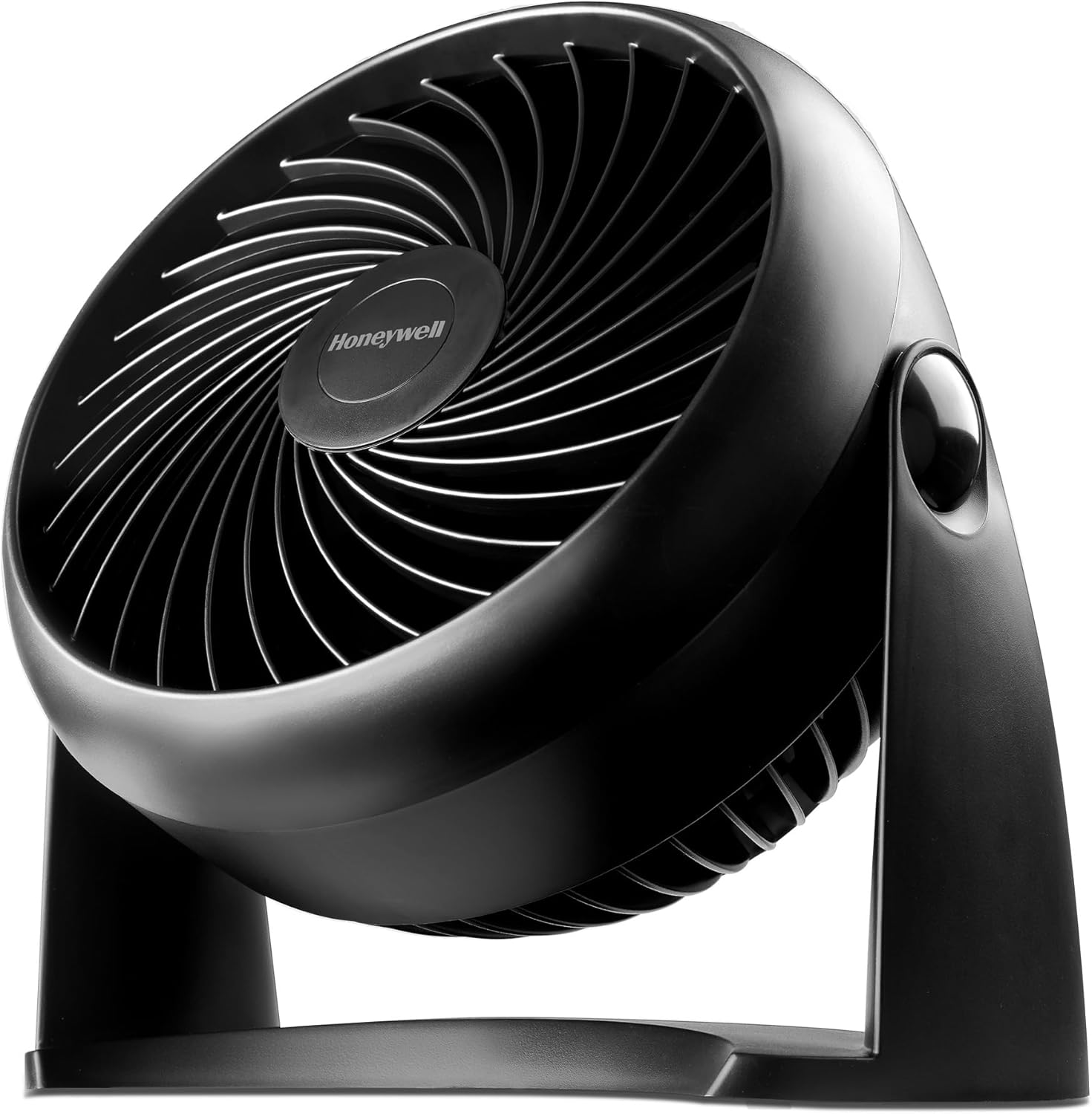
The Honeywell TurboForce HT-900 is a small, no-frills tabletop air circulator designed to move a surprising amount of air for its size. It offers three push-button speeds and a 90-degree pivoting head so you can direct airflow toward a desk, bed, or seating area, and its aerodynamic turbo design is built to reach across a room for targeted cooling. The fan is lightweight and can be used on a table, mounted on a wall, or carried between rooms, and the brushless motor and claimed quiet operation make it suitable for bedrooms or home offices. Practical benefits include low power draw and simple controls that require no setup. Limitations are the modest physical size and single-direction output so it is best for spot cooling rather than replacing a whole-room HVAC system, and the plastic construction means it is utilitarian rather than premium-feeling.
Best for: Buyers looking for an affordable, portable fan to provide targeted cooling at a desk, bedside, or small room who prioritize simplicity and low running cost.
Less Ideal for: People who need to cool large open-plan rooms or want a premium metal-bodied fan with advanced controls.
- Compact and portable for use on desks or bedside tables
- Three speeds with a 90-degree pivoting head for directed airflow
- Aerodynamic design that delivers strong airflow for its size
- Brushless motor and low noise suitable for bedrooms or offices
- Small footprint limits effectiveness for large or open rooms
Verdict: A budget-friendly, compact desk fan that delivers strong directed airflow and quiet operation for spot cooling in small spaces.
DREO TurboPoly Fan 513S

| Power Source | dc |
|---|---|
| Number of Speeds | 8 |
| Air Flow Capacity | 1100 cfm |
| Noise Level | 25 db |
| Wattage | 36 watts |
The DREO TurboPoly Fan 513S is a pedestal air circulator built to move a lot of air quietly while giving multiple control options. It uses a brushless DC motor and a five-blade design to produce up to 1100 CFM and reach long distances, while offering 8 speeds and 6 wind modes so you can dial in anything from a gentle bedroom breeze to a powerful circulation jet. The fan supports app control, a physical remote, touchpad, and voice assistants for convenient scheduling, angle adjustment, and speed changes, and it also includes wide horizontal and vertical oscillation to distribute air across a room. In real use it is notably quiet at around 25 dB on low settings and draws modest power (listed at 36 watts), making it suitable for overnight use and longer runtime. Limitations to consider are its plastic construction and a multi-part pedestal that requires assembly, and while the controls are feature-rich the smart features add complexity compared with a basic mechanical fan.
Best for: Buyers who prioritize reliable, quiet whole-room airflow and want flexible control options for daily home use, where consistent performance and low noise matter more than minimalist simplicity.
Less Ideal for: If you need a heavy-duty metal industrial fan or prefer a simple plug-and-play mechanical fan with no app or voice features, this model is not the best fit.
- High airflow capacity (1100 CFM) for whole-room circulation
- Brushless DC motor for quieter operation and better efficiency
- Multiple control methods including app, remote, touchpad and voice
- Wide horizontal and vertical oscillation for more even air distribution
- Eight speed levels and six modes for fine-grained airflow control
- Plastic body and components may feel less durable than metal alternatives
- Requires assembly and setup to access smart features and app connectivity
Verdict: Choose the DREO TurboPoly Fan 513S when you want dependable, quiet whole-room circulation with versatile smart and manual controls.
DREO Tower Fan 307

| Number of Speeds | 8 |
|---|---|
| Modes | Normal, Natural, Sleep, Auto |
| Oscillation | 90° |
| Wattage | 36 watts |
| Motor Type | brushless DC motor |
The DREO Tower Fan 307 is a compact 36-inch oscillating floor fan built around an upgraded brushless DC motor that pushes strong airflow while keeping noise low. It offers eight speed settings and four modes including Normal, Natural, Sleep, and Auto, so you can dial in anything from a gentle bedroom breeze to a higher-velocity boost; the unit supports remote and touchpad control for easy adjustments. With 90 degree oscillation and a claimed airflow capacity for broad room coverage, it pairs well with an air conditioner to circulate cool air more effectively. Practical touches include a timer, removable rear grille and impeller for easier cleaning, and ETL safety certification. On the downside the fan runs on standard corded power and lists voltage at 240 volts which may matter for some regions, and the plastic construction means it is lightweight but less premium-feeling than metal alternatives. For buyers focused on quiet, adjustable oscillating cooling in bedrooms or living rooms, this model balances airflow and low noise in a small footprint.
Best for: Buyers who want a quiet, adjustable tower fan that delivers wide oscillating coverage and easy remote control for bedrooms and living spaces backed by strong customer feedback.
Less Ideal for: People seeking a heavy-duty, industrial-strength fan or a premium metal build should consider sturdier floor or bladeless alternatives.
- Brushless DC motor for efficient, high-velocity airflow with lower noise
- Eight speed levels and four modes for flexible comfort settings
- 90° oscillation spreads air across a wide area for better room coverage
- Includes remote and touch controls plus a timer for convenient operation
- Removable rear grille and impeller simplify cleaning and maintenance
- Plastic construction feels less durable compared with metal fans
- Corded operation and listed voltage may limit regional compatibility
Verdict: A feature-rich, quiet oscillating tower fan that gives flexible speeds and modes for effective bedroom and living-room cooling.
Honeywell TurboForce HT-904
| Power Source | Corded Electric |
|---|---|
| Number of Speeds | 3 |
| Air Flow Capacity | 185 cfm |
| Noise Level | 25 db |
| Motor Type | Brushless |
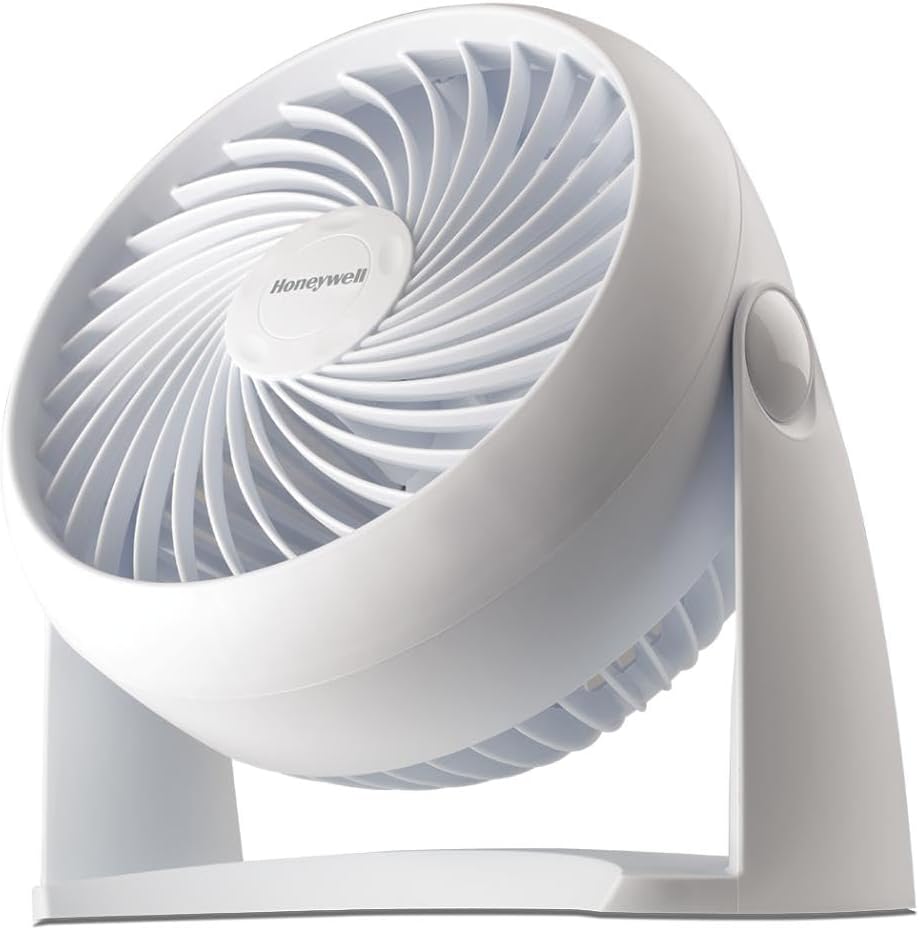
The Honeywell TurboForce HT-904 is a compact tabletop fan built to move a surprising amount of air for its size. Its aerodynamic turbo design and three plastic blades deliver up to 185 cfm, and the 90 degree pivoting head lets you aim airflow precisely for desk, bedside, or small living spaces. Three push-button speeds give straightforward control, and the manufacturer notes noise levels around 25 dB at lower settings, making it a reasonable choice for bedrooms and home offices. The unit is corded, portable, and can also be wall-mounted if you need hands-free placement. Practical benefits include energy-saving circulation to supplement air conditioning and a durable brushless-style motor for steady operation. Limitations are its small footprint, which means it is best for personal or small-room use rather than whole-house cooling, and the plastic construction is utilitarian rather than premium. There are no advanced controls or timers, so if you want smart features or variable fan programming you will need a different model.
Best for: Buyers who want a reliable, no-frills personal fan that delivers noticeable airflow for desks, bedside use, or small rooms while prioritizing quiet operation and simplicity.
Less Ideal for: People who need whole-room or multi-room cooling, programmable or smart control, or a high-end aesthetic should consider other models.
- Strong airflow for a small fan (185 cfm)
- Three simple speeds and a 90° pivoting head for directed cooling
- Quiet operation on low settings (around 25 dB) suitable for bedrooms and offices
- Portable corded design that can be used tabletop, floor, or wall-mounted
- No smart features, timer, or remote control
- Plastic construction lacks premium finish options
- Not intended to cool large rooms or replace an air conditioner
Verdict: Choose the Honeywell TurboForce HT-904 if you want a dependable, quiet tabletop fan that delivers strong directed airflow for personal and small-room cooling.
Choosing the Right Fan for Home: Key Factors to Consider
Airflow and Coverage
How much air a fan moves and how well it distributes that air across a room matters more than a single top speed number. Look for documented airflow figures or user reports describing how far the breeze reaches and whether it creates a consistent circulation pattern.
Coverage affects how many fans you need and where to place them. A fan with high airflow but narrow focus suits spot cooling, while models with wider sweep or better oscillation are better for whole-room comfort. Think about ceiling height and furniture layout because they change effective coverage.
Noise Level and Sound Character
Noise is about more than decibels. The character of the sound—steady whoosh, low hum, or higher-pitched whine—determines whether a fan is tolerable in a bedroom or office.
Consider low-speed noise because fans spend most time on moderate settings. Check whether models advertise quiet modes or sleep settings. For light sleepers or nurseries, prioritize models with smooth, broadband sound rather than tonal whines that are more likely to be annoying.
Energy Use and Operating Cost
Fans are generally efficient, but power draw varies by motor type and maximum speed. Over months of use, differences in watts consumed add up, especially if you run fans overnight or for many hours a day.
Look for lower wattage at usable airflow, and consider fans with multiple speed options or eco modes. If you plan to run a fan continuously, small improvements in efficiency will reduce your electricity bill and extend motor life.
Size, Portability, and Placement
The physical dimensions and weight determine where you can place a fan and how easy it is to move between rooms. Tower and pedestal fans offer different tradeoffs compared with compact box or clip-on styles.
Consider how a fan mounts or sits—floor footprint, tilt range, and whether it fits on a table or window sill. Portability matters if you frequently reposition the unit or store it seasonally. Choose a size that suits your rooms without obstructing traffic or blocking vents.
Controls, Features, and Usability
Controls influence everyday convenience. Simple rotary dials are reliable, while remote controls, timers, and programmable schedules add convenience for bedrooms and living areas.
Useful features include multiple speed steps, oscillation control, timer/sleep modes, and clear indicators. Consider whether the control interface is intuitive and if a remote or app is necessary for your setup. For households with children, lockable controls or minimal exposed moving parts can be important.
Maintenance and Cleanability
Fans collect dust and lint, which reduces airflow and can increase noise. Ease of disassembly and access to the blades or grille affects how often you will actually clean the unit and how thorough that cleaning can be.
Prefer designs with tool-free grille removal or smooth surfaces that wipe clean. If filters are present, check whether they are washable or need replacement. Maintenance demands affect long-term performance and user satisfaction.
Fan Types and When to Use Them
Different fan form factors suit different needs. Tower and pedestal fans work well for whole-room airflow and offer slim footprints, while box and clip-on fans are better for targeted cooling or tight spaces. Floorstanding fans typically move more air but take more floor space.
Choosing the right type depends on the room layout and how you plan to use the fan. For bedrooms, low-noise tower models with sleep modes are often preferable. For garages or workshops, robust floor fans that prioritize raw airflow are a better fit.
- Tower: Good for narrow spaces and whole-room circulation.
- Pedestal: Adjustable height and stronger mid-range airflow.
- Box/Clip: Compact, directional cooling for desks and windows.
- Floor: High-volume airflow for larger or open spaces.
Placement Tips to Maximize Cooling
Small placement changes can significantly improve perceived cooling. Position fans to create a cross-breeze when possible, aiming one fan at an open window and another toward the room interior to encourage air exchange. In rooms without open windows, angle fans to push air along the floor or toward occupied seating areas.
Ceiling height affects direction and tilt. For taller rooms, consider a fan with stronger vertical throw or place the unit higher to avoid dead zones. Avoid placing fans directly behind large furniture that will block airflow.
- Create cross-breezes by aligning fans with window openings.
- Use oscillation to cover seating areas without moving the unit.
- Tilt floor fans slightly upward to circulate warm air in winter.
Noise Reduction Strategies
If you need a fan that stays unobtrusive, choose a model designed for quiet operation and install it on a stable surface to prevent rattles. Soft rubber feet and firm placement reduce vibration transmission to furniture and floors.
Running a fan at a lower steady speed usually produces a more pleasant sound than frequently changing speeds. Regular cleaning also keeps motors from working harder and emitting extra noise as dust accumulates.
- Use sleep or low-noise modes at night.
- Secure loose grilles and fasteners to eliminate rattle.
- Keep blades and motor housings clean to reduce mechanical noise.
Safety and Child-Friendly Considerations
Homes with children or pets require fans with secure grills and minimal exposed moving parts. Look for units with stable bases and tip-over protection to reduce accident risk. Smaller fans that clip or sit on elevated surfaces should have guarded cords and secure clamps.
Consider models with simpler controls or lockable panels to prevent unsupervised adjustments. Avoid fans with easily removable blades unless you can keep them out of reach or locked.
- Tip-over switches add a layer of safety for tall or lightweight fans.
- Sturdy bases reduce the chance of accidental knocks.
- Guarded blades and small grille spacing protect curious hands.
Seasonal Use and Year-Round Benefits
Fans are useful beyond summer cooling. In winter they help circulate warm air from ceiling fixtures or heat registers, reducing cold spots and improving heater efficiency. Choosing a fan with reversible tilt or adjustable speed helps adapt it to seasonal needs.
Think about storage and durability if you plan to put a unit away for months. Corrosion-resistant materials and sealed motor housings extend life when fans are used intermittently across seasons.
- Use fans to redistribute warm air in colder months.
- Select durable finishes for outdoor or semi-outdoor seasonal use.
- Consider storage footprint if you plan to stow the fan seasonally.
How We Chose the Best Fan for Home
We focused on practical performance and everyday use when assembling this list of fans for home. Our selection filters prioritized units that deliver measurable airflow at realistic power settings, while keeping noise low enough for living rooms and bedrooms. Energy efficiency and measured power draw were key criteria because ongoing electricity use is an important ownership cost for fans. Build quality and durability were assessed with emphasis on motor design, materials, and warranty-friendly construction. Ease of use factors included control options, oscillation range, size and portability, and how straightforward routine cleaning and maintenance are. We excluded novelty or single-purpose units that sacrifice durability or effective airflow for gimmicks. The final picks balance sustained performance, quiet operation, straightforward controls, and reasonable upkeep needs, reflecting the dimensions most buyers care about in home fans.
Our full evaluation process is outlined in our review methodology.
FAQ
How loud is too loud for a bedroom fan?
Bedroom acceptability varies by person, but generally look for fans that advertise low-noise or sleep modes and produce a smooth, steady sound. Models with fewer tonal peaks and noise ratings below typical conversation level are usually comfortable for sleeping.
Can a fan cool a room by itself or do I still need air conditioning?
Fans do not lower room temperature but improve comfort by increasing air movement and helping sweat evaporate. In moderate climates or at night, a well-placed fan can replace air conditioning for comfort, but during extreme heat a fan may not be sufficient alone.
How often should I clean my fan?
Frequency depends on dust levels and usage, but a light cleaning every few weeks with deeper cleaning every few months keeps airflow efficient. Regular wiping of blades and grilles prevents buildup that reduces performance and can increase noise.
Are bladeless fans quieter or more efficient?
Bladeless designs can be quieter at some speeds because they mask blade noise, but efficiency and airflow depend on the underlying motor and design. They often cost more and may offer easier cleaning, so weigh noise advantages against power and airflow needs.
What features matter most for an energy-efficient fan?
Multiple speed settings, low-wattage operation at usable airflow, and reliable motor design are the primary contributors to efficiency. Timers and smart scheduling help reduce run time, which lowers energy use over the long term.
Final Verdict
Choose a fan by matching form factor and airflow to your room layout and how you use the space. Prioritize real-world airflow and low-noise operation for bedrooms and living areas, and favor robust motors and easy-clean designs if you expect heavy or year-round use. Balance energy efficiency against required airflow to keep operating costs reasonable. With clear priorities around airflow, noise, efficiency, and maintenance, you can confidently pick a home fan that delivers comfortable, reliable performance.