
Note: This article contains affiliate links. If you click on these links and make a purchase, we may earn a small commission at no extra cost to you. This helps support our research and content. Read our full affiliate disclosure here.
When you spend hours riding on Zwift, thermal comfort matters as much as training structure. A purpose-selected fan reduces overheating, helps maintain power output, and prevents sweat from affecting sensors and equipment. This guide covers the top shortlisted fans for Zwift use, chosen for their airflow control, noise profile, and mounting or placement flexibility. Below you will find our top picks and a clear explanation of the evaluation criteria so you can pick a fan that fits your training space, noise tolerance, and workout intensity.
Top Picks at a Glance
| Best Overall The best all-around choice for most situations | Vornado FLY MAX Floor Fan |  |
| Best Quality Built to a higher standard if you want something more solid | Wahoo KICKR HEADWIND Fan |  |
| Best Value The sweet spot between price and what you get | Lasko Pivoting Utility Blower U15617 |  |
| Best Budget The cheapest option that still gets the job done reliably | Koonie Stroller Fan F981 |  |
| Top Rated A top-rated pick with lots of positive feedback | CYCPLUS F1 Cycling Fan |  |
| Most Popular A crowd favorite that many people choose with confidence | Amazon Basics Air Circulator Fan FT26-16A |  |
| Best Seller A high-volume bestseller chosen again and again | Lasko Pivoting Pro 12" Fan |  |
Vornado FLY MAX Floor Fan

| Number of Speeds | 4 |
|---|---|
| Air Flow Capacity | 2300 cfm |
| Motor Type | Brushless |
| Wattage | 75 watts |
| Noise Level | 45 db |
The Vornado FLY MAX is a purpose-built high-velocity floor fan aimed at intense indoor training and whole-room circulation. It produces up to 2300 FPM of airflow across four speed settings, letting you dial in a steady cooling breeze during Zwift sessions or interval workouts, and the 180° pivoting head directs air where you need it. The included omnidirectional remote with magnetic cradle and straps keeps controls accessible during rides or runs, and the brushless motor and non-slip base support durable daily use while keeping vibration low. At 75 watts it is energy efficient for extended sessions, and the blower-style design focuses airflow for a wind-like feel that can help simulate outdoor riding. Noise is listed at 45 dB which is reasonable for high-output fans but may be noticeable at top speed in quiet rooms. The fan is indoor-only and made of plastic, so while it is portable and compact it is not intended for outdoor or heavy industrial use. If you want a compact, powerful fan that stays stable and lets you control airflow from your trainer, the FLY MAX is a strong option.
Best for: Riders and indoor cyclists who want a compact, high-output fan that mimics outdoor wind and stays easy to control during Zwift workouts.
Less Ideal for: People who need a weatherproof or industrial-strength blower for outdoor spaces or garage workshops should consider a more rugged, outdoor-rated fan.
- High airflow up to 2300 FPM delivers a wind-like breeze useful for indoor cycling and intense workouts
- Four speed settings and 180° tilt let you precisely aim airflow during Zwift sessions
- Omnidirectional remote with magnetic cradle and straps keeps controls handy while training
- Brushless motor provides durable, energy-efficient operation with reduced vibration
- Noise around 45 dB at higher speeds may be noticeable in quiet rooms
- Plastic construction limits outdoor or heavy-duty use
Verdict: A compact, high-velocity floor fan with targeted airflow and remote control that is well suited to Zwift riders who want a realistic, wind-like cooling boost during indoor training.
Wahoo KICKR HEADWIND Fan

| Power Source | dc |
|---|---|
| Number of Speeds | 4 |
| Wattage | 30 watts |
| Control Method | App |
The KICKR HEADWIND is a purpose-built cycling fan that delivers targeted airflow for indoor training sessions. It pairs via Bluetooth or ANT+ to speed sensors, heart-rate monitors, or smart trainers so fan speed automatically rises with your effort, and it also supports four manual speeds and app control through the Wahoo app. The fan's housing and three-blade design concentrate airflow to mirror a rider's frontal profile, producing wind speeds rated over 30 mph for sustained cooling during intense efforts. It is floor-standing and intended to sit behind your trainer or bike, and the button controls plus remote/app options make quick adjustments easy between intervals. Practical limitations include its specialized positioning and higher power draw compared with a basic household fan, and its size and styling prioritize function for cyclists rather than general-room circulation. For riders using Zwift and other structured workouts, the HEADWIND provides more ride-relevant cooling than a standard fan but is a focused solution rather than a multiroom appliance.
Best for: Serious indoor cyclists who prioritize realistic, effort-linked cooling during structured workouts and want a fan that scales with speed or heart rate.
Less Ideal for: People seeking a compact, multipurpose household fan for general room circulation or those who will not connect the fan to sensors or a training app.
- Sensor-controlled speed that responds to ANT+ or Bluetooth speed and heart-rate inputs
- Targeted airflow pattern shaped for a cyclist’s riding position
- App and remote/button control for quick adjustments during workouts
- High top wind speed (over 30 mph) suitable for intense training sessions
- Designed specifically for cycling placement so it is less effective for general room cooling
- Relatively large footprint and dedicated setup compared with standard fans
Verdict: If you train on Zwift and want airflow that automatically matches your effort, the KICKR HEADWIND delivers focused, sensor-driven cooling built for cyclists.
Lasko Pivoting Utility Blower U15617

| Number of Speeds | 3 |
|---|---|
| Air Flow Capacity | 375 cfm |
| Wattage | 120 watts |
| Noise Level | 57.6 db |
| Power Source | Corded Electric |
The Lasko U15617 is a small but powerful pivoting blower fan built for jobsites and hot rooms where targeted airflow matters. It provides three high-velocity speeds and up to 375 CFM through a 15-inch blower, and the pivoting head makes it easy to aim airflow at a rider, wet floor, or paint surface. Practical touches include two 120V accessory outlets for pass-through power, a 10-foot cord, large carry handle for portability, and a circuit breaker with reset for basic motor protection. The fan uses a brushless motor and a simple rotary dial control, so it starts reliably and is straightforward to operate during workouts or garage projects. Trade-offs are its utilitarian plastic build and higher noise at full speed, so it is louder than quiet pedestal or desk fans tuned for bedrooms. For cyclists using Zwift, its compact footprint and strong, directed airflow make it effective at cooling you and drying sweat, though you may prefer a quieter oscillating model if noise matters for video or streaming audio.
Best for: A practical buyer who wants a compact, no-nonsense fan that delivers strong targeted airflow for indoor training, workshops, or wet-floor drying without fuss.
Less Ideal for: People who prioritize ultra-quiet operation or a decorative, premium look should consider quieter tower or desk fans instead.
- High airflow up to 375 CFM for strong, directed cooling
- Pivoting head lets you aim air precisely at your bike or workout area
- Two grounded accessory outlets provide pass-through power for a trainer or devices
- Large carry handle and 10 ft cord make the unit easy to move and position
- Circuit breaker with reset adds basic electrical protection
- Plastic construction is utilitarian rather than premium
- Higher noise level on top speed compared with quieter desk or tower fans
Verdict: Choose this fan if you need compact, high-velocity, directionable airflow to keep cool and dry during intense indoor training sessions.
Koonie Stroller Fan F981

| Power Source | Battery Powered |
|---|---|
| Number of Speeds | 3 |
| Battery Capacity | 5000 mAh |
| Connector Type | USB Type C |
| Motor Type | brushless |
The Koonie Stroller Fan F981 is a small, battery-powered clip fan that doubles as a tripod desk or handheld fan for outdoor and on-the-go cooling. It runs from a built-in 5000 mAh rechargeable battery and offers three speed settings controlled by a single push button, making it simple to adjust airflow while cycling through stroller or treadmill workouts. The flexible legs secure to stroller bars, seats, bike frames, or a treadmill console and allow 360 degree head rotation so you can direct airflow where you need it. The brushless motor and five-blade design are tuned for relatively strong airflow with reported low noise, and charging uses a USB-C port that works with power banks or phone adapters. Expect several hours of run time depending on speed and about 3 to 5 hours to recharge. Limitations include a mostly plastic build and a non-removable battery, so long-term durability and battery replacement are potential concerns for heavy daily use during intense indoor training sessions.
Best for: Cyclists and indoor trainers on a budget who need a compact, rechargeable fan they can attach to a stroller, bike, or treadmill for spot cooling during Zwift rides.
Less Ideal for: Riders seeking a powerful, high-volume training fan for sustained, high-intensity indoor sessions should consider dedicated floor fans instead.
- Large 5000 mAh rechargeable battery for multi-hour runtime
- Flexible tripod and clip-on design that secures to strollers, bikes, and treadmill consoles
- USB-C charging compatible with power banks and phone adapters
- Brushless motor with five blades for stronger airflow at lower noise
- Plastic construction and non-removable battery may limit long-term durability
- May not match airflow of larger dedicated training fans for high-intensity Zwift sessions
Verdict: A compact, affordable rechargeable clip-on fan that delivers directed cooling for budget-conscious Zwift riders who need portable spot airflow.
CYCPLUS F1 Cycling Fan
| Number of Speeds | 5 |
|---|---|
| Motor Type | Brushless DC Motor |
| Wattage | 40 watts |
| Control Method | App, Remote |
| Power Source | ac |
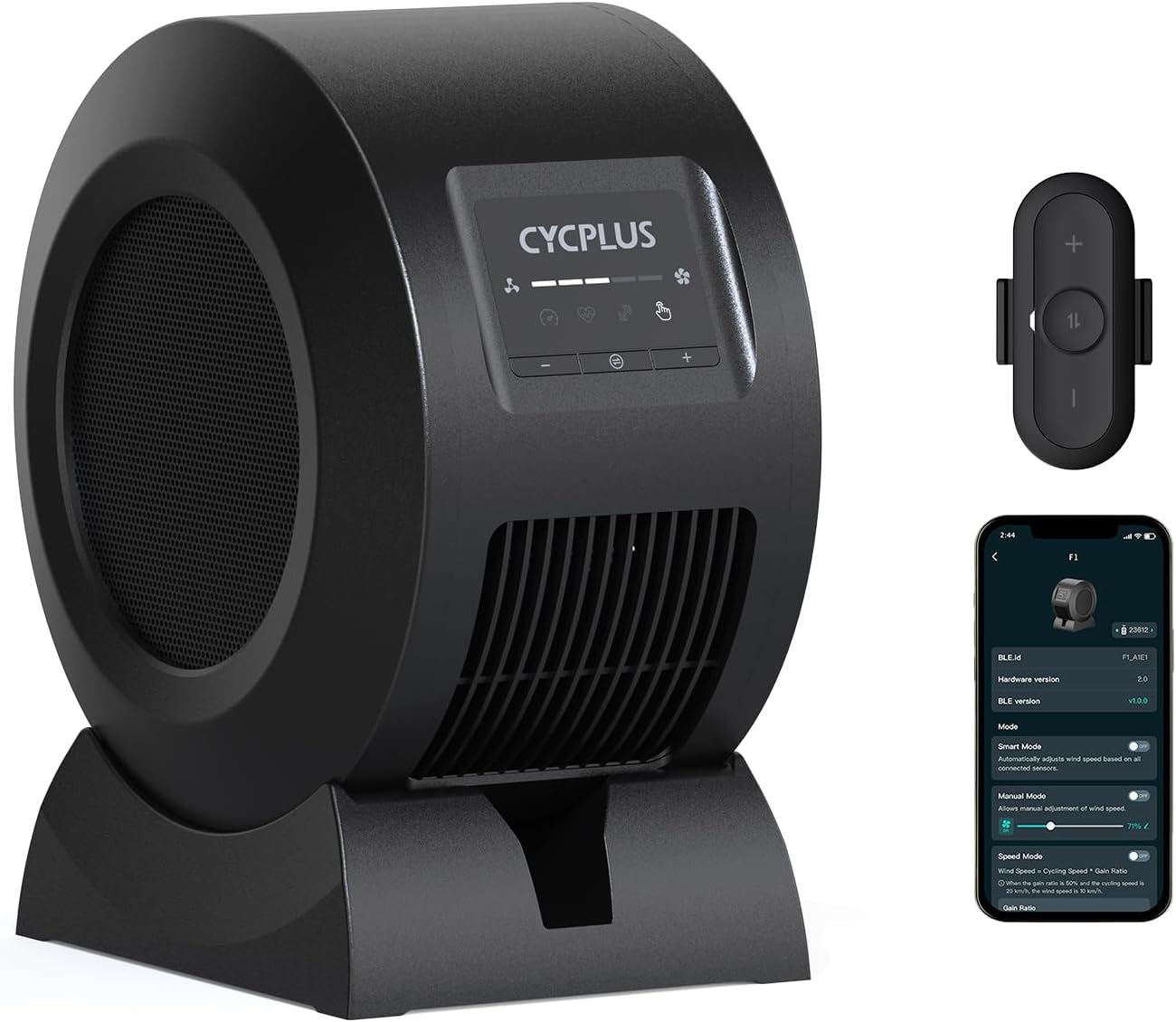
The CYCPLUS F1 is a purpose-built floor fan for indoor cycling that pairs ANT+ sensors and smart trainers to adjust airflow in real time. Its BLDC motor and centrifugal blade design produce strong directed wind, and five modes let you choose fixed speed, heart-rate or power-following modes, manual control, or a smart automatic mode. You can control it from the included remote or the CYCPLUS app and pair heart-rate monitors, speed sensors, power meters, or smart bikes for hands-off adjustments during workouts. The ground base allows low or upward airflow placement and the package includes both AC and DC power options plus silicone straps and spare screws for stable setup. Noise is addressed with a low-noise motor and soft-impact blades, but the unit is designed as a focused cycling blower rather than a room circulator so its airflow pattern is narrow and optimized for a 1 meter placement. If you need broader room cooling or fan oscillation, this is not intended for that use, but for Zwift and trainer sessions it delivers controlled, sensor-driven cooling with reliable factory-quality components.
Best for: Serious indoor cyclists who want dependable, sensor-linked cooling during structured trainer sessions and value integrated ANT+ control and quiet, consistent performance.
Less Ideal for: People seeking a general-purpose floor fan for living spaces or those who need wide-area oscillation and room circulation rather than a focused trainer fan.
- ANT+ pairing with speed, power, and heart-rate sensors for automatic, workout-linked airflow
- Brushless DC motor delivers strong directed wind while keeping operation quiet
- Five modes including smart automatic and manual give flexible control during training
- Includes remote, app control, and both AC and DC power options for stable setup
- Airflow pattern is focused for rider cooling and not designed to circulate a whole room
- No oscillation feature, so placement must be chosen for optimal coverage
Verdict: If you need a reliable, trainer-focused fan that automatically follows ANT+ workout data for hands-off cooling on Zwift, the CYCPLUS F1 is a strong choice.
Amazon Basics Air Circulator Fan FT26-16A

| Number of Speeds | 3 |
|---|---|
| Wattage | 70 watts |
| Noise Level | 30 db |
| Power Source | Corded Electric |
| Blade Count | 3 |
This Amazon Basics air circulator is a straightforward, no-frills fan suited for keeping a training area ventilated during indoor cycling sessions like Zwift. It uses three 11-inch plastic blades driven by a 70-watt motor and offers three speed settings controlled by a rear rotary knob, so you can dial in gentle airflow for recovery rides or stronger output during intense efforts. The 90-degree adjustable tilt lets you aim air directly at your torso or pedals, and its lightweight, compact tabletop profile makes it easy to move and position near a bike. Noise is listed around 30 dB which should be acceptable at lower speeds although the fan will be louder on high and may be noticeable in quiet rooms. Construction is basic plastic which keeps cost and weight down but may feel less durable than pro-grade metal units. There is no oscillation or smart control, so you lose automated coverage and remote adjustments, but for a budget-focused rider who wants dependable directional airflow, this fan delivers simple performance without extras.
Best for: Cyclists seeking an affordable, portable fan to provide direct, adjustable airflow during indoor training sessions and who prioritize straightforward, reliable performance over advanced features.
Less Ideal for: Riders who want ultra-quiet operation, metal build quality, wide oscillation, or smart app/remote controls should consider higher-end cycling-specific fans instead.
- Compact tabletop design that fits beside an indoor bike
- Adjustable 90-degree tilt for targeted airflow
- Three speed settings for easy control
- Lightweight and portable for quick repositioning
- Basic plastic construction may feel less durable than higher-end fans
- No oscillation or smart/remote controls for automated airflow adjustments
Verdict: A budget-friendly, portable fan that gives focused, adjustable airflow for indoor cycling sessions without unnecessary frills.
Lasko Pivoting Pro 12" Fan

| Power Source | Corded Electric |
|---|---|
| Number of Speeds | 3 |
| Air Flow Capacity | 289 cfm |
| Noise Level | 59.3 db |
| Motor Type | Brushless |
The Lasko Pivoting Pro 12" is a small but powerful utility blower designed to move a lot of air in tight spaces. It is typically used in garages, workshops, basements, or near exercise setups to direct focused airflow where you need cooling or drying. The fan delivers up to 289 CFM through three speeds and a 270-degree pivoting head so you can angle the airflow across a rider on a bike trainer or toward wet floors after cleaning. Practical touches include a 10-foot cord, a carry handle for easy repositioning, and two grounded outlets on the housing so you can power a device nearby without extra extension cords. The unit is ETL listed and has a circuit breaker with reset for added electrical protection. Expect a plasticky, worksite-oriented build and a noise level that is noticeable at higher speeds, so it will cool effectively but is not whisper-quiet. For someone who values reliable, concentrated airflow and simple controls, this fan delivers dependable performance with minimal setup.
Best for: Riders who want a no-nonsense, safety-minded fan to deliver strong, directed airflow during indoor training sessions and prefer durable, easy-to-use equipment.
Less Ideal for: Users seeking a near-silent fan for low-noise streaming or those who prioritize premium materials and aesthetic design over raw airflow.
- High-velocity airflow up to 289 CFM for strong focused cooling
- Pivoting head with wide angle to aim air precisely
- Two built-in grounded outlets reduce the need for extra extension cords
- Long 10-foot power cord and carry handle for easy placement and transport
- Noticeable noise on higher speeds, not ideal for quiet indoor sessions
- Plastic construction is utilitarian rather than premium in feel
Verdict: Choose this fan if you need a compact, safety-minded blower that delivers strong, aimed airflow for intense indoor cycling sessions.
Choosing the Right Fan for Zwift: Key Factors to Consider
Airflow Strength and Coverage
How much air a fan moves and the pattern it produces directly affects cooling during intervals and steady-state efforts. Strong focused airflow directed at the torso and head helps evaporate sweat and keeps core temperature lower, which can preserve power and delay fatigue.
Consider whether the fan produces a concentrated jet or a wider plume. A narrower, high-velocity stream is useful when you want targeted cooling while keeping the rest of the room unaffected. Wider coverage is better for multiple riders or for cooling both rider and bike components, such as power meters or derailleurs that can overheat in extreme cases.
Noise Output
Noise matters for Zwift because you may be listening to audio cues, group ride chat, or structured workouts. A fan that produces excessive noise can mask cadence cues, communications, or audio coaching, and it becomes fatiguing during long sessions.
Look for measured noise levels or user feedback about tonal quality. Low-frequency hums can be less annoying than high-pitched whines at similar decibel levels. Also consider how noise changes at higher speeds since interval rides often require stronger airflow.
Speed Control and Responsiveness
Precise speed control lets you match airflow to effort level. Step-less or multi-stage fan controls, remote or app control, and programmable profiles help you dial in comfort without interrupting a ride. Smooth ramping is useful during warmups and cooldowns, and quick responsiveness is important when transitioning into high-intensity efforts.
Evaluate whether the control interface is easy to operate from the trainer position. Physical knobs, remotes, or smartphone controls are all valid but assess how intuitive they are while you are clipped in.
Mounting Options and Placement
Where you can place or mount the fan determines how effectively it cools you and whether it blocks your riding position. Tripod stands, adjustable-height poles, wall mounts, and clamp mounts each have tradeoffs for stability and directional control.
Think about whether you need a compact footprint for small spaces, a clamp to attach to a bike trainer or trainer stand, or a tall stand to match your seated and standing positions. Stability is crucial to avoid accidental knocks during out-of-saddle efforts.
Power Source and Portability
The fan's power options affect where you can use it. AC-powered units deliver consistent output but require an outlet, while USB or battery-powered fans allow flexible placement and portability for rides in different rooms or outdoor warmups.
Consider runtime for battery models and whether the fan sustains airflow at higher settings on battery. Also check cable length and whether a USB connection shares power with other devices or requires a dedicated adapter.
Durability and Maintenance
Indoor training environments expose fans to sweat and elevated humidity, which can affect electronics over time. Durable construction, rust-resistant materials, and easy-to-clean grilles extend usable life. Replaceable parts and accessible power switches add to longevity.
Regular maintenance, such as periodic cleaning of blades and vents, preserves airflow performance. Look for models designed with tool-free cleaning or easily removable covers to make upkeep straightforward.
How Fan Placement Affects Cooling During Rides
Small changes in fan placement change perceived cooling more than raw airflow numbers. A fan positioned slightly above and in front of the rider targets the head and chest, which creates a strong cooling effect with less total airflow. Lower placements aim at the legs and can help maintain comfort during seated intervals.
If you alternate between seated and standing efforts, consider a placement that can be adjusted quickly or a fan that produces a broad airflow pattern so you do not need to reposition between efforts.
- Place the fan 2 to 4 feet in front for maximum torso cooling.
- Mount higher to cool the head and upper body during out-of-the-saddle efforts.
- Use a secondary, lower fan if you want consistent leg cooling without moving the main unit.
Balancing Airflow and Noise for Group Rides
During group rides on Zwift, you may want a quieter background level to hear voice chat and audio. This often means choosing a fan with better low-speed performance and a smoother noise signature. High-end units often maintain useful airflow while keeping noise intrusions to a minimum.
If you need more cooling for a short interval, plan to temporarily increase fan speed rather than relying on maximum constant output, which can be disruptive to others in the same house.
- Test fans at typical training speeds to judge actual in-use noise.
- Favor fans with multiple speed steps or variable control for fine tuning.
Power and Connectivity Considerations
Fans with integrated timers, USB power, or app control can fit more neatly into a training setup. For example, a fan that powers from a nearby USB outlet on a smart trainer or bike light source reduces cable clutter. Timers help manage ventilation for cooldowns without manual adjustments.
If you ride in different rooms, portability and quick mount or clamp options make it simpler to move the fan. Some fans include foldable stands or compact profiles that fit into storage when not training.
- USB-powered fans increase placement options but check if high-speed output is maintained on USB.
- App or remote control is useful when you are clipped into pedals and cannot reach a knob easily.
Safety and Trainer Equipment Interaction
Ensure the fan does not blow directly into sensors or electronics that are not protected from moisture. Place the fan to avoid blowing sweat into power meters, battery compartments, or trainer electronics. Using a shield or strategic angle can prevent direct spray onto sensitive components.
Also check that mounts and stands are stable and out of the pedal path to avoid accidental contact. Secure placement reduces the risk of a fan tipping during a hard sprint.
- Aim airflow at the rider, not directly at exposed electronics.
- Use stable clamps and avoid placing fans where cables can be tripped on.
Routine Care to Maintain Performance
Regular cleaning keeps airflow consistent and prevents motor strain. Wipe down grills and remove dust or sweat buildup on blades. If the fan has washable filters or covers, follow manufacturer cleaning intervals to retain peak output.
Inspect power cables and mounting hardware periodically for wear. Replacing any frayed cords or loose fasteners early prevents sudden failures during training sessions.
- Schedule cleaning after particularly sweaty training blocks.
- Keep fan vents unobstructed for best cooling and motor life.
How We Chose the Best Fan for Zwift
We focused on features that matter for indoor cycling and Zwift-specific use rather than general room cooling. Primary filters included adjustable airflow control that supports a range of intensity levels, low noise at moderate-to-high speeds, and stable mounts or stands that work with trainer setups. We also prioritized fans with wide airflow patterns or directional control to cover both rider and equipment, and those with durable motors and reliable speed control. Excluded items were general-purpose tower or decorative fans that lack adjustable airflow direction, fans rated only for outdoor use, and units without clear speed control or mounting options. We evaluated product specs for airflow (CFM or equivalent), noise ratings, control precision, build stability, and convenience features such as remote control or programmable speeds. The shortlist reflects products that balance cooling performance with a noise profile suitable for group rides or race efforts on Zwift.
Our full evaluation process is outlined in our review methodology.
FAQ
How close should a fan be to my trainer for Zwift rides?
Usually 2 to 4 feet in front of the rider provides effective torso and head cooling. Adjust distance and height to suit seated versus standing efforts and to avoid blowing directly onto sensitive equipment.
Is a single fan enough for high-intensity interval sessions?
Often a single high-velocity fan can be sufficient, but for very long or very intense sessions you may benefit from a second fan to cover both upper and lower body or to provide consistent airflow when changing positions.
Should I prioritize noise reduction or maximum airflow?
It depends on your training context. If you do group rides, zoom calls, or listen to audio cues, a quieter fan with good low-speed output is preferable. For maximal cooling during short sprints, prioritize higher airflow and accept increased noise temporarily.
Can a USB-powered fan keep up with a wall-powered unit?
Some high-quality USB fans provide surprisingly strong airflow, but many USB fans have lower maximum output than AC-powered models. Check whether the fan maintains airflow at higher settings on USB power if you plan to rely on that source.
How do I prevent sweat from damaging my trainer electronics?
Angle the fan to blow over your torso rather than directly at trainer electronics. Use absorbent towels, sweat guards, or splash shields on frames and near power meters to protect components.
Final Verdict
When choosing a fan for Zwift, prioritize airflow pattern and adjustable control so you can match cooling to intensity without creating distracting noise. Consider placement and mounting options that keep airflow aimed at your torso while protecting trainer electronics. Tradeoffs between raw airflow and noise are inevitable, so decide whether consistent long-ride comfort or short-burst maximum cooling is more important for your typical sessions. With a clear sense of your space, noise tolerance, and portability needs, you can confidently select a fan that improves training comfort and helps you maintain performance on Zwift.