
Note: This article contains affiliate links. If you click on these links and make a purchase, we may earn a small commission at no extra cost to you. This helps support our research and content. Read our full affiliate disclosure here.
When indoor humidity climbs, the right fan can make a measurable difference in comfort and mold prevention. You want a fan that moves the right volume of air, operates quietly in living spaces, and manages moisture without constant intervention. This guide covers seven shortlisted fans for humidity, each chosen for strengths like airflow, moisture-management features, and ease of maintenance. Below you will find the evaluation criteria we used and practical info to help you match a fan to the size and humidity challenges of your rooms.
Top Picks at a Glance
| Best Overall The best all-around choice for most situations | Lasko Wind Machine 3300 |  |
| Best Quality Built to a higher standard if you want something more solid | AC Infinity CLOUDLINE T4 |  |
| Best Value The sweet spot between price and what you get | Amazon Basics 28" Tower Fan DC1663 |  |
| Best Budget The cheapest option that still gets the job done reliably | Comfort Zone 9" Box Fan BP-9B-BLK |  |
| Top Rated A top-rated pick with lots of positive feedback | DEWALT 20V MAX Jobsite Fan DCE512B |  |
| Most Popular A crowd favorite that many people choose with confidence | Honeywell TurboForce HT-900 |  |
| Best Seller A high-volume bestseller chosen again and again | DREO Tower Fan DR-HTF018 |  |
Lasko Wind Machine 3300

| Power Source | Corded Electric |
|---|---|
| Number of Speeds | 3 |
| Air Flow Capacity | 1985 cfm |
| Wattage | 107 watts |
| Motor Type | brushless |
The Lasko Wind Machine 3300 is a straightforward high-velocity floor circulator designed to move a lot of air in large or humid spaces. It offers three manual speeds and a pivoting head so you can aim strong airflow where you need it, which helps accelerate drying of damp floors, carpets, or painted surfaces and improves air mixing in rooms with elevated humidity. The fan is portable thanks to a large carry handle and ships fully assembled, and its plastic and metal construction tolerates garage or basement conditions better than delicate tower fans. At the same time it is a simple, no-frills unit: controls are rotary and manual, there is no timer or remote, and the three-speed range limits fine-grain quiet operation. The motor produces noticeable white noise on high, which can be useful for masking sounds but may be intrusive in a bedroom at top speed. Built-in fused plug safety and ETL listing give basic electrical protection for home use.
Best for: Buyers who need a durable, portable fan that pushes a lot of air to speed drying or improve ventilation in humid rooms and work areas.
Less Ideal for: Those seeking a quiet, feature-rich bedroom fan with remote control, timers, or many speed increments should consider other options.
- High airflow capacity up to 1,985 CFM for rapid air circulation and drying
- Pivoting head lets you direct strong airflow to specific areas
- Large built-in carry handle for easy portability between rooms
- Durable plastic and metal construction suitable for garages and workspaces
- ETL listed and fused plug safety for basic electrical protection
- Only three manual speed settings limit quieter, lower-power operation
- No timer, remote, or advanced controls for automated or quiet night use
- Motor can be noisy on the highest setting
Verdict: Choose the Lasko Wind Machine 3300 when you need a tough, portable fan that delivers powerful airflow to dry damp areas and improve ventilation in humid spaces.
AC Infinity CLOUDLINE T4

| Air Flow Capacity | 205 cfm |
|---|---|
| Noise Level | 28 db |
| Wattage | 21 watts |
| Motor Type | EC motor |
| Control Method | App |
The CLOUDLINE T4 is a 4-inch inline duct fan designed for precise ventilation in grow tents, humid spaces, and small HVAC runs. It pairs a mixed-flow impeller with a PWM-controlled EC motor to deliver up to 205 CFM while keeping noise down around 28 dBA, making it useful where quiet continuous exchange matters. The unit includes a smart controller with temperature, humidity and VPD programming accessible over WiFi so you can set climate triggers, schedules, and receive alerts from the app. Installation is typical for a mounted inline fan and AC power makes hookup straightforward; the included mounting hardware and long power cable help placement. Practical benefits are energy-efficient continuous operation, fine-grained speed control across multiple presets, and remote automation that helps maintain humidity targets without constant manual adjustment. Limitations are that this model is sized for small ducts and spaces only, so it will not move enough air for larger rooms or commercial HVAC ducts, and the plastic housing means it is best for indoor, non-corrosive environments.
Best for: Buyers focused on precise humidity and climate control in small grow tents, closets, or compact HVAC runs who prioritize quiet, energy-efficient continuous ventilation and smart automation.
Less Ideal for: People needing high-volume ventilation for large rooms, commercial spaces, or outdoor/harsh environments should choose a larger metal fan or commercial-grade unit.
- High-efficiency EC motor with PWM control for low energy draw
- Smart WiFi app and controller with temperature, humidity, VPD triggers and scheduling
- Quiet operation around 28 dBA suitable for noise-sensitive spaces
- Mixed-flow design delivers a usable 205 CFM from a compact 4-inch duct
- Limited to small duct applications and not suitable for large-room ventilation
- Plastic construction may not be ideal for corrosive or outdoor installations
Verdict: A compact, energy-efficient inline fan with quiet operation and smart humidity/temperature automation for precise control in small humid spaces.
Amazon Basics 28" Tower Fan DC1663

| Power Source | Corded Electric |
|---|---|
| Number of Speeds | 3 |
| Wattage | 35 watts |
| Special Features | Oscillating |
The Amazon Basics 28" Tower Fan is a no-frills oscillating tower designed to move air in small to medium rooms. It offers three straightforward speed settings controlled by mechanical push buttons on the top, and the fan head oscillates to spread airflow across a room rather than a single spot. With a 35-watt motor and three plastic blades, it runs efficiently without complicated menus or remote controls, making it easy to use for bedroom, living room, or home office cooling. The compact footprint and lightweight design let you place it in corners or next to furniture, and the painted finish keeps the look unobtrusive. Expect steady, audible airflow rather than whisper-quiet operation, and the basic plastic construction means it is functional but not premium-feeling. There are no timers, remote, or app features, so if you want automated schedules or quieter performance you will need a higher-end model. For buyers seeking a straightforward, affordable tower fan that circulates air reliably, this covers the essentials well.
Best for: Buyers looking for an inexpensive, easy-to-use tower fan to provide straightforward room circulation without extra features or complexity.
Less Ideal for: Users who want silent operation, smart controls, timers, or a premium build should consider higher-end models instead.
- Three simple speed settings for easy adjustments
- Oscillating head provides wide airflow coverage across a room
- Low power draw at 35 watts for economical operation
- Compact, lightweight design fits small spaces and is easy to move
- Basic plastic construction feels inexpensive compared with premium fans
- No remote, timer, or advanced quiet mode for overnight use
Verdict: A budget-friendly, easy-to-use oscillating tower fan that delivers reliable room circulation with minimal fuss.
Comfort Zone 9" Box Fan BP-9B-BLK

| Number of Speeds | 3 |
|---|---|
| Noise Level | 40.6 db |
| Wattage | 32 watts |
| Air Flow Capacity | 153 cfm |
The Comfort Zone 9" portable box fan is a lightweight, plug-in tabletop fan intended to deliver focused airflow in small rooms, desks, or bedside areas. It offers three rotary speed settings and a three-blade design that produces up to 153 cfm at about 32 watts, so it can move a noticeable amount of air while using little power. The unit is fully assembled out of the box and has a high-density protective grill for safety in homes with children or pets. Noise is modest at roughly 40.6 dB on lower settings, making it suitable for bedrooms or home offices, though the top speed will be louder. Its compact footprint and low weight make it easy to reposition for spot cooling or to boost circulation near a dehumidifier or window. Limitations include its small 9-inch blade size, which restricts effective coverage to personal or small-area use rather than cooling large rooms, and the lack of advanced controls like timers or oscillation.
Best for: Buyers who need an inexpensive, portable way to boost air circulation in small rooms or to direct airflow toward a dehumidifier or drying area will appreciate its simplicity and low running cost.
Less Ideal for: People looking to cool medium or large rooms, or who need features like oscillation, timers, or remote control, should consider larger or more feature-rich fans instead.
- Compact, space-saving design for tight surfaces
- Low power draw (32 watts) for energy-efficient continuous use
- Three-speed dial makes it simple to adjust airflow quickly
- Protective high-density grill improves safety around kids and pets
- Lightweight and fully assembled for immediate portability
- Small 9-inch blade best suited for personal or small-area cooling
- No oscillation or advanced controls limits coverage pattern
Verdict: A very affordable, low-power personal box fan that reliably boosts air circulation in small spaces and pairs well with dehumidifiers for spot humidity control.
DEWALT 20V MAX Jobsite Fan DCE512B

| Power Source | Battery Powered |
|---|---|
| Air Flow Capacity | 650 cfm |
| Motor Type | Brushless |
| Specification Met | IP54 |
| Number of Speeds | 3 |
The DEWALT 20V MAX Jobsite Fan is a portable cordless blower aimed at moving a lot of air on job sites or in damp spaces where a cord is inconvenient. It uses a brushless motor and an axial three-blade design to produce up to 650 CFM, and a variable speed dial lets you dial airflow to the task. The IP54 rating and plastic housing make it resistant to dust and splash exposure for use around humid or messy environments, and the integrated hook and freestanding design give flexible mounting options. Runtime depends on the battery you pair with it, but DEWALT rates up to 4.5 hours with a compatible 20V battery, so you can run it for long stretches without mains power. Controls are simple push-button/touch style rather than advanced digital menus, and the unit is tool-only so you must already own a DEWALT 20V battery and charger. Expect a solid, rugged fan that prioritizes airflow and on-site durability over quiet operation or fine-grain speed automation.
Best for: Someone who needs a rugged, cordless fan that reliably moves large volumes of air in humid, dusty, or mobile workspaces and values durability over silent operation.
Less Ideal for: People seeking a quiet, plug-and-play household fan with included power accessories or those who need precise digital controls and timers.
- High airflow up to 650 CFM for fast air circulation
- Brushless motor for durability and efficient operation
- IP54 rating offers dust and splash resistance suitable for humid or rough environments
- Variable speed control and multiple mounting options increase versatility
- Battery and charger sold separately so runtime varies with battery choice
- Noise level is relatively high at around 65 dB under load
Verdict: Choose this fan if you want a durable, high‑airflow cordless blower built to withstand humid, dusty jobsite conditions.
Honeywell TurboForce HT-900
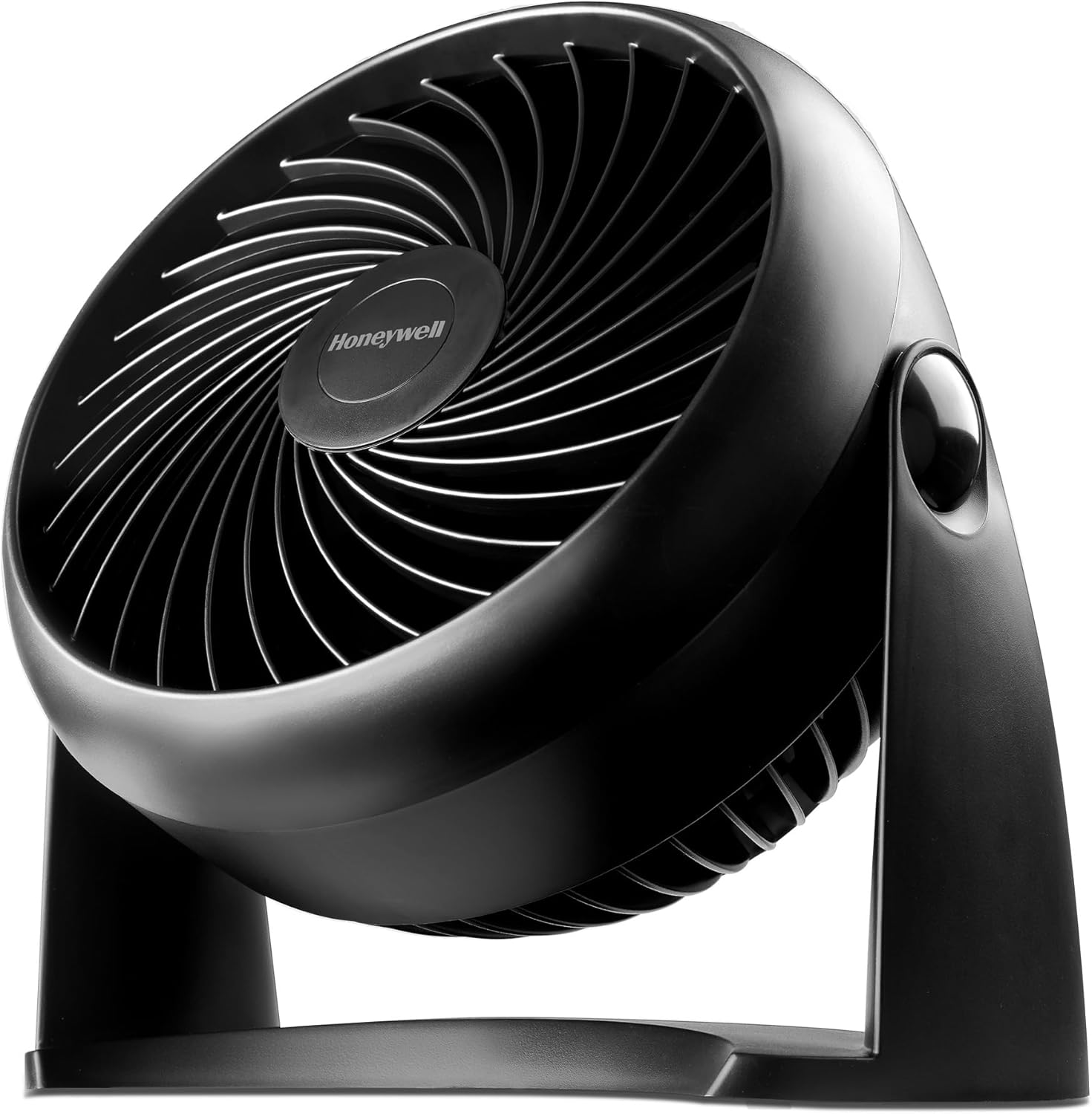
| Power Source | Corded Electric |
|---|---|
| Number of Speeds | 3 |
| Air Flow Capacity | 185 cfm |
| Motor Type | brushless |
| Installation Type | Tabletop or Wall Mount |
The Honeywell TurboForce HT-900 is a small, corded tabletop air circulator designed to move air efficiently in bedrooms, home offices, or other small to medium spaces. It uses an aerodynamic turbo-style grill and a brushless motor to produce up to 185 cfm of airflow while offering three push-button speed settings and a 90-degree pivoting head so you can aim the breeze where you need it. The unit can be mounted on a wall or placed on a desk and is light enough to move between rooms. In practice it provides a concentrated stream of air that helps circulate humid air and can assist dehumidifiers by improving room airflow. Noise is low compared with similar-sized circulators, and the plastic housing is easy to wipe clean. Limitations are its small size and single-direction output, so it is best for spot cooling and circulation rather than whole-room mixing in large spaces, and it lacks timers or smart controls for automated humidity schedules.
Best for: Buyers who want a proven, reliable small fan to provide targeted airflow and boost circulation around a dehumidifier or in a humid room, and who value social proof from a top-selling, well-reviewed model.
Less Ideal for: Those who need whole-room circulation for large spaces or want programmable, app-controlled humidity scheduling should consider larger or smart fans instead.
- Compact and portable for tabletop or wall mounting
- Aerodynamic design and brushless motor deliver strong airflow for its size (185 cfm)
- Three speed settings and 90° pivoting head for directed airflow
- Relatively quiet operation compared with similar small circulators
- No timer, remote, or smart connectivity for automated control
- Small footprint limits effectiveness for large or open-plan rooms
Verdict: A compact, well-reviewed tabletop circulator that reliably boosts airflow around dehumidifiers and in humid rooms for targeted, quiet cooling.
DREO Tower Fan DR-HTF018

| Power Source | Corded Electric |
|---|---|
| Number of Speeds | 9 |
| Special Features | 9 Speeds 4 Modes, Oscillating, Timer |
| Wattage | 35 watts |
| Air Flow Capacity | 1473 cfm |
The DREO 42-inch tower fan uses a brushless DC motor to deliver strong airflow (listed at 1473 CFM) with up to nine speed settings and four modes including Natural, Sleep, Turbo and Standard. It is controlled by touch buttons or the included remote and offers 90° oscillation and a 12-hour timer, making it simple to set and forget in bedrooms, home offices, or living areas. The unit is designed to run quietly for night use and its rear grille is removable for easy cleaning, which helps when managing dust in humid environments. At 35 watts rated power it is energy efficient for continuous circulation. Practical limitations: it is an indoor-only freestanding fan so it does not dehumidify or filter air and it requires occasional cleaning to maintain peak performance in sticky, humid conditions. The fan balances powerful room circulation with quiet operation and straightforward maintenance.
Best for: Buyers who prioritize low-risk, reliable room circulation with quiet operation and easy maintenance for bedrooms, home offices, or living rooms.
Less Ideal for: People seeking a combined dehumidifier or air-purifying solution or those needing an outdoor-rated cooling device should look elsewhere.
- Powerful airflow rated at 1473 CFM for fast room circulation
- Brushless DC motor for quieter, more efficient operation
- Nine-speed settings and four modes let you tailor airflow intensity
- 90° oscillation and 12-hour timer cover wide areas and scheduled use
- Removable rear grille for easy cleaning and dust removal
- Does not remove humidity or provide air filtration
- Freestanding indoor design limits use to protected indoor spaces
Verdict: Choose this tower fan if you want a quiet, energy-efficient indoor fan that delivers strong, adjustable airflow and is simple to maintain in humid rooms.
Choosing the Right Fan for Humidity: Key Factors to Consider
Room Size and Air Changes Per Hour
Matching a fan's airflow to the room size determines how quickly humid air is refreshed. Calculate the room's volume and choose a fan with sufficient cubic feet per minute (CFM) to achieve several air changes per hour depending on how damp the space is. Bathrooms and laundry rooms often require higher air-change rates than living rooms because moisture sources are concentrated.
Undersized fans will run constantly without effectively lowering humidity, while oversized units may be noisy and create uncomfortable drafts. Consider placement and directional airflow too because a fan that circulates air across the room will reduce localized dampness more effectively than one that only moves air in a single direction.
Humidity Sensors and Automatic Controls
Built-in humidity sensors or smart controls let a fan respond to moisture spikes without manual intervention. Automatic operation prevents overrun and reduces energy waste while maintaining target humidity levels. Timers and programmable speeds also help manage run times after showers or cooking events.
Not all sensors are equally accurate, so prefer units that allow calibration or manual override. Even simple features like a delayed shutoff can clear residual moisture after an activity, reducing the workload on any supplemental dehumidification equipment.
Noise and Nighttime Comfort
Fans that control humidity are often left running during sleep hours, so noise matters. Look for acoustic performance ratings or manufacturer noise levels at different speeds. Lower decibel operation at typical humidity-control speeds will make continuous running less intrusive.
Consider blade design and motor type because these affect both sound and airflow efficiency. Fans offering low, medium, and high modes let you balance noise and performance across different needs and times of day.
Materials and Corrosion Resistance
Humid environments accelerate corrosion and microbial growth. Fans with moisture-resistant housings, sealed motors, and corrosion-proof fasteners last longer and require less maintenance. Plastic components that are mildew-resistant or powder-coated metals are preferable in bathrooms, basements, or laundry rooms.
Inspect whether the motor is rated for continuous duty in damp locations and whether the finish resists peeling. Durable materials reduce the chance of odor and staining and minimize long-term replacement costs.
Ease of Cleaning and Maintenance
Fans in moist spaces attract dust and can grow mold, so easy disassembly and smooth surfaces are important. Removable grills, tool-free access to blades, and washable filters make routine cleaning quick and more likely to be performed. Filters that trap airborne particulates reduce residue on surfaces and prolong fan life.
Also consider serviceability for bearings and motors. Units designed for straightforward maintenance reduce downtime and help sustain peak humidity-control performance over years of use.
Energy Use and Continuous Operation Cost
Because humidity-control fans often run for extended periods, efficiency affects operating cost. Look for motors with low wattage relative to airflow output, and features like variable-speed motors or EC motors that maintain performance with reduced energy draw. Timers and smart scheduling reduce unnecessary run time.
Balancing energy use with required runtime is crucial. An efficient fan may cost more upfront but deliver lower monthly operating costs when used to control persistent humidity.
Sizing a Fan to Different Rooms
Different spaces demand very different airflow. Small bathrooms need a fan sized to remove the moisture produced by showers, while basements and larger laundry rooms require higher-capacity fans that can move air across larger volumes.
Start by estimating the room volume and target air changes per hour for the level of humidity control you want. For localized problem areas, consider combining directional floor or wall fans with a ceiling or exhaust unit to break up stagnant pockets.
- Bathrooms: shorter run times but higher peak moisture load after showers
- Laundry rooms: intermittent high moisture and lint management needs
- Basements: continuous low-level dehumidification and circulation
Placement and Airflow Patterns
Where you place a fan affects how well it mixes air and prevents damp corners. Ceiling exhausts are ideal for removing warm moist air near the ceiling, while floor or oscillating fans help redistribute dry air across surfaces and speed drying.
Aim the airflow so that it crosses wet surfaces and creates broad circulation rather than just blowing along a wall. In some layouts, pairing a small exhaust fan with an oscillating circulation fan yields faster moisture reduction than either alone.
- Position near moisture sources but ensure intake and exhaust paths are clear
- Avoid pointing directly at people for prolonged comfort
- Use oscillation to broaden coverage in open-plan areas
Integrating Fans with Ventilation and Dehumidifiers
Fans for humidity are one tool in a broader moisture-control strategy. In spaces with severe or persistent humidity, pairing a fan with proper ventilation or a dehumidifier creates better results. Use fans to move moist air toward an exhaust or dehumidifier intake for more efficient removal.
Fans can reduce the workload on mechanical dehumidifiers by speeding drying and preventing pockets of humid air. For intermittent humidity spikes, a well-configured fan plus timed ventilation often suffices without continuous mechanical dehumidification.
- Use fans to direct moist air to an exhaust point or dehumidifier
- Ventilate during and after moisture-generating activities
- Consider airflow balance to avoid creating negative pressure that pulls in outdoor humidity
Smart Controls and Automation
Automated controls expand a fan's usefulness by responding only when needed. Humidity-triggered activation, schedules tied to typical activities, and integration with other home sensors keep fans from running unnecessarily while preserving comfort.
Smart features can also deliver maintenance reminders and runtime logs so you can track performance and adjust behavior. When using automation, allow manual overrides to handle unusual events or rapid drying needs.
- Humidity-triggered on/off keeps runtime efficient
- Schedules reduce manual intervention after recurring activities
- Connectivity can provide alerts for cleaning and filter changes
Dealing with Noise Without Sacrificing Airflow
Noise is often the limiting factor for running a fan continuously. Look for multi-speed controls and modes specifically tuned for low-noise operation at lower airflow. Blade design and motor mounting influence which speed delivers the best balance of sound and performance.
If sleep-time operation is required, select units that keep decibel output low at the recommended humidity-control speed, or choose a quieter circulation fan for nighttime use while reserving the higher-capacity unit for daytime or active drying.
- Prioritize sound ratings at the speeds you will use most
- Combine a quiet low-speed fan for night with higher-flow options for peak events
- Check for vibration-reducing mounts to limit tonal noise
How We Chose the Best Fan for Humidity
We focused on attributes that directly affect a fan's ability to improve indoor humidity and occupant comfort. Primary filters included measured airflow capacity relative to room size, the presence of moisture-management features such as humidity sensors or variable speed controls, and effectiveness of air circulation patterns to prevent stagnant, damp pockets. Noise level under typical operating conditions was a key consideration because persistent high-humidity solutions need to run for extended periods. We also evaluated ease of cleaning and maintenance since fans exposed to humid environments collect dust and can harbor mold. Energy efficiency and runtime cost were considered to favor options that can run longer without excessive power use. We excluded units with poor airflow relative to their advertised size, fans lacking variable speeds or timing options, and models with design traits that impede cleaning. The final picks emphasize a balance between measurable airflow performance, control over operation, durability in damp environments, and practical upkeep requirements. These same dimensions guided the scoring labels used in the product cards.
Our full evaluation process is outlined in our review methodology.
FAQ
Can a fan alone reduce long-term humidity in a damp basement?
A fan improves air circulation and can reduce localized damp spots, but long-term reduction of high humidity often requires a dehumidifier or improved ventilation. Use fans to move moist air toward an exhaust or dehumidifier intake to make those systems more effective.
How loud should I expect a humidity-control fan to be?
Noise varies by size and speed. Expect higher-capacity fans to be louder at top speed. Look for units with rated decibel levels and multi-speed settings to find a balance between effective airflow and acceptable noise, especially for overnight use.
Are humidity sensors on fans accurate enough to rely on?
Sensors are usually accurate enough for general control but can vary by quality and placement. They work well for automated on/off control and maintaining broad humidity targets, but periodic manual checks are useful in critical or unusually damp spaces.
How often should I clean a fan used in a humid area?
Plan on a basic cleaning every 1 to 3 months depending on dust and moisture exposure, with more thorough cleaning and inspection every 6 to 12 months. Regular cleaning prevents buildup that reduces airflow and increases the risk of mold or odors.
Will an energy-efficient fan be less effective at removing moisture?
Not necessarily. Efficiency describes energy used relative to airflow delivered. Many efficient motors maintain high airflow while consuming less power. Focus on the fan's CFM per watt or similar measures to judge both effectiveness and operating cost.
Final Verdict
When selecting a fan for humidity, prioritize airflow capacity matched to your room volume, meaningful control options, and materials that withstand damp conditions. Noise and ease of cleaning are practical concerns because these units often run for extended periods. Balance continuous operation costs with the runtime and efficiency features offered. Choose a fan that aligns with your typical moisture events and room layout: higher CFM and automated humidity control for persistent problems, or lower-noise, easier-to-maintain units for intermittent use. Focusing on those tradeoffs will help you pick a reliable solution that keeps humidity in check without creating new comfort or maintenance headaches.