
Note: This article contains affiliate links. If you click on these links and make a purchase, we may earn a small commission at no extra cost to you. This helps support our research and content. Read our full affiliate disclosure here.
A good fan for indoor cycling does more than circulate air. It stabilizes your core temperature, reduces perceived exertion, and prevents excessive sweating that can damage equipment or make long sessions miserable. Whether you train on a smart trainer, turbo trainer, or a stationary bike, the right fan choice affects comfort, performance, and how long you can sustain high-intensity intervals. This guide presents seven shortlisted fans that work well for indoor cycling, chosen for airflow, noise, adjustability, and long-term durability. Below you will find concise buying guidance and the evaluation criteria we used to select these top options.
Top Picks at a Glance
| Best Overall The best all-around choice for most situations | CYCPLUS F1 Cycling Fan |  |
| Best Quality Built to a higher standard if you want something more solid | Wahoo KICKR HEADWIND |  |
| Best Value The sweet spot between price and what you get | Amazon Basics 20-Inch Box Fan |  |
| Best Budget The cheapest option that still gets the job done reliably | BESKAR USB Clip-On Fan ZLS-E300 |  |
| Top Rated A top-rated pick with lots of positive feedback | Vornado 630 Air Circulator |  |
| Most Popular A crowd favorite that many people choose with confidence | Lasko Pivoting Pro 12" Fan U12104 |  |
| Best Seller A high-volume bestseller chosen again and again | Honeywell TurboForce HT-900 |  |
CYCPLUS F1 Cycling Fan
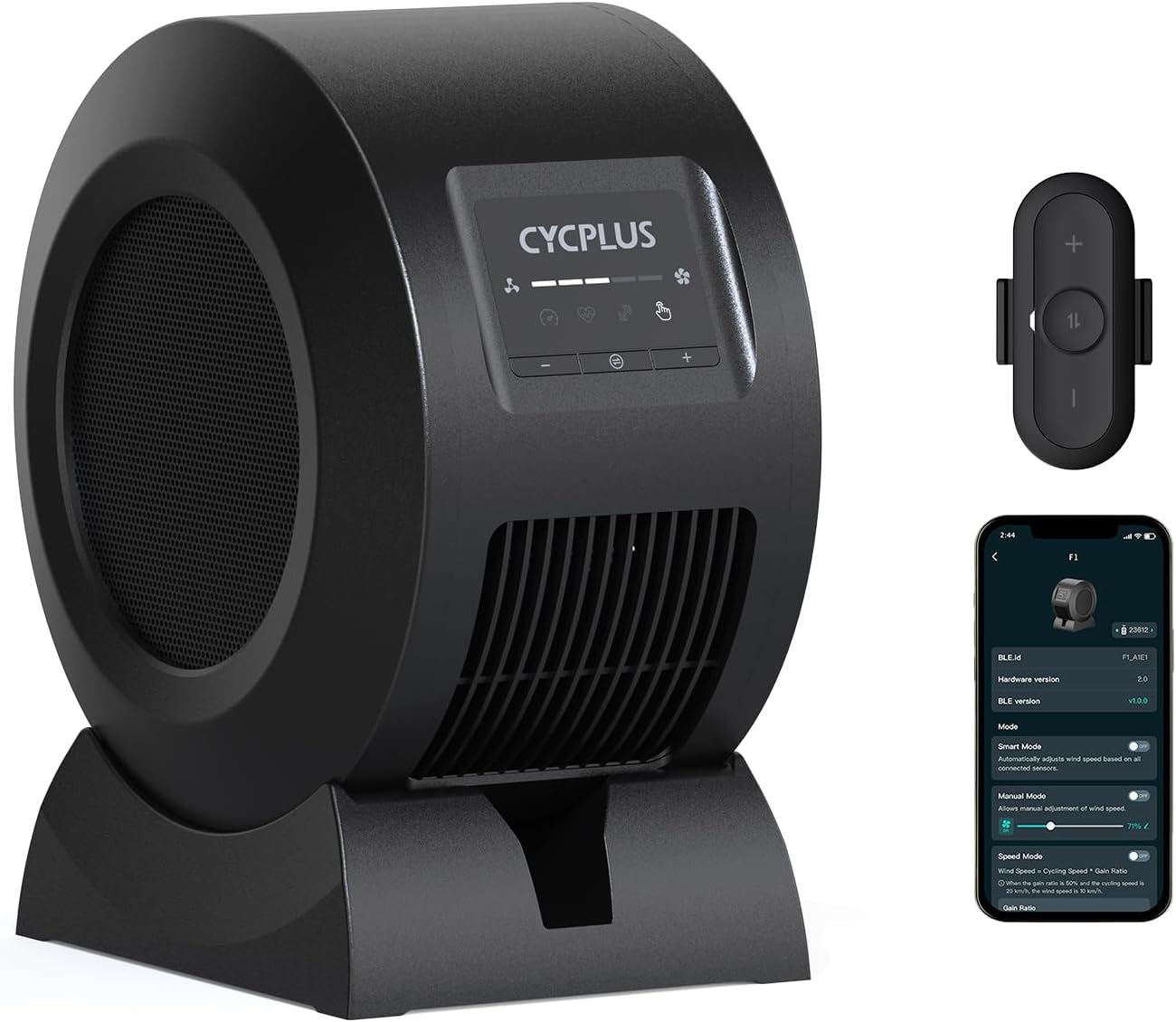
| Number of Speeds | 5 |
|---|---|
| Wattage | 40 watts |
| Control Method | App, Remote |
| Motor Type | Brushless DC Motor |
| Recommended Uses For Product | Cooling |
The CYCPLUS F1 is a purpose-built floor fan for indoor cycling that uses a brushless DC motor and centrifugal blades to deliver directed airflow for trainers and spin bikes. It offers five modes including speed, heart-rate and power-linked modes so the fan can follow data from ANT+ speed sensors, heart-rate monitors or smart trainers, and you can control it from the included remote or the CYCPLUS app. The ground base and adjustable angle let you position airflow toward the front or upward, and the manufacturer notes a peak outlet wind speed useful at about a 1-meter distance. Practical benefits include quieter operation thanks to the BLDC motor and soft-impact blades, plus a wide kit of accessories like straps, a power adapter and spare screws for easy setup. Limitations are that it is a single-purpose indoor cycling blower rather than a whole-room circulator and it requires compatible ANT+ sensors for the automatic workout-linked modes to work as advertised.
Best for: Serious indoor cyclists who want a dedicated training fan that can link to workout sensors and be controlled without interrupting a session.
Less Ideal for: People looking for a general-purpose or whole-room fan for cooling multiple people or large spaces should consider a different, higher-output model.
- Brushless DC motor for efficient, relatively quiet operation
- Five modes including heart-rate and power-linked modes that can follow ANT+ sensors
- App and remote control for convenient adjustments during workouts
- Adjustable ground base lets you direct airflow toward the rider or upward
- Includes necessary accessories for setup like power adapter, straps and spare screws
- Designed primarily as a cycling trainer fan so it does not replace larger room fans
- Smart modes require ANT+ or compatible sensors to provide full functionality
Verdict: Buy this if you want a quiet, sensor-aware floor fan that pairs with ANT+ training gear to deliver targeted cooling for indoor cycling sessions.
Wahoo KICKR HEADWIND

| Number of Speeds | 4 |
|---|---|
| Wattage | 30 watts |
| Number of Blades | 3 |
| Control Method | App |
| Power Source | dc |
The Wahoo KICKR HEADWIND is a floor-standing cycling fan designed to simulate real-world airflow for indoor training. It creates a targeted airflow pattern aimed at a cyclist's torso and can reach wind speeds over 30 mph, which helps with cooling during high-intensity efforts. The fan pairs via Bluetooth or ANT+ with speed sensors, heart-rate monitors, or smart trainers so fan speed automatically increases as your effort rises, and you can also control it from the Wahoo app. There are four manual speeds and simple button controls for quick adjustments without an app. Because it is built for trainers, it mounts on the floor and produces a strong, concentrated breeze rather than wide-room circulation. Trade-offs are a focus on directional airflow rather than whole-room cooling and a relatively simple control set compared with more general-purpose fans, but for focused indoor cycling sessions the automation and airflow profile make it effective.
Best for: Serious indoor cyclists and training-focused riders who prioritize realistic, effort-responsive cooling during workouts and want automation tied to speed or heart rate.
Less Ideal for: People seeking a multiuse household fan for whole-room comfort or users who need oscillation or multiple mounting orientations.
- Sensor-controlled speed that links to ANT+ and Bluetooth devices for automatic responsiveness
- Targeted airflow pattern tailored to a cyclist's riding position
- High top wind speed (over 30 mph) for effective cooling during intense efforts
- App control plus simple onboard buttons and four manual speed settings
- Designed for directional rider cooling, not for cooling large rooms
- Limited feature set if you want broader fan functions like oscillation or multi-angle mounting
Verdict: Buy this if you want a powerful, trainer-integrated fan that automatically ramps airflow with your speed or heart rate for realistic cooling during indoor cycling sessions.
Amazon Basics 20-Inch Box Fan

| Power Source | Corded Electric |
|---|---|
| Number of Speeds | 3 |
| Wattage | 67 watts |
| Number of Blades | 5 |
| Main Power Connector Type | Standard North American 2-prong |
This 20-inch Amazon Basics box fan delivers straightforward, no-frills airflow control suitable for cooling or ventilating indoor spaces. It offers three front-facing speeds controlled by a knob, a recessed cord wrap for tidy storage, and a top carry handle that makes it easy to move between rooms. The fan is plastic-bodied with five blades and wide feet for stable floor placement, so it can sit in front of an indoor cycling setup to push steady air across a rider during workouts. At 67 watts it provides solid output for its size but lacks oscillation or targeted tilt features, so positioning matters to get the best sweep. The simple controls and lightweight build keep operation and storage easy, though the plastic construction may sound louder than higher-end models and limits durability in heavy daily use. For someone prioritizing practical, reliable airflow on a budget, this fan offers good utility with minimal fuss.
Best for: Cyclists who want a simple, portable fan to place near a trainer for steady airflow and easy storage between sessions.
Less Ideal for: Users who need precision cooling, directional airflow control, or a very quiet, heavy-duty fan for daily intense training.
- Three speed settings let you dial airflow to workout intensity
- Lightweight with a carry handle for easy repositioning
- Wide feet provide stable free-standing placement
- Recessed cord wrap keeps storage tidy
- No oscillation or tilt adjustment for focused, adjustable airflow
- Plastic construction can be louder and less durable than metal fans
Verdict: A straightforward, portable box fan that gives practical three-speed airflow for indoor cycling sessions without extra bells or complexity.
BESKAR USB Clip-On Fan ZLS-E300

| Power Source | Corded Electric (USB) |
|---|---|
| Number of Speeds | 3 |
| Noise Level | 25 db |
| Wattage | 9.6 watts |
| Motor Type | Brushless |
The BESKAR ZLS-E300 is a small, USB-powered clip-on desk fan designed for targeted personal cooling. It mounts with a sturdy clamp that fits surfaces up to about 2.4 inches thick and also sits freestanding, and its head tilts and rotates to aim airflow where you need it during indoor cycling sessions. The brushless motor runs quietly—listed at about 25 dB on low—and offers three push-button speeds for easy adjustment; the manufacturer claims noticeable airflow at distance and a top speed near 4000 rpm. Powered by a USB Type-A cable, it runs from a laptop, wall adapter, or power bank so you can position it close to your trainer without complex installation. The fan is lightweight and has a detachable grille for simple cleaning. Trade-offs are its small blade size and compact footprint, which mean it provides focused breeze for one rider rather than moving large volumes of air across a room, and it requires a USB power source since it has no battery.
Best for: Cyclists on a budget who want a compact, quiet fan they can clamp near a trainer for focused cooling during indoor rides and who value portability and USB power flexibility.
Less Ideal for: Riders who need high-volume room circulation, multi-rider cooling, or a cordless solution for placement far from USB power should consider larger or battery-equipped fans.
- Sturdy clip and free-standing base let you position it on handlebars, trainer frames, or nearby surfaces.
- Brushless motor provides relatively strong airflow with low noise on lower settings.
- USB Type-A power makes it compatible with laptops, power banks, and USB adapters for flexible placement.
- Detachable grille and compact size simplify cleaning and storage.
- Small 3.5-inch blades deliver a focused personal breeze rather than whole-room airflow.
- No internal battery so it must remain plugged into a USB power source.
Verdict: A compact, quiet USB clip-on fan that gives budget-minded indoor cyclists a focused, easy-to-position breeze close to their trainer.
Vornado 630 Air Circulator

| Number of Speeds | 3 |
|---|---|
| Noise Level | 52 db |
| Wattage | 50 watts |
| Air Flow Capacity | 1120 cfm |
| Voltage | 120 volts |
The Vornado 630 is a compact whole-room air circulator designed to push steady, focused airflow rather than just a nearby breeze. It uses Vornado vortex action with deep-pitched blades and a spiral grille to move air across a room, and the three-speed dial makes it simple to dial in gentle circulation for recovery or a stronger blast during intense indoor cycling sessions. The adjustable tilt lets you aim air at a rider and the relatively high airflow rating means it can reach across a bike and studio space more effectively than a basic desk fan. It is built with a plastic housing and removable grill for easy cleaning, and the unit is safety certified for U.S. use and backed by a five year limited warranty. Noise is moderate on high speed, and the unit is single-purpose with no remote or oscillation, so placement matters if you want moving coverage for multiple riders.
Best for: Cyclists or home studio users who prioritize a reliable, purpose-built circulator that provides steady directed airflow for training sessions and recovery without complicated controls.
Less Ideal for: People who need wide-area oscillation, remote control, or very quiet operation for shared group classes should consider different models with those specific features.
- Vortex-design airflow delivers consistent, whole-room circulation rather than a localized puff
- Three simple speed settings let you quickly adjust intensity during workouts
- Adjustable tilt and a compact footprint make it easy to aim airflow at a bike or rider
- Removable grill and plastic construction for easy cleaning and low maintenance
- Backed by a five year limited warranty and U.S. safety certification
- No oscillation or remote control, so it must be repositioned to cover multiple riders
- Moderate noise level on high speed which can be noticeable during quiet recovery periods
Verdict: Choose the Vornado 630 when you want a dependable, directed air circulator that reliably keeps a single indoor cycling rider cool with simple controls and proven vortex airflow.
Lasko Pivoting Pro 12" Fan U12104

| Power Source | Corded Electric |
|---|---|
| Number of Speeds | 3 |
| Air Flow Capacity | 289 cfm |
| Noise Level | 59.3 db |
| Motor Type | Brushless |
The Lasko Pivoting Pro 12" utility fan is a portable high-velocity blower that pushes up to 289 CFM through a 12-inch blade and offers three speed settings and a 270-degree pivoting head to aim air where you need it. It is typically used in garages, basements, workshops, and home exercise spaces to cool people or speed drying after workouts and can be carried easily by its built-in handle. Practical features for indoor cycling include the powerful motor, a long 10-foot cord and two grounded outlets that let you power nearby devices or chargers without extra extension cords. The fan is ETL listed and includes a circuit breaker/reset for motor protection. Trade-offs are straightforward: it is a basic mechanical unit with rotary controls and no oscillation or smart features, and its noise level (around 59 dB on high) can be noticeable during intense indoor workouts. For riders who need raw airflow and directional control without extras, this delivers reliable performance at a small footprint.
Best for: Cyclists who prioritize powerful, focused airflow and portability to cool intense indoor training sessions or speed-dry gear, and who prefer simple, reliable controls backed by broad user reviews.
Less Ideal for: Riders who want very quiet operation, app control, or wide-area oscillation should consider quieter, feature-rich circulation fans instead.
- High airflow capacity (up to 289 CFM) for strong cooling and rapid sweat evaporation
- 270-degree pivoting head for precise directional airflow
- Two built-in grounded outlets for powering nearby devices or tools
- Compact, lightweight design with carry handle for easy repositioning
- No oscillation or remote control for hands-free adjustments
- Relatively loud on the highest speed compared with quieter circulation fans
Verdict: Choose this fan if you need a compact, no-frills high-velocity blower that delivers strong, aimed airflow for intense indoor cycling sessions.
Honeywell TurboForce HT-900
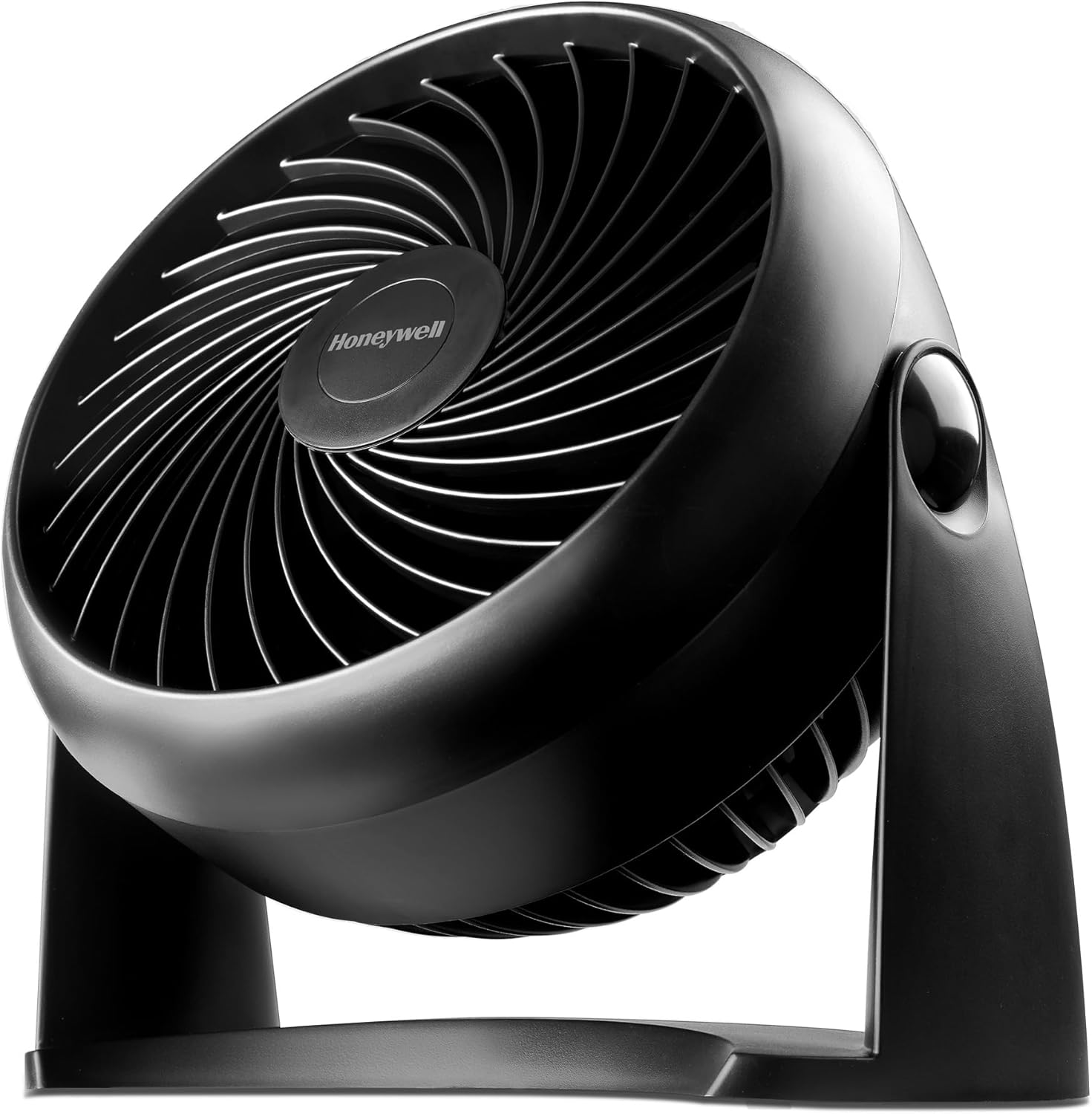
| Power Source | Corded Electric |
|---|---|
| Number of Speeds | 3 |
| Air Flow Capacity | 185 cfm |
| Motor Type | brushless |
| Installation Type | Tabletop or Wall Mount |
The Honeywell TurboForce HT-900 is a small tabletop air circulator designed to deliver focused airflow for desks, home offices, and small rooms. It uses an aerodynamic turbo blade design driven by a brushless motor to move air efficiently, and three push-button speeds let you dial in light to strong airflow. The head pivots 90 degrees so you can aim the stream where you need it, and the unit can also be wall-mounted if floor or desk space is limited. With an airflow rating around 185 cfm it can provide a noticeable breeze across a short distance, and Honeywell positions it as quieter than comparable fans so it is suitable for workouts or cycling sessions that need steady airflow without loud distraction. The fan is lightweight, plastic-built, and plugs into a standard 110V outlet with a NEMA 1-15 plug. It is simple to operate and easy to move between locations, but it lacks timers, oscillation, and advanced controls like variable-speed dials or remote operation, so placement and manual speed changes are needed during longer indoor cycling workouts.
Best for: A buyer who values a reliable, no-frills fan that is quiet, portable, and easy to use for focused cooling during indoor cycling sessions.
Less Ideal for: People who want wide-area oscillation, programmable controls, or premium build materials should consider larger or feature-rich fans instead.
- Compact, portable design fits on desks or mounts to walls
- Aerodynamic turbo blades and brushless motor deliver strong, efficient airflow
- Three simple speed settings for quick adjustments during workouts
- 90-degree pivoting head for targeted cooling
- Relatively quiet operation suitable for focused indoor exercise
- No oscillation or timer functions
- Basic push-button controls without fine-grain speed adjustment
- Plastic construction may feel less durable than heavier units
Verdict: If you need a compact, quiet, and dependable fan to deliver targeted airflow for indoor cycling, the Honeywell HT-900 is a practical, low-risk choice.
Choosing the Right Fan for Indoor Cycling: Key Factors to Consider
Sustained Airflow Versus Peak CFM
What matters for indoor cycling is how much continuous air a fan can move at realistic distances and settings. A high peak CFM spec is useful only if the fan can maintain meaningful airflow without the motor struggling or thermal limiting. Continuous output affects how quickly you cool down during steady-state rides and whether the fan keeps pace during long intervals.
Look for fans designed for prolonged duty cycles or with motors rated for continuous operation. Fans that advertise momentary blasts but lose power under load will not keep riders comfortable during sustained efforts.
Noise Profile
Noise matters because cyclists often use audio cues, coaching apps, or music while training. A fan that produces high-frequency whine or broad-spectrum noise can mask audio cues and increase mental fatigue. Measure noise at typical riding distance rather than at the source, since distance and aiming change perceived loudness.
Consider fans that list dBA at defined distances or those with variable-speed settings that allow a compromise between airflow and quieter operation. Also note that some fans sound louder because of blade design even when moving the same volume of air.
Directionality and Mounting Options
Indoor cyclists benefit from being able to direct airflow to different body zones — face, chest, and upper legs — depending on riding position. Fans with pivoting heads, height-adjustable stands, or clamp mounts that attach to trainers or nearby structures provide better targeting than fixed-base floor fans.
Evaluate how easy it is to reposition the fan for seated efforts, out-of-the-saddle sprints, or when switching between bikes. A fan that can be quickly angled and locked into place reduces setup time and improves comfort during varied workouts.
Durability and Motor Cooling
Trainers and long workouts demand fans that run for extended periods without overheating. Durable housing, well-ventilated motor assemblies, and thermal protection features increase the odds a fan will last through years of training. Cheap motors may exhibit reduced output or failure after repeated long sessions.
Check for robust base designs that resist tipping during sprint intervals and components such as metal grilles or reinforcement where prolonged use could cause wear. Durability also includes how easy it is to service or clean the fan to maintain performance.
Control Precision and Speed Range
A fan with a wide and usable speed range helps you dial in comfort across easy recovery rides and maximal efforts. Smooth, incremental control — either via variable knobs, multiple speed steps, or digital control — prevents sudden jumps in airflow that can be distracting.
Additional control convenience such as a remote, simple onboard interface, or memory presets can be helpful for keeping adjustments quick between intervals. Consider how intuitive the controls are when you are catching your breath during intervals.
Portability and Footprint
Training setups vary and you may need to move the fan between rooms or store it when not in use. Lightweight designs with comfortable handles, foldable stands, or compact footprints make storage and repositioning easier. A very small fan might be easy to move but struggle to cool effectively; conversely, a large industrial unit can be effective but difficult to place in a typical home gym.
Balance the fan size with your available space and transportation needs. If you train in shared spaces, consider models that are quick to set up and tear down.
Where to Place a Cycling Fan for Best Cooling
Positioning a fan correctly multiplies its effectiveness. For most indoor cycling sessions, aim the airflow at the upper body and face from a distance of about 2 to 4 feet. This creates a cooling boundary layer that increases convective heat loss without blasting your lower legs unnecessarily.
If you alternate between seated and standing efforts, choose a fan with a tilting head or mount it slightly higher so you can angle it downward for sprints. In small rooms, position the fan to avoid recirculating hot air from walls and windows.
- Face and chest at 2 to 4 feet for steady efforts
- Higher angle for standing sprints, lower for seated steady-state work
- Avoid pointing directly at walls or heat sources that reflect warm air
Balancing Airflow and Noise During Virtual Training
During virtual training sessions you need enough airflow to keep comfortable without drowning out voice cues or audio. Use mid-tier speed settings during guided workouts and increase to high only for short sprints. If your fan has a multi-speed controller, practice shifting quietly between levels so it becomes an automatic part of your interval routine.
Some cyclists use two smaller fans to create layered airflow while keeping each unit at a lower, quieter speed. That approach can reduce perceived noise while maintaining similar overall cooling performance.
- Use mid speeds for guided sessions
- Reserve maximum power for short efforts
- Consider two smaller units for layered airflow
Maintenance Tips to Keep Fans Performing
Regular cleaning preserves airflow and reduces noise. Dust builds up on blades and grilles, which reduces effective airflow and can cause imbalance. Wipe down accessible surfaces weekly if you train frequently and deep-clean blades and motor housings every few months according to the manufacturer guidance.
Inspect stands, clamps, and tilt mechanisms for wear and tighten fasteners if the fan begins to wobble. If your training space is humid, check for corrosion points and keep electrical contacts dry and protected.
- Dust blades and grilles weekly
- Tighten mounting hardware periodically
- Follow manufacturer cleaning recommendations for motor areas
When to Choose a Clamp or Pedestal Fan
Clamp fans save floor space and let you mount airflow closer to the rider without a large base, making them ideal for tight training areas. Pedestal fans offer greater height range and a stable base, which helps during heavy sprints on a fixed trainer.
Choose a clamp model if you need close, targeted cooling and portability. Choose a pedestal fan if you prefer a stable platform and broader positioning options. Evaluate how secure the clamp is under vibration to avoid mid-workout shifts.
- Clamp: close targeting, compact footprint
- Pedestal: stable, wider height adjustment
- Check clamp security and base stability before buying
How We Chose the Best Fan for Indoor Cycling
We focused on features that matter most during indoor cycling sessions and filtered options that fail to deliver sustained, targeted airflow. Primary evaluation criteria included continuous airflow output over time, measured as realistic sustained airflow rather than brief gusts; noise level at typical training distances to avoid interference with virtual coaching or music; mounting and positioning flexibility so the fan can be aimed at torso and face during different riding positions; and build quality and motor cooling to ensure reliable operation during long training blocks. We also considered power delivery and speed range for fine control during different workout intensities, and ease of use including controls and portability for moving the fan between training spaces. Units that relied on novelty features without consistent airflow performance or that lacked basic durability were excluded. We did not include outdoor-only models or units intended solely for whole-room circulation when they lacked directional control appropriate for cycling. The result is a list of options that prioritize steady, adjustable airflow, low noise, and durable construction aligned with real indoor cycling needs.
Our full evaluation process is outlined in our review methodology.
FAQ
How large of a fan do I need for indoor cycling?
Size depends on distance and space. A medium fan that produces steady airflow at 2 to 4 feet is usually enough. Larger units move more air but require more space and can be louder; smaller units may need to be positioned closer to be effective.
Will a regular room fan work for intense indoor workouts?
A regular room fan can work if it provides continuous directional airflow and runs quietly at your preferred distance. However, fans designed for duty-cycle operation and targeted airflow tend to perform better during repeated long sessions.
How close should the fan be during sprints versus steady rides?
For sprints you can move the fan slightly farther or increase speed to cover higher heat output. During steady rides aim the fan at the face and chest from roughly 2 to 4 feet to sustain cooling without excessive noise.
Are bladeless fans a good choice for indoor cycling?
Bladeless fans can provide smooth airflow and often look sleek, but their real-world cooling depends on how much sustained airflow they generate at training distances. They can be quieter, but check sustained output and stability under prolonged use.
How often should I clean my cycling fan?
Wipe external surfaces weekly if you train regularly, and schedule a deeper clean of blades and grilles every few months. Regular cleaning maintains airflow efficiency and reduces noise caused by dust buildup.
Final Verdict
Prioritize sustained, directional airflow and a noise profile that does not interfere with coaching or music when choosing a fan for indoor cycling. Balance adjustability and mounting options with durable construction so the unit can handle repeated long sessions and intense intervals. Finally, accept tradeoffs between raw airflow and footprint: larger high-power fans cool better but require more space and can be louder, while compact units are easier to position but may need to run closer to the rider. Focus on the criteria covered here to match a fan to your training space and routine, and you will get consistent cooling that makes indoor workouts more comfortable and productive.