
Note: This article contains affiliate links. If you click on these links and make a purchase, we may earn a small commission at no extra cost to you. This helps support our research and content. Read our full affiliate disclosure here.
Fitting an effective fan in a room with a low ceiling requires balancing airflow, safety, and visual scale. A poorly chosen unit can feel overwhelming, rattle near heads, or deliver weak circulation. This guide isolates the factors that matter most for rooms with limited vertical space and presents seven shortlisted fans that suit shallow clearances and frequent use. You will find compact mounting options, noise and airflow tradeoffs, and installation considerations explained. The picks below reflect the top choices for low-ceiling situations across common room types, plus the evaluation criteria we used to narrow the list.
Top Picks at a Glance
| Best Overall The best all-around choice for most situations | Ohniyou 52" Low Profile Ceiling Fan |  |
| Best Quality Built to a higher standard if you want something more solid | DREO DR-HCF010S 20" Ceiling Fan |  |
| Best Value The sweet spot between price and what you get | addlon 20" Low-Profile Ceiling Fan |  |
| Best Budget The cheapest option that still gets the job done reliably | Xcity 40-Inch Low Profile Ceiling Fan |  |
| Top Rated A top-rated pick with lots of positive feedback | Hunter Low Profile IV 42" Fan |  |
| Most Popular A crowd favorite that many people choose with confidence | ocioc 22-inch Ceiling Fan |  |
| Best Seller A high-volume bestseller chosen again and again | ZMISHIBO 52 Inch Ceiling Fan BJ52 |  |
Ohniyou 52" Low Profile Ceiling Fan

| Power Source | Corded Electric |
|---|---|
| Motor Type | DC |
| Air Flow Capacity | 4580 cfm |
| Number of Speeds | 6 |
| Wattage | 35 watts |
The Ohniyou 52" Low Profile Ceiling Fan is designed for rooms with low ceilings where a flush mount is required but you still want modern controls and good airflow. It uses a reversible DC motor with six speeds and claims as low as 20 dB noise, which makes it suitable for bedrooms and living areas that need quiet operation. The integrated 18W LED supports three color temperatures and 5% to 100% dimming controlled by the included remote or a smartphone app, while a memory function remembers your last settings. The five double-sided blades offer a contemporary look and the fan is rated at about 4,580 CFM, so it moves a noticeable amount of air despite the low profile. Installation is intended to be straightforward for flat ceilings and the package includes mounting hardware and a manual. Limitations to note are the instruction to use a standard on/off wall switch only and not to connect dimmers or smart wall controllers, and the light and remote replacement process may require contacting support if parts are lost.
Best for: Buyers who need a modern, quiet ceiling fan that sits close to the ceiling and provides adjustable light color and reliable airflow for bedrooms or living rooms with limited vertical space.
Less Ideal for: Homes that require wall-mounted dimmers or integrated smart wall switches or tall-ceiling aesthetic where a downrod-style fan is preferred.
- Flush mount low-profile design suited for low ceilings and small clearances
- Quiet reversible DC motor with six speeds for year-round airflow control
- App and remote control with memory function for convenient adjustments
- Dimmable 3CCT LED light (3000K/4500K/6000K) with wide brightness range
- High airflow rating (~4,580 CFM) despite compact housing
- Cannot be used with wall dimmers or external fan speed controls
- Installation still requires safe clearance and basic DIY skills despite included hardware
Verdict: A quiet, low-profile 52" fan with app/remote controls and adjustable LED lighting that fits low-ceiling rooms while still delivering strong airflow.
DREO DR-HCF010S 20" Ceiling Fan

| Number of Speeds | 12 |
|---|---|
| Noise Level | 25 db |
| Air Flow Capacity | 1500 cfm |
| Control Method | App, Remote, Voice |
| Motor Type | DC |
The DREO DR-HCF010S is a compact, low-profile ceiling fan built for rooms with low ceilings where you still want strong airflow and smart lighting control. Its brushless DC motor delivers up to 1500 CFM while producing reported noise around 22–25 dB, so it can move a lot of air without being distracting in a bedroom or game room. Lighting is a standout: an integrated RGBIC LED ring offers tunable white (2700–6500K), six brightness levels, and multi-color effects controllable from the DREO app, remote, or Alexa voice commands. The fan includes multiple speeds, preset modes like Sleep and Natural, scheduling and a memory function for convenience. Installation is simplified with a one-blade, one-screw system intended to cut alignment frustration on tight ceilings. Trade-offs to note are the 20" size and plastic construction, which suit smaller rooms but limit coverage compared with larger fans, and advanced lighting effects add complexity for buyers who only need basic illumination.
Best for: Buyers who need a high-performance, low-clearance fan that delivers strong airflow and advanced smart lighting for bedrooms, game rooms, or compact living spaces.
Less Ideal for: Do not pick this if you need cooling for large open-plan rooms or prefer a heavy-duty metal fan aesthetic.
- Low-profile 20" design fits low ceilings and tight spaces
- Brushless DC motor with up to 1500 CFM airflow for strong cooling
- Very quiet operation around 22–25 dB suitable for bedrooms
- Full smart control via app, remote, and Alexa plus presets and scheduling
- RGBIC LED adds tunable white and multi-color lighting effects for ambiance
- Smaller 20" sweep limits effective coverage to small or medium rooms
- Plastic/ABS construction rather than metal may feel less premium
Verdict: If you need a quiet, high-airflow low-profile fan with smart RGBIC lighting for low ceilings, this DREO 20" model is a strong choice.
addlon 20" Low-Profile Ceiling Fan

| Size | 20 Inch |
|---|---|
| Power Source | AC (DC motor) |
| Light Source | LED |
| Brightness | 3000 lm |
| Control Method | Remote/APP Control |
The addlon 20" low-profile ceiling fan pairs a compact, flush-mount design with an integrated dimmable LED, making it a practical choice for rooms with low ceilings. It provides adjustable light color (3000K, 4500K, 6000K) and stepless dimming so you can tune brightness for tasks or relaxation, and the included remote plus app control let you change fan speed, light output, and set timers from across the room. The reversible DC motor and six speed settings deliver usable airflow in both summer and winter while staying energy-efficient and quiet. The enclosed blade design reduces clearance requirements and simplifies installation in bedrooms, small living rooms, or home offices. Expect straightforward setup and useful memory and timer features, though the fan is plastic-bodied and uses a GU10 bulb base which may mean bulb replacements or repairs are less premium than metal fixtures. Also avoid connecting dimmer or smart wall switches since the DC motor requires a standard on/off switch.
Best for: Buyers who need a compact, easy-to-control ceiling fan that provides both adjustable light and effective airflow in low-ceiling spaces and value practical, energy-efficient operation.
Less Ideal for: Those seeking a heavy-duty, metal-bodied or designer fixture or anyone who wants to control the fan with an in-wall dimmer or smart wall switch should look elsewhere.
- Low-profile flush mount fits low ceilings and small rooms
- Dimmable LED with three color temperatures for flexible lighting
- Remote and app control plus timer and memory functions for convenience
- Reversible DC motor with six speeds for year-round air circulation
- Compact enclosed blades improve safety and reduce clearance needs
- Plastic construction and GU10 bulb base feel less durable than metal fixtures
- Not compatible with wall dimmers or fan-speed switches
Verdict: A compact, low-profile fan with dimmable LED and remote/app control that delivers practical, year-round airflow for low-ceiling rooms.
Xcity 40-Inch Low Profile Ceiling Fan

| Size | 40 Inch Low Profile |
|---|---|
| Air Flow Capacity | 3110 cfm |
| Wattage | 30 watts |
| Control Method | Remote |
| Indoor Outdoor Usage | Indoor |
This low-profile 40-inch ceiling fan combines basic lighting and air circulation in a compact, budget-friendly package intended for rooms with low ceilings. It offers three color temperature settings (3000K, 4500K, 6000K) so you can switch between warm, natural, and bright white light, and the included remote controls both fan speed and lighting for convenient adjustments from the room. The fan is engineered for quiet, smooth operation, making it suitable for bedrooms and home offices where noise matters. With a reported airflow of 3110 cfm and a 30-watt light, it delivers effective circulation and illumination without a large motor or wide blade span. Expect a straightforward installation as a ceiling-mount fixture and a simple, painted finish that blends with many interiors. Limitations are its basic feature set and modest build details typical of budget models, so buyers wanting advanced smart controls, premium materials, or heavy-duty airflow may want a higher-end unit.
Best for: Buyers looking for an affordable, space-saving ceiling fan that provides quiet airflow and adjustable lighting for bedrooms or other low-ceiling rooms.
Less Ideal for: Customers who need smart features, high-end finishes, or maximum high-output airflow for large rooms should consider higher-tier alternatives.
- Low-profile 40-inch design fits rooms with low ceilings
- Remote control lets you change fan speed and lighting from across the room
- Three selectable color temperatures (3000K, 4500K, 6000K) for lighting flexibility
- Engineered for quiet, smooth operation suitable for bedrooms and workspaces
- Basic construction typical of budget models without premium materials
- No smart home integration or advanced control options
Verdict: A budget-friendly, low-profile ceiling fan that delivers quiet circulation and three-color lighting for tight, low-ceiling spaces.
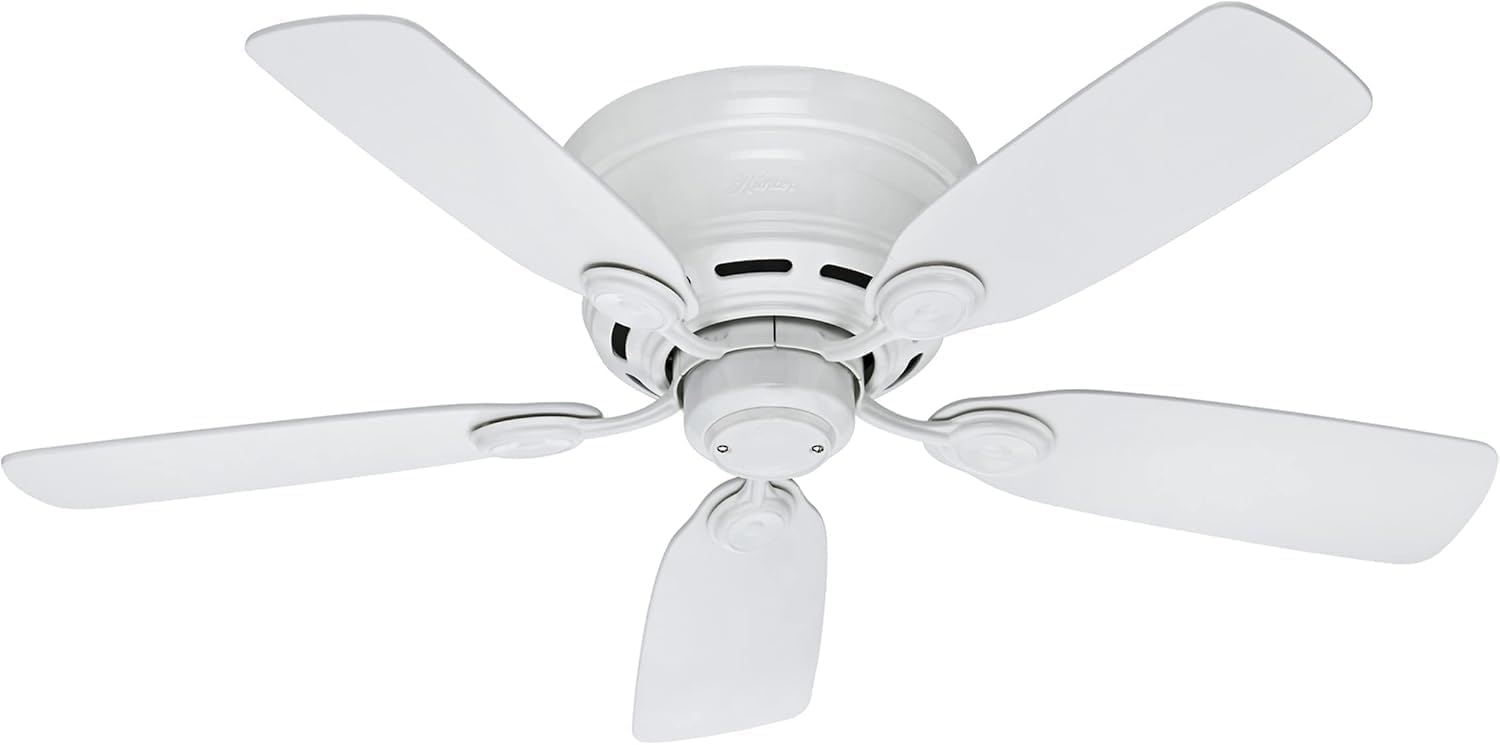
Hunter Low Profile IV 42" Fan
| Number of Speeds | 3 |
|---|---|
| Noise Level | 14 db |
| Wattage | 57.4 watts |
| Air Flow Capacity | 2902 cfm |
| Motor Type | AC Motor |
The Hunter Low Profile IV is a flush-mount 42-inch ceiling fan designed for rooms with low ceilings where a close-to-ceiling installation matters. It uses a WhisperWind AC motor with three speeds and reversible rotation, so you get strong airflow (listed at 2902 CFM) while keeping noise very low, making it suitable for bedrooms, living rooms, kitchens, and home offices. The fan is controlled by a traditional pull chain and also lists app control, offering simple operation without relying on a remote. Its five plastic blades and metal body provide a sturdy, no-frills build and the white finish integrates into most interiors. Practical benefits include an easy installation for ceilings under 9 feet and a motor backed by Hunter's lifetime limited warranty on the motor. Limitations are the lack of an integrated light kit and reliance on pull-chain control if you prefer wall switches or remotes, and blade material is plastic rather than wood or composite for a premium look. For buyers who prioritize dependable, quiet performance in tight ceiling spaces, this fan delivers consistent results.
Best for: Buyers who need a dependable, quiet ceiling fan that fits close to low ceilings and prioritizes long-term motor reliability over decorative extras.
Less Ideal for: If you want a fan with built-in lighting, a premium blade finish, or a bundled remote/wall control, consider other models that include those features.
- Low-profile flush mount suitable for ceilings under 9 feet
- WhisperWind AC motor provides high airflow with low noise
- Three-speed pull chain control for straightforward, reliable operation
- Reversible motor allows year-round airflow direction
- Lifetime limited motor warranty from the manufacturer
- No integrated light kit included
- Pull chain control may be inconvenient for users wanting a remote or wall control
Verdict: A reliable, whisper-quiet flush-mount fan built for low ceilings that focuses on consistent airflow and long-term motor performance.
ocioc 22-inch Ceiling Fan

| Power | 48 watts |
|---|---|
| Brightness | 1800 lm |
| Color Temperature | 3000K/4000K/5000K |
| Control Method | Remote |
| Certification | ETL |
The ocioc 22-inch ceiling fan is a flush-mount model designed for rooms with low ceilings that need steady air movement without bulk. It uses a DC reversible motor with six speeds and three timer options, controlled by the included remote, so you can change airflow, reverse the blade rotation for winter, and schedule runtime from across the room. The fan integrates a tri-color temperature LED light that delivers up to 1800 lumens and remembers your last color setting, offering warm to cool white outputs for different tasks. Built from ABS and stainless-steel components with an IP-style waterproof body, the unit is marketed for indoor and covered patio use and carries ETL specification. Practical benefits include quiet operation suitable for bedrooms, a slim 10-inch profile for low-clearance installs, and energy-efficient LED illumination. Limitations are the small 22-inch sweep which is best for compact rooms rather than open-plan spaces, and the plastic construction which prioritizes light weight over a premium metal finish.
Best for: Buyers seeking a compact, low-clearance ceiling fan that provides quiet, adjustable airflow and versatile LED lighting for bedrooms, small dining areas, or covered patios while prioritizing space-saving installation.
Less Ideal for: Avoid this fan if you need to circulate air in large or open-plan rooms or if you prefer heavy-gauge metal fixtures with a decorative, high-end look.
- Flush-mount, low-profile design for low ceilings
- DC reversible motor with six speeds for precise airflow control
- Integrated dimmable LED with three color temperatures and memory function
- Included remote control and timer settings for convenient operation
- ETL-listed and waterproof-rated body suitable for covered patios
- 22-inch blade span is small for larger rooms or open areas
- Predominantly plastic construction may look less premium than metal fixtures
Verdict: A low-profile, quiet 22-inch fan with adjustable LED lighting and remote control that fits tight, low-ceiling spaces.
ZMISHIBO 52 Inch Ceiling Fan BJ52

| Power Source | DC Motor |
|---|---|
| Number of Speeds | 6 |
| Noise Level | 30 db |
| Air Flow Capacity | 3057 cfm |
| Light Type | LED |
The ZMISHIBO 52 Inch BJ52 is a flush-mount ceiling fan designed for rooms with low ceilings that need both airflow and lighting. It uses a high-efficiency DC motor and five engineered-wood blades to deliver strong airflow (listed at 3057 CFM) while keeping noise low around 30 dB, and the flush mount keeps the unit close to the ceiling for tight clearances. Controls include a handheld remote, a Bluetooth-enabled app for pairing and settings, and compatibility with a wall switch, and the 20W LED is dimmable with stepless color temperature adjustment from warm to cool. Practical benefits include year-round reversible airflow, a memory function to retain your preferred speed and light level, and a compact modern look that fits bedrooms, living rooms, and kitchens. Expect straightforward installation for standard flat ceilings but note this model is not intended for sloped ceilings and advanced smart-home integrations may require following the pairing steps carefully. The vendor offers multi-year motor support which adds reassurance for cautious buyers.
Best for: Buyers who prioritize a compact, quiet ceiling fan for rooms with low ceilings and want simple remote and app control plus integrated lighting.
Less Ideal for: Those needing a fan for sloped or vaulted ceilings or buyers seeking deep smart-home platform integration without Bluetooth setup.
- Flush-mount low-profile design suitable for low ceilings
- Quiet, energy-efficient DC motor with strong listed airflow (3057 CFM)
- Multiple control options: remote, app (Bluetooth), and wall switch
- Dimmable LED with stepless color temperature and memory function
- Reversible blades for year-round circulation and included remote and light kit
- Not designed for sloped ceilings
- App setup requires Bluetooth pairing steps that may be awkward for some users
- Specifications like noise and airflow are manufacturer-provided and may vary in real homes
Verdict: If you need a low-profile, quiet ceiling fan with integrated dimmable lighting and simple remote/app control for a low-ceiling room, this model is a solid, risk-averse choice.
Choosing the Right Fan for Low Ceilings: Key Factors to Consider
Mounting Profile and Blade Clearance
Low ceilings demand a mounting profile that minimizes the fan's vertical projection while keeping blades safely out of reach. Flush mount or hugger designs sit close to the ceiling and reduce the risk of contact in rooms with limited headroom.
When assessing clearance, consider both the fan housing depth and the blade drop. Even compact fans vary in how their motor housing and blade arms tuck against the ceiling, and some flush models still extend enough to interfere with tall occupants or loft areas. Confirm the combined depth against the room height and typical head clearance in walkways before choosing.
Airflow Relative to Room Size
Effective circulation depends on matching the fan's airflow capability to the room's square footage, not just the blade diameter. Fans designed for low ceilings should still deliver adequate CFM for the space without relying on oversized blades that require more clearance.
Think about typical room use. A low-ceiling living room needs stronger sustained airflow than a small bedroom. Also factor in ceiling height when estimating required airflow: rooms with lower ceilings often need slightly higher airflow per square foot to avoid stagnant zones, especially if furniture blocks natural air paths.
Noise and Motor Efficiency
Noise is more noticeable when a fan sits closer to ear level. Brushless or well-balanced motors tend to run quieter and more efficiently, which matters for bedrooms, nurseries, and home offices. Look for models with multiple speed settings and documented noise ratings when available.
Motor efficiency affects both noise and long-term reliability. A more efficient motor produces less heat and stress, which reduces wear and the chance of humming or vibration over time. For low-ceiling installations, prioritize quieter operation over raw top-end wind speed unless you regularly need high airflow.
Safety and Headroom Considerations
Safety in low-ceiling rooms centers on preventing accidental contact with blades and ensuring secure mounting. Even with compact fans, position matters: avoid placing fans directly above stair landings, bunk beds, or areas where someone might stretch or stand on furniture.
Codes and best practices often specify minimum vertical clearance from the floor to the lowest point of the fan. If your room is marginal, choose a fan with the smallest possible vertical profile and confirm that the mounting hardware locks the unit tight against the ceiling to prevent sagging over time.
Integrated Lighting and Fixture Depth
Many low-profile fans pair with integrated lighting to save ceiling space and maintain a streamlined appearance. The depth of the light module can add to overall projection, so inspect how the lamp housing interfaces with the fan motor and blades.
Choose fixtures where the light sits flush or within the fan's silhouette rather than hanging below it. Consider LED modules for shallow housings because they require less space and generate less heat than legacy bulbs.
Installation and Wiring Constraints
Installing a fan in a low-ceiling room often means working in tight spaces and dealing with shallow electrical boxes. Check that the fan's mounting bracket and canopy fit your existing box depth and that the unit can be wired without forcing conductors into a cramped cavity.
Also evaluate whether the fan supports standard wall controls or remote operation. Remote controls can be advantageous when wall switches are awkward or when the fixture sits near head height. If retrofit installation is required, consider whether a qualified electrician might be needed to reinforce the ceiling or swap the electrical box.
Mounting Options for Shallow Ceilings
When ceiling height is limited, the mounting style determines both safety and aesthetics. Flush-mounted or hugger fans are the most common solution because they minimize vertical projection while keeping blades close to the ceiling line.
Low-profile fans may offer a short downrod option that still preserves a near-flush look while improving airflow slightly by creating a small gap above the blades. Evaluate the tradeoff between added clearance for performance and the need to stay as close to the ceiling as possible in tight rooms.
- Flush mount: tightest fit, best for very low ceilings.
- Short downrod: small increase in airflow, still compact.
- Integrated canopy: hides wiring and creates a cleaner look.
Choosing Blade Size and Pitch for Close Quarters
Blade diameter and pitch both influence how much air the fan moves. In low-ceiling rooms, you may want a slightly smaller blade span to avoid encroaching on headroom while choosing a pitch that still moves air efficiently.
A moderate blade angle can compensate for reduced diameter by increasing airflow per rotation, but it can also increase motor load. Look for fans engineered to balance blade geometry and motor capability for sustained, quiet circulation.
- Smaller spans reduce clearance issues but may need more powerful motors.
- Steeper pitch increases airflow but may raise noise or power draw.
Lighting Options Without Increasing Depth
Integrated LED modules are the best fit for low ceilings because they occupy less depth and run cooler than traditional bulbs. Some low-profile fans offer dimmable fixtures that sit within the fan body rather than beneath it.
If you need bright, distributed light in the same fixture, choose fans where the luminaire is recessed or covers the same plane as the blades to avoid adding extra drop.
- Recessed LED modules save depth and energy.
- Diffused covers spread light without extending below the fan.
Remote Controls and Wall Switch Compatibility
When a fan is mounted low, wall controls may be awkward to reach depending on switch placement. Remote controls offer flexibility and allow multiple speed settings and light control without modifying wall wiring.
Confirm that the fan supports the control method you prefer and that any receiver modules fit within the canopy or the electrical box. For homes with smart-home setups, compatibility with common hubs or voice assistants can be a useful convenience.
- Remote: easy access for low-mounted units.
- Wall control: cleaner look if switch is conveniently located.
- Smart integration: optional, but adds convenience.
Maintaining Stability and Reducing Vibration
Fans operating near head level reveal wobble and vibration more clearly than high-mounted units. Quality balancing, sturdy mounting brackets, and robust motor mounts reduce noise and prevent long-term loosening.
During installation, make sure the canopy seats tightly to the ceiling and that blade arms are securely fastened. Periodic checks for loose screws and rebalancing hardware will keep a low-mounted fan running quietly and safely.
- Balance kits or pre-balanced blades lower vibration.
- Solid mounting and correct box support prevent sagging.
How We Chose the Best Fan for Low Ceilings
We prioritized specifications and real-use attributes that directly affect performance and safety in low-ceiling installations. Key evaluation criteria included blade-to-ceiling clearance and mounting profile, measured airflow (or manufacturer-rated CFM) relative to blade span, noise output at normal operating speeds, build quality and wobble resistance for close-quarters use, and ease of installation in shallow boxes or remodel ceilings. We favored fans with low-profile mounting hardware such as flush or hugger mounts when vertical clearance was limited. Products with uncertain clearance data, incompatible mounting options, or that required a minimum downrod length exceeding typical low-ceiling allowances were excluded. We also filtered out units that relied solely on large blade spans to achieve airflow, since those often conflict with headroom constraints. Practical considerations such as reversible motors for seasonal airflow and integrated lighting options that do not add significant depth were part of the selection filters. The result is a list that balances compact form, safe clearance, and usable circulation for low-ceiling rooms.
Our full evaluation process is outlined in our review methodology.
FAQ
How low can a fan be installed safely?
Safe installation height depends on local codes and the fan design, but generally the lowest blade tip should allow adequate headroom for occupants. If ceiling height is borderline, choose a flush-mount fan specifically designed for low clearance and confirm the combined depth meets recommended minimums.
Are flush-mount fans less effective than downrod models?
Flush-mount fans can be very effective when engineered for efficiency. They may move slightly less air than the same model on a downrod, but careful blade design and motor sizing can compensate, making them a solid choice for low ceilings.
Can I add a light kit without increasing clearance problems?
Yes, if you choose a fan with an integrated or recessed LED module that stays within the fan's profile. Avoid light kits that hang below the fan or add significant depth, which would negate the benefits of a low-profile installation.
Is a remote control worthwhile for a low-mounted fan?
Often yes. Remote controls simplify operation when wall switches are inconvenient due to low mounting. They also permit finer speed and light adjustments without altering wiring.
Do low-profile fans require special electrical boxes?
Not always, but shallow boxes or retrofit situations may need a low-profile mounting bracket or an upgraded box to provide sufficient support. If the existing box is old or not rated for fan loads, it should be replaced or reinforced.
Final Verdict
For low-ceiling rooms, prioritize a compact mounting profile, adequate airflow for the room size, and quiet, well-balanced operation. Flush or hugger mounts, efficient blade geometry, and integrated shallow lighting deliver the best combination of safety and performance in limited vertical space. Weigh the tradeoffs between slightly reduced blade span and motor power, and focus on installation compatibility with your ceiling box. With these priorities in mind, you can pick a fan that keeps the room comfortable without sacrificing headroom or introducing noise and vibration.