
Note: This article contains affiliate links. If you click on these links and make a purchase, we may earn a small commission at no extra cost to you. This helps support our research and content. Read our full affiliate disclosure here.
If you rely on a horizontal sliding window for ventilation, the right window fan can make a big difference in comfort and air circulation. A fan designed for horizontal sliding windows helps move fresh air through the room, exhaust hot air, or create cross-breeze patterns without requiring permanent installation. This guide covers seven shortlisted fans built for horizontal sliding windows and focuses on practical considerations like airflow capacity, installation method, noise, and durability. Use the evaluation notes to match a fan to your room size and mounting preferences before moving to the product sections below.
Top Picks at a Glance
| Best Overall The best all-around choice for most situations | EVO Window Fan WF300 |  |
| Best Quality Built to a higher standard if you want something more solid | Vornado Transom Window Fan |  |
| Best Value The sweet spot between price and what you get | BLACK+DECKER 9" Dual Window Fan BFW9M |  |
| Best Budget The cheapest option that still gets the job done reliably | Comfort Zone 9" Twin Window Fan CZ319WT2 |  |
| Top Rated A top-rated pick with lots of positive feedback | Bionaire Twin Window Fan BW2300-N |  |
| Most Popular A crowd favorite that many people choose with confidence | HOLMES Dual Blade Window Fan |  |
| Best Seller A high-volume bestseller chosen again and again | shinic 9" Window Fan BP2-9AQ |  |
EVO Window Fan WF300

| Power Source | Electric |
|---|---|
| Mounting Type | Window Mount |
| Number of Speeds | 4 |
| Control Method | Remote |
| Recommended Uses For Product | Air Circulation |
The EVO Window Fan WF300 is a window-mounted air circulator built to fit horizontal sliding windows up to 40 inches wide and deliver multi-directional airflow. It installs with adjustable side panels and sits low in the frame to preserve the view while the internal oscillation and three directional settings help move air across a room. Control is straightforward via the touch pad or included remote, with four speed levels, an adjustable timer, and an electronically reversible exhaust mode to push stale air outside. Practical touches include a washable pre-filter for easier upkeep and a weather-resistant case with a bug screen for outdoor-facing installations. The fan is plastic-bodied with plastic blades, so it is lightweight but not as rugged as metal fans, and its listed speed value appears misstated as rpm which may confuse tech-focused buyers. Expect solid performance for general cooling and ventilation in bedrooms, home offices, and living spaces, but not the heavy-duty airflow of larger inline or industrial fans.
Best for: Buyers who want an easy-to-install, low-profile window fan to improve room circulation and reduce stuffiness in bedrooms or home offices while keeping controls simple.
Less Ideal for: Not a good choice for buyers needing high-volume industrial-strength airflow or a heavy-duty exterior-rated unit for continuous outdoor exposure.
- Fits horizontal sliding windows up to 40 inches using adjustable side panels
- Multi-directional airflow with automatic oscillation evens air distribution across the room
- Four speeds plus reversible exhaust mode and timer give flexible ventilation control
- Includes remote and touch pad controls for convenient operation
- Washable pre-filter and weather-resistant case simplify maintenance and outdoor exposure
- Plastic construction and blades are lightweight but less durable than metal alternatives
- Product spec lists 'Speed: 4 rpm' which appears inaccurate and could confuse buyers
Verdict: Choose the EVO WF300 when you want a compact, easy-to-use window fan that preserves your view while reliably circulating air in a standard horizontal sliding window.
Vornado Transom Window Fan

| Number of Speeds | 4 |
|---|---|
| Air Flow Capacity | 185 cfm |
| Wattage | 25 watts |
| Motor Type | Brushless |
| Noise Level | 45 db |
The Vornado Transom is a horizontally mounted window fan built for strong whole-room circulation and flexible ventilation. It installs in single- or double-hung windows 26"–40" wide using a foam Soft-Fit system and can draw fresh air in or reverse electronically to exhaust stale air. The unit offers four speed settings, a brushless motor rated at 1600 rpm and 185 cfm airflow, a remote plus touchpad controls, and a weather-resistant housing for occasional exposure at the window. At typical use it functions as either a primary ventilation source on cool evenings or as a supplemental circulation fan to boost an existing HVAC system, and the low-profile design keeps the unit unobtrusive in the sill. Noise is modest at about 45 dB on higher settings and power consumption is low at 25 watts. Limitations include its requirement to be mounted horizontally and the need to remove some window screens for deeper sills, so it is best where the window opening and orientation match the installation requirements.
Best for: Buyers who prioritize strong, controllable ventilation for horizontal window openings and want a durable, low-profile fan they can switch between intake and exhaust modes.
Less Ideal for: People seeking a universal fit for vertical or unusually shaped windows or those who need a higher-capacity ventilation solution for very large rooms.
- Electronically reversible chamber for intake or exhaust ventilation
- Four speed settings with remote and touchpad control for convenient adjustment
- Low power draw at 25 watts with brushless motor for efficient operation
- Weather-resistant case suitable for exposed window installations
- Soft-Fit foam system fits 26"–40" wide windows for a snug seal
- Must be installed horizontally and may require screen removal for deeper sills
- Airflow (185 cfm) is strong for a window fan but may not replace a high-capacity inline or whole-home system
Verdict: Choose the Transom when you want a durable, low-profile horizontal window fan that delivers controllable intake or exhaust ventilation with efficient, weather-resistant performance.
BLACK+DECKER 9" Dual Window Fan BFW9M
| Power Source | Corded Electric |
|---|---|
| Number of Speeds | 2 |
| Wattage | 56 watts |
| Mounting Type | Window Mount |
| Motor Type | Brushless |
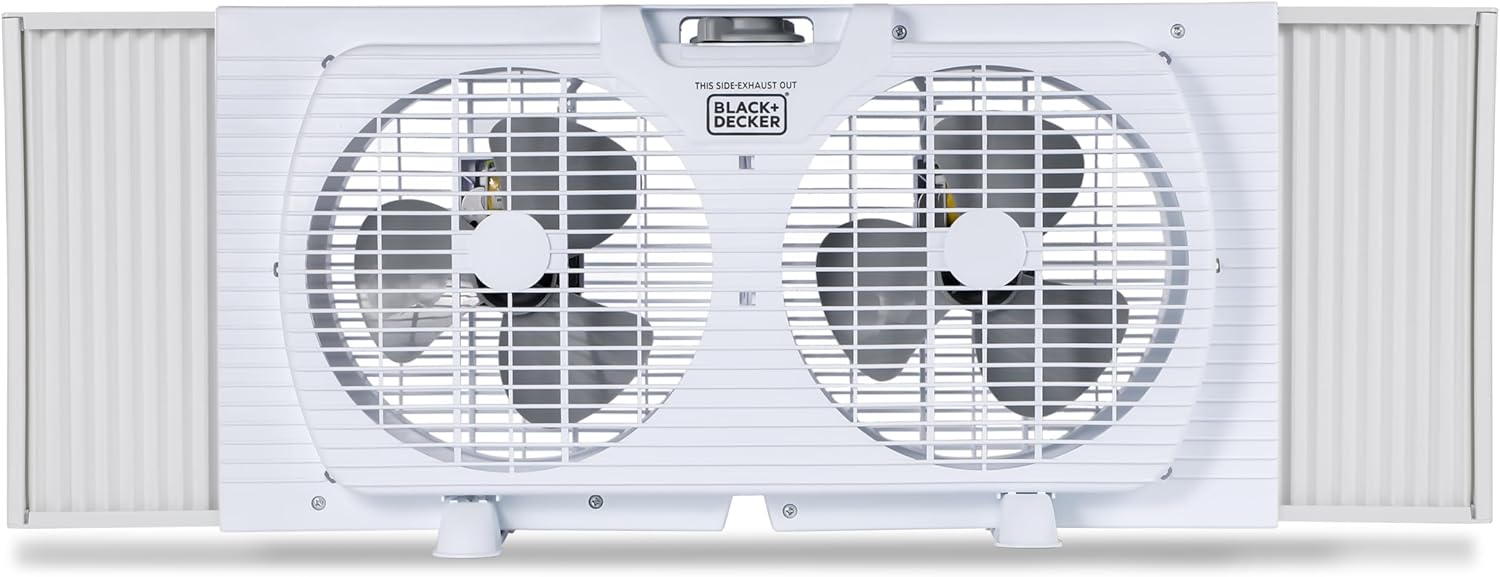
The BLACK+DECKER 9" Dual Window Fan is a lightweight, portable twin-head unit designed to sit in a horizontal sliding window and either draw fresh air in or exhaust stale air out. Installation uses accordion expanders that adjust from 22.5" to 33" and removable legs let you convert it to a floor fan when needed. Two mechanical speed settings (Low and High) control airflow from the paired 9" poly blades, and a manual dial makes adjustments quick and simple. The fan runs on a standard 120V plug and the brushless motor is rated at 56W, so it moves air without consuming much power. Practical touches include a carrying handle and rust-resistant plastic housing for easy transport and seasonal storage. Limitations are a basic two-speed control rather than variable speeds or a remote, and the plastic construction is functional but not premium-feeling, so it is best for straightforward ventilation tasks rather than decorative placement.
Best for: Buyers who want a practical, no-frills solution to improve ventilation in horizontal sliding windows and prioritize easy installation, portability, and low energy use.
Less Ideal for: Those seeking quiet, decor-forward designs, precise speed control, or a premium metal build should look at higher-end window or inline ventilation options instead.
- Adjustable accordion expanders fit most horizontal sliding windows from 22.5" to 33"
- Manual reversible operation for intake or exhaust airflow
- Lightweight and portable with a carrying handle and removable legs
- Energy-efficient brushless motor rated at 56 watts
- Only two fixed speed settings, no variable speed or remote control
- Plastic construction feels basic compared with higher-end models
Verdict: A straightforward, energy-efficient twin fan that fits most horizontal sliding windows and provides simple intake or exhaust ventilation.
Comfort Zone 9" Twin Window Fan CZ319WT2

| Number of Speeds | 3 |
|---|---|
| Air Flow Capacity | 272 cfm |
| Wattage | 45.9 watts |
| Noise Level | 53.3 db |
| Mounting Type | Window Mount |
This Comfort Zone 9-inch twin window fan is built to move air through a horizontal sliding or double-hung window using two 9-inch blades and a manual dial with three speeds. Installation is straightforward: accordion expanders lock the fan in place across a 22.25 to 33 inch opening, and the unit can be flipped to exhaust or intake air depending on whether you want to pull cool outdoor air in or push stale indoor air out. A removable bug screen and fabric cover keep pests and debris out when the fan is running, and included tabletop feet let you use it on a desk or floor when windows are closed. At 272 CFM and roughly 46 watts, it provides noticeable circulation without high power draw, though the highest speed can be loud compared with a dedicated quiet fan. The lightweight plastic construction and integrated carry handle make it easy to move between rooms, but plastic components mean it is not as durable as heavier metal fans. For budget-focused buyers wanting a simple, flexible window-mounted airflow solution, this model covers the basics well.
Best for: Buyers seeking an affordable, no-frills window fan that fits sliding or double-hung windows and provides both intake and exhaust options for everyday air circulation.
Less Ideal for: People who prioritize whisper-quiet operation or heavy-duty, long-lasting construction should consider higher-end or metal-frame fans instead.
- Expandable accordion fit for 22.25 to 33 inch windows secures into most horizontal sliding and double-hung openings
- Reversible intake/exhaust function lets you choose fresh-air intake or room exhaust
- Removable bug screen and fabric cover block insects and debris during operation
- Includes tabletop feet and carry handle for quick conversion to freestanding use and easy transport
- Uses modest power (about 45.9 watts) while delivering up to 272 CFM of airflow
- Plastic construction can feel less robust than metal alternatives
- Highest speed produces noticeable noise compared with quieter fans
Verdict: A budget-friendly, easy-to-install twin window fan that gives sliding-window households reversible intake/exhaust airflow and portable freestanding use.
Bionaire Twin Window Fan BW2300-N

| Power Source | Standard 120V Outlet |
|---|---|
| Number of Speeds | 3 |
| Noise Level | 47 db |
| Wattage | 120 watts |
| Included Components | Remote |
The Bionaire Twin Window Fan is a ready-to-use window-mounted fan that draws fresh air in, exhausts warm air out, or exchanges airflow using two reversible 8.5" blades with independent control. Installation requires no assembly and the unit includes a built-in accordion extender plus an extra extender panel to fit 24" to 36" double-hung or vertical slider windows. You control airflow with three speed settings from the front panel or with the included remote, and a programmable thermostat with an LED display lets the fan cycle on and off to maintain a set temperature. Practical touches include a dimmable display, 6 plastic blades driven by a 120-watt motor, and ETL listing. Trade-offs are typical of plastic-bodied window fans: it is a straightforward plug-in design without advanced filtration or ultra-quiet operation, and performance depends on window fit and outdoor conditions. For routine ventilation and seasonal cooling in bedrooms, kitchens, or home offices this model offers dependable, simple operation and useful automation features.
Best for: Buyers who prioritize a reliable, easy-to-install window fan that will run on a schedule and keep rooms ventilated with minimal fuss.
Less Ideal for: People who need heavy-duty industrial airflow, advanced air filtration, or ultra-quiet operation should consider other specialized ventilation options.
- Reversible dual blades allow intake, exhaust, or exchange airflow modes
- Programmable thermostat with LED display automates on/off based on room temperature
- Includes remote control for easy operation from across the room
- Built-in and additional extender panels fit a 24–36" window range with no assembly required
- Constructed from plastic which can transmit fan noise and feel less durable than metal alternatives
- No built-in air filtration or advanced noise-reduction features
Verdict: A practical, dependable window fan with reversible airflow and a programmable thermostat that reliably ventilates 24–36" horizontal sliding windows.
HOLMES Dual Blade Window Fan

| Power Source | Corded Electric |
|---|---|
| Number of Speeds | 2 |
| Motor Type | Brushless |
| Special Features | Water Resistant |
| Controller Type | Button Control |
The HOLMES Dual Blade Window Fan is a plug-in reversible twin fan made to fit double-hung and horizontal sliding windows using the included extender panel. Each fan operates independently and can intake, exhaust, or exchange air for whole-room circulation, and the unit offers two speed settings plus a one-touch programmable thermostat for automatic on/off at a set temperature. Water-resistant motors increase durability for damp conditions and the adjustable extender screen and bonus extender panel let the unit span a wide range of window widths. Setup is straightforward: mount the fan in the opening, extend the panels to fill gaps, and plug into a standard 120V outlet. Practical benefits include quieter efficient airflow compared with portable fans, simple electronic controls, and the ability to create cross-ventilation by reversing one side while drawing fresh air with the other. Limitations to consider are only two speed levels and basic button controls rather than variable speeds or smart connectivity, and the fan is designed for indoor window mounting only.
Best for: Buyers who want a reliable, easy-to-install window fan that can both bring in cool outdoor air and exhaust stale indoor air for improved ventilation in horizontal sliding windows while valuing straightforward controls and proven performance.
Less Ideal for: People who need precise variable-speed control, app or remote operation, or an outdoor-rated unit for permanent external installation should consider other options.
- Reversible twin fans allow intake, exhaust, or air exchange for flexible ventilation
- One-touch programmable thermostat automates fan operation to maintain a set temperature
- Adjustable extender screen and bonus extender panel fit a wide range of window widths
- Water-resistant motors provide safer use in damp or rainy conditions
- Only two speed settings limit fine control of airflow
- No smart features or remote control for wireless operation
Verdict: A straightforward reversible twin window fan that fits horizontal sliding windows and provides dependable intake, exhaust, or air-exchange ventilation with simple thermostat control.
shinic 9" Window Fan BP2-9AQ

| Number of Speeds | 3 |
|---|---|
| Noise Level | 45 db |
| Wattage | 50 watts |
| Power Source | Corded Electric |
| Control Method | Remote |
The shinic 9" twin window fan is a compact window-mounted unit designed to bring fresh air in, exhaust stale air, or create cross-ventilation by running both fans in opposite directions. It installs in horizontal sliding or double-hung windows using expandable side panels that fit 24"–37" and includes foam sealing tape, a mesh bug screen, and a fabric dust cover for year-round use. The fan offers three speeds and remote control for convenient adjustment, and the brushless motor and noise-reduction tuning keep operation relatively quiet at about 45 dB. Detachable feet let you use it as a freestanding fan on a table when window mounting is not an option. Practical benefits include simple setup, included accessories to block drafts and insects, and ETL listing for safety. Limits to expect are modest airflow compared with larger or whole-room fans due to the 9" blades and 50 W power, and performance depends on window fit and outdoor conditions.
Best for: Buyers who prefer a low-risk, easy-to-install solution for ventilating a specific room with a horizontal sliding window and value included accessories and quiet operation.
Less Ideal for: Do not choose this if you need to cool large open-plan rooms or want the highest possible airflow from a single fan; larger or whole-room fans will move more air.
- Reversible 3-in-1 airflow (intake, exhaust, circulate) for flexible room ventilation
- Expandable panels and included sealing tape for secure fit in 24"–37" horizontal sliding windows
- Remote control plus three speeds for easy, quiet adjustments from across the room
- Includes removable bug screen and dust cover so the unit can be used year-round without pests or drafts
- Detachable feet allow freestanding tabletop use when window mounting is not suitable
- Small 9" fans and 50 W motor provide limited whole-room airflow compared with larger window or floor fans
- Performance varies with window tightness and outdoor air conditions, so cooling effectiveness is situational
Verdict: A compact, easy-to-install window fan built for quiet, flexible ventilation in horizontal sliding windows with all necessary sealing and insect-control accessories included.
Choosing the Right Fan for Horizontal Sliding Windows: Key Factors to Consider
Airflow Capacity (CFM) and Room Size
Airflow measured in cubic feet per minute indicates how much air the fan moves. Higher CFM is important for larger rooms or when you need to rapidly exchange indoor and outdoor air.
Estimate the cubic footage of the room you intend to ventilate and choose a fan whose rated CFM can achieve several air changes per hour. Undersized fans will run continuously without noticeably improving comfort, while oversized fans may create drafts and noise. Also consider whether you need primarily exhaust, intake, or reversible flow when matching CFM to the task.
Mounting Method and Window Fit
Horizontal sliding windows present limited vertical clearance and a sliding sash to work around, so the mounting hardware and how the fan seals are critical. Look for fans with adjustable brackets, expandable panels, or sash clamps designed to bridge an open horizontal opening without leaving gaps.
A secure, weather-tight fit prevents air leakage and reduces wind noise. Consider whether the fan requires tool-free installation, temporary brackets, or a semi-permanent frame. If you rent the space or need to remove the fan seasonally, prioritize solutions that leave the window and frame undamaged.
Noise Output and Operating Speeds
Noise can be the deciding factor for units that run while people are sleeping, working, or watching media. Fans with multiple speed settings let you trade off between airflow and quiet operation.
Check manufacturer noise ratings where available and prefer models with a lower decibel output at typical speeds you will use. Also consider the fan's motor type and blade design, since those affect tonal character and whether vibration transmits into the window frame.
Durability and Weather Resistance
Fans used in window openings are exposed to temperature swings, humidity, and possibly rain or dust. Durable housings, rust-resistant hardware, and sealed motor compartments extend the working life of the unit.
Assess material quality, warranty length, and whether parts like filters or grilles are replaceable. Units designed with corrosion-resistant finishes or removable, washable components are easier to maintain and less likely to fail from environmental wear.
Control Features and Convenience
Controls shape daily usability. Features such as reversible airflow, multiple speeds, remote control, timers, or simple mechanical switches change how flexible the fan is in different ventilation scenarios.
Convenient features reduce friction in everyday use and can improve energy efficiency by letting you run the fan only when needed. Also check how easy it is to clean the fan blades and grille, since accessible maintenance prolongs performance and keeps noise levels low over time.
Installation Checklist for Horizontal Sliding Windows
Before you buy, measure the open window width and the vertical clearance between the sill and the top of the opening. Note where the sliding sash rests when open and whether any obstructions like handles or security bars interfere with mounting hardware. Check that the window can close enough to engage a sash clamp or that there is space for an expandable panel to seal gaps.
Confirm the mounting approach you prefer: temporary sash clamps, adjustable side panels, or a semi-permanent frame that sits in the opening. Gather basic tools such as a level, tape measure, screwdriver, and possibly a drill if any anchors are required. If the fan uses an external bracket, make sure the bracket location allows the window to close securely without pinching screens or weatherstripping.
- Measure open width and vertical clearance
- Check for sash obstructions and handle placement
- Decide on temporary versus semi-permanent mounting
- Prepare basic tools and a helper for larger units
Setting Up for Best Airflow
Position the fan to support your intended airflow pattern. For exhaust use, place the fan on the window that opens to the outdoors and aim to pull warm air out. For intake, place the fan to blow fresh outdoor air into the room. For cross-ventilation, pair a window fan with another opening or a ceiling fan positioned to assist circulation.
If the fan offers reversible flow, use lower speeds for gentle incoming air and higher speeds for rapid exhaust. Small adjustments to the fan height in the opening and angling of louvers, if available, can influence the distribution of airflow across the room.
- Match fan direction to intake or exhaust need
- Combine with other openings for cross-ventilation
- Use speed control to balance airflow and noise
Maintaining Performance and Cleanliness
Regular cleaning keeps airflow steady and noise low. Dust and pollen build up on blades and in grilles, reducing effective CFM and increasing strain on the motor. Remove the grille or front panel according to the manufacturer instructions and wipe blades with a damp cloth on a regular schedule.
Inspect seals and weatherstripping at each season change. Replace worn foam or rubber sealing strips to maintain efficient airflow exchange and prevent drafts. For units used year-round, consider a light lubrication check if recommended by the manufacturer to prevent motor wear.
- Clean blades and grille periodically
- Inspect and replace seals or foam strips
- Follow motor maintenance guidance when provided
Common Installation Challenges and Fixes
Gaps and leaks around the fan are common with sliding windows. If you notice rattling or wind noise, inspect the mounting hardware and add thin foam strips to fill small gaps. Larger gaps may require an expandable side panel or adjustable framing to create a consistent seal.
If the fan vibrates or transmits noise to the window sash, try adding vibration-damping pads between the fan housing and the window frame. For units that do not sit flush, temporary wooden wedges or rubber bumpers can stabilize the fan without altering the frame.
- Use foam strips or expandable panels to seal gaps
- Add vibration-damping pads to reduce rattle
- Stabilize loose fit with non-damaging wedges
Energy Use and When to Run the Fan
Window fans are generally lower wattage than whole-home systems but still add to household energy use when run continuously. Use timers or intermittent schedules to ventilate during cooler parts of the day or to remove peak heat build-up. Running a fan at lower speeds often yields efficient ventilation with acceptable noise.
Use outdoor temperature and humidity as guides. On high-humidity days, running the fan to bring in humid air can be counterproductive unless you are exhausting indoor humidity. Reverse the fan to exhaust in those situations.
- Prefer low or intermittent speeds for efficiency
- Time ventilation for cooler outdoor conditions
- Reverse for exhaust to remove indoor humidity
How We Chose the Best Fan for Horizontal Sliding Windows
We prioritized features and performance metrics that matter specifically for fans used in horizontal sliding windows. Selection centered on airflow output and distribution, because these determine how effectively a fan moves air through a room and exchanges indoor and outdoor air. We also weighed mounting options and adjustability, since horizontal sliding windows require different sealing and bracket solutions than vertical or casement windows. Noise level during typical operating speeds was considered so a fan can run for hours without becoming a nuisance. Build quality, material longevity, and weather resistance were included to ensure sustained performance in exposed window openings. Finally, controls and user conveniences such as multiple speeds, reversible airflow, and easy-clean grille access were part of the filter. We excluded fans meant only for through-wall, casement, or vertical slider installations, as well as units requiring complex electrical work or permanent modifications. The final shortlist contains units that balance airflow, straightforward mounting for horizontal sliding windows, manageable noise, and durable construction.
Our full evaluation process is outlined in our review methodology.
FAQ
Can I install a window fan in any horizontal sliding window?
Often, but not always. Most horizontal sliding windows can accept a fan if there is enough open width and vertical clearance. Measure the opening and check for interfering hardware. Choose a fan with mounting options that match your window's sash configuration.
How do I reduce noise when using a window fan?
Use lower speeds for quieter operation, add vibration-damping pads between the fan and frame, and ensure the fan is tightly sealed to avoid rattles. Regular cleaning also prevents noise caused by dust buildup on blades.
Should I use the fan for intake or exhaust?
It depends on your goal. Use intake to bring in cooler fresh air, and use exhaust to remove hot or stale air. For many rooms, pairing intake on one side with exhaust on another creates effective cross-ventilation.
Will a window fan work in rainy or humid conditions?
Some fans are designed to tolerate occasional moisture, but prolonged exposure to rain and high humidity can shorten lifespan. Prefer models with sealed motors and corrosion-resistant materials, and avoid running an intake fan directly in heavy rain.
How often should I clean and maintain a window fan?
Clean blades and the grille every one to three months depending on dust load. Inspect seals and mounting hardware each season and perform any recommended motor maintenance as outlined by the manufacturer.
Final Verdict
Pick a fan that matches the size of the room and the specific constraints of your horizontal sliding window. Prioritize adequate airflow for the space, a mounting method that seals well without damaging the window, and noise levels that suit how you will use the fan. Consider durability and maintenance needs if the unit will be exposed to weather or heavy use. Balancing these tradeoffs—CFM versus noise, seal quality versus ease of removal, and construction versus convenience—will help you choose a fan that delivers the ventilation you want with minimal hassle.