
Note: This article contains affiliate links. If you click on these links and make a purchase, we may earn a small commission at no extra cost to you. This helps support our research and content. Read our full affiliate disclosure here.
If you need consistent indoor comfort and moisture management, a fan with humidistat and thermostat built in makes a big difference. These fans monitor both temperature and humidity and adjust speed or run time automatically so rooms stay comfortable without constant manual adjustments. Whether you want to reduce muggy air in living spaces or keep a utility room dry, choosing the right unit affects comfort, energy use, and noise. This guide shortlists six top options and explains the practical strengths buyers should weigh, including control accuracy, airflow capacity, ease of installation, and runtime efficiency. Use the evaluation criteria below to match a fan to your room size and control needs before checking specific models.
Top Picks at a Glance
| Best Overall The best all-around choice for most situations | QuietCool AFG SMT ES-3.0 Attic Fan |  |
| Best Quality Built to a higher standard if you want something more solid | Master Flow ERV6 Roof Mount Attic Fan |  |
| Best Value The sweet spot between price and what you get | ALORAIR VentirMax 300SD |  |
| Best Budget The cheapest option that still gets the job done reliably | ALORAIR VentirPro 260S |  |
| Most Popular A crowd favorite that many people choose with confidence | QuietCool AFG SMT PRO-2.0 |  |
| Best Seller A high-volume bestseller chosen again and again | AC Infinity CLOUDLINE T4 |  |
QuietCool AFG SMT ES-3.0 Attic Fan

| Air Flow Capacity | 2801 cfm |
|---|---|
| Number of Speeds | 3 |
| Motor Type | brushless ECM |
| Noise Level | 45 db |
| Power Source | ac |
The QuietCool AFG SMT ES-3.0 is a plug-and-play gable attic fan designed to lower attic temperature and humidity using a brushless ECM motor and three-speed operation. It mounts to a gable vent and connects to standard power without hardwiring, then pairs with the QuietCool Smart Control app to monitor attic temperature and humidity, set seasonal presets, and run the fan automatically. On high it moves up to 2801 CFM while using relatively low power thanks to the ECM motor, and built-in mounting tabs plus anti-vibration pads reduce installation noise and vibration. The integrated thermostat and humidistat let the fan run only when needed, helping prevent attic mold and reduce cooling load on the house. Trade-offs include a midlevel reported noise figure around 45 dB and the physical size and weight typical of high-CFM gable fans, which may require two people for installation and enough gable venting for effective intake. If you want a smart, high-flow attic ventilator that actively controls humidity as well as temperature, this model delivers practical climate control for the attic space.
Best for: Buyers who want an automated attic ventilation solution that actively manages both temperature and humidity with app-based presets for consistent year-round attic climate control.
Less Ideal for: Homes without adequate gable venting, installers looking for a near-silent indoor fan, or those who need a compact, lightweight unit for tight installs.
- Smart app control with thermostat and humidistat for automated operation and presets
- High airflow up to 2801 CFM driven by an energy-efficient brushless ECM motor
- Plug-and-play installation with standard electrical plug and built-in mounting tabs
- Three-speed control lets you balance ventilation and energy use
- Anti-vibration pads to reduce noise transfer to the structure
- Reported noise level around 45 dB may be noticeable in nearby living spaces
- Large, heavier unit that may need two people to install and appropriate gable venting
Verdict: Choose this fan if you want high airflow plus smart thermostat and humidistat control to actively reduce attic heat and moisture.
Master Flow ERV6 Roof Mount Attic Fan

| Air Flow Capacity | 1500 cfm |
|---|---|
| Power Source | Corded Electric |
| Mounting Type | Roof Mount |
| Control Method | Push Button |
| Special Features | w/Thermostat & Humidistat (HT1) |
The Master Flow ERV6 is a roof-mounted attic exhaust fan designed to pull hot, humid air from attics up to roughly 2,800 sq ft using a 1500 CFM airflow rating and a hard-wired corded electric connection. It installs on the roof and is controlled by the included HT1 humidistat and thermostat, so the unit runs automatically when attic temperature or humidity thresholds are reached. The housing is galvanized steel with a powder-coated finish and an internal screen to keep animals out, while plastic blades and a high-efficiency motor provide continuous ventilation without excessive energy draw. Practical benefits include lowered attic temperatures that can reduce cooling load and the convenience of automatic operation, plus robust exterior construction for outdoor roof use. Limitations to note are that it requires hard-wired installation and is not compatible with tile roofing systems, and the dome-style roof mount may need careful flashing and sealing during installation to prevent leaks.
Best for: Buyers prioritizing attic performance and automatic climate-triggered ventilation who want a powerful, weatherproof roof-mounted fan to reduce attic heat and humidity.
Less Ideal for: Homeowners with tile roofs or those who need a plug-in or easily portable ventilation solution should consider other options.
- High airflow capacity at 1500 CFM suitable for large attics
- Includes HT1 humidistat and thermostat for automatic temperature and humidity control
- Galvanized steel, powder-coated housing with internal screen for durability and animal protection
- Requires hard-wired electrical connection which adds installation complexity
- Not compatible with tile roofing systems
Verdict: Choose the ERV6 when you want a high-capacity, automatically controlled roof attic fan that cuts attic heat and humidity for better cooling performance.
ALORAIR VentirMax 300SD
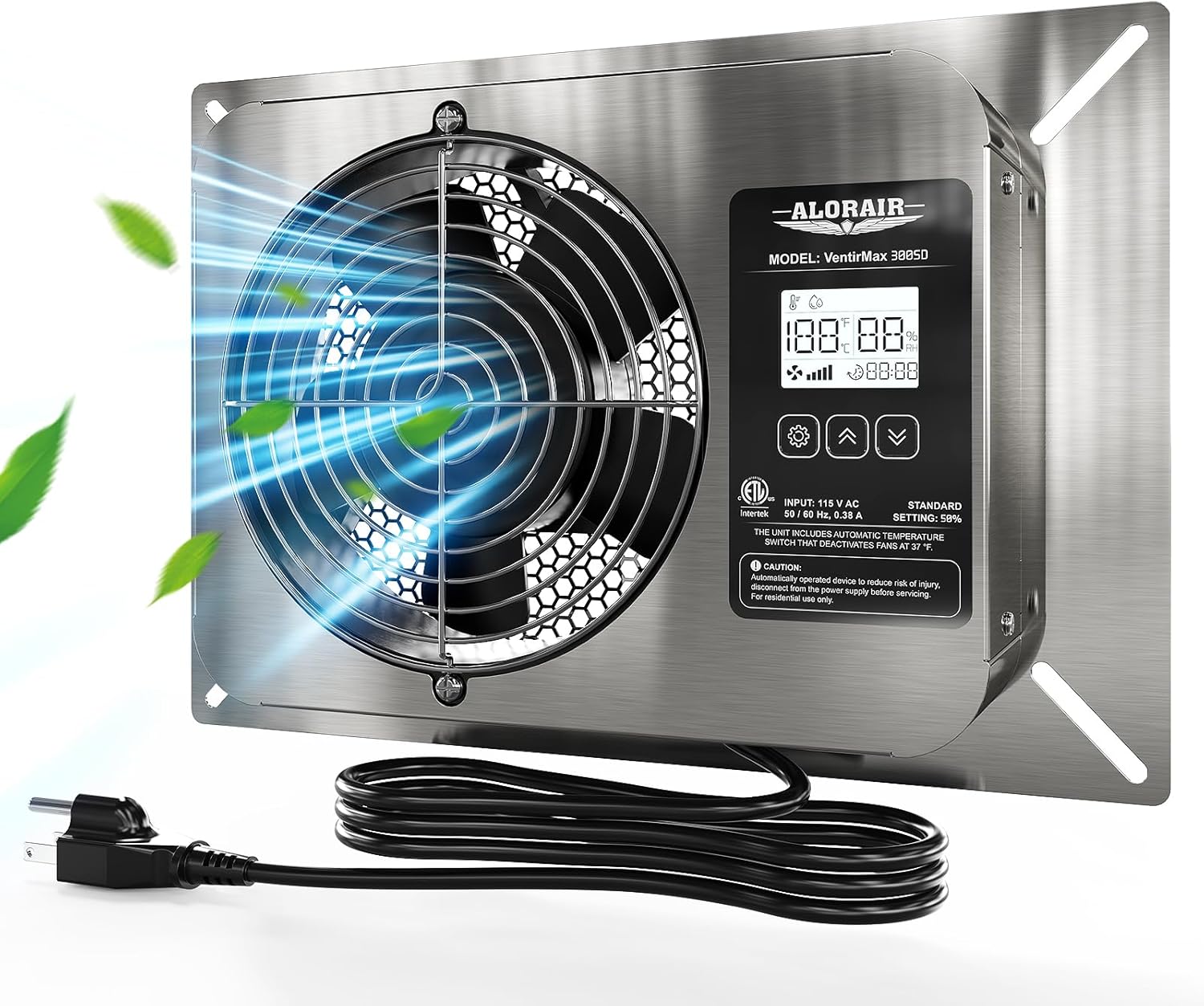
| Air Flow Capacity | 300 cfm |
|---|---|
| Noise Level | 40 db |
| Wattage | 34 watts |
| Voltage | 115 volts_of_alternating_current |
| Motor Type | brushless |
The VentirMax 300SD is a compact wall-mounted exhaust fan designed to move up to 300 CFM for crawl spaces, basements, attics and garages. It pairs a stainless steel housing and five plastic blades with a brushless motor to deliver steady air circulation while keeping noise around 40 dB. The built-in digital controller supports programmable temperature, humidity and timed cycles and includes a freeze-protection thermostat that stops the unit below 37°F, plus an automatic start when humidity rises above the setpoint. The fan is IP55-rated and uses an upgraded isolation mesh to keep particulates out, and it remembers settings after a power loss. Installation is for a fixed wall mount and it runs from standard 115V with a NEMA 5-15 connector. Practical benefits include reliable automated humidity control to reduce moisture risk and a durable stainless exterior for damp locations, while limitations are that it is intended for indoor fixed installation only and its 300 CFM rating best suits smaller spaces rather than large open areas.
Best for: Buyers who want a durable, automated ventilation solution that actively controls humidity and temperature in small enclosed spaces and prefer a set-and-forget controller.
Less Ideal for: Those who need portable or floor-mounted ventilation or require high-volume airflow for very large or open areas should look elsewhere.
- Integrated humidistat and programmable thermostat for automatic moisture and temperature control
- 300 CFM airflow with brushless motor delivers effective circulation for confined spaces
- Stainless steel housing with IP55 rating and isolation mesh for dust and moisture resistance
- Memory restart restores settings after power interruptions
- Wall-mount fixed installation limits placement flexibility
- 300 CFM capacity is best for small to medium-sized spaces, not large areas
Verdict: A durable, automated 300 CFM wall-mounted ventilator ideal for controlling humidity and temperature in small crawl spaces and basements.
ALORAIR VentirPro 260S

| Air Flow Capacity | 260 cfm |
|---|---|
| Noise Level | 40 db |
| Number of Speeds | 3 |
| Power Source | ac |
| Material | Stainless Steel |
The ALORAIR VentirPro 260S is a compact wall-mount exhaust fan designed to improve airflow and control moisture in crawlspaces, basements, garages, and similar small spaces. It delivers up to 260 CFM through a five-blade AC axial motor while producing modest sound levels around 40 dB, and the stainless-steel housing with an IP55 rating helps resist dust and water. Built-in controls include a humidistat with adjustable 10 to 80 percent range and a factory-installed antifreeze thermostat that prevents operation below about 35°F, so the unit can be set-and-forgotten to maintain drier conditions and protect against condensation and wood rot. Installation is straightforward for standard vent openings and the faceplate can be trimmed for nonstandard openings; the fan ships with a cord and mounting screws. Limitations are its modest airflow, which suits up to small crawlspaces (manufacturer lists coverage up to about 550 sq ft) but is not enough for larger areas, and it runs on a basic AC motor without advanced smart controls. For buyers wanting a durable, weather-resistant humidistat fan on a budget, this model covers the essentials reliably.
Best for: Buyers who need an affordable, durable crawlspace or small-basement ventilator that automatically controls humidity and protects against freezing conditions.
Less Ideal for: Those who need high-capacity ventilation for large basements or want integrated smart-home control and scheduling features.
- Stainless steel, IP55-rated housing resists moisture and dust for longer life.
- Built-in humidistat lets the fan run automatically to control crawlspace humidity.
- Factory-installed antifreeze thermostat prevents operation below ~35°F.
- Relatively quiet operation at about 40 dB for continuous use.
- Includes cord and mounting screws for simple plug-in installation.
- 260 CFM airflow is suitable for small spaces but may be insufficient for larger basements.
- No advanced smart connectivity or programmability beyond basic controls.
Verdict: A budget-friendly, weather-resistant crawlspace fan that automatically manages humidity and prevents low-temperature operation, ideal for small humid spaces.
QuietCool AFG SMT PRO-2.0
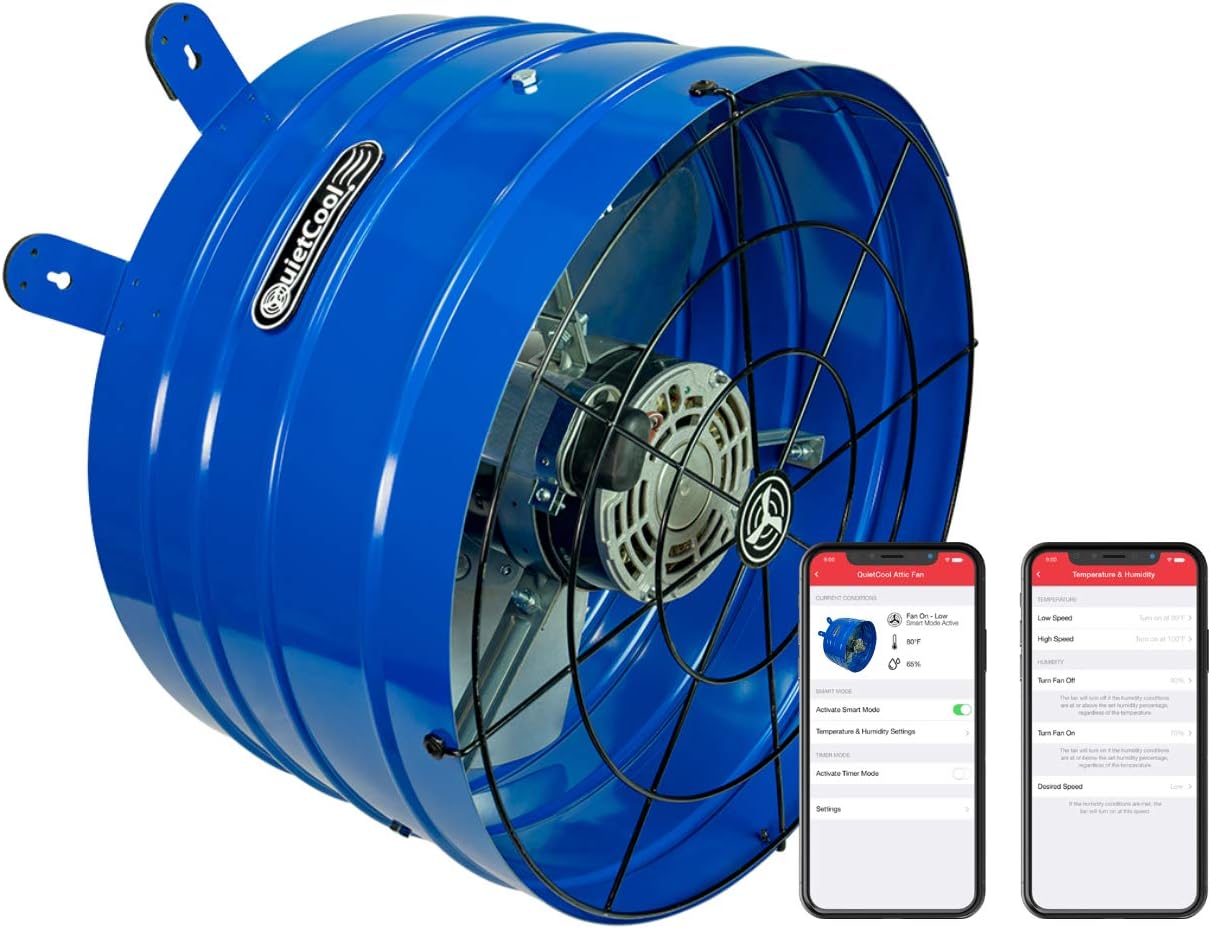
| Air Flow Capacity | 1945 cfm |
|---|---|
| Number of Speeds | 2 |
| Wattage | 120 watts |
| Motor Type | PSC |
| Control Method | App |
The QuietCool AFG SMT PRO-2.0 is a plug-and-play attic gable fan designed to lower attic temperature and humidity using its two-speed PSC motor and smart control hub. It mounts in a gable, connects via a 20 ft power cord and pairs with the QuietCool app so you can set temperature and humidity presets, monitor attic conditions, and switch speeds remotely. On high the fan moves up to 1,945 CFM while drawing about 120 watts, giving strong daytime ventilation for midsize attics and helping reduce A/C cycling. The included humidistat and thermostat automate operation to prevent mold-prone humidity and to limit roof ice in winter. Installation is simplified by the plug-and-play design and included vent covers, though proper sizing and some basic mounting work are still required. The fan is a no-nonsense, functional option for buyers who want automated attic climate control and smartphone monitoring, but its gable mounting means it is not suitable where roof-mounting is required and a two-speed PSC motor offers less fine-grained control than multi-speed or ECM-driven units.
Best for: Buyers who prioritize documented performance and want automated attic climate control with smartphone monitoring and humidity protection for midsize attics.
Less Ideal for: Homes that require a roof-mounted fan or buyers who need variable-speed ECM control for finer airflow tuning should consider other options.
- Smart app control with temperature and humidity presets for automated operation
- High airflow up to 1,945 CFM for effective attic ventilation
- Plug-and-play installation with included smart hub and vent covers
- Built-in thermostat and humidistat to prevent excess humidity and reduce roof ice
- Gable-mount design limits installation locations compared with roof-mount fans
- Two-speed PSC motor provides less precise speed control than multi-speed or ECM motors
Verdict: Choose the QuietCool AFG SMT PRO-2.0 if you want a proven smart attic fan that automates temperature and humidity control with strong CFM and easy plug-and-play installation.
AC Infinity CLOUDLINE T4

| Air Flow Capacity | 205 cfm |
|---|---|
| Noise Level | 28 db |
| Wattage | 21 watts |
| Motor Type | EC motor |
| Control Method | App |
The AC Infinity CLOUDLINE T4 is a compact inline duct fan built for controlled ventilation in grow tents, small HVAC runs, and equipment closets. It pairs a mixed-flow impeller and PWM-controlled EC motor to deliver up to 205 CFM while keeping noise down to about 28 dBA, which makes it suitable for spaces where quiet operation matters. The integrated smart controller and WiFi app let you set temperature and humidity thresholds, create schedules, and trigger the fan automatically using dynamic climate rules and VPD-based programming. Installation is straightforward for mounted duct setups and the included mounting hardware covers basic needs. Practical benefits include low power draw (21 W), multiple speed levels for fine airflow tuning, and remote monitoring with alerts so you can catch environmental swings early. Limitations are its 4-inch duct size and 205 CFM capacity, which restrict its use to small grow tents or short duct runs, and the plastic construction that favors lightweight portability over heavy-duty industrial durability. If you need a quiet, app-controlled solution for a modest ventilation job with accurate climate-triggering, the T4 is a sensible option.
Best for: Buyers who want a low-noise, app-controlled ventilation fan that automates climate triggers and provides remote monitoring for small grow tents or equipment closets.
Less Ideal for: Users needing high-capacity ventilation for large spaces, long ductwork, or heavy-duty commercial installations should choose a larger fan.
- Smart WiFi controller with temperature and humidity automation and VPD programming
- Quiet mixed-flow EC motor operation rated around 28 dBA
- Energy efficient at about 21 watts with PWM speed control and multiple speed levels
- Compact 4-inch duct size that fits small grow tents and short runs
- Limited to 205 CFM, so not suitable for larger rooms or long duct runs
- Plastic housing may be less durable than metal alternatives
Verdict: Choose the CLOUDLINE T4 when you need a quiet, energy-efficient inline fan with smart temperature and humidity automation for small-scale ventilation.
Choosing the Right Fan with Humidistat and Thermostat: Key Factors to Consider
Sensor Accuracy and Calibration
Reliable humidistat and thermostat operation starts with good sensors. Accurate sensors reduce cycling and keep the room closer to your chosen setpoints. Inaccurate humidity sensing can let a room feel clammy or needlessly run the fan, increasing wear and energy use.
Check whether the fan offers calibration or offset adjustments so you can fine-tune readings to match a known reference. Also consider sensor placement; integrally mounted sensors work best in free air away from direct vents or splash zones to avoid false readings.
Airflow Capacity Relative to Room Size
A fan must move enough air to impact temperature and moisture in the intended space. Manufacturers sometimes rate airflow in CFM or similar units; higher numbers are better for larger rooms but can increase noise.
Match the fan's airflow capacity to room volume rather than floor area alone, and account for obstructions like furniture or partial partitions. For tight or high-ceiling rooms, prioritize units with stronger airflow or more aggressive boost modes to maintain effective circulation.
Control Options and User Interface
Controls determine how easily you set temperature and humidity targets and how the fan responds. Look for fans with distinct setpoints for both humidity and temperature, multi-speed settings, and scheduling or timer functions. Some units offer simple knobs while others provide digital displays or remote access.
Assess whether you need programmability or just straightforward auto modes. A clearer user interface reduces frustration and makes it simpler to balance comfort versus energy consumption.
Noise and Comfort at Typical Settings
Noise is often the limiting factor for continuous fan operation. Evaluate reported sound levels at low and medium speeds because fans with humidistat control may run frequently. A quiet low-speed setting makes automatic operation tolerable in bedrooms and living spaces.
Consider where the fan will be installed and how noise travels; wall- or ceiling-mounted units can transmit vibration differently than freestanding fans. Look for features that dampen vibration and allow quieter operation without sacrificing necessary airflow.
Installation Requirements and Compatibility
Installation complexity affects total cost and suitability. Confirm whether the fan needs hardwiring, a specific electrical circuit, or a particular mounting configuration. Some residential fans are plug-and-play while others require a licensed electrician.
Also consider whether the unit fits standard ceiling or wall openings, and whether its footprint or clearances suit your space. Units intended for humid areas should have appropriate IP or moisture resistance ratings to prevent premature corrosion.
Energy Use and Automatic Behavior
Built-in thermostats and humidistats influence runtime and therefore energy use. Efficient motors, variable-speed controls, and smart auto modes can lower operating costs while maintaining comfort. Fans that minimize runtime through precise sensing tend to be both quieter and cheaper to operate.
Look for features such as programmable thresholds, adaptive run-time logic, or low-power standby modes that prevent unnecessary cycling. Energy-efficient fans are especially valuable in rooms where long daily runtime is expected, such as basements or laundry spaces.
Where Fans with Humidistat and Thermostat Work Best
These combined-control fans excel in spaces where both humidity and temperature matter. Typical use cases include basements that are prone to dampness, bathrooms that see intermittent moisture buildup, laundry rooms, and bedrooms where overnight humidity can cause discomfort. The integrated sensors let the fan respond automatically rather than relying on manual switches.
Place the fan so its sensors sample representative air. Avoid mounting directly above showers, dishwashers, or heat sources where local spikes can trigger unnecessary operation. Proper placement improves control accuracy and reduces false triggers.
- Basements and crawl spaces where moisture control is important
- Laundry rooms to remove drying moisture without constant monitoring
- Bathrooms to control humidity after showers while limiting noise
- Bedrooms and living rooms where automatic comfort maintenance is desired
Installation Tips to Ensure Accurate Sensing
To get reliable readings, mount the unit away from direct airflow of HVAC registers and out of sunlight or heat-producing fixtures. If the fan is ceiling-mounted, aim for a central position in the room. For wall-mounted units, install at the height recommended by the manufacturer so humidity and temperature gradients do not skew sensor readings.
If calibration options are available, verify the fan's readings against a handheld hygrometer and thermometer during the first week and apply small offsets if necessary. Secure mounting and proper electrical connections also reduce audible vibration and improve long-term reliability.
- Avoid direct exposure to steam or splashes unless the unit is rated for damp environments
- Follow recommended clearance and mounting height for correct sensing
- Test and adjust sensor offsets if your fan supports calibration
Balancing Noise, Airflow, and Auto Sensitivity
Auto modes that react quickly to minor humidity or temperature swings can cause frequent speed changes that may be annoying. Look for sensitivity or threshold settings that let you choose how aggressively the fan responds. Setting a slightly wider humidity deadband reduces short cycling while still protecting comfort.
When quieter operation is a priority, pick a fan with effective low-speed airflow and a larger capacity so it does not need high speeds as often. Consider units with programmable schedules or night modes that reduce responsiveness during sleep hours.
- Use a humidity deadband to prevent short cycling
- Prioritize quiet low-speed performance for bedrooms
- Enable night or eco modes to reduce responsiveness when needed
Maintenance and Longevity Considerations
Regular maintenance keeps sensors and moving parts accurate. Clean external sensor openings and air inlets periodically to prevent dust buildup that can bias readings. Inspect mounting hardware and vibration pads to reduce noise and wear.
For fans operating in high-moisture areas, check for corrosion-prone fasteners and ensure the unit's enclosure resists water ingress. Replace filters or screen elements where applicable and confirm electrical connections remain secure after the first few months of operation.
- Wipe sensor areas gently to remove dust every few months
- Inspect for corrosion in damp installations
- Tighten mounting hardware to prevent vibration over time
Smart Controls and Integration Options
Some fans offer digital interfaces, timers, or compatibility with home automation systems. Digital controls and remote access let you fine-tune setpoints and review recent runtime trends. If integration matters, verify that the unit supports the specific control methods you need, such as a simple wired remote or a digital scheduler.
Keep in mind that smart features can add complexity. Choose integrations that align with how you plan to use the fan rather than opting for advanced networking features you will rarely use.
- Digital displays simplify precise setpoint entry
- Timers and schedules can minimize unnecessary runtime
- Prioritize simple, reliable integrations over complex ecosystems
How We Chose the Best Fan with Humidistat and Thermostat
We focused on features and real-world performance that matter for fans with built-in humidistats and thermostats. Key evaluation criteria included control accuracy, to measure how reliably the integrated sensors maintain setpoints; airflow and coverage, to ensure the fan moves enough air for different room sizes; control flexibility, meaning how many modes, setpoints, and scheduling options the unit provides; noise and comfort, evaluating audible levels at typical speeds; installation and compatibility, covering mounting options, power requirements, and whether the unit suits common room types; and energy efficiency, accounting for motor type and automatic on/off behavior. We excluded units that lack dedicated humidity sensing or that only offer one basic on/off thermostat without adjustable setpoints. We also filtered out fans designed exclusively for specialty commercial applications because their control expectations differ from residential use. The list favors units that balance sensor quality, usable controls, and airflow rather than those that only advertise features without practical control refinement.
Our full evaluation process is outlined in our review methodology.
FAQ
Can the humidistat prevent mold growth?
A properly set humidistat helps keep relative humidity in a range that makes mold less likely, typically below common comfort thresholds. It does not eliminate all mold risk because ventilation, surface drying, and moisture sources also matter.
Where should I place the fan so the sensors read correctly?
Mount the fan where it samples representative room air, away from direct vents, sunlight, or localized moisture sources. Follow manufacturer height recommendations to avoid skewed readings from stratification.
Will the thermostat control stop the fan from running when it is hot?
A built-in thermostat can be set to limit or trigger operation based on temperature in addition to humidity. Whether the fan stops entirely or just adjusts speed depends on the unit's control logic and configurable setpoints.
How noisy are these fans when running automatically?
Noise varies by design and speed. Many models are quiet at low speeds but can be audible when boosting airflow. Look for reported low-speed dB figures and features that dampen vibration for quieter automatic operation.
Do I need a professional to install a fan with humidistat and thermostat?
It depends on the unit. Some plug-in or surface-mount fans are suitable for DIY installation, while ceiling- or hardwired units usually require a licensed electrician. Check the installation requirements before purchasing.
Final Verdict
Choose a fan with humidistat and thermostat by matching sensor quality and airflow to the room's size and moisture profile. Prioritize accurate sensors, appropriate airflow capacity, and control options that fit how and when you want the fan to run. Also weigh noise at typical settings and the installation complexity for your space. The right balance depends on whether quiet continuous operation, strong intermittent boosts, or tight automation is most important. Focus on the factors described here and select a unit whose controls and capacity align with your daily use for reliable comfort and moisture management.