
Note: This article contains affiliate links. If you click on these links and make a purchase, we may earn a small commission at no extra cost to you. This helps support our research and content. Read our full affiliate disclosure here.
Picking the right fan for a nursery matters more than you might think. A well-chosen fan keeps air moving to reduce stuffiness, supports safer sleep temperature, and can provide gentle white noise that helps infants settle. At the same time, noise level, safety features, and airflow direction need careful consideration in a room where an infant sleeps and spends time. This guide shortlists the top options in the fan-for-nurseries category and evaluates each for sound output, safety design, ease of cleaning, and airflow control. Read on to see the specific strengths we prioritized and how those strengths map to different nursery needs.
Top Picks at a Glance
| Best Overall The best all-around choice for most situations | Vornado 460 Small Desk Fan |  |
| Best Quality Built to a higher standard if you want something more solid | DREO DR-HPF013 Pedestal Fan |  |
| Best Value The sweet spot between price and what you get | Honeywell QuietSet HYF260 |  |
| Best Budget The cheapest option that still gets the job done reliably | Honeywell TurboForce HT-904 |  |
| Top Rated A top-rated pick with lots of positive feedback | DREO TurboPoly Pedestal Fan DR-HPF008S |  |
| Most Popular A crowd favorite that many people choose with confidence | Levoit Classic 36-inch Tower Fan |  |
| Best Seller A high-volume bestseller chosen again and again | Gaiatop Stroller Fan SF40 |  |
Vornado 460 Small Desk Fan

| Number of Speeds | 3 |
|---|---|
| Noise Level | 52 db |
| Wattage | 63 watts |
| Air Flow Capacity | 320 cfm |
| Power Source | Corded Electric |
The Vornado 460 is a small whole-room air circulator designed to move air efficiently from a tabletop or nightstand using Vornado's signature vortex grill and deep-pitched propeller. It has three manual speed settings controlled by a dial, a chrome glide bar to aim airflow, and a compact footprint that fits easily on desks or beside cribs. In practice it produces steady, directional circulation rather than broad, gusty blasts, which helps distribute cool or warm air through a nursery without constant repositioning. At typical bedroom volumes the fan is reasonably quiet for sleeping but can be audible on higher speeds. The unit is corded and runs on a brushed motor rated at 63 watts with an airflow capacity listed at 320 cfm. Important practical notes are the potential for a reset GFCI outlet to trip when changing speeds and that it is intended for indoor, U.S. voltage use only. For parents wanting consistent room circulation in a small nursery the 460 offers targeted airflow and reliable construction, though noise and the lack of a timer or remote may matter for some setups.
Best for: Parents who want steady, directional room circulation in a small nursery and prioritize reliable, compact equipment over smart controls.
Less Ideal for: Those who need ultra-quiet operation, programmable timers, or remote/smart control features for overnight nursery use.
- Vortex design circulates air up to 70 feet for whole-room airflow
- Three simple speed settings with easy dial control
- Adjustable chrome glide bar lets you direct airflow precisely
- Compact tabletop footprint fits nightstands and small surfaces
- Backed by a multi-year manufacturer support policy
- Brushed motor and higher speeds can be noticeably audible
- No timer, remote, or quiet/sleep-specific mode for overnight use
- May trip a GFCI outlet when changing speeds under some conditions
Verdict: A compact, reliable air circulator that delivers steady whole-room airflow ideal for parents who want consistent nursery ventilation without extra smart features.
DREO DR-HPF013 Pedestal Fan

| Power Source | Corded Electric |
|---|---|
| Number of Speeds | 8 |
| Noise Level | 28.2 db |
| Air Flow Capacity | 1000 cfm |
| Control Method | Remote, Touch |
The DREO DR-HPF013 is a freestanding pedestal air circulator built to move a lot of air quietly across a room. It uses a brushless DC motor and a three-blade TurboPoly design to deliver up to 1000 CFM and reach about 90 feet, which is useful for circulating air through a nursery or adjacent rooms. Controls include an intuitive top touch panel and an included remote, plus 8 discrete speeds, an auto mode that adjusts with temperature, an 8-hour timer, and 90° horizontal plus 105° vertical tilt for directing airflow where needed. The fan is unusually quiet for its output (listed 28.2 dB), and the detachable grill and blade make cleaning straightforward. There is also an aroma pad for light scenting. Trade-offs are minimal but include a plastic construction that feels less premium than metal and a relatively small 3-blade head compared with larger blade designs. For parents who prioritize steady, adjustable airflow and quiet operation, this fan balances power and low noise effectively in a nursery setting.
Best for: Parents who need a powerful yet quiet fan to move air through a nursery and nearby rooms and who value adjustable direction and automated speed control for consistent comfort.
Less Ideal for: People looking for a heavy-duty metal fan build or integrated nightlight and white-noise features should consider other specialized nursery products.
- High airflow capacity up to 1000 CFM for effective whole-room circulation
- Brushless DC motor for efficient, quiet operation
- Remote and top touch controls with 8 speeds plus auto mode and 8-hour timer for flexible scheduling
- Adjustable height, 90° horizontal oscillation and 105° vertical tilt to precisely direct airflow
- Detachable front and rear grill and blade for easier cleaning
- Plastic construction can feel less sturdy than metal pedestal fans
- No built-in sleep light or nightlight feature for nursery-specific convenience
Verdict: Choose this fan if you want strong, low-noise whole-room airflow with flexible controls tailored to a nursery environment.
Honeywell QuietSet HYF260

| Number of Speeds | 5 |
|---|---|
| Noise Level | 46 db |
| Wattage | 1500 watts |
| Air Flow Capacity | 253 cubic meter per hour |
| Control Method | Remote, Touch |
The Honeywell QuietSet HYF260 is a freestanding oscillating tower fan built for steady whole-room cooling and flexible control. It offers five distinct speed settings accessed via touch panel or the included remote, plus oscillation to move air across a room and auto-dim panel lights for nighttime use. The unit is lightweight plastic and designed for indoor use in bedrooms and living rooms; its motorized airflow rating and 1500-watt electrical spec deliver noticeable circulation while the QuietSet tuning keeps sound low enough for sleeping. Typical use is as a supplement to A/C or as a primary circulation fan in spaces where focused, adjustable airflow is needed. Practical benefits include easy placement, simple controls, and an effective blend of power and quiet for overnight use. Important limitations are the plastic construction which is basic compared with higher-end metal or aero-designed towers and the fan relies on a conventional corded power connection rather than battery or smart home integration.
Best for: Buyers who prioritize strong, quiet airflow and straightforward controls for regular room cooling and improved air circulation will appreciate this fan.
Less Ideal for: If you need smart home integration, battery portability, or a premium metal build, this model is not the best choice.
- Five speed settings and oscillation provide flexible whole-room airflow.
- Remote and touch controls make adjustments convenient from across the room.
- Auto-dim panel lights reduce nighttime disturbance.
- Designed for bedrooms and living rooms with straightforward freestanding setup.
- Plastic construction feels basic compared with premium tower fans.
- No smart home connectivity or battery operation for portable use.
Verdict: Choose the QuietSet HYF260 when you want a dependable, quiet tower fan that delivers strong adjustable whole-room airflow with easy remote control.
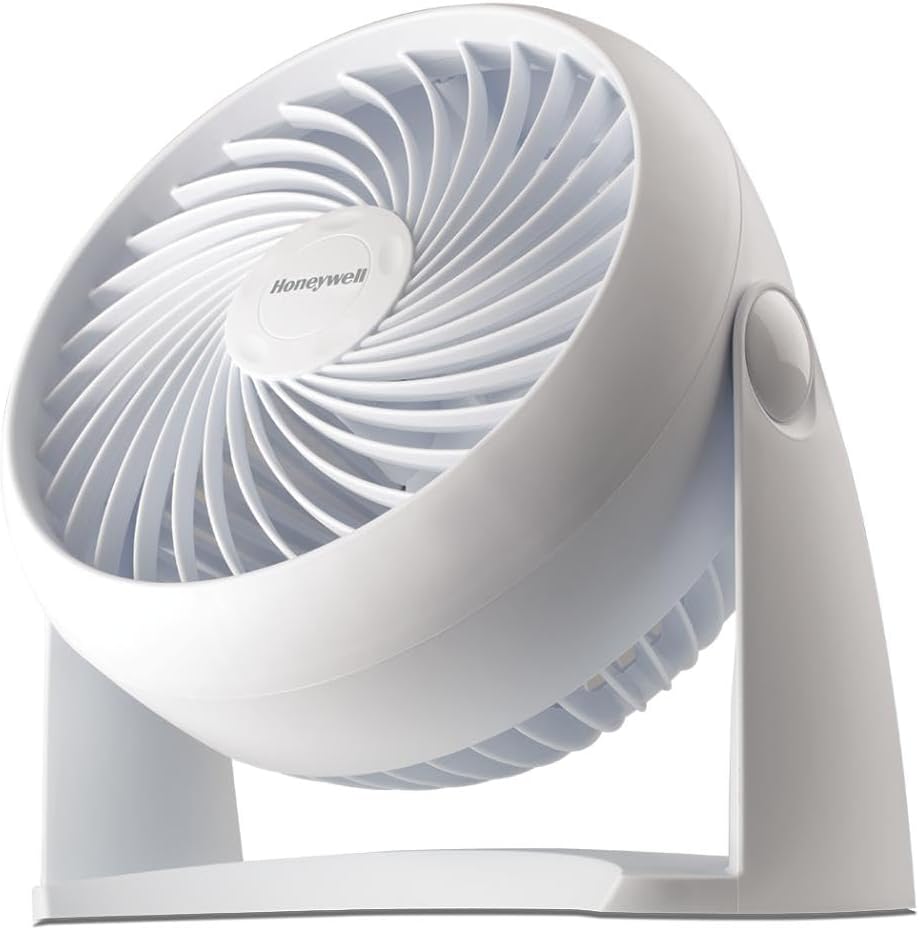
Honeywell TurboForce HT-904
| Power Source | Corded Electric |
|---|---|
| Number of Speeds | 3 |
| Air Flow Capacity | 185 cfm |
| Noise Level | 25 db |
| Motor Type | Brushless |
The Honeywell TurboForce HT-904 is a compact tabletop air circulator designed to move a surprising amount of air for its size while staying relatively quiet. It is typically used on desks, nightstands, or mounted on a wall to improve circulation in small to medium rooms and can help white-noise a nursery. The aerodynamic turbo blade and brushless motor produce up to 185 cfm of airflow and three push-button speeds let you tailor intensity without complicated controls. The 90-degree pivoting head focuses airflow where you need it and the unit is lightweight and portable for repositioning around the room. Practical benefits include energy-saving circulation that can reduce AC runtime and a low noise profile rated around 25 dB for nighttime use. Limitations are its small coverage compared with larger room fans and a simple manual control scheme with no timer or smart features, so you may need to move it or pair it with other airflow strategies in larger nurseries.
Best for: Parents or caregivers seeking an affordable, quiet tabletop fan to provide targeted airflow and gentle background noise in a nursery or small bedroom.
Less Ideal for: Families who need whole-room circulation for large nurseries or want app control, timers, or advanced automation should consider larger or smart fans instead.
- Compact and portable for tabletop or wall mounting
- Aerodynamic turbo design delivers strong airflow for its size (185 cfm)
- Quiet operation around 25 dB suitable for sleeping spaces
- Simple three-speed push-button controls and 90-degree pivot for directional cooling
- No timer, remote, or smart connectivity for automated nursery scheduling
- Coverage is best for small to medium rooms and not ideal as a sole fan in larger spaces
Verdict: A budget-friendly, quiet tabletop fan that delivers focused airflow and gentle background noise ideal for nurseries and small sleeping spaces.
DREO TurboPoly Pedestal Fan DR-HPF008S

| Power Source | dc |
|---|---|
| Number of Speeds | 9 |
| Noise Level | 28.2 db |
| Air Flow Capacity | 1000 cfm |
| Control Method | App, Remote, Touch |
This DREO pedestal fan is built as a smart whole-room air circulator that balances strong airflow with quiet operation. It uses a DC motor and claims up to 1000 CFM and long-distance reach while offering nine speed settings, six modes, and simultaneous horizontal and vertical oscillation to move air across the room. Controls are flexible: app, remote, touch, and voice work with timers and an RGB light, so you can set hands-free or schedule off for nighttime use. The fan is freestanding with adjustable height and tilt and a detachable grille for cleaning. Practical benefits for a nursery include a very quiet low-speed operation, programmable timers, and stable DC motor performance that reduces vibration. Important limitations are that strong Turbo settings push higher airflow and may be louder, the unit is plastic so it is lighter rather than heavy-duty, and advanced smart features require a Wi-Fi setup and app familiarity. The fan suits continuous circulation and scheduled night use, but expect to dial speeds for the balance of airflow versus noise.
Best for: Parents who prioritize dependable, quiet overnight airflow and programmable controls to keep a nursery comfortable without constant manual adjustments.
Less Ideal for: People who need an industrial-grade, heavy metal fan or who want a purely mechanical fan without any smart features or app setup.
- Quiet DC motor for low-noise operation suitable for bedrooms and nurseries
- 9 speed levels and 6 modes including Auto for adaptable, fine-grained airflow control
- 3D oscillation (horizontal and vertical) spreads air across the room for even circulation
- Multiple control options: app, remote, touch and voice plus an 8-hour timer for scheduled use
- Detachable grille and adjustable tilt make cleaning and directing airflow straightforward
- Strong Turbo mode increases noise and may be too intense for very small spaces
- Plastic construction is lightweight but less substantial than metal fans
Verdict: A quiet, feature-rich smart pedestal fan that delivers reliable, adjustable whole-room circulation tailored for overnight nursery comfort.
Levoit Classic 36-inch Tower Fan

| Number of Speeds | 5 |
|---|---|
| Noise Level | 28 db |
| Wattage | 39 watts |
| Air Flow Capacity | 1044 cfm |
| Power Source | Corded Electric |
The Levoit Classic 36-inch tower fan is a bedroom-focused, floor-mounted fan designed to provide quiet, whole-room airflow with a slim footprint. It offers five speeds and four modes—Normal, Turbo, Sleep, and Auto—so you can pick steady output, quick circulation, or a nearly silent night setting; Auto mode uses a built-in temperature sensor to adjust fan speed automatically. The fan oscillates and delivers up to 28 ft/s airflow and 1044 cfm, which helps move air across a nursery or small bedroom, and the included remote and 12-hour timer make night adjustments easy without disturbing a sleeping child. At low speed the unit is marketed at about 28 dB, making it suitable for light sleepers and infant rooms, while the removable back grille simplifies cleaning. Limitations to note are its plastic construction and standard AC motor, which are typical at this price point, and the fan is not a heater or air purifier, so it only circulates air rather than changing air quality or temperature directly.
Best for: Parents or caregivers who prioritize a quiet, easy-to-control fan for a nursery or bedroom and want automatic temperature-based adjustments and remote/timer convenience.
Less Ideal for: People who need air purification, heating, or heavy-duty industrial airflow should choose a dedicated purifier, heater, or high-end blower instead.
- Built-in temperature sensor with Auto mode that adjusts speed based on room temperature
- Very quiet on low speeds (around 28 dB) suitable for bedrooms and nurseries
- Five speeds, Turbo mode, wide oscillation and 1044 cfm airflow for effective whole-room circulation
- Remote control and 12-hour timer let you change settings without entering the room
- Removable back grille for easier cleaning
- Plastic construction and a standard AC motor rather than premium materials or brushless motor
- No air filtration or heating functions—only air circulation
Verdict: A quiet, remote-controlled tower fan with auto temperature adjustment that is well suited for keeping a nursery comfortably circulated without disturbing sleep.
Gaiatop Stroller Fan SF40

| Power Source | Battery Powered |
|---|---|
| Number of Speeds | 3 |
| Wattage | 10 watts |
| Motor Type | brushless |
| Mounting Type | Clip On |
This compact Gaiatop stroller fan is built for close-quarters cooling in strollers, cribs, and bedside nursery use. It runs on a 2000 mAh rechargeable battery or USB power, offers three speeds driven by a brushless motor, and can rotate horizontally and vertically so you can aim airflow without moving the mount. The fan housing has 5.5 mm grill gaps to reduce the risk of little fingers reaching the blades, and a flexible silicone tripod/clip that clamps to bars or attaches to flat surfaces for stable mounting. In use the motor produces noticeably strong airflow for its size while remaining relatively quiet, and the detachable head makes charging or repositioning easier. Limitations are its small coverage area — it is meant for personal or near-field use rather than cooling a whole room — and run time varies by speed from roughly 3.5 to 10 hours, so frequent charging may be needed on high setting.
Best for: Parents and caregivers who prioritize a safe, portable near-field cooling solution for strollers and nursery close-up use and want a quiet, easy-to-mount fan.
Less Ideal for: People seeking a fan to cool an entire nursery or open room should choose a larger upright or tabletop fan instead.
- Safety-minded grill with 5.5 mm gaps to protect small fingers
- Rechargeable 2000 mAh battery with USB pass-through use while charging
- Brushless motor that delivers strong airflow with relatively low noise
- 360° horizontal and 210° vertical rotation for precise aiming
- Flexible silicone tripod/clip that mounts securely to strollers and rails
- Small airflow footprint not suitable for cooling larger rooms
- Battery runtime varies widely by speed and may require frequent recharging on high
Verdict: A compact, safety-focused rechargeable stroller fan that gives quiet, adjustable near-field airflow for babies and caregivers.
Choosing the Right Fan for Nurseries: Key Factors to Consider
Noise Level and Sound Character
Sound is one of the most important factors when choosing a fan for a nursery. Continuous low-frequency noise can be soothing, but high-pitched mechanical whine will disturb a baby and make naps harder to achieve.
Look for fans with published decibel ratings at different speed settings when possible, and consider the tonal character of the sound as much as the volume. Units that advertise sleep or whisper modes typically have quieter motor mounts and tuned blade or airflow designs that produce a smoother sound. Also consider whether the fan's white-noise effect suits your child's sleep pattern: some babies respond well to steady, gentle noise while others may be sensitive to changes in speed or oscillation.
Safety Features and Physical Design
Because the fan will operate in a room with an infant, physical safety features are essential. This includes blade guards with gaps small enough to prevent tiny fingers from reaching moving parts, a stable, low center-of-gravity base or wall-mount option to prevent tipping, and automatic shut-off on impact or tilt.
Also consider materials and finishes that resist small-part breakage, and whether the cord can be routed out of reach. For floor units, a weighted base and low profile reduce the chance of being pulled or knocked over, while wall or high shelf placement can add separation from curious hands.
Airflow Control and Direction
Nurseries vary in size and layout, so flexible airflow is valuable. Adjustable speed settings let you dial in gentle circulation for sleep and stronger airflow for diaper changes or playtime. Oscillation and vertical tilt help distribute air across a crib or seating area without creating a direct, concentrated draft against a sleeping infant.
Consider how the fan's airflow pattern interacts with the room: whether it can create a soft cross-breeze, support HVAC circulation, or be angled safely to avoid constant direct flow on the child. Fans that offer multiple modes for steady or naturalized airflow can be easier to tune to your baby's comfort.
Ease of Cleaning and Allergens
Dust buildup on blades or inside housings can reduce airflow and become an allergen source over time. For nursery use, selecting a fan that disassembles easily for routine cleaning matters for hygiene and performance.
Look for models with tool-free grille removal or accessible filters. Surfaces that wipe clean and fewer crevices help keep maintenance quick. If your household is prone to airborne dust or pet dander, factor in how frequently you will need to deep-clean the unit and choose a model whose cleaning steps fit your routine.
Size, Placement, and Room Compatibility
The fan's physical size and mounting options determine where it will live in the room. A compact floor fan can fit beside a dresser, while a tower or wall-mounted unit might be better for tiny rooms or to keep devices out of reach.
Measure available floor and shelf space before buying. Also consider whether the unit's airflow reach matches the nursery's square footage: a small fan may suffice for a compact room, but a larger nursery benefits from greater circulation or multiple placement options. Think about cable length and the proximity of outlets, and whether you prefer a cordless or battery-backed option for flexibility.
Convenience Features and Controls
Practical controls reduce night-time fumbling. Timers let you run the fan for set periods so it does not need manual shutoff after a feeding or nap. Remote control or app-based operation can be useful when you want to adjust settings without entering the room and disturbing the baby.
Other conveniences to weigh include indicator lights that are dimmable or can be turned off, memory functions that recall the previous speed, and simple button layouts that are easy to use in low light. Balance desired features against the potential for unnecessary complexity.
Placement Strategies for Safer Nursery Airflow
Where you place a fan in a nursery affects both safety and comfort. Floor units should sit at least a couple of feet from the crib and be positioned so airflow circulates around the room rather than blowing directly onto a sleeping infant.
Wall- or shelf-mounted fans can keep moving parts away from curious hands and free up floor space, but ensure they are securely anchored and that cords are routed safely. For smaller rooms, angling a fan toward a doorway or across the room can create gentle cross-ventilation that improves overall air exchange without concentrated drafts.
- Keep fans out of reach of crib rails and changing stations.
- Aim airflow to circulate, not to aim directly at the cot.
- Secure wall mounts with appropriate anchors for the wall type.
Using Fans to Support Safe Sleep Temperature
Maintaining an appropriate sleeping temperature is one of the best uses of a nursery fan. Circulating air helps distribute conditioned air from an HVAC system and reduces hot spots in the room.
Monitor room temperature with a reliable thermometer. Use the fan to support, not replace, appropriate room heating or cooling; a gentle circulation can make the room feel more even without chilling the child when used at low speeds.
- Aim for a steady, low setting during naps and overnight.
- Combine fan use with monitoring to avoid overcooling.
Cleaning Routine and Maintenance Tips
Establish a simple cleaning schedule to keep the fan performing and to limit allergen buildup. A quick wipe of external surfaces weekly and a deeper grille and blade clean monthly are sufficient for most nursery environments.
If the unit has a washable filter or removable grille, follow the manufacturer's guidelines for disassembly, drying, and reassembly. Always unplug the fan before cleaning and allow motors to dry completely before reuse.
- Wipe surfaces weekly with a damp cloth.
- Deep-clean grilles and blades monthly or as dust accumulates.
- Check screws and mounts seasonally to ensure stability.
Balancing White Noise Needs with Airflow
Some caregivers rely on a fan's steady sound to help infants sleep. If this is important, choose a unit whose sound signature is steady and low in pitch rather than choppy or high-frequency.
If the fan's sound is intended as white noise, prefer continuous-running modes and avoid frequent speed changes during sleep periods. For flexibility, look for models that separate sound generation from airflow so you can get white-noise benefits without excessive wind on the child.
- Test sound character before long-term use in the nursery.
- Use timers or programmable modes to maintain consistent noise during nap windows.
Power and Cord Safety in Infant Rooms
Cord management is an often-overlooked safety detail. Keep cords taut, routed behind furniture, and out of reach of the crib. Consider shorter power cords or tucking excess cable behind a dresser when appropriate.
If using extension devices, ensure they are rated for continuous use and do not create tripping hazards. For added safety, opt for fans with internal wiring protections and tip-over shutoff features.
- Use cord clips or covers to keep cables out of reach.
- Avoid placing cords where toddlers can pull them into the crib.
How We Chose the Best Fan for Nurseries
We selected these fans by applying filters and evaluation criteria focused specifically on use in infant bedrooms and daytime nursery spaces. First, we required demonstrably low operating noise across normal speed ranges so units can run during naps and nighttime sleep without causing disturbance. Second, we prioritized safety-oriented designs such as bladeless housings, tightly guarded blades with small gaps, tip-over protection, and stable bases to reduce any risk around a crib or play area. Third, airflow control and distribution mattered: adjustable speeds, oscillation options, and vertical tilt help place airflow where it is useful without blasting directly at a sleeping child. Fourth, maintenance and cleaning were considered; easy-to-remove grilles or tool-free access reduce dust build-up and allergen concerns. Finally, we looked at user-focused convenience features such as timers, remote control, and compact footprints for smaller rooms. Excluded from consideration were industrial or outdoor fans, models with high minimum noise levels, and appliances lacking basic safety features appropriate for a nursery. The selections reflect a balance of measurable specifications and practical design choices that matter for infant comfort and caregiver peace of mind.
Our full evaluation process is outlined in our review methodology.
FAQ
Is it safe to run a fan in a nursery all night?
Running a fan all night is often safe if the unit is quiet, positioned to avoid direct drafts on the infant, and has appropriate safety features. Use low speeds and ensure the room temperature remains in a comfortable range.
What noise level should I look for in a nursery fan?
Aim for the quietest practical decibel rating, particularly on low and medium settings. The tonal quality matters too; low-frequency steady noise is typically less disruptive than high-pitched mechanical sounds.
Should I choose a bladeless or guarded-blade fan for a nursery?
Both can work well. Bladeless designs offer easy access safety and simpler cleaning, while well-guarded blade fans can provide strong airflow. Prioritize secure guards, small grille gaps, and stable bases if choosing a blade model.
How often should I clean the fan in a nursery?
Wipe external surfaces weekly and perform a deeper grille and blade clean monthly, or more often if you notice visible dust. Regular cleaning helps maintain airflow and reduces allergens.
Can a fan help with stuffy rooms or poor ventilation?
Yes. A fan improves air circulation and helps distribute conditioned air, which can reduce stuffiness. For lasting ventilation improvements, combine fan use with periodic fresh-air exchange when weather and safety permit.
Final Verdict
Choosing a fan for a nursery comes down to balancing quiet operation, safety-minded physical design, and the right airflow controls for the room size. Prioritize units that minimize noise at low speeds, offer secure guards or bladeless housings, and allow flexible placement so airflow does not blow directly on a sleeping infant. Consider how easy the unit is to clean and whether convenient controls like timers or remotes fit your routine. When you weigh those tradeoffs, you can select a fan that supports safe sleep temperature, helps manage stuffiness, and provides gentle background sound without adding risk or maintenance burden. Focus on the criteria most important to your household and you will be able to choose confidently.