
Note: This article contains affiliate links. If you click on these links and make a purchase, we may earn a small commission at no extra cost to you. This helps support our research and content. Read our full affiliate disclosure here.
If you plan to make beef jerky at home, the right food dehydrator makes a big difference in safety, texture, and flavor. A dehydrator designed for jerky gives you precise temperature control and steady airflow so meat dries evenly without overcooking the edges or leaving damp spots that could spoil. This guide shortlists the top food dehydrators for beef jerky and explains how each option meets common home‑kitchen needs. We evaluated units for temperature accuracy, airflow patterns, capacity, and ease of cleaning so you can find a dehydrator that fits your batch size and workflow. Read on to see the top picks and what to look for when choosing a model for making jerky at home.
Top Picks at a Glance
| Best Overall The best all-around choice for most situations | Magic Mill Premium Dehydrator MFD-7100 |  |
| Best Quality Built to a higher standard if you want something more solid | Excalibur 8-Tray Dehydrator DH08SCSS13 |  |
| Best Value The sweet spot between price and what you get | Magic Mill Pro Dehydrator MFD-7700 |  |
| Best Budget The cheapest option that still gets the job done reliably | FOHERE Food Dehydrator FD-1024 |  |
| Top Rated A top-rated pick with lots of positive feedback | PSIIDAN Food Dehydrator FD-1033 |  |
| Most Popular A crowd favorite that many people choose with confidence | Cosori Stainless Steel Dehydrator CP267-FD |  |
| Best Seller A high-volume bestseller chosen again and again | Cosori Stainless Steel Dehydrator P501 |  |
Magic Mill Premium Dehydrator MFD-7100

| Wattage | 700 watts |
|---|---|
| Number of Trays | 10 |
| Temperature Range | 95°F to 167°F |
| Voltage | 120 volts |
The Magic Mill MFD-7100 is a roomy, rear-fan dehydrator built for serious home use and small-batch jerky projects. It uses a rear-mounted fan with Precision Airflow to promote even drying across its ten extra-large stainless steel trays so you rarely need to rotate racks, and the transparent door makes it easy to check progress. The digital control lets you set temperatures from 95°F to 167°F and a 48-hour countdown timer, plus a Keep Warm function to hold finished snacks. Its 700W motor provides steady, relatively quiet drying power, and trays are dishwasher safe for easier cleanup. Safety features include automatic shut-off and overheat protection, and the unit is made from food-grade stainless steel and BPA-free parts. Limits to consider are the footprint and weight typical of a 10-tray machine, which take more counter or storage space, and long jerky runs still require monitoring for preferred dryness and food safety practices.
Best for: Home cooks who want a high-capacity, reliable dehydrator for regular jerky and snack batches and value even airflow and simple digital controls.
Less Ideal for: Minimalist users who need a compact, packable unit or those who require advanced humidity/probe monitoring for commercial-scale curing.
- Ten extra-large stainless steel trays provide ample capacity for batch jerky and large fruit loads
- Rear-mounted fan with Precision Airflow promotes even drying without frequent tray rotation
- Digital temperature control from 95°F to 167°F and 48-hour timer for precise dehydration settings
- Dishwasher-safe trays and wipe-clean housing simplify cleanup
- Large footprint and weight may be cumbersome in small kitchens
- No humidity control or built-in probe for exact doneness monitoring
Verdict: Buy this if you want a high-capacity, even-drying kitchen dehydrator tailored for regular beef jerky and large snack batches.
Excalibur 8-Tray Dehydrator DH08SCSS13

| Wattage | 700 watts |
|---|---|
| Voltage | 120 |
| Number of Trays | 8 |
The Excalibur 8-Tray dehydrator is built for serious preservation and makes jerky production straightforward. It delivers 7.2 square feet of drying space across eight chrome trays inside a compact footprint that fits under cabinets, and a clear glass French door lets you monitor batches without opening the unit. The digital LED controls let you set temperatures from 85°F to 165°F and run the unit up to 80 hours with automatic shutoff, which is useful for long low-and-slow jerky cycles. Patented Hyperwave Pulse technology and horizontal parallax airflow aim to dry evenly so you rarely need to rotate trays, saving time during multi-tray jerky runs. At 700 watts the unit brings consistent heat for reliable results, and included mesh and crumb trays simplify small items and cleanup. The main limitations are the stainless steel exterior and chrome trays require basic care to avoid spots and the unit occupies counter space during long runs, but for anyone who regularly makes batches of beef jerky this model is a capable, performance-oriented choice.
Best for: Home cooks who make beef jerky regularly and prioritize even, consistent drying and the ability to run large multi-tray batches with precise temperature control.
Less Ideal for: Casual or occasional users who only dehydrate small amounts or who need a compact, stow-away solution for infrequent use.
- Large drying area with eight chrome trays for multi-batch jerky production
- Precise temperature range (85°F–165°F) and 80-hour digital timer with auto shutoff
- Patented Hyperwave Pulse and horizontal airflow for more even drying without rotating trays
- Clear glass door for monitoring without interrupting the drying cycle
- Requires counter space during long runs which may be inconvenient in small kitchens
- Chrome trays and stainless finish need routine cleaning to prevent spotting
Verdict: Choose the Excalibur 8-Tray if you want a high-capacity, performance-focused dehydrator that delivers consistent, even drying for large jerky batches.
Magic Mill Pro Dehydrator MFD-7700

| Wattage | 600 |
|---|---|
| Voltage | 120 |
| Number of Trays | 7 |
| Material | Stainless Steel |
The Magic Mill Pro is a heavy-duty countertop dehydrator built for serious home jerky makers and batch drying. Its all-stainless-steel interior, exterior, and trays resist warping and avoid plastic contact with food, while the 600W rear fan and rear-mounted heating deliver consistent airflow so trays do not need rotating for even results. Temperature adjusts from 95 to 176 F in 1-degree increments, which makes it simple to dial in low-and-slow drying for fruit and herbs or higher heat for safe, chewy jerky. The 48-hour timer with auto shutoff and a Keep Warm hold mode through 24 hours are useful for long jerky cycles you want to start and leave. Included mesh screens and a fruit-roll tray expand what you can dry and simplify cleanup. It is larger and heavier than small hobby units, so it needs dedicated countertop space, and the more powerful motor can be louder than compact models, but for repeatable, even jerky batches the Pro focuses on durability and control rather than ultra-quiet operation.
Best for: Home cooks who prioritize repeatable, even jerky batches and want a durable, factory-quality dehydrator built for regular use.
Less Ideal for: Casual users who need a compact, quiet unit for occasional small batches or who have very limited countertop space.
- Full stainless-steel construction including trays for durable, food-safe drying
- 600W rear fan and rear heat provide even airflow across all trays without rotation
- Precise digital temperature control from 95 to 176°F in 1° increments
- 48-hour timer with auto shutoff plus 24-hour Keep Warm hold for long jerky cycles
- Comes with two mesh screens and a fruit roll/drip tray for small items and cleanup
- Larger, heavier footprint requires significant counter or storage space
- More powerful motor may run louder than compact dehydrators
Verdict: Choose this stainless-steel, rear-fan dehydrator when you want precise temperature control and reliable, even drying for consistent homemade beef jerky.
FOHERE Food Dehydrator FD-1024

| Wattage | 400 watts |
|---|---|
| Voltage | 120 volts |
| Number of Trays | 5 |
| Temperature Range | 95-158 °F |
The FOHERE FD-1024 is a budget-friendly countertop dehydrator designed for home use and small batch jerky. It uses a 400W heater and forced airflow to deliver even drying across five stackable trays; the trays adjust to two heights so you can fit thicker cuts for jerky or laid-flat fruit slices. Temperature and time are set on a simple LED control with a 0–48 hour timer and a 95–158°F range, which covers typical jerky and fruit dehydration needs. The BPA-free trays and dishwasher-safe parts make cleanup straightforward, and the unit is small enough to store easily when not in use. Expect quiet operation suitable for overnight runs, but because it is a compact, plastic-and-stainless design it is best for batch sizes of a few pounds rather than large-scale jerky production. The digital controls are basic but reliable, and the energy draw is modest for extended cycles. For the price-conscious buyer who wants consistent home-made jerky without complexity, this model covers the essentials well.
Best for: Home cooks on a budget who want a simple, no-frills dehydrator to make jerky and small batches of dried fruit or herbs without needing commercial capacity.
Less Ideal for: People who need to process large volumes of meat or who want an industrial-grade metal dehydrator for frequent heavy use should look at higher-capacity models.
- Five stackable, BPA-free trays for flexible drying layouts
- Wide temperature range (95–158°F) and 0–48 hour timer for precise jerky settings
- Dishwasher-safe trays and removable lid for easy cleaning
- Compact footprint with adjustable tray heights to fit thicker cuts
- Designed for small to medium batches rather than high-volume jerky production
- Plastic construction may feel less durable than all-metal commercial units
Verdict: A low-cost, compact dehydrator that gives budget-minded home users the temperature control and tray flexibility needed to make reliable small-batch beef jerky.
PSIIDAN Food Dehydrator FD-1033

| Wattage | 650 watts |
|---|---|
| Number of Trays | 8 |
| Temperature Range | 167 °F |
The PSIIDAN FD-1033 is a countertop food dehydrator built for batch drying jerky, fruit, and herbs with an emphasis on even airflow and long runs. Its 650W motor and 360° airflow design push consistent heat across eight stainless steel trays, letting you dehydrate full racks of strips or multiple trays of fruit without rotating them. Controls are simple: a one-touch interface, adjustable temperature up to 167°F, and a 48-hour timer with auto shut-off so you can start a long jerky cycle and leave it unattended. Practical extras include a mesh tray for small items, a drip tray for juicy fruit leather, an interior viewing light, and dual-layer insulation that keeps the exterior cooler during extended use. Cleanup is straightforward since the trays are stainless steel and the interior is smooth. The unit is relatively compact for eight trays, but heavy-duty users should know it is designed as a countertop appliance rather than a commercial dehydrator and large multi-day runs will still require checking moisture levels manually for food-safety reasons.
Best for: Buyers who prioritize reliable, even drying for home-made jerky and want a robust countertop unit that can run long cycles unattended with safety features.
Less Ideal for: Users needing a commercial or industrial dehydrator for continuous high-volume production should look at purpose-built commercial equipment instead.
- Powerful 650W motor supports consistent, large-batch drying.
- Eight stainless steel trays provide roomy capacity for jerky and fruit.
- Adjustable temperature to 167°F and 48-hour timer with auto shut-off for long drying cycles.
- Dual-layer insulation keeps the exterior cooler during extended use.
- Includes mesh tray and drip tray for small items and juicy foods plus a recipe guide.
- Not intended for commercial-scale production; best for home or serious hobbyist use.
- Temperature ceiling of 167°F may require longer drying times for thick cuts of jerky.
Verdict: A dependable, high-capacity home dehydrator that delivers even drying and long unattended runs, making it a strong choice for serious jerky makers.
Cosori Stainless Steel Dehydrator CP267-FD

| Wattage | 600 watts |
|---|---|
| Voltage | 120 volts |
| Number of Trays | 6 |
| Temperature Range | 95-165 F °F |
The Cosori CP267-FD is a countertop food dehydrator built around six stainless steel trays and a rear-mounted drying fan that pushes air horizontally for consistent results. It is typically used for making jerky, fruit leather, and dried herbs; the 95 to 165°F temperature range and precise digital controls let you dial in low temperatures for fruit or the higher range needed for thicker jerky. The unit includes a 48-hour timer and runs quietly thanks to a brushless motor marketed at under 48 dB, so it can operate overnight without much disturbance. Practical benefits include generous drying area and mostly stainless-steel contact surfaces that simplify cleanup and keep food away from plastic. The 600 W motor speeds drying compared with lower-power compact models, but the unit is fairly heavy and takes up counter space. If you need single-tray rotating or compact storage, this box-style dehydrator may be bulkier than some alternatives.
Best for: Buyers who prioritize reliable, even dehydration and prefer stainless-steel contact surfaces for food safety and easy cleaning, especially those making large batches of jerky or fruit snacks.
Less Ideal for: If you need a very compact or lightweight unit for occasional single-tray use or prefer automatic tray rotation, choose a smaller or specialized model instead.
- Six stainless steel trays provide large, even drying area for batch jerky or fruit leather
- Digital temperature control from 95–165°F and 1° increments let you set precise drying profiles
- Rear-mounted fan and upgraded airflow promote even drying without tray rotation
- Quiet brushless motor suitable for overnight runs
- Includes mesh screen, fruit roll sheet, and recipe book for immediate use
- Relatively heavy and takes significant counter or storage space
- No tray rotation feature so very unevenly sliced pieces may require manual rearranging
Verdict: A roomy, stainless-steel dehydrator with precise temperature control and strong airflow that makes it a dependable choice for producing consistent batches of beef jerky.
Cosori Stainless Steel Dehydrator P501
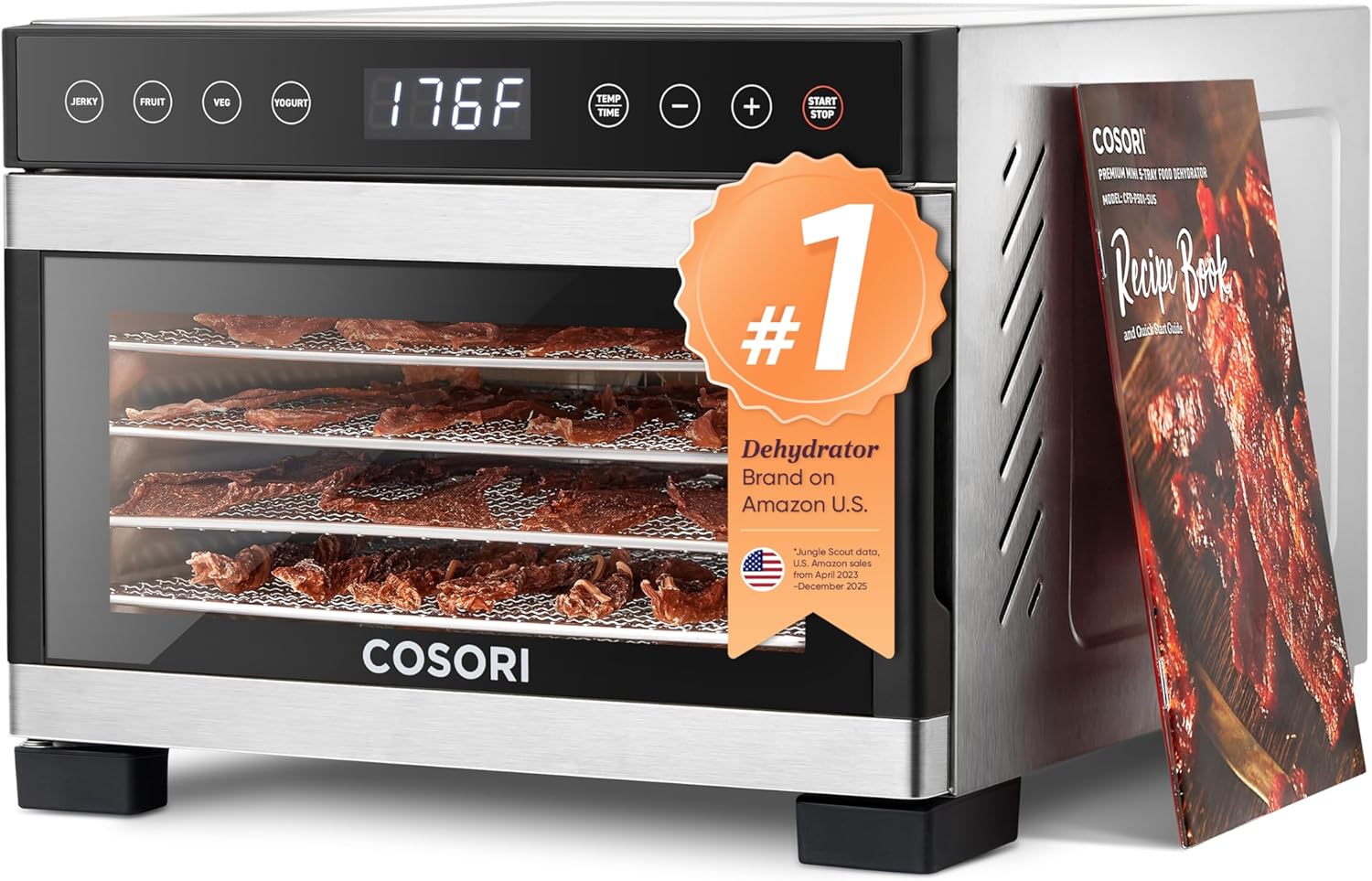
| Number of Trays | 5 |
|---|---|
| Wattage | 480 watts |
| Temperature Range | 95-176 F |
| Voltage | 110 volts |
The Cosori P501 is a compact stainless steel dehydrator built for home jerky, fruit leather, vegetable chips and yogurt. It uses a rear-mounted fan with horizontal airflow and a 95 to 176°F temperature range adjustable in 1°F increments, which helps produce even drying across the five included stainless steel trays. Four presets (jerky, fruit, vegetables, yogurt) and a 48-hour timer simplify common recipes while the included mesh screen and fruit roll sheet expand what you can dehydrate. At 480 watts it brings predictable heat for longer runs like jerky without needing frequent monitoring. The stainless construction avoids plastic contact with food and the trays are easy to load and clean compared with stack-style plastic racks. Trade-offs are its countertop footprint and the need to plan for longer cycles for thicker cuts; it does not have smart connectivity or a built-in probe for internal meat temperature, so users should follow USDA guidelines for safe jerky finishing.
Best for: Buyers who want a reliable, low-risk dehydrator for making jerky and other snacks with predictable, even results and an easy-to-clean stainless interior.
Less Ideal for: People who need remote monitoring, app controls, or an integrated probe for internal meat temperature, or those who need the smallest possible footprint for limited counter space.
- Precise temperature control 95–176°F in 1°F increments for safe jerky processing
- Rear fan with horizontal airflow for more even drying across trays
- All stainless steel interior and trays so food does not contact plastic
- Includes five trays plus mesh screen and fruit roll sheet for versatile dehydrating
- User presets and a 48-hour timer make repeated jerky batches straightforward
- No built-in meat probe or Wi‑Fi connectivity for remote monitoring
- Larger countertop footprint compared with the smallest stack-style dehydrators
Verdict: Choose the Cosori P501 if you want a dependable, stainless-steel countertop dehydrator that delivers precise temps and even airflow for consistent homemade beef jerky.
Choosing the Right Food Dehydrator for Beef Jerky: Key Factors to Consider
Temperature Control and Stability
Accurate and stable temperature control is essential when drying beef jerky because meat must be dehydrated within a specific heat range to reduce water activity without overcooking. Look for units with a wide, adjustable temperature range and a reliable thermostat that holds the set point for many hours.
Inconsistent temperatures can leave pockets of higher moisture where bacteria survive or produce jerky that is overly tough. A dehydrator with incremental temperature settings and good insulation will produce more consistent results across tray levels and long drying cycles.
Airflow Design
Airflow pattern influences how evenly slices dry across all trays. Models with true horizontal airflow move air across each tray uniformly, while some vertical or top/bottom designs can create hot or cold zones. Consider how the dehydrator circulates air and whether the trays promote unobstructed flow.
Good airflow reduces drying time and minimizes the need to rotate or rearrange trays midcycle. For jerky, even circulation matters more than raw heat because it ensures consistent moisture removal from each slice.
Capacity and Tray Configuration
Capacity matters depending on how much jerky you plan to make in one run. Larger families or frequent makers benefit from more trays and deeper surface area so you can lay strips without overcrowding. Pay attention to tray spacing, whether trays are perforated for airflow, and if they can be removed or adjusted to accommodate thicker cuts.
A flexible tray layout lets you alternate thin and thick strips without compromising airflow. Portable or countertop constraints may limit size, so balance batch needs with available storage and counter space.
Ease of Cleaning and Maintenance
Meat juices and marinades increase the need for frequent, thorough cleaning. Trays and drip pans that are dishwasher-safe or easy to hand wash speed up maintenance and reduce odor carryover between batches. Smooth interior surfaces and removable components make sanitizing more practical.
Regular maintenance also preserves performance. Units that are simple to disassemble for cleaning help prevent residue buildup that can impair airflow or harbor bacteria.
Controls, Timers, and Programmability
Simple, accurate controls reduce guesswork in multi-hour drying cycles. A reliable timer and temperature hold function let you set up a run and step away, while digital readouts and incremental settings improve repeatability from batch to batch. Preset programs can be useful if they match jerky temperatures, but manual control is often preferable for experienced users.
Consider whether the interface provides audible alerts, memory for favorite settings, or a countdown so you can manage drying without constant monitoring.
Construction Quality and Heat Resistance
A dehydrator used for extended meat drying runs should be built to withstand repeated heating without warping or degrading seals. Look for sturdy materials, stable feet, and a design that resists vibration during long cycles. Units that maintain structural integrity are less likely to develop hotspots or lose temperature calibration.
Durable construction also affects longevity and resale value. A well-built machine will retain consistent performance for many batches, reducing the chance of midcycle failures.
Why Temperature Range Matters for Jerky
Beef jerky requires drying at temperatures that remove moisture while keeping the meat safe. A dehydrator that cannot hit or hold the recommended range will extend drying time or risk uneven results. Lower temperatures slow moisture removal and can leave the interior too damp, while excessively high settings can make the outside hard and brittle.
When choosing a unit, check the minimum and maximum temperature settings and whether the control system maintains that temperature over long runs. If you plan to experiment with different recipes, choose a model with fine control rather than broad on/off settings.
- Fine-grain temperature adjustments help dial in texture.
- Stable temperature avoids repeated tray shuffling.
- Programmable timers pair well with reliable heating control.
Tray Types and Preparation Tips
Trays come in solid, perforated, or mesh styles. Perforated trays offer better airflow and faster drying, while solid trays might be easier to clean from sticky marinades. Mesh inserts can support thin strips and improve circulation but may require more careful cleaning.
To maximize efficiency, arrange strips with small gaps between pieces and avoid overlapping. If a dehydrator has widely spaced trays, you can use more layers without sacrificing air movement, but always follow food‑safety guidelines for slicing and preheating if required by the recipe.
- Use perforated or mesh trays for best airflow.
- Avoid overcrowding to ensure uniform drying.
- Pat strips dry before loading to reduce initial moisture load.
Food Safety Practices When Making Jerky
Because jerky is a dried meat product, safe handling is essential. Start with lean cuts trimmed of excess fat, and use a clean workspace and utensils. Many recipes recommend briefly heating meat after slicing or before dehydrating to reduce surface bacteria; check food‑safety guidance related to your chosen method.
Sanitize trays and surfaces after each use and dry the dehydrator interior before storage to discourage bacterial growth and odors. Proper storage of finished jerky in airtight containers or vacuum bags will extend shelf life.
- Trim fat to reduce rancidity during storage.
- Consider a brief preheat step per safety guidance.
- Cool and store jerky fully dry in airtight packaging.
Energy Use and Drying Time Expectations
Drying jerky is a long process that can take several hours depending on temperature, slice thickness, and airflow. Higher temperatures shorten drying time but can affect texture. Expect multi-hour runs and account for the appliance running for extended periods when considering energy use.
Models with efficient airflow and good insulation typically finish faster and waste less electricity. If you plan frequent batches, factor in operational cost and how long you are comfortable running the appliance.
- Thin slices dry faster than thick cuts.
- Good airflow reduces total runtime.
- Insulated designs waste less energy over long cycles.
Maintenance Tips to Keep Performance Consistent
Regular cleaning of trays and the interior prevents residue buildup that can obstruct airflow and affect drying uniformity. Inspect seals and vents periodically to ensure unobstructed circulation. Replace worn trays or mesh inserts when they start to warp or collect stains that cannot be removed.
Store the dehydrator in a dry place with trays stacked loosely or supported to avoid bending. Periodic calibration checks with an external thermometer can confirm the unit is still holding temperature accurately.
- Clean trays after each use to avoid odor transfer.
- Check vents and fans for dust or grease buildup.
- Use an external thermometer to verify temperature settings.
How We Chose the Best Food Dehydrator for Beef Jerky
We prioritized features that directly affect how safely and consistently beef jerky dries. Temperature accuracy and stability were primary filters because meat must reach and hold safe drying ranges to remove moisture without cooking the exterior. Airflow design was the next critical criterion since consistent circulation prevents cold spots and uneven drying that cause chewy or underdried slices. Capacity and tray layout were evaluated to match different batch sizes and cutting methods, including how trays stack and whether trays are removable for flexible loading. We also assessed ease of cleaning and maintenance because dehydrators used for meat require regular sanitizing. User controls and programmability mattered for repeatable results and convenience. Finally, build quality and warranty coverage were considered to favor units that hold calibration and resist warping from prolonged heat. We excluded units lacking adjustable temperature ranges suitable for jerky or those without reliable airflow solutions. The selected finalists met all the above filters and represent practical choices for home jerky makers.
Our full evaluation process is outlined in our review methodology.
FAQ
What temperature should I set for beef jerky?
Most jerky recipes call for temperatures in a range that removes moisture safely without cooking the meat. Exact settings vary by recipe and slice thickness. Use a dehydrator with an adjustable thermostat and consult food‑safety guidance for target temperature ranges and any recommended preheat steps.
How long does beef jerky take to dry?
Drying time depends on temperature, slice thickness, marinade, and airflow. Thin strips at a moderate temperature might finish in several hours, while thicker cuts can take much longer. Expect multi‑hour runs and plan batch timing accordingly.
Can I use mesh trays for jerky?
Yes. Mesh trays improve airflow around thin strips and often speed drying. They can require more careful cleaning and may need replacement sooner than solid trays, but they are a practical option for getting even circulation around each piece.
How should I store finished jerky?
Once fully dried and cooled, store jerky in airtight containers or vacuum bags. For longer storage, keep packages in a cool, dry place and consider refrigeration or freezing to extend shelf life, especially if you made large batches without preservatives.
Do I need to flip trays during drying?
With good airflow and a well‑designed dehydrator, flipping trays is often unnecessary. However, if you notice uneven drying between top and bottom trays, rotating or switching tray positions midcycle can help achieve more uniform results.
Final Verdict
Choosing a food dehydrator for beef jerky comes down to controlling temperature and ensuring consistent airflow. Prioritize units with precise thermostats, a circulation pattern that eliminates cold spots, and a capacity that matches the batch sizes you expect to make. Ease of cleaning and durable construction round out the practical considerations. Balance tradeoffs between faster drying and desired texture, and use reliable controls to reproduce results. With the right combination of temperature stability, airflow design, and tray flexibility, you can produce safe, evenly dried jerky at home with predictable outcomes.