
Note: This article contains affiliate links. If you click on these links and make a purchase, we may earn a small commission at no extra cost to you. This helps support our research and content. Read our full affiliate disclosure here.
If you want reliable, shelf-stable egg snacks or lightweight protein additions for hiking and meal prep, choosing the right food dehydrator matters. Eggs require steady low heat, consistent airflow, and trays that handle delicate, often flat or spread mixtures. The wrong unit can yield unevenly dried eggs, longer drying times, or difficult cleanup. This guide covers seven carefully shortlisted food dehydrators for eggs, chosen for consistent temperature control, airflow design, and easy maintenance. We explain the features that affect safety, texture, and convenience so you can pick the best model for your kitchen and intended uses.
Top Picks at a Glance
| Best Overall The best all-around choice for most situations | Magic Mill Pro Dehydrator MFD-7700 |  |
| Best Quality Built to a higher standard if you want something more solid | Excalibur 8-Tray Dehydrator DH08SCSS13 |  |
| Best Value The sweet spot between price and what you get | Magic Mill Food Dehydrator MFD-5000 |  |
| Best Budget The cheapest option that still gets the job done reliably | Konfintos Food Dehydrator GGJ-300A |  |
| Top Rated A top-rated pick with lots of positive feedback | Cosori Food Dehydrator CP267-FD |  |
| Most Popular A crowd favorite that many people choose with confidence | Hamilton Beach Digital Food Dehydrator |  |
| Best Seller A high-volume bestseller chosen again and again | Cosori Stainless Steel Dehydrator P501 |  |
Magic Mill Pro Dehydrator MFD-7700

| Wattage | 600 |
|---|---|
| Voltage | 120 |
| Number of Trays | 7 |
| Material | Stainless Steel |
The Magic Mill Pro is a full‑stainless steel countertop dehydrator built for multi‑batch drying and repeatable results. It uses a 600W rear fan and rear heating to push even airflow across seven full‑size stainless trays so you do not need to rotate trays for consistent drying. The digital control panel adjusts temperature in 1° increments between 95 and 176°F, which covers delicate herbs and fruit plus the higher temps needed for jerky; a 48‑hour timer with auto shutoff and a keep‑warm hold mode up to 24 hours lets you run long recipes and walk away. The unit includes two mesh screens and a fruit roll/drip tray for small items and leather, and ETL listing plus overheat protection add safety. Expect a sturdy, durable machine that handles large batches without plastic contact, though the stainless construction and seven trays mean it is relatively heavy and takes significant counter space. It is designed for steady, hands‑off dehydration rather than ultracompact or travel use.
Best for: Buyers who want a heavy‑duty, reliable dehydrator for regular multi‑batch drying and value precise temperature control and durable stainless construction.
Less Ideal for: If you need a lightweight, compact, or travel‑friendly dehydrator or only dry very small occasional batches, this larger stainless unit is more than necessary.
- All‑stainless interior and trays avoid plastic contact and improve durability
- Rear fan and rear heat deliver even drying across all seven trays without rotation
- Precise digital temperature control in 1° increments from 95–176°F for repeatable results
- 48‑hour timer with auto shutoff plus 24‑hour keep‑warm hold for long recipes and convenience
- Includes mesh screens and a fruit‑roll/drip tray for herbs, small items, and leather
- Larger, heavier stainless build requires more counter or storage space
- No compact or travel form factor for users needing portability
Verdict: Choose this Magic Mill Pro when you want a durable, 7‑tray stainless dehydrator that delivers precise, even drying for frequent multi‑batch use.
Excalibur 8-Tray Dehydrator DH08SCSS13

| Wattage | 700 watts |
|---|---|
| Voltage | 120 |
| Number of Trays | 8 |
| Temperature Range | 85°F to 165°F |
| Timer | Up to 80 hours |
The Excalibur 8-Tray Compact is a countertop dehydrator built for consistent, high-capacity drying sessions. It provides 7.2 square feet of drying space across eight chrome trays and uses Excalibur's Hyperwave Pulse technology with horizontal parallax airflow to deliver even drying without rotating trays. The digital LED controls let you set temperatures from 85°F to 165°F and an 80-hour timer with automatic shutoff, which is helpful for long low-and-slow runs like eggs and delicate proteins. The stainless steel body and clear glass French door make it easy to monitor progress and keep a tidy work surface. Included mesh and crumb trays simplify cleanup and handling small items. The unit is compact enough to fit under cabinets but still runs on 700 watts, so expect a noticeable power draw during long cycles; it is not silent but typical for high-performance dehydrators. If you need precise, repeatable drying for experimental recipes or batch preservation, this model delivers reliable, uniform results with minimal tray management.
Best for: Buyers who prioritize consistent, repeatable drying performance and need enough capacity to run multiple batches of delicate foods like eggs or jerky without rotating trays.
Less Ideal for: Users who only dry single small snacks occasionally or need a very quiet, ultra-compact travel-friendly unit should consider smaller models instead.
- Large 7.2 sq ft drying area across eight trays for batch dehydrating
- Patented Hyperwave Pulse and horizontal airflow for even drying without rotating trays
- Wide temperature range (85°F–165°F) and 80-hour digital timer with auto shutoff for precise control
- Clear glass door and included mesh tray and crumb tray simplify monitoring and cleanup
- Consumes 700 watts so long runs can draw noticeable power
- Relatively tall footprint compared with very compact single-tray units
Verdict: Choose this Excalibur when you want a high-capacity, performance-focused dehydrator that delivers even, precise drying for eggs and other delicate foods.
Magic Mill Food Dehydrator MFD-5000

| Wattage | 240 watts |
|---|---|
| Voltage | 110 volts |
| Number of Trays | 5 |
| Temperature Range | 95–167 °F |
The Magic Mill MFD-5000 is a countertop food dehydrator built for everyday drying tasks like fruit snacks, herbs, jerky, and small batches of specialty items such as powdered egg products. It uses a 240 W heating system and a digital control panel to set temperature (95–167°F) and a timer up to 48 hours, so you can run long low-and-slow cycles needed for even moisture reduction. Five food-grade stainless steel trays stack inside the BPA-free plastic body and can be adjusted for taller pieces, making it easy to dry mixed loads. Trays are detachable and dishwasher-safe for straightforward cleanup. Because it is compact and lightweight, it fits small kitchens and is simple to store, but its capacity is limited compared with tower-style or commercial dehydrators, so expect to run multiple batches for larger quantities. The unit is practical and user-friendly, offering solid temperature control and safe materials for home drying projects.
Best for: Buyers who want a practical, easy-to-use dehydrator for home projects and occasional specialty drying like making egg powder or small jerky batches, and who value predictable temperature control and easy cleanup.
Less Ideal for: Not a great choice for users who need high-volume or commercial-scale drying or who prioritize the largest possible single-batch capacity.
- Five stainless steel, food-safe trays for multi-item batches
- Digital timer and adjustable temperature up to 167°F for low-and-slow drying
- Detachable trays that are dishwasher-safe for easy cleaning
- Compact, lightweight design that stores easily in small kitchens
- Smaller internal capacity requires multiple batches for large quantities
- Maximum temperature listed as 158 °F in some specs which may limit very high-heat applications
Verdict: A compact, user-friendly dehydrator that delivers reliable temperature control and easy cleanup for practical home drying tasks including small-batch egg dehydration.
Konfintos Food Dehydrator GGJ-300A

| Wattage | 250 watts |
|---|---|
| Number of Trays | 5 |
| Temperature Range | 95 to 158 °F |
| Voltage | 120 volts |
The Konfintos GGJ-300A is a small, energy-efficient dehydrator built for countertop use and simple daily batches. It uses a 250W heating system and electronic air circulation to maintain even drying across five stackable, height-adjustable transparent trays, and the temperature dial covers 95 to 158°F for a range of foods. It can run continuously for up to 72 hours, which is handy for longer jerky or egg-drying cycles, and the trays are dishwasher-safe below 158°F for easier cleanup. The unit is lightweight and designed for small spaces like apartments, dorms, or RVs, and its BPA-free trays mean safe contact with food. Limitations include its compact capacity — five small trays are suited to modest batches rather than bulk production — and it does not list precise timer programming beyond continuous operation and manual temperature control, so you will need to monitor some recipes closely. Noise is described as low but not silent, and the ABS housing is basic rather than premium.
Best for: Buyers on a tight budget who need a compact, no-frills dehydrator for occasional small-batch snacks, experimentation, or travel-friendly use.
Less Ideal for: If you want to dry large quantities regularly, run commercial-scale batches, or need precise digital timers and larger capacity, look for a bigger or more feature-rich model.
- Energy-efficient 250W heater suitable for small-batch drying
- Five stackable, height-adjustable BPA-free trays for flexible layouts
- Temperature range 95–158°F covers fruit, herbs, and meat/egg dehydration
- Can run up to 72 hours for long drying cycles
- Dishwasher-safe trays for easier cleanup
- Small footprint limits batch size for larger projects
- No advanced digital timer or programming — relies on manual control
Verdict: A budget-friendly, compact dehydrator that delivers reliable small-batch drying with simple controls and low energy use.
Cosori Food Dehydrator CP267-FD

| Wattage | 600 watts |
|---|---|
| Voltage | 120 volts |
| Number of Trays | 6 |
| Temperature Range | 95-165 F |
| Operating Frequency | 60 hertz |
The Cosori CP267-FD is a stainless steel, six-tray dehydrator built for steady, unattended drying. It uses a rear-mounted fan and 600W motor to push horizontal airflow across all trays, which helps produce even drying without rotating trays or manual flipping. The digital touch controls let you set temperatures precisely between 95 and 165°F and run up to 48 hours, so it handles low-and-slow jobs like drying eggs for long periods as well as fruit, herbs, and jerky. The unit is relatively quiet thanks to a brushless motor and the trays and included mesh and fruit-roll sheets are dishwasher-safe for straightforward cleanup. At the same time the machine is fairly large and heavy, so it takes counter space and will sit best in a dedicated spot. If you plan to dry very small, delicate items like powdered egg or very thin slices, you may need to experiment with tray layout and timing to avoid over-drying.
Best for: Buyers who prioritize a reliable, durable dehydrator for regular batch drying and want precise temperature and long-timer control for consistent results.
Less Ideal for: People who need a compact, lightweight travel unit or those who expect a rotating-tray design for completely hands-off handling of very small pieces.
- Six stainless steel trays provide a large 6.5 ft² drying area for batch processing
- Digital controls with 95–165°F range and 48-hour timer allow precise low-temperature drying
- Rear-mounted fan and horizontal airflow promotes more even drying across trays
- Brushless 600W motor runs quietly under 48 dB for overnight use
- Included mesh screen and fruit roll sheet plus dishwasher-safe trays simplify cleanup
- Relatively heavy and sizable countertop footprint limits portability and storage
- No tray rotation means very small or unevenly cut items may require manual rearranging
Verdict: Choose this stainless steel, six-tray dehydrator when you want dependable, quiet, long-duration drying with precise temperature control for consistent batches.
Hamilton Beach Digital Food Dehydrator

| Number of Trays | 5 |
|---|---|
| Wattage | 500 watts |
| Temperature Range | 100-160 °F |
| Timer | 1–48 hours, auto shutoff |
The Hamilton Beach Digital Food Dehydrator is a compact 5‑tray machine intended for drying fruit, jerky, herbs and other small items; it offers up to 4.2 sq. ft. of drying space. You set the temperature between 100 and 160°F and use the digital timer for runs from 1 to 48 hours, after which the unit automatically shuts off. A 500W base-mounted heater and quiet fan provide steady airflow so trays do not need rotating, and the clear vented lid lets you monitor progress without disturbing the environment. Included accessories like a mesh screen and a solid fruit‑leather sheet expand what you can dehydrate, and the BPA‑free trays are dishwasher‑safe for easy cleanup. The unit is plastic‑bodied and reasonably compact for countertop storage, and nonslip feet protect surfaces. Limitations: it is not a high‑capacity commercial unit, runs on 110V, and care is needed with very thin or small items to avoid over‑drying at higher temperatures. For delicate items like eggs (when attempting egg-based snacks), you will need to watch timing closely and may want to use the lower temperature settings and mesh for support.
Best for: Buyers who want a reliable, mid‑size countertop dehydrator for home experimentation and regular snack making, who value ease of use, presettable timer control, and the reassurance of a well‑known brand with many customer reviews.
Less Ideal for: Commercial users or anyone needing very large continuous batches or a metal‑bodied industrial machine should consider higher‑capacity commercial dehydrators instead.
- Five stackable BPA‑free trays provide up to 4.2 sq. ft. of drying area for multi‑batch drying.
- Adjustable 100–160°F temperature and 1–48 hour digital timer with auto shutoff for precise control.
- 500W base‑mounted heater and quiet fan promote even drying without rotating trays.
- Clear vented lid and included mesh and fruit‑leather sheets increase versatility and monitoring.
- Trays and lid are dishwasher‑safe for straightforward cleanup (mesh screen hand wash).
- Plastic construction and consumer-grade power limit continuous heavy use compared with commercial units.
- No specialized egg drying setting so fragile egg preparations require careful temperature and time management.
Verdict: A practical, user‑friendly 5‑tray dehydrator that delivers even, controllable drying for home cooks looking to make snacks, including careful small‑batch egg preparations.
Cosori Stainless Steel Dehydrator P501
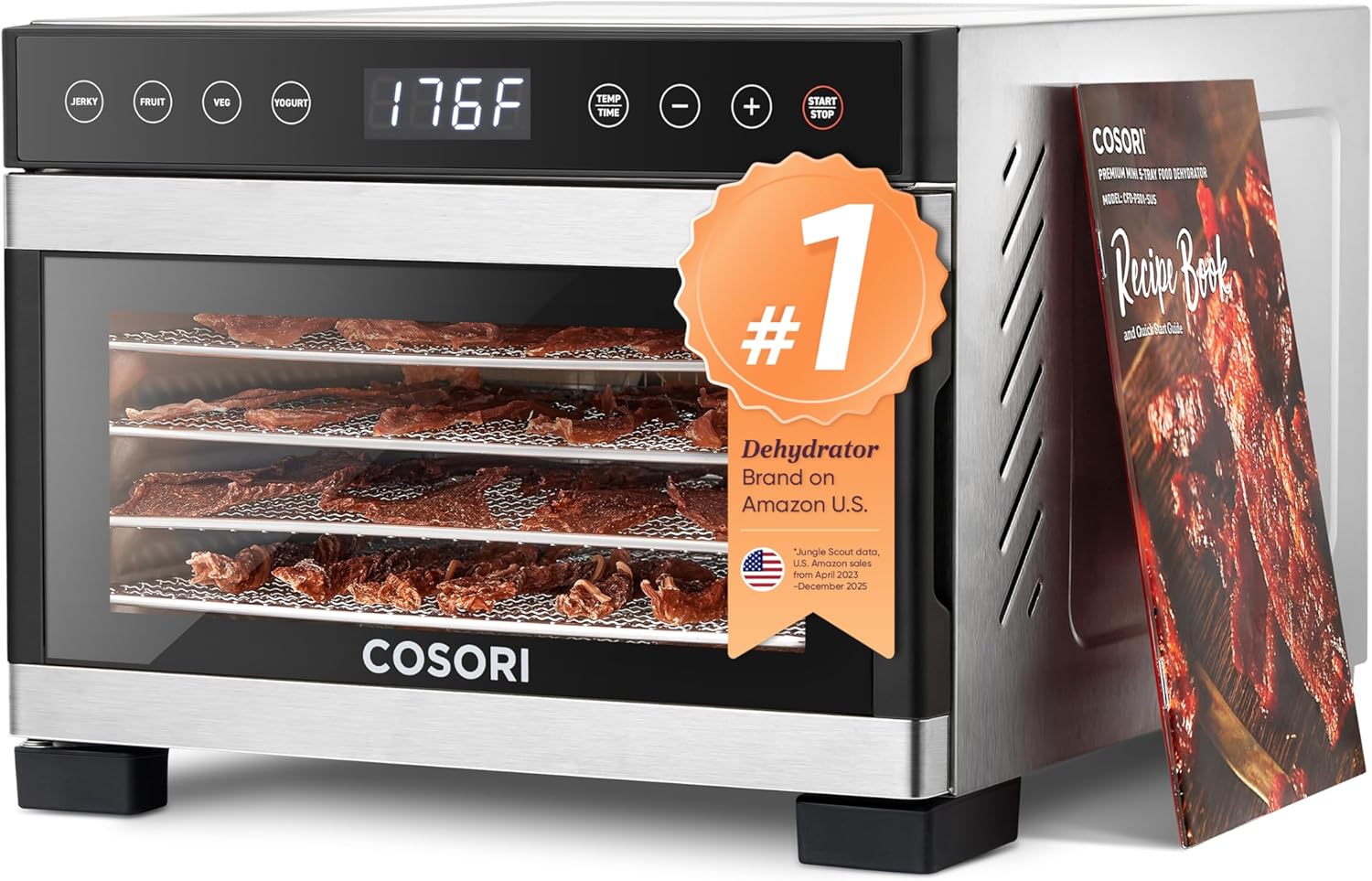
| Wattage | 480 watts |
|---|---|
| Voltage | 110 volts |
| Number of Trays | 5 |
| Temperature Range | 95-176 F |
| Operating Frequency | 60 hertz |
The Cosori P501 is a compact, stainless steel food dehydrator built for straightforward home use. It offers five stainless steel trays that provide about 3.1 ft² of drying space and a rear-mounted fan with horizontal airflow to promote even drying across trays. Temperature is adjustable from 95 to 176°F in 1°F increments, and four presets (jerky, fruit, vegetables, yogurt) plus a 48-hour timer make it easy to run unattended batches. The all-stainless interior design keeps food off plastic surfaces, and included accessories like a mesh screen and fruit roll sheet expand what you can dry. Practical benefits include easy cleanup of metal trays, predictable results for jerky thanks to high maximum temperature, and a compact footprint that fits most counters. Limitations are typical for countertop dehydrators: it is not designed for very large volume commercial use and produces continuous fan noise while running, so it is best placed where background noise is acceptable. For cautious buyers focused on food safety and reliable results, the P501 is a sensible home option.
Best for: Home cooks who prioritize food safety and reliable, consistent drying results and want an easy-to-use countertop dehydrator for jerky, fruit, vegetables, or yogurt.
Less Ideal for: Buyers who need large-scale or commercial throughput, ultra-quiet operation, or a unit designed for industrial continuous use should look elsewhere.
- Stainless steel construction with no plastic contact for food safety.
- Precise temperature control up to 176°F in 1°F increments for safe jerky preparation.
- Rear fan with horizontal airflow for more even dehydration across trays.
- Includes five trays plus mesh screen and fruit roll sheet so you can start drying right away.
- Produces continuous operating noise from the fan during cycles.
- Not intended for high-volume or commercial-scale dehydration.
Verdict: A compact, all-stainless countertop dehydrator that delivers safe, even home drying with precise temperature control ideal for risk-averse home users.
Choosing the Right Food Dehydrator for Eggs: Key Factors to Consider
Temperature Control And Accuracy
Eggs dry best at low, steady temperatures to avoid overcooking the proteins while removing moisture. Precise thermostat control and minimal fluctuation matter because even small temperature swings can change texture and increase drying time. Look for units with adjustable settings that reliably hold low ranges and, if possible, a digital display or independent thermometer verification.
When temperature is accurate, you get predictable drying cycles and lower risk of unsafe moisture pockets. This factor directly impacts food safety and the texture of the finished product, from brittle egg chips to pliable rehydration pieces.
Airflow Design And Consistency
Uniform airflow across trays is essential to prevent hotspots or damp pockets. Convection-style or rear-fan designs that distribute air evenly across each layer produce consistent results, especially important for thin, spreadable egg mixtures that dry faster than chunky items.
Consider whether airflow is adjustable or directed. Some models use horizontal airflow that favors the center trays, while others are engineered to move air uniformly from back to front. Consistent airflow shortens overall drying time and reduces the need to rotate trays mid-cycle.
Tray Type And Surface
Tray material and shape affect how you prepare eggs for drying. Smooth, nonstick trays or those compatible with silicone liners make it easier to dry liquid egg spreads or mashed mixtures without sticking. Removable or stackable trays that are dishwasher-safe save time and reduce sanitation concerns.
Also consider tray spacing and whether trays accept custom inserts for small pieces. A versatile tray system lets you dry whole peeled quail eggs, thinner omelet-like spreads, or chopped egg pieces without waste or cross-contamination.
Cleaning And Sanitation
Egg mixtures can adhere strongly and require thorough cleaning to avoid off-flavors or bacterial growth. Units with removable, dishwasher-safe trays and accessible interiors reduce the burden of post-batch cleanup. Smooth interior surfaces and minimal crevices help prevent residue buildup.
Materials that tolerate frequent washing and high-heat sanitation maintain food safety over time. Prioritize designs that make it simple to disassemble and sanitize the parts that contact egg products.
Capacity And Batch Flexibility
Think about how much finished product you want per run. Larger dehydrators let you process more eggs at once but take up more counter or storage space. Smaller units are fine for occasional snack batches or trial recipes.
Also evaluate whether the unit performs well when partly loaded. Some machines rely on full stacking for even airflow, while better designs maintain consistent results with varying tray counts.
Safety Features And Materials
Since eggs are perishable and require thorough moisture removal, safety features matter. Stable temperature controls, auto-shutoff in case of overheating, and food-safe tray materials reduce contamination risk. BPA-free plastics and stainless-steel interiors are preferable for surfaces that touch egg products.
Durability of materials also affects long-term hygiene. Avoid units with porous plastics or hard-to-reach seams that trap residue and complicate sanitation.
Preparing Eggs For Dehydration
Proper preparation keeps drying predictable and reduces food-safety risks. For whole eggs you want to ensure even heat penetration by using small, uniform pieces or thin slices. For egg spreads, whisk thoroughly to a smooth consistency and spread thinly and evenly across a tray lined with nonstick material.
Use low, steady temperatures and consider pre-cooking scrambled or omelet-style mixes until barely set to reduce drying time and improve texture. Patience and thin layering are more important than higher temperature when working with eggs.
- Use silicone liners or parchment to prevent sticking with raw egg mixtures.
- Spread batter no more than a few millimeters thick to promote even drying.
- Pre-cook to a soft set for some recipes to reduce cycle length and improve uniformity.
Testing Moisture Levels And Storage
Drying to the right endpoint matters more than clock time. Finished egg pieces should be brittle or leathery depending on your intended use. For shelf-stable snacks, aim for thoroughly dry, snap-able pieces with no soft spots. For rehydratable pieces, retain some pliability but ensure no tackiness remains.
After drying, use a short conditioning period in a loosely covered container to equalize residual moisture between pieces. Then store fully dry eggs in airtight jars or vacuum-sealed bags with desiccant packs if long-term storage is intended.
- Break test larger pieces to confirm there are no damp centers.
- Label storage with a dehydration date and intended use.
- Rehydrate a small sample to check texture if you plan to use pieces in cooking.
Common Egg Dehydration Issues And Fixes
Uneven drying is the most frequent problem and usually points to airflow or tray loading issues. Rotate trays mid-cycle if your dehydrator has uneven zones, or switch to a unit with more uniform airflow. Reducing layer thickness often helps more than raising temperature.
Stickiness can result from insufficient pre-cooking or improper liners. Use silicone mats or nonstick trays and ensure pieces are spread thinly. If odor or off-flavors develop, thoroughly deep-clean trays and consider swapping liners after a few batches.
- If edges dry faster than centers, spread thinner and check airflow.
- For sticky residues, soak trays promptly after the run to prevent baked-on protein.
- Use a thermometer to verify the machine's low-end temperature matches its setting.
Using Dehydrated Eggs In Recipes
Dehydrated eggs are versatile: rehydrate for scrambled eggs, use powdered reconstituted egg in baking, or snack on crisp egg chips. Adjust rehydration ratios by experiment; thinner spreads generally rehydrate more quickly than powder forms.
Consider seasoning before or after drying depending on the recipe. Some seasonings concentrate during drying, so start with lighter seasoning and adjust after reconstitution.
- For scrambling, rehydrate with warm water using a 1:1 to 1.5:1 water-to-egg ratio by weight as a starting point.
- Crumble crisp dried pieces into soups or trail mixes for protein boosts.
- Store rehydrated leftovers in the refrigerator and use within a day when not fully dried.
Maintenance Tips To Prolong Performance
Regular cleaning after each egg batch prevents buildup and preserves flavor neutrality. Remove trays and soak them before washing to remove protein residue easily. Check seals and fan intakes for dust or crumbs that can reduce airflow efficiency.
Periodically inspect temperature sensors and calibration. If drying times drift over months of use, consult the unit's manual on recalibration or use an independent oven thermometer for verification.
- Run an occasional empty-cycle to evaporate residual moisture from the unit interior.
- Replace worn silicone liners and clean or replace filters if present.
- Store trays and parts dry and separated to prevent trapped moisture and odors.
How We Chose the Best Food Dehydrator for Eggs
We focused on the specific needs of drying eggs and egg-based batters rather than general fruit or jerky use. Primary evaluation criteria were temperature accuracy and stability at low settings, airflow uniformity across multiple trays, and tray design that supports both liquid spreads and whole items. We also weighed ease of cleaning and food-contact materials because egg mixtures can stick and require thorough sanitation. Energy efficiency and dryer capacity were considered for users who plan repeat batches or larger yields. We excluded units that cannot reliably maintain low temperatures under 140 F or that lack adjustable airflow options, because those limitations increase the risk of uneven drying or long cycle times. Units with uncleanable tray surfaces or materials known to absorb odors were also removed from consideration. The final list emphasizes models that balance consistent low-heat performance, tray versatility for thin egg spreads and small pieces, and practical cleanup and safety features.
Our full evaluation process is outlined in our review methodology.
FAQ
What is the safest temperature to dehydrate eggs?
Safest dehydrating uses a low, steady temperature that removes moisture without overcooking proteins. Aim for the lower end of the unit's recommended range for eggs and verify with an independent thermometer because maintaining steady low heat reduces risk of uneven drying.
Can I dehydrate raw eggs directly on trays?
You can dehydrate raw egg mixtures spread thinly on nonstick liners, but pre-cooking to a soft set reduces stickiness and drying time. Always ensure there are no soft centers before storage to prevent spoilage.
How long do dehydrated eggs last in storage?
Shelf life depends on final moisture content and storage method. Thoroughly dried eggs stored airtight with desiccants in a cool, dark place can last many months. For longer or guaranteed shelf stability, vacuum sealing and controlling residual moisture are important.
Do I need special trays for egg powders or spreads?
Special trays are not required but nonstick or mesh trays and silicone liners make drying spreads and powders much easier to remove. Trays that accept inserts for small pieces increase versatility when working with varied egg formats.
How do I know when dehydrated eggs are done?
Finished pieces should be uniformly brittle or leathery depending on use, with no tacky or damp spots. Perform a break test on thicker pieces and allow a short conditioning period before final storage to detect any residual moisture.
Final Verdict
When choosing a food dehydrator for eggs, prioritize stable low-temperature control, even airflow, and tray systems that handle thin spreads and small pieces. Ease of cleaning and food-safe materials are equally important because egg products demand thorough sanitation. Balance the capacity you need with the unit's ability to deliver consistent results regardless of tray load. Picking a dehydrator that aligns with these priorities helps you produce safe, well-textured dehydrated eggs reliably.