
Note: This article contains affiliate links. If you click on these links and make a purchase, we may earn a small commission at no extra cost to you. This helps support our research and content. Read our full affiliate disclosure here.
If you make fruit snacks, preserve seasonal harvests, or want portable ingredients for baking and trail mixes, choosing the right food dehydrator for fruit matters. Fruit requires steady low heat, even airflow, and gentle dehydration to keep sugars balanced and avoid leathery or overly brittle results. The models shortlisted in this guide are selected for their ability to dry fruit reliably and to deliver predictable results across batches. Below you will find the top picks for fruit-focused dehydrators plus the evaluation criteria we used to assess temperature control, airflow, capacity, and usability. Read on to learn which features matter most for turning fresh fruit into tasty, long-lasting snacks.
Top Picks at a Glance
| Best Overall The best all-around choice for most situations | Magic Mill Pro Food Dehydrator MFD-7700 |  |
| Best Quality Built to a higher standard if you want something more solid | Magic Mill Premium Food Dehydrator |  |
| Best Value The sweet spot between price and what you get | OSTBA Food Dehydrator GGJ-261A |  |
| Best Budget The cheapest option that still gets the job done reliably | Commercial CHEF Food Dehydrator CCD100W6 |  |
| Top Rated A top-rated pick with lots of positive feedback | Cosori Stainless Steel Dehydrator CP267-FD |  |
| Most Popular A crowd favorite that many people choose with confidence | NESCO Snackmaster FD-75A |  |
| Best Seller A high-volume bestseller chosen again and again | Cosori Stainless Steel Dehydrator P501 |  |
Magic Mill Pro Food Dehydrator MFD-7700

| Wattage | 600 |
|---|---|
| Voltage | 120 |
| Number of Trays | 7 |
| Material | Stainless Steel |
The Magic Mill Pro is a full-stainless steel dehydrator built for multi-batch drying and repeatable results. It uses a 600W rear-mounted fan and rear heat to push consistent airflow across seven full-size stainless trays so you do not need to rotate racks for even drying, which is handy when making large batches of fruit leather or sliced fruit. Temperature is adjustable from 95 to 176°F in 1°F increments, letting you dry delicate herbs at low temps and switch to higher settings for chewier snacks and jerky. The digital 48-hour timer with auto shutoff and a 24-hour keep-warm mode makes long runs mostly hands-off. Included mesh screens and a fruit roll tray add versatility for small pieces and leather. Practical safety features and an ETL listing give confidence for unattended drying. The machine is heavier and larger than compact plastic models and its stainless build and multiple trays mean it occupies counter or pantry space, but for anyone who wants consistent, repeatable fruit drying and a durable, mostly metal appliance, it performs very well.
Best for: Home cooks who want a robust, mostly hands-off dehydrator for frequent fruit drying, batch-making, and precise temperature control.
Less Ideal for: Buyers who need a lightweight, ultra-compact unit for occasional use or who have very limited counter or storage space.
- All-stainless interior and trays reduce plastic contact and increase durability
- Rear-mounted 600W fan and heat deliver even drying across all trays without rotation
- Precise temperature control in 1°F steps for repeatable results with fruit and herbs
- 48-hour timer with auto shutoff plus 24-hour keep-warm for long unattended cycles
- Includes mesh screens and fruit roll tray for small items and leather
- Larger and heavier than compact plastic dehydrators so it needs dedicated storage space
- Higher power and all-metal construction make it less portable for occasional users
Verdict: Choose the Magic Mill Pro if you want a durable, full-stainless dehydrator that delivers even, repeatable results for fruit and batch drying.
Magic Mill Premium Food Dehydrator

| Wattage | 800 watts |
|---|---|
| Voltage | 120 volts |
| Number of Trays | 15 |
| Temperature Range | 95°F to 167°F |
This Magic Mill dehydrator is built for high-capacity home drying with 15 extra-large stainless steel trays and a rear-mounted fan that promotes even airflow so you rarely need to rotate trays. The digital control panel gives precise temperature control from 95°F to 167°F and a 48-hour timer plus a keep-warm function, which is useful for slow-cooking fruit leathers and reliably finishing thick slices. At 800 watts it moves moisture efficiently while the manufacturer claims whisper-quiet operation, and the stainless interior and dishwasher-safe trays make cleanup straightforward after large runs. Safety features like automatic shut-off and overheat protection reduce worry during long cycles. The unit is fairly large and heavy, so it suits a dedicated counter or pantry spot rather than occasional countertop use, and large-capacity drying can take many hours depending on humidity and slice thickness. For fruit dehydration it delivers consistent results and high throughput, but expect to reserve space and time for big batches.
Best for: Home cooks and fruit-preservers who prioritize high throughput and precise temperature control for consistent, large-batch fruit drying.
Less Ideal for: Casual users who want a compact, lightweight unit for infrequent small batches or limited counter space should consider a smaller dehydrator.
- Large 15 extra-large stainless steel trays let you dry big batches of fruit at once
- Rear-mounted fan with Precision Airflow promotes even drying without rotating trays
- Digital temperature control (95°F–167°F) and 48-hour timer for precise, long runs
- Dishwasher-safe trays and stainless construction simplify cleaning and food safety
- Large footprint and weight make it less convenient for small kitchens or occasional use
- Long dehydration cycles can be time-consuming for dense or high-moisture fruit
Verdict: Choose this unit when you need reliable, large-capacity fruit dehydration with precise temperature control and even airflow.
OSTBA Food Dehydrator GGJ-261A

| Wattage | 240 watts |
|---|---|
| Voltage | 120 volts |
| Number of Trays | 5 |
| Temperature Range | 96-158℉ °F |
The OSTBA GGJ-261A is a small, user-friendly food dehydrator built around five BPA-free trays and 360 degree airflow to dry fruit, herbs, and meat evenly. You set temperature with a knob (96 to 158°F) and use the 72-hour timer for long low-temperature runs, while the clear lid makes it easy to watch progress. The unit is light and compact so it stores easily and the stainless steel front plus dishwasher-safe trays simplify cleanup after sticky fruit or sticky roll-ups. At 240 watts it is energy efficient for regular home use, and ETL certification and overheating protection add a safety layer. Limitations include modest capacity compared with larger stackable systems and a plastic body that feels less heavy-duty than all-stainless models, so very large batches will require multiple runs. Noise is low but not silent, and controls are basic rather than precise digital presets. For home cooks who want straightforward fruit drying without complexity, it hits the key boxes.
Best for: Buyers who want a compact, no-fuss dehydrator to make regular batches of dried fruit and snacks at home and who prioritize easy cleanup and efficient countertop storage.
Less Ideal for: Those who need to dehydrate very large volumes at once or who prefer rugged, all-metal commercial-style equipment.
- Adjustable 96–158°F temperature range good for delicate fruits through jerky.
- Five BPA-free, dishwasher-safe trays for easy cleanup and flexible stacking.
- 360 degree airflow helps even drying across trays.
- Compact, lightweight footprint that stores easily on a countertop or in a cabinet.
- Includes recipe book and safety features like ETL certification and overheating protection.
- Smaller overall drying capacity compared with larger multi-tier dehydrators.
- Mostly plastic construction feels less durable than full stainless models.
Verdict: A compact, efficient 5-tray dehydrator that makes drying fruit at home simple and cleanup quick, ideal for buyers optimizing for practicality and countertop convenience.
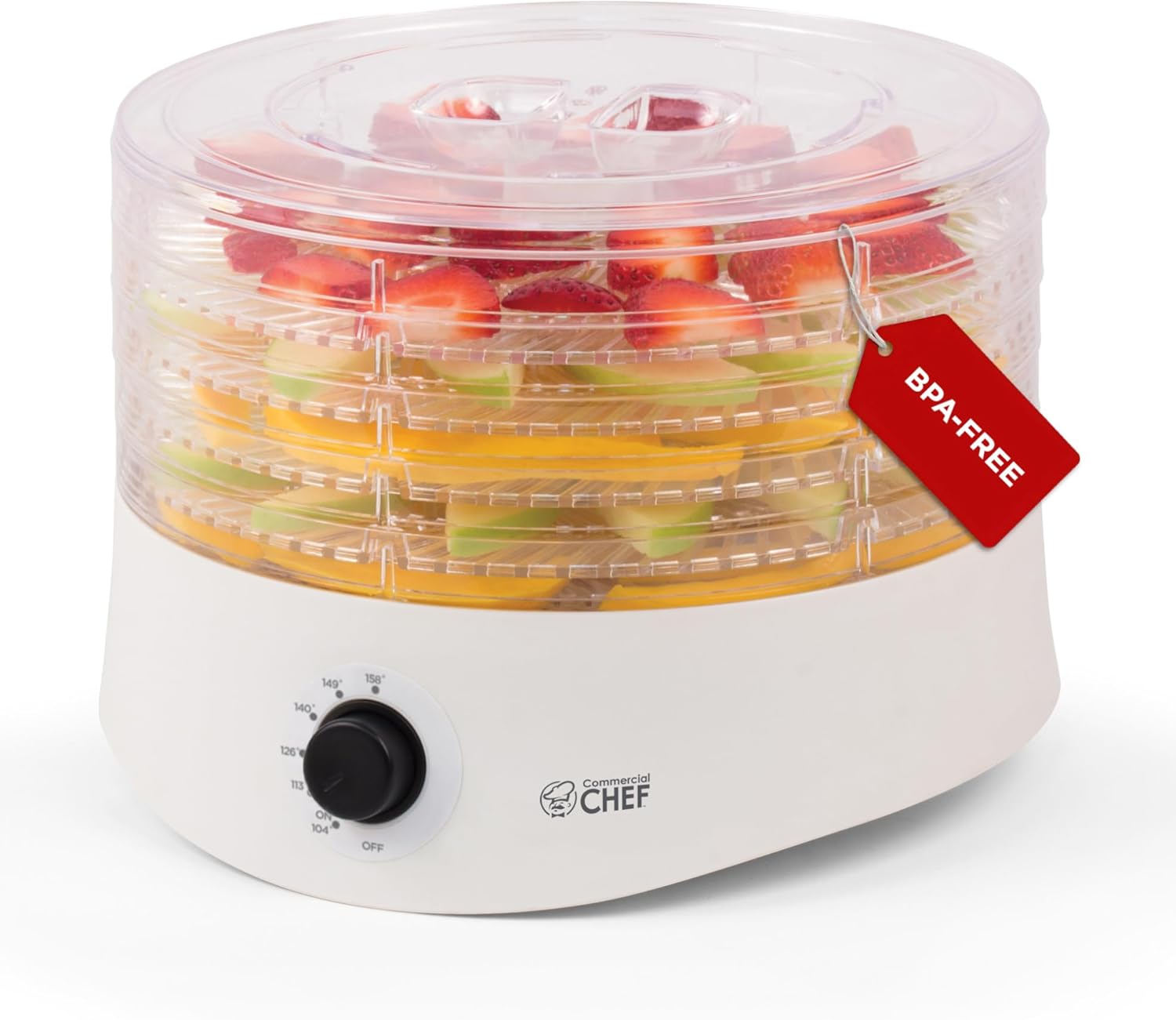
Commercial CHEF Food Dehydrator CCD100W6
| Wattage | 280 watts |
|---|---|
| Voltage | 120 volts |
| Number of Trays | 5 |
| Temperature Range | 104˚F – 158˚F |
The Commercial CHEF CCD100W6 is a small, budget-minded electric dehydrator built around five reversible BPA-free trays and a top-mounted heating fan that circulates warm air for even drying. It is typically used to make dried fruit slices, banana chips, herbs, and small batches of jerky; the trays reverse and offer two height settings so you can fit thicker items without needing extra accessories. Temperature is set with a simple mechanical dial that ranges from 104 to 158 F, which covers most fruit- and herb-drying needs, and a power indicator light shows when the unit is running. At 280 watts it is energy efficient for occasional home use and compact enough to tuck into a pantry between jobs. Trade-offs include basic controls with no timer or digital readout and a plastic housing that is lightweight but not as durable as metal units. For the price this model makes fruit dehydration approachable for first-time users and snack makers on a tight budget.
Best for: Buyers who want an affordable, easy-to-use dehydrator for making dried fruit and small snack batches without complicated controls.
Less Ideal for: Do not choose this unit if you need large-capacity continuous drying, precise digital controls, or heavy-duty commercial use.
- Five BPA-free reversible trays let you dry multiple small batches and accommodate thicker slices
- Adjustable thermostat from 104 to 158 F covers typical fruit and herb dehydration settings
- Compact, lightweight design that stores easily when not in use
- Low 280W power draw suitable for occasional home use
- No digital timer or automatic shutoff so you must monitor run times manually
- Plastic exterior and components are less heavy-duty than higher-end metal dehydrators
Verdict: A compact, low-power dehydrator that delivers straightforward fruit drying on a tight budget.
Cosori Stainless Steel Dehydrator CP267-FD

| Number of Trays | 6 |
|---|---|
| Wattage | 600 watts |
| Temperature Range | 95-165 F |
| Voltage | 120 volts |
| Operating Frequency | 60 hertz |
The Cosori CP267-FD is a countertop food dehydrator built for making large batches of dried fruit, jerky, and snacks. It uses a rear-mounted fan and upgraded horizontal airflow to move warm air evenly across six stainless steel trays so you can stack multiple layers without rotating them. The digital touch controls let you set temperatures between 95 and 165°F and a timer up to 48 hours, which makes drying delicate fruit leather or thicker fruit slices straightforward. A 600W motor and brushless design keep drying relatively fast while keeping noise under 48 dB, so it is suitable for overnight runs. The stainless steel housing and dishwasher-safe trays reduce contact with plastic and simplify cleanup, and the included mesh screen and fruit roll sheet widen what you can prepare. On the downside it is fairly large and heavy for countertop storage and may be more capacity than casual users need. The control panel is simple but not as detailed as some pro units. For reliability-focused home cooks who want repeatable, even drying and durable materials, this model performs consistently for fruit dehydration tasks.
Best for: Buyers who prioritize consistent, repeatable drying results and durable construction for regular fruit dehydration will appreciate this unit.
Less Ideal for: If you only dry small amounts occasionally or need a compact, lightweight unit for limited counter space, a smaller dehydrator would be a better fit.
- Six stainless steel trays provide large drying area for batch drying
- Rear-mounted horizontal airflow delivers even drying without tray rotation
- Digital temperature control from 95–165°F and 48-hour timer for precise fruit dehydration
- Brushless 600W motor designed for quieter operation under 48 dB
- Dishwasher-safe trays and included accessories (mesh screen, fruit roll sheet) simplify cleanup and expand use
- Relatively heavy and large, which can be cumbersome to store or move
- Control panel offers basic controls but lacks advanced program presets
Verdict: A reliable, stainless-steel 6-tray dehydrator that delivers even, quiet drying ideal for regular fruit dehydration.
NESCO Snackmaster FD-75A

| Wattage | 600 watts |
|---|---|
| Voltage | 120 volts |
| Number of Trays | 5 |
| Temperature Range | 95–160 °F |
The NESCO FD-75A Snackmaster is a straightforward home dehydrator built for reliable fruit and snack drying. Its top-mounted fan and patented Converga-Flow system push air across each tray for even drying without the need to rotate trays, which keeps flavors separate and shortens run time. The adjustable thermostat (95 to 160°F) gives control for delicate herbs or thicker fruit slices, and the 600-watt heater provides steady performance for weeknight batches or larger weekend sessions when expanded with extra trays. It ships with five BPA-free trays plus fruit roll sheets, clean-a-screen inserts, and jerky seasoning so you can start making fruit leather and small items immediately. The top fan design also reduces the risk of drips into the heater, letting you run longer cycles with less oversight. Expect a plastic exterior and a relatively compact footprint, so this is best for countertop use rather than heavy-duty commercial loads; extra trays are sold separately for high-volume drying.
Best for: Buyers who want a reliable, easy-to-use dehydrator for making dried fruit, fruit leather, and small-batch snacks with predictable, even results and included starter accessories.
Less Ideal for: People needing a heavy-duty or commercial-capacity machine for continuous large-volume drying should consider larger, commercial-focused units instead.
- Even drying from patented Converga-Flow airflow that eliminates tray rotation
- Adjustable thermostat (95–160°F) for precise control across fruits, herbs, and meat
- Expandable tray system lets you scale from small batches to larger loads
- Includes fruit roll sheets and clean-a-screen inserts to start making fruit leather and small items right away
- Top-mounted fan reduces risk of liquids reaching the heating element
- Plastic exterior instead of metal may feel less durable over long heavy use
- Extra trays required for larger capacity are sold separately
Verdict: A dependable, user-friendly dehydrator for home fruit drying that delivers even results and includes starter accessories for immediate use.
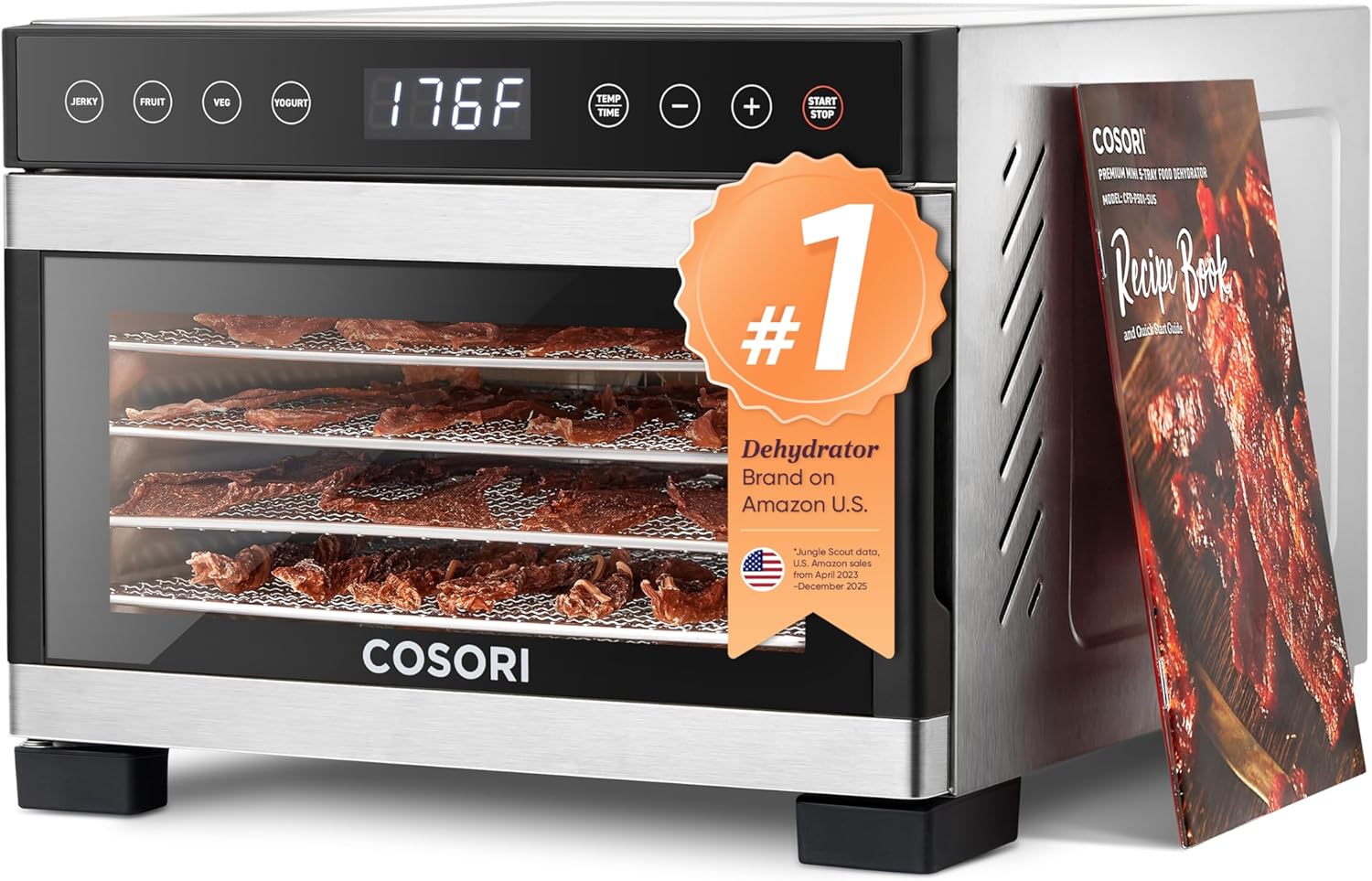
Cosori Stainless Steel Dehydrator P501
| Number of Trays | 5 |
|---|---|
| Wattage | 480 watts |
| Temperature Range | 95-176 F |
| Voltage | 110 volts |
The Cosori P501 is a compact countertop dehydrator built around a rear fan and horizontal airflow to deliver even drying across five stainless steel trays. It is used for drying fruit, vegetables, jerky, and yogurt using four presets or fully manual control with a 48-hour timer and 1°F temperature increments from 95 to 176°F, which helps follow USDA recommendations for safe jerky. Stainless steel trays and stated no-plastic-food-contact make it easy to clean and more food-safe than plastic tray units, while the included mesh screen and fruit roll sheet add versatility for delicate items. At 480 watts the unit heats efficiently without taking up much counter space, and the compact footprint still provides about 3.1 sq ft of drying area. Limitations include the single rear fan design, which while effective may require rotating trays for very dense loads, and the dehydrator's weight and stainless construction make it less portable than plastic models. For home fruit drying the precise temp control and food-safe trays make it a practical, durable choice.
Best for: Buyers who prioritize food safety and consistent, controlled drying for fruit and homemade snacks and prefer a durable, easy-to-clean machine they can set and leave running.
Less Ideal for: Users who need a very lightweight, ultra-portable dehydrator for travel or those who want the absolute largest drying capacity for commercial-scale batches.
- Precise temperature control from 95 to 176°F in 1°F increments for safe, repeatable drying.
- Five stainless steel trays with no plastic contact improve food safety and durability.
- Rear fan with horizontal airflow promotes even drying across trays.
- Includes useful accessories: fruit roll sheet, mesh screen, and a recipe book for fruit and snack recipes.
- Compact countertop footprint delivering about 3.1 sq ft of drying space.
- Single rear-fan design may need tray rotation with very thick or uneven loads to ensure uniform results.
- Stainless steel construction and weight make it less convenient to move or store than lightweight plastic units.
Verdict: A food-safe, precise countertop dehydrator that gives reliable, even results for home fruit drying thanks to stainless trays and fine temperature control.
Choosing the Right Food Dehydrator for Fruit: Key Factors to Consider
Temperature Range and Accuracy
Fruit typically dehydrates best at lower temperatures, often between about 125°F and 135°F. A dehydrator that can hold a stable low temperature prevents sugars from caramelizing and preserves natural flavor and color. Accurate thermostats and reliable heating elements shorten overall drying time variability and reduce the risk of over-drying.
When a unit cannot maintain a steady low setting, you may end up with uneven textures or loss of nutrients. For delicate fruits like berries or thin apple slices, tight temperature control is especially important because small changes in heat have outsized effects on texture.
Airflow Pattern and Tray Design
Even airflow across trays is essential to prevent pockets of dampness or excessively dry edges. Look for models with horizontal or well-distributed vertical airflow and trays that allow air to pass freely around each slice. Uniform circulation reduces the need to rotate trays mid-cycle and produces consistent results across multiple layers.
Tray spacing and the size of openings in tray grids matter for smaller fruits. Trays that are too open will let small pieces fall through, while overly fine meshes can trap sugars and make cleaning harder. Removable screens or mesh inserts that fit the tray geometry are a useful compromise.
Capacity and Stackability
Consider how much fresh fruit you plan to dehydrate per batch. Large, stackable trays let you process more at once but may increase drying time if airflow is restricted. Smaller households may prefer compact units that run efficiently on small loads, while gardeners and orchard owners might prioritize larger-capacity systems.
Also evaluate how trays nest or store and whether the unit allows adding or removing trays without interrupting drying. Flexibility to scale batch size helps match the machine to changing seasonal needs.
Control Options and Usability
Precision controls that let you set time and temperature independently are invaluable for fruit. Digital timers and temperature readouts simplify repeatable recipes and reduce guesswork. Mechanical dials can work but may drift over time and are harder to calibrate.
User-friendly features like clear manufacturer guidance for common fruits, audible cycle end alerts, and an easy-to-read display improve the day-to-day experience. Controls should be straightforward enough that you can run overnight cycles with confidence.
Ease of Cleaning and Maintenance
Fruit sugars can stick to trays and fan housing, so removable trays and dishwasher-safe screens reduce maintenance time. Smooth interior surfaces and minimal crevices prevent sticky buildup and make wiping residue easier after each batch.
Consider how easily you can inspect and clean the heating element and fan area. Units that require disassembly for cleaning add friction to regular use, while accessible parts encourage frequent upkeep and longer equipment life.
Noise Level and Energy Use
Dehydration often runs for many hours or overnight, so quieter machines are better for home kitchens. Look for units with low-noise fans and stable motor mounts. Energy efficiency matters if you dehydrate frequently; steady low-temperature operation typically draws less power than high-heat, fast-drying cycles and can save on running costs over time.
Balancing noise and energy with drying performance is key. A very quiet but underpowered fan may produce uneven drying, while a powerful noisy motor may be fine for daytime use.
Preparing Fruit for Consistent Results
Proper preparation reduces drying time and improves texture. Slice fruit uniformly so pieces dry at the same rate. For apples and pears, cored and thinly sliced rounds or rings dry evenly; berries and grapes can be halved or blanched briefly to reduce drying time when appropriate.
- Pat fruit dry before loading to remove surface moisture that can extend drying time.
- Pre-treat some fruits like apples or peaches with an acid bath to prevent browning when color retention matters.
- Arrange pieces in a single layer with space around each piece for air to circulate.
Common Drying Times and Signs of Doneness
Drying time varies by fruit, slice thickness, humidity, and machine airflow. In general, small berries can take 6 to 12 hours, apple slices 6 to 14 hours, and dense fruits like mango 8 to 16 hours. Check fruit periodically during the final hours to avoid overdrying.
Doneness cues: fruit should be pliable and leathery for chewy snacks, brittle and crisp for chips, and without pockets of visible moisture. Cool a small sample to room temperature before judging final texture, as warm fruit can feel softer than it will be when cooled.
- Thinner slices dry faster and more evenly.
- High-humidity environments increase drying times significantly.
- Rotate trays if you notice uneven results until you are confident in the unit's airflow pattern.
Storing Dehydrated Fruit Safely
Once fully dried and cooled, store fruit in airtight containers away from direct light to preserve quality. For long-term storage, use oxygen-barrier containers or vacuum sealing to extend shelf life and prevent rehydration.
Label containers with the drying date and check periodically for moisture reabsorption or mold. Properly dried fruit stored in cool, dark conditions can last many months to a year depending on humidity and packaging.
- Use small portions of airtight jars or resealable pouches for frequent access.
- Consider adding a desiccant packet for very long storage periods.
- Freeze a test batch if you plan to store for a year or more to guard against unseen moisture.
Using Dehydrated Fruit in Recipes
Dehydrated fruit is versatile in cooking and baking. Rehydrate by soaking in warm water for quick uses like compotes or fillings, or chop and add directly to granola and trail mixes for chewy texture.
Concentrated flavors from dehydrated fruit can intensify sweetness in recipes, so adjust sugar in baking accordingly. Rehydrated pieces also work well in savory dishes where a touch of natural sweetness is desired.
- For rehydration, simmer briefly until desired softness is reached.
- Store rehydrated fruit in the refrigerator and use within a few days.
- Chopped dried fruit is convenient for topping cereals and salads.
How We Chose the Best Food Dehydrator for Fruit
Our selection process prioritized features that most directly affect how fruit dehydrates and the user experience during repeated batches. We assessed temperature accuracy and range because fruit needs low, steady heat to preserve color and nutrients. Airflow and tray design were another major filter, since even circulation prevents hot or damp spots that cause uneven drying. Capacity and tray size were considered for home users who dehydrate anything from single batches of berries to whole apples or multiple trays of sliced fruit. We also evaluated ease of cleaning and maintenance, plus control interfaces that let you set time and temperature precisely. Noise level and energy efficiency were reviewed for frequent home use. We excluded units that lack stable low-temperature settings or provide no way to monitor progress, and we filtered out dehydrators with poor build quality or tray designs that inhibit airflow. The final list balances drying performance, practical capacity, and day-to-day usability for fruit-focused home dehydrating.
Our full evaluation process is outlined in our review methodology.
FAQ
What temperature is best for drying most fruits?
Most fruits dehydrate well between roughly 125°F and 135°F. That range gently removes moisture without cooking the fruit or causing excessive browning. Adjust within that window for different textures and slice thickness.
How do I prevent fruit from turning dark while drying?
Quick acid treatments, such as a brief dip in lemon juice and water, reduce enzymatic browning for susceptible fruits. Also dry at stable low temperatures and avoid overcrowding trays to keep air circulating and reduce oxidation.
Can I dehydrate whole small fruits like cherries or grapes?
Whole small fruits usually need to be halved or pitted to dry evenly and to let moisture escape. Whole dense fruits can trap moisture and take much longer to dry, increasing the risk of spoilage.
How long does properly dehydrated fruit last in storage?
When fully dried and stored in airtight, cool, dark conditions, fruit can last many months to a year depending on humidity and packaging. Using oxygen-barrier containers or vacuum sealing extends shelf life.
Should I use trays or mesh screens for berries?
Mesh screens prevent small pieces from falling through and promote airflow. Removable screens that fit trays are convenient because they are easy to clean and let you use the base tray when needed for larger slices.
Final Verdict
Choose a food dehydrator for fruit with stable low-temperature control, consistent airflow, and tray geometry that matches the fruits you plan to process. Prioritize models that balance capacity with reliable drying consistency so you can scale from small snack batches to larger harvests without sacrificing texture. Tradeoffs are inevitable: higher capacity units may need longer cycles, while compact machines can be faster on small loads. Focus on temperature accuracy, easy cleaning, and control precision to get repeatable results and preserve the best flavor and texture from your fruit.