
Note: This article contains affiliate links. If you click on these links and make a purchase, we may earn a small commission at no extra cost to you. This helps support our research and content. Read our full affiliate disclosure here.
If you want to preserve seasonal produce, make healthy snacks, or batch-dry herbs, a reliable food dehydrator for home use makes the job far easier and more consistent than DIY oven methods. The right unit affects drying time, final texture, energy use, and countertop space. This guide presents a shortlist of top food dehydrators for home use chosen for consistent drying performance, simple controls, and easy cleaning. Below you will find concise evaluations of seven leading home dehydrators plus clear buying criteria and practical tips to help you pick the best option for your kitchen and preservation goals.
Top Picks at a Glance
| Best Overall The best all-around choice for most situations | Magic Mill Food Dehydrator MFD-7100 |  |
| Best Quality Built to a higher standard if you want something more solid | NESCO Gardenmaster FD-1018A |  |
| Best Value The sweet spot between price and what you get | Cercker 12-Tray Food Dehydrator CE-12 |  |
| Best Budget The cheapest option that still gets the job done reliably | Commercial Chef Food Dehydrator CCD100W6 |  |
| Top Rated A top-rated pick with lots of positive feedback | Cosori Food Dehydrator CP267-FD |  |
| Most Popular A crowd favorite that many people choose with confidence | Magic Mill Food Dehydrator MFD-5000 |  |
| Best Seller A high-volume bestseller chosen again and again | OSTBA Food Dehydrator GGJ-261A |  |
Magic Mill Food Dehydrator MFD-7100

| Wattage | 700 watts |
|---|---|
| Voltage | 120 volts |
| Number of Trays | 10 |
| Temperature Range | 95°F to 167°F |
The Magic Mill MFD-7100 is a large-capacity countertop dehydrator built for home cooks who want to dry fruits, vegetables, jerky, and snacks in volume. Its rear-mounted fan and Precision Airflow circulation aim to produce even drying across ten extra-large stainless steel trays so you rarely need to rotate racks. The digital control panel offers a wide 95°F–167°F temperature range, a 48-hour countdown timer, and a keep-warm function for extended holding. Trays and liners are dishwasher safe, and the stainless steel housing plus BPA-free parts make cleanup straightforward. At 700 watts it delivers relatively fast dehydration while remaining whisper-quiet, and safety features such as automatic shut-off and overheat protection add peace of mind. The unit is substantial in footprint and weight, so it suits a dedicated food-preservation area rather than cramped counters, and its large capacity may be overkill for someone who only dries small batches occasionally.
Best for: Home cooks who regularly preserve produce or make large batches of jerky and snacks and who value even drying, durability, and precise digital controls.
Less Ideal for: Anyone who only needs to dry occasional small batches or has very limited counter or storage space should consider a smaller, lighter unit instead.
- Rear-mounted fan with Precision Airflow promotes even drying across all trays
- Wide 95°F–167°F temperature range and 48-hour digital timer for precise control
- Ten extra-large stainless steel trays increase capacity and durability
- Dishwasher-safe trays and BPA-free parts simplify cleaning and food safety
- 700W motor provides efficient drying with low noise and safety auto shut-off
- Large footprint and weight make it less suited to small kitchens or occasional users
- No accessory list beyond trays is included in product details
Verdict: Choose the Magic Mill MFD-7100 when you want a high-capacity, durable home dehydrator with precise digital controls and even airflow for serious at-home food preservation.
NESCO Gardenmaster FD-1018A

| Wattage | 1000 watts |
|---|---|
| Voltage | 120 volts |
| Number of Trays | 8 |
| Temperature Range | 95°F to 160°F |
The NESCO Gardenmaster FD-1018A is a high-power, expandable food dehydrator built for regular home use and larger batches. It uses a top-mounted fan with Converga-Flow airflow to push heated air up and across trays for even drying without rotating them, and the 1,000-watt heater gets the job done faster than lower-powered models. The unit ships with eight BPA-free trays plus fruit roll sheets, clean-a-screens, a jerky seasoning sample and a 52-page recipe book, and you can expand capacity up to 30 trays if you need to process bulk harvests or large jerky runs. Temperature is adjustable from 95°F to 160°F so you can handle delicate herbs, fruit leathers, and meat safely. The plastic construction keeps weight down but means it is less rugged than metal machines, and because it is a high-watt unit it draws noticeable power during long cycles. For cooks and preservers who value consistent, fast drying and the ability to scale batch size, this model makes sense; casual users who only dry small quantities may find it larger than needed.
Best for: Home cooks and gardeners who regularly preserve medium to large quantities and prioritize fast, even drying and the option to scale up batch size.
Less Ideal for: People who only plan occasional, small-quantity drying or who prefer a heavier-duty metal build should consider smaller or more rugged alternatives.
- 1,000-watt heater for faster drying and shorter cycle times
- Converga-Flow top-mounted fan provides even airflow across trays without rotation
- Expandable from 8 up to 30 trays for large batches
- Includes useful accessories and a 52-page recipe and instruction book
- Plastic construction is less durable than metal alternatives
- Higher power draw during long drying cycles
Verdict: Choose the Gardenmaster FD-1018A if you need a powerful, expandable home dehydrator that delivers fast, even drying for regular medium-to-large batches.
Cercker 12-Tray Food Dehydrator CE-12

| Wattage | 800 watts |
|---|---|
| Voltage | 120 volts |
| Number of Trays | 12 |
| Temperature Range | 70℉-190℉ |
The Cercker CE-12 is a commercial-style countertop dehydrator aimed at high-capacity home users who want to dry fruits, herbs, vegetables, and jerky in larger batches. Its stainless steel cabinet and 12 wrapped stainless trays give a roomy footprint and dishwasher-safe tray convenience, while a rear dual-row fan with air circulation helps distribute heat more evenly than single-fan units. You can set temperature between 70 and 190°F in 5°F steps and run the 24-hour timer in half-hour increments, and built-in overheating protection and automatic shutoff improve safety and peace of mind. At 800 watts the unit dries faster than lower-powered hobby models, but it is correspondingly louder and draws more power. The machine ships with a recipe, door handle, drip tray, silicone gloves, and basic tools, and Cercker offers a three-year warranty. This model suits users who need capacity and controllable drying rather than a compact or ultra-quiet appliance.
Best for: Home cooks and small-batch producers who want a higher-capacity, controllable dehydrator to batch-process fruits, herbs, and jerky with reliable temperature control and durable construction.
Less Ideal for: Minimalist or occasional users who need a compact, ultra-quiet, or very low-power countertop dehydrator should consider smaller hobby models instead.
- Large 12-tray stainless steel design for high-capacity batch drying
- Wide temperature range (70°F–190°F) adjustable in 5°F increments
- 24-hour timer with 0.5-hour steps and automatic shutdown for unattended runs
- Rear dual-row fan and air circulation for more even drying
- Includes recipe, drip tray, silicone gloves, and a three-year warranty
- 800W motor increases drying speed but raises noise and power use
- Stainless steel may have a factory odor that requires airing before use
Verdict: Choose the Cercker CE-12 if you need a durable, high-capacity home dehydrator with precise temperature and long-timer control for frequent batch drying.
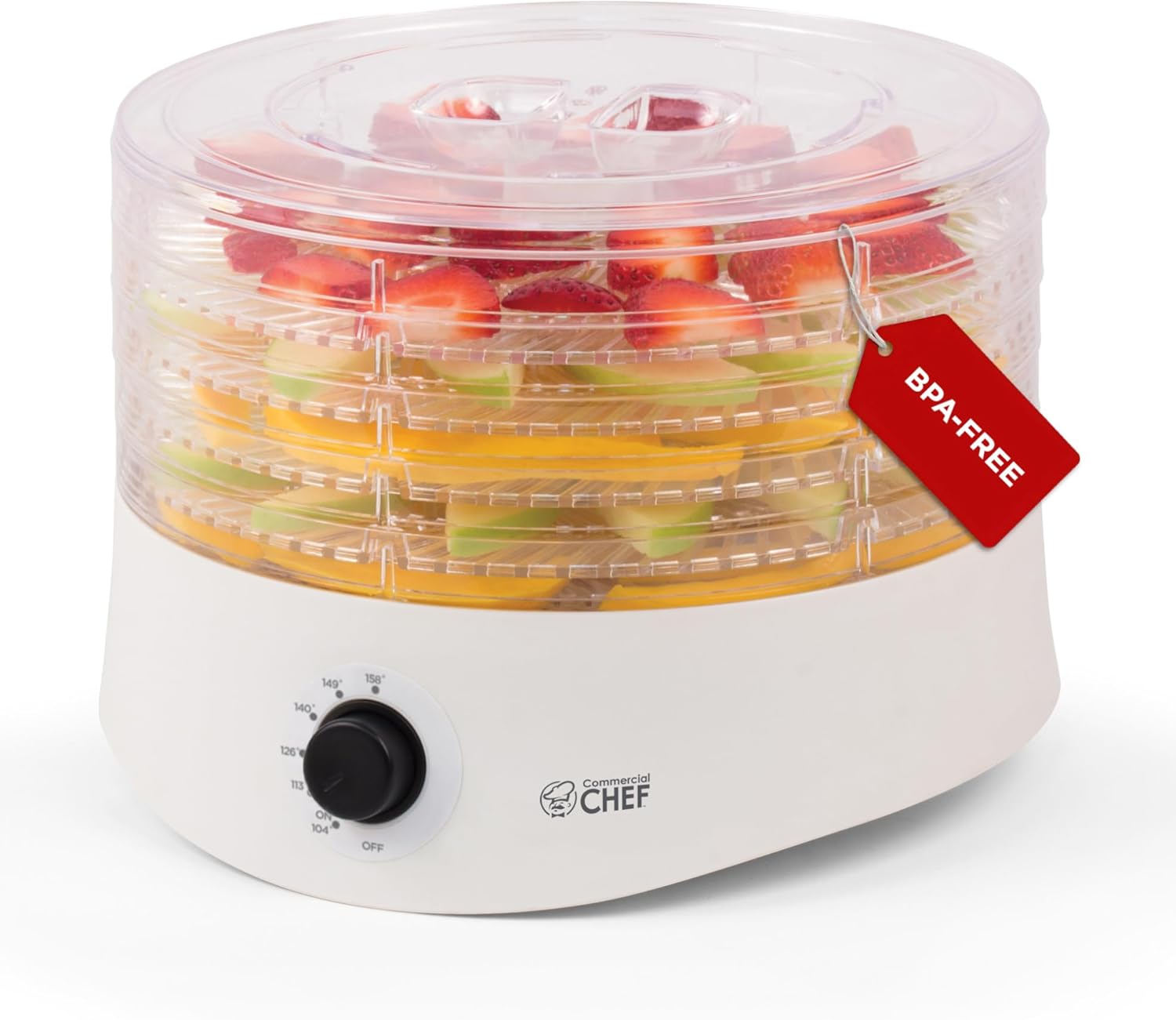
Commercial Chef Food Dehydrator CCD100W6
| Wattage | 280 watts |
|---|---|
| Voltage | 120 volts |
| Number of Trays | 5 |
| Temperature Range | 104˚F – 158˚F |
This compact Commercial Chef dehydrator uses a top-down airflow and a 280W heater to gently remove moisture from fruits, vegetables, herbs, and meats using five reversible BPA-free trays. Setup and use are straightforward: load sliced food across the circular trays, set the mechanical temperature knob between 104 and 158 degrees F, and the power indicator shows when it is running. The reversible trays offer two height positions to accommodate thicker items like jerky strips, and the unit is light and easy to store when not in use. For everyday home dehydrating it delivers even drying for small batches and is easy to clean by hand. Trade-offs are its small footprint and lower wattage, which limit large-volume or continuous dehydrating compared with larger stack-style or high-wattage models, and the plastic construction is less durable than metal alternatives. Still, its simple controls and compact design make it a practical entry-level dehydrator for occasional snack-making and recipe experimentation.
Best for: Buyers on a budget who want a simple, compact dehydrator to make occasional batches of dried fruit, herbs, and jerky without complicated controls.
Less Ideal for: People who need to dehydrate large quantities regularly or professionals who want heavy-duty metal construction and higher wattage for faster drying.
- Five reversible BPA-free trays allow two height settings for thicker or thinner foods
- Adjustable thermostat from 104°F to 158°F for control over drying intensity
- Compact, lightweight design is easy to store and move
- Simple mechanical controls and power indicator make it beginner-friendly
- Low 280W power and small capacity limit throughput for large batches
- Plastic construction may not feel as durable as metal-bodied dehydrators
Verdict: A compact, easy-to-use dehydrator that delivers reliable small-batch drying at a budget-friendly entry point.
Cosori Food Dehydrator CP267-FD

| Wattage | 600 watts |
|---|---|
| Voltage | 120 volts |
| Number of Trays | 6 |
| Temperature Range | 95-165 F |
| Operating Frequency | 60 hertz |
The Cosori CP267-FD is a countertop food dehydrator built around six stainless steel trays and a rear-mounted fan that delivers horizontal airflow for even drying. It is used to dry fruit, jerky, herbs, and make fruit rolls using a digital control panel that sets temperatures between 95 and 165 F and a timer up to 48 hours. The 600W brushless motor improves drying speed while keeping noise under 48 dB, and the included mesh screen and fruit roll sheet broaden what you can dehydrate without mess. The stainless steel housing and dishwasher-safe trays make cleanup straightforward and keep food contact surfaces free of plastic. Limitations are its relatively large footprint and weight for small kitchens and the lack of rotating trays requires arranging items for consistent spacing, but the precision temperature control and substantial tray capacity make it a reliable choice for regular home use.
Best for: Home cooks who want a durable, precise dehydrator for frequent batch drying and value consistent results and low operating noise.
Less Ideal for: People with very limited counter or storage space or those who only need an occasional, small-capacity dehydrator.
- Six stainless steel trays provide large drying capacity for batch dehydration
- Digital temperature control from 95 to 165 F with a 48-hour timer for precise results
- Rear-mounted fan and horizontal airflow promote even drying without tray rotation
- Brushless 600W motor runs quietly under 48 dB, suitable for overnight cycles
- Dishwasher-safe trays and stainless steel housing minimize plastic contact and ease cleaning
- Relatively heavy and sizable compared with compact dehydrators
- Requires manual tray arrangement for best airflow since trays do not rotate
Verdict: Choose the Cosori CP267-FD when you need a reliable, quiet, high-capacity dehydrator with precise temperature and long-timer control for regular home use.
Magic Mill Food Dehydrator MFD-5000

| Wattage | 240 watts |
|---|---|
| Voltage | 110 volts |
| Number of Trays | 5 |
| Temperature Range | 95-167 °F |
The Magic Mill MFD-5000 is a compact electric food dehydrator designed for home use, with five stackable stainless steel trays and a digital control panel for timer and temperature. It heats between 95 and 167°F and runs up to 48 hours, which covers everything from fruit and herb drying to jerky and pet treats. The adjustable tray spacing helps accommodate thicker cuts and multiple foods at once, and the stainless trays are dishwasher-safe for easier cleanup. With a 240W motor and a top-to-bottom airflow design, it removes moisture efficiently while aiming to preserve nutrients. Practical limitations include its relatively small footprint—best for batch-sized projects rather than large-volume preserving—and the body uses BPA-free plastic which may show wear over heavy daily use. The straightforward controls make it easy for beginners to set time and temperature, while experienced users will appreciate the adjustable trays and stainless construction for food safety.
Best for: Buyers who rely on verified user feedback and want a reliable, easy-to-use dehydrator for occasional to regular home batches will appreciate this model's simple digital controls and stainless trays.
Less Ideal for: Avoid this unit if you plan to dehydrate very large quantities frequently or need a heavy-duty, commercial-capacity machine.
- Five stainless steel, dishwasher-safe trays for durable, food-safe drying
- Digital timer and temperature control up to 167°F for precise drying
- Adjustable tray heights to fit thicker cuts or varying foods
- Compact footprint suitable for countertop storage and small batches
- Not ideal for large-volume dehydration or commercial-scale use
- Plastic exterior may be less durable under heavy long-term use
Verdict: A compact, user-friendly dehydrator with stainless trays and precise digital controls that suits home cooks who want reliable small-batch drying guided by social proof.
OSTBA Food Dehydrator GGJ-261A

| Wattage | 240 watts |
|---|---|
| Number of Trays | 5 |
| Temperature Range | 96-158℉ |
| Voltage | 120 volts |
The OSTBA GGJ-261A is a small, user-friendly food dehydrator designed for home use. It heats with a 240-watt element and uses 360 degree airflow to dry fruit, herbs, vegetables, and jerky evenly across five stackable BPA-free trays. Temperature is adjustable from the mid-90s to about 158°F so you can run low-heat drying for fruit or higher settings for meat, and the unit includes a long timer range for extended batches. Controls are simple: a rotary knob to set power and temperature and a transparent cover to monitor progress. Cleanup is straightforward because the trays are dishwasher safe and the front panel is stainless steel. Because it is compact and lightweight it tucks into a cupboard when not in use, but that smaller footprint also limits overall capacity compared with larger multi-tier models and it runs at modest power so very large loads will take longer. For buyers who want a reliable, no-frills machine to experiment with snacks and preserve produce, this is a practical entry-level choice.
Best for: Buyers who want a straightforward, low-risk dehydrator to make occasional batches of fruit, herbs, or jerky without complicated controls or a large countertop footprint.
Less Ideal for: Those who need to dry very large volumes at once or want faster commercial-scale throughput should look at larger, higher-power dehydrators.
- Adjustable temperature range (96–158°F) supports drying a wide variety of foods
- Five BPA-free, dishwasher-safe trays make cleanup and storage convenient
- 360° airflow helps distribute heat evenly for consistent drying
- Compact, lightweight design is easy to store and suitable for small kitchens
- 240-watt motor and smaller footprint limit throughput for large batches
Verdict: A compact, easy-to-use 5-tray dehydrator that reliably handles home batches of fruit, herbs, and jerky with simple controls and dishwasher-safe trays.
Choosing the Right Food Dehydrator for Home Use: Key Factors to Consider
Airflow and Heating Design
How air moves inside the dehydrator directly affects drying speed and evenness. Units that use horizontal airflow tend to dry more uniformly without rearranging trays, while some vertical or bottom-heated designs require tray rotation or repositioning to avoid uneven results.
For home use, choose a design that matches your tolerance for hands-on management. If you plan to dry mixed loads or thicker slices, prioritize even airflow to reduce checking foods during long runs. Poor airflow can increase overall drying time and produce inconsistent textures, which makes preserving more work.
Temperature Control and Range
Different foods require different dehydration temperatures. Herbs and delicate fruits are best dried at low temperatures, while meats for jerky need higher, steady heat for safety. Precise controls and an appropriate temperature range let you tailor runs to preserve nutrients, color, and texture.
Digital thermostats with accurate readouts give repeatable results. Basic dial controls can work well but may need a separate thermometer to confirm actual interior temperature. For home users who value repeatability, better control reduces guesswork and rework.
Capacity, Expandability, and Footprint
Capacity determines how much you can preserve in a single batch. If you routinely process large quantities of produce, look for units with more trays or modular stacking options. Conversely, if counter and storage space are limited, a compact dehydrator with fewer trays might be a better fit.
Think about typical batch size and where the machine will live when not in use. A larger capacity reduces the number of runs required, but increases initial counter or cabinet footprint and storage needs when not active.
Tray Material and Ease of Cleaning
Trays can be made of plastic, stainless steel, or have nonstick coatings, and each has pros and cons. Smooth, removable trays that are dishwasher-safe or simple to wipe down minimize post-run cleanup and reduce odor transfer between batches.
Look for designs with few crevices where food particles and juices can collect. Easy cleaning encourages more frequent use and better food safety practices, while hard-to-clean trays increase the chance of buildup and off flavors between runs.
Noise, Run Time, and Energy Use
Dehydration often takes many hours or even days. Noise level matters if the dehydrator will run in a kitchen near living spaces. Models with quieter fans are more comfortable for home use.
Energy efficiency affects operating cost and how much heat the unit dumps into your kitchen. For long runs, modest differences in wattage add up, so balance drying speed against energy consumption and typical run lengths.
Safety Features and Durability
Durable construction and safety features protect your kitchen and make daily use less stressful. Look for stable bases, secure tray stacking, and reliable thermal controls that prevent overheating. Materials that resist warping from heat hold up better over repeated use.
A well-built dehydrator reduces maintenance and replacement frequency, which matters for home users who plan to make dehydrating a regular activity.
Best Foods to Dehydrate at Home
Certain ingredients are especially well suited to home dehydration. Fruits like apples, bananas, and mangoes become portable snacks when sliced thin and dried; tomatoes and peppers concentrate flavor for sauces and long-term storage. Herbs lose moisture quickly and retain flavor when dried at low temperatures.
Meats require proper temperature control and drying technique to ensure safety when making jerky. It is also possible to dehydrate vegetables, flowers for teas, and even make fruit leathers, but slicing thickness and pre-treatment methods affect final texture and shelf life.
- Thin fruit slices dry fastest and most evenly.
- Herbs need low heat and short run times to preserve aroma.
- Blanched vegetables can dehydrate more evenly and rehydrate better.
Preparation Tips for Consistent Results
Uniform slicing is one of the most important steps for even drying. Use a mandoline or consistent knife technique to ensure pieces are the same thickness. For thicker or denser items, consider pre-treatment such as blanching or an acid soak for fruits to preserve color.
Arrange items in a single layer with space for air circulation. Avoid overlapping pieces and rotate trays when using models with less even airflow. Checking foods periodically during long runs helps avoid over-drying or uneven patches.
- Use consistent slice thickness for predictable drying times.
- Rotate trays if the dehydrator shows hot spots.
- Label trays with start time and expected finish time.
Storage and Shelf Life After Dehydration
Proper storage extends the shelf life of dehydrated goods. Once fully dry and cooled, pack items in airtight containers or vacuum-seal them to reduce moisture uptake. Store in a cool, dark place to minimize quality loss over time.
Moisture migration can occur when dry items are stored with slightly moister ones, so sort batches by dryness level. Periodically check stored goods for signs of regained softness or discoloration, which indicate inadequate drying or storage conditions.
- Use oxygen absorbers or vacuum sealing for long-term storage.
- Keep herbs and spices separate from sweeter fruit to avoid flavor transfer.
- Record the dehydration date and contents on containers.
Common Troubleshooting and Fixes
If items dry unevenly, reassess slice thickness and tray layout first. Increasing airflow by spacing pieces or lowering load per run often helps. If trays require repeated rotation, consider a model with more uniform airflow for future runs.
If drying takes longer than expected, verify the internal temperature with an oven thermometer and inspect for blocked vents or overloaded trays. Persistent off odors suggest trays or the machine need a deeper clean and airing out between batches.
- Uneven drying: check slice uniformity and airflow.
- Extended run times: confirm thermometer reading and avoid overloading.
- Off smells: deep-clean trays and run an empty cycle to air out the unit.
Accessories That Make Dehydrating Easier
A few simple accessories can improve convenience and results. Mesh or nonstick tray liners simplify cleanup and allow drying small items like berries without small holes blocking. A dedicated interior thermometer helps confirm advertised temperatures match actual conditions.
Vacuum sealer systems and oxygen absorbers are useful for preserving dehydrated goods long-term. Stackable storage solutions keep dried foods organized and protected from humidity.
- Tray liners for small items or sticky fruits.
- Digital thermometer for verifying temperature accuracy.
- Vacuum sealing supplies for extended shelf life.
How We Chose the Best Food Dehydrator for Home Use
We evaluated units based on measures that matter for everyday home preservation. First, drying consistency was a primary filter: models that circulate air evenly and avoid hot spots ranked higher because even drying reduces spoilage and rework. Temperature control and range were next, since different foods and thicknesses require different settings for safe, high-quality results. We also prioritized energy efficiency and run-time performance, because many dehydration jobs run for hours and efficiency affects operating cost and heat management in the home. Ease of cleaning and maintenance was a key exclusion criterion: designs with sealed, dishwasher-safe trays or surfaces that resist food buildup were favored. Capacity and stackability mattered for buyers who preserve larger batches or have limited storage. Finally, noise level and footprint were considered to ensure the units are practical for regular kitchen use. We excluded commercial or oversized units intended for professional kitchens and any dehydrators lacking basic temperature control or with poor air circulation designs.
Our full evaluation process is outlined in our review methodology.
FAQ
How long does it take to dehydrate fruits at home?
Drying time depends on slice thickness, fruit type, and humidity. Thinly sliced fruits typically take 6 to 12 hours, while denser pieces can require longer. Check periodically and test for pliable, no-moisture centers before storing.
Can I dehydrate raw meat safely at home?
Yes, but safety depends on using appropriate temperatures and proper preparation. Slice meat thinly, marinate or cure if desired, and use a temperature that brings the meat to a safe endpoint. Follow food-safety guidance for jerky to minimize bacterial risk.
Do I need to blanch vegetables before dehydrating?
Blanching often improves texture and color retention for many vegetables. It helps break down cellular structure so pieces rehydrate more evenly. Root vegetables and green beans commonly benefit from a brief blanch before drying.
How should I store dehydrated foods to keep them fresh?
Store fully cooled, fully dried foods in airtight containers in a cool, dark place. Vacuum sealing and oxygen absorbers extend shelf life further. Check stored items occasionally for any sign of moisture reabsorption.
Will a digital thermostat make a big difference?
A digital thermostat improves repeatability and fine control, which helps with delicate items and consistent batches. Analog dials can work but may require an external thermometer to confirm actual temperatures.
Final Verdict
For home preservation, prioritize consistent airflow, reliable temperature control, and trays that are simple to clean. Balance capacity against countertop and storage constraints so you do not end up running many small batches. Consider noise and energy use if you plan long dehydration runs frequently. Select a dehydrator that matches the kinds of foods you plan to dry and the space you have. Focusing on the core factors discussed here will help you pick a dependable unit that produces consistent, safe, and tasty results.