
Note: This article contains affiliate links. If you click on these links and make a purchase, we may earn a small commission at no extra cost to you. This helps support our research and content. Read our full affiliate disclosure here.
If you make gummies at home, the right food dehydrator can mean the difference between chewy, shelf-stable treats and sticky, uneven batches. You want consistent low-heat drying, predictable airflow, and a unit that protects texture without overcooking delicate gelatin-based candies. This guide shortlists the top food dehydrators for gummies and explains the practical features that matter for reliable results. We evaluated units for temperature accuracy, airflow uniformity, and usable tray space so you can pick the model that fits your production habits. Read on for what to look for and how each shortlisted option performs against the needs of gummy makers.
Top Picks at a Glance
| Best Overall The best all-around choice for most situations | Excalibur 8-Tray Dehydrator DH08SCSS13 |  |
| Best Quality Built to a higher standard if you want something more solid | Magic Mill Pro Dehydrator MFD-7700 |  |
| Best Value The sweet spot between price and what you get | Magic Mill Food Dehydrator MFD-5000 |  |
| Best Budget The cheapest option that still gets the job done reliably | vassillias Food Dehydrator 704M |  |
| Top Rated A top-rated pick with lots of positive feedback | Cosori Stainless Steel Dehydrator CP267-FD |  |
| Most Popular A crowd favorite that many people choose with confidence | NESCO Snackmaster FD-75A |  |
| Best Seller A high-volume bestseller chosen again and again | Cosori Stainless Steel Dehydrator P501 |  |
Excalibur 8-Tray Dehydrator DH08SCSS13

| Wattage | 700 watts |
|---|---|
| Voltage | 120 |
| Number of Trays | 8 |
The Excalibur 8-Tray dehydrator is a countertop unit built for steady, even drying of fruits, meats and more, using its patented Hyperwave Pulse and Horizontal Parallex airflow to avoid tray rotation. You load up to eight chrome trays (plus a mesh and crumb tray), set temperature between 85°F and 165°F and use the 80-hour digital timer; the unit displays a countdown and shuts off when finished. The clear glass French door makes it easy to watch gummies and fruit leathers as they set, and the compact footprint is intended to fit under standard cabinets while still offering 7.2 square feet of drying area. Practical benefits include consistent temperatures for reproducible results and a downloadable recipe book to get started. Trade-offs are typical for serious dehydrators: it occupies bench space and runs for long cycles when making thick gummies or fruit leathers, and the stainless exterior and chrome trays need occasional cleaning to stay pristine. For someone who wants predictable, even drying and the ability to run long low-temperature cycles, this model delivers dependable performance.
Best for: Buyers who want consistent, repeatable dehydration for snacks and preserves and who value even airflow and precise temperature control for making gummies and fruit leathers.
Less Ideal for: Casual users who only dehydrate small amounts occasionally or need a very compact, single-tray appliance should consider simpler, smaller models instead.
- Even drying without rotating trays thanks to Hyperwave Pulse and Horizontal Parallex airflow
- Wide temperature range (85°F–165°F) and long 80-hour timer for slow-setting gummies and fruit leathers
- Seven plus square feet of drying area across eight chrome trays for batch processing
- Clear glass French door lets you monitor progress without opening the unit
- Long run times for thicker fruit leathers or dense gummy mixtures
- Requires countertop space and occasional cleaning of stainless steel and chrome trays
Verdict: Choose the Excalibur 8-Tray if you need reliable, even low-temperature drying and enough tray space to batch-produce gummies and fruit leathers.
Magic Mill Pro Dehydrator MFD-7700

| Wattage | 600 |
|---|---|
| Voltage | 120 |
| Number of Trays | 7 |
| Material | Stainless Steel |
The Magic Mill Pro is a heavy-duty countertop dehydrator built around a 600W rear fan that pushes even airflow across seven full-size stainless steel trays, which helps produce consistent textures without tray rotation. It is typically used for batch drying fruit, herbs, jerky, and thin snacks like gummies or fruit leather; the digital temperature control with 1°F increments (95–176°F) plus a 48-hour timer makes it easy to dial in low-and-slow cycles and longer finishing holds. Included mesh screens and a fruit roll tray are useful for sticky or small items so gummies and fruit leathers do not sag through the racks. The all-stainless interior and trays resist odor absorption and are easier to clean than plastic units, and ETL-listed safety with overheat protection and an auto shutoff gives confidence during multi-hour runs. The unit is relatively tall and weighty compared with compact models, so it is best for hobbyists who run medium-to-large batches rather than occasional single trays, and it lacks specialty humidity control or a dedicated gummy preset so some recipe testing is still required for perfect chew.
Best for: Buyers who prioritize performance and consistency and who plan to run medium-to-large batches of gummies, fruit leather, or jerky and want precise temperature control and durable stainless construction.
Less Ideal for: People who only dry a tray or two occasionally or need a very small, lightweight unit for tight storage spaces should consider smaller compact dehydrators instead.
- Powerful 600W rear-fan system for consistent, even drying across all trays
- Precise digital temperature control in 1°F increments from 95–176°F
- Seven full-size stainless steel trays plus mesh screens and a fruit roll tray included
- All-stainless interior and trays resist odors and are durable for frequent use
- 48-hour timer with auto shutoff and keep-warm hold mode for long drying cycles
- No dedicated humidity control or gummy-specific presets, requiring recipe tuning
- Larger and heavier than compact models, so it takes more countertop space
Verdict: For performance-focused home users making gummies or fruit leather, this stainless 600W dehydrator delivers even drying, precise temperature control, and the capacity for multi-tray batches.
Magic Mill Food Dehydrator MFD-5000

| Wattage | 240 watts |
|---|---|
| Voltage | 110 volts |
| Number of Trays | 5 |
| Temperature Range | 95-167 °F |
The Magic Mill MFD-5000 is a countertop dehydrator built for everyday home use and batch drying small runs of fruit, jerky, or pet treats. It uses a 240W heater and a digital control panel to set temperatures from about 95°F to 167°F and run times up to 48 hours, which makes it easy to follow standard recipes for gummies and fruit leather that need low, steady heat. The five stackable, food-safe stainless steel trays are adjustable so you can increase spacing for thicker pieces, and the trays detach for straightforward hand- or dishwasher-cleaning. The unit's compact footprint and stainless accents keep it tidy on a counter and simple to store. Expect typical small-dehydrator limits: the capacity is enough for modest batches but not for heavy commercial loads, and the fan/heater is optimized for even home-style drying rather than rapid industrial throughput. For gummy-style snacks that require low-temperature, long-duration drying, the precise temperature control and long timer make this model a practical, easy-to-use option.
Best for: Buyers who want a practical, compact dehydrator for regular home batches of gummies, fruit leather, jerky, and pet treats and value precise low-temperature control and easy cleanup.
Less Ideal for: This is not the best choice for users needing commercial-scale throughput or very large single-batch capacity.
- Digital timer up to 48 hours for long, low-temperature drying cycles
- Five adjustable stainless steel trays for flexible spacing and easy cleaning
- Temperature control up to 167°F suitable for fruit leathers and low-temp snacks
- Compact footprint fits easily on a kitchen counter
- Dishwasher-safe removable trays simplify cleanup
- Smaller batch capacity not suited for large or commercial drying runs
- 240W motor limits how quickly large volumes will dehydrate
Verdict: Choose the Magic Mill MFD-5000 if you want a compact, easy-to-use home dehydrator that delivers precise low-temperature control and simple cleanup for regular small batches of gummies and fruit snacks.
vassillias Food Dehydrator 704M

| Wattage | 280 |
|---|---|
| Number of Trays | 5 |
| Material | Plastic |
This compact vassillias dehydrator is a straightforward, budget-friendly unit for making jerky, dried fruit, herbs and small-batch gummies that need low, steady heat. It uses a 280W fan-forced airflow and five removable BPA-free trays spaced about 0.79 inches apart to promote even drying across layers, and the temperature is adjustable from 104°F to 158°F so you can dial in the low temps gummies and delicate herbs require. The trays are easy to remove for cleaning and the plastic body keeps the unit lightweight and countertop-friendly, though you should leave clearance behind the air outlet. Built-in overheat protection and an automatic shutoff on abnormal temperatures add safety. Limitations include a smaller drying area per tray compared with larger models and a plastic construction that is less durable than metal-bodied units, so it is best for occasional or experimental use rather than heavy daily production.
Best for: Buyers seeking an affordable, easy-to-use dehydrator for small homemade batches and experimenting with low-temperature recipes will appreciate this unit.
Less Ideal for: Large-scale or frequent dehydrating, commercial use, or anyone who needs a heavy-duty metal-bodied machine for high-volume production should look at larger models.
- Adjustable 104°F–158°F temperature range suitable for low-temp drying.
- Five removable BPA-free trays for flexible batch sizes and easy cleaning.
- 280W fan provides even airflow for consistent drying across trays.
- Compact countertop footprint fits small kitchens and is easy to store.
- Plastic construction is less robust than metal-bodied dehydrators.
- Smaller tray spacing and total drying area limit large-batch production.
Verdict: A low-cost, compact dehydrator that gives reliable low-temperature control and even airflow for small-batch drying and recipe testing.
Cosori Stainless Steel Dehydrator CP267-FD

| Wattage | 600 watts |
|---|---|
| Voltage | 120 volts |
| Number of Trays | 6 |
| Temperature Range | 95-165 F °F |
The Cosori CP267-FD is a countertop food dehydrator designed for batch drying with six stainless steel trays and a digital control panel that sets temperature between 95 and 165°F and a timer up to 48 hours. It uses a rear-mounted fan and upgraded airflow to deliver even horizontal airflow across trays, which reduces the need to rotate trays during long drying cycles. The 600 W motor and brushless fan aim for faster drying while keeping noise under 48 dB so you can run overnight without a loud hum. Included accessories like a mesh screen and fruit roll sheet expand what you can dehydrate, and the stainless steel housing avoids plastic contact with food. The unit is relatively heavy and sizable, so it suits a counter with room, and long multi-day cycles are still required for high-moisture items like gummies or thick fruit leathers. Controls are straightforward but lack advanced program presets specific to delicate candy-like items, so expect some trial and error when dialing in texture for gummies.
Best for: Buyers who prioritize a durable, consistent dehydrator for regular batch drying and want predictable, even results without frequent tray changes.
Less Ideal for: People who need an ultra-compact or lightweight unit for occasional small batches or those who prefer appliance presets tuned specifically for gummy/candy recipes.
- Six stainless steel trays provide large 6.5 ft² drying area for batch projects
- Digital temperature control from 95–165°F and 48-hour timer for precise, long runs
- Rear-mounted fan with horizontal airflow promotes even drying without rotating trays
- Brushless motor design keeps operation quiet, below 48 dB, suitable for overnight use
- Includes mesh screen and fruit roll sheet so you can dehydrate a wider range of textures
- Bulky and relatively heavy, requiring permanent counter space
- No specialized presets for confectionery or gummy-specific programs
Verdict: A sturdy, low-noise stainless steel dehydrator that delivers large, even drying runs ideal for reliability-focused home dehydrating.
NESCO Snackmaster FD-75A

| Wattage | 600 watts |
|---|---|
| Voltage | 120 volts |
| Number of Trays | 5 (expandable to 12) |
| Temperature Range | 95°F–160°F |
The NESCO FD-75A Snackmaster is a straightforward countertop dehydrator built for regular home use and small-batch production. Its top-mounted fan and Converga-Flow system push air down the outer chamber and across each tray so foods dry evenly without rotating trays, which is handy for multi-hour runs like fruit leathers and gummies. The unit includes five BPA-free trays and ships with fruit roll sheets, clean-a-screen inserts, and jerky seasoning so you can get started right away, and the tray system can be expanded up to 12 trays for larger batches. Temperature is adjustable from 95 to 160 F and the 600-watt heater is capable of sustained drying sessions while the opaque exterior helps protect light-sensitive ingredients. Practical limitations: the body is plastic rather than stainless, and the compact footprint means very large batches require additional trays purchased separately. For home cooks focused on consistent, no-fuss drying and who value included accessories, this model covers the basics reliably.
Best for: Buyers who want a reliable, no-fuss dehydrator for making fruit leathers, gummies, herbs, and jerky at home and who prefer a unit that works consistently out of the box with useful starter accessories.
Less Ideal for: People needing heavy-duty commercial throughput or those who prefer all-metal construction for long-term heavy use should consider larger or more industrial models.
- Converga-Flow airflow and top-mounted fan provide even drying without rotating trays
- Adjustable thermostat from 95 to 160 F for precise drying control
- Expandable from 5 up to 12 trays for scaling batch size
- Includes fruit roll sheets, clean-a-screens, and jerky seasoning to start immediately
- Plastic exterior instead of metal may feel less durable
- Additional trays sold separately to reach maximum capacity
Verdict: A practical, easy-to-use home dehydrator that delivers even drying and useful starter accessories, making it a strong pick for small-batch fruit leathers and gummies.
Cosori Stainless Steel Dehydrator P501
| Wattage | 480 watts |
|---|---|
| Voltage | 110 volts |
| Number of Trays | 5 |
| Temperature Range | 95-176 F °F |
| Operating Frequency | 60 hertz |
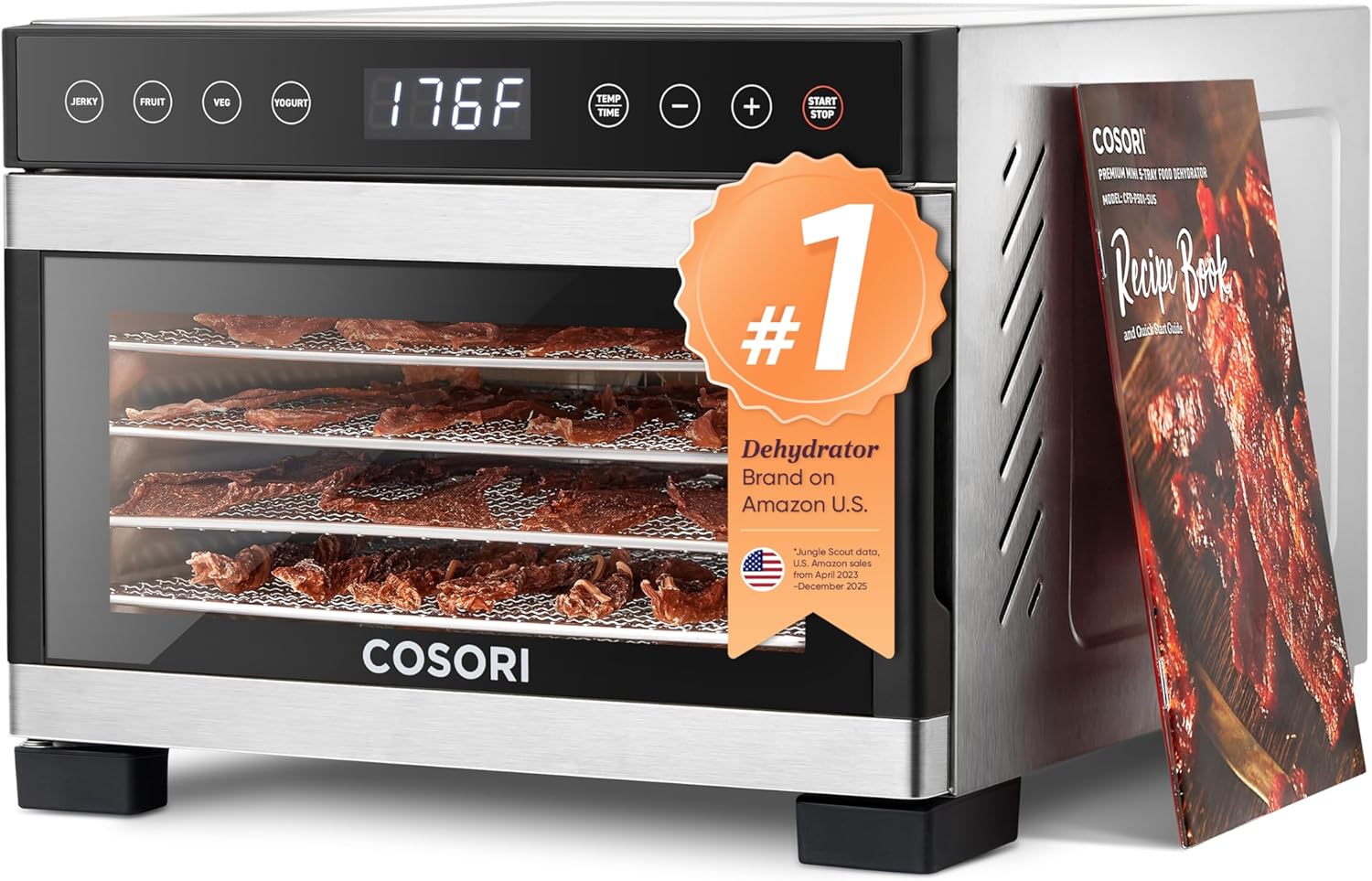
The Cosori P501 is a compact countertop dehydrator built around five stainless steel trays and a rear fan that pushes horizontal airflow for even drying. It is typically used for making jerky, fruit leather, dried vegetables, and yogurt but its precise temperature control down to 1°F and a 95–176°F range also make it capable of low‑temperature work like gummy dehydration. Four presets (jerky, fruit, vegetables, yogurt) simplify setup while the 48‑hour timer covers long runs without monitoring. Construction is mostly stainless steel and the included mesh screen and fruit roll sheet keep food off plastic, which helps with food safety and cleanup. At 480 watts the unit reaches higher setpoints quickly, though the rear exhaust means it needs a bit of countertop clearance and can move warm air into the kitchen during long cycles. The unit is straightforward to operate and the compact footprint fits small kitchens, but if you need very large batch capacity or silent operation you may want a larger or more specialized model.
Best for: Buyers who prioritize food‑safe materials, easy presets, and reliable, controllable temperature for small to medium home batches will appreciate this model.
Less Ideal for: Those who need high‑volume commercial capacity, near‑silent operation, or stacked multi‑level drying for very large batches should consider larger or commercial units instead.
- Five stainless steel trays provide ample, non-plastic drying surfaces for food-safe dehydration.
- Precise temperature control from 95 to 176°F in 1°F increments supports low‑temp recipes and safe jerky preparation.
- Rear fan with horizontal airflow promotes even drying across trays, reducing spot over‑drying.
- Includes mesh screen, fruit roll sheet, and recipe book so you can start projects without extra accessories.
- Rear exhaust can warm the surrounding area during long cycles and requires countertop clearance.
- Relatively compact drying area limits large batch processing compared with full‑size dehydrators.
Verdict: A compact, stainless‑steel countertop dehydrator that gives risk‑averse home cooks precise temperature control and food‑safe drying for small to medium gummy and snack batches.
Choosing the Right Food Dehydrator for Gummies: Key Factors to Consider
Temperature Range and Stability
Gummies need low, steady heat to set and dehydrate without melting or discoloring. Look for dehydrators that can maintain temperatures in the lower range reliably over many hours. Stability matters more than absolute maximum temperature because fluctuations of just a few degrees can change moisture removal rates and final texture.
A unit with a calibrated thermostat or accurate digital readout helps you repeat successful recipes and avoid over-drying. If you plan to experiment with different gel formulas or infusion levels, a model with finer temperature increments gives you better control.
Airflow Pattern and Uniformity
Even airflow prevents spots that dry too quickly or not enough, which is especially important when trays are stacked. Choose dehydrators with crossflow or circulating fans that push air uniformly across all shelves. Bottom- or rear-mounted fans with well-designed baffle systems tend to distribute air more evenly than basic top-heated models.
Uniform airflow reduces the need to rotate trays mid-cycle and results in more predictable batch outcomes. For multi-tray processing, consider how well the unit retains even drying when fully loaded.
Tray Material and Spacing
Tray surfaces and spacing affect sticking and airflow. Nonstick or smooth, food-safe trays make it easier to remove gummies and clean sticky residue. Removable trays simplify loading and washing, while fine mesh or silicone sheets can be useful for very small shapes and sticky formulations.
Tray spacing determines how many layers you can dry at once without blocking airflow. Dehydrators with adjustable or removable trays let you balance capacity with air circulation for larger or odd-shaped batches.
Control Interface and Presets
Precise controls let you set and maintain the low temperatures gummies need. Digital controls with clear temperature and timer settings are preferable for repeatable results. Simple mechanical dials can work but may be harder to set to a precise value and to replicate across batches.
Useful interfaces include timers that run long cycles and the ability to hold a set temperature continuously. Some units offer small presets, but the ability to manually dial in exact temperatures is most important for gummy work.
Cleaning and Maintenance
Gummy mixtures are sticky, so ease of cleaning is critical. Trays that are dishwasher-safe or have nonstick surfaces reduce the time you spend scraping and soaking. A dehydrator with a simple interior finish and removable drip trays minimizes buildup in corners.
Consider how easy it is to disassemble parts, the availability of replacement trays or screens, and whether the unit design traps residue in hard-to-reach places. Regular cleaning preserves airflow and prevents flavor transfer between batches.
Capacity Relative to Your Batch Size
Think about how many gummies you normally make in one run. A unit with more trays or larger trays reduces the number of cycles you must run, saving time. However, larger capacity can sometimes compromise airflow uniformity unless the dehydrator is designed to handle full loads.
If you only make small batches, a compact unit can be more energy efficient and easier to store. For semi-regular production, choose a balance of tray count and spacing that fits your typical batch while maintaining even drying.
Preparing Gummy Sheets for Dehydration
Pour gummies onto flat trays or silicone sheets in uniform thickness to ensure even drying. Aim for consistent thickness across the entire tray; uneven thickness is one of the most common causes of inconsistent texture after dehydration.
Use silicone liners or fine mesh screens to prevent sticking and to allow airflow around the candy. Lightly oiling a silicone sheet is usually unnecessary and can affect texture, so choose nonstick-rated liners and test them with a small batch first.
- Spread mixture to a uniform thickness for predictable drying times
- Use silicone or mesh liners to prevent sticking and ease cleanup
- Avoid overcrowding shapes; leave small gaps for air circulation
Typical Drying Schedules and Expectations
Gummies dry at low temperatures over several hours rather than minutes. Expect multi-hour cycles where you monitor moisture and texture rather than relying on a single preset. Drying time depends on thickness, formulation, and humidity in your kitchen.
Start checking toward the end of the estimated time and learn the feel, bounce, and tackiness that match your preferred finish. Document temperatures and hours so you can reproduce successful batches.
- Low temperatures and long times preserve texture
- Ambient humidity will extend drying times
- Record settings that produce the desired chew for repeatability
Managing Sticky Residue and Cleanup Tips
Soak trays promptly after a run to soften sticky buildup before washing. Use warm water and mild detergent, and avoid abrasive pads on coated trays to preserve nonstick surfaces. For mesh screens, a soft brush helps dislodge residue without tearing the mesh.
Consider using disposable release liners for very sticky formulations to reduce the frequency of deep cleaning. Regular maintenance prevents sticky buildup from affecting airflow and helps maintain consistent drying performance.
- Soak trays soon after use to make cleaning easier
- Use gentle brushes on mesh screens to avoid damage
- Disposable liners can reduce cleaning frequency for very sticky batches
Scaling Up Production Without Sacrificing Quality
If you increase batch size, monitor how full loading changes drying times and texture. It is common to add 10 to 30 percent more drying time when running a dehydrator at full capacity because airflow is diminished. Consider running test batches when changing tray counts or layouts.
Invest in additional trays or stackable units only if the dehydrator is designed to maintain even airflow under heavier loads. For consistent results at scale, document the changes in temperature and time you make and keep notes on any shifts in final chew and moisture.
- Expect longer cycles when running full loads
- Test new layouts before committing to large runs
- Document changes to maintain consistent texture as you scale
Storage and Shelf Stability of Dehydrated Gummies
Properly dried gummies should be stored in airtight containers away from heat and direct light to preserve texture and prevent moisture uptake. Use moisture-absorbing packets when storing for extended periods to maintain chewiness and reduce stickiness.
Label containers with the date and the drying conditions used so you can track shelf life differences across batches. Depending on final moisture, gummies may remain stable at room temperature for weeks or require cooler storage for longer shelf life.
- Airtight containers extend shelf life
- Moisture absorbers help maintain chew and reduce stickiness
- Label and date batches to monitor storage performance
How We Chose the Best Food Dehydrator for Gummies
We focused on features that directly affect gummy drying rather than general dehydration performance. Temperature accuracy was a primary filter because gummies require steady low heat to set texture without scorching. Airflow uniformity and tray layout were prioritized to prevent hot or cool spots that cause inconsistent chewiness across batches. We also considered tray capacity and ease of loading for common gummy batch sizes, plus materials and finish to avoid sticky residue and to make cleanup manageable. Other criteria included quiet operation for home kitchens, precise digital controls or thermostats for repeatable results, and energy efficiency during long, low-temperature cycles. We excluded units designed exclusively for high-heat drying of jerky or fruit leather, and any dehydrators lacking controllable temperature ranges suitable for gelatin-based confections. Our selection favors machines that balance steady low-temperature performance with practical tray access and maintenance.
Our full evaluation process is outlined in our review methodology.
FAQ
What temperature is best for dehydrating gummies?
Gummies generally dry best at low temperatures that are steady rather than high heat. Aim for the lower end of a dehydrator's range and maintain that temperature consistently. Exact degrees depend on the gelatin and recipe, so test small batches to find the ideal setting.
Do I need special trays to make gummies in a dehydrator?
Special trays are not required, but silicone liners or fine mesh screens help prevent sticking and make removal easier. Removable trays that are easy to wash will also save time when working with sticky mixtures.
How can I tell when gummies are done?
Finished gummies will feel set through, have reduced tackiness, and retain a slight chew rather than being wet or overly brittle. Check texture by letting a test piece cool completely; the final feel after cooling is the best indicator of readiness.
Will ambient humidity affect drying times?
Yes, higher ambient humidity slows moisture removal and lengthens drying cycles. In humid environments, expect longer run times and consider dehumidifying the room or drying on drier days for more predictable results.
Can I use the same dehydrator for other candy or food projects?
Usually, yes. A dehydrator suitable for gummies can also handle fruit leathers and low-temperature tasks. Be mindful of flavor transfer and clean trays thoroughly between different uses to avoid residual flavors affecting delicate confections.
Final Verdict
Choose a food dehydrator for gummies by prioritizing steady low-temperature control and an airflow system that delivers uniform drying across trays. Balance tray capacity with design features that keep circulation effective when the unit is full. Cleanability and precise controls matter for repeatable batches and manageable maintenance. Focus on the settings and workflow that match your batch size and desired texture, and document successful runs to reproduce results confidently.