
Note: This article contains affiliate links. If you click on these links and make a purchase, we may earn a small commission at no extra cost to you. This helps support our research and content. Read our full affiliate disclosure here.
If you grow, buy, or cook with fiery peppers, a dehydrator tailored to hot peppers will help you preserve heat, brighten flavor, and store harvests year-round. Choosing the right food dehydrator for hot peppers matters because peppers need stable low-to-moderate heat, even airflow, and enough capacity to handle batches without over-drying. This guide shortlists the top options and focuses on practical features like temperature range, airflow design, and tray capacity. We evaluated models against consistent criteria so you can pick a dehydrator that matches your processing volume and pepper types. Read on to see the key features we judged and what to consider before you buy.
Top Picks at a Glance
| Best Overall The best all-around choice for most situations | Magic Mill Pro Food Dehydrator MFD-7700 |  |
| Best Quality Built to a higher standard if you want something more solid | Excalibur 8-Tray Dehydrator DH08SCSS13 |  |
| Best Value The sweet spot between price and what you get | OSTBA Food Dehydrator GGJ-261B |  |
| Best Budget The cheapest option that still gets the job done reliably | NESCO FD-37 Food Dehydrator |  |
| Top Rated A top-rated pick with lots of positive feedback | Cosori Stainless Steel Dehydrator CP267-FD |  |
| Most Popular A crowd favorite that many people choose with confidence | Cosori Compact Food Dehydrator N051 |  |
Magic Mill Pro Food Dehydrator MFD-7700

| Wattage | 600 |
|---|---|
| Voltage | 120 |
| Number of Trays | 7 |
| Material | Stainless Steel |
The Magic Mill Pro is a full-stainless-steel dehydrator designed for multi-batch home drying and jerky or pepper drying. It uses a 600W rear fan and rear-mounted heating to provide consistent airflow across seven full-size stainless trays so you do not need to rotate trays during long cycles. The digital control lets you set temperature in 1°F increments from 95 to 176°F and a 48-hour timer with auto shutoff makes long runs hands-off, while a keep-warm mode maintains low heat after the cycle. Included mesh screens and a fruit-roll tray let you dry small pieces and pepper flakes without losing product through the racks. The unit is ETL listed and has built-in overheat protection, and the all-metal interior and trays reduce plastic contact and make cleaning and odor control easier when working with hot peppers. Trade-offs are the countertop footprint and the 600W power draw, which are typical for a high-capacity electric dehydrator, and the unit is heavier than compact plastic models.
Best for: Buyers who want a high-capacity, durable dehydrator for frequent batch drying and consistent results—especially useful for making jerky, drying hot peppers, herbs, and fruit for long runs.
Less Ideal for: Those who need a very compact, lightweight, or ultra-low-power unit for occasional small batches should consider smaller tray-style or stackable models instead.
- Seven full-size stainless steel trays for large or multi-batch drying
- Rear fan and heater deliver even drying without tray rotation
- Precise digital temperature control in 1°F increments up to 176°F
- 48-hour timer with auto shutoff plus 24-hour keep-warm mode
- Includes mesh screens and fruit roll tray for small items and pepper leather
- Larger, heavier countertop unit compared with compact plastic dehydrators
- 600W power consumption may be higher than very small models
Verdict: A durable, high-capacity stainless-steel dehydrator built for repeatable, even drying—ideal if you regularly dry hot peppers or large batches.
Excalibur 8-Tray Dehydrator DH08SCSS13

| Wattage | 700 watts |
|---|---|
| Voltage | 120 |
| Number of Trays | 8 |
The Excalibur 8-Tray is a performance-focused countertop dehydrator built for serious preservation projects like jerky, fruit leathers and hot pepper drying. It delivers 7.2 square feet of drying space across eight chrome trays and uses patented Hyperwave Pulse technology with Horizontal Parallex air flow to promote even drying without rotating trays. The LED control panel sets temperatures from 85°F to 165°F and an 80-hour digital timer with automatic shutoff handles long pepper-drying cycles. A clear glass French door makes it easy to check progress and the compact footprint fits under most cabinets while still offering generous capacity. Construction is stainless steel and glass, and the unit ships with a mesh tray and crumb tray for small pieces or seeds. The main compromises are the unit size and 700-watt power draw, which require a dedicated countertop spot and a modest electricity use during extended runs, but those are common for high-capacity, fixed-box dehydrators built for consistent results.
Best for: Buyers who want consistent, high-capacity drying and precise temperature control for serious pepper preservation and batch drying.
Less Ideal for: Casual users who only dry a few peppers occasionally or those needing a highly portable or ultra-low-power unit should consider smaller or simpler dehydrators instead.
- Large 7.2 sq ft drying area across eight trays for processing many peppers at once
- Patented Hyperwave Pulse and horizontal airflow for more even drying without tray rotation
- Wide temperature range (85°F–165°F) and 80-hour digital timer for precise, long drying cycles
- Clear glass door and LED controls make monitoring and adjusting a simple, single-person workflow
- Requires a permanent countertop spot due to its footprint despite being labeled compact
- 700-watt power draw during long runs increases energy use compared with smaller units
Verdict: Choose this Excalibur if you need a high-capacity, temperature-accurate dehydrator that delivers even, repeatable results for hot peppers and other preservation projects.
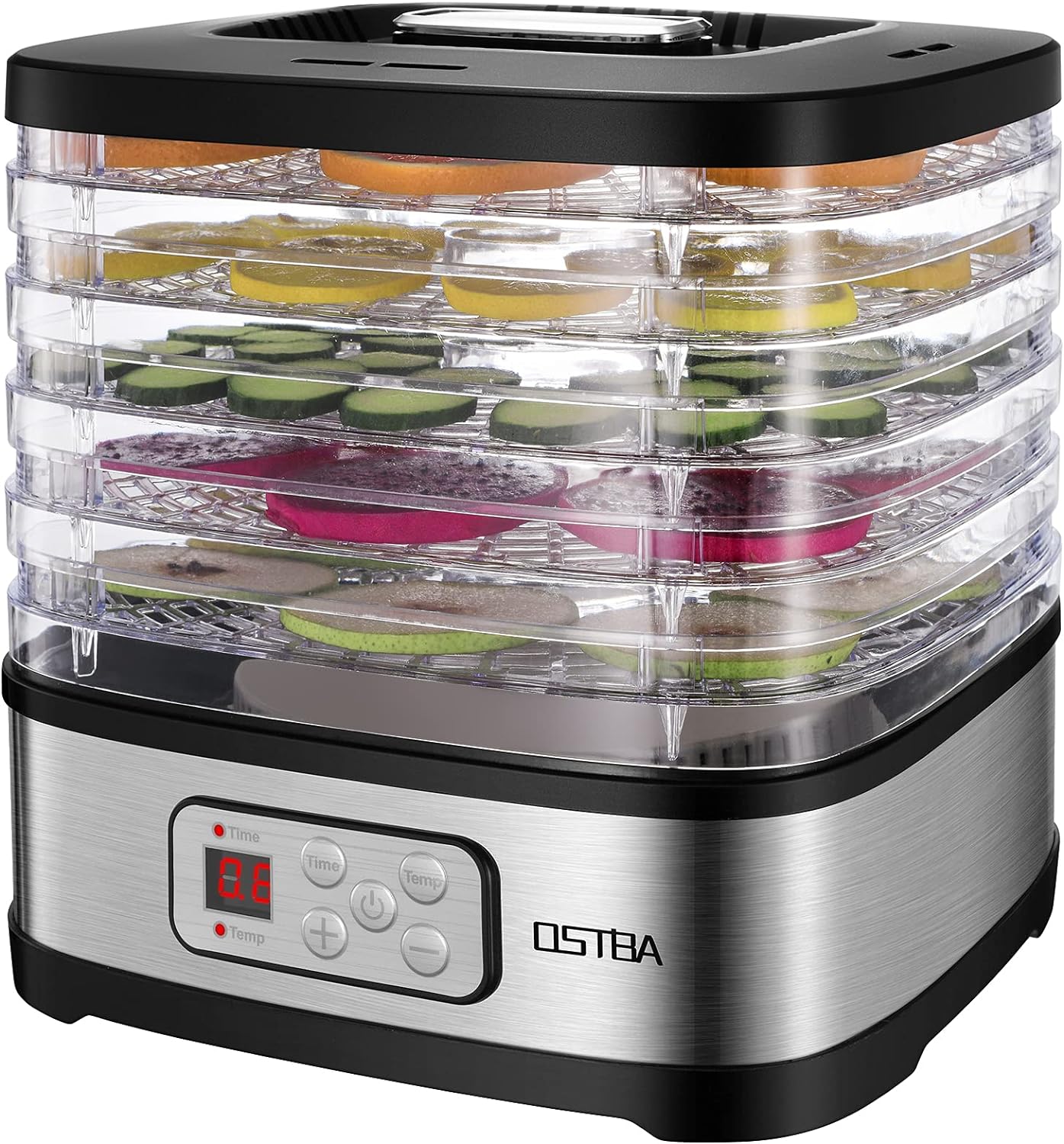
OSTBA Food Dehydrator GGJ-261B
| Wattage | 240 watts |
|---|---|
| Number of Trays | 5 |
| Temperature Range | 95℉ to 160℉ |
| Voltage | 120 volts |
This OSTBA 5-tray dehydrator is a small, user-friendly unit aimed at everyday home preservation tasks like drying hot peppers, herbs, fruit slices, and jerky. It uses a rear-mounted fan with 360° circulation to promote even drying and an LED touchscreen that displays temperature and remaining time for simple operation. The thermostat covers roughly 95 to 160°F and a 1–72 hour timer gives plenty of range for low-and-slow drying favored by peppers and thin slices. The stacked BPA-free trays save counter space and are dishwasher-safe for easy cleanup, and the clear door lets you monitor progress without interrupting the cycle. At 240 watts it runs quietly and should be fine for small batches, but its compact footprint limits throughput if you plan to dry large pepper harvests all at once. For pepper drying it handles thin slices and whole smaller pods very well, though larger batches will require multiple runs or a larger multi-tray unit.
Best for: Home cooks who prioritize efficient, small-batch food preservation and precise temperature control for drying peppers, herbs, and snacks without taking much counter space.
Less Ideal for: People who need to process very large pepper harvests or high-volume commercial drying should choose a larger multi-tray or higher-power dehydrator.
- Adjustable temperature 95–160°F and 1–72 hour timer for precise low-temperature drying
- 360° airflow design helps produce even drying across all trays
- Five stacked BPA-free trays save counter space and are dishwasher safe for easy cleaning
- Clear front window and LED touchscreen make monitoring and programming convenient
- 240W power and compact size limit batch capacity for large harvests
Verdict: A compact, precise 5-tray dehydrator well suited for small-batch hot pepper drying and home food preservation.
NESCO FD-37 Food Dehydrator

| Wattage | 400 watts |
|---|---|
| Number of Trays | 4 |
| Temperature Range | 160 °F |
The NESCO FD-37 is a straightforward countertop dehydrator that uses a top-mounted powerhead and radial fan-flow to push heated air down through a central chamber and across four clear plastic trays. It is typically used for making fruit chips, herbs, and beef or turkey jerky, and the clear cover makes it easy to monitor progress without opening the unit. The fixed temperature control removes guesswork for beginners but does mean you cannot lower or raise heat for very delicate items. Trays are BPA-free and the unit expands to up to seven trays with add-on trays, so you can scale batch size gradually. The powerhead detaches for easier cleaning and the 400-watt motor runs quietly while providing consistent drying without tray rotation. Expect a basic, reliable dehydrator that covers common drying tasks well but lacks precise temperature adjustment for advanced pepper-drying techniques that require exact low-temperature control.
Best for: Home cooks who want an affordable, no-fuss dehydrator for making snacks, jerky, and dried peppers without learning complex temperature settings.
Less Ideal for: Users who need precise, adjustable low-temperature control for slow-drying specialty hot peppers or who prefer all-metal construction should consider higher-end models instead.
- Top-mounted fan-flow provides even drying without rotating trays
- Clear top cover lets you monitor food during drying
- Expandable from 4 to 7 trays to increase capacity
- Detachable powerhead for easier cleaning and maintenance
- Fixed, non-adjustable temperature limits precise control for very low-temp drying
- Trays are plastic rather than metal, which some users may prefer
Verdict: A budget-friendly, easy-to-use dehydrator that reliably handles everyday snacks and jerky and can be expanded for larger batches.
Cosori Stainless Steel Dehydrator CP267-FD

| Wattage | 600 watts |
|---|---|
| Voltage | 120 volts |
| Number of Trays | 6 |
| Temperature Range | 95-165 F |
| Operating Frequency | 60 hertz |
The Cosori CP267-FD is a countertop dehydrator built for batch drying and predictable results. It uses a rear-mounted 600W fan and horizontal airflow to circulate heat evenly across six stainless steel trays, so you can dry many peppers at once without rotating trays. The digital controls let you set temperatures from 95 to 165 F and a 48-hour timer, which is handy for slow-drying hot peppers or making fruit leather and jerky. Stainless-steel construction and included mesh and fruit-roll sheets keep food off plastic surfaces and make cleanup easy since the trays are dishwasher-safe. Noise is low thanks to a brushless motor rated under 48 dB, so overnight runs are practical. The unit is fairly large, so it takes counter space, and the temperature tops out at 165 F which is fine for peppers but limits very high-heat applications. For cooks who want straightforward, repeatable dehydration with large capacity and a focus on durability, this model performs well.
Best for: Home cooks who prioritize steady performance and durability and want to dry large batches of hot peppers or snacks with predictable, repeatable results.
Less Ideal for: People with very limited counter space or those who need temperatures above 165 F for specialized drying or cooking techniques.
- Six stainless-steel trays provide large drying area for whole or sliced peppers
- Digital temperature control from 95 to 165 F and 48-hour timer for precise, repeatable results
- Rear-mounted fan with horizontal airflow promotes even drying without tray rotation
- Brushless motor runs quietly under 48 dB suitable for overnight cycles
- Includes mesh screen and fruit roll sheet and dishwasher-safe trays for easy cleaning
- Maximum temperature of 165 F may be low for users needing higher heat for certain recipes
- Relatively large footprint requires dedicated counter or storage space
Verdict: A large-capacity, stainless-steel dehydrator that delivers quiet, even, and repeatable drying—ideal for reliably drying hot peppers at home.
Cosori Compact Food Dehydrator N051

| Wattage | 350 watts |
|---|---|
| Voltage | 120 volts |
| Number of Trays | 5 |
| Temperature Range | 95-165 F |
The Cosori Compact Food Dehydrator N051 is a straightforward countertop unit for making jerky, fruit leather, dried herbs, and hot pepper flakes. It uses a 350W heater and fan with a digital control that sets temperature from 95 to 165°F in 1°F increments and a timer that runs up to 48 hours in 30-minute steps, so you can dial in low-and-slow drying or the higher heat recommended for safe beef jerky. The round stackable design includes five large BPA-free trays with adjustable tray height and the option to expand to seven trays, which helps when processing long peppers or thicker slices. Built from food-safe polypropylene, it is quieter than many models at under 47 dB, and Cosori includes a 50-recipe booklet to get started. Trade-offs are the plastic construction instead of metal and a compact footprint that limits batch size compared with larger cabinet-style dehydrators, so expect to run multiple batches for large pepper harvests.
Best for: Buyers who prioritize precise temperature control and quiet, countertop drying for small to medium pepper batches and who value peer-recommended, reliable performance.
Less Ideal for: Not a good fit for users who need commercial capacity or want a heavy-duty metal cabinet for continuous large-batch processing.
- Precise temperature control from 95 to 165°F in 1°F steps for accurate drying of peppers and herbs
- Five large BPA-free trays with adjustable heights and expandable capacity to 7 trays
- Quiet operation under 47 dB suitable for overnight drying
- Digital timer up to 48 hours allows unattended long runs
- Included recipe book helps with drying times and techniques
- Polypropylene body is less rugged than metal cabinet dehydrators
- Compact capacity means larger pepper harvests may require multiple batches
Verdict: Choose this Cosori if you want a quiet, precisely controlled countertop dehydrator that handles small to medium hot pepper batches reliably.
Choosing the Right Food Dehydrator for Hot Peppers: Key Factors to Consider
Temperature Control
Precise temperature control matters because hot peppers lose volatile flavor compounds and can become bitter if dried too hot. A unit with an adjustable thermostat and accurate readout allows you to dial in the low-to-moderate temperatures most peppers require. Digital controls make repeatable results easier, while simple analog knobs can be acceptable if the range includes lower settings and is stable.
Also consider whether the dehydrator maintains temperature under load. Full trays and higher humidity can pull heat down, so models that compensate or have stronger heating elements produce more consistent batches.
Airflow and Tray Design
Even airflow across the trays prevents uneven drying and reduces the need to rotate trays mid-cycle. Look for designs that distribute air horizontally or vertically in a balanced way, and for tray spacing that allows good circulation around whole peppers or sliced pieces.
Transparent or stackable tray systems that let you monitor progress without interrupting the cycle are helpful. Mesh trays or inserts can be useful for small seeds and flakes, while solid trays are easier to clean when dealing with sticky pepper oils.
Capacity and Batch Size
Think about how much you will process at once. If you harvest garden batches, you may want several large trays or an expandable unit so you can dry a large quantity in one run. For occasional use, a compact dehydrator with fewer trays saves counter space and energy.
Keep in mind that filling trays too densely slows drying and can lead to spoilage during drying. Choosing the right capacity reduces the number of batches you need to run and improves overall efficiency.
Cleaning and Maintenance
Peppers can release sticky oils and pigments that stain or cling to tray surfaces. Removable, dishwasher-safe trays or wipe-clean surfaces reduce the time spent on cleanup and prevent flavor transfer between batches. Smooth plastic or stainless steels are typically easier to sanitize than porous materials.
Also consider how easy it is to access the heating element and fan for occasional cleaning. Units that require special tools to disassemble will make maintenance harder and can shorten effective service life if owners skip upkeep.
Drying Speed and Energy Use
Faster drying reduces the time peppers are exposed to air and potential contamination, but speed should not come at the cost of excessive heat. Efficient units balance wattage and airflow to shorten cycle time while keeping temperatures safe for preserving flavor.
For users running frequent large batches, energy-efficient models lower operating costs. Look for units that circulate air effectively so they do not rely solely on higher wattage to accelerate drying.
Safety and Materials
Materials that contact food should be BPA-free and resistant to staining from oils and pigments. Check that the unit has thermal cutoffs or overheat protection to reduce fire risk during long cycles.
Stable feet and secure tray locks prevent spills when moving full trays. If you process very hot peppers, consider a unit where removable parts can be safely washed without exposing electronics to moisture.
Preparing Hot Peppers for Dehydration
Proper preparation shortens drying time and improves the final texture. Wash peppers and dry them thoroughly to remove surface moisture. For consistent drying, slice thicker varieties into uniform rings or halves so pieces reach the same dryness at the same time.
Decide whether to leave seeds and membranes in place. Leaving them can preserve maximum heat, while removing them reduces drying bulk and can produce milder flakes. For very hot varieties, consider wearing gloves and work in a well-ventilated area to avoid irritation.
- Pat peppers dry before slicing to reduce initial moisture load.
- Use consistent slice thickness for even drying.
- Wear gloves when handling super-hot peppers.
Ideal Drying Temperatures and Timelines
Most hot peppers dehydrate well between 125°F and 140°F. Lower temperatures preserve volatile flavors and capsaicin better, but they take longer. Thinner slices and smaller varieties dry faster than thick, meaty peppers.
Typical drying cycles range from 6 to 18 hours depending on temperature, humidity, and piece size. Check progress periodically and test for brittleness or leathery texture; peppers should be fully dry to avoid mold during storage.
- Thin slices: faster drying, lower heat.
- Whole small pods: may need longer time and airflow.
- Higher humidity environments increase drying time.
Storage and Rehydration Tips
Store fully dried peppers in airtight containers in a cool, dark place. For long-term storage, consider vacuum sealing to reduce oxygen exposure and maintain flavor. Moisture indicators or small desiccant packets can help keep products stable.
For rehydration, soak pieces in warm water for 15 to 30 minutes before using in sauces or stews. Grinding dried peppers into flakes or powder is an efficient use of space, but ensure they are completely dry to avoid clumping or spoilage.
- Use airtight jars or vacuum bags for long-term storage.
- Label containers with variety and drying date.
- Toast briefly before grinding to boost aroma.
Common Drying Problems and Fixes
Uneven drying is often caused by crowded trays or poor airflow. If you see soft spots, remove trays and rearrange pieces so air moves freely around each pepper. Increasing the dehydrator temperature slightly can help, but avoid overshooting the recommended range.
If peppers develop off smells, they may not have been fully dry before storage. In that case, re-dry the batch at low heat until all moisture is eliminated. For sticky residue buildup, wash trays promptly after use to prevent transfer between runs.
- Rotate trays if design causes uneven spots.
- Increase airflow or lower tray load to improve circulation.
- Re-dry suspect batches before storing to prevent spoilage.
Using Dried Peppers in Cooking
Dried peppers are versatile: rehydrate them for sauces and chiles or grind them into flakes and powders for seasoning. Rehydrated peppers add texture and depth to soups and stews, while powdered forms provide concentrated heat. Consider toasting dried pieces lightly to awaken oils and intensify aroma before blending.
When substituting dried peppers in recipes, remember that heat concentrates during drying, so use smaller amounts and adjust to taste. Combine different dehydrated varieties to build complex spice profiles.
- Rehydrate in warm water for sauces and stews.
- Toast before blending to boost flavor.
- Start with small amounts when adding powdered peppers to dishes.
How We Chose the Best Food Dehydrator for Hot Peppers
We evaluated dehydrators using criteria that matter specifically for preparing hot peppers and preserving their flavor and capsaicin. Our selection prioritized precise temperature control that holds steady across long cycles, because peppers are sensitive to overheating which dulls flavor. We also looked for uniform airflow designs that reduce the need to rotate trays and prevent spotty drying. Capacity and tray layout were evaluated to match both small-batch kitchen use and larger harvest runs, including stackable or multi-tray systems that keep airflow efficient. Build quality and ease of cleaning were important since sticky pepper oils can transfer between batches. We favored units with removable trays and surfaces that tolerate routine washing. Energy use and drying speed were considered together, preferring models that balance faster drying without high heat. Finally, we excluded single-use or novelty devices lacking temperature control or consistent airflow, and we filtered out models with poor safety features or unclear materials that contact food. The result is a practical set of dehydrators suited to preserving hot peppers safely and effectively.
Our full evaluation process is outlined in our review methodology.
FAQ
What is the best temperature to dry hot peppers?
Most hot peppers dry well between 125°F and 140°F. Lower temperatures preserve volatile flavors but require longer drying times, while higher temperatures speed drying but can reduce aroma and alter heat perception.
How can I tell when peppers are fully dehydrated?
Fully dehydrated peppers are brittle or leathery with no soft, cool spots. Small pieces should snap easily. If any moisture remains, re-dry before storage to prevent mold.
Should I remove seeds before dehydrating?
Removing seeds is optional. Leaving them preserves maximum heat and flavor but increases bulk. Removing seeds can reduce drying time and yield milder flakes for seasoning.
Can I dehydrate whole peppers?
Yes, small or thin-walled varieties can be dried whole. Larger, thicker peppers dry more slowly and may need slicing to ensure the center dries completely. Ensure air can circulate around whole pods.
How should I store dried peppers to keep them fresh?
Store dried peppers in airtight containers in a cool, dark place. For longer life, use vacuum sealing or include desiccant packets to limit moisture and oxygen exposure.
Final Verdict
Choosing the right food dehydrator for hot peppers comes down to controlling temperature, ensuring even airflow, and matching capacity to your typical batch size. Prioritize units with accurate, low-range temperature control and designs that distribute air uniformly across trays. Balance drying speed against flavor preservation and pick a design that is easy to clean and maintain. Ultimately, focus on the features that reduce hands-on time and produce consistent, fully dry peppers. That approach helps you preserve heat and flavor reliably so you can use your dried peppers in a wide range of recipes with confidence.