
Note: This article contains affiliate links. If you click on these links and make a purchase, we may earn a small commission at no extra cost to you. This helps support our research and content. Read our full affiliate disclosure here.
If you process dried fruit, jerky, herbs, or snacks regularly, choosing the right food dehydrator for small business matters for output consistency and product quality. A commercial-capable unit with stable temperature control and enough tray capacity reduces batch variability and labor time. This guide curates the top shortlisted options suitable for small-scale production and side businesses, focusing on the features that affect daily throughput, energy use, and food safety. Below we list our top picks and explain the evaluation factors you should weigh before buying, including capacity, temperature accuracy, and cleaning considerations. Use this guide to narrow choices and match a dehydrator to your production rhythm.
Top Picks at a Glance
| Best Overall The best all-around choice for most situations | Magic Mill Pro Food Dehydrator MFD-7700 |  |
| Best Quality Built to a higher standard if you want something more solid | Tribest Sedona Express SDE-S6780-B |  |
| Best Value The sweet spot between price and what you get | Magic Mill Food Dehydrator MFD-5000 |  |
| Best Budget The cheapest option that still gets the job done reliably | vassillias Food Dehydrator FD704MJY-1 |  |
| Top Rated A top-rated pick with lots of positive feedback | PSIIDAN Food Dehydrator FD-1033 |  |
| Most Popular A crowd favorite that many people choose with confidence | Cosori Stainless Steel Dehydrator CP267-FD |  |
| Best Seller A high-volume bestseller chosen again and again | Cosori Stainless Steel Dehydrator P501 |  |
Magic Mill Pro Food Dehydrator MFD-7700

| Wattage | 600 |
|---|---|
| Voltage | 120 |
| Number of Trays | 7 |
| Material | Stainless Steel |
The Magic Mill Pro is a heavy-duty countertop dehydrator built for frequent use, with a full stainless-steel interior and seven full-size trays that make batch drying straightforward. A 600W rear-mounted fan and rear heat design deliver even airflow across all trays so you can dry jerky, fruit, herbs, and fruit leather without rotating trays, and the 95–176°F range with 1°F increments gives precise control for repeatable results. The digital 48-hour timer with auto shutoff and a keep-warm mode up to 24 hours makes longer runs easier to manage, and included mesh screens plus a fruit roll/drip tray help with small items and marinades. Safety features include ETL listing and overheat protection, and the stainless construction reduces plastic contact and improves durability and cleanup. Trade-offs are its footprint compared with compact units and the lack of specialized commercial features like removable drip trays on wheels or higher-capacity stacking, so very large-scale production operations may prefer commercial dehydrators designed for continuous high-volume throughput.
Best for: A small-business operator who needs reliable, repeatable batch drying with food-safe construction and precise temperature control for products like jerky, fruit leather, and dried herbs.
Less Ideal for: Businesses requiring continuous, high-volume production or trolley-style racks for large batches should consider purpose-built commercial dehydrators instead.
- Full stainless-steel interior and seven full-size stainless trays for durable, food-safe batch drying.
- 600W rear fan and rear heat provide consistent, even drying across all trays without rotation.
- Digital temperature control with 1°F increments from 95–176°F for precise, repeatable results.
- 48-hour timer with auto shutoff plus 24-hour keep-warm mode supports long runs and unattended cycles.
- Includes mesh screens and a fruit roll/drip tray for small items and sticky mixtures.
- Larger countertop footprint than compact home dehydrators, which may limit placement in small kitchens.
- Not a commercial rack system so throughput is lower than dedicated commercial dehydrators for very high-volume operations.
Verdict: A robust, stainless-steel countertop dehydrator with precise controls and seven trays that fits small businesses wanting reliable multi-batch drying without stepping up to full commercial equipment.
Tribest Sedona Express SDE-S6780-B

| Wattage | 470 watts |
|---|---|
| Voltage | 120 volts |
| Number of Trays | 11 |
| Temperature Range | 167 °F |
The Tribest Sedona Express is a compact, performance-focused dehydrator built around a single-center fan and all-digital controls that let you set precise temperatures and staged timers. It is typically used for drying fruit, vegetables, crackers and jerky, and its 167 F top temperature meets USDA guidance for beef jerky while a low setting supports fermenting or raw food dehydration. Eleven stainless steel trays and a glass hinged door with internal LED make loading and monitoring straightforward, and the reusable air filter plus removable trays simplify cleaning. The Two-Stage Sequential Temperature Timer (TST) gives repeatable results for multi-step recipes, and the unit runs quietly for countertop use. Because it uses a single fan for airflow, drying is uniform for most loads but very large or densely packed batches may require tray rotation or thinner slicing for fastest results. At its price and size the Sedona Express balances professional features and a kitchen-friendly footprint for high-frequency home or small-scale use.
Best for: Small-business operators or serious hobbyists who need a compact, countertop dehydrator that delivers repeatable, high-temperature performance for jerky and frequent small-batch production.
Less Ideal for: Large-scale commercial producers who require higher throughput, multiple independent airflow zones, or rack systems sized for continuous processing.
- Precise digital controls with Two-Stage Sequential Temperature Timer for repeatable drying
- Eleven stainless steel trays increase usable capacity for small-batch commercial runs
- Maximum 167 F temperature suitable for USDA-compliant jerky preparation
- Compact countertop design with glass door and internal LED for easy monitoring
- Single central fan may need tray rotation for very dense or uneven loads
- Relatively heavy unit for its size, which reduces portability
Verdict: The Sedona Express packs professional-grade temperature control and an 11-tray stainless steel capacity into a compact, quiet machine ideal for small-business or high-volume home dehydrating.
Magic Mill Food Dehydrator MFD-5000

| Wattage | 240 watts |
|---|---|
| Voltage | 110 volts |
| Number of Trays | 5 |
| Temperature Range | 95-167 °F |
| Material | Stainless Steel trays |
The Magic Mill MFD-5000 is a compact countertop dehydrator aimed at home cooks and small-scale producers who need a straightforward drying solution. It uses a 240W heater and a digital control panel to set temperature (95–167°F) and a 48-hour timer, making it suitable for drying fruits, herbs, jerky, and pet treats. Five food-grade stainless steel trays are adjustable to accommodate thicker cuts and are dishwasher-safe for easy cleanup. The unit emphasizes food-safe materials with stainless trays and a BPA-free plastic body, and the top temperature and long timer let you reliably finish tougher items like jerky. Because it is compact and relatively low wattage, throughput is limited compared with commercial belt or cabinet dehydrators, so expect longer batches or smaller yields per run. For small businesses testing recipes, making samples, or producing modest weekly quantities, this model delivers consistent, usable results without complicated controls.
Best for: Small business owners who need a reliable countertop dehydrator for recipe development, small-batch production, or sampling and prioritize straightforward controls and easy cleaning.
Less Ideal for: Businesses that require high daily throughput or continuous commercial-scale drying should look at larger cabinet or conveyor-style dehydrators instead.
- Five stainless steel, adjustable trays that are food-safe and dishwasher-cleanable
- Digital timer up to 48 hours and temperature control from 95 to 167°F for precise drying
- Compact footprint and 240W power draw suitable for countertop use
- BPA-free plastic body and stainless base for durable, food-safe construction
- Limited capacity compared with commercial cabinet or multi-batch dehydrators
- Lower wattage means longer drying cycles for large or high-moisture loads
Verdict: A compact, easy-to-use stainless-steel tray dehydrator that fits small-batch production and recipe testing for growing food businesses.
vassillias Food Dehydrator FD704MJY-1

| Wattage | 280 |
|---|---|
| Number of Trays | 5 |
| Material | Plastic |
This vassillias dehydrator is a simple, budget-friendly unit designed for small-batch drying of fruit, jerky, herbs, vegetables and mushrooms. It uses a 280W fan and evenly spaced trays to promote consistent airflow across five removable BPA-free trays, and the temperature dial adjusts from 104°F to 158°F to handle delicate herbs or thicker cuts of meat. The compact footprint fits most counters and the trays lift out for easy cleaning or loading. Safety features include an automatic shutoff on abnormal temperatures and a recommendation to keep dishwasher loads under 122°F. Expect straightforward operation without advanced presets or digital controls, so timing and temperature management rely on the user. For small business owners testing products or producing modest quantities, it offers a low-cost way to produce dehydrated goods, though it lacks the capacity, precise digital control, and commercial durability of larger pro-grade machines.
Best for: Small business owners seeking an inexpensive, compact dehydrator to experiment with recipes or produce limited batches for markets and sampling.
Less Ideal for: Producers who need high-capacity, continuous-use commercial dehydrators or precise digital process controls should look at larger, commercial-grade equipment.
- Five removable BPA-free trays for flexible small-batch drying and easy cleaning
- Adjustable temperature range (104°F–158°F) to handle herbs, fruit and jerky
- 280W fan-driven airflow design promotes more even drying across trays
- Compact countertop footprint that fits into tight kitchen spaces
- No digital controls or timers, so users must monitor run time manually
- Not built for high-volume commercial production or continuous heavy use
Verdict: A low-cost, compact dehydrator that gives small-scale producers a simple way to dry test batches and small runs without a big equipment investment.
PSIIDAN Food Dehydrator FD-1033

| Wattage | 650 watts |
|---|---|
| Number of Trays | 8 |
| Temperature Range | up to 167 °F |
The PSIIDAN FD-1033 is a compact, 650W countertop dehydrator built for frequent home or small-batch commercial use. It uses 360° airflow and eight stainless steel trays to dry large quantities in a single run, while a mesh tray and drip tray handle small or juicy items. Controls let you set temperature up to 167°F and a 48-hour timer with one-touch start and auto shut-off, and an interior light allows visual checks without opening the door. Dual-layer insulation keeps the exterior cooler during long cycles and the motor is designed for quiet operation so it can run overnight or in a small kitchen. Practical benefits include easy-to-clean stainless trays, included recipe guidance to speed setup, and accessories that let you switch between jerky, fruit leather, and herbs. Limitations are the single-chamber design, which means you cannot independently control zones, and the top temperature ceiling may be lower than some specialty commercial units that require higher heat for very fast production.
Best for: Small-batch producers or home-based food businesses that need reliable, consistent drying for jerky, fruit, and herbs and value easy cleanup and quiet operation.
Less Ideal for: High-volume commercial operations that need multi-zone control, larger continuous throughput, or higher maximum drying temperatures.
- Large 8-tray stainless steel capacity for single-batch production
- 650W motor with 360° airflow for even drying
- Adjustable temperature up to 167°F and a 48-hour timer with auto shut-off
- Dual-layer insulation keeps the exterior cooler during long runs
- Single-chamber unit so all trays run at the same temperature
- Maximum temperature may be lower than some commercial dehydrators
Verdict: A practical, compact dehydrator that reliably handles single-batch small-business runs with even drying and easy cleanup.
Cosori Stainless Steel Dehydrator CP267-FD

| Wattage | 600 watts |
|---|---|
| Voltage | 120 volts |
| Number of Trays | 6 |
| Temperature Range | 95-165 F |
The Cosori CP267-FD is a countertop dehydrator built around six stainless steel trays and a rear-mounted 600 W fan that delivers horizontal airflow for more even drying without rotating trays. You use the touch-control panel to set temperatures from 95 to 165 F and a timer up to 48 hours, which makes it simple to run long jerky, fruit roll, or herb batches unattended. Practical touches include dishwasher-safe metal trays, a mesh screen and fruit roll sheet, and a compact rectangular housing that maximizes tray area. The upgraded brushless motor is relatively quiet at under 48 dB so overnight runs are less intrusive. For small-business use the sizable drying area and precise controls help maintain consistency across batches, but the unit is still a consumer countertop appliance so throughput is limited to six trays per cycle and heavier commercial demands may need multiple units or pro-grade equipment. Overall it is a capable, user-friendly option for makers scaling up from hobby production to light small-batch sales.
Best for: Small-batch producers and foodmakers who want reliable, repeatable drying and quiet overnight operation while scaling from hobby to light sales.
Less Ideal for: High-volume commercial operations that need continuous industrial throughput or larger single-cycle capacity.
- Six stainless steel trays provide a large drying area suitable for batch processing
- Precise digital temperature control from 95 to 165 F with a 48-hour timer for repeatable results
- Rear-mounted horizontal fan promotes even drying without tray rotation
- Brushless motor rated under 48 dB enables quiet operation for overnight runs
- Designed as a consumer countertop unit so capacity is limited to six trays per cycle
- Relatively heavy for a home appliance which may make moving between locations awkward
Verdict: A precise, quiet six-tray stainless steel dehydrator that suits small-batch producers moving beyond hobby projects into light commercial sales.
Cosori Stainless Steel Dehydrator P501
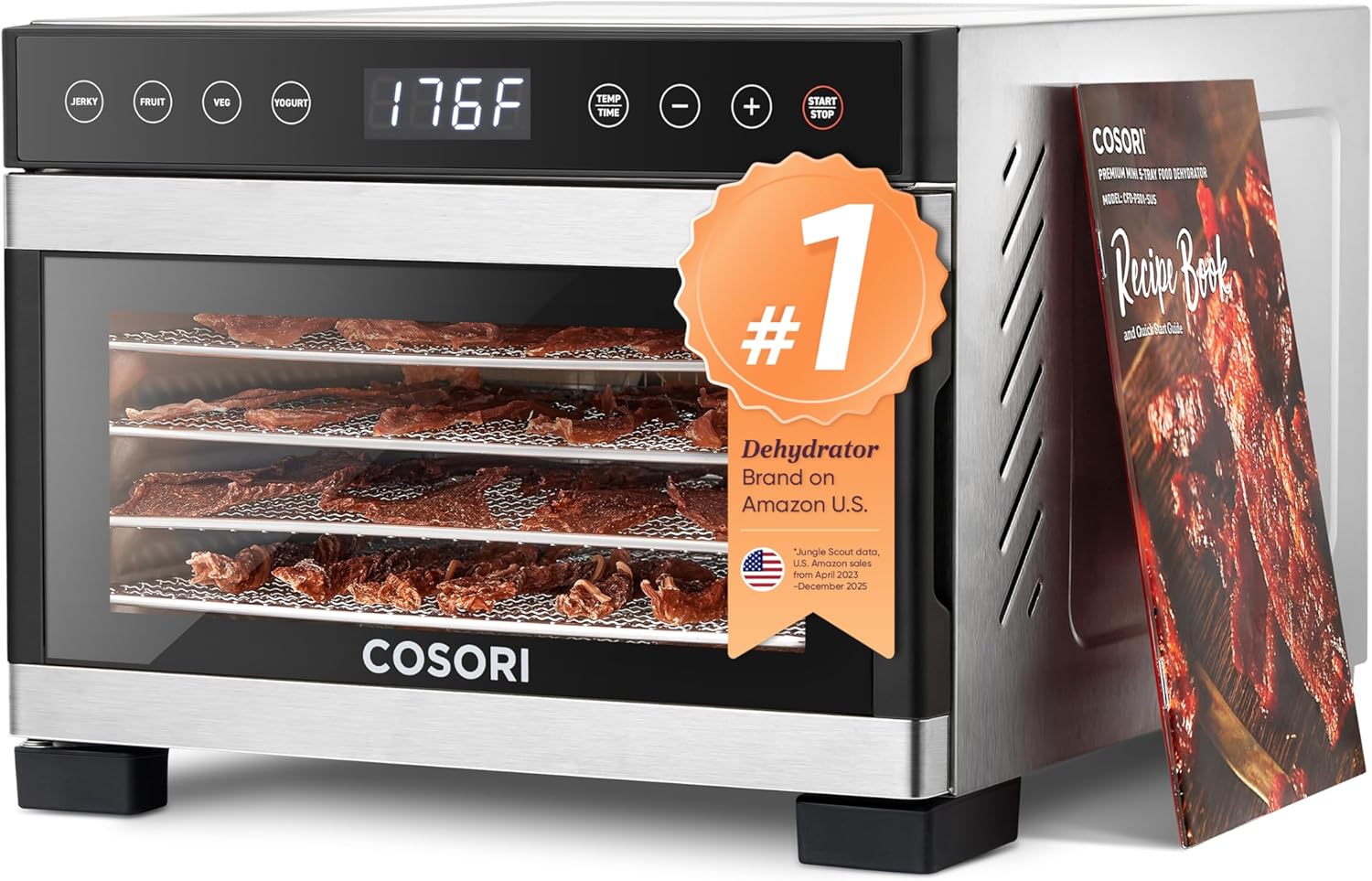
| Number of Trays | 5 |
|---|---|
| Temperature Range | 95-176 F |
| Wattage | 480 watts |
| Material | Stainless Steel |
The Cosori P501 is a countertop dehydrator built around a stainless steel cabinet and five stainless steel trays that give about 3.1 sq ft of drying area. It uses a rear-mounted fan and horizontal airflow to move heat evenly across trays and offers a digital thermostat adjustable from 95 to 176°F in 1°F increments plus four presets for jerky, fruit, vegetables, and yogurt. Typical use is straightforward: load sliced produce or seasoned meat on trays, select a preset or set time and temperature, and let the unit run for extended cycles up to 48 hours. The all-metal food path avoids plastic contact and the included mesh screen and fruit roll sheet expand what you can dry. For small-batch commercial use the precise temperature control and durable trays make consistent results easier to achieve, though its 480W power and compact footprint mean longer batches compared with larger industrial units. Noise is moderate from the rear fan and capacity is limited to five trays, so expect to run multiple batches for higher-volume production.
Best for: Small-business operators who prioritize food safety and consistent results in small batches and want a durable, easy-to-use countertop dehydrator for test batches, product development, or limited retail runs.
Less Ideal for: Businesses that need high hourly throughput or continuous production should choose a larger, higher-capacity commercial dehydrator instead.
- Stainless steel construction and trays prevent plastic contact with food
- Precise temperature control from 95 to 176°F in 1°F increments
- Rear fan with horizontal airflow promotes even dehydration across trays
- Includes useful accessories: mesh screen, fruit roll sheet, and recipe book
- Five-tray capacity is limited for higher-volume small business needs
- 480W power and compact size can require longer run times compared with larger commercial dehydrators
Verdict: A compact, factory-quality stainless steel dehydrator with precise temperature control that suits small-batch commercial testing and limited retail production.
Choosing the Right Food Dehydrator for Small Business: Key Factors to Consider
Drying Capacity & Tray Area
Tray area and the number of trays determine how much product you can process per cycle. For a small business, capacity affects batch scheduling, labor, and inventory turnover. Larger tray area or modular expansion options let you scale production without running more cycles, reducing total runtime and labor per finished pound.
Also consider tray spacing and stackability. Crowded trays can block airflow and extend drying times. If you plan varied product shapes and thicknesses, choose adjustable spacing or removable trays to adapt the usable surface area to different recipes.
Temperature Range and Accuracy
Accurate, stable temperature control prevents underdrying or overheating, which can cause microbial concerns or degraded texture and flavor. Small-business users often run long cycles overnight, so a controller that holds setpoints within a narrow margin minimizes batch variability and product loss.
Look for models with clearly marked settings, reliable thermostats, and options for low-temperature dehydration for herbs and higher temps for jerky. Digital controls with calibrated probes are typically easier to monitor than simple dial thermostats, but robustness matters more than fancy displays.
Airflow Design and Even Drying
Even airflow across all trays is critical to avoid spotty results that require rework. Convection fans combined with directed airflow or reverse-flow designs reduce the need to rotate trays mid-cycle. Uneven drying increases labor and can force you to run longer cycles to reach safe moisture levels throughout the load.
Consider whether the unit uses top, bottom, or rear-mounted fans and whether trays are perforated for better circulation. For small-business production, designs that deliver consistent airflow with minimal intervention save time and improve batch uniformity.
Material Safety and Cleaning
Materials in contact with food should be nonreactive and easy to sanitize. Stainless steel interiors and removable, dishwasher-safe trays reduce cleaning time and contamination risk. For high-volume use, gaskets, seals, and fan housings should be accessible for routine cleaning and inspection.
Sanitation protocols matter for shelf life and regulatory compliance. Units that minimize crevices and allow full tray removal shorten turnaround between batches and lower labor costs associated with cleaning.
Energy Use and Operating Cost
Drying is an energy-intensive process, especially for long cycles. Energy-efficient heating elements and well-insulated cabinets lower operating costs and heat loss into the workspace. For small businesses, tally expected daily runtime to estimate energy consumption and factor that into per-batch cost calculations.
Some models offer lower-wattage modes or timers to avoid running longer than necessary. Also evaluate how quickly a unit reaches set temperature, since faster heat-up reduces wasted energy and cycle time.
Control Features and Automation
Controls that support timers, delayed starts, and programmable cycles reduce hands-on time and help standardize recipes across batches. Automation features are valuable in small production settings where consistent outcomes are needed from different operators.
Simple, durable controls are preferable to delicate interfaces that may fail under frequent use. Verify that any digital features are serviceable and that replacement parts or firmware updates are accessible for longer-term reliability.
Sizing a Dehydrator to Your Production Volume
Estimate how many pounds of finished product you need per day and work backward to determine required tray area and cycle count. Consider peak days and seasonal demand when sizing; a unit that meets average demand but cannot absorb spikes will force overtime or extra cycles.
If you process a range of items with different thicknesses, allow for extra drying time and choose a dehydrator with flexible tray spacing. For many small businesses, modular expansion or using multiple identical units provides a predictable scaling path without investing in a large single machine.
- Calculate batch throughput by dividing desired daily output by expected yield per cycle.
- Allow contingency capacity for slow-drying recipes or higher-humidity days.
- Consider parallelizing with multiple units rather than oversizing one machine to handle peaks.
Optimizing Drying Schedules and Workflow
Design production runs that maximize full-tray loads and reduce partial-cycle waste. Group similar products to avoid cross-contamination of flavors and to standardize temperature/time settings.
Stagger start times or use multiple machines to smooth labor demand and oven-space usage. Plan cleaning windows into your schedule to maintain food-safety standards without disrupting production.
- Run batches overnight where allowed by facility rules to use off-peak hours.
- Keep a simple log of temperature, humidity, and cycle time for each recipe to refine scheduling.
Maintenance, Spare Parts, and Longevity
Regular maintenance preserves performance and avoids unexpected downtime. Check fan bearings, heating elements, door seals, and tray condition on a schedule based on runtime. Replace worn components before they fail during a production run.
Identify which parts are user-replaceable and source spares for high-wear items. For small businesses, serviceability and a clear maintenance plan reduce downtime and the need for emergency replacements.
- Keep spare trays and gaskets on hand.
- Document maintenance tasks and intervals for staff.
Food Safety and Moisture Targets
Drying reduces water activity but may not eliminate pathogens if not done correctly. Follow established moisture and water-activity targets for your product type and use calibrated thermometers and hygrometers when necessary. Safe endpoint measurements reduce the risk of spoilage during storage.
Understand drying curves for your main products so you can set realistic cycle times. Overdrying wastes energy and can harm product quality, while underdrying shortens shelf life and may create safety issues.
- Measure final moisture or water activity rather than relying solely on time.
- Maintain traceability logs showing drying conditions for each batch.
Space, Ventilation, and Workspace Integration
A dehydrator for small business can generate heat and humidity in its immediate vicinity. Position units where ventilation and heat dissipation will not affect staff comfort or other equipment. Ensure adequate clearances for airflow and servicing.
Plan for storage of wet and dried goods close to the dehydrator to minimize handling time, but maintain separation to prevent cross-contamination.
- Allow sufficient clearance for heat output and door opening.
- Provide dedicated cleaning and staging areas nearby.
How We Chose the Best Food Dehydrator for Small Business
We evaluated units based on attributes that affect small-business drying workflow and finished-product consistency. Key filters included steady, accurate temperature control across the drying chamber, tray capacity and expandability to meet batch sizes, and airflow design that ensures even drying without constant tray rotation. We prioritized equipment with simple, serviceable components and materials suited to food handling, such as nonreactive trays and easily accessible seals. Energy efficiency and daily operating cost were assessed because running time can be long for commercial loads. We also considered ease of cleaning and maintenance to minimize downtime and food-safety risk. We excluded countertop novelty units and single-use appliances intended only for occasional home use. We did not include large industrial racks or systems requiring dedicated commercial installation. The resulting shortlist focuses on small-business-ready dehydrators offering repeatable performance, practical capacity, and manageable running costs.
Our full evaluation process is outlined in our review methodology.
FAQ
How do I estimate how many trays I need per day?
Estimate daily finished pounds, then determine yield per full tray based on product thickness and slicing. Divide total pounds by yield per tray to get the required tray count, and account for cycle time to calculate how many cycles you can run per day.
Can I use a home kitchen dehydrator for small-business production?
Often a home unit lacks capacity, airflow design, and serviceability needed for frequent commercial use. It may work for very small or occasional runs, but for sustained production you should choose a unit designed for heavier daily cycles and easier maintenance.
What temperature should I use for jerky versus fruit?
Jerky typically requires higher temperatures to reach safe internal moisture levels, while fruits and herbs dry at lower temperatures to preserve color and flavor. Use product-specific guidelines and confirm endpoints with moisture or water-activity measurements.
How important is a timer versus an automatic shutoff?
A timer helps prevent overdrying and reduce energy waste, while automatic shutoff tied to a sensor can provide more consistent endpoints. Both are useful; pick controls that match your operational discipline and the recipes you run.
How often should I perform maintenance on a business dehydrator?
Frequency depends on runtime, but inspect key components weekly for high-use operations and perform deeper cleaning and checks monthly. Replace consumables like trays and seals based on wear rather than a fixed timetable.
Final Verdict
Choose a dehydrator for small business by prioritizing consistent temperature control, adequate tray area, and a proven airflow design. Balance capacity with ease of cleaning and energy use to keep per-batch costs predictable. For many small producers, serviceability and spare-part availability matter as much as raw capacity. Decide based on your typical batch size and processing cadence: select a machine that comfortably handles peak production without excessive energy waste or extra labor. That approach keeps product quality consistent and operations scalable as your business grows.