
Note: This article contains affiliate links. If you click on these links and make a purchase, we may earn a small commission at no extra cost to you. This helps support our research and content. Read our full affiliate disclosure here.
Buying a freezer on a tight budget requires balancing usable capacity, energy consumption, and durability. You want enough storage for staples and bulk buys without a unit that spikes your electricity bill or fails after a season. This guide covers six shortlisted freezers under $200 that are practical for dorms, garages, or small kitchens. We focused on models that deliver efficient cold performance, smart interior layouts, and straightforward maintenance. Below you will find our top picks followed by clear buying guidance and the criteria we used to evaluate each freezer.
Top Picks at a Glance
| Best Overall The best all-around choice for most situations | EUHOMY Chest Freezer MCF-28H |  |
| Best Quality Built to a higher standard if you want something more solid | BLACK+DECKER 2.0 Cu. Ft. Chest Freezer |  |
| Best Value The sweet spot between price and what you get | Kismile Chest Freezer BD-80 |  |
| Best Budget The cheapest option that still gets the job done reliably | Climate Choice 3.5 Cu Ft Chest Freezer |  |
| Top Rated A top-rated pick with lots of positive feedback | DEMULLER 3.5 Cu Ft Chest Freezer |  |
| Best Seller A high-volume bestseller chosen again and again | BODACIOUS 5.0 Cu Ft Chest Freezer |  |
EUHOMY Chest Freezer MCF-28H
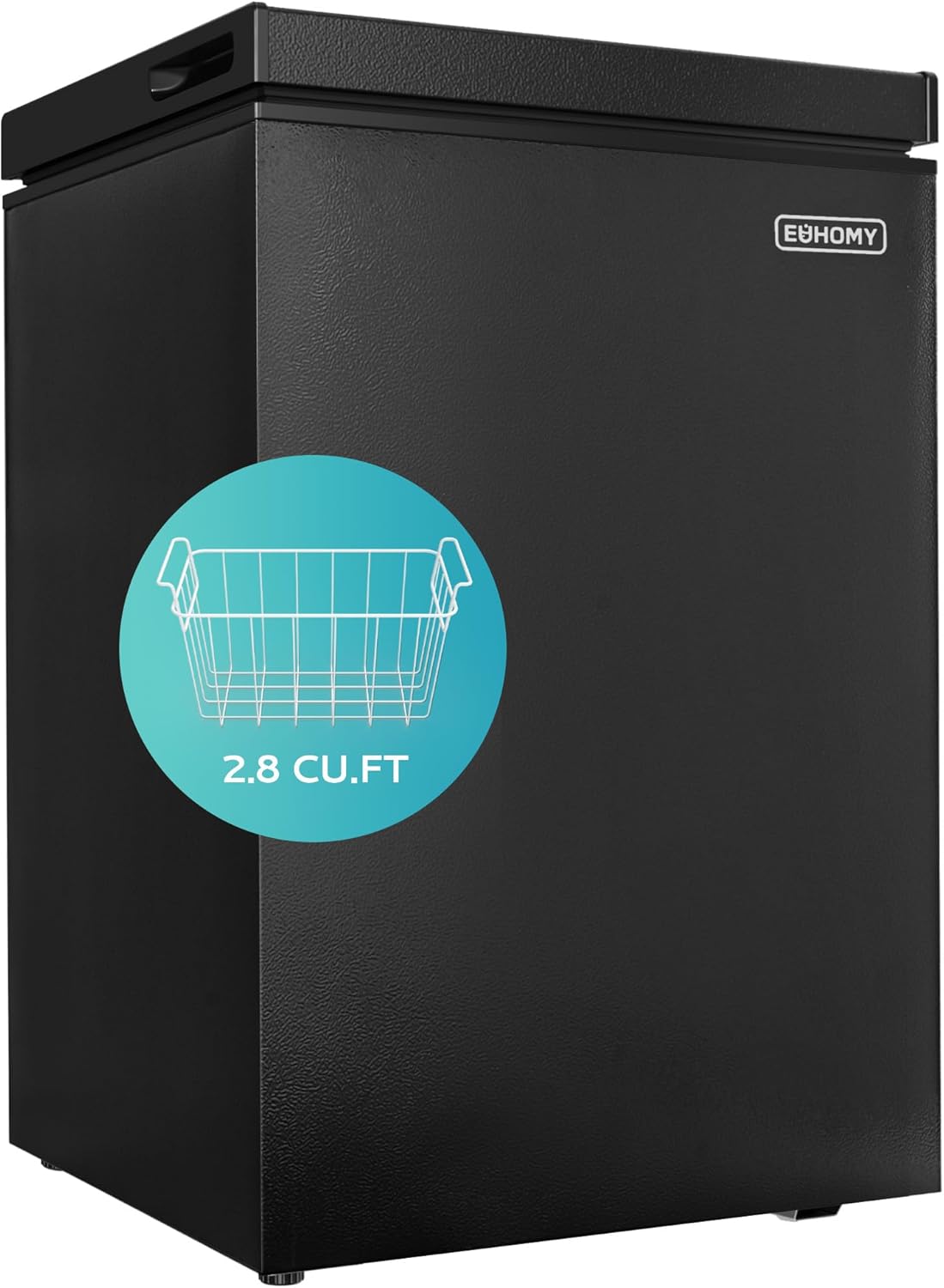
| Capacity | 3.1 cubic feet |
|---|---|
| Wattage | 90 watts |
| Voltage | 115 |
| Door Orientation | Top |
| Number Of Shelves | 2 |
The EUHOMY MCF-28H is a small chest freezer built to add extra frozen storage in apartments, dorms, or kitchens with limited space. It offers about 2.8 cubic feet of usable capacity and a removable mesh basket for sorting smaller items, while the top-opening lid can hold at a mid angle so you can access contents without holding the lid. Temperature is set with a 7-stage mechanical knob that spans roughly -7.6°F to 10°F for storing meats, seafood, and ready meals at a variety of coldness levels. The unit uses an R600a compressor rated at low noise (about 38 dB) and modest power draw (listed around 90 watts), which helps it run quietly and keep energy use low. Practical touches include a drainage port for defrosting and a compact footprint that fits tight corners. Limitations are its small capacity compared with full-size freezers and basic manual controls with no digital display or fast-freeze mode, so it is best for supplemental use rather than large-batch long-term storage.
Best for: Buyers who want an affordable, space-saving secondary freezer to hold weekly meat and frozen meals in tight kitchens or living spaces and who prioritize quiet, simple operation.
Less Ideal for: People who need large-volume long-term storage, precise digital temperature control, or rapid deep-freeze capability for big batches should consider larger or feature-rich models instead.
- Compact footprint fits small spaces like apartments and dorms
- Quiet operation (~38 dB) suitable for shared living areas
- Seven-stage thermostat gives fine manual temperature control
- Removable mesh basket and drain port simplify organization and defrosting
- No digital controls or fast-freeze function
- Limited total capacity compared with full-size freezers
Verdict: A quiet, budget-friendly compact chest freezer that fits tight spaces and provides reliable supplemental frozen storage under $200.
BLACK+DECKER 2.0 Cu. Ft. Chest Freezer

| Capacity | 2 cubic feet |
|---|---|
| Voltage | 115 volts |
| Number Of Shelves | 1 |
| Door Orientation | Top |
This BLACK+DECKER 2.0 cu. ft. chest freezer is a straightforward small deep freezer for adding extra cold storage in kitchens, garages, or basements. It holds roughly 70 pounds of food and includes a removable storage basket to keep frequently used items accessible while the larger cavity stores bulkier items. Temperature is set with an external mechanical dial offering seven settings and an indicator light so you can fine tune cooling without opening the lid. Maintenance is manual defrost, but the built-in drain makes thawing and cleanup easier than many compact chests. The unit runs on standard 115V power and uses R600a refrigerant. Expect typical chest-freezer behavior: efficient cold retention and simple reliable cooling, but you will need to plan for manual defrost cycles and allow clearance for proper ventilation. For buyers focused on cost-effective extra capacity, this model delivers dependable performance in a small footprint.
Best for: Buyers who need an inexpensive, compact secondary freezer to increase frozen storage capacity and prioritize straightforward, reliable cooling performance.
Less Ideal for: People who want a no-maintenance, frost-free freezer or frequent upright-style access should consider different models.
- Compact 2.0 cu. ft. capacity that holds about 70 lbs. of frozen food
- Removable storage basket for organizing frequently used items
- External mechanical temperature dial with seven settings and indicator light
- Easy manual defrost with built-in drain simplifies cleanup
- Manual defrost requires periodic thawing rather than automatic defrost
- Top-opening chest design can be less convenient in tight vertical spaces
Verdict: A budget-friendly compact chest freezer that delivers dependable extra frozen storage and simple mechanical controls.
Kismile Chest Freezer BD-80

| Capacity | 3.2 cubic feet |
|---|---|
| Door Orientation | Top |
| Number Of Shelves | 1 |
| Installation Type | Freestanding |
This Kismile chest freezer is a small, no-frills deep freezer intended for tight spaces like dorms, apartments, or a kitchen corner. It offers 3.2 cubic feet of storage and two removable baskets that make organizing small packages, frozen meals, or breast milk straightforward. Temperature is set with a 7-grade adjustable thermostat that ranges roughly from 6.8 F to -7.6 F so you can choose between normal freezing and deeper cold for longer storage. The balanced hinge-style top door stays open at multiple angles for easier loading, and a convenient drain port speeds defrosting and clean-up. The compressor is marketed as energy efficient and the unit runs quietly under 40 dB, which helps in living areas. Important limitations are its fairly small capacity compared with full-size freezers and the narrower temperature range that may not reach extremely low commercial deep-freeze levels. Overall it performs as an economical, space-saving secondary freezer for everyday household needs.
Best for: Buyers looking to maximize usable cold storage in a small footprint who want an affordable secondary freezer for routine home use and easy organization.
Less Ideal for: Those who need large-capacity or commercial-grade deep-freezing for long-term bulk storage or very low temperature requirements should consider larger upright or chest models.
- Compact 3.2 cu ft footprint fits small spaces like dorms or apartments
- Two removable baskets help organize small items and make access easier
- 7-step adjustable thermostat for choosing between normal and deeper freezing
- Balanced hinge top door that holds open at multiple angles for loading
- Low reported noise level and modest daily energy use (about 0.68 kWh/day)
- Small overall capacity limits how much bulk frozen food you can store
- Temperature range tops out around -7.6 F, which may not suit ultra-low deep-freeze needs
Verdict: A practical, space-saving chest freezer that delivers organized, quiet secondary cold storage at a budget-friendly level.
Climate Choice 3.5 Cu Ft Chest Freezer

| Capacity | 4.2 cubic feet |
|---|---|
| Wattage | 58 watts |
| Voltage | 115 volts |
| Installation Type | Freestanding |
This small chest freezer provides usable extra frozen storage in a compact footprint, making it a practical choice for apartments, dorms, garages, or offices. It offers seven temperature settings that span roughly -11.4°F to 10.2°F so you can dial in a colder setting for long-term storage or a milder setting for quick freezing, and a removable top basket helps keep frequently used items organized. The unit is freestanding with a top-opening lid and side handles that make lifting items easier, and it includes a drain for simpler manual defrost cycles. At under 40 dB it runs quietly and consumes about 0.37 kWh per day, so it is reasonable on energy costs for continuous use. Expect a basic feature set without advanced frost-free or smart controls, and plan to defrost periodically to maintain efficiency. For buyers prioritizing straightforward, inexpensive extra freezer capacity in a small footprint, this delivers solid value.
Best for: Buyers on a tight budget who need reliable extra frozen storage in a small space and value low running costs and simple controls.
Less Ideal for: Households that need large capacity, hands-off frost-free operation, or app-connected controls should look at larger or feature-rich models instead.
- Compact footprint fits small spaces like apartments and dorm rooms
- Seven adjustable temperature settings for flexible storage needs
- Removable storage basket and side handles improve organization and access
- Quiet operation below 40 dB and low daily energy consumption (0.37 kWh/24h)
- Manual defrost design requires periodic draining and maintenance
- No smart features or automatic frost-free operation
Verdict: A budget-friendly, space-saving chest freezer that gives reliable extra frozen storage with low energy use for small homes and tight budgets.
DEMULLER 3.5 Cu Ft Chest Freezer

| Capacity | 3.5 cubic feet |
|---|---|
| Wattage | 70 watts |
| Voltage | 110 volts |
| Number Of Shelves | 1 |
| Installation Type | Freestanding |
The DEMULLER 3.5 cubic foot chest freezer is a small, freestanding unit aimed at adding extra frozen storage in apartments, dorms, garages, or RVs. It uses an electronic control and digital display that allow you to set temperatures between -15°F and 41°F in 1°F increments, which makes it useful for everything from rapid freezing to storing produce. The freezer includes two removable stainless steel baskets for organizing smaller items and a drain hole to simplify manual defrosting. DEMULLER highlights D-shaped cooling tubes and a high-efficiency compressor that keep operation relatively quiet (under 38 dB) while delivering effective cooling. On the downside this is a manual-defrost chest rather than frost-free, so occasional thawing and draining is required, and its compact internal dimensions limit how many large items you can store. For buyers who want reliable, no-frills extra freezer capacity in a tight space, this unit combines precise temperature control and quiet operation at a budget-friendly scale.
Best for: Buyers who need an affordable, space-saving secondary freezer that holds a modest amount of food and delivers precise, quiet temperature control for everyday frozen storage.
Less Ideal for: People who want large capacity or a frost-free, low-maintenance freezer for high-volume long-term storage should look at larger or automatic-defrost models instead.
- Digital electronic temperature control with 1°F precision and a wide -15°F to 41°F range
- Compact 3.5 cubic foot capacity fits small spaces like apartments, dorms, or garages
- Two removable stainless steel baskets for easier organization
- Quiet operation with a low-noise compressor rated under 38 dB
- Built-in drain hole eases manual defrosting
- Manual defrost design requires periodic thawing and draining
- Limited internal space restricts large or bulky item storage
Verdict: A compact, quiet, and budget-friendly chest freezer that delivers precise temperature control for buyers needing dependable extra frozen storage under $200.
BODACIOUS 5.0 Cu Ft Chest Freezer

| Capacity | 5 cubic feet |
|---|---|
| Wattage | 58 watts |
| Voltage | 110 volts |
| Number Of Shelves | 1 |
| Specification Met | ETL |
This BODACIOUS chest freezer gives you a straightforward, compact deep-freezing option for apartments, garages, or small shops. It provides 5.0 cu ft of storage with a top-opening lid, one removable shelf/basket, and a fast-freeze function to lower temperatures quickly for better food preservation. The unit emphasizes low power use and quiet operation, advertising under 40 dB noise and roughly 0.36 kWh per 24 hours, which helps keep running costs down. Setup is simple since it is freestanding or countertop compatible and includes a built-in drain for easier defrosting and cleaning. Practical limitations include basic controls and a compact footprint that may not suit large households, and the documentation lists mixed warranty lengths so confirm coverage details before buying. For buyers focused on economical operation and unobtrusive performance, this freezer covers essential needs without extra smart features or large capacity frills.
Best for: Buyers who want a reliable, no-frills freezer that is inexpensive to run and fits into tight spaces, prioritizing low noise and predictable performance over advanced features.
Less Ideal for: Households needing very large freezer capacity, sophisticated temperature control, or networked monitoring should consider larger or feature-rich models instead.
- Quiet operation under 40 dB suitable for noise-sensitive spaces
- Low energy consumption (~0.36 kWh/24h) for affordable running costs
- Fast-freeze function helps preserve freshness after stocking
- Compact footprint fits small kitchens, apartments, garages
- Built-in drain and removable basket simplify cleaning and organization
- Limited capacity for large families or bulk storage
- Basic controls and no smart connectivity or advanced temperature readout
Verdict: A compact, quietly running 5.0 cu ft chest freezer built for low operating cost and dependable everyday frozen storage.
Choosing the Right Freezer: Key Factors to Consider
Capacity Vs Footprint
Pay attention to interior usable volume rather than just the advertised size. Budget freezers often list gross capacity that includes hard-to-reach corners or areas blocked by hinges and insulation. Measure the footprint you can dedicate at home and compare interior shelving layouts to ensure the unit will actually hold the items you plan to freeze.
Also consider vertical versus chest configurations. A tall upright unit can make better use of a narrow space and offers easier organization on shelves, while a chest-style freezer can provide more cubic feet per dollar but requires more floor area and may be harder to access.
Energy Consumption
Running costs matter more over the lifespan of a freezer than the purchase price. Look for units with reasonable estimated annual energy use and simple features that reduce compressor runtime, such as thicker insulation or efficient door seals. Even a modest improvement in kilowatt-hours per year adds up if the freezer runs continuously.
If utility costs are a concern, prioritize models with lower tested energy use and simple thermostatic control so you can avoid unnecessary overcooling. Consider where the freezer will live: warmer locations will increase run time and energy draw.
Temperature Control and Stability
Stable internal temperature prevents freezer burn and helps food keep longer. Check how the thermostat is controlled—mechanical dials are common on budget models and are easy to repair, while some units include basic digital readouts. A good seal and consistent compressor cycling are as important as the control interface.
Think about how often you will open the freezer. Frequent door openings make it harder to maintain steady cold, so look for designs with multiple internal baskets or compartments that limit exposure when accessing frequently used items.
Defrosting and Maintenance
Many budget freezers use manual defrost systems. Manual defrost can improve long-term energy use and avoid expensive auto-defrost components, but it requires you to plan time to thaw and clean the interior. Check how easy it is to remove shelves or baskets and whether drain plugs or removable liners are provided.
Also evaluate gasket design and accessibility. A replaceable gasket and straightforward access to the drain make routine maintenance simpler and extend the unit's functional life.
Noise Level and Location
Compressor noise and vibration vary widely, and where you place the freezer will affect how noticeable those sounds are. If the unit lives in a living area, lower noise and steady, low-frequency operation are preferable. For garage or basement placement, noise is less critical but you should still watch for excessive vibration which can damage items stored on or near the freezer.
Also consider the door swing and clearance so that you can position the freezer without blocking walkways or doors.
Interior Organization
A simple interior layout can make everyday use far easier. Look for removable baskets, adjustable shelves in uprights, or dividers for chest models. Good organization reduces how long the door stays open and helps you rotate stock to avoid waste.
Also check for accessory compatibility like sliding baskets or optional trays that can improve usability without adding much cost.
Where to Put a Budget Freezer in Your Home
Placement affects performance. Keep the freezer in a ventilated spot away from direct sunlight and heat sources like ovens or laundry appliances. Adequate airflow around the compressor area helps the unit run more efficiently and extends component life.
For indoor placement, choose a level surface and allow the recommended clearance around the sides and back. In garages or basements, consider ambient temperature swings seasonally. Some budget freezers are rated for cooler environments but can struggle in very hot or very cold ambient temperatures.
- Allow clearance for airflow and door swing
- Avoid placing near heat sources or in direct sun
- Use a level base to reduce vibration and wear
Organizing Food to Reduce Energy Use
How you load and organize a freezer impacts both convenience and energy efficiency. Keep frequently used items near the top or in a dedicated basket to minimize open-door time. Group similar items so you can find things quickly.
A well-packed freezer retains cold better than an empty one, but avoid blocking vents. Leave small gaps to allow circulation but avoid clutter that forces long door openings.
- Label and date items to rotate stock and reduce waste
- Use uniform containers to stack efficiently
- Keep a running inventory sticky on the unit to avoid unnecessary openings
Tips for Manual Defrosting
Manual defrosting requires planning but can keep a budget freezer running efficiently. Schedule defrost sessions when inventory is low and transfer important frozen goods to coolers or another freezer if possible. Unplug the unit, remove baskets and shelves, and let the ice soften; use towels to catch meltwater.
Avoid sharp tools to chip away ice because they can puncture the liner. After defrosting, wipe the interior dry, check the gasket for damage, and run the freezer empty for a short period before restocking to ensure temperature stability.
- Defrost when frost layer exceeds 1/4 inch
- Use warm water and plastic scrapers for safe ice removal
- Inspect and clean the door gasket during defrost
Maximizing Lifespan on a Budget Unit
Routine maintenance extends the usable life of inexpensive freezers. Keep the condenser area free of dust and debris and ensure the unit sits level. Regularly check door seals and replace them if they become brittle or loose.
Avoid overloading the compressor with heavy use in very warm conditions. If the freezer is to be used seasonally in a garage, consider extra insulation around the unit or move it indoors during extreme temperatures to reduce wear.
- Clean condenser coils or vents periodically
- Replace worn gaskets to maintain cold-holding
- Avoid placing hot food directly inside
Safety and Food Storage Best Practices
Keep a thermometer in the freezer to verify it is maintaining safe temperatures. The recommended freezer storage temperature is 0 degrees Fahrenheit or below for long-term storage. Rapidly freeze fresh items in small batches to preserve quality.
Label and date packages and practice first-in, first-out rotation to avoid long-forgotten items. Store raw meats on low shelves or in dedicated baskets to prevent leaks from contaminating other foods.
- Maintain 0 degrees Fahrenheit or lower for long-term storage
- Wrap foods tightly to prevent freezer burn
- Keep raw and ready-to-eat items separated
How We Chose the Best Freezer
We evaluated freezers under $200 using a focused set of practical, measurable criteria that reflect how these units are used in everyday homes. Our editorial filters prioritized cold-holding consistency because steady internal temperature directly affects food safety and storage life. Energy efficiency was another core filter since budget freezers can otherwise become expensive to operate over time. Usable storage drove selection rather than gross external size; we considered shelving, basket configuration, and how much of the advertised capacity is actually accessible. Build quality and durability were judged by material choices, gasket design, and user-serviceable features such as manual defrost access. Noise level and compressor cycling patterns mattered for units intended for indoor living spaces. Finally, ease of cleaning and basic maintenance were assessed for longevity and user convenience. We excluded units that exceeded the $200 cap, specialty freezers meant for commercial use, or models with persistent reliability warnings. We did not include brand-specific performance claims; instead, entries were chosen because they demonstrated solid results across the criteria above.
Our full evaluation process is outlined in our review methodology.
FAQ
How much freezer space do I actually need for one person?
It often depends on how frequently you buy in bulk. For a single person who shops weekly, a compact unit with 3 to 6 cubic feet of usable space is usually sufficient. If you buy large quantities or prepare meals in advance, aim for a larger interior volume to avoid overcrowding.
Are chest freezers more energy efficient than uprights?
Chest freezers can be more energy efficient because cold air settles and is less likely to escape when the lid opens. However, efficiency also depends on insulation quality, seal integrity, and compressor design, so check measured energy use rather than relying on layout alone.
Can a budget freezer be used in an unheated garage?
It depends on the unit's ambient temperature rating. Some budget freezers can tolerate cooler spaces, but extreme cold or heat can affect compressor performance and thermostat accuracy. If you plan garage use, choose a unit rated for that environment and monitor temperatures seasonally.
How often should I defrost a manual freezer?
Defrost when ice buildup reaches about a quarter inch. For typical household use, that might be once or twice a year, but high-humidity environments or frequent door openings may require more frequent defrosting.
What causes freezer odor and how do I remove it?
Odors usually come from spills or poorly sealed packages. Remove spoiled items, wipe interior surfaces with a baking soda and water solution, and air out the unit when possible. Long-term odor issues can indicate liner damage or persistent contamination that may need professional attention.
Final Verdict
When choosing a freezer under $200, focus on the real-world details: how much usable storage you need, how efficiently the unit will run in your intended location, and how easy it is to maintain. Expect tradeoffs between absolute capacity and features like digital controls or auto-defrost. Prioritize steady cold-holding, a good door seal, and a practical interior layout that reduces door-open time. With those priorities in mind, you can confidently pick a budget freezer that meets your needs while keeping operating costs and upkeep manageable.