
Note: This article contains affiliate links. If you click on these links and make a purchase, we may earn a small commission at no extra cost to you. This helps support our research and content. Read our full affiliate disclosure here.
Choosing the right fruit juicer for home use changes how easily you can enjoy fresh juice every day. The ideal machine balances extraction efficiency, noise, countertop footprint, and cleanup time so you actually use it instead of stashing it away. This guide covers a short list of top fruit juicers chosen for residential kitchens, highlighting practical tradeoffs and who each style suits. Below you will find the best shortlisted options for home use and a clear explanation of the performance and usability factors we considered. Use the evaluation notes to match a juicer to your routine and kitchen setup.
Top Picks at a Glance
| Best Overall The best all-around choice for most situations | Ninja NeverClog Cold Press Juicer JC151 |  |
| Best Quality Built to a higher standard if you want something more solid | EanOruus 3-in-1 Cold Press Juicer |  |
| Best Value The sweet spot between price and what you get | GDOR Centrifugal Juicer GS378 |  |
| Best Budget The cheapest option that still gets the job done reliably | Elite Gourmet ETS623 Citrus Juicer |  |
| Top Rated A top-rated pick with lots of positive feedback | Deodak Cold Press Juicer SJ-071 |  |
| Most Popular A crowd favorite that many people choose with confidence | BLACK+DECKER Citrus Juicer CJ625 |  |
| Best Seller A high-volume bestseller chosen again and again | Juilist Centrifugal Juicer |  |
Ninja NeverClog Cold Press Juicer JC151

| Maximum Power | 150 watts |
|---|---|
| Number of Speeds | 2 |
| Capacity | 24 fluid ounces |
| Power Source | Corded Electric |
The Ninja NeverClog JC151 is a slow masticating juicer designed for steady, non-stop cold-press extraction of fruits and vegetables. Its 150-watt high-torque motor turns an auger at low speed to reduce foam and preserve nutrients while powering through fibrous ingredients like celery, kale, carrots, and ginger. Two one-touch programs including a reverse function help clear jams and improve yield, and the NeverClog filter plus interchangeable pulp filters let you choose between smoother juice or thicker, fiber-rich results. The set includes a 24 oz juice jug and a 36 oz pulp container so you can make larger batches without frequent stops, and most juice-contact parts are dishwasher safe for easier cleanup. Practical trade-offs are lower speed and power compared with centrifugal models, so it extracts more gently and takes longer per batch, and the wider footprint and 7.9 lb weight mean it is a more permanent countertop appliance. For everyday home juicing where nutrient retention and handling fibrous produce matter, this juicer balances performance, ease of use, and cleaning convenience.
Best for: Buyers who want a reliable home juicer that handles leafy greens and fibrous vegetables well and who value nutrient retention and adjustable pulp control for everyday fresh juice.
Less Ideal for: People who need very quick single-serve juice on demand or those with very limited countertop space should consider faster or more compact alternatives.
- High-torque 150W motor and auger extract juice from fibrous produce with less clogging
- Two interchangeable pulp filters let you control juice texture from smooth to pulpy
- Includes larger 24 oz juice jug and 36 oz pulp container for bigger batches
- One-touch Start/Stop and Reverse program simplify operation and help clear jams
- Dishwasher-safe juice-contact parts make cleanup easier than many slow juicers
- Slower extraction speed than centrifugal juicers, so batches take longer to produce
- Relatively heavy and takes more countertop space compared with compact models
Verdict: A practical cold-press juicer that reliably handles fibrous fruits and vegetables while giving you control over pulp and easy cleanup for regular home use.
EanOruus 3-in-1 Cold Press Juicer

| Capacity | 100 fluid ounces |
|---|---|
| Wattage | 250 watts |
| Power Source | ac |
| Voltage | 110 volts |
| Special Features | Auto-Reversing, Overheat Protection, Whole Fruit Processing |
The EanOruus 3-in-1 Cold Press Juicer is a single-auger masticating machine designed for heavy home use and batch juicing. It accepts whole fruit and large produce through a 6.5-inch wide chute into a 100 oz hopper so you can process multiple servings without constant refilling, and interchangeable strainers let you switch between juice, sorbet and nut milk. A 250 W AC brushless motor with auto-reverse and overheat protection delivers consistent, high-yield extraction while running relatively quietly compared with typical centrifugal machines. Detachable parts and a removable pulp outlet simplify cleaning, but parts are hand-wash only so expect some post-use maintenance. The unit is relatively large and built from polycarbonate and plastic components, which keeps weight down but may feel less premium than metal-bodied models. For home cooks who want efficient, nutrient-retaining cold press extraction and the flexibility to make frozen desserts or nut milk, this juicer offers strong performance and capacity; casual users who want minimal cleanup or a compact countertop footprint should consider simpler alternatives.
Best for: Home buyers who prioritize extraction performance and want to make large batches of nutrient-rich juice, nut milk, or sorbet without frequent refilling.
Less Ideal for: People looking for the smallest, lightest countertop juicer or those who want dishwasher-safe parts and minimal post-use cleaning.
- 6.5-inch extra-wide chute reduces prep time by accepting whole fruits
- 100 oz hopper lets you batch juice without frequent refills
- 250 W AC brushless motor provides steady, quiet cold-press extraction with auto-reverse and overheat protection
- Interchangeable strainers allow making juice, nut milk, or sorbet
- Detachable pulp outlet and removable parts make cleaning more straightforward than fixed designs
- Hand-wash only parts require more cleaning effort after use
- Polycarbonate and plastic construction feels less premium than metal alternatives
- Large footprint may be bulky for small kitchens
Verdict: Buy this juicer if you want a performance-focused cold-press machine that handles whole fruits and large batches while also making nut milk and sorbet.
GDOR Centrifugal Juicer GS378
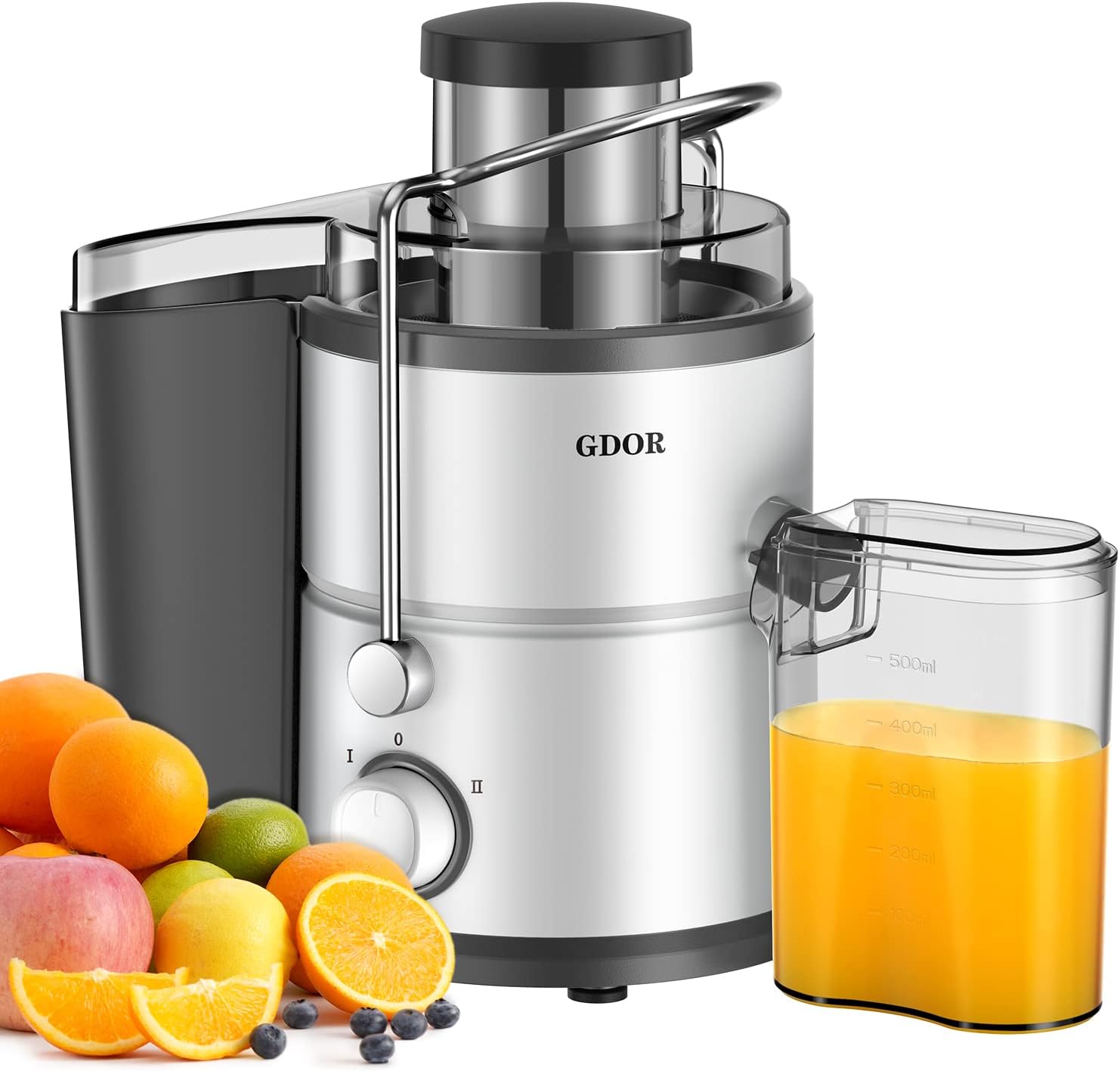
| Maximum Power | 800 watts |
|---|---|
| Number of Speeds | 2 |
| Power Source | ac |
| Voltage | 120 volts |
| Capacity | 1.1 pounds |
The GDOR Centrifugal Juicer is a countertop centrifugal extractor built for quick home juicing. It uses an 800W motor and a two-speed knob to handle soft fruits at the lower setting and harder produce at the higher setting, while the 3-inch feed chute reduces prep by accepting larger pieces or whole small fruits. Juice is collected in the included jug that has a built-in foam separator to reduce froth and keep pours cleaner, and an anti-drip spout helps protect counters. Practical safety features include a locking arm, micro switch protection so it will not run unless assembled correctly, non-slip feet, and automatic overheat/overload shutoff. The juicer is mostly plastic with stainless steel blades and comes with a cleaning brush; several removable parts are dishwasher-safe which speeds cleanup. Limitations are typical of centrifugal designs: it will create more foam and slightly less yield than slow masticating machines and works best when run in batches rather than continuous heavy-duty commercial use.
Best for: Buyers who want a practical, time-saving home juicer that minimizes prep and gives fast results for daily fresh juices without fuss.
Less Ideal for: People who prioritize maximum juice yield, very low foam, or commercial/continuous heavy-duty juicing should consider slow masticating or professional models instead.
- Powerful 800W motor handles both soft and hard produce.
- 3-inch wide feed chute reduces prep by fitting larger pieces or whole small fruits.
- Dual-speed control matches speed to ingredient texture for better extraction.
- Built-in foam separator and anti-drip spout make pouring and serving cleaner.
- Safety features including locking arm and overheat protection improve reliability.
- As a centrifugal juicer it yields less juice and more foam than slow masticating models.
- Mostly plastic construction may feel less durable than heavier metal-bodied machines.
Verdict: A fast, user-friendly centrifugal juicer that saves prep time with a wide chute and dual speeds, ideal for busy home users seeking quick fresh juice.
Elite Gourmet ETS623 Citrus Juicer

| Maximum Power | 40 watts |
|---|---|
| Power Source | Corded Electric |
| Voltage | 120 |
| Capacity | 24 oz (3 cups) |
The Elite Gourmet ETS623 is a small, affordable electric citrus juicer designed for quick home use. Its 40-watt motor and auto-reversing reamer give stronger extraction than many basic 25-watt models, so it squeezes oranges, lemons, limes, and grapefruit efficiently with a simple push-down action. The 24 oz (3-cup) container and easy-pour spout make it convenient for preparing a couple of servings at once, while the built-in pulp and seed filter keeps the juice smooth. Detachable components are top-rack dishwasher safe for faster cleanup, and the unit is compact enough for small kitchens, dorms, or RVs. Practical limitations include modest overall capacity for larger batches and manual push-down operation rather than a full automatic feed, but for everyday fresh citrus juice it delivers reliable performance and easy storage. BPA-free materials and ETL listing add basic safety confidence without a premium price tag.
Best for: Buyers who want an inexpensive, space-saving appliance for making fresh citrus juice a few times a week and prioritize straightforward operation and easy cleanup.
Less Ideal for: People who need to process large volumes of juice at once or who want a heavy-duty or fully automatic juicing system for frequent, high-volume use should look elsewhere.
- 40-watt motor with auto-reversing reamer for better juice extraction
- 24 oz container with easy-pour spout for serving multiple portions
- Built-in pulp and seed filter for smoother juice
- Compact footprint suitable for small kitchens and RVs
- Removable parts are top-rack dishwasher safe for easy cleaning
- Limited 24 oz capacity is small for larger households or batch juicing
- Manual push-down operation may feel less convenient than some automatic feeders
Verdict: A compact, budget-friendly citrus juicer that delivers stronger extraction and easy cleanup for everyday home use.
Deodak Cold Press Juicer SJ-071

| Recommended Uses | Fruits, Leafy greens, Vegetables, Wheatgrass |
|---|---|
| Unit Count | 1 Count |
| Model Number | SJ-071 |
The Deodak SJ-071 is a budget-friendly cold press juicer built for everyday home use. Its slow masticating auger extracts juice from fruits, leafy greens, and vegetables to produce higher yield and drier pulp, which helps retain more nutrients and flavor compared with high-speed models. The 4.7 inch feed chute accepts whole fruits and vegetables, reducing prep time, and the machine includes attachments that let you make juice, sorbet, or nut and oat milk. Removable components make assembly and cleaning straightforward, and the manufacturer emphasizes quiet operation and durable construction for regular use. Important limitations are typical for single-auger machines: extraction is slower than centrifugal juicers and you may need to alternate soft and hard produce for best results. For buyers who prioritize steady, nutrient-rich juicing without complex maintenance, this model delivers solid everyday performance.
Best for: Home cooks who want a reliable, low-speed juicer that prioritizes consistent juice quality and easy day-to-day use rather than top speed or commercial throughput.
Less Ideal for: Users who need very fast extraction for large volumes or who prioritize maximum throughput over nutrient retention should consider faster centrifugal models.
- Slow masticating auger yields more juice and drier pulp for better nutrient retention
- Large 4.7 inch feed chute accepts whole fruits and vegetables to cut prep time
- 3-in-1 functionality supports juice, sorbet, and nut/oat milk
- Removable parts simplify assembly and cleaning
- Slower extraction speed compared with high-speed centrifugal juicers
Verdict: Choose the Deodak SJ-071 if you want a simple, dependable cold press juicer that delivers nutrient-rich juice with minimal prep and easy cleaning.
BLACK+DECKER Citrus Juicer CJ625

| Special Features | Auto-Reversing |
|---|---|
| Wattage | 150 watts |
| Power Source | Corded Electric |
| Product Care Instructions | Dishwasher Safe |
| Blade Material | Stainless Steel |
The BLACK+DECKER CJ625 is a straightforward countertop citrus juicer built for everyday home use. It uses auto-reversing reamer cones to extract more juice from each half, and the package includes small and large cones to handle different sized fruit. Juice collects in a clear pitcher with easy-read measurement markings and a drip-free spout, so it doubles as a serving container and simplifies recipe prep. Pulp level is adjustable via a removable pulp basket, and most removable parts are dishwasher safe for quick cleanup. The motor is corded and intended for routine juicing rather than heavy commercial use, and the unit is mostly plastic with stainless steel blade components, so it is lightweight but not extremely rugged. Practical limits are capacity and continuous runtime: the pitcher is sized for small to medium batches, making this best for single-family use rather than high-volume juicing sessions.
Best for: Buyers who want a reliable, easy-to-use citrus juicer for everyday home use and value features like auto-reverse extraction, pulp control, and easy cleanup.
Less Ideal for: People who plan to juice large quantities frequently or need a heavy-duty, commercial-grade machine should look for a higher-capacity, more robust alternative.
- Auto-reversing cones improve juice extraction from each fruit half
- Adjustable pulp basket lets you control juice texture
- Clear pitcher with measurement marks and drip-free spout for easy pouring
- Dishwasher-safe removable parts speed up cleaning
- Plastic construction limits long-term durability compared with heavier-duty models
- Pitcher capacity and motor are suited to small batches, not high-volume juicing
Verdict: A simple, user-friendly countertop citrus juicer that offers efficient extraction and easy cleanup for everyday home use.
Juilist Centrifugal Juicer

| Maximum Power | 800 watts |
|---|---|
| Wattage | 400 watts |
| Number of Speeds | 3 |
| Capacity | 400 ml |
| Material | Stainless Steel |
The Juilist centrifugal juicer is a countertop machine that turns whole fruits and many vegetables into juice quickly using high-speed centrifugal extraction. It accepts large pieces through a 3" wide feed chute so you can skip extensive chopping, and three speed settings let you match motor speed to soft or hard produce. The stainless steel cutting disc and micro-mesh filter aim to boost yield while the visible window helps you monitor the process. Practical touches include a juice cup and cleaning brush plus dishwasher-safe components that make cleanup easier after short sessions. Safety and durability are addressed with a double safety lock, non-slip base, and thermal overheat protection. Expect fast extraction and compact footprint, but avoid using very fibrous or frozen items as the manufacturer warns and the unit is not intended for heavy continuous commercial use. For routine home juicing of common fruits and vegetables it balances performance, simple controls, and easy maintenance.
Best for: Buyers who want a straightforward, low-fuss home juicer that delivers fast extraction, minimal prep, and easy cleanup for everyday fruit and vegetable juices.
Less Ideal for: Users seeking the quietest, lowest-foam cold-press extraction or those who plan heavy commercial use should look at slow masticating or commercial models instead.
- 3" wide feed chute reduces prep time by fitting larger fruit and vegetable pieces
- Three speed settings for matching speed to soft or hard produce
- Stainless steel cutting disc and micro-mesh filter for improved juice yield
- Dishwasher-safe accessories plus included brush simplify cleaning
- Safety features include double lock, non-slip base, and overheat protection
- Not suitable for very fibrous items or frozen produce as recommended by the manufacturer
- Higher-speed centrifugal design can produce more foam and slightly less pulp-free juice than slow masticating juicers
Verdict: A fast, easy-to-use countertop centrifugal juicer that saves prep time with a wide feed chute and keeps cleanup simple, making it a safe choice for everyday home juicing.
Choosing the Right Fruit Juicer for Home Use: Key Factors to Consider
Extraction Efficiency
A juicer's extraction efficiency determines how much juice you can extract from the same amount of fruit. Higher extraction reduces waste and saves money over time, especially if you juice frequently. Efficiency matters more for leafy greens and soft fruits, which some juicer designs handle poorly.
When assessing efficiency, consider how thoroughly the machine separates pulp from liquid and whether it leaves dry pulp behind. Machines with deliberate, low-speed pressing or slow augers typically produce higher yields from leafy greens and soft fruit. For citrus-heavy household routines, a simple centrifugal model may suffice, but for broader fruit variety and maximum yield, prioritize models known for higher extraction.
Ease of Cleaning
Cleaning frequency and complexity strongly influence whether a juicer becomes part of your regular routine. Removable parts that are dishwasher-safe, straightforward mesh filters, and minimal nooks where pulp accumulates make post-use cleanup faster and more reliable.
Also consider how easy it is to flush the machine between batches and whether the design allows quick disassembly. Some juicers require a thorough scrub of many small pieces, which increases time spent after each use. For busy mornings, a design that cleans in a few minutes will be far more usable.
Noise Level
Noise level matters if you often juice early in the morning or in shared living spaces. Some high-speed machines produce considerable noise that can disturb others, while slow masticating models tend to operate more quietly.
Look for decibel information when available and consider how long the machine runs per session. A quieter machine may run slightly longer but can be far less disruptive. Noise also ties into perceived build quality; quieter operation often indicates better mechanical dampening and fit.
Countertop Footprint and Storage
Space constraints are a reality in many kitchens. The juicer's footprint affects where you store it and whether it can remain on the counter ready for daily use. Tall, narrow units may fit under cabinets but can be harder to store in shallow cupboards, while wide units take more counter space but may be easier to stabilize during operation.
Consider how often you will use the device and whether you need quick-access storage. If you plan to leave the juicer on the counter, choose a model with a compact footprint and tidy cord storage. If storage space is limited, prioritize designs that disassemble into fewer parts that fit into a cabinet.
Versatility for Different Fruits
Different fruit types demand different juicing actions. Soft fruits and berries can clog some machines, while citrus may be best handled by a reamer. If you plan to juice a wide variety—apples, pears, leafy greens, citrus, and soft berries—choose a model suited to multi-fruit use.
Consider whether the juicer requires prepping such as peeling or chopping, and whether it handles small fruits without complex adapters. Versatile machines reduce prep time and expand the kinds of drinks and recipes you can make at home.
Build Quality and Maintenance
Durable construction and accessible maintenance impact long-term ownership. Machines with robust housings, quality internal components, and clear maintenance instructions tend to last longer and need fewer repairs. Ease of sourcing replacement parts or filters also affects long-term value.
Assess whether maintenance tasks such as filter replacement or seal checks are user-friendly and whether the design minimizes wear points. Regular maintenance routines that are simple to perform will keep performance consistent over years of home use.
Types of Fruit Juicers and How They Fit Home Kitchens
Juicers generally fall into several functional types that suit different home needs. High-speed centrifugal models extract juice quickly and work well if you prioritize speed and convenience, though they can be noisier and sometimes yield less from leafy greens. Slow or masticating juicers press and chew produce at lower speeds, often resulting in higher yields and smoother juice, while typically operating more quietly.
Citrus reamers and manual presses are simple, compact options for households that mostly juice oranges or lemons. Twin-stage or triturating models exist but are less common for casual home users. Match the type to the fruits you use most often and the space you can dedicate to the appliance.
- Centrifugal: Fast extraction, lower yield on greens, louder.
- Masticating: Slower, higher yield, quieter operation.
- Citrus reamers: Compact, specialized for citrus only.
- Triturating: Best yield and nutrient retention, larger footprint and cost.
Daily Use Tips to Extend Life and Improve Results
Rinse parts immediately after each use to prevent dried pulp from becoming difficult to remove. Running water through the filter and pulp container before a full wash saves time and reduces scrubbing.
Rotate fruits and vary recipes to avoid repeated stress on the same components. Allow the machine to rest for a minute between long batches to prevent overheating. Check seals and brushes periodically for wear and replace them as recommended.
- Rinse parts right after juicing.
- Alternate produce to reduce wear on cutting elements.
- Give the motor a short rest during extended use.
- Follow manufacturer maintenance intervals for seals and filters.
Countertop Placement and Kitchen Integration
Place the juicer on a stable, level surface close to a sink for easy cleanup. If you plan to juice frequently, leaving the unit on the counter reduces setup friction. Consider proximity to electrical outlets and room for venting motor heat during longer sessions.
Think about where parts will drip during disassembly. Use a washable mat or tray to protect countertops. If storage is required, check cabinet dimensions for the unit's height and width with the lid or feed chute attached.
- Keep near sink for fast rinsing.
- Use a drip tray or mat under the unit.
- Measure cabinet openings for upright storage.
Preparing Fruit for Best Performance
Trim hard pits and cut large fruit into pieces that fit your juicer's feed chute. For machines with narrow chutes, a small food-safe knife and a consistent chopping routine save time. Remove thick rinds or inedible skins when necessary to avoid bitter flavors.
Leafy greens often benefit from rolling or compacting into the feed chute to increase contact with the pressing element. For very soft or pulpy fruits, alternate with harder pieces to maintain consistent feeding and prevent clogging.
- Cut large fruit into chute-friendly pieces.
- Remove thick rinds and large pits.
- Compact greens to improve extraction.
Storing Juice and Safety Considerations
Fresh juice is best consumed quickly but can be refrigerated for up to 48 hours in airtight containers. Use opaque containers to limit light exposure and slow nutrient loss. Stir before serving if separation occurs and discard if off-odors or mold appear.
Follow basic food-safety practices: chill immediately, label with the date, and clean the juicer parts thoroughly to avoid bacterial buildup. Beware of prolonged contact between acidic citrus and metal surfaces that are not corrosion-resistant.
- Refrigerate in airtight containers up to 48 hours.
- Label containers with the date.
- Clean all parts thoroughly after each use to prevent bacterial growth.
How We Chose the Best Fruit Juicer for Home Use
Our shortlist focuses on machines that perform well in typical home kitchens, not commercial settings. We prioritized extraction efficiency because it directly affects how much juice you get from fruit and the quality of the final drink. Ease of cleaning is critical since a difficult cleanup routine makes a juicer less likely to be used. Noise level and daily usability were included because many people operate juicers in the morning while others are asleep. Countertop footprint and storage convenience were evaluated to fit apartments and smaller kitchens. Durability and warranty coverage were considered as proxies for long-term reliability. We excluded heavy commercial models, single-use novelty machines, and devices that require specialized parts or tools for routine maintenance. We also filtered out options that consistently scored poorly on basic safety features or that lacked clear cleaning pathways. The remaining picks reflect machines that balance high juice yield, straightforward cleaning, and quiet, reliable operation suitable for home life.
Our full evaluation process is outlined in our review methodology.
FAQ
Do I need to peel fruit before juicing?
It depends on the fruit and the juicer. Thick, bitter rinds and large pits should be removed. For many fruits like apples and pears, leaving the skin on is fine if you wash produce thoroughly first.
Which juicer type is best for leafy greens?
Low-speed masticating or slow auger designs usually extract more juice from leafy greens and produce drier pulp than high-speed centrifugal models, making them a better choice for green-heavy routines.
How noisy are home juicers typically?
Noise varies widely. High-speed centrifugal units tend to be louder, while slow masticating models run quieter. Consider quieter options if you need to juice early in the morning or in shared living spaces.
How often should I clean the juicer filter?
Clean the filter after each use to prevent pulp buildup and bacterial growth. For heavily used machines, inspect the filter weekly for wear and replace it according to the manufacturer recommendations.
Can I juice frozen fruit?
Most juicers are not designed for frozen fruit and forcing frozen pieces through the feed can damage blades or augers. Thaw frozen fruit slightly and pat dry before attempting to juice.
Final Verdict
Choosing the right fruit juicer for home use comes down to balancing extraction efficiency, cleaning effort, and how it fits into your daily routine. If you juice leafy greens often, prioritize slow-extraction designs that yield more and run quieter. If speed and minimal prep matter most, faster centrifugal units may be the better tradeoff. Consider countertop space, noise tolerance, and how much time you want to spend cleaning. Focus on the factors that most affect your regular use and pick a model that makes fresh juice simple enough to become a habit.