
Note: This article contains affiliate links. If you click on these links and make a purchase, we may earn a small commission at no extra cost to you. This helps support our research and content. Read our full affiliate disclosure here.
If you cook at home, a sharp knife makes prep faster, safer, and more enjoyable. A handheld knife sharpener gives you a compact, fast way to restore an edge without bench stones or complicated setups. This guide covers a curated shortlist of the top handheld knife sharpeners available, explaining how they perform on edge retention, ease of use, and day-to-day maintenance. Read on to see which compact sharpeners made our list and why each excels on particular tasks, from quick touch-ups to re-profiling dull blades.
Top Picks at a Glance
| Best Overall The best all-around choice for most situations | AccuSharp Hand-Held Sharpener 2-Pack |  |
| Best Quality Built to a higher standard if you want something more solid | Miyabi 2-Stage Handheld Sharpener |  |
| Best Value The sweet spot between price and what you get | Amazon Basics 4-in-1 Knife Sharpener |  |
| Best Budget The cheapest option that still gets the job done reliably | Smith's 2-Step Knife Sharpener CCKS |  |
| Top Rated A top-rated pick with lots of positive feedback | AccuSharp Knife Sharpener ACCU-001C |  |
| Most Popular A crowd favorite that many people choose with confidence | KitchenIQ Edge Grip 2-Stage Sharpener |  |
| Best Seller A high-volume bestseller chosen again and again | KITCHELLENCE 3‑Stage Knife Sharpener |  |
AccuSharp Hand-Held Sharpener 2-Pack

| Number of Items | 2 |
|---|---|
| Material Type | Plastic |
| Grit Type | Coarse |
| Included Components | Accusharp sharpener (2) |
The AccuSharp hand-held sharpener is a simple pull-through tool that restores dull blades in a few strokes and can also hone already sharp knives. Intended for everyday kitchen use, it fits comfortably in either hand and has a full-length finger guard for safer sharpening. The sharpening element is diamond-honed tungsten carbide and the reversible blade design doubles service life compared with a single-sided unit. Because it is a coarse grit, the sharpener works fastest on very dull or damaged edges and on common kitchen knives including serrated styles, though it does not replace a fine ceramic rod or stone for mirror-polished edges. The plastic body is lightweight and dishwasher-safe for easy cleaning, and AccuSharp supplies two identical units in the pack for a backup or to keep one in the kitchen and one elsewhere. Practical, fast, and easy to use, this sharpener gives a noticeable cutting improvement with minimal technique, but experienced sharpeners looking for precise edge angles or ultra-fine finishes may want a dedicated honing stone instead.
Best for: Buyers who want a fast, no-fuss way to restore everyday kitchen knives to usable sharpness with minimal learning curve and a focus on convenience.
Less Ideal for: Those seeking precise edge profiling or a mirror-polished finish for professional blades should choose stones or fine ceramic systems instead.
- Diamond-honed tungsten carbide blades for quick material removal and consistent results
- Ergonomic handle and full-length guard improve safety and control
- Reversible blades extend usable life
- Dishwasher-safe plastic body simplifies cleaning
- Two sharpeners in the pack provide a spare or multi-location convenience
- Coarse grit only so it removes material quickly but will not produce a polished, razor-finish edge
Verdict: A practical, easy-to-use pull-through sharpener that quickly restores everyday knives and comes as a useful two-pack.
Miyabi 2-Stage Handheld Sharpener

| Included Components | 2-stage Diamond/Ceramic Handheld Knife Sharpener |
|---|---|
| Material Type | ABS – Ceramic |
| Grit Type | Coarse |
The Miyabi 2-stage handheld sharpener uses a coarse diamond stage and a fine ceramic stage to restore and refine kitchen knives quickly by hand. You draw the blade through the coarse slot to re-establish a bevel and then through the ceramic slot to polish and hone the edge; the unit is ambidextrous so left- and right-handed users can use it easily. An ergonomic plastic handle with a molded hand guard plus six silicone nubs on the base help stabilize the tool during use, making sharpening safer and more controlled than freehand methods. Because it is a compact, manual sharpener it works best for routine maintenance and edge rescue rather than full blade reprofile work enjoyed by whetstone users. It sharpens plain fine-edge knives only and does not replace professional sharpening for heavily damaged or specialty blades, but for cooks who want fast, repeatable results on standard kitchen knives this delivers a reliable, easy-to-use solution.
Best for: Buyers who prioritize fast, consistent edge maintenance and want a simple handheld tool to quickly restore kitchen knives between honeings.
Less Ideal for: Users seeking a tool to reshape heavily damaged blades, sharpen serrated or specialty knives, or those who prefer full control of angle and technique via whetstones.
- Two-stage system combines diamond coarse grit and ceramic fine grit for both edge setting and polishing
- Ambidextrous design suits left- and right-handed users
- Non-slip base with six silicone nubs improves stability during sharpening
- Ergonomic handle and hand guard increase user safety and control
- Intended for plain fine-edge knives only and not suitable for serrated or specialty blades
- Not a substitute for a whetstone or professional service for heavy re-profiling
Verdict: A compact two-stage handheld sharpener that gives cooks quick, repeatable edge restoration with a stable, user-friendly design.
Amazon Basics 4-in-1 Knife Sharpener
| Material Type | Metal, Plastic |
|---|---|
| Grit Type | Coarse, Medium, Fine |
| Included Components | Knife Sharpener |
| Item Type Name | 4-in-1 Knife Sharpener with Safety Glove |
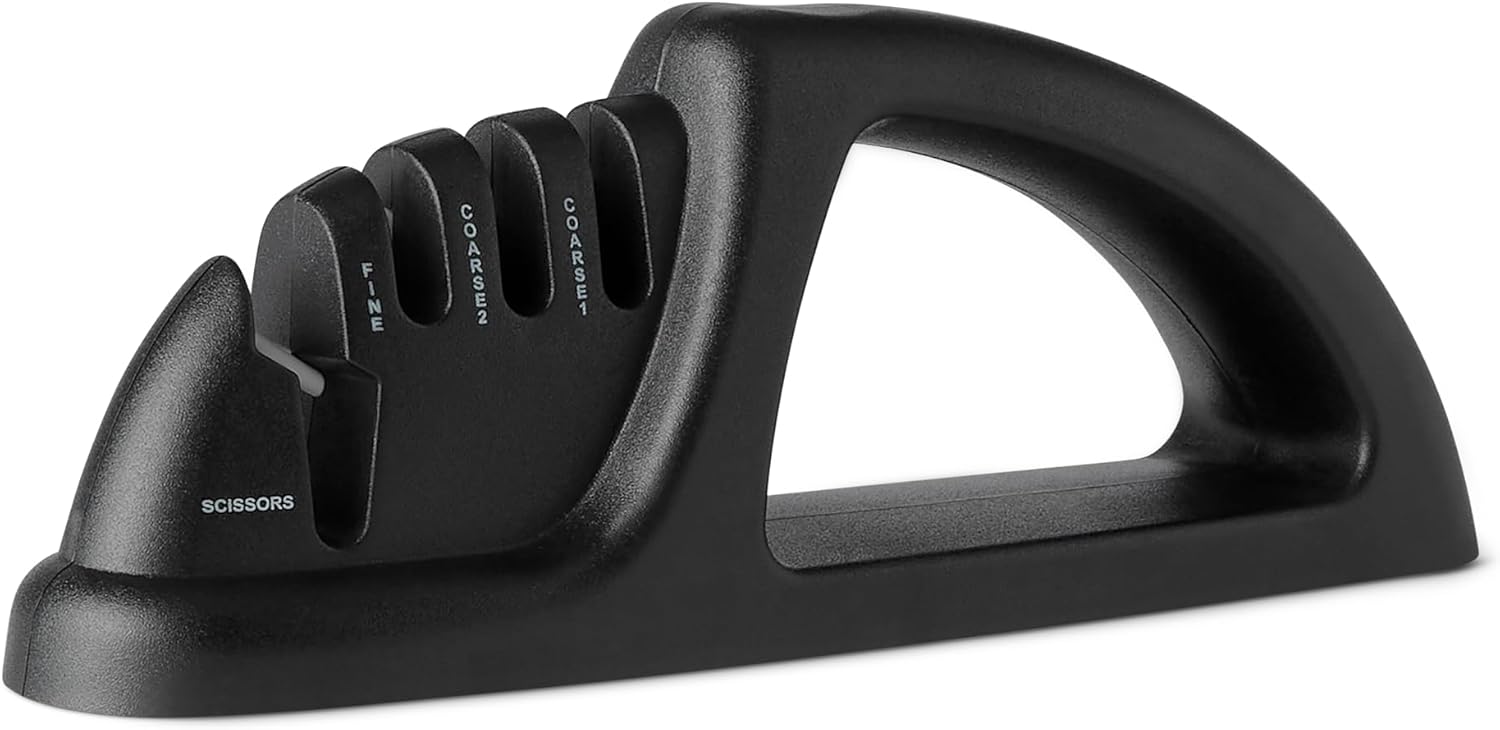
This Amazon Basics 4-in-1 Knife Sharpener is a simple, hands-on tool for restoring edge to straight-edge kitchen, pocket, and hunting knives. It uses three dedicated stages—coarse, medium, and fine—to remove nicks, reestablish bevels, and polish an edge; a separate slot handles scissor blades. The non-slip silicone base keeps the sharpener steady during use and the included cut-resistant glove adds safety while you pull blades through the slots. Construction mixes metal and plastic for a lightweight, easy-to-store unit that is quick to rinse clean after sharpening. It will not work on serrated knives, and because it is a manual pull-through device you need to control angle and pressure for best results, so the sharpness you get depends on technique. For regular home kitchen maintenance it offers a low-cost, no-fuss way to keep knives useful between professional sharpening sessions.
Best for: Buyers who want an affordable, no-frills tool to keep everyday straight-edge knives sharp at home and value practical safety features and easy storage.
Less Ideal for: People who need to sharpen serrated knives, prefer electric or guided-angle sharpeners, or require professional-grade reprofiling for very damaged blades should look elsewhere.
- Three-stage sharpening covers coarse reshaping to fine honing
- Dedicated scissor slot expands usefulness beyond knives
- Non-slip silicone base improves stability during use
- Includes cut-resistant glove for safer handling
- Easy to rinse clean and compact to store
- Not suitable for serrated blades
- Manual pull-through design requires correct technique for best results
Verdict: A compact, budget-friendly manual sharpener that reliably maintains straight-edge knives at home while prioritizing stability and user safety.
Smith's 2-Step Knife Sharpener CCKS

| Included Components | 1 sharpener |
|---|---|
| Material Type | Synthetic |
| Grit Type | Coarse,Fine |
Smith's CCKS 2-Step Knife Sharpener is a tiny, handheld pull-through tool that combines crossed tungsten carbide blades for coarse re-profiling and crossed ceramic rods for fine honing. You use it by pulling the blade through the carbide slot a few times to reestablish a bevel, then finishing with the ceramic rods to smooth and refine the edge. Its preset angles remove the guesswork so even an unskilled user can quickly restore a dull blade with three to four strokes. The plastic housing is lightweight, includes non-slip rubber feet and a lanyard hole for attachment, and the unit floats, which makes it convenient for fishing and hunting trips. Because it is a preset pull-through, it cannot change sharpening angles or replace full-length stropping and it will remove more metal than guided stones when used aggressively. For a low-cost, portable sharpener that delivers fast, repeatable results in the field or at home, this is a practical choice.
Best for: Buyers who want an inexpensive, take-anywhere sharpener to quickly refresh blades during outdoor trips or for occasional kitchen use without learning complex sharpening techniques.
Less Ideal for: Those seeking precision angle control, restoration of very damaged blades with minimal material removal, or a full sharpening system for professional blades should choose stones or guided systems instead.
- Two preset stages (tungsten carbide coarse and ceramic fine) for quick edge restoration
- Very compact and lightweight with a lanyard hole for easy carrying
- Non-slip rubber feet improve safety and control during use
- Floats in water, useful for fishing or boat trips
- Preset angles do not allow for different bevels or precision angle control
- Pull-through design removes more metal than stones when used frequently
Verdict: A very affordable, pocketable two-step pull-through sharpener that delivers fast, reliable edge touch-ups for outdoor and casual kitchen use.
AccuSharp Knife Sharpener ACCU-001C

| Material Type | Acrylonitrile Butadiene Styrene |
|---|---|
| Grit Type | Coarse |
| Included Components | Sharpener |
The AccuSharp ACCU-001C is a simple pull-through handheld sharpener designed for fast, repeatable sharpening of kitchen and outdoor knives. You pull the blade once or twice through the fixed tungsten carbide edges to remove burrs and quickly restore a working edge, which the manufacturer says takes about ten seconds. Its ergonomic full-length handle and finger guard make it easy and safe to hold for both right- and left-handed users, and the reversible carbide blades extend usable life. The plastic body is lightweight and dishwasher-safe, so it is easy to clean and convenient to store. This sharpener is built for convenience and speed rather than precision profiling or finishing; it removes material quickly and is best for routine touch-ups or repairing dull edges rather than establishing razor-sharp, factory-style bevels. Replacement blades are available, and users report long blade life, but aggressive use will still wear the carbide over time.
Best for: Buyers who prioritize a reliable, low-effort tool to keep everyday knives usable with minimal fuss and maintenance.
Less Ideal for: Users seeking professional-level sharpening, precise angle control, or a polished finish on premium blades should consider stones or guided sharpening systems instead.
- Very quick edge restoration in seconds for common kitchen and outdoor knives
- Ergonomic full-length handle and finger guard for safer, comfortable use
- Diamond-honed tungsten carbide blades are durable and reversible to extend life
- Dishwasher-safe plastic body makes cleaning simple and storage convenient
- Not designed for fine honing or precise angle control needed by chefs or sharpening enthusiasts
- Removes material relatively quickly so frequent heavy use can shorten blade life
Verdict: A fast, dependable handheld sharpener that reliably restores working edges on everyday knives with minimal effort.
KitchenIQ Edge Grip 2-Stage Sharpener

| Material Type | Plastic |
|---|---|
| Grit Type | Fine |
| Included Components | Complete |
| Model Number | 50009 |
The KitchenIQ Edge Grip is a small, manual two-stage pull-through sharpener built for fast at-home edge maintenance. Use the carbide slot first to reset very dull or nicked edges, then finish with the ceramic rod slot to polish and refine the bevel. Its patented V-shaped grip and non-slip rubber feet let you secure the tool on a countertop edge or flat surface so larger knife tips do not contact the counter while you pull through the slots. The preset sharpening angles simplify use so you can get a usable edge with a few steady pulls, and the soft-grip handle adds comfort for quick sessions. Because it is a compact plastic unit it stores easily in a drawer and is suited to straight and many serrated blades. It is not a precision system for custom angles or professional reprofiling, and aggressive carbide sharpening removes more metal than stones or guided systems, so limit use to restoring very dull knives rather than frequent fine-tuning.
Best for: Buyers who want a low-effort, reliable way to restore household kitchen knives quickly and value ease of use and compact storage over workshop-level precision.
Less Ideal for: If you need professional-level reprofiling, exact angle control, or routinely sharpen high-end knives, choose a guided stone system or an electric sharpener instead.
- Two-stage system with carbide for edge-setting and ceramic for honing
- Patented V-Grip base lets you sharpen on a countertop edge safely
- Non-slip rubber feet and soft-grip handle improve stability and control
- Compact, lightweight design stores easily in a drawer
- Pre-set angles make sharpening fast and simple for novices
- Plastic housing and fixed angles limit precision and long-term durability
- Carbide stage can remove more material than gentler methods if overused
Verdict: A simple, portable two-stage pull-through sharpener that reliably restores household knives with minimal effort and storage footprint.
KITCHELLENCE 3‑Stage Knife Sharpener
| Material Type | Plastic |
|---|---|
| Item Weight | 180 g |
| Included Components | Yes |
| Number of Items | 1 |
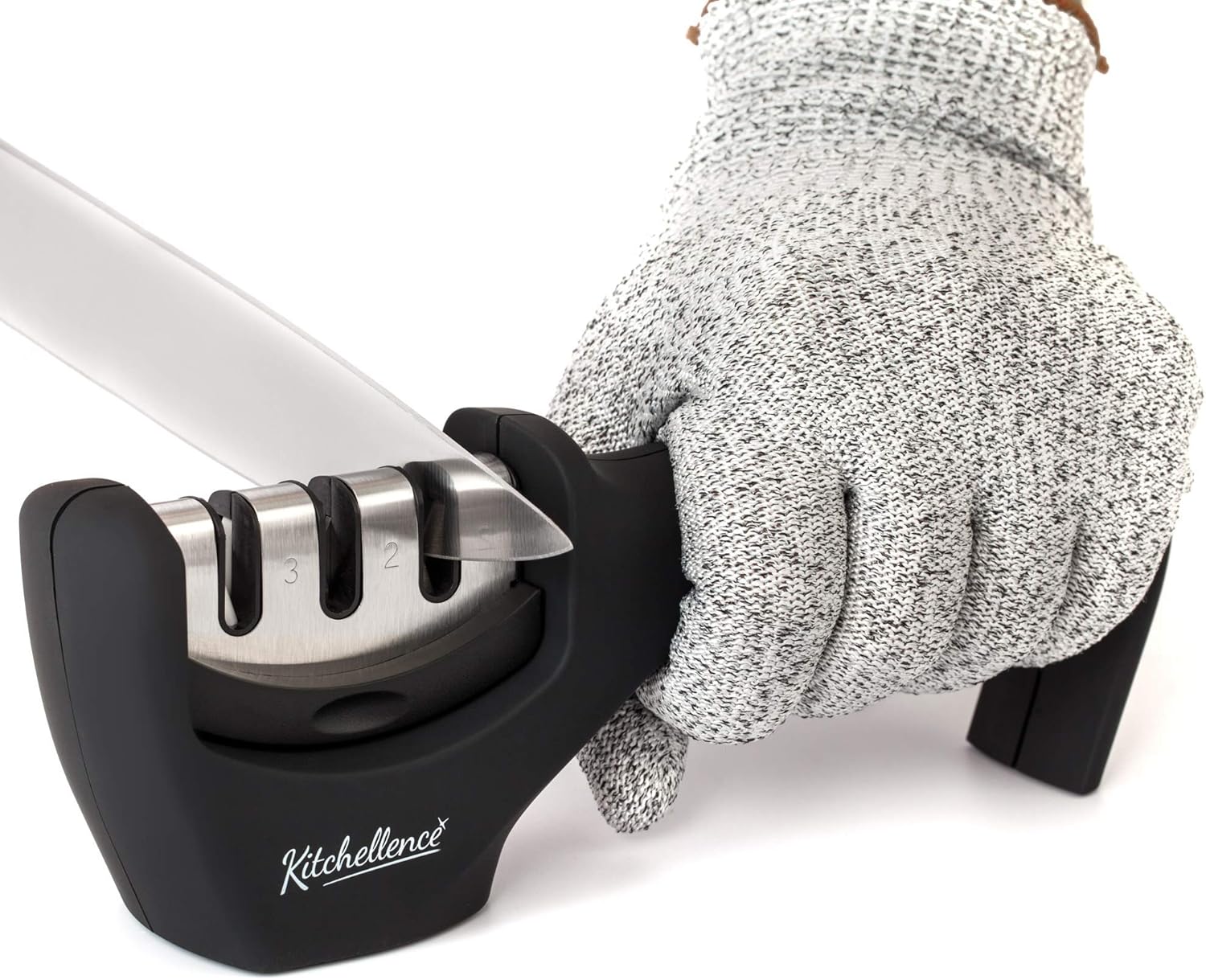
This compact 3-stage sharpener is designed to repair, sharpen and polish kitchen knives quickly by pulling blades through three dedicated slots: a diamond rod for repairing nicks and straightening edges, a coarse slot to restore the V-bevel, and a fine polishing slot for a finished edge. It is easy to use for right- or left-handed people thanks to an ergonomic handle and a non-slip base that keeps the tool stable on the counter. The included cut-resistant glove adds a layer of safety while working with dull blades. Construction uses ABS plastic for a lightweight but durable body suitable for regular home use, and the small footprint makes it easy to store. Limitations include that manual pull-through sharpeners are best for standard kitchen knives and will not replace professional whetstone technique for high-end blades, and repeated aggressive sharpening can shorten blade life if not done carefully.
Best for: Buyers who want a straightforward, low-risk way to restore daily-use kitchen knives at home and value safety and ease of use over professional-level precision.
Less Ideal for: Those who own high-end specialty knives or who want full control over bevel angle and microbevels should opt for a whetstone or professional sharpening service instead.
- Three dedicated stages for repairing, sharpening and polishing edges
- Diamond rod in the first stage for fixing chips and straightening bent edges
- Ergonomic handle and non-slip base for stable, ambidextrous use
- Includes a cut-resistant glove to improve user safety
- Not suitable for precision sharpening of high-end knives or changing blade geometry
- Manual pull-through design can remove more metal than guided whetstone methods if overused
Verdict: A safe, simple 3-stage handheld sharpener that quickly restores everyday kitchen knives for risk-averse home cooks.
Choosing the Right Handheld Knife Sharpener: Key Factors to Consider
Sharpening Effectiveness
This measures how well a handheld sharpener restores a clean, usable edge across typical kitchen knives. A good unit should remove enough metal to form a keen bevel without requiring excessive strokes. For home use you want predictability: consistent edge angle, even contact across the blade, and the ability to remove nicks or rolling edges when needed.
Effectiveness matters because a poor sharpener can leave an inconsistent edge that cuts poorly or requires repeat passes, increasing wear. Consider the range of abrasives in the sharpener and whether it offers coarse and fine stages so you can both reprofile a dull blade and finish with a refined edge.
Edge Durability
Edge durability refers to how long the sharpened edge holds up under normal kitchen tasks. Some abrasives produce a very keen edge that dulls quickly, while others create a slightly more robust bevel that stays usable longer. The geometry the sharpener creates—angle and microbevel—plays a major role in longevity.
When choosing, think about the knives you use and how often you want to resharpen. A sharp edge that requires frequent touch-ups may be fine if sharpening is quick, but many buyers prefer a balance that extends time between sessions without sacrificing cutting performance.
Ease of Use
Ease of use covers how straightforward the sharpener is for cooks of different skill levels. Important elements include clear angle guides, stable handholds or base supports, intuitive progression through stages, and minimal setup. Handheld units should let you make reproducible strokes without a steep learning curve.
A unit that is easy to use reduces the risk of accidental damage to the blade or to the user. If you plan to touch up blades frequently, prioritize models with simple, repeatable motion and low cognitive overhead so sharpening becomes a quick routine rather than a chore.
Build Quality and Safety
Durable construction and thoughtful safety features protect both the user and the blade. For handheld sharpeners, that means a secure grip or non-slip base, guarded abrasive slots or covers, and materials that resist chipping or deformation. Poor fit and finish can cause wobble, inconsistent angles, or accelerated wear of the abrasive surfaces.
Safety also covers hand placement and the potential for slips during a sharpening pass. Choose designs that isolate the blade from exposed moving parts and that provide clear, stable contact points to guide each stroke safely.
Maintenance and Consumables
Different abrasive materials wear at different rates and may require replacement, cleaning, or occasional dressing. Ceramic rods and diamond-coated plates typically last longer but can have different effects on edge geometry. Consider whether the sharpener's parts are user-replaceable, how easy they are to clean, and whether the maintenance is something you are willing to do regularly.
Low-maintenance sharpeners are appealing for busy kitchens, but some users accept replacement parts for better long-term performance. Evaluate the tradeoff between upfront convenience and ongoing consumable costs or upkeep.
How Handheld Sharpeners Work
Handheld knife sharpeners use abrasive media arranged in slots or along rods to abrade metal and reform a blade edge. Typically they provide a coarse stage to remove material and correct geometry and a finer stage to polish and refine the bevel. The blade is drawn through the abrasive at a controlled angle, which is either built into the unit or guided by the user.
Understanding the difference between abrasive types helps set expectations. Diamond abrasives cut aggressively and are good for very dull blades. Ceramic is less aggressive and excels at refining and polishing. Some units combine materials so you can perform a multi-stage process without changing tools.
- Coarse stages remove metal rapidly for reshaping.
- Fine stages polish the edge and reduce burrs.
- Built-in angle guides help beginners maintain consistency.
Preparing Your Knife and Sharpening Safely
Before sharpening, clean and dry the blade to remove grit that could abrade the sharpener. Secure the unit on a stable surface or use any provided non-slip features. Maintain a steady, even stroke rhythm and avoid forcing the blade through at odd angles.
Start with a small number of passes and inspect the edge frequently. Excessive pressure or too many coarse passes can remove more metal than necessary and shorten blade life. Always follow manufacturer instructions for the particular sharpener you use.
- Wipe the blade clean before and after sharpening.
- Use light, controlled pressure and consistent strokes.
- Check the edge visually or with a light paper test to gauge progress.
When to Touch Up Vs. Reprofile
Minor dulling or rolled edges respond well to quick touch-ups using the fine stage of a handheld sharpener. These sessions are short and preserve blade material. If a knife is noticeably chipped, has a rounded profile, or has not been sharpened in a long time, a coarser stage or full reprofile may be necessary.
Frequent light maintenance keeps knives performing better and reduces the need for aggressive material removal. Plan touch-ups as part of weekly kitchen maintenance for frequently used knives, and reserve reprofiling for more serious edge damage.
- Use fine abrasives for quick touch-ups.
- Reserve coarse stages for reshaping or heavy dulling.
- Monitor edge performance to set a maintenance cadence.
Caring for Sharpeners and Consumable Parts
After use, remove metal filings or debris from slots and abrasive surfaces. Some sharpeners can be rinsed; others should be wiped with a dry cloth. Inspect ceramic rods or diamond plates for glazing or wear; glazing can reduce cutting action and may be removed with light abrasion or replaced if designed to be user-serviceable.
Store the sharpener in a dry place to prevent corrosion of metal components and to protect abrasive coatings. If replacement modules are available, plan for eventual part swaps and follow manufacturer guidance on intervals based on frequency of use.
- Clean abrasives after each use to remove metal particles.
- Avoid soaking bonded abrasives unless specifically allowed.
- Replace worn abrasive stages to maintain consistent results.
Limitations of Handheld Sharpeners
While convenient, handheld sharpeners are not a universal solution. They are best for standard kitchen blades and common edge angles. Very thin, specialized blades or knives with complex geometries may not be suited to simple handheld slots and can be damaged if forced through incompatible guides.
For users seeking precision regrinds, mirror polishing, or specialty bevels, bench stones or professional sharpening services are more appropriate. Accept the tradeoff: handheld units offer speed and ease at the expense of the highest possible edge refinement.
- Not ideal for specialty or extremely thin blades.
- May change factory grind lines if used aggressively.
- Best treated as a maintenance and touch-up tool rather than a full-service solution.
How We Chose the Best Handheld Knife Sharpener
We focused on practical performance and regular-use durability to choose the handheld knife sharpeners on this list. Evaluation prioritized measurable sharpening outcomes and real-world usability rather than marketing claims. Key criteria included sharpening effectiveness across common kitchen blade geometries, the speed and consistency of the edge produced, and how well the sharpener preserves blade material over repeated use. We also assessed ergonomics and safety features, since handheld sharpening happens during active use and user control matters. Build quality and longevity of consumable parts such as ceramic or diamond elements were weighed, along with maintenance needs like cleaning and part replacement. Ease of use for home cooks with varied skill levels was a central filter, including clarity of angle guides and the need for setup. Products that required specialized jigs, bench mounting, or significant skill to achieve acceptable results were excluded. We focused on compact, handheld units suitable for everyday kitchen knives and practical touch-ups. The final selection balances sharpening performance, user safety, durability of abrasive media, and low maintenance.
Our full evaluation process is outlined in our review methodology.
FAQ
How often should I use a handheld sharpener on my kitchen knives?
It depends on use, but many home cooks touch up knives every few weeks with a fine stage and reprofile only when the edge becomes noticeably dull or damaged. Frequent light maintenance reduces the need for aggressive material removal.
Will a handheld sharpener damage my knives?
If used properly, handheld sharpeners should not damage blades. Risk rises with excessive pressure, too many coarse passes, or forcing an ill-suited blade through the guides. Use short, controlled strokes and follow the unit's recommended sequence.
Can I sharpen serrated knives with a handheld sharpener?
Most handheld sharpeners are designed for plain-edge knives. Serrated edges require specialized tools or techniques to maintain each scallop. Some multi-tool sharpeners include a narrow rod for serrations, but it usually requires more time and skill.
Do ceramic and diamond abrasives perform differently?
Yes. Diamond abrasives cut faster and are effective on very dull or hard steels. Ceramic is gentler and better for polishing and refining an edge. Many handheld units combine both to offer coarse and finishing stages.
How do I know when an abrasive stage needs replacement?
Signs include reduced cutting action, glazed or smooth abrasive surfaces, inconsistent edge formation, or visible wear. If cleaning does not restore performance, consult the sharpener's maintenance guidance for replacement intervals.
Final Verdict
Handheld knife sharpeners are a fast, space-efficient way to keep kitchen knives performing well between major services. Prioritize a tool that produces a predictable edge geometry, offers both coarse and fine stages if you need reprofiling, and feels safe and stable during use. Balance how often you want to maintain blades against the aggressiveness of the abrasive: frequent light touch-ups with a finer stage preserves blade life, while coarser options are reserved for restoring very dull edges. Choose a handheld sharpener that matches your cooking habits and comfort with basic sharpening technique, and you will get more consistent, safer cutting without adding a complicated sharpening routine.