
Note: This article contains affiliate links. If you click on these links and make a purchase, we may earn a small commission at no extra cost to you. This helps support our research and content. Read our full affiliate disclosure here.
Picking the right knife sharpener for beginners matters because a poor choice can damage blades or leave you with inconsistent edges. If you are new to blade maintenance, you want a tool that is forgiving, repeatable, and safe to operate. This guide covers seven top-rated options specifically selected for ease of use and predictable results. We evaluated practical factors that matter to new users, including ease of setup, angle control, and how forgiving each method is on kitchen knives. Below are our top picks followed by clear guidance on choosing and using a beginner-friendly sharpener.
Top Picks at a Glance
| Best Overall The best all-around choice for most situations | Chef'sChoice ProntoPro 4643 |  |
| Best Quality Built to a higher standard if you want something more solid | Sharp Pebble 1000/6000 Whetstone |  |
| Best Value The sweet spot between price and what you get | AccuSharp Knife Sharpener ACCU-001C |  |
| Best Budget The cheapest option that still gets the job done reliably | Smith's 2-Step Knife Sharpener CCKS |  |
| Top Rated A top-rated pick with lots of positive feedback | Work Sharp Guided Field Sharpener |  |
| Most Popular A crowd favorite that many people choose with confidence | KitchenIQ Edge Grip 2-Stage Sharpener |  |
| Best Seller A high-volume bestseller chosen again and again | KITCHELLENCE 3‑Stage Knife Sharpener |  |
Chef'sChoice ProntoPro 4643

| Sharpening angles | 15° or 20° |
|---|---|
| Sharpening element | 100% diamond abrasives |
| Stages | 3-stage (sharpen, hone, polish) |
| Knife type | Straight-edge and serrated knives |
The Chef'sChoice ProntoPro 4643 is a small, manual three-stage sharpener that uses diamond abrasive wheels to quickly restore a shaving edge to kitchen, pocket, and sporting knives. You pick a 15° or 20° angle with built-in guides, pull the blade through the coarse/fine stages that cut and refine the bevel, then finish in the polishing stage for a micro-serrated, durable edge. Its diamond-plated wheels sharpen both into and out of the edge for burr-free results and the separate honing stage helps produce a long-lasting, arch-shaped profile. The unit is compact, lightweight, and has a soft-touch handle that makes single-handed sharpening easy at the counter or in a drawer. Trade-offs are that it is a manual pull-through system so it requires a steady hand and consistent pressure for best results, and it cannot replace full-precision jig or whetstone techniques for advanced reprofiling.
Best for: Buyers who want a reliable, compact manual sharpener that produces restaurant-quality edges quickly and prefer a simple pull-through tool over learning whetstone technique.
Less Ideal for: Those seeking a motorized, fully guided electric sharpener or users who need to change blade bevel angles or perform full reprofiling frequently.
- Three-stage system with dedicated sharpening, honing, and polishing stages for a finished edge
- Uses 100% diamond abrasives for faster cutting and durable edges
- Selectable 15° or 20° angle guides for Asian and Western-style knives
- Compact, lightweight footprint with a soft-touch handle for easy use and storage
- Requires steady, even pulls; results depend on user technique compared with guided electric sharpeners
- Not suitable for advanced blade reprofiling that a whetstone or precision jig can achieve
Verdict: A compact, easy manual sharpener that reliably delivers razor-sharp 15° or 20° edges for beginners who want fast, durable results without learning whetstones.
Sharp Pebble 1000/6000 Whetstone

| Grit | 1000/6000 |
|---|---|
| Material Type | Corundum |
| Included Components | Angle guide, bamboo base, instructions |
This Sharp Pebble whetstone is a two-sided 1000/6000 grit waterstone kit aimed at restoring and polishing kitchen blades. You soak or wet the stone and use the included angle guide and non-slip bamboo base to hold the blade at a consistent angle, which makes it straightforward for beginners to remove nicks on the 1000 side and refine a razor edge on the 6000 side. The kit bundles instructions, an angle guide, and an ebook so first-timers can learn technique without guessing. The corundum-based stone is described as staying flat longer than cheaper stones, so you get more usable life before needing to flatten it, and no oil is required which keeps cleanup simple. Practical limits: the kit covers typical kitchen knives and many hand tools but lacks coarser grits for heavy reprofiling, and achieving a truly professional edge still requires practice and time with consistent strokes. For everyday home sharpening this delivers reliable, long-lasting results once you learn the motions.
Best for: Home cooks and hobbyists who prioritize sharp, high-performance edges and want a guided, hands-on sharpening system that teaches proper technique.
Less Ideal for: Users who need rapid coarse re-profiling of severely damaged or very dull blades or who prefer motorized sharpeners for speed.
- Dual 1000/6000 grit covers edge repair and polishing for most home knives
- Included angle guide and bamboo non-slip base simplify consistent sharpening for beginners
- No oil required; uses water-based sharpening for easier cleanup
- Corundum composition resists chipping and is claimed to stay flat longer than bargain stones
- Does not include coarser grit for heavy-duty reshaping or very damaged blades
Verdict: A beginner-friendly, performance-focused 1000/6000 whetstone kit that teaches consistent sharpening and produces razor edges for most home knives.
AccuSharp Knife Sharpener ACCU-001C

| Material Type | Acrylonitrile Butadiene Styrene |
|---|---|
| Grit Type | Coarse |
| Included Components | Sharpener |
| Manufacturer | Accu Sharp |
The AccuSharp ACCU-001C is a small, easy-to-use pull-through sharpener aimed at quickly restoring dull blades. You use it by drawing the knife through the carbide V-slot a few times while holding the comfortable ergonomic handle and finger guard; the reversible diamond-honed tungsten carbide blades do the cutting work so most knives regain a usable edge in seconds. It handles common kitchen blades including chef, paring, filet and serrated knives and is dishwasher-safe for simple cleanup. Practical benefits include very fast results with minimal technique required, a long blade life thanks to reversible cutters, and a compact design that stores easily in a drawer. Important limitations are that it is a coarse, pull-through tool so it removes metal relatively quickly and is not intended for precision angle control or fine polishing like whetstones or guided systems, and very high-end or specialized blades may need professional sharpening for best results.
Best for: Buyers who want a no-fuss, time-saving way to keep everyday kitchen knives usable without learning sharpening technique or investing in specialist tools.
Less Ideal for: Users seeking mirror-polished edges, precise angle control, or restoration of very expensive/specialty blades should consider stones or professional sharpening instead.
- Very quick edge restoration—most knives sharpened in ~10 seconds
- Diamond-honed tungsten carbide blades for durable cutting performance
- Ergonomic handle and full-length finger guard for safer, one-handed use
- Reversible blades extend service life and lower maintenance frequency
- Dishwasher-safe and compact for easy cleaning and storage
- Coarse grit removes material quickly and cannot produce a razor-polished finish
- Limited control over sharpening angle compared with whetstones or guided systems
Verdict: If you want a fast, foolproof way to restore everyday knives, this compact pull-through sharpener delivers reliable edges with almost no learning curve.
Smith's 2-Step Knife Sharpener CCKS

| Included Components | 1 sharpener |
|---|---|
| Material Type | Synthetic |
| Grit Type | Coarse,Fine |
The Smith's CCKS 2-Step Knife Sharpener is a lightweight, portable pull-through tool designed to quickly restore and refine blade edges. It uses crossed tungsten carbide blades in a coarse slot to reprofile very dull edges with three to four strokes, while the crossed ceramic rods in the fine stage polish and refine the bevel for a smoother, sharper finish. Its small plastic housing has non-slip rubber feet for safer use, a lanyard hole for attachment, and is advertised to float, making it convenient for fishing and outdoor use. The preset angles remove the need to learn complex sharpening motions, which makes this particularly approachable for beginners and casual users who want a fast, reliable edge in the field or at home. Limitations include a basic plastic body and fixed angles that do not replace stropping or using stones for high-end knives, and it is best suited for everyday blades rather than premium or specialty steels.
Best for: Buyers looking for an inexpensive, easy-to-use sharpener to maintain everyday and outdoor knives will appreciate this as a simple entry-level tool.
Less Ideal for: Professionals, knife collectors, or anyone needing precision angle control and polishing for premium steels should choose a stone or guided sharpening system instead.
- Two-stage system (coarse tungsten carbide and fine ceramic) restores and polishes edges quickly
- Preset sharpening angles make it easy for beginners to use without technique training
- Very compact and lightweight with a lanyard hole for outdoor use and flotation if dropped in water
- Non-slip rubber feet add stability and safety during sharpening
- Fixed preset angles limit use on specialty or high-end blades that require custom bevels
- Plastic housing is basic and less durable than metal-bodied sharpeners
Verdict: A very affordable, user-friendly two-step sharpener that gives beginners a fast, reliable edge restoration for everyday and outdoor knives.
Work Sharp Guided Field Sharpener

| Material Type | Diamond and Ceramic Sharpener |
|---|---|
| Grit Type | Coarse, Fine |
| Included Components | WSGFS221 |
The Work Sharp Guided Field Sharpener is a compact, all-in-one sharpening kit aimed at outdoors and home use that guides you to consistent 20° or 25° edges. It includes removable diamond plates for faster material removal, a rotating ceramic honing rod with coarse and fine faces plus a grooved side for fish hooks, and a leather strop for polishing and refining the bevel. The guided angles and contained parts make it simple for beginners to set and maintain a repeatable edge without complex setup, and the small footprint and self-contained design suit trips, hunting, and garage use. Practical benefits include quick reprofiling with the diamond plates, straightforward honing with the ceramic rod, and the strop for final touch-ups. Limitations are that it is designed for a restricted set of angles (20° and 25°) so users who need very acute or specialty angles will find it less flexible, and the abrasive sizes are small compared with bench systems so heavy stock removal can be slower. Still, it is durable and easy to carry for basic to intermediate sharpening tasks.
Best for: Buyers who prioritize a reliable, easy-to-use sharpener that produces consistent edges with minimal setup, especially those who want a portable solution for field or kitchen use.
Less Ideal for: Users who need extreme acute angles, professional re-profiling, or very fast heavy material removal should consider a benchtop system instead.
- All-in-one kit with diamond plates, ceramic rod and leather strop for a complete sharpening process
- Guided angle system delivers consistent 20° and 25° edges for repeatable results
- Compact, self-contained design is easy to transport and requires no assembly
- Rotating ceramic rod offers coarse, fine and a grooved surface for fish hooks
- Limited to two preset guide angles which reduces flexibility for specialty edges
- Abrasives are small compared with bench systems so rapid heavy stock removal is slower
Verdict: A dependable, portable guided sharpener that makes consistent, beginner-friendly edges without fuss.
KitchenIQ Edge Grip 2-Stage Sharpener

| Material Type | Plastic |
|---|---|
| Grit Type | Fine |
| Model Number | 50009 |
The KitchenIQ Edge Grip 2-Stage Sharpener is a small, easy-to-use manual pull-through hone that restores dull blades with a carbide coarse slot and polishes edges with crossed ceramic rods. You use it by placing the unit on a flat surface or hooking the patented V-grip over the edge of a counter, then pulling the blade through the coarse slot a few times to re-establish the bevel and finishing with the fine slot for a smoother edge. Its non-slip rubber feet and soft-grip handle help keep the sharpener steady during use, and the compact plastic body tucks into a drawer when not needed. The preset sharpening angles make it beginner-friendly since you do not need to set or judge bevel angles, and the pull-through design is fast for routine touch-ups and fixing moderately dull kitchen knives. Limitations are typical for this class: it is not a precision sharpening system for restoring severely damaged or high-end blades and repeated carbide pulls remove material faster than stropping or guided stones, so users focused on long-term edge geometry control may prefer a different method.
Best for: Home cooks who want a low-effort, reliable way to refresh everyday kitchen knives without learning angle sharpening techniques and who value quick, repeatable results.
Less Ideal for: Knife enthusiasts who need precise angle control, professional users, or anyone restoring badly damaged or premium high-precision blades should choose stones or guided systems instead.
- Two-stage system (carbide coarse and ceramic fine) for edge setting and polishing
- Patented V-grip and non-slip base provide stability on countertops or edges
- Preset angles make sharpening straightforward for beginners
- Compact, lightweight design that stores easily in a drawer
- Not suitable for precision angle control or repairing severely chipped blades
- Carbide coarse stage removes metal relatively quickly compared with stones
Verdict: A beginner-friendly, compact two-stage pull-through sharpener that quickly restores everyday kitchen knives with minimal skill required.
KITCHELLENCE 3‑Stage Knife Sharpener
| Material Type | Plastic |
|---|---|
| Included Components | Yes |
| Item Type Name | 4-in-1 Kitchen Knife Accessories: 3-Stage Knife Sharpener |
| Item Weight | 180 g |
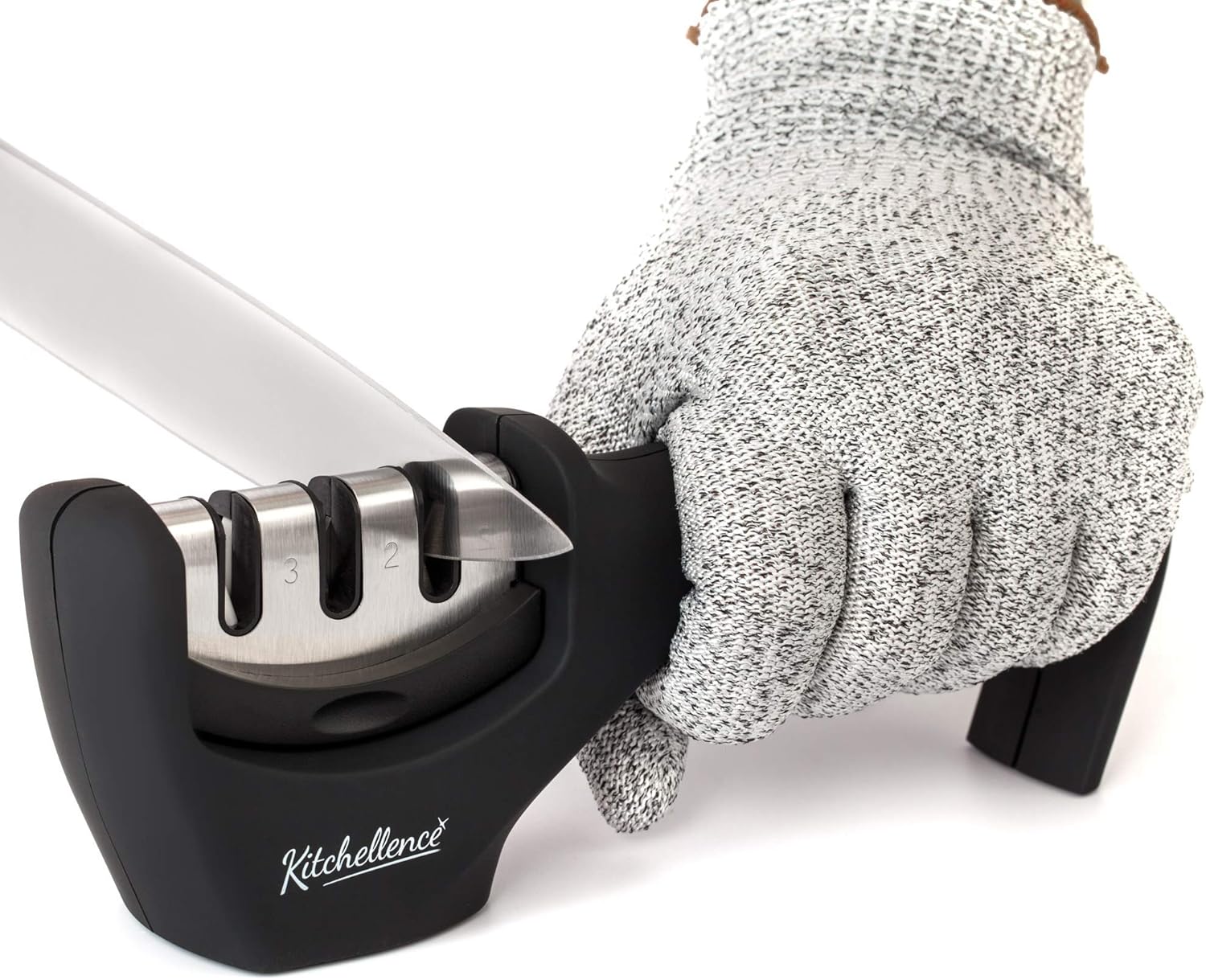
This three-stage sharpener is built for everyday home cooks who want an easy, low-risk way to restore dull knives. The first slot uses a diamond rod to realign and repair damaged edges, the second reshapes the bevel to reestablish a sharp angle, and the third polishes the edge for a finer finish. Its ergonomic handle and non-slip base make it simple to use whether you are right- or left-handed, and the included cut-resistant glove adds a layer of safety while you pull blades through the slots. Constructed from ABS plastic, the unit feels lightweight and durable for routine kitchen use and is compact enough to store in a drawer. Limitations are typical of guided manual sharpeners: it does not offer micro-adjustable angles or the precision of whetstones and is best for general kitchen knives rather than high-end specialty blades. For cautious beginners this kit provides predictable, repeatable sharpening with minimal setup or skill required.
Best for: Buyers who want a safe, low-effort way to bring common kitchen knives back to usable sharpness without learning whetstone techniques.
Less Ideal for: Experienced sharpeners or owners of high-end specialty blades who need precise angle control or professional-level edge work should look at stones or guided systems instead.
- Three-stage system (repair, sharpen, polish) covers common edge needs
- Ergonomic handle and non-slip base for stable, easy use
- Includes cut-resistant glove to improve user safety
- Compact, lightweight ABS construction for everyday kitchen storage
- Does not allow precise angle control needed for specialty knives
- Not suitable for ceramic or very hardened professional blades
Verdict: A beginner-friendly, safety-minded 3-stage sharpener that reliably restores everyday kitchen knives with minimal skill required.
Choosing the Right Knife Sharpener for Beginners: Key Factors to Consider
Sharpening Method
Different sharpening systems use stones, guided slots, electric abrasives, or pull-through carbide elements. The method affects how much skill you need. Manual stones require steady hand control and are more forgiving for experienced users but have a steeper learning curve for beginners.
Guided systems and pull-through sharpeners fix the blade angle, making consistent results easier to achieve. Electric sharpeners automate the motion but can remove metal quickly, so look for models that offer progressive abrasive stages to refine the edge without oversharpening.
Angle Control
Maintaining the correct bevel angle is critical to a sharp, durable edge. Beginners benefit from devices that either lock the blade at a recommended angle or provide clear, repeatable positioning aids. Tools that allow angle adjustment are useful if you work with different knife types, but fixed-angle guides reduce setup errors.
Poor angle control leads to uneven edges, excessive metal removal, and shortened knife life. Choose a sharpener that documents its guide angles or lets you easily replicate the same angle across strokes.
Abrasive Progression
Sharpening typically requires coarse abrasives for reshaping a dull edge, medium grits for refining, and fine or polishing stages to remove burrs and improve cutting performance. For beginners, a device that combines multiple stages or allows switching between coarse and fine surfaces is ideal.
A single-grit tool can be useful for touch-ups but will not recover very dull knives effectively. Check that abrasive materials are replaceable or long-wearing so the tool remains effective over time.
Safety Features
Handling sharp blades during sharpening carries risk, so features that increase stability and protect hands matter a lot. Look for anti-slip bases, finger guards, and blade clamps that secure the knife. A stable platform reduces the chance of slips when applying pressure.
Also consider whether the device keeps fingers clear of the abrasive path during normal use. Tools that require awkward hand positions or expose fingers to rotating elements are less suitable for those new to sharpening.
Compatibility With Knife Types
Not every sharpener works well with all blade steels or edge geometries. Beginners should pick a tool compatible with common kitchen knives and standard edge angles. Very hard specialty steels or serrated edges may need different approaches.
If you own a variety of knives, prefer a versatile system that can handle different blade widths and thicknesses without forcing unsafe positioning or uneven wear.
Maintenance and Longevity
A sharpener that requires frequent replacement parts or complicated upkeep can be frustrating. Consider how easy it is to clean, whether abrasives are removable for replacement, and whether the device stores compactly.
Durable construction and quality abrasives mean the unit will provide consistent results for longer, reducing the need to replace the whole tool. Ease of cleaning is important for kitchen hygiene and to prevent abrasive clogging.
First-Time Setup and Safe Sharpening Habits
Before you sharpen, clear a well-lit, stable workspace and secure the sharpener if it has a non-slip base or mounting option. Read any included angle guides and start with light strokes to get a feel for how the tool removes metal.
Always work with clean, dry knives and inspect the blade for chips or damage first. If a blade has significant chips or a rolled tip, address those issues with a coarser abrasive or professional service rather than risking damage by incorrect technique.
- Begin with the least aggressive setting that still improves the edge.
- Use consistent stroke counts per side to maintain symmetrical geometry.
- Keep fingers behind guards and never force the blade through a slot.
Maintaining an Edge Between Sharpenings
Regular honing with a honing rod or leather strop helps maintain edge alignment and extends the time between full sharpening sessions. Honing does not remove significant metal but straightens the bevel and realigns microscopic burrs.
For daily kitchen use, light honing once a week and a full sharpening session every few months is a practical rhythm for many cooks. Adjust frequency based on cutting frequency and the hardness of your knives.
- Hone before each use if you notice the blade catching or tearing food.
- Use light, even pressure during honing and avoid overcompensating for a dull edge.
Common Beginner Mistakes and How to Avoid Them
Applying too much pressure, changing angles mid-stroke, and skipping progression from coarse to fine stages are common errors that lead to poor edges. Start with light, deliberate motions and let the abrasive do the work.
Another frequent mistake is trying to sharpen serrated knives with a standard flat abrasive. Serrations require specialized tools or techniques to maintain their profile.
- Count and match strokes per side instead of guessing when the edge is ready.
- If a device feels unstable, stop and reposition it; stability is more important than speed.
Care and Storage of Sharpening Tools
Keep abrasives clean and dry to prevent clogging and corrosion. Certain whetstones may require flattening over time; follow manufacturer guidance on maintenance if available.
Store sharpeners and accessories in a dry place away from heavy humidity to protect abrasives and any metal components. Well-maintained equipment gives more consistent results and lasts longer.
- Wipe residues off abrasive surfaces after use and allow them to air dry.
- Keep small accessories together in a box or drawer to avoid losing guides or clamps.
When to Seek Professional Sharpening
If your knives have deep chips, broken tips, or an uneven edge that does not respond to coarse abrasives, a professional service can restore geometry safely. Professionals can reprofile blades and remove metal uniformly with specialized tools.
Also consider professional help if you need a very narrow edge angle for specialized knives or if you are uncomfortable performing coarse shaping yourself. Professional work can extend blade life and avoid accidental damage by inexperienced sharpening.
- Use professional service for major regrinds or when blades are significantly damaged.
- Reserve home sharpening for routine maintenance and moderate edge restoration.
How We Chose the Best Knife Sharpener for Beginners
Our shortlist focused on tools that make it straightforward to restore a knife edge with minimal skill. We prioritized devices that offer clear angle guidance or fixed-angle systems, simple and repeatable sharpening motions, and protective features that reduce the risk of accidental cuts. Durability and the quality of abrasive materials were important because low-quality abrasives wear quickly and give inconsistent results. We applied measurable filters: the device had to provide stable blade support or reliable angle control, demonstrate consistent material removal across strokes, and include safety or anti-slip features for steady operation. We excluded specialty sharpening systems designed only for professional use or devices that require advanced setup and repeated calibration. We also filtered out tools that rely solely on subjective visual cues without consistent mechanical guidance. Key dimensions that decided placements were ease of use for first-time operators, sharpening consistency across common kitchen steel types, abrasive progression and material quality, safety and handling, and build durability. These criteria shaped the scoring labels and ensure the picks work well for home cooks getting started with knife maintenance.
Our full evaluation process is outlined in our review methodology.
FAQ
What is the easiest way to get a consistent edge as a beginner?
Using a guided-angle sharpener or a simple pull-through guide provides repeatable positioning and consistent strokes. These systems reduce the need to judge angle manually and are easier to learn than freehand stones.
Can I sharpen serrated knives with a beginner sharpener?
Most entry-level flat abrasives do not work well on serrations. Serrated edges usually need a tapered ceramic rod or a specialized tool to restore the scalloped profile without rounding the teeth.
How often should I sharpen my kitchen knives?
Frequency depends on use and steel hardness, but many home cooks sharpen every few months and hone weekly. If a knife starts tearing instead of slicing, it is a sign a sharpening session is needed.
Will electric sharpeners damage my knives?
Electric models can remove metal quickly if used aggressively, but models with multi-stage abrasives and moderate removal rates can be safe. Use the gentlest effective stage and avoid repeated heavy passes.
Do I need to learn to freehand sharpen on a stone?
Freehand sharpening offers flexibility and fine control but has a steeper learning curve. Many beginners get excellent results with guided systems and later learn stone techniques if they want more control or to work with specialized steels.
Final Verdict
Choose a beginner-friendly sharpener that prioritizes consistent angle control, safe handling, and a sensible abrasive progression. Tradeoffs include speed versus control and ease of use versus versatility. Beginners usually benefit most from guided systems or simple multi-stage sharpeners that protect the blade while teaching repeatable technique. Focus on stability, documented angle guidance, and abrasive quality when deciding. With the right tool and safe habits, you can restore and maintain kitchen knives confidently without risking damage or injury.