
Note: This article contains affiliate links. If you click on these links and make a purchase, we may earn a small commission at no extra cost to you. This helps support our research and content. Read our full affiliate disclosure here.
Cold, damp unfinished basements can make living space unusable and create moisture problems if not heated properly. Picking the right heater for an unfinished basement matters because these spaces have high ceilings, concrete floors, and fewer thermal barriers, so you need steady output, moisture-tolerant components, and clear safety features. This guide presents seven top heaters shortlisted for unfinished basements, focusing on real-world factors like heating output, coverage area, durability in cooler damp spaces, and safety controls. Read on to see which features matter most and how the shortlisted options stack up against typical basement conditions.
Top Picks at a Glance
| Best Overall The best all-around choice for most situations | Heat Storm Phoenix HS-1500-PHX-WIFI |  |
| Best Quality Built to a higher standard if you want something more solid | Mr. Heater Big Maxx F260550 |  |
| Best Value The sweet spot between price and what you get | GiveBest 1500W Wall Heater |  |
| Best Budget The cheapest option that still gets the job done reliably | Amazon Basics Portable Space Heater DF1501 |  |
| Top Rated A top-rated pick with lots of positive feedback | DR. Infrared Heater DR-968 |  |
| Most Popular A crowd favorite that many people choose with confidence | Cadet 30" Baseboard Heater 500W |  |
| Best Seller A high-volume bestseller chosen again and again | DREO Tower Space Heater DR-HSH003 |  |
Heat Storm Phoenix HS-1500-PHX-WIFI
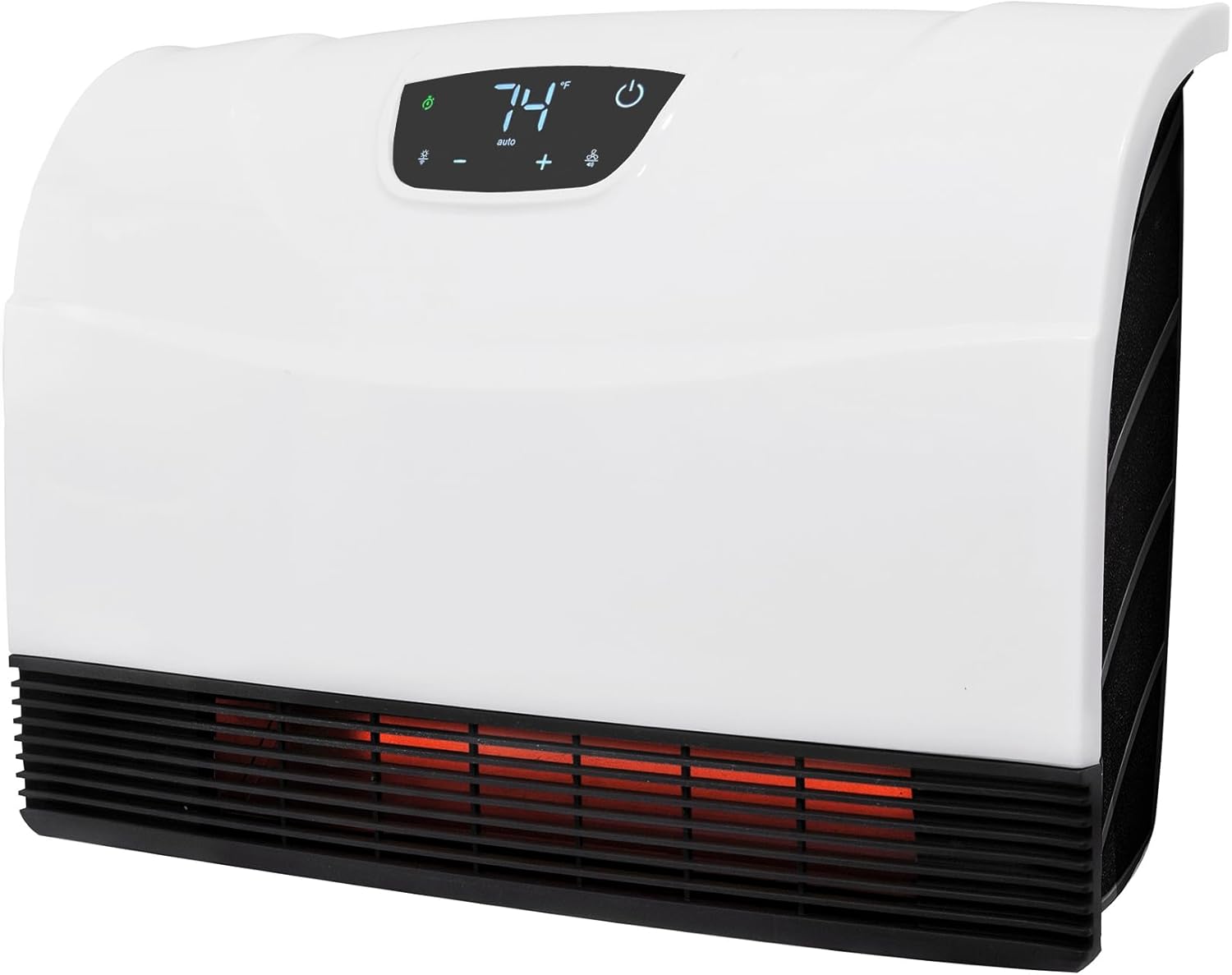
| Power | 1500 W |
|---|---|
| Heating Coverage | 150 ft² (primary), 750 ft² (secondary) |
| Voltage | 110 volts |
| Max Temperature Setting | 99 °F |
The Heat Storm Phoenix HS-1500-PHX-WIFI is a plug-in, wall-mounted infrared heater designed to provide targeted zone heat in small rooms. It uses a 1500 W radiant heating element to warm people and surfaces rather than large volumes of air, making it practical for bathrooms, bedrooms, home offices, or small unfinished spaces where floor space is limited. The built-in Wi‑Fi and one-touch Bluetooth setup let you control temperature and schedules from a phone, and a touchscreen plus included remote offer local control. Safety-minded touches include tip-over shutoff for portable setups, a cool-to-touch grill, and the ability to mount over the outlet to hide the cord. Because it is infrared and sized for roughly 150 sq ft as a primary heater, it delivers quick, comfortable warmth at the point of use but is not intended to heat large open basements by itself. Expect straightforward installation and modest electrical draw on a standard 110 V circuit, with washable filters for basic maintenance.
Best for: Buyers who want a compact, wall-mounted infrared unit to add controllable zone heat to a small unfinished basement area or to warm a workbench, hobby corner, or adjacent finished room without taking up floor space.
Less Ideal for: Not a good choice for heating large, open, poorly insulated basements as a primary system; whole-space or higher-capacity heating solutions are preferable.
- 1500 W infrared element provides quick, localized warming
- Wall-mount design saves floor space and can hide cord when mounted over outlet
- Wi‑Fi and Bluetooth setup allow remote scheduling and phone control
- Includes touchscreen and remote for easy local control
- Washable filters and safety features like cool-to-touch grill and tip-over shutoff
- Rated as a primary heater for about 150 sq ft so it is not sufficient as the sole heater for large unfinished basements
- Max temperature listed is modest, so it warms people and surfaces rather than large volumes of air
Verdict: A compact, Wi‑Fi enabled 1500 W wall-mounted infrared heater that delivers quick, controllable zone heat for small basement areas or workspaces.
Mr. Heater Big Maxx F260550

| Heat Output | 50,000 BTU |
|---|---|
| Heating Coverage | 1,667 sq ft |
| Fuel Type | Natural Gas (includes LP conversion kit) |
| Mounting Type | Ceiling Mount |
| Power Source | Requires 120V AC |
The Mr. Heater Big Maxx F260550 is a ceiling-mounted forced-air unit heater designed to warm large unfinished workspaces. It produces 50,000 BTU and the industrial fan distributes warm air by convection, making it suitable for garages, barns, and workshops up to about 1,667 square feet. The heater ships set for natural gas but includes an NG-to-LP conversion kit, and it accepts standard 24-volt thermostats or newer Wi-Fi enabled thermostats for centralized control. Installation is simplified with included angle brackets and options for vertical or horizontal venting, while a high temperature safety shut-off and gas flame sensor add protection. Practical limits are that it requires 120V AC for the fan and a minimum ceiling/clearance requirement, and like all gas unit heaters it needs proper venting and code-compliant installation. For anyone who needs a robust, ceiling-mounted gas heater to quickly heat a large unfinished basement or workspace, this model delivers steady output and trusted safety features.
Best for: Buyers who need a performance-oriented, ceiling-mounted gas heater to reliably warm a large unfinished basement or workshop and prioritize steady, high BTU output and thermostat control.
Less Ideal for: Those who cannot meet venting or electrical requirements, have low ceiling heights, or prefer portable electric heaters for easy relocation.
- High 50,000 BTU output suitable for large unfinished spaces up to ~1,667 sq ft
- Includes NG-to-LP conversion kit for fuel flexibility
- Ceiling-mounted design clears floor space and comes with angle brackets for installation
- Compatible with standard 24V and Wi-Fi thermostats for remote/control integration
- Built-in safety features including high temperature shut-off and gas flame sensor
- Requires 120V AC power and proper venting which adds installation complexity
- Ceiling clearance and minimum height requirements limit placement in low-ceiling basements
Verdict: A high-output ceiling-mounted gas unit that reliably heats large unfinished basements and workshops for buyers focused on performance and thermostat control.
GiveBest 1500W Wall Heater

| Heat Output | 1500 watts |
|---|---|
| Heating Coverage | up to 200 square feet |
| Heating Element | PTC |
| Voltage | 120 volts of alternating current |
| Number of Speeds | 3 |
The GiveBest 1500W wall heater is a compact, wall-mounted electric heater that provides quick, targeted warmth for single rooms such as a finished corner of a basement, garage, or office. It mounts to the wall to save floor space and offers three control methods: onboard touch panel, included remote, and WiFi app control for scheduling or preheating. The heater uses a PTC heating element and a precision thermostat with an ECO mode that cycles output to reduce energy use while maintaining average comfort. Safety features include ETL-listed overheat protection, tip-over response behavior, and flame-retardant materials. In practice the unit gets a small room up to roughly 200 square feet comfortably on its highest setting, but ECO mode will produce noticeable temperature cycling in poorly insulated, unfinished spaces. The unit is most useful when mounted where airflow is unobstructed and when paired with reasonable insulation or zone heating; in large open or very cold unfinished basements you will likely need a higher-capacity solution or supplementary heat source to keep temperatures steady.
Best for: Buyers who need a compact, controllable wall heater to provide zone heat in a small to medium area of a basement or workshop and who prioritize remote scheduling and energy management.
Less Ideal for: People seeking a primary heat source for large, open, unfinished basements or very cold spaces should choose a higher-capacity or whole-room heating solution instead.
- Wall-mounted design saves floor space and installs with included template
- Three control options (touch panel, remote, WiFi app) for convenient scheduling and remote preheating
- 1500W PTC heater with precision thermostat and ECO mode helps manage energy use
- ETL-listed safety features including overheat protection and flame-retardant materials
- 1500W output is limited to well-insulated spaces up to about 200 sq ft and may struggle to maintain steady temps in large unfinished basements
- ECO mode cycles heating, which can cause noticeable temperature fluctuation in poorly insulated rooms
Verdict: A space-saving, smart 1500W wall heater that offers convenient remote control and efficient zone heating for insulated basement areas up to about 200 sq ft.
Amazon Basics Portable Space Heater DF1501

| Heat Output | 1500 watts |
|---|---|
| Heating Coverage | 160 square feet |
| Power Settings | 750W / 1500W |
| Voltage | 120 volts |
This Amazon Basics portable space heater is a freestanding infrared cabinet heater designed to provide targeted warmth in small to medium rooms. It runs on 120V with 750W and 1500W power options plus an ECO‑Smart setting intended to balance comfort and energy use, and it uses four infrared heating elements and a radiant heating element to produce steady heat. An adjustable electronic thermostat and easy-to-read LED display make it simple to set a temperature between 65 and 85 F, and the included remote lets you change settings from across the room. The wood-finish cabinet helps it blend with finished spaces, and built-in overheat protection adds a basic safety layer. For an unfinished basement the heater can supply local warmth to a work area or seating zone, but its 160 sq ft coverage and cabinet form factor mean it is best for spot heating rather than whole basements; large open, uninsulated spaces will still lose heat quickly. The unit is straightforward to operate and reasonably energy-aware with the ECO mode, but expect modest performance limits compared with more powerful or fan-forced units.
Best for: Buyers who need an affordable, user-friendly heater to warm a single zone or small unfinished basement workspace and who prioritize simple controls and modest energy savings.
Less Ideal for: Not a good choice for warming large, open, poorly insulated basements or for users who need rapid whole-room heating; consider a higher-output or fan‑assisted unit for those needs.
- Two power settings (750W and 1500W) plus ECO‑Smart mode for energy savings
- Adjustable electronic thermostat with LED display for easy temperature control
- Includes remote control for convenient operation from a distance
- Built-in overheat sensor for added safety
- Rated coverage about 160 sq ft so not suitable for heating large or fully open basement areas
- Cabinet/radiant design provides gentler heat than forced-air heaters, so it may take longer to feel warm
Verdict: A wallet-friendly spot heater that gives controlled, energy-aware warmth for a single basement zone rather than whole-space heating.
DR. Infrared Heater DR-968

| Wattage | 1500 Watts |
|---|---|
| Heating Coverage | 576 square feet |
| Number of Speeds | 3 |
| Voltage | 120 |
| Amperage | 12.5 A |
The DR. Infrared Heater DR-968 combines a quartz infrared tube and a PTC element to deliver fast, object-focused heat while a high‑velocity but quiet blower helps spread warmth through a room. It is meant for freestanding indoor use and is commonly used to supplement central heat or heat single unfinished spaces like basements, garages, and large rooms up to the stated coverage. Controls include an electronic thermostat (50 to 85°F), three power settings (Auto, Low 1000W, High 1500W), a 12‑hour timer, and an IR remote for convenient adjustments. Built-in safety features include tip‑over protection and overheat auto shutoff, and caster wheels make it easy to move and position. Trade-offs are typical for a 1500W electric heater: it requires a standard 120V circuit and can only run at its rated wattage limits, and while the unit claims broad coverage the actual effectiveness will depend on basement insulation and air leaks. The unit is UL certified and designed to stay warm to the touch rather than exposing heating elements, which is useful where safety is a priority.
Best for: Buyers who want a reliable, safety‑focused supplemental heater for cooler unfinished basement spaces and prioritize steady, quick warmth over whole‑house heating.
Less Ideal for: Not a good choice for permanently heating large, poorly insulated basements as a sole heat source or where hardwired high‑wattage heating is required.
- Dual heating system (PTC plus quartz infrared) for faster felt warmth
- Electronic thermostat with Auto mode for energy‑saving cycling
- Remote control and timer for hands‑off operation
- Tip‑over and overheat protections plus UL certification for safety
- Wheels and a quiet high‑pressure blower for easy placement and low noise
- Limited to 1500W output so heating performance depends on basement insulation and room tightness
- Requires a standard 120V/12.5A circuit which may limit simultaneous use of other high‑draw devices
Verdict: A dependable, safety‑minded 1500W infrared heater that delivers fast, movable supplemental heat for unfinished basement areas.
Cadet 30" Baseboard Heater 500W

| Heat Output | 500 watts |
|---|---|
| Voltage | 120 V |
| Amperage | 4.17 A |
| Max Temperature Setting | 54 °C |
| Heating Coverage | 1710 square feet (approximation) |
This Cadet 30-inch baseboard heater is a simple, corded electric unit designed to deliver steady convection heat for single-room supplemental warmth. It mounts to the floor and uses a radiant heating element to move heat into the room, and the included remote control makes it easy to change temperature settings up to 54°C from across the room. At 500 watts on 120V/4.17A it is best used to top up comfort in smaller areas or to maintain temperature in a space that needs light heat overnight. The heater is compact and unobtrusive in white, and the convection output is quiet compared with forced-air options. Important limitations are its modest power—500 watts will not warm large, poorly insulated spaces quickly—and it requires a dedicated corded connection and appropriate circuit capacity. You get practical, low-profile supplemental heat that's simple to install and operate, but not a replacement for a primary heating system in a cold, unfinished basement.
Best for: Buyers seeking an easy-to-install supplemental heater to maintain background warmth in a single room or spot-heat a finished area of a basement while prioritizing straightforward operation and proven performance.
Less Ideal for: Those looking to heat a large, uninsulated unfinished basement as a primary heat source or anyone who needs rapid whole-room temperature recovery should look for a higher-capacity heating solution.
- Includes remote control for convenient temperature adjustments
- Quiet convection heating suitable for maintaining room temperature
- Compact floor-mount design that blends into room trim
- Corded electric power requires no fuel or exhaust ventilation
- Only 500 watts of heat output, insufficient as primary heat for large or very cold unfinished basements
- Requires appropriate electrical circuit and a nearby outlet
Verdict: A compact, remote-controlled 500W baseboard heater that is a practical, low-noise supplemental heater for single rooms or spot heating in basements.
DREO Tower Space Heater DR-HSH003

| Heat Output | 1500 watts |
|---|---|
| Heating Coverage | 270 sq.ft. |
| Heating Element | PTC |
| Oscillation | 70° |
| Number of Speeds | 5 |
The DREO DR-HSH003 is a tower-style 1500W ceramic (PTC) space heater designed to heat medium to large rooms quickly and quietly. It combines forced-air and convection heating with a digital thermostat that can be set from 41 to 95°F, five fan speeds and a 70° oscillation to spread warm air across a wider area. Useful controls include a remote, a 12-hour timer and an ECO mode that steps power between about 1000W and 1500W to maintain temperature more efficiently. Safety features are thorough for a risk-averse buyer: ETL-listed construction, tip-over and overheat protection, flame-retardant materials and a long flat 6 ft cord. In practice the heater warms a roughly 270 sq ft space and runs at library-quiet levels (about 34 dB), so it can be left running in bedrooms or workspaces without much distraction. Important limits: it is a plug-in electric heater so it cannot replace whole-house heating and should be used only where code and outlet capacity allow, and the manufacturer warns against using extension cords. For unfinished basements this model offers focused, safe supplemental heat if you have a dedicated outlet and moderate-sized open area.
Best for: Buyers who prioritize safety and predictable, quiet supplemental heat for a single unfinished basement zone and want simple digital controls and remote operation.
Less Ideal for: People seeking to heat very large open basements, multiple rooms at once, or replace permanent HVAC should look at larger or hardwired solutions instead.
- Quick 1500W PTC heating that warms rooms up fast
- 70° oscillation and five speeds for wider, adjustable coverage
- Digital thermostat with 1°F increments and ECO mode for steady temperature control
- Multiple built-in safety features including ETL listing, tip-over and overheat protection
- Quiet operation (~34 dB) and convenient remote control and timer
- Requires a dedicated wall outlet and should not be used with extension cords
- Effective for single-room supplemental heating but not a substitute for central HVAC
Verdict: A safe, quiet 1500W tower heater that delivers reliable supplemental heat for a single unfinished basement area while prioritizing built-in safety and simple temperature control.
Choosing the Right Heater for Unfinished Basement: Key Factors to Consider
Heating Capacity and Coverage
Basements have different thermal characteristics than conditioned rooms, so heating capacity must match room volume and heat loss. Calculate the cubic footage and choose a heater with sufficient BTU or kilowatt output to raise temperatures in a concrete-walled, often poorly insulated space. A unit that lists an estimated square-foot coverage is a starting point, but always cross-check with your basement ceiling height and insulation level.
Undersizing leads to constant runtime and humidity issues, while oversizing can short-cycle and waste energy. Look for units with adjustable output or multiple power settings so you can scale heat to changing conditions throughout the season.
Safety Features
Safety is critical in unfinished basements because floors are often concrete and there may be exposed wiring or stored items. Prioritize heaters with automatic tip-over shutoffs, overheat protection, and cool-touch housings to reduce fire risk and accidental burns. Thermostats that cycle properly reduce overheating and improve runtime safety.
Also consider placement options and cord length to avoid running cords across walkways or near wet areas. Hardwired or permanently mounted options may be safer for long-term installation but require appropriate electrical work.
Moisture and Dust Resistance
Unfinished basements commonly have higher humidity, occasional damp spots, and more airborne dust. Choose heaters with sealed heating elements, corrosion-resistant materials, and straightforward designs that resist dust buildup. Units with IP-rated components or enclosed ceramic elements resist moisture better than exposed coil designs.
Easier-to-clean grilles and washable filters reduce maintenance needs and keep efficiency high. If the basement is prone to water intrusion, avoid placing portable heaters directly on the floor; wall-mounted or elevated installations can mitigate direct exposure.
Thermostatic Controls and Programmability
Good thermostatic control keeps a basement at a steady temperature, reduces energy waste, and prevents wide temperature swings that can cause condensation. Look for accurate digital thermostats, programmable schedules, or smart-home compatibility if you want remote control. Basic mechanical thermostats can work but may be less precise in large spaces.
Programmable features let you lower temperature during unused hours and raise it before you occupy the space, saving energy while maintaining comfort and protecting stored items from freezing or dampness.
Installation and Placement Options
How a heater is installed affects performance and safety in an unfinished basement. Portable units offer flexibility but need appropriate clearance and stable placement. Wall-mounted or ceiling-mounted units free floor space and reduce flood risk, but require secure mounting and possibly electrical hardwiring. Consider whether you need a permanent installation, a temporary solution, or a hybrid approach.
Also evaluate cord length, plug type, and whether the heater needs a dedicated circuit. Positioning near heat loss sources such as exterior walls or windows improves effectiveness.
Maintenance and Longevity
Basement heaters encounter more dust and sometimes higher humidity, which affects longevity and the need for maintenance. Choose units with accessible panels, washable filters, or components that can be wiped down without special tools. Corrosion-resistant finishes and serviceable fan motors extend service life in harsher basement conditions.
Consider spare part availability and whether routine tasks like filter cleaning or fan lubrication are user-serviceable. A straightforward maintenance routine reduces the chance of sudden failures during cold spells.
Choosing Between Portable and Fixed Heaters
Portable heaters are flexible and do not require installation, making them useful for renters or intermittent use. They are quick to deploy to a problem area but may need frequent repositioning and require a safe, level surface and proper clearance from combustible materials.
Fixed heaters, including wall-mounted or vented options, create a cleaner long-term solution for unfinished basements. They reduce trip hazards and floor exposure to moisture and can provide more even heat distribution when positioned strategically.
- Portable: no installation, easy to move, needs floor clearance
- Fixed: permanent placement, better for long-term use, may need electrical work
- Consider hybrid use: a fixed heater for base heat plus a portable for spot warming
Placement Tips to Maximize Warmth and Safety
Place heaters where airflow is not blocked by stored items and away from direct contact with water. Elevating the unit slightly off the floor helps protect against minor water intrusion and improves airflow over concrete surfaces.
Avoid positioning directly under exposed ductwork that can drop condensation onto the unit. Keep a clear zone around the heater per the manufacturer guidance to ensure safe operation and prevent overheating.
- Keep at least the recommended clearance around all sides
- Avoid corners that trap cold air and limit circulation
- Position near exterior walls to counteract heat loss
Managing Humidity and Condensation When Heating
Heating a cold, damp basement can temporarily increase relative humidity as the air warms. Good ventilation and occasional dehumidification help prevent condensation on walls and stored items. Pairing heating with airflow, such as a fan or mechanical ventilation, reduces moisture buildup.
If condensation is recurring, address the underlying moisture source through better drainage, sealing, or insulation before relying solely on heat to solve dampness.
- Use ventilation to reduce trapped moisture
- Combine heating with a dehumidifier in very damp basements
- Monitor for water intrusion and seal cracks if needed
Electrical Considerations and Circuit Load
High-output electric heaters can draw significant current and may require a dedicated circuit. Before selecting a heater, check your basement electrical capacity and whether outlets are on shared circuits with other heavy appliances. Overloading a circuit increases trip hazards and reduces heater effectiveness.
For gas or propane-fueled options, ensure proper ventilation and follow local codes for installation. Hardwired electric units avoid extension cords but usually require professional installation.
- Confirm outlet amperage and circuit loading
- Avoid extension cords with high-draw units
- Consult an electrician for permanent or high-wattage installations
Seasonal Use and Storage Strategy
Think about whether you need year-round heat or occasional winter use. Seasonal users benefit from portable units that can be stored in warmer months, while year-round needs point toward more permanent, serviceable systems. Proper storage and winterization extend the life of portable heaters.
During storage, clean the unit, remove dust from fans and grilles, and keep it in a dry location to prevent corrosion and motor damage.
- Store portable heaters in a dry, temperature-controlled space
- Perform basic maintenance before storing each season
- Label cords and accessories to simplify redeployment
How We Chose the Best Heater for Unfinished Basement
We shortlisted heaters that match the unique demands of unfinished basements by applying clear, practical filters. First, we prioritized sustained heating capacity and coverage area so a unit can raise and maintain temperature in large, concrete-floored rooms. Second, we focused on moisture- and dust-tolerant designs, including sealed elements or IP-rated components where applicable, because basements often have higher humidity and particulate exposure. Third, safety features were a must: tip-over shutoff, overheat protection, cool-touch surfaces, and thermostatic control were required for inclusion. Fourth, durability and ease of maintenance mattered, including accessible filters or washable grilles and corrosion-resistant housings. Finally, we considered runtime efficiency and controls that let you set and hold target temperatures without constant intervention. We excluded units meant only for temporary outdoor use or small personal heaters that cannot heat a typical unfinished basement. The resulting picks balance output, safety, durability, and user controls for dependable basement performance.
Our full evaluation process is outlined in our review methodology.
FAQ
What size heater do I need for my unfinished basement?
It depends on the basement's cubic footage and insulation. Estimate required BTUs or kilowatts using room volume and adjust upward for concrete walls and high ceilings. Choose a unit with multiple output settings or one rated for the recommended coverage area.
Is it safe to use a space heater in a damp basement?
Space heaters can be safe if designed for higher humidity and used per safety guidelines. Prefer sealed elements, raised placement, and units with overheat and tip-over protections. Avoid placing heaters directly on wet surfaces and keep electrical connections off the floor.
Should I hardwire a heater or use a plug-in model?
Hardwiring can be safer and neater for a permanent solution and may be required for high-wattage units. Plug-in models are simpler for temporary or seasonal use but verify outlet capacity and avoid extension cords with high-draw heaters.
Can heating my basement reduce moisture problems?
Heating can help reduce cold spots that cause condensation, but it is not a standalone fix for moisture intrusion. Combine heating with ventilation, dehumidification, and moisture-proofing measures for lasting results.
How do I maintain a heater used in a basement?
Regularly clean dust from grills and fan blades, check for corrosion or moisture damage, and replace or wash filters as recommended. Periodic inspection of cords, plugs, and mounting hardware helps prevent failures.
Final Verdict
Choosing a heater for an unfinished basement requires balancing output, moisture tolerance, and safety. Prioritize units that deliver the necessary BTU or kilowatt rating for your basement volume, offer reliable safety shutoffs, and are built to resist dust and humidity. Consider installation style, electrical needs, and how heating will interact with existing moisture issues. With those priorities in mind, select the solution that matches your usage pattern—portable for occasional spot heating or fixed for continuous comfort—and maintain it to ensure safe, dependable basement warmth.