
Note: This article contains affiliate links. If you click on these links and make a purchase, we may earn a small commission at no extra cost to you. This helps support our research and content. Read our full affiliate disclosure here.
Picking the right heater for living rooms changes how comfortable your main gathering space feels across chilly months. The correct heater delivers enough warmth for the room size, maintains a consistent temperature, and keeps noise and energy consumption manageable so you can relax, entertain, or watch TV without distractions. This guide shortlists the top options for living-room use and explains the practical tradeoffs you should expect. Below we cover shortlisted heaters that fit common living-room layouts, then break down the performance and convenience factors that matter when choosing one.
Top Picks at a Glance
| Best Overall The best all-around choice for most situations | DR. Infrared Heater DR-968 |  |
| Best Quality Built to a higher standard if you want something more solid | EdenPURE CopperPLUS Infrared Heater 1500W |  |
| Best Value The sweet spot between price and what you get | Lasko Ceramic Tower Heater 751320 |  |
| Best Budget The cheapest option that still gets the job done reliably | Amazon Basics Ceramic Space Heater DQ1927-Y |  |
| Top Rated A top-rated pick with lots of positive feedback | DREO Space Heater DR-HSH004 |  |
| Most Popular A crowd favorite that many people choose with confidence | GiveBest Portable Space Heater PTC-905 |  |
| Best Seller A high-volume bestseller chosen again and again | DREO Space Heater HSH006 |  |
DR. Infrared Heater DR-968

| Wattage | 1500 Watts |
|---|---|
| Heating Coverage | 576 square feet |
| Number of Speeds | 3 |
| Voltage | 120 |
| Amperage | 12.5 A |
The DR. Infrared Heater DR-968 combines a quartz infrared tube and a PTC element with a high‑pressure low‑noise blower to warm living areas quickly and evenly. It is typically used as a freestanding room heater in living rooms, bedrooms or home offices where faster radiant warmth and targeted comfort are preferred to whole-house heat. Notable features include three power modes (Auto, Low 1000W, High 1500W), an electronic thermostat adjustable from 50 to 85 F, a remote control, timer and caster wheels for easy repositioning. Safety protections include tip‑over and overheat auto shutoff and a cool‑to‑the‑touch exterior, which makes it suitable around households with children or pets. Practical benefits are fast perceived warmth from infrared heating, quieter operation at around 39 dB, and an auto energy‑saving mode that cycles between settings to maintain temperature. Limitations are the usual boundaries of a 1500W portable unit: it is meant to heat single rooms rather than whole homes and requires a standard 120V outlet and adequate circuit capacity.
Best for: Buyers who want a portable living‑room heater that delivers quick, noticeable warmth and quiet operation while prioritizing safety and simple controls.
Less Ideal for: People seeking whole‑house heating or large open floor plan solutions should consider larger hardwired systems or multi‑zone options instead.
- Dual heating system (quartz infrared + PTC) for faster, more even warmth
- Auto energy‑saving mode with thermostat control for stable comfort
- Remote control and timer for convenient operation
- Tip‑over and overheat protections plus a cool-touch exterior for safer use
- Limited to single‑room heating; not a replacement for central heating
- Uses 1500W so may trip weak or shared circuits in older homes
Verdict: A quiet, safety‑focused 1500W infrared heater that delivers fast, room‑level warmth ideal for living rooms.
EdenPURE CopperPLUS Infrared Heater 1500W

| Power | 1500W |
|---|---|
| Heating coverage | 1000 square feet |
| Heat output | 5000 BTU |
| Number of speeds/settings | 24 |
| Power source | Corded Electric |
The EdenPURE CopperPLUS is a 1500W portable infrared heater made to deliver steady, zone-focused warmth for living rooms and similar spaces. It uses copper PTC heating elements and radiant heat to warm people and objects directly rather than blasting hot air, which helps maintain natural humidity. In practice the unit is used on the floor with its rolling casters to move between rooms, and a wireless remote plus 24 preset heat levels make fine temperature control simple from across the room. Safety is well-considered with dual overheat sensors, tip-over shutoff, and a cool-touch grill, and the washable lifetime filter removes dust without recurring filter purchases. The heater runs quietly, claims coverage up to 1000 sq ft, and offers both high and low power modes for economical zone heating. Expect a relatively large cabinet for a portable unit and typical electric power draw at full output, so it is best for supplemental room heating rather than replacing central systems in very large homes.
Best for: Buyers who want a performance-oriented zone heater for living rooms and prioritize efficient, direct infrared heating with fine-grain temperature control and strong safety features.
Less Ideal for: People seeking a tiny, ultra-compact heater or a whole-house replacement; those who need battery or cordless operation should look elsewhere.
- Copper PTC element for efficient, steady infrared heat transfer
- 24 precision heat settings and wireless remote for easy, exact control
- Built-in safety sensors with tip-over shutoff and cool-touch housing
- Lifetime washable filter eliminates ongoing filter replacement costs
- Portable design with rolling casters for easy room-to-room use
- Large cabinet footprint for a portable heater
- High power draw at 1500W when operating on maximum output
Verdict: Choose this heater if you want a performance-focused, portable infrared unit that delivers efficient zone heating with precise controls and robust safety features.
Lasko Ceramic Tower Heater 751320

| Heat Output | 1500 watts |
|---|---|
| Heating Element | Ceramic |
| Special Features | Adjustable Thermostat, Auto-Off Timer, Widespread Oscillation, Remote Control |
| Power Source | Corded Electric |
| Indoor Outdoor Usage | Indoor |
The Lasko Ceramic Tower Heater 751320 is a slim 1500-watt forced-air space heater made to warm small to medium living rooms and bedrooms. It uses a ceramic heating element and widespread oscillation to push warm air across the room while an electronic programmable thermostat keeps temperature steady without constant adjustments. Controls are straightforward on the unit and on the included multi-function remote, which also stores on-board, and the seven-hour auto-off timer is handy for evening use. Built-in safety features include overheat protection and cool-touch housing for safer placement around furniture. Its lightweight, narrow footprint and carry handle make it easy to move between rooms, though it does not include a tip-over switch or child lock on this model. Expect quiet operation on the low setting and noticeable warmth at high, but like all 1500 W portable heaters it is best for targeted or supplemental heating rather than replacing central heat in very large spaces.
Best for: Buyers who want a practical, easy-to-use living room heater that provides quick, adjustable warmth and room-wide coverage without complicated setup.
Less Ideal for: People who need whole-home heating or features like tip-over protection and child lock built into the unit should consider other solutions.
- 1500-watt ceramic element provides fast, effective warmth for small to medium rooms
- Widespread oscillation helps distribute heat more evenly across a living room
- Electronic thermostat and 7-hour timer allow consistent, programmable comfort
- Includes multi-function remote with on-board storage for convenient control
- Slim, portable tower design with built-in handle for easy relocation
- No tip-over switch or child lock on this specific model
- Limited to supplemental heating for single rooms rather than whole-house use
Verdict: A compact, user-friendly tower heater that reliably delivers targeted living-room warmth with thermostat control and remote convenience.
Amazon Basics Ceramic Space Heater DQ1927-Y

| Heat Output | 1500 watts |
|---|---|
| Number of Speeds | 3 |
| Power Source | Corded Electric |
| Max Temperature Setting | 130 °F |
This Amazon Basics ceramic space heater is a small, no-frills unit designed to warm a single room quickly. It offers three modes — high (1500W), low (900W) and fan-only — and a basic adjustable thermostat so you can dial in comfort without complicated menus. The ceramic heating element and convection design produce rapid, even heat for personal spaces, and the fan-only mode helps circulate air when you do not need heat. Safety features include tip-over and overheat protection plus a power indicator light, which makes it sensible for living-room use around normal household traffic. The heater is very compact and lightweight, making it easy to move between seating areas, but it is not intended for damp rooms and lacks oscillation or smart controls found on pricier models. If you need straightforward, effective spot heating in a living room and want to keep operating cost and complexity low, this model covers the basics well.
Best for: Buyers looking for an affordable, portable heater to add quick spot warmth to a living room without extra features or complexity.
Less Ideal for: If you want whole-room heating for larger spaces, smart controls, or use in damp areas, choose a larger or feature-rich model instead.
- Compact and easy to move between rooms
- Three settings including 1500W for fast heat
- Adjustable thermostat for basic temperature control
- Built-in tip-over and overheat protection for safer use
- No oscillation or advanced controls like timers or Wi-Fi
- Not rated for use in high-humidity rooms such as bathrooms or laundry areas
Verdict: A simple, budget-friendly 1500W ceramic heater that delivers quick spot heating and basic safety features ideal for keeping a living room cozy.
DREO Space Heater DR-HSH004
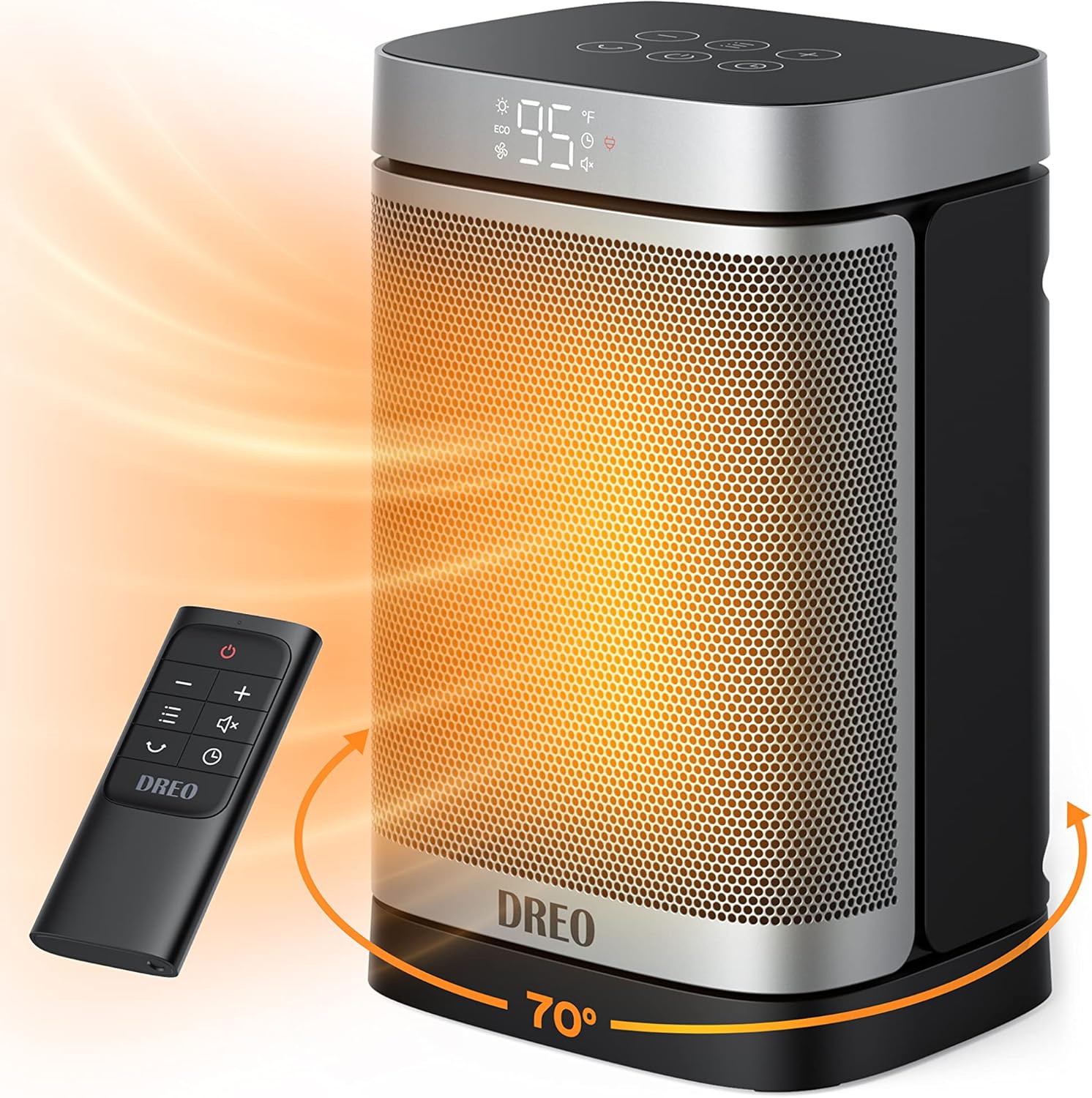
| Heat Output | 1500 watts |
|---|---|
| Heating Coverage | 200 sq.ft |
| Heating Element | PTC Ceramic |
| Number of Speeds | 5 |
| Adjustable Thermostat | 41-95 °F |
The DREO DR-HSH004 is a portable tower heater aimed at heating single rooms quickly and quietly. It delivers up to 1500 watts through a PTC ceramic element and forced-air delivery, with a programmable digital thermostat that adjusts in 1°F increments between 41 and 95°F. A 70° oscillation spreads heat across a wider area, and ECO mode helps regulate output to maintain set temperature while limiting energy use. Controls are available on an LED panel or by remote, and a 1–12 hour timer adds convenience for living room use. Safety is emphasized with ETL listing, tip-over and overheat protections and flame-retardant materials, and the unit includes a detachable filter for basic upkeep. Limitations include its 200 sq ft recommended coverage, which suits one main living area but not large open-plan spaces, and its floor-mounted tower form factor which may be less effective for whole-house heating. For buyers who prioritize consistent, safe operation and simple temperature control, it is a practical living room heater that balances warmth, quiet operation, and energy-awareness.
Best for: Someone who wants a reliable, safety-focused heater to warm a single living room or similar-sized space with precise thermostat control and quiet operation.
Less Ideal for: People seeking whole-house heating or a heater for very large, open-plan living rooms should consider higher-capacity or different heater types.
- Powerful 1500W output for fast room warming
- Programmable digital thermostat with 1°F increments for precise temperature control
- 70° oscillation helps distribute heat across a living room area
- Multiple convenience features including remote, LED controls and 1–12 hour timer
- Built-in safety features with ETL listing, tip-over and overheat protection plus flame-retardant materials
- Rated for about 200 sq ft so not ideal for very large or open-plan living rooms
- Tower/forced-air design may not retain heat as long as oil-filled radiators
Verdict: A reliable, safety-minded 1500W tower heater that gives precise thermostat control and quiet, efficient heat for a single living room.
GiveBest Portable Space Heater PTC-905

| Heat Output | 1500 watts |
|---|---|
| Heating Coverage | 200 sq.ft |
| Power Source | Corded Electric |
| Number of Speeds | 2 |
| Max Temperature Setting | 158 °F |
The GiveBest PTC-905 is a small ceramic space heater meant to warm a single room quickly. It offers two heat modes (750W and 1500W) plus a cool-fan setting, and an electronic thermostat that cycles the unit to maintain your chosen temperature. Practical touches include a built-in carry handle for moving it between a living room, bedroom, or home office and safety features such as overheat shutoff, tip-over protection with audible beep, and flame-retardant exterior material. The unit is relatively quiet thanks to its PTC element and rated fan speed, so it can run while you watch TV or work. Because it is compact and tabletop-mounted, it is best used as a supplemental heater for one living area rather than as a primary whole-house solution; it also uses a standard two-prong plug and has a fixed cord length. For buyers who want simple plug-and-play warmth, clear safety protections, and proven ceramic heating, this is a solid option, though it lacks advanced controls like Wi-Fi or a remote and will need repositioning to heat different rooms effectively.
Best for: Buyers who want a proven, no-frills supplemental heater for a living room or similar sized space and who prioritize reliable safety features and straightforward operation backed by many user reviews.
Less Ideal for: People seeking smart-enabled control, large-area or whole-house heating, or a permanently installed heating solution should consider other options.
- Two heat settings (750W and 1500W) plus a cool fan for year-round use
- Electronic thermostat that maintains a preset temperature automatically
- Multiple safety features including overheat shutoff and tip-over protection
- Compact, portable form with built-in carry handle for easy relocation
- No smart features or remote control for convenient adjustments from a distance
- Designed to heat a single room only, not suitable for whole-house heating
Verdict: A compact, safety-focused ceramic heater that reliably heats a single living room area with simple controls and proven performance.
DREO Space Heater HSH006

| Heat Output | 1500 watts |
|---|---|
| Heating Coverage | 200 sq.ft |
| Heating Element | PTC Ceramic |
| Number of Speeds | 4 |
| Min–Max Temp | 41 °F–95 °F |
The DREO HSH006 is a compact tower heater designed to warm small to medium living areas quickly with a 1500W PTC ceramic element and forced-air output. It is typically placed on the floor near seating to push warm air across the room and offers four speeds, several heat modes including ECO, and an adjustable thermostat that spans 41 to 95°F in 1°F increments for precise comfort. Practical extras include a 12-hour timer, remote control, memory and child lock functions, and a carry handle for moving between rooms. Safety is emphasized with tip-over detection, overheat protection, flame-retardant materials and ETL listing. The unit runs quietly thanks to a brushless DC motor and a winglet fan design, making it suitable for living rooms where low noise matters. Trade-offs are standard for a compact forced-air heater: it is best for localized heating up to about 200 sq ft rather than whole-house use, and it relies on continuous electric power at full output.
Best for: Buyers who prioritize safe, quiet, and precise spot heating for living rooms and want a plug-and-play unit with remote and timer convenience.
Less Ideal for: Homes seeking a primary whole-house heating solution or those needing heat for very large, open-plan living spaces should consider higher-capacity or different heater types.
- 1500W PTC ceramic element delivers fast, consistent warmth for a living room spot
- Adjustable thermostat with 1°F increments for precise temperature control
- Multiple safety features including tip-over detection, overheat protection and ETL listing
- Quiet operation (about 34 dB) suitable for conversations and TV listening
- Handy remote, 12-hour timer and memory function for convenient daily use
- Designed for rooms up to about 200 sq ft so not ideal as a primary heat source for large open living areas
- Forced-air design provides rapid warmth but can be less even than radiator-style heaters
Verdict: A safe, quiet, and precise 1500W tower heater that is ideal for targeted living room warmth and easy daily use.
Choosing the Right Heater for Living Rooms: Key Factors to Consider
Room Size and Heating Output
Heating output must match the living room volume more than a simple square footage number. High ceilings, open floor plans, or connected rooms increase the volume a heater must warm and may require higher wattage or a unit designed for broader coverage. Consider not just peak output but how long a heater can sustain target temperatures without cycling constantly.
A good rule is to match a heater's rated output to your room's cubic footage and account for insulation quality. Undersized heaters will run continuously, driving up electricity use and failing to maintain comfort. Oversized units can short-cycle and feel noisy or drafty, so choose a model whose output aligns with your typical living-room layout.
Heat Distribution Method
How a heater delivers warmth affects comfort and placement. Convection heaters gently warm air, creating steady background heat that fills a room but may take longer to notice. Radiant or infrared units provide immediate warmth to objects and people in their line of sight, which is useful for focused seating areas but may leave corners cooler. Fan-forced heaters speed up room warm-up and improve air mixing but can be louder.
Think about how you use the living room. For even ambient warmth in an open-plan living area, convection or convection with gentle fans often works best. For spot heating near a sofa or reading chair, a directional radiant element can feel more efficient. Placement relative to furniture, curtains, and walkways also matters for even distribution and safety.
Energy Efficiency and Running Cost
Initial wattage does not tell the whole story about ongoing expenses. Energy efficiency depends on how effectively the heater maintains your chosen temperature and how well it cycles. Models with accurate thermostats and programmable controls will usually run less overall power than a manual-on heater because they reduce overrun and maintain a steady setpoint.
Also consider available heat modes such as eco settings, timers, and adaptive thermostats, which can reduce total runtime. Insulation quality and thermostat placement will influence measured efficiency, so a more controllable heater that can hold a set temperature typically yields lower monthly bills in real use than a simple constant-output unit.
Safety Features and Placement
Living rooms are high-traffic, multiuse spaces that often include children, pets, and electronics. Safety features such as tip-over shutoff, overheat protection, cool-touch surfaces, and secure grilles reduce risk. Hard-wired or permanently installed units may offer different safety considerations than portable models, such as required clearance and installation integrity.
Always plan placement so the heater has adequate clearance from flammable items, and avoid blocking air intakes. Consider models with automatic shutoffs and lockable controls if the household includes children or pets. Safety certifications and clearly documented installation or placement guidance are important decision factors.
Noise Level and Comfort
A living room heater should not interrupt conversation, TV, or sleep. Fan-assisted units generally produce audible airflow, and high-speed settings can be distracting. Convection and oil-filled radiators are often much quieter, providing near-silent operation at the expense of slower warm-up times.
Decide how important near-silence is for your living-room use. If you often watch movies or host guests, prioritize low-noise designs and check reported sound levels or user feedback about fan noise. Look for adjustable fan speeds and modes that let you trade faster heating for quieter operation when needed.
Controls, Thermostat Accuracy, and Convenience
Good controls let you maintain comfort without constant adjustment. Built-in thermostats that accurately sense room temperature reduce overshoot and short cycling. Programmable timers, multiple heat settings, remote controls, and simple interfaces increase convenience, especially in a living room where frequent manual adjustments are inconvenient.
Smart or app-enabled controls can add convenience but are not required for effective operation. Consider how you will operate the heater day to day: will you set a schedule, adjust manually from a couch, or leave it running on a steady setting? Choose controls that match your routine and provide clear feedback on the current mode and setpoint.
Choosing the Right Type for a Living Room
Different heater technologies suit different living-room priorities. Convection units and oil-filled radiators provide steady ambient warmth, which is ideal for open spaces and quiet operation. Fan-forced ceramic or infrared models heat up faster and can be effective when you need quick comfort, such as when sitting down to watch TV.
Think about how quickly you want the room to reach a comfortable temperature and whether you prioritize silent operation or faster warm-up. For households that use the living room intermittently, models with timers or programmable thermostats give the best balance between comfort and energy use.
- Convection: Best for steady, whole-room warmth and quiet operation
- Radiant/Infrared: Good for focused seating areas and instant comfort
- Fan-forced: Fast warm-up and better air mixing but more noise
- Oil-filled: Long-lasting residual heat and very quiet
Placement and Clearance Tips
Where you place a heater affects both safety and effectiveness. Position the unit so it can circulate warm air unobstructed; avoid tucking it behind furniture or curtains. For directional heaters, ensure the warm path targets seating areas without directing heat at fragile items or electronics.
Maintain manufacturer-recommended clearances on all sides and avoid high-foot-traffic spots where the unit could be knocked over. If using a portable heater on the floor, place it on a stable, level surface and keep cords clear of walkways.
- Keep at least the recommended clearance from walls and fabrics
- Avoid placing near curtains, magazines, or paper stacks
- Do not block air intake or outlet grilles
- Use stable surfaces and route cords safely
Thermostat Placement and Temperature Control
Thermostat location influences how the heater perceives room temperature. A thermostat near a draft, a heat source, or in direct sunlight may misread the overall room climate and cause cycling or uneven warmth. Place the heater where it senses air representative of the living room, typically away from windows, doors, and direct sunlight.
If a heater's built-in thermostat cannot be optimally located, consider models with remote sensors or external thermostats. Using timers and lower steady-state setpoints often yields a more comfortable and energy-efficient result than repeatedly boosting the heater to a high setting.
- Avoid placing thermostat near drafts or direct sunlight
- Remote sensors can improve accuracy in larger rooms
- Use gradual setpoint changes to prevent overshoot
Maintenance and Long-Term Upkeep
Regular maintenance keeps a living-room heater safe and efficient. Clean intake and outlet grilles periodically to prevent dust buildup that reduces airflow and increases operating temperature. For fan-assisted units, check the fan housing and blades for dust and hair accumulation and follow the manufacturer's cleaning instructions.
Inspect cords and plugs for damage on portable units and ensure any permanently installed heater is checked periodically for electrical integrity. Replace or repair components per guidelines; neglect can reduce efficiency and increase safety risk.
- Dust grilles and fan housings regularly
- Inspect power cords and connections for wear
- Follow recommended schedules for professional servicing if applicable
Integrating a Heater Into Your Home Energy Plan
A living-room heater is one element of a broader home heating strategy. Pairing a localized heater with good insulation and targeted use can be more cost-effective than upscaling central heating. Use programmable schedules to heat the living room only when occupied and lower temperatures at night or when the room is empty.
Consider combining the heater with smart thermostats or zoned scheduling to minimize overlap with whole-house systems. Monitoring your energy use for a few weeks after installing a new heater helps you understand real running costs and adjust settings to optimize efficiency.
- Use timers and schedules to limit runtime
- Complement central systems with targeted heating when practical
- Track energy use after installation to fine-tune settings
How We Chose the Best Heater for Living Rooms
We focused on features and performance that directly affect day-to-day comfort in living rooms. Selection began with widely available heater types designed for whole-room use and eliminated units intended only for small personal zones or specialty outdoor use. Each candidate was evaluated across thermal output relative to room size, heat distribution method, steady-state energy use, safety features for occupied spaces, and operational convenience such as controls and noise. Specific criteria we prioritized include heating power and coverage, energy efficiency and steady running cost, distribution method and how evenly heat spreads, safety systems such as tip-over and overheat shutoffs, and usability factors like thermostats and quiet operation. We excluded compact personal heaters that do not reliably warm a living room and units lacking essential safety protections. The final list reflects products that balance effective heating, reasonable running costs, and features that matter for a shared living space.
Our full evaluation process is outlined in our review methodology.
FAQ
What size heater do I need for my living room?
Size depends on the room volume, insulation, and ceiling height. Match a heater's rated output to your living-room cubic footage and allow extra capacity for high ceilings or poor insulation. When in doubt, choose a unit with adjustable output and an accurate thermostat so you can fine-tune performance.
Are portable heaters safe to use in living rooms?
Portable heaters can be safe when used according to guidelines. Choose units with tip-over and overheat protection, keep required clearances, and place them on stable surfaces away from flammable materials. Never leave a portable heater unattended for long periods and inspect cords regularly.
What is the quietest type of heater for a shared living space?
Oil-filled radiators and passive convection heaters are typically the quietest because they have no continuously running fan. Fan-assisted models are louder but heat up faster. If noise is a priority, look for units marketed for low-noise operation and select lower fan speeds for normal use.
Will a radiant heater warm the entire living room?
Radiant heaters deliver direct warmth to objects and people in their line of sight and are excellent for spot heating. They do not warm the air as evenly as convection units, so larger or open-plan living rooms may still feel cool in corners. Use radiant units to supplement ambient heating rather than rely on them alone for whole-room warmth.
How can I minimize running costs for a living-room heater?
Use a heater with an accurate thermostat and program schedules to limit runtime. Improve room insulation and close off unused spaces to reduce heat loss. Running at a moderate setpoint and using eco or low-power modes often lowers overall energy use compared with repeatedly heating from a very low starting temperature.
Final Verdict
Choose a heater for living rooms by balancing output, distribution method, and usable controls. Prioritize a unit whose rated heating capacity matches your room volume, offers an appropriate distribution style for how you use the space, and includes accurate thermostatic control to avoid wasted runtime. Factor in safety features, noise levels, and ease of placement to ensure the heater fits your lifestyle. The right choice depends on whether you need fast, targeted warmth or steady, quiet ambient heat. Focus on the tradeoffs described above and pick the option that aligns with your living-room layout and daily routines to get dependable comfort without unnecessary cost.