
Note: This article contains affiliate links. If you click on these links and make a purchase, we may earn a small commission at no extra cost to you. This helps support our research and content. Read our full affiliate disclosure here.
Choosing the right HVAC thermostat affects comfort, energy use, and how you interact with your heating and cooling system every day. A well-matched thermostat keeps rooms at a steady, comfortable temperature while avoiding wasted runtime and excessive utility bills. This guide shortlists the top HVAC thermostats built for home systems and examines practical factors like temperature accuracy, compatibility with common HVAC setups, ease of installation, and user controls. You will find curated options that fit different control preferences and technical comfort levels. Read on for a concise evaluation of each pick and the criteria used to select them.
Top Picks at a Glance
| Best Overall The best all-around choice for most situations | Honeywell Home Smart Color Thermostat RTH9585WF |  |
| Best Quality Built to a higher standard if you want something more solid | ecobee Smart Thermostat Premium |  |
| Best Value The sweet spot between price and what you get | Honeywell Home X2S Smart Thermostat RTH2CWF |  |
| Best Budget The cheapest option that still gets the job done reliably | Aowel AW701 Non-Programmable Thermostat |  |
| Top Rated A top-rated pick with lots of positive feedback | White‑Rodgers 80 Series 1F83H-21NP |  |
| Most Popular A crowd favorite that many people choose with confidence | Google Nest Thermostat |  |
| Best Seller A high-volume bestseller chosen again and again | Amazon Smart Thermostat |  |
Honeywell Home Smart Color Thermostat RTH9585WF

| Connectivity Technology | Wi‑Fi |
|---|---|
| Controller Type | Touch Screen, Voice |
| Power Source | AC Power Supply |
| Temperature Control Type | Heating and Cooling |
| Specification Met | Energy Star |
The Honeywell Home Smart Color Thermostat is a wall‑mounted, Wi‑Fi programmable thermostat designed for everyday home HVAC control. It provides a bright customizable color touchscreen for direct control, plus app and voice assistant access so you can change settings remotely or with Alexa or Google Home. The unit learns preferences with Smart Response Technology, supports 7‑day scheduling, shows local weather and indoor humidity, and sends intelligent alerts like filter or humidity pad reminders. Installation is aimed at DIYers but requires a C‑wire and only supports low‑voltage systems, so check compatibility before buying. Practical benefits include Energy Star certification and utility rebate eligibility, flexible fan control modes, and handy remote management via Honeywell's app. Limitations are compatibility restrictions with line‑voltage and some baseboard systems and the dependence on a C‑wire for power, which may require an adapter in older homes. For buyers who want a feature‑rich, user‑friendly smart thermostat that blends with decor, this is a solid midrange choice.
Best for: Homeowners who want a feature‑rich, attractive smart thermostat that is easy to control locally or remotely and who have a compatible low‑voltage HVAC system with a C‑wire.
Less Ideal for: Homes with line‑voltage heating or electric baseboard systems or buyers who need a thermostat that runs solely on battery power without a C‑wire.
- Customizable full‑color touchscreen makes the interface easy to read and lets you match home decor
- Wi‑Fi connectivity with app control and voice assistant compatibility for remote operation
- Smart Response Technology learns preferences and supports flexible 7‑day scheduling
- Energy Star certified and eligible for some utility rebate and demand response programs
- Sends maintenance and extreme temperature/humidity alerts to help protect HVAC equipment
- Requires a C‑wire and only works with low‑voltage HVAC systems, excluding most line‑voltage and electric baseboard setups
- Some advanced smart features depend on the companion app and a reliable 2.4 GHz Wi‑Fi connection
Verdict: A stylish, Energy Star certified smart thermostat that gives balanced remote control, scheduling, and equipment alerts for homes with low‑voltage systems and a C‑wire.
ecobee Smart Thermostat Premium

| Connectivity Protocol | Wi-Fi |
|---|---|
| Controller Type | Amazon Alexa, Android, Apple HomeKit, Google Assistant, iOS |
| Power Source | Battery Powered |
| Voltage | 24 volts |
| Number of Batteries | 1 Lithium Ion batteries required. (included) |
The ecobee Smart Thermostat Premium combines a large, vibrant touchscreen with integrated voice control and advanced home-sensing features to deliver precise comfort and energy savings. It functions as a conventional wall-mounted thermostat while adding a built-in Alexa or Siri speaker, dual-band Wi-Fi, Bluetooth, and an air quality monitor that alerts you to poor indoor air and reminds you about filter changes. The included SmartSensor can detect occupancy and temperature in specific rooms to eliminate hot and cold spots, and radar occupancy sensing helps with presence detection for automatic adjustments and basic security alerts. Installation is DIY-friendly for most 24VAC HVAC systems and the box includes a Power Extender Kit for setups without a C wire. Practical benefits include potential heating and cooling savings, voice control for hands-free adjustments, and live doorbell view integration when paired with the ecobee doorbell camera. Limitations to note are system compatibility requirements for some legacy or line-voltage systems and the need for an Apple home hub to fully enable Siri features.
Best for: Buyers who prioritize precise climate control and energy savings and want a premium smart thermostat with integrated voice, occupancy sensing, and air quality features for a well-controlled home environment.
Less Ideal for: People with non-24VAC line-voltage HVAC systems or specialized control setups should avoid this unit and look for thermostats designed specifically for those systems.
- Built-in Alexa or Siri voice assistant for hands-free control and media playback
- Air quality monitor with alerts and filter-change reminders
- Included SmartSensor reduces hot and cold spots by adjusting room-level temperature
- Radar occupancy sensing improves presence detection and automated adjustments
- Power Extender Kit and trim kit included for easier DIY installation on many systems
- Not compatible with line-voltage or certain low-voltage control systems
- Some advanced voice features require an Apple home hub to enable Siri
Verdict: Choose the ecobee Smart Thermostat Premium if you want a performance-focused smart thermostat that pairs accurate room-level sensing and air-quality monitoring with built-in voice and strong smart-home integrations.
Honeywell Home X2S Smart Thermostat RTH2CWF

| Connectivity Technology | Wi‑Fi (2.4/5 GHz) |
|---|---|
| Compatibility | Up to 2H/2C conventional or up to 2H/1C heat pump |
| ENERGY STAR | Yes |
| Control Method | App, Push Button, Voice |
The Honeywell Home X2S is a straightforward smart thermostat built for everyday HVAC control and energy savings. It connects to 2.4 or 5 GHz Wi‑Fi and works with Alexa, Google Assistant, and Apple HomeKit via Matter for voice and app control, while offering programmable schedules, auto‑away, and filter reminders to reduce wasted run time. The LCD display and interchangeable trim pieces let you pick a look and see temperature and humidity at a glance. It targets conventional and heat pump systems (up to 2 heat/2 cool conventional or up to 2 heat/1 cool heat pump) and requires a C‑wire for power, so installation is typical for modern homes but may need an adapter in older setups. Practical features like demand response capability and ENERGY STAR certification make it eligible for some energy programs and rebates. The X2S focuses on reliable connectivity and basic smart features rather than advanced learning algorithms, making it a sensible upgrade for buyers who want energy-aware scheduling and wide smart home compatibility without extra complexity.
Best for: Buyers who want a reliable, energy‑focused smart thermostat with broad smart home compatibility and straightforward scheduling rather than adaptive learning behavior.
Less Ideal for: People who want a thermostats that learns your habits automatically or who need a solution for systems without C‑wire power without adding adapters.
- ENERGY STAR certified for potential energy savings and rebate eligibility
- Matter certified with Alexa, Google Assistant, and Apple HomeKit for broad smart home integration
- Flexible scheduling options including 7‑day and 5‑1‑1/5‑2 presets plus auto‑away
- Humidity monitoring and change‑filter reminders for basic home comfort maintenance
- Requires a C‑wire (24 VAC) which may need an adapter in older homes
Verdict: A practical, ENERGY STAR certified smart thermostat that delivers dependable Wi‑Fi control and broad smart home integration for buyers focused on programmable schedules and energy savings.
Aowel AW701 Non-Programmable Thermostat

| Power Source | Battery Powered (2 AAA) or 24VAC |
|---|---|
| Compatible Systems | Conventional single-stage heating and cooling (1H/1C) |
| Display | Blue backlit LCD with temperature and humidity |
| Adjustable Settings | Heating/Cooling swing, temperature calibration, 3-minute compressor delay |
| Mounting Type | Wall Mount |
The Aowel AW701 is a simple, no-frills thermostat intended for conventional 1 heat/1 cool systems. Installation is straightforward: it mounts to a standard wall or junction box and accepts common HVAC terminals (RH/RC, W, Y, G, O, B, C) and can run on two AAA batteries so a C-wire is usually unnecessary. The large blue backlit LCD shows room temperature and humidity and the unit offers technician-adjustable settings like heating/cooling swing, temperature calibration, and an optional 3-minute compressor delay for system protection. Controls are push-button and the interface is easy to use for anyone who wants manual temperature control without programming. Limitations include lack of scheduling or smart features and incompatibility with multistage, heat pump, line-voltage, RV, and some specialty systems, so it only fits straightforward single-stage setups. For buyers prioritizing simplicity and low cost, the AW701 gives reliable basic control with clear readouts and easy installation, but it is not suitable if you want Wi-Fi control, learning capabilities, or advanced energy-saving schedules.
Best for: Buyers who need a low-cost, easy-to-install replacement thermostat for a standard single-stage furnace or central AC and prefer manual control over automation.
Less Ideal for: People who want Wi-Fi connectivity, programmable schedules, or who have multistage or heat pump HVAC systems should choose a different thermostat.
- Compatible with conventional single-stage 1H/1C systems and common HVAC terminals
- Runs on 2 AAA batteries so no C-wire required in most installs
- Large blue backlit LCD shows temperature and humidity clearly
- Adjustable heating/cooling swing and temperature calibration for finer control
- Selectable 3-minute compressor delay helps protect the HVAC compressor
- No programmable schedules or smart/home connectivity features
- Not compatible with multistage, heat pump, line-voltage, or RV systems
Verdict: Aowel AW701 is a budget-friendly, easy-to-install manual thermostat that delivers clear temperature and humidity display for simple single-stage HVAC systems.
White‑Rodgers 80 Series 1F83H-21NP

| Specific Uses For Product | Heat Pump |
|---|---|
| Temperature Control Type | Heating, Cooling |
| Power Source | Battery Powered |
| Voltage | 24 volts |
| Display Type | LCD |
The White‑Rodgers 80 Series 1F83H-21NP is a straightforward heat pump thermostat that provides reliable, no-frills temperature control. It installs quickly using a universal back plate, built-in level, and a simple setup menu, which makes it a realistic DIY replacement for older thermostats. The large backlit LCD and button controls keep everyday operation easy to read and use, and features like keypad lockout, adjustable heat/cool limits, and a low battery indicator add practical convenience and protection against accidental changes. It runs on two included AA batteries and supports typical heat pump configurations including dual fuel control without needing an outdoor sensor. Because it is non-programmable, it does not offer scheduling or Wi‑Fi monitoring, so homeowners should expect manual adjustments rather than automated energy-saving schedules. For those who need a basic, dependable controller for a heat pump system, this model delivers solid build quality and straightforward operation without extra complexity.
Best for: Buyers who prioritize a dependable, easy-to-install thermostat to replace an existing unit on a heat pump system and want uncomplicated, accurate temperature control.
Less Ideal for: Users who want programmable schedules, remote control, or smart-home integration should look at programmable or Wi‑Fi models instead.
- Fast, DIY-friendly installation with a universal back plate and built-in level
- Large backlit LCD and simple button controls for easy daily use
- Supports heat pump systems and dual fuel control without an outdoor sensor
- Keypad lockout and adjustable temperature limits prevent unwanted changes
- Includes batteries and a clear low-battery indicator for maintenance awareness
- Non-programmable so it lacks scheduling and remote/Wi‑Fi features
- Wired connectivity only with no smart-home integration
Verdict: Choose this thermostat when you need a rugged, easy-to-install, and dependable heat-pump controller without the complexity of smart features.
Google Nest Thermostat
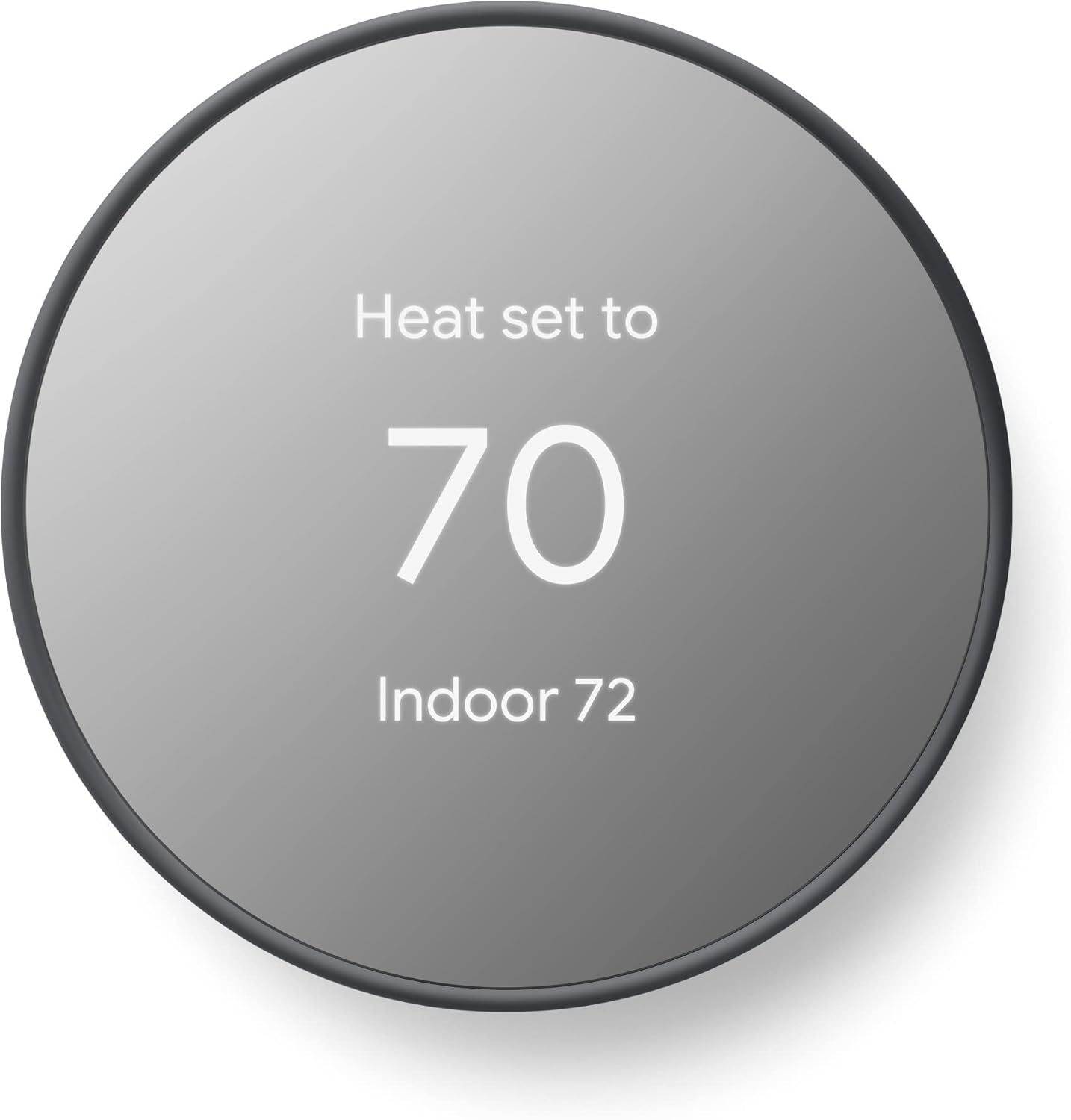
| Connectivity Technology | Bluetooth, Wi-Fi |
|---|---|
| Power Source | Battery Powered |
| Display Type | LCD |
| Control Type | Remote Control, Voice Control |
| Number of Batteries | 2 A batteries required (included) |
The Google Nest Thermostat is a compact smart thermostat designed to make heating and cooling easier to manage from anywhere. It installs on a standard wall mount and is aimed at DIY setup using the Google Home app, which guides you through wiring and creates a schedule with Quick Schedule and Savings Finder suggestions. The thermostat uses Wi-Fi and Bluetooth for remote control and integrates with voice assistants for hands-free adjustments. Practical benefits include automatic Eco Temperature when the house is empty, basic HVAC monitoring that can send alerts if the system behaves unusually, and compatibility with many common systems without a C wire in most homes. Limitations include reliance on the Google Home ecosystem for full functionality, the need for a C wire or power accessory in some HVAC configurations, and a simpler LCD interface compared with higher-end Nest models that include color touchscreens and more advanced sensors.
Best for: Buyers who want an affordable, easy-to-install smart thermostat that helps reduce energy use and integrates with Google Home for remote and voice control, and who value mainstream social validation when choosing tech.
Less Ideal for: Users who need advanced HVAC diagnostics, a full-color touchscreen, or who avoid ecosystem-locked devices and want a completely platform-agnostic thermostat.
- Remote control and scheduling through the Google Home app for temperature changes from anywhere
- Energy-saving features like automatic Eco Temperature and Savings Finder
- Wireless connectivity with 2.4 GHz and 5 GHz Wi‑Fi plus Bluetooth Low Energy
- Simple DIY installation intended to take about 30 minutes with app guidance
- May require a C wire or power accessory for some HVAC systems
- Limited interface and sensor set compared with higher-end Nest models
Verdict: A budget-friendly smart thermostat that makes remote control and energy-saving scheduling simple for most homes while fitting into the Google Home ecosystem.
Amazon Smart Thermostat
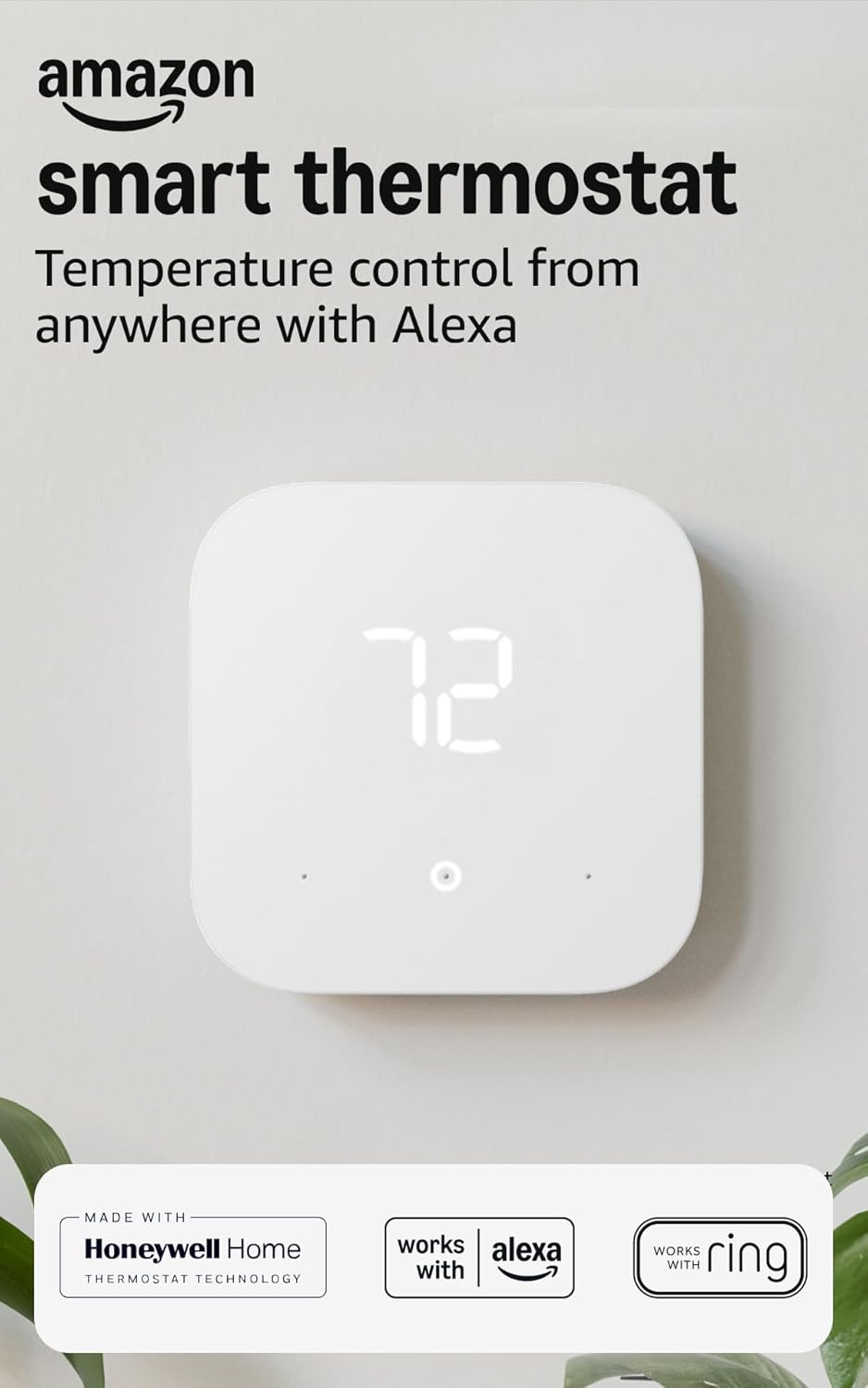
| Works with | Alexa and Ring |
|---|---|
| Power requirement | C-wire required |
| Manufacturer tech | Honeywell Home technology |
| Control | Alexa app and voice routines |
The Amazon Smart Thermostat is a straightforward, voice-friendly replacement for a traditional wall thermostat designed to simplify temperature control and lower energy use. It connects to Alexa and Ring devices so you can control temperature by voice, set schedules in the Alexa app, and create automated routines tied to presence or other smart devices. Installation is intended for DIY with c-wire required and the app provides step-by-step guidance. The unit uses Honeywell Home thermostat technology under the hood, which supports common programmable modes like home, away, and sleep and exposes basic remote control through the Alexa app. Practical benefits include easy voice and app control, integration into Alexa routines, and potential utility rebates noted after purchase. Limitations are that it requires a C-wire for power so older battery-only systems may need a wiring update and advanced HVAC features found in high-end smart thermostats are not emphasized in the product information provided.
Best for: Buyers who want a reliable, low-friction smart thermostat that integrates tightly with Alexa and smart home routines and prefer simple setup and everyday convenience over advanced HVAC tuning.
Less Ideal for: Homes without an available C-wire or buyers who need advanced commercial-style HVAC diagnostics, multi-stage heat/cool, or granular zoning controls.
- Works with Alexa and Ring for voice control and routines
- App-based scheduling and remote temperature control via the Alexa app
- Built on Honeywell Home thermostat technology for reliable basic HVAC control
- Designed for DIY installation with guided steps in the Alexa app
- Requires a C-wire which may need a professional or additional wiring for older systems
- Does not advertise advanced HVAC diagnostics or zoned-system features in provided info
Verdict: Choose this thermostat if you want an Alexa-native, easy-to-use smart replacement that brings reliable basic scheduling and voice control to your home HVAC.
Choosing the Right HVAC Thermostat: Key Factors to Consider
Temperature Accuracy and Sensor Options
Accurate temperature sensing keeps rooms comfortable and prevents short cycling of the HVAC system. Look for thermostats with well-placed internal sensors and support for remote or external sensors when you need to measure temperature in specific rooms. Some units let you calibrate readings or average multiple sensors, which helps when the thermostat is in a hallway or near a heat source.
Inconsistent readings can cause the system to run longer than necessary or to shut off before the desired comfort level is reached. For zoned spaces, the ability to add extra sensors or choose a sensor priority mode matters because it affects perceived comfort where people spend most time.
Wiring Requirements and Installation Complexity
Installation effort varies with wiring, mounting, and whether a common 24V C-wire or power adapter is required. Confirm which terminals your HVAC system exposes and choose a thermostat that supports those connections without needing an add-on module. Some models work without a C-wire using power-stealing techniques, but that can cause unpredictable behavior on certain systems.
If you are comfortable with basic wiring and have access to the system control board, gauge whether the thermostat's instructions and labeled connectors are clear. Professional installation may be the safer route for multi-stage systems, heat pumps with auxiliary heat, or older equipment with nonstandard control wiring.
HVAC System Compatibility
Thermostats must match the control type used by your heating and cooling equipment. Basic compatibility items include support for single-stage gas/electric systems, heat pump configurations, multi-stage compressors, and systems with separate humidification or ventilation controls. Failing to match control capabilities can prevent a thermostat from managing the system correctly, leading to loss of features like auxiliary heat or compressor lockouts.
Check whether the thermostat supports O/B reversing valves, dual fuel logic, and staged heating or cooling if your system uses those features. A thermostat that cannot handle the system's control signals will either function poorly or require bypassing important safety and efficiency features.
User Interface, Scheduling, and Accessibility
Daily interaction with the thermostat should be simple and predictable. Consider whether you prefer a touchscreen, physical buttons, or app-first control. Scheduling capabilities range from simple programmable blocks to adaptive learning schedules that adjust based on occupancy patterns. Choose an interface that matches how much you want to tinker with temperature settings.
Accessibility also includes display readability, backlight behavior, and dedicated controls for modes like emergency heat. If multiple household members will adjust the thermostat, look for straightforward override options and lock features to prevent accidental changes.
Connectivity and Energy Reporting
Wi-Fi or network connectivity enables remote temperature changes, alerts, and energy usage reports. Connectivity can help you monitor runtime and identify inefficient cycles, leading to informed decisions about setpoints and maintenance. Verify the thermostat's app quality, cloud features, and whether it provides actionable runtime or energy estimates rather than just raw logs.
If privacy or local control matters, check whether the thermostat supports local network control or requires cloud services. Some units provide integration with smart home platforms for automation, while others limit remote access to manufacturer services.
Choosing Between Programmable and Learning Thermostats
Programmable thermostats give you direct control over daily and weekly setpoints with predictable schedules. They are a good fit if you have regular routines and prefer to fine-tune time-based temperature changes yourself.
Learning thermostats observe occupancy and temperature patterns to build a schedule automatically. They can save time for owners who do not want to manage schedules, but they rely on consistent behavior to adapt effectively. Consider whether you want hands-off automation or precise manual scheduling.
- Programmable: predictable, easy to understand, manual optimization
- Learning: convenience, adaptive schedules, may need a behavior baseline
Remote Sensors and Multi-Room Comfort
Remote or optional room sensors help address temperature variation within a home. If the primary thermostat is in an unrepresentative location, sensors in living areas and bedrooms can balance comfort by averaging readings or prioritizing occupied rooms.
When planning sensor placement, avoid areas near direct sunlight, vents, or equipment that skews temperature. Decide whether you want automatic averaging, manual sensor selection, or zone-based logic to guide how the thermostat uses additional inputs.
- Common sensor locations: living room, master bedroom, upstairs hallway
- Sensor strategies: averaging, priority room, or occupancy-triggered adjustments
Power Options and C-Wire Alternatives
Many modern thermostats require a common 24V C-wire for reliable power. If your wall wiring lacks a C-wire, some thermostats support power-stealing operation or include an adapter that provides the necessary 24V supply at the control board. Be aware that power-stealing can cause intermittent reboots or compatibility problems on some equipment.
If you prefer not to run new wiring, evaluate models that explicitly support C-wire-less installation and review their stated limitations. When in doubt, inspect the furnace or air handler control board for spare terminals and consult installation documentation before purchasing.
- C-wire required: recommended for stable connectivity
- Adapters: available but add installation steps
- Power-stealing: may work but can be less reliable
Smart Home Integration and Automation
If you use automation platforms, confirm the thermostat's compatibility with the systems or protocols you rely on. Integration enables rules like turning down the heat when a security system arms or using presence sensors to adjust comfort automatically.
Some thermostats provide robust automation through local network APIs or direct platform support, while others depend on cloud services. Decide if you need local automation for privacy and reliability or if cloud-based integrations are acceptable.
- Check for native platform integration and voice assistant support
- Local APIs are preferable for reliability and privacy
- Consider automation scenarios you want to enable before choosing
Maintenance, Diagnostics, and Firmware Updates
A thermostat that surfaces clear diagnostic information can save time when troubleshooting HVAC issues. Look for devices that report wiring problems, sensor faults, and runtime anomalies. Firmware updates can add features and security patches, so prefer models with a reliable update path.
Consider how updates are delivered and whether the device allows manual firmware control. Regular maintenance tasks include checking sensor calibration, reviewing runtime reports, and confirming schedules after seasonal changes.
- Diagnostic alerts: wiring, sensors, and system faults
- Firmware: verify update frequency and delivery method
- Routine checks: recalibrate sensors and review runtime periodically
How We Chose the Best HVAC Thermostat
We evaluated available HVAC thermostats using criteria focused on real-world homeowner needs and system compatibility. Key considerations included temperature accuracy and sensor options, installation complexity and wiring support, compatibility with common residential HVAC systems (including conventional, heat pump, and multi-stage setups), user interface and control features, and connectivity for remote access and energy reporting. We prioritized devices that provide consistent setpoint control and clear diagnostics because reliable temperature management reduces system cycling and improves comfort. Installation filters excluded models that require uncommon wiring or external modules for basic functionality. We also favored thermostats with accessible setup guides and robust reporting tools that help owners track runtime and energy use. Units lacking clear compatibility information or with noticeably limited control features were excluded. The resulting list balances ease of use with technical capability so buyers can match a thermostat to their skill level and system needs.
Our full evaluation process is outlined in our review methodology.
FAQ
Do I need a C-wire to install a modern HVAC thermostat?
Often, yes. Many modern thermostats expect a 24V common wire for reliable power. Some models work without a C-wire using power-stealing methods or include an adapter, but those approaches can be less reliable on certain HVAC systems.
Will a smart thermostat save energy in my home?
It depends. Smart control and better scheduling can reduce runtime and energy use if you take advantage of features like setback schedules or remote adjustments. Savings are influenced by home insulation, occupant behavior, and how aggressively you adjust setpoints.
Can I install an HVAC thermostat myself?
Many thermostats are designed for DIY installation if you are comfortable turning off power and matching labeled terminals. However, multi-stage systems, heat pumps with auxiliary heat, or unclear wiring are reasons to get professional help to avoid incorrect connections.
Are remote sensors necessary for good temperature control?
Remote sensors are useful when the main thermostat location does not reflect typical living areas. They help balance comfort across rooms but are not strictly necessary if the thermostat's location represents where occupants spend most of their time.
How do firmware updates affect thermostat performance?
Firmware updates can add features, fix bugs, and patch security issues. Updates also occasionally change behavior, so review release notes and ensure your network and device backup options are in place before applying major updates.
Final Verdict
Prioritize compatibility and installation simplicity when selecting an HVAC thermostat. Confirm wiring and control match your system, and choose sensor and connectivity features that align with how you manage comfort. If you value hands-off convenience, favor learning and remote-control capabilities; if you prefer deterministic control, choose a programmable unit with clear scheduling. Balancing these tradeoffs lets you pick a thermostat that improves comfort while minimizing installation hassle and unnecessary runtime.