
Note: This article contains affiliate links. If you click on these links and make a purchase, we may earn a small commission at no extra cost to you. This helps support our research and content. Read our full affiliate disclosure here.
If you rely on gas to heat household water, upgrading to a high efficiency gas water heater can cut monthly fuel use and improve hot-water availability. Choosing the right unit matters for households with varying demand patterns, tight utility budgets, or limited installation space. This guide shortlists seven top-rated high efficiency gas water heaters and explains the practical specs that affect performance, costs to operate, and installation complexity. We evaluate heat output, efficiency ratings, venting needs, and real-world recovery to help you pick a model suited to your home and hot-water habits.
Top Picks at a Glance
| Best Overall The best all-around choice for most situations | Noritz NRC66DVNG Tankless Water Heater |  |
| Best Quality Built to a higher standard if you want something more solid | Rinnai RE199iN Tankless Water Heater |  |
| Best Value The sweet spot between price and what you get | APUS Tankless Water Heater 140,000 BTU |  |
| Best Budget The cheapest option that still gets the job done reliably | LiberLive Natural Gas Tankless 4.3 GPM |  |
| Top Rated A top-rated pick with lots of positive feedback | Rinnai RX199iN 11.1 GPM Tankless Water Heater |  |
| Most Popular A crowd favorite that many people choose with confidence | GASLAND BE528 Tankless Propane Heater | 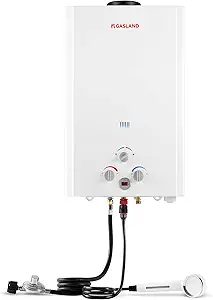 |
| Best Seller A high-volume bestseller chosen again and again | ThermoMate CZ422NG Tankless Water Heater |  |
Noritz NRC66DVNG Tankless Water Heater

| Power Source | Natural Gas |
|---|---|
| Flow Rate | 6.5 gpm |
| Maximum Temperature | 140 °F |
| Special Features | Vented |
The Noritz NRC66DVNG is a fully condensing indoor tankless water heater built for steady hot water delivery and high efficiency. It uses natural gas and an advanced heat exchanger to produce up to about 6.5 gpm, making it suitable for a typical household hot water load while minimizing standby losses associated with tanks. The unit accepts PVC/PP/CPVC Schedule 40 or 80 venting and ships with a built-in controller and a 6 foot power cord, but requires a separate valve kit for installation. Practical benefits include low NOx emissions, compact wall mounting, and manufacturer-backed heat exchanger coverage. Expect straightforward installation for retrofit or new indoor installs when paired with the correct venting and the required valve kit, though professional gas plumbing and venting work is recommended. The NRC66DVNG is a solid choice when you want efficient continuous hot water without a storage tank and with flexible venting options and strong factory support.
Best for: Buyers seeking an efficient, space-saving natural gas solution for consistent household hot water who value flexible indoor venting and strong factory heat-exchanger coverage.
Less Ideal for: Homes that need very high simultaneous hot water flow or installations where outdoor ventless units are required should consider larger-capacity or different-style water heaters.
- Fully condensing design for high energy efficiency
- Delivers up to about 6.5 gallons per minute for steady domestic hot water
- Compatible with 3" Schedule 40/80 PVC, PP, or CPVC venting for flexible installations
- Built-in controller and included 6' power cord simplify setup
- Required IK-WV-200 valve kit is sold separately, adding to installation cost
- Flow rate may be marginal for very large homes with simultaneous heavy hot water demand
Verdict: A compact, high-efficiency indoor condensing gas tankless heater that delivers reliable continuous hot water with flexible PVC-compatible venting.
Rinnai RE199iN Tankless Water Heater

| Power Source | Gas Powered |
|---|---|
| Flow Rate | 9.8 gpm |
| Maximum Temperature | 140 °F |
| Heat Output | 199000 british thermal units |
| Mount Type | Wall |
The Rinnai RE199iN is a wall-mounted, non-condensing natural gas tankless water heater built for high-flow, whole-house use. It produces up to 199,000 BTU and a rated flow of 9.8 gallons per minute, so it can run multiple showers, a dishwasher, and laundry at once without depleting a storage tank. Mounting is compact and space-saving, and the LED display shows diagnostic codes and service reminders to simplify maintenance. Because it heats on demand it reduces standby losses compared with tank systems, and it can be paired with Rinnai Controlr for optional WiFi monitoring. Installation requires proper indoor venting and a licensed technician to ensure safe gas connections and preserve warranty coverage. As a non-condensing unit it is simpler and often less expensive than condensing models but it does not capture latent heat from exhaust the way condensing units do, which affects maximum efficiency. For buyers wanting robust, continuous hot water for larger households, the RE199iN is a practical, high-capacity option; budget-conscious buyers seeking the absolute highest energy efficiency should compare condensing alternatives.
Best for: Buyers who prioritize sustained high flow rates and reliable whole-house performance for larger households or multiple simultaneous fixtures.
Less Ideal for: People whose main goal is maximizing fuel efficiency or lowest operating cost should consider condensing models instead.
- High maximum output at 199,000 BTU for steady hot water to multiple simultaneous fixtures
- Rated up to 9.8 gallons per minute suitable for whole-house demand
- Compact wall-mounted design saves floor space and eases placement
- LED display with diagnostic codes and service reminders improves serviceability
- Compatible with optional WiFi Controlr for remote monitoring and smarter operation
- Non-condensing design means lower fuel-to-hot-water efficiency than condensing units
- Professional installation and proper venting required, adding to upfront cost
Verdict: Choose the RE199iN when you need a robust, high-output tankless gas unit that reliably supplies continuous hot water to a busy household.
APUS Tankless Water Heater 140,000 BTU

| Power Source | Natural Gas |
|---|---|
| Flow Rate | 6.8 gpm |
| Maximum Temperature | 140 °F |
| Heat Output | 140000 british thermal units |
| Voltage | 120 volts |
This APUS tankless unit is built for whole‑home hot water delivery, using a 140,000 BTU burner and a copper heat exchanger to produce near‑instant hot water and support multiple fixtures. It includes a built‑in booster pump that raises flow up to 6.8 GPM so two showers plus sinks can run without big temperature drops, and the Zero Cold Water circulation reduces the usual wait for hot water. Smart features like Wi‑Fi control (Tuya app), a Smart Seasonal mode that adjusts output by inlet conditions, and an ECO cycle improve convenience and efficiency. Safety systems include freeze and overheat protection and a quieter bottom turbo fan. Practical limitations are that it is an indoor natural gas model requiring proper venting and 120V power for the pump and controls, and it still needs draining in prolonged freezing conditions; professional installation is recommended to achieve the rated performance and safety. For buyers focused on efficient, on‑demand whole‑home hot water, the unit combines strong flow, smart controls, and energy modes that matter in daily use.
Best for: Buyers who want an efficient whole‑home on‑demand water heater that prioritizes steady flow and smart energy controls to reduce waste and improve daily convenience.
Less Ideal for: If you need an outdoor or electric model, or cannot provide correct venting and a qualified gas installation, choose a different heater type.
- High 140,000 BTU output for strong heating capacity
- Built‑in booster pump increases flow to support multiple fixtures
- Zero‑Cold‑Water circulation for almost instant hot water at taps
- Wi‑Fi remote control and Smart Seasonal/ECO modes for convenience and efficiency
- Multiple safety protections including freeze and overheat safeguards
- Indoor natural gas unit requires proper venting and gas hookup
- Must be drained if exposed to extended freezing temperatures
- Professional installation recommended to meet performance and safety expectations
Verdict: Choose this model if you want a high‑output, smart tankless gas heater that delivers near‑instant hot water and strong flow for whole‑home use.
LiberLive Natural Gas Tankless 4.3 GPM

| Power Source | gas_powered |
|---|---|
| Flow Rate | 4.3 gpm |
| Maximum Temperature | 149 °F |
| Heat Output | 100000 british thermal units |
| Maximum Pressure | 116 psi |
This LiberLive natural gas tankless unit provides on-demand hot water with a rated output of 4.3 gallons per minute and 100,000 BTU, aimed at small homes or apartments that need simultaneous hot water at a few fixtures. It mounts on the wall and connects with 1/2" NPT water fittings and standard 3" OD venting, and uses an oxygen-free copper heat exchanger plus a DC high-speed fan for quicker heat transfer and quieter operation. The LED temperature control lets you set water between 95°F and 149°F while built-in safety protections guard against flame failure, overheating, dry burn, CO leakage, and low/high pressure; there is also anti-freeze protection to about -5°C. Its compact design saves space compared with tank heaters and eliminates standby heat loss, which helps cut energy use in budget-focused households. Limitations to consider are the modest 4.3 GPM capacity — fine for a shower plus a sink but marginal for multiple full-flow showers — and the requirement for professional gas venting and installation which adds upfront cost and complexity.
Best for: Buyers looking to replace a tank-style heater with a space-saving, energy-conscious gas on-demand unit for everyday household hot water on a budget.
Less Ideal for: Large households that frequently run multiple high-flow showers at the same time or installations where professional gas venting is impractical.
- Delivers continuous hot water with 4.3 GPM and 100,000 BTU suitable for several fixtures at once.
- Compact wall-mounted design saves space compared to tank heaters.
- LED temperature control with broad 95°F–149°F range for stable temperature management.
- Multiple built-in safety protections including flame failure, overheating, CO leakage, and anti-freeze.
- Oxygen-free copper heat exchanger and DC fan improve heat transfer and reduce noise.
- 4.3 GPM output may be insufficient for households wanting simultaneous high-flow showers on multiple bathrooms.
- Requires professional gas venting and licensed installation, adding to upfront cost.
Verdict: A compact, budget-friendly natural gas tankless heater that cuts standby energy loss while delivering reliable hot water for small to medium households.
Rinnai RX199iN 11.1 GPM Tankless Water Heater

| Power Source | Gas Powered |
|---|---|
| Flow Rate | 11 gpm |
| Maximum Temperature | 140 °F |
| Efficiency | UEF 0.98 |
| Mount Type | Wall |
The Rinnai RX199iN is a compact condensing tankless water heater designed to supply continuous hot water without a storage tank. It uses a Smart Sense gas control system and Versa Vent option so the same unit can run on natural gas or propane and be adapted for indoor or outdoor mounting. The unit advertises a peak flow of 11.1 gallons per minute suitable for multiple fixtures at once, an easy-to-use interface, and a Quick Flush routine that simplifies periodic maintenance. With a very high UEF of 0.98 and a modern condensing design, it reduces energy use compared with traditional tank heaters and prolongs service life by avoiding sediment buildup. Practical limits include the need for professional installation and the optional Wi-Fi control module sold separately, and like all high-capacity tankless units it must be properly sized to your household hot water demand and incoming ground water temperature to meet expectations.
Best for: Buyers who prioritize long-term reliability and energy savings and want a durable, high-efficiency on-demand gas water heater that can be installed in a variety of locations.
Less Ideal for: People who need a plug-and-play electric water heater or those unwilling to arrange professional installation and gas-line configuration should consider different options.
- Very high energy efficiency (UEF 0.98) lowers operating costs compared with tank heaters
- Convertible fuel option supports natural gas or propane for installation flexibility
- Versa Vent allows indoor or outdoor installation with simple adaptation
- 11.1 gpm flow rate can supply several fixtures simultaneously
- Quick Flush feature and compact form factor simplify maintenance and installation placement
- Control-R Wi-Fi module is sold separately so smart features are not built in
- Requires professional installation and proper sizing to perform as advertised
Verdict: Choose the RX199iN if you want a robust, super-high-efficiency tankless gas heater built for reliable continuous hot water and flexible indoor or outdoor installation.
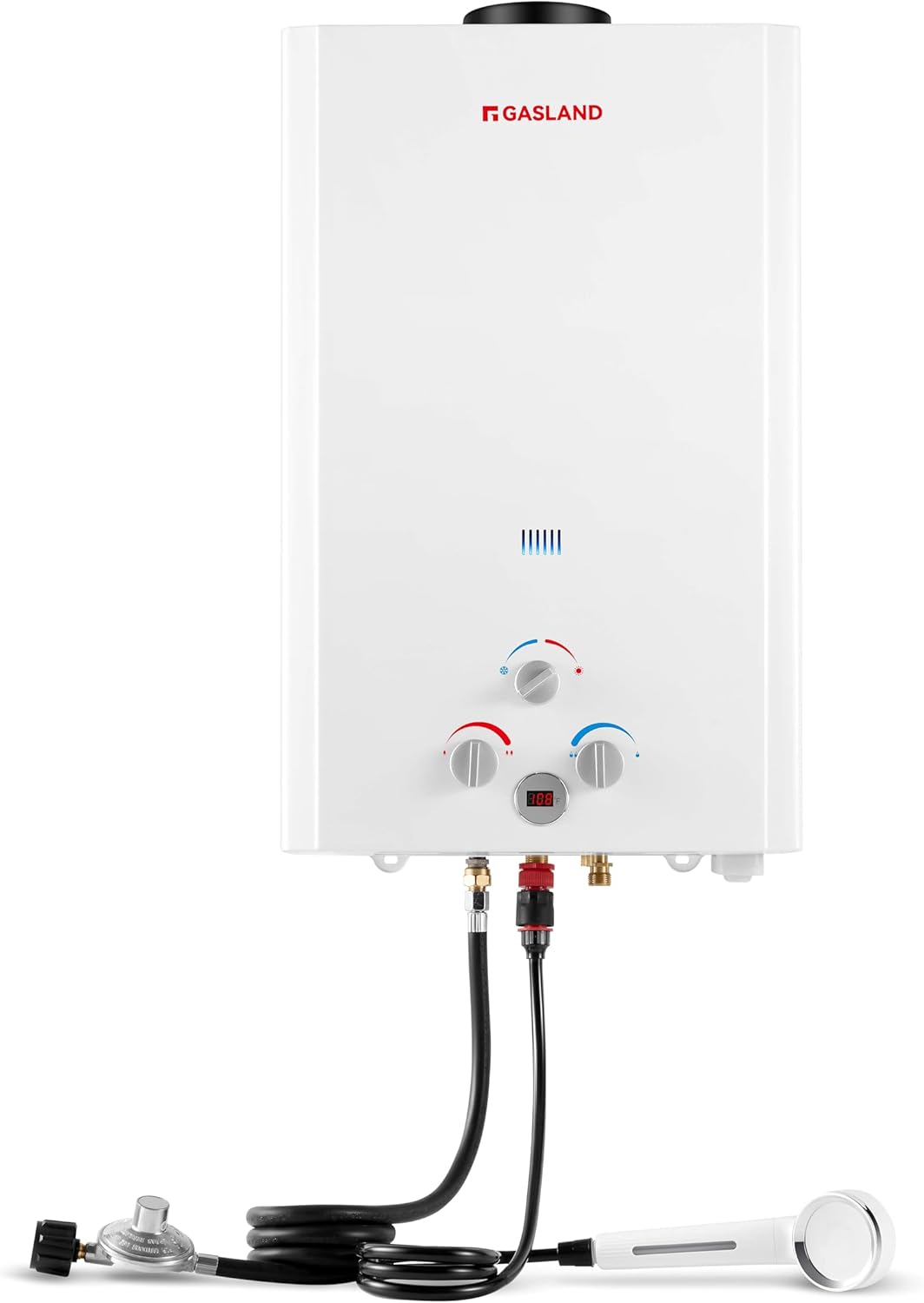
GASLAND BE528 Tankless Propane Heater
| Power Source | gas_powered |
|---|---|
| Flow Rate | 5.28 gpm |
| Maximum Temperature | 176 °F |
| Heat Output | 136000 btu_per_hour_per_foot_per_fahrenheit |
| Maximum Pressure | 110 psi |
The GASLAND BE528 is an outdoor propane tankless water heater designed to deliver instant hot water for off-grid and mobile applications. It fires from a 20 lb LPG tank and uses two D-cell batteries for electronic ignition and the LED temperature readout, making it usable where AC power is unavailable. With a reported flow of 5.28 GPM and 136,000 BTU output the unit can supply continuous hot water for showers, outdoor kitchens, vehicle and animal washing, or small cabin use. Safety features include overheat, low-flow and flame-failure protections and a temperature lock on the digital display. The heater is wall-mount only and splash resistant rather than fully weatherproof, so it should be installed under some cover and protected from prolonged rain. It is not convertible to natural gas and is not rated for high-altitude or very windy conditions, so plan installation and fuel accordingly. The unit ships with a CSA gas regulator, hose and a 5-foot shower head for quick setup in many outdoor scenarios.
Best for: Buyers who need a high-capacity, portable hot water source for outdoor, RV or off-grid use and who prioritize documented features and safety protections when choosing a heater.
Less Ideal for: People who need an indoor or fully weatherproof installation, users at high elevations, or anyone requiring a natural gas hookup should look elsewhere.
- High heat output (136,000 BTU) supporting up to 5.28 GPM continuous flow
- Works off a standard 20 lb propane tank with battery-powered electronic ignition for off-grid use
- Built-in safety features including overheat, low-flow and flame failure protection
- Digital LED temperature display with temperature lock for easy control
- Includes regulator, hose, 5 ft shower head and mounting hardware for faster setup
- Splash resistant but not intended for prolonged exposure to rain or direct weather
- Cannot be converted to natural gas and not recommended above 3300 feet elevation
Verdict: Choose the GASLAND BE528 when you want a high-output, portable propane tankless heater with clear safety features and a digital temperature display for outdoor and off-grid hot water needs.
ThermoMate CZ422NG Tankless Water Heater

| Power Source | Natural Gas |
|---|---|
| Flow Rate | 5 gpm |
| Maximum Temperature | 140 °F |
| Heat Output | 113000 BTU |
| Voltage | 120 volts_of_alternating_current |
The ThermoMate CZ422NG is a compact indoor natural gas tankless water heater designed to deliver continuous hot water for small to mid-size households. It heats water on demand up to 5 gallons per minute using a 113,000 BTU burner and an oxygen-free copper heat exchanger for faster, efficient heat transfer. Typical use is feeding two showers or a shower plus sink simultaneously while maintaining stable temperatures via a smart flow sensor and control chip that adjusts heating rapidly. The unit includes a 3.5-inch LED display for temperature control (90 to 140°F) and diagnostic codes, plus eight built-in safety protections such as freeze, flame failure, overheat, and dry combustion protection. Practical benefits are a small footprint for tight mechanical rooms, claimed high thermal efficiency and a UEF around 0.81 for lower operating costs, and wind-resistant exhaust performance thanks to a DC high-speed fan. Limitations include a 5 GPM ceiling that may not support larger multi-bath homes and the need to purchase a pressure relief valve and venting pipe separately during installation.
Best for: Buyers who prioritize steady, efficient on-demand hot water and built-in safety features for everyday household use where two simultaneous fixtures are typical.
Less Ideal for: Large households with high simultaneous hot water demand or users who need flow rates above 5 GPM should consider higher-capacity solutions or multiple units.
- High heat output (113,000 BTU) with an oxygen-free copper heat exchanger for efficient heating
- Smart flow sensor and control chip for stable temperature control and quick adjustments
- Multiple safety protections including anti-freeze and flame failure protection
- Compact wall-mounted design saves space compared with tank heaters
- Onboard LED display with error codes simplifies basic diagnostics and temperature setting
- Maximum flow rate of 5 GPM limits simultaneous high-demand fixture use
- Requires purchasing a pressure relief valve and appropriate venting components separately
Verdict: A compact, safety-focused gas tankless heater that delivers efficient, stable hot water for risk-conscious households needing up to two simultaneous fixtures.
Choosing the Right High Efficiency Gas Water Heater: Key Factors to Consider
Energy Efficiency and UEF
Thermal efficiency determines how much of the gas input becomes usable hot water. The Uniform Energy Factor, or UEF, is the standard metric that summarizes standby and recovery performance. A higher UEF usually means lower gas consumption for the same delivered hot water, which matters most if you have heavy daily hot-water use or high fuel costs.
When comparing units, pay attention to whether the efficiency figure is measured for typical draw patterns or optimized lab conditions. Real-world gains depend on household draw profiles, so match higher-efficiency models to homes where the extra savings will offset any increased upfront complexity.
First-Hour Rating and Recovery Rate
The first-hour rating and recovery rate indicate how much hot water the heater can supply during a busy period and how quickly it can replenish that supply. For families with overlapping showers, laundry, and dishwasher cycles, higher recovery is essential to avoid drops in water temperature.
Recovery depends on burner input and heat-exchanger design. Tank units with larger burner output or condensing designs can restore hot water faster. Tankless or condensing gas options deliver continuous hot water but require careful sizing against peak flow rates and simultaneous fixture use.
Venting Type and Installation Requirements
High efficiency gas water heaters may use traditional atmospheric venting, power venting with a fan, or direct venting that draws combustion air from outdoors. Each venting method has implications for installation cost, placement flexibility, and safety.
Power-vent and direct-vent systems are often necessary in tight mechanical rooms or basement installs where indoor combustion air is limited. Condensing high-efficiency units typically require PVC venting and condensate drains, so plan for condensate disposal and routing. Evaluate available installation space, local code requirements, and whether existing venting can be adapted.
Heat-Exchanger Materials and Durability
The long-term life of a gas water heater often hinges on construction quality and corrosion resistance. Stainless steel and specially coated heat exchangers resist corrosion better than standard materials, extending service life in areas with aggressive water chemistry.
Also consider anode designs, access for maintenance, and quality of seals and valves. Durable components reduce the likelihood of leaks and costly repairs, which is especially important if the heater will be installed in a living area or above finished spaces.
Controls, Safety, and Serviceability
User controls and safety features affect daily use and long-term reliability. Digital thermostats, adaptive modulation, freeze protection, and fail-safe shutoffs improve temperature control and reduce energy waste.
Serviceability matters too: accessible panels, clear diagnostic indicators, and replaceable parts make routine maintenance and repairs faster and less expensive. For condensing units, check access to condensate traps and heat-exchanger panels for periodic cleaning.
Size, Footprint, and Placement
The physical size and required clearances influence where a unit can be installed and whether modifications to the mechanical space are necessary. Wall-mounted condensing or tankless units save floor space but require secure mounting and correct vent routing.
Tank models need floor space and service clearance. Measure the installation area and plan for combustion-air intake, vent runs, and condensate routing before choosing a model to avoid surprises during installation.
Sizing for Your Household
Correctly sizing a high efficiency gas water heater starts with estimating peak simultaneous demand. For tank models, use the first-hour rating to ensure enough hot water during busiest hours. For continuous-flow units, match the maximum expected combined flow rate of fixtures that may run at the same time.
If you regularly run multiple fixtures simultaneously, prioritize higher recovery or larger capacity. For smaller households, a compact condensing tank or a properly sized tankless option can deliver efficiency gains without oversizing equipment.
- Calculate peak demand from shower, dishwasher, and laundry schedules
- Allow for future household changes such as added bathrooms
- Consider recovery for tank units versus continuous flow for tankless
Condensing Vs Non-Condensing Designs
Condensing high-efficiency gas water heaters extract extra heat from combustion exhaust, delivering higher UEF ratings but producing condensate that must be drained. These units are better suited to installations where condensate routing and PVC venting are practical.
Non-condensing units are simpler and may use standard venting, but they typically deliver lower efficiency. Weigh the installation complexity and maintenance of condensate systems against the ongoing savings in gas use.
- Condensing: higher efficiency, requires condensate drain and corrosion-resistant materials
- Non-condensing: simpler venting, potentially lower upfront installation needs
Venting Practicalities and Code Considerations
Venting type affects placement options and compliance. Direct-vent and power-vent units allow more flexible placement since they do not rely on a traditional chimney. PVC venting for condensing units reduces heat loss but requires planning for pipe runs and slope for condensate.
Always check local codes for combustion-air requirements and acceptable materials. A professional installer can confirm whether existing venting can be reused or if new vent runs and condensate lines are necessary.
- Direct venting draws combustion air from outside, improving indoor air safety
- Power venting uses a fan to push exhaust to an exterior termination
- Condensing units typically need PVC venting and include condensate management requirements
Maintenance Needs and Expected Lifespan
Regular maintenance extends service life and preserves efficiency. Tasks include inspecting burners, flushing tanks if applicable, checking condensate lines for blockages, and replacing sacrificial anodes where present. Units with accessible service panels and clear diagnostic codes reduce labor time for routine checks.
Plan for periodic inspections by a qualified technician, especially for condensing units where heat-exchanger cleaning and condensate trap checks are necessary. Good maintenance practices also help identify small problems before they become leaks or failures.
- Flush tanks annually if your water has significant mineral content
- Inspect condensate drains and traps on condensing models periodically
- Keep vents and combustion air openings clear of debris
Matching Controls to Usage Patterns
Advanced controls such as modulating burners, programmable temperature setpoints, and diagnostic readouts can improve comfort and reduce wasted fuel. Modulation that adjusts burner output to demand reduces cycling losses during light draw periods.
However, simpler mechanical controls may suffice for households with predictable schedules. Balance the desire for digital features with the need for straightforward serviceability and long-term reliability.
- Look for modulation to reduce cycling and improve efficiency at partial loads
- Consider programmable setpoints for vacation or low-use periods
- Diagnostic displays aid troubleshooting and reduce service time
How We Chose the Best High Efficiency Gas Water Heater
We looked for gas-fired water heaters that deliver measurable gains in fuel efficiency and usable hot-water output without adding unreasonable installation complexity. Our selection criteria prioritized measured thermal efficiency and Uniform Energy Factor ratings, continuous and first-hour recovery rates, and compatible venting options for common home installations. We also considered build quality indicators such as heat-exchanger materials and corrosion resistance, as well as available control features that affect temperature stability and safety. Practical installation factors were included, such as footprint, clearances, and whether direct-vent or power-vent configurations are available for tighter spaces. Models with unclear specification disclosure, unverifiable efficiency claims, or limited replacement-part availability were excluded. The final list balances laboratory-rated efficiency with real-world usability and installation practicality.
Our full evaluation process is outlined in our review methodology.
FAQ
How much can I expect to save by switching to a high efficiency gas water heater?
Savings depend on current equipment efficiency, household hot-water use, and local gas rates. Homes with high daily hot-water demand typically see larger absolute savings because efficiency gains apply to a bigger baseline of consumption. Exact savings vary, so compare UEF and likely usage patterns to estimate annual fuel reduction.
Do condensing high efficiency units need special drainage?
Yes. Condensing units produce acidic condensate that must be routed to a drain or neutralized before disposal. Installers often connect condensate to a floor drain or a condensate pump. Check local codes for discharge requirements and plan a drain route during installation.
Can I replace a non-condensing water heater with a condensing model in the same space?
Possibly, but not always. Condensing units use different venting materials and require condensate management. They may also have different clearance and combustion-air requirements. Have an installer assess the space and existing venting to determine whether modifications are needed.
How do I size a unit for multiple simultaneous showers?
Estimate the combined flow rates of the fixtures that will run at once and add a safety margin. For tankless or condensing continuous systems, choose a unit rated for that peak flow at the expected inlet water temperature. For tank systems, prioritize first-hour rating to ensure adequate supply during peak periods.
Are high efficiency gas water heaters more maintenance intensive?
They can require specific maintenance tasks such as condensate line inspection and heat-exchanger checks, particularly for condensing designs. Routine maintenance intervals are similar, but access to service panels and clear diagnostic features can make upkeep easier and less costly over time.
Final Verdict
Prioritize matching capacity and recovery characteristics to your household demand while choosing a unit with a high UEF and serviceable design. Consider venting and condensate requirements early, since installation constraints can outweigh nominal efficiency gains. Balance advanced controls and modulation against your willingness to perform or schedule periodic maintenance. Focusing on these tradeoffs will help you select a high efficiency gas water heater that reduces fuel use without introducing disproportionate installation or upkeep burdens.