
Note: This article contains affiliate links. If you click on these links and make a purchase, we may earn a small commission at no extra cost to you. This helps support our research and content. Read our full affiliate disclosure here.
If you need dependable, long-term freezing capacity without sacrificing efficiency, a high-end 10-cubic-foot chest freezer is a smart choice. These units are designed to hold bulk purchases, garden harvests, and large cuts of meat while maintaining steady temperatures and minimizing energy use. Choosing the right model matters because insulation, temperature control, and internal layout all affect how well items freeze and how much power the unit consumes. This guide covers our shortlist of the top premium 10-cu.-ft. chest freezers, highlighting the practical features and specs that matter in home use. We evaluated insulation performance, temperature stability, control accuracy, and real-world usability to create a concise set of top picks. Read on for what to look for and how these features translate to everyday freezer performance.
Top Picks at a Glance
| Best Overall The best all-around choice for most situations | Premium Levella 10.9 cu ft Chest Freezer |  |
| Best Quality Built to a higher standard if you want something more solid | Danby Diplomat 10 cu. ft. Chest Freezer |  |
| Best Value The sweet spot between price and what you get | BLACK+DECKER 10 Cu. Ft. Chest Freezer |  |
| Best Budget The cheapest option that still gets the job done reliably | TABU 10.0 Cubic Feet Chest Freezer |  |
| Top Rated A top-rated pick with lots of positive feedback | Kismile 10 Cu Ft Chest Freezer BD-285C |  |
| Most Popular A crowd favorite that many people choose with confidence | Avanti 10 cu. ft. Chest Freezer |  |
Premium Levella 10.9 cu ft Chest Freezer

| Capacity | 10.9 cu ft |
|---|---|
| Wattage | 255 |
| Voltage | 115 volts |
| Door Orientation | Top |
This Premium Levella 10.9 cu ft chest freezer is a straightforward freestanding unit built for extra frozen storage in homes or small businesses. It uses a top-opening curved glass lid that makes contents visible and gives a retail-friendly look, and the interior organizes items with four removable storage bins. Typical use is long-term frozen storage and overflow cold storage where visibility and locked access matter; the keyed lock and rear thermostat knob help secure settings and prevent accidental changes. The freezer runs on standard 115 volt power and lists 255 watts, and it meets ETL safety specification. Practical benefits include a roomy 10.9 cu ft capacity, accessible organization via bins and wide handles for easy opening, and the glass lid that reduces the need to fully open the lid to check contents. Important limitations are that it is a large, heavy freestanding unit that requires dedicated floor space and it lacks features like adjustable temperature readouts, auto-defrost, or digital controls that higher-end models sometimes offer.
Best for: Buyers who want a roomy, visually accessible chest freezer for home or small retail display and prioritize simple, secure storage over advanced electronics.
Less Ideal for: Anyone needing compact, lightweight freezers for tight spaces or users who want precise digital temperature control and auto-defrost features.
- Curved glass top provides easy visibility without fully opening the lid
- Includes four removable storage bins for organized frozen storage
- Key lock and rear-mounted thermostat knob protect contents and settings
- ETL listed and designed for freestanding installation
- No digital temperature display or advanced control features
- Large footprint and substantial weight make placement and moving difficult
Verdict: Choose this freezer if you want a high-capacity, visible chest freezer with organized storage and secure, simple controls.
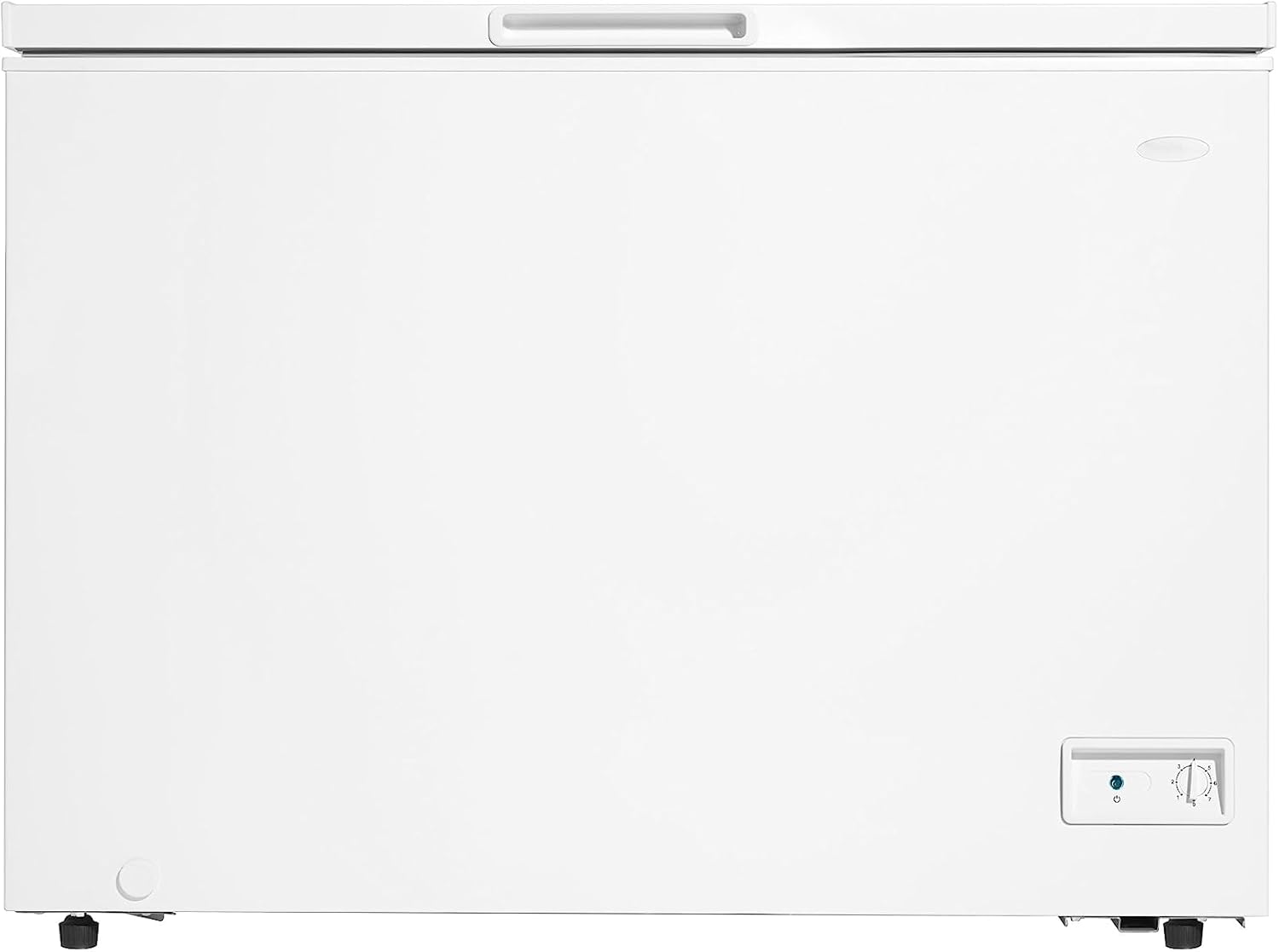
Danby Diplomat 10 cu. ft. Chest Freezer
| Capacity | 10 cubic feet |
|---|---|
| Voltage | 115 volts |
| Wattage | 234 kwh |
| Number Of Shelves | 1 |
| Door Orientation | Top |
The Danby Diplomat 10 cu. ft. chest freezer delivers straightforward cold storage for buyers who need reliable, high-capacity freezing without extra frills. It uses a front-mounted mechanical thermostat for simple temperature adjustment, a manual defrost system with a front drain for easier water removal, and a removable storage basket to keep frequently used items organized. The cabinet is designed with thinner-profile counterbalance hinges so the lid stays open at any angle and the unit can sit closer to walls, while leveling legs and rear rollers make placement and occasional moves manageable. Performance-focused features include a 360-degree cooling coil layout that speeds initial freezing of new items and DOE compliance for better energy efficiency. Important limitations are the manual defrost requirement and the absence of digital controls or an alarm for temperature excursions, so it is not as convenient as premium feature-rich models for users wanting set-and-forget automation.
Best for: Buyers who prioritize dependable freezing power and energy efficiency in a simple, high-capacity chest rather than advanced electronics or automated features.
Less Ideal for: Shoppers who want digital controls, remote monitoring, or fully automatic frost management should consider models with electronic thermostats and auto-defrost systems instead.
- 10.0 cu. ft. capacity offers substantial bulk storage for frozen goods
- Garage-ready design maintains performance across a wide ambient temperature range
- 360-degree D-shaped coil cooling helps freeze newly added items faster
- Front-mounted mechanical thermostat and power-on indicator provide easy basic control and status
- Counter-balance hinges and removable basket improve access and organization
- Manual defrost requires periodic thawing and draining
- No digital thermostat, alarms, or smart monitoring features
Verdict: Choose this Danby chest freezer if you want a roomy, energy-conscious 10 cu. ft. unit built for reliable performance and garage-ready operation.
BLACK+DECKER 10 Cu. Ft. Chest Freezer

| Capacity | 10 cubic feet |
|---|---|
| Wattage | 72 watts |
| Voltage | 120 volts |
| Refrigerant | R600a |
| Safety Certification | ETL |
The BLACK+DECKER 10 Cu. Ft. Chest Freezer is a straightforward deep freezer designed to add substantial cold storage to a home, garage, or basement. It offers a 10.0 cu. ft. interior with a removable storage basket so commonly used items stay accessible while larger items fit below. Temperature is set with an exterior mechanical dial that provides up to seven settings and is accompanied by power and compressor indicator lights, which makes adjustments simple without opening the lid. Maintenance is manual defrost but includes an easy-access drain to speed thawing and cleanup. The unit runs on R600a refrigerant and meets ETL safety standards, and four adjustable leveling legs help on uneven floors. Trade-offs are the manual defrost system and basic mechanical controls rather than digital or frost-free convenience, and at nearly 100 pounds it requires two people to move. For buyers who prioritize reliable, no-frills frozen storage and easy organization, this freezer delivers solid capacity and practical features.
Best for: Buyers who want reliable, high-capacity frozen storage without extra smart features and prefer simple, easy-to-maintain appliances that prioritize usable interior space.
Less Ideal for: If you need a low-maintenance frost-free unit or want digital temperature control and advanced connectivity, this model is not the best choice.
- Generous 10.0 cu. ft. capacity for bulk food storage
- Removable storage basket keeps frequently used items accessible
- Exterior mechanical dial with power and compressor indicator lights for easy temperature control
- Manual defrost with easy-access drain simplifies cleaning and water removal
- Uses R600a refrigerant and meets ETL safety standards
- Manual defrost rather than frost-free operation requires periodic thawing
- Basic mechanical controls lack digital precision and advanced features
Verdict: A practical, spacious 10 cu. ft. chest freezer that favors simple mechanical controls and easy organization for buyers who want dependable extra frozen storage.
TABU 10.0 Cubic Feet Chest Freezer

| Capacity | 10 cubic feet |
|---|---|
| Door Orientation | Top |
| Installation Type | Freestanding |
This TABU chest freezer is a straightforward 10.0 cubic foot top-opening unit aimed at expanding cold storage without complicated controls. It uses an R600a compressor and a 7-level front temperature dial that the listing says ranges from about -7.6°F to 6.8°F, letting you dial in colder settings for long-term storage or slightly warmer for ready-to-eat items. The hinged lid supports 45°–90° opening angles and a removable sliding basket keeps small items accessible while larger items sit below. The unit is freestanding and sized for tight spaces, and the manufacturer highlights a noise level of 40 dB or less for quiet operation. Practical limits include basic mechanical controls rather than digital precision, and the design is utilitarian without advanced features like fast-freeze, interior lighting, or door lock. Expect a competent, no-frills freezer that prioritizes capacity and simple operation over premium conveniences.
Best for: Buyers seeking a budget-focused, high-capacity chest freezer for storing bulk meats, ice cream, and long-term items who value simple reliable operation over digital features.
Less Ideal for: Those who want premium features like digital temperature display, quick-freeze modes, integrated locks, or a stainless professional finish should consider higher-end alternatives.
- Generous 10.0 cu ft capacity for bulk frozen storage
- Seven-level adjustable thermostat for flexible temperature control
- Removable sliding basket helps organize small items
- Freestanding top-open design fits compact spaces and offers wide access
- Manufacturer states low noise operation (<=40 dB) for quiet use
- Mechanical dial control lacks digital readout or precise temperature display
- No listed fast-freeze function, interior light, or advanced features
Verdict: If you need a roomy, no-frills 10 cu ft chest freezer on a budget, this TABU model delivers straightforward capacity and quiet operation.
Kismile 10 Cu Ft Chest Freezer BD-285C

| Capacity | 10 cubic feet |
|---|---|
| Door Orientation | Top |
| Installation Type | Freestanding |
The Kismile 10.0 cu ft chest freezer is a straightforward, no-frills deep freezer designed for household storage. It holds bulk food, breast milk, and frozen goods across three removable baskets that slide for easy organization, and the balanced hinge top lid opens smoothly and can stay partially open between 45 and 90 degrees. Temperature is set with a 7‑position dial that ranges roughly from 6.8°F to -7.6°F and includes an off setting, while separate power and run indicator lights make it easy to verify operation at a glance. The unit uses a low-noise compressor and claims modest energy use (about 0.68 kWh/day), which helps steady performance in kitchens, garages, or basements. Practical limits: the control is manual rather than digital so fine temperature targeting is limited, and clearance for the top-hinged lid must be planned. For buyers who prize reliable cooling and simple maintenance, this freezer delivers sensible capacity and organization without extra smart features or complex controls.
Best for: Buyers who want a dependable, straightforward chest freezer for steady long-term cold storage and easy organization without relying on smart controls.
Less Ideal for: Shoppers who need exact digital temperature control, remote monitoring, or a freezer designed for very tight spaces with limited top clearance should look elsewhere.
- Generous 10.0 cu ft capacity with three removable baskets for organized storage
- Adjustable 7‑position thermostat covering a practical household temperature range
- Balanced hinge top lid that opens smoothly and can stay open for loading
- Low noise operation and relatively low daily energy use for continuous cooling
- Manual dial thermostat lacks precise digital temperature control
- Top-hinged design requires overhead clearance and space to open fully
Verdict: A reliable, roomy 10 cu ft chest freezer that prioritizes simple, steady cooling and easy organization for everyday household use.
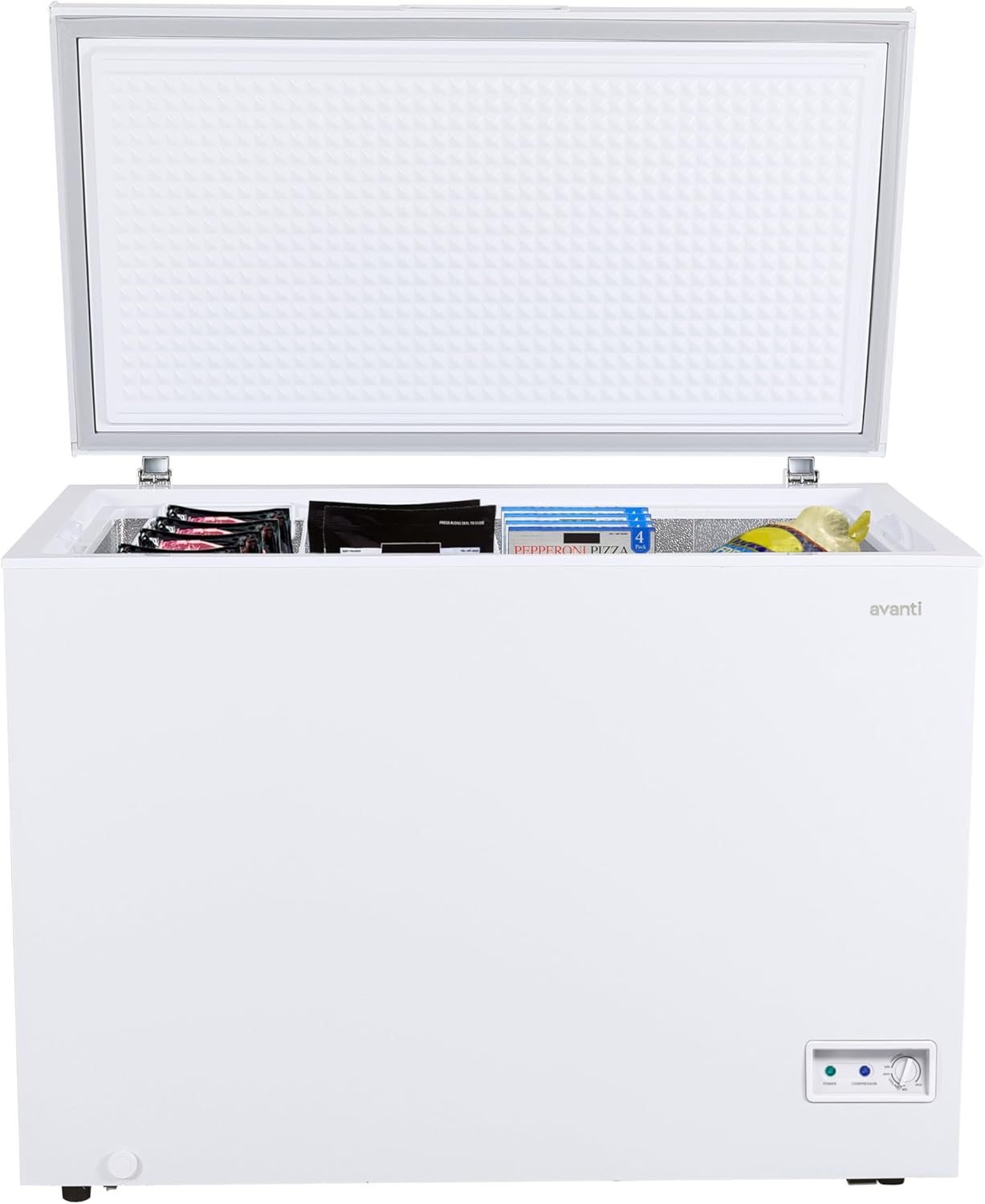
Avanti 10 cu. ft. Chest Freezer
| Capacity | 10 cubic feet |
|---|---|
| Wattage | 130 watts |
| Voltage | 110 volts |
| Installation Type | Freestanding |
The Avanti 10 cu. ft. chest freezer is a straightforward, garage-ready unit that works as either a freezer or a refrigerator thanks to its adjustable thermostat. Typical use is seasonal bulk storage in basements, garages, or utility rooms where non-climate-controlled performance matters; the cooling mode is tuned for 50 to 109°F while freezer mode operates from 0 to 110°F. It has a top-opening lift-up lid with an integrated handle and two removable storage baskets for basic organization. Maintenance is simple: manual defrost plus a defrost drain keeps cleanup manageable. The external temperature control and power indicator light make day-to-day checks easy without opening the lid. Trade-offs are its manual defrost (no auto-defrost convenience) and modest feature set compared with premium models, and it is a heavier, freestanding appliance intended for utility spaces rather than sleek kitchen integration. For buyers wanting reliable, no-frills cold storage that handles variable environments, this covers the essentials well.
Best for: Buyers who prioritize dependable, heavy-duty cold storage for garages or basements and value proven real-world performance backed by user feedback.
Less Ideal for: Shoppers who want a low-maintenance, feature-rich kitchen freezer with auto-defrost and integrated styling should look elsewhere.
- Garage-ready design for non-climate-controlled spaces
- Convertible thermostat lets the unit act as a fridge or freezer
- Top-opening lid with removable baskets for simple organization
- External temperature control and power indicator for easy monitoring
- Defrost drain simplifies manual defrost maintenance
- Manual defrost requires periodic maintenance rather than automatic defrosting
- Basic feature set lacks advanced temperature management and conveniences
Verdict: Choose this Avanti if you need a rugged, convertible 10 cu. ft. chest freezer that reliably operates in garage or basement environments.
Choosing the Right High-End 10-Cu.-Ft. Chest Freezer: Key Factors to Consider
Insulation and Lid Seal
Thick, high-density insulating foam and a tight lid gasket reduce heat gain and lessen compressor runtime. Better insulation means the freezer holds safe temperatures longer during power outages and requires fewer cycles to maintain setpoints, which lowers energy use and wear on cooling components.
Examine how the lid closes and whether the gasket compresses evenly. Some premium chest freezers use stepped or magnetic-style seals that reduce air leakage. Also consider lid construction and whether the hinge system keeps the lid aligned over years of use.
Temperature Control and Stability
Precise control electronics and a responsive compressor allow the freezer to maintain a consistent temperature, which is essential for food quality and safety. Look for units with a stable thermostat, clear setpoint range, and indicators that show current temperature.
Stable recovery after lid openings is important if you frequently access the freezer. A design that minimizes warm-air intrusion and quickly recovers set temperature will protect frozen goods and reduce frost buildup.
Energy Consumption and Runtime
Even high-end freezers should balance cooling capacity with efficient operation. Lower kWh usage reduces household energy bills over the unit's life. Consider models with efficient compressors and thermostats that minimize run-time while maintaining temperature.
Also factor in local climate and placement. Freezers in warm basements or unconditioned garages will run more often. Energy-efficient designs and better insulation help offset harder operating conditions.
Interior Layout and Organization
How the interior is organized affects usability for large-volume storage. Look for removable baskets, dividers, and a layout that makes it easy to separate short-term from long-term items. Baskets that hang from the rim or slide out help avoid digging and reduce warm-air exposure during retrievals.
Depth and shelf access matter too. A shallow basket system can make frequent items easier to reach, while deeper floor space is useful for bulky items. Consider how you plan to load the freezer and whether the layout supports that workflow.
Defrosting and Maintenance
Most chest freezers are manual-defrost, which requires periodic thawing to remove frost. The design should allow easy water drainage or provide features that simplify defrost cycles. Consider whether components like drains, removable baskets, and smooth interior surfaces make maintenance straightforward.
Also consider service access. Units with easily replaceable parts and clear documentation reduce downtime and repair costs over many years.
Durability and Build Quality
Long-term value in a high-end freezer comes from robust construction and reliable components. Look for thick cabinet panels, solid hinges, corrosion-resistant interior finishes, and compressors rated for long life. High-quality materials reduce the chance of dents, rust, or seal failure over time.
Warranty terms and supportability matter as well. A well-built unit backed by good service policies typically costs less to own over a decade of use.
Where to Place a 10-Cubic-Foot Chest Freezer
Choose a location with stable ambient temperature and good ventilation around the compressor compartment. Avoid placing the freezer in direct sunlight or in small, poorly ventilated closets. A location with a flat, level surface helps the lid seal evenly and prevents stress on the hinge.
If you place the freezer in an unheated garage or basement, expect longer run times in warm weather. Allow the recommended clearance from walls so the heat exchanger can dissipate heat efficiently. Positioning the lid to open away from walls or obstructions improves access and reduces the risk of bumping stored items when loading or unloading.
- Keep at least 2 to 3 inches of clearance on the sides and back.
- Avoid carpeted or soft surfaces that block ventilation.
- Place near an accessible outlet to avoid long extension cords.
Organizing a Chest Freezer for Efficiency
Good organization saves energy by reducing the time the lid is open. Use labeled baskets for categories like vegetables, meat, and prepared meals. Put frequently used items near the top or in hanging baskets for quick retrieval.
Rotate stock using a first-in, first-out approach. Freeze portions in meal-size packages and stack them flat to save space. Consider keeping an inventory list on the freezer lid to avoid repeated searches that let warm air in.
- Use airtight, freezer-safe containers or vacuum bags to reduce freezer burn.
- Defrost and reorganize seasonally to maintain efficient airflow.
- Avoid overpacking; leave some circulation space for cold air.
Managing Frost and Manual Defrost Cycles
Many chest freezers rely on manual defrosting to achieve the best long-term efficiency. Frost buildup increases energy consumption and reduces usable space. Schedule defrost cycles when the freezer is at its emptiest, and transfer food to a cooler or temporary insulated container while you thaw.
To defrost, unplug the unit and allow the ice to melt with the lid open. Use the unit drain if provided, and clean the interior with gentle detergent once thawed. Dry surfaces thoroughly before restarting to prevent ice reformation and to keep seals working properly.
- Plan defrosts every 6 to 12 months depending on frost accumulation.
- Use towels and a shallow pan to collect meltwater if no drain is available.
- Avoid sharp tools to chip ice to prevent damage to the interior lining.
Noise, Compressor Type, and Start-Up Behavior
Compressor noise varies with design and mounting. Premium units often use better vibration isolation or quieter compressors to reduce humming. Consider where the freezer will sit relative to living spaces; quieter models are preferable for basements or adjacent rooms.
Start-up cycles can be loud when the compressor first engages and when the thermostat calls for cooling after warm loads are added. Look for units with soft-start components or insulated compressor mounts if noise is a concern.
- Measure decibel levels if placing near living areas.
- Allow the unit to settle for a few hours after installation before loading.
- Expect higher duty cycles after large loads or warm ambient conditions.
Safety and Food-Safety Considerations
Keep frozen food at safe temperatures to prevent spoilage and bacterial growth. Use a thermometer inside the freezer to verify that the temperature reaches and holds at the intended setpoint. If the unit does not have a built-in alarm, consider adding a separate monitor to alert you to temperature rises.
Store raw meats in sealed containers on the bottom to avoid cross-contamination when thawing. Label packages with dates and contents to manage rotation and prevent long-term storage of questionable items.
- Maintain at least 0 degrees Fahrenheit for long-term storage when possible.
- Avoid refreezing items repeatedly to preserve quality.
- Check seals periodically and replace if cracked or deformed.
How We Chose the Best High-End 10-Cu.-Ft. Chest Freezer
We prioritized attributes that materially affect how well a premium 10-cu.-ft. chest freezer performs in everyday home use. Core evaluation criteria included insulation and thermal retention, because thick, well-engineered foam and lid seals determine how long a freezer holds temperature during power interruptions and how often the compressor cycles. Temperature control and stability were assessed for control precision, setpoint range, and how well the unit recovers after door openings. We also weighed energy efficiency and run-time characteristics, focusing on units that balance low consumption with reliable cooling. Usability factors such as basket configuration, interior layout flexibility, and lid hinges or shocks were considered to ensure convenient loading and organization. Build quality and serviceability were included to reflect long-term ownership costs and ease of repairs. We excluded basic entry-level models and compact units that do not meet the 10-cu.-ft. specification or lack premium insulation and control features. Our shortlisting favored units that deliver strong thermal performance, precise controls, efficient compressors, and practical interiors for serious home freezing needs.
Our full evaluation process is outlined in our review methodology.
FAQ
How often should I defrost a 10-cu.-ft. chest freezer?
Most chest freezers need defrosting when frost exceeds about a quarter inch or every 6 to 12 months depending on use. Heavy use or frequent warm-item loading can require more frequent defrosts to maintain efficiency.
Can a high-end chest freezer be kept in an unheated garage?
It often depends on the unit's ambient temperature rating. In an unheated garage, the freezer will run more in warm weather and may struggle in very cold conditions. Choose a unit rated for the expected ambient range to ensure reliable operation.
What temperature should I set my chest freezer for long-term storage?
For long-term preservation, aim for 0 degrees Fahrenheit. Some users prefer slightly lower setpoints to protect against occasional warm-ups, but extremely low temperatures are usually unnecessary and increase energy use.
How can I reduce energy use without sacrificing storage capacity?
Keep the freezer well insulated, avoid overpacking, and organize items to minimize lid-open time. Regular defrosting to remove excess ice and keeping the compressor area clear of dust will also improve efficiency.
Is it better to pack a chest freezer full or leave space for air circulation?
A mostly full freezer holds temperature better because frozen mass stabilizes the interior, but avoid cramming items so tightly that air cannot circulate. Leave some channels for cold air movement and use baskets to keep items accessible.
Final Verdict
When choosing a high-end 10-cu.-ft. chest freezer, prioritize insulation performance and temperature stability because these factors determine food quality, run-time, and resilience during power interruptions. Balance energy efficiency against usable interior layout to match how you store and retrieve items. Also consider maintenance needs and serviceability for long-term ownership. Focus on the features that align with your usage pattern: better seals and thicker insulation if you expect infrequent access, or configurable baskets and quick recovery if you open the unit often. That approach will help you select a durable, efficient freezer that meets both storage needs and operating-cost expectations.