
Note: This article contains affiliate links. If you click on these links and make a purchase, we may earn a small commission at no extra cost to you. This helps support our research and content. Read our full affiliate disclosure here.
If you care about preserving bottle character and want a quiet, energy-efficient cooler, a high-end thermoelectric wine cooler can be a smart investment. These units use a compressor-free design to reduce vibration and noise while keeping temperatures steady across the interior. Picking the right model matters because subtle differences in temperature accuracy, shelving, and airflow affect aging, taste, and how you store different bottle sizes. This guide covers six carefully shortlisted high-end thermoelectric wine coolers and explains the evaluation points we used. Read on for practical buying guidance and the product features that matter most when you need premium, low-vibration storage.
Top Picks at a Glance
| Best Quality Built to a higher standard if you want something more solid | Whynter WC-201TD Wine Cooler |  |
| Best Value The sweet spot between price and what you get | KingChii 12-Bottle Wine Cooler BCW-36A |  |
| Best Budget The cheapest option that still gets the job done reliably | Ivation 8-Bottle Wine Cooler |  |
| Top Rated A top-rated pick with lots of positive feedback | Koolatron Urban Series WC08 |  |
| Most Popular A crowd favorite that many people choose with confidence | Koolatron WC20 20‑Bottle Wine Cooler |  |
| Best Seller A high-volume bestseller chosen again and again | BLACK+DECKER 12-Bottle Wine Fridge BD60336 |  |
Whynter WC-201TD Wine Cooler

| Capacity | 20 bottles |
|---|---|
| Cooling Method | Thermoelectric |
| Temperature Range | 46°F – 65°F |
| Power | 75 watts |
The Whynter WC-201TD is a compact thermoelectric wine cooler designed to keep up to 20 standard bottles chilled without the compressor noise and vibration that can disturb wine sediment. It is typically used as a countertop or freestanding unit in kitchens, home bars, or small entertaining spaces and features a mirrored tinted glass door, soft-touch digital thermostat (46°F to 65°F), soft interior LED lighting, and five removable scalloped chrome-trimmed shelves for bottle organization. Thermoelectric cooling delivers very low noise and minimal vibration, which helps preserve delicate wines, though it is best suited for moderate ambient temperatures and not for very hot rooms since thermoelectric systems have limited cooling range compared with compressor models. The mirrored tint reduces UV exposure and the key lock adds security for a collected assortment. Practical benefits include quiet operation, intuitive temperature control, and a slim footprint for small spaces, while buyers seeking faster cooling or very low setpoint temperatures will find compressor units more capable.
Best for: Buyers who prioritize quiet, vibration-free wine storage and want a compact freestanding cooler for a kitchen, bar, or small entertaining area.
Less Ideal for: Those who need rapid cooling, very low cellar temperatures, or reliable performance in hot rooms should consider compressor-based units instead.
- Thermoelectric cooling provides very low noise and minimal vibration to protect wine sediment
- Mirrored tinted glass door blocks UV light and offers a sleek look
- Soft-touch digital thermostat with adjustable temperature range for precise control
- Five removable scalloped shelves allow tidy bottle storage and flexible arrangement
- Thermoelectric system has a more limited cooling range and is sensitive to high ambient temperatures
- Smaller capacity and slower temperature recovery compared with compressor-based wine fridges
Verdict: Choose the Whynter WC-201TD if you want a quiet, vibration-free 20-bottle thermoelectric cooler that fits compact spaces and protects wine sediment.
KingChii 12-Bottle Wine Cooler BCW-36A

| Size | 12 Bottles (Thermoelectric) |
|---|---|
| Cooling Method | Thermoelectric |
| Door Material Type | Stainless Steel+Glass |
| Installation Type | Freestanding |
| Specification Met | ETL, DOE |
The KingChii 12-bottle wine cooler is a compact freestanding unit aimed at keeping a small collection at a steady serving temperature. It uses thermoelectric cooling with an internal fan and digital touch controls to set and maintain temperatures within a typical wine range, and the double-layer tempered glass door helps insulate and block UV light while showing bottles on wire shelves. The simple digital display and soft interior LED make it easy to check and adjust settings, and adjustable shelves let you fit a mix of standard and slightly larger bottles. In practice it runs quietly and is suited to countertop or small-bar placement, but thermoelectric cooling is best for moderate ambient temps and not for heavy-duty cellar use where very low temperatures or broad temperature differentials are required. The unit is ETL and DOE specified and includes a keyed lock for secure display. For someone who wants a tidy, low-noise cooler to store and present a modest wine selection, this model delivers core functionality with a sleek stainless-steel and glass look, while buyers needing precise cellar-grade performance should consider compressor-based alternatives.
Best for: Buyers looking to optimize space and noise while storing a modest wine selection in a stylish freestanding unit will appreciate this cooler for everyday serving and display.
Less Ideal for: Collectors who need cellar-grade temperature range, large-capacity storage, or reliable performance in warm ambient environments should choose a compressor-based, larger unit instead.
- Compact 12-bottle capacity fits small kitchens, bars, or countertops
- Thermoelectric cooling with fan provides quiet, vibration-free operation
- Double-layer tempered glass door offers UV protection and visual display
- Digital touch control and interior LED make temperature adjustments and monitoring easy
- Adjustable wire shelves and keyed lock for flexible storage and security
- Thermoelectric cooling is less effective than compressors in very warm rooms or for very low setpoints
- Limited capacity unsuitable for larger collections
Verdict: A compact, quiet thermoelectric cooler that optimizes space and presentation for a small wine collection.
Ivation 8-Bottle Wine Cooler
| Capacity | 0.8 cubic feet |
|---|---|
| Size | 8 Bottle Vertical |
| Cooling Method | Thermoelectric |
| Voltage | 115 volts |
| Defrost System Type | Automatic |
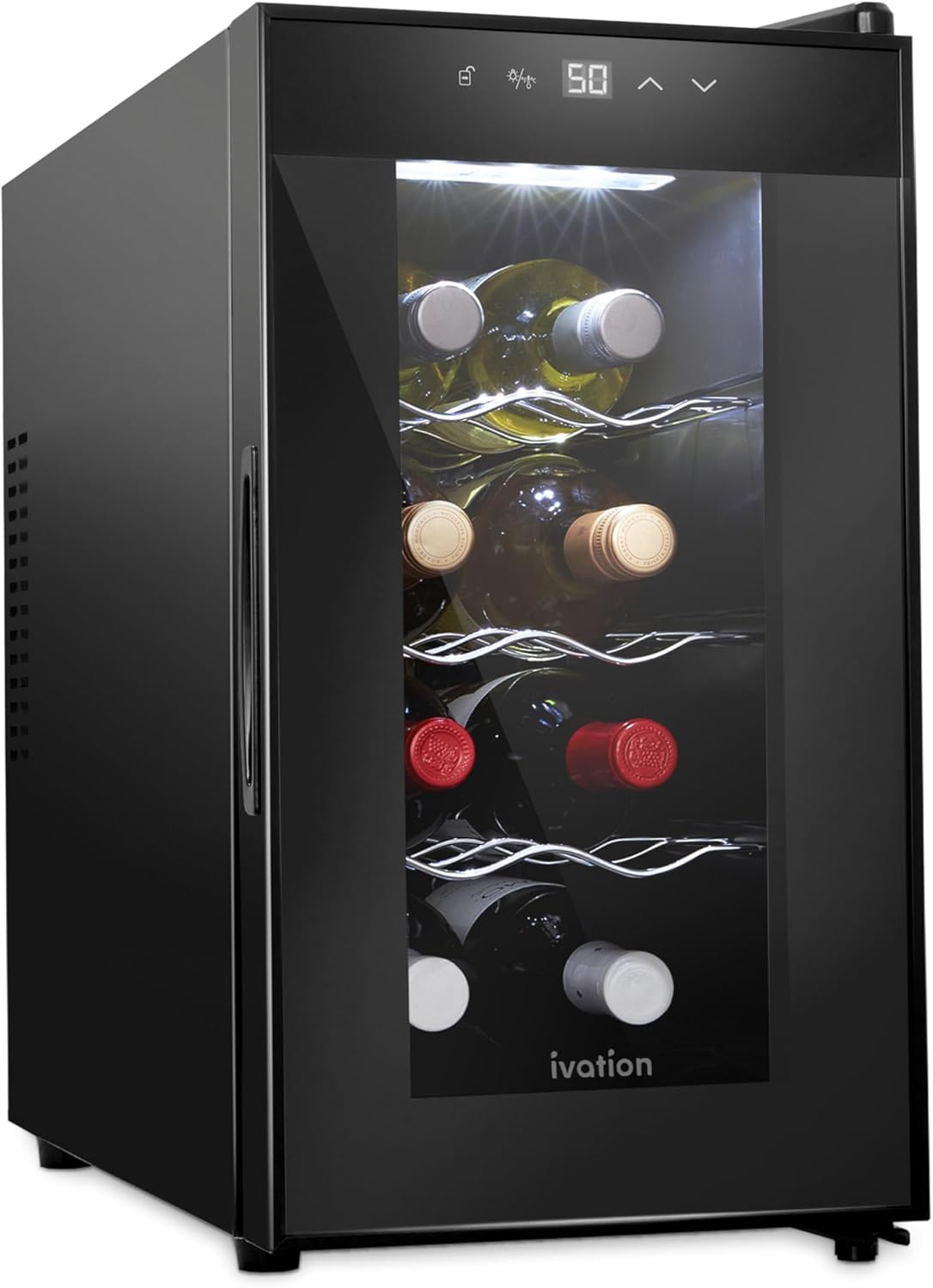
This Ivation 8-bottle wine cooler is a compact, freestanding thermoelectric chiller aimed at countertop or small-space use. It cools without a compressor, so vibration and operational noise are low, and the digital touch controls let you set temperatures between about 46 and 64°F to suit reds or whites. The smoked thermopane door and interior foam insulation help limit light and preserve humidity, which protects corks during short- to medium-term storage. A single wire shelf and soft interior lighting keep the layout simple, and the unit meets DOE and ETL specifications. Expect limited capacity and single-zone cooling, so it works best for a small personal collection rather than long-term aging for many bottles or mixed-temperature storage. The thermoelectric system is less powerful than compressor units in hot rooms, and the interior space is compact, so large-format bottles may not fit comfortably. For buyers who want quiet, low-vibration cooling and a compact footprint, this unit delivers sensible features in an affordable package.
Best for: Buyers who need an affordable, quiet countertop cooler for a small personal collection and value low noise and simple temperature control.
Less Ideal for: Those who need large capacity, dual-zone temperature control, reliable performance in hot rooms, or long-term aging for many bottles should consider larger compressor-based cellars instead.
- Quiet, low-vibration thermoelectric cooling good for settling wine sediments
- Digital touch controls and LCD allow straightforward temperature selection in °F/°C
- Smoked tempered glass door and insulation reduce light exposure and help maintain humidity
- Compact freestanding design fits on counters or small spaces and includes soft interior lighting
- Single-zone, small-capacity design limits mixed-temperature storage and long-term cellaring
- Thermoelectric cooling is less effective in hot ambient rooms compared with compressor models
Verdict: A budget-friendly, quiet thermoelectric cooler that reliably stores a small wine collection on a countertop.
Koolatron Urban Series WC08

| Capacity | 23 liters |
|---|---|
| Size | 8 Bottles |
| Temperature Range | 46-66°F (8-18°C) |
| Cooling Method | Thermoelectric (Peltier elements) |
| Installation Type | Free-standing; Counter Top |
The Koolatron WC08 is a small freestanding thermoelectric wine cooler built to keep bottles at serving temperatures without vibration or harsh compressors. It holds up to eight standard Bordeaux bottles on four removable wire racks and uses a Peltier-based cooling system to maintain an adjustable 46-66F (8-18C) range controlled by an external touch panel and LED interior light. The mirrored double-paned glass door offers UV protection while the unit stays quiet and lightweight enough to move around the kitchen or place on a countertop. Practical benefits include the removable racks for awkward bottle shapes, a lock for security, and energy-efficient interior lighting that does not add heat. Important limitations are its small 23-liter capacity, which only suits modest collections, and the inherent cooling limits of thermoelectric technology that make it best for ambient-to-moderate climates rather than very hot spaces. For buyers prioritizing a quiet, vibration-free cooler for everyday serving, the WC08 delivers consistent, user-friendly performance in a compact package.
Best for: Buyers who want a reliable, quiet countertop cooler to keep a small selection of bottles at serving temperature and who value low vibration and simple digital controls.
Less Ideal for: Not a good fit for serious collectors who need large capacity or for installations in hot rooms where a compressor cooler is required for steady low temperatures.
- Quiet, vibration-free thermoelectric cooling preserves sediment and aroma
- External touch controls and digital display for easy temperature adjustment
- UV-blocking double-paned glass door protects wine from light damage
- Four removable wire racks accommodate different bottle shapes
- Compact freestanding design fits on countertops and is easy to relocate
- Small 8-bottle capacity limits use to casual collectors or short-term serving
- Thermoelectric cooling is less effective in very warm ambient conditions
Verdict: Choose the WC08 if you want a dependable, quiet countertop thermoelectric cooler that keeps a small serving collection at ready-to-serve temperatures.
Koolatron WC20 20‑Bottle Wine Cooler

| Capacity | 20 Bottle |
|---|---|
| Temperature Range | 46-66°F (8-18°C) |
| Cooling Method | Thermoelectric |
| Included Shelves | 5 Removable Shelves |
| Power | 110 volts |
The Koolatron WC20 is a compact freestanding wine cooler that uses a dual-unit thermoelectric system to keep bottles chilled between 46 and 66°F. It is intended for countertop or freestanding placement and holds about twenty standard 750 ml bottles on five removable wire racks, so you can reorganize shelving to fit larger formats. External touchscreen controls and an LED interior light let you check and change temperature without opening the door, helping the unit hold steady. The mirrored double-paned door provides UV protection and the thermoelectric design promises quiet, low-vibration operation so sediment stays undisturbed. Because it is thermoelectric rather than compressor-based, expect modest cooling capacity that is fine for maintaining serving temperatures but may struggle in very warm rooms or with heavy door use. The unit is lightweight and easy to move, and includes a keyed lock for security, but annual energy consumption is relatively high for its size. For buyers seeking a small, attractive, low-vibration cooler for home bars and apartments, the WC20 is a practical choice; buyers needing stronger cooling in hot environments should consider compressor models instead.
Best for: Buyers who want a compact, low-vibration wine cooler that looks good on a counter or in a small home bar and prioritizes quiet, attractive storage backed by solid customer feedback.
Less Ideal for: Those who need strong cooling in hot ambient conditions, frequent heavy use, or separate temperature zones for different wine types should consider compressor or dual-zone models instead.
- Quiet, vibration-free thermoelectric cooling that preserves sediment and aroma
- Compact 20-bottle capacity with five removable racks for flexible storage
- External touchscreen controls and LED interior light let you adjust temperature without opening the door
- Mirrored double-pane glass door provides UV protection and a polished appearance
- Keyed lock adds simple security for stored bottles
- Thermoelectric cooling is less effective than compressor units in hot rooms or with frequent door openings
- Not a dual-zone cooler, so you cannot store whites and reds at separate temperatures
Verdict: Choose the Koolatron WC20 when you want a quiet, stylish 20-bottle thermoelectric cooler that protects wine from vibration and UV while fitting neatly on a countertop.
BLACK+DECKER 12-Bottle Wine Fridge BD60336

| Capacity | 12 Bottles |
|---|---|
| Temperature Range | 46°F – 66°F |
| Cooling Method | Thermoelectric |
| Shelves | 5 removable chrome racks |
| Power | 115 volts |
The BLACK+DECKER 12-bottle wine fridge is a small freestanding cooler that uses thermoelectric cooling to keep bottles between 46 and 66°F. It is set up with five removable chrome racks and an LED temperature display for simple electronic control, plus an interior light and a recessed handle for a tidy look. Thermoelectric technology means quieter operation and low vibration, which helps short- to medium-term storage and entertaining use in living rooms, home bars, or offices. The mirrored glass door blocks UV light and gives the unit a sleek, space-conscious presence on a countertop or floor. Because it is thermoelectric rather than compressor-based, it is more energy efficient and avoids refrigerants, but it will struggle to maintain very low temperatures in hot ambient rooms and is not intended for long-term cellar aging. Its 12-bottle capacity and compact footprint make it a practical, affordable option for buyers who want a stylish secondary cooler rather than a high-end cellar-grade appliance.
Best for: Buyers on a tight budget who want a tidy, low-noise secondary cooler for entertaining or short-term bottle storage and who prioritize style and compact footprint over professional-grade performance.
Less Ideal for: Collectors who need long-term, cellar-grade temperature stability or anyone placing the unit in very warm rooms where compressor cooling is required.
- Compact 12-bottle capacity fits small spaces and counters
- Thermoelectric cooling provides quiet, low-vibration operation
- Electronic temperature control with LED display for easy set-up
- Mirrored glass door blocks UV light and adds a modern look
- Five removable chrome racks and interior light improve access and presentation
- Thermoelectric system cannot cool as aggressively as compressor units in hot rooms
- Not designed for long-term cellar aging or strict temperature stability
Verdict: A budget-friendly, compact wine cooler that delivers quiet, low-vibration chilling and a stylish mirrored door for short-term storage and entertaining.
Choosing the Right High-End Thermoelectric Wine Cooler: Key Factors to Consider
Temperature Stability & Accuracy
Consistent temperature is the cornerstone of bottle preservation. Thermoelectric coolers do not use compressors, so their ability to maintain a target temperature under varying ambient conditions and when loaded with bottles is a key difference between units.
Look for models with tight temperature tolerance and a control system that reacts smoothly to door openings and changes in room temperature. Poor stability can accelerate premature aging or create inconsistent tasting notes across bottles stored side by side.
Vibration Control
Vibration disrupts the sediment in older wines and can subtly affect maturation. High-end thermoelectric designs should minimize internal vibration through careful component mounting and shock-absorbing shelving systems.
Consider interiors that use flexible or slatted shelving and rubberized mounts. Even small differences in how a unit isolates its cooling element from the cabinet can matter for delicate, long-term storage.
Shelving Capacity and Flexibility
Bottle sizes and styles vary, so shelving that adapts matters for a useful cooler. High-end units often provide adjustable trays or combination layouts for standard Bordeaux bottles, burgundies, and occasional magnums.
Think about how many bottles you typically store versus rotate for serving. A flexible interior lets you maximize usable capacity without forcing awkward stacking that risks labels and corks.
Noise Output and Daily Use
Thermoelectric units are generally quieter than compressor models, but noise still varies. If the cooler sits in an open kitchen or living area, low acoustic signature and steady hum characteristics are important to avoid annoyance during daily use.
Check for rated decibel levels and look for smooth, non-choppy airflow. Fans that cycle on and off abruptly can be more noticeable than a slightly higher but steady fan speed.
Door Seals, Insulation, and UV Protection
A high-quality door seal and insulated cabinet reduce thermal leakage and help maintain humidity. Glass doors should include UV protection to limit light exposure that can degrade wine.
Tight seals also reduce the frequency of the cooler compensating for thermal loss, which supports both stability and energy efficiency over time.
Controls, Readouts, and Ease of Use
Precise, easy-to-read controls let you set and verify temperatures without guesswork. High-end models provide digital displays with clear setpoint adjustments and sometimes memory for preferred settings.
Simple, intuitive controls reduce the risk of accidental mis-settings and make it easier to maintain the environment you want for different wine styles.
Thermoelectric Cooling: How It Works
Thermoelectric units use the Peltier effect to move heat from the interior to the exterior without a compressor. That absence of reciprocating parts is why these coolers are quieter and produce less vibration than compressor-based alternatives.
Because thermoelectric cooling is sensitive to ambient temperature, these units perform best in moderate room conditions. Understanding that limitation helps set expectations for how far below room temperature a high-end model can maintain consistently.
- Quiet operation from compressor-free design
- Lower vibration levels ideal for delicate storage
- Performance depends on ambient room temperature
Interpreting Noise and Vibration Specs
Decibel ratings give a baseline for noise, but perceived disturbance depends on frequency and how steady the sound is. A smooth, constant hum often feels less intrusive than intermittent fan bursts even at the same decibel level.
Vibration metrics are less commonly published, so examine construction details. Rubber grommets, floating shelves, and a solid back panel all reduce how much mechanical energy reaches bottles.
- Check for rubberized or floating shelving
- Consider fan design and whether speed control is available
- Look for heavier panels or thicker glass for dampening
Sizing the Cooler for Your Collection
Decide between long-term storage and short-term serving. If you plan to age bottles for years, prioritize stability and humidity control over sheer capacity. For serving, easy access and flexible shelving are more important.
Measure typical bottle shapes and count how many you expect to store. A high-end cooler with a slightly lower listed capacity but better shelving layout can often hold more usable bottles than a larger but poorly configured unit.
- Count active versus archived bottles
- Plan shelf adjustments for occasional larger formats
- Allow airflow space between bottles for even cooling
Placement and Ambient Considerations
Thermoelectric coolers are sensitive to surrounding temperature. Place the unit away from direct sunlight, heat sources, or enclosed spots that trap warm air. A stable room temperature helps the unit maintain its setpoint with minimal fan activity.
Provide clearance for ventilation on the exterior panels as recommended by the manufacturer. Restricted airflow increases internal temperature and forces the cooler to work harder, which can raise noise and reduce longevity.
- Avoid direct sunlight or proximity to ovens and heaters
- Leave recommended clearance for air exchange
- Install on a level surface to preserve vibration isolation
Maintaining Performance Over Time
Regularly check door seals for compression loss and clean vents of dust to keep airflow unobstructed. Periodic inspection of shelving mounts and cushioning prolongs vibration dampening effectiveness.
If you move the unit, allow it to settle before powering up so internal components reach operating stability. Keeping the interior tidy and not overfilling shelves helps maintain even cooling and reduces cycling frequency.
- Clean vents and seals every few months
- Avoid overloading shelves
- Allow cooldown time after door openings for stability
How We Chose the Best High-End Thermoelectric Wine Cooler
We focused on attributes that matter for long-term bottle care and daily usability in high-end thermoelectric wine coolers. Key evaluation criteria included temperature stability under real-world loads, internal vibration dampening, shelving flexibility and capacity for common bottle shapes, and build quality including door insulation and seals. We also considered noise output during steady-state operation, user controls and display clarity, and energy efficiency for continuous use. Units were excluded if they relied on compressor cooling, lacked adjustable shelving, or had poor door sealing that would compromise humidity and thermal consistency. We prioritized models that combined precise temperature regulation, low vibration, and premium materials because these directly affect wine aging and service. The final shortlist reflects durability, practical storage features, and the control fidelity buyers expect from high-end thermoelectric designs.
Our full evaluation process is outlined in our review methodology.
FAQ
Are thermoelectric wine coolers good for long-term aging?
Thermoelectric coolers can be suitable for long-term aging if they provide stable temperatures and low vibration. Their effectiveness depends on consistent ambient room temperatures and strong door seals to maintain humidity.
How quiet are high-end thermoelectric units compared with compressors?
High-end thermoelectric units are usually quieter because they lack a compressor. Noise levels vary, but well-designed models produce a steady, low hum rather than the cyclical sounds common with compressors.
Can I store magnums or odd-shaped bottles in a thermoelectric cooler?
Storage of larger bottles depends on shelving flexibility. Many high-end units offer adjustable or removable shelves to accommodate magnums, but always check internal dimensions and shelf spacing for fit.
Do thermoelectric coolers require special installation or ventilation?
They need adequate clearance for heat to dissipate from the exterior heat sink. While not requiring complex installation, placing the unit in a well-ventilated area away from heat sources improves performance.
How should I maintain the cooler to preserve performance?
Regularly clean vents and door seals, avoid overfilling shelves, and check shelving mounts for wear. These small maintenance steps help sustain temperature stability and vibration isolation over time.
Final Verdict
Choose a high-end thermoelectric wine cooler by prioritizing temperature stability and vibration control first, then assess shelving flexibility and noise for your intended use. Balance capacity needs with the unit's ability to maintain consistent conditions rather than chasing maximum bottle counts. A thoughtful selection focused on control fidelity, solid construction, and practical shelving will give the most reliable preservation and serving performance. Use the evaluation criteria in this guide to match a cooler to how you store and enjoy wine.