
Note: This article contains affiliate links. If you click on these links and make a purchase, we may earn a small commission at no extra cost to you. This helps support our research and content. Read our full affiliate disclosure here.
Choosing the right hot-and-cold water dispenser with a filter matters because it affects the safety, taste, and convenience of water you use every day. A quality unit delivers hot water for beverages and cold water for drinking while removing common impurities through built-in filtration. You want dependable temperature control, easy filter access, and a footprint that fits your counter or floor space. This guide presents six shortlisted hot-and-cold water dispensers with filters that meet practical home needs. Each pick was vetted for filtration performance, dispensing reliability, and maintenance ease. Read on to see the evaluation criteria and the features that make these units suitable for routine household use.
Top Picks at a Glance
| Best Overall The best all-around choice for most situations | iSpring DS4-S Water Dispenser |  |
| Best Quality Built to a higher standard if you want something more solid | Waterdrop KJ600 Instant Hot RO |  |
| Best Value The sweet spot between price and what you get | Brio 520 UV Bottleless Water Cooler |  |
| Best Budget The cheapest option that still gets the job done reliably | Aqua Optima Aurora AUR002 |  |
| Top Rated A top-rated pick with lots of positive feedback | Waterdrop CT01 Countertop Water Filter |  |
| Most Popular A crowd favorite that many people choose with confidence | Avalon B8BLK Countertop Water Cooler | 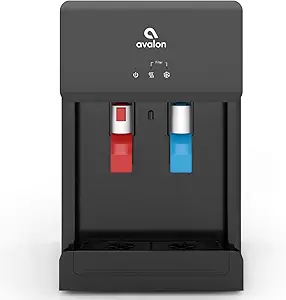 |
iSpring DS4-S Water Dispenser

| Model Number | DS4-S |
|---|---|
| Material Type | Stainless Steel |
| Included Components | Water dispenser, filters |
| Filtration Stages | 4-Stage filtration |
The iSpring DS4-S is a bottleless water dispenser that delivers hot, cold, and room-temperature filtered water on demand while integrating a four-stage filtration stack to reduce sediments, chlorine, lead, mercury, PFAS, and other common contaminants. It is designed for countertop or small-office placement and includes the tubing and adapters needed for DIY hookup to a cold water line. Daily use is straightforward: push-button dispensing with a child safety lock on the hot tap for protection, and the stainless steel finish gives a cleaner, more durable look than plastic units. Filter stages are clearly labeled and meant to be replaced on a regular schedule, which keeps water taste and performance consistent but requires ongoing filter purchases. The unit is fairly compact for a bottleless dispenser and claims leak-free operation, but installation does require basic plumbing connection and occasional maintenance when replacing filters. For buyers who want filtered hot and cold water without bottled jugs, this unit pairs convenience with strong contaminant removal in a compact package.
Best for: Buyers who want a compact, bottleless dispenser that supplies on-demand hot and cold filtered water for a home or small office and who value contaminant removal and convenience over fully hands-off setup.
Less Ideal for: People who prefer a completely plug-and-play countertop appliance or who cannot connect to a dedicated water line should consider alternatives.
- Built-in 4-stage filtration targeting sediments, chlorine, lead, mercury, PFAS and chloramine
- Delivers instant hot, cold, and room-temperature water with a child safety lock on the hot tap
- Compact bottleless design saves space and removes need for replacement jugs
- Includes installation kit with tubing and adapters for DIY hookup
- Requires regular filter replacements on a multi-stage system
- Installation requires connection to a water line rather than simple plug-and-play
Verdict: Choose the iSpring DS4-S if you want a compact bottleless dispenser that provides on-demand hot, cold, and room-temperature water with a multi-stage filter that targets heavy metals and PFAS.
Waterdrop KJ600 Instant Hot RO

| Purification Method | Reverse Osmosis |
|---|---|
| Other Special Features | 5-stage deep filtration; hot and cold dispense; 600 GPD; 2:1 pure to drain |
| Maximum Flow Rate | 0.4 gpm |
| Operating Pressure Range | 14.5-87 psi |
| Power Source | Corded Electric |
The Waterdrop KJ600 combines a tankless RO purifier with an integrated instant hot water dispenser so you can draw cold or hot filtered water from the same under-sink unit. It uses a five-stage filter (RO membrane, carbon block and PP cotton) to cut TDS, PFAS, fluoride, heavy metals and other contaminants, and a smart display faucet shows TDS and filter status while offering a child lock and temperature readout. The system is rated for fast flow up to 600 GPD and a low 2:1 pure-to-drain ratio, and the heater can be preset between 104 and 203 F with anti-dry burning protection and thermal insulation to route steam safely to the drain. Practical advantages include a high hot-water flow for cooking or beverages, whole-process monitoring that alarms on abnormalities, and compatibility with an optional remineralization filter on the cold line. Expect a short warm-up time when heating from room temperature and plan for a dedicated electrical outlet under the sink; the unit is not designed to connect to a refrigerator or ice maker.
Best for: Buyers who prioritize fast, purified hot and cold water on demand for cooking and frequent beverage use and who want an under-sink system with strong contaminant reduction and monitoring.
Less Ideal for: People who need a plug-and-play countertop solution, want a refrigerator/ice-maker feed, or who do not have space or a dedicated electrical outlet under the sink.
- Integrated tankless heating delivers adjustable hot water up to 203 F without a separate kettle or boiler
- Five-stage RO filtration reduces TDS, PFAS, fluoride, heavy metals and common contaminants
- High throughput with 600 GPD rating and 2:1 pure-to-drain ratio for efficient water use
- Smart faucet displays TDS and filter status and includes a child lock for safer hot dispensing
- Safety features such as anti-dry burning protection and thermal insulation for under-sink heating
- Heating can take up to about 15 minutes to reach maximum temperature from room temperature
- Requires a dedicated electrical outlet and may need more under-sink space and installation effort
Verdict: Choose the KJ600 if you want an under-sink RO that delivers high-flow filtered water plus adjustable instant hot water with smart monitoring and built-in safety.
Brio 520 UV Bottleless Water Cooler

| Wattage | 410 watts |
|---|---|
| Installation Type | Under Sink |
| Number of settings | 3 |
| Capacity | 1500 gallons |
| Power Source | Corded Electric |
The Brio 520 UV is a point-of-use, bottleless water cooler that delivers hot, cold, and ambient water while filtering tap supply through a two-stage sediment and carbon block system. It is typically installed at the point of use with the included installation kit and serves kitchens, offices, or shared spaces where on-demand hot drinks and chilled water are needed. Notable features include the 2-stage filtration that claims to reduce contaminants including PFAS, stainless steel reservoirs to help preserve taste, and an automated UV self-cleaning cycle that sanitizes the cold tank to limit biofilm buildup. The unit ships with two replacement filters plus an extra set for roughly a year of initial filtration, and LED indicators and push-button dispensing make operation straightforward. Trade-offs are a relatively tall cabinet and the need to replace filters periodically to retain contaminant reduction; professional or careful DIY installation is required to hook to under-sink or line supply. For someone prioritizing filtered hot-and-cold convenience and low ongoing plastic waste, this model offers a practical, feature-rich solution.
Best for: Buyers who want a low-maintenance, point-of-use dispenser that delivers filtered hot and cold water for kitchens, offices, or shared spaces and who prioritize reducing bottled water waste.
Less Ideal for: People who need an ultra-compact or countertop solution or those unwilling to perform periodic filter changes or a line installation should consider other options.
- Provides hot, cold, and room-temperature water on demand
- Built-in 2-stage sediment and carbon block filtration with initial replacement filters included
- Automatic UV self-cleaning to sanitize the cold reservoir
- Stainless steel food-grade reservoirs to help maintain water taste
- Requires periodic filter replacements to maintain contaminant reduction
- Tall cabinet footprint may not suit very compact spaces
Verdict: A practical, feature-rich bottleless cooler that delivers filtered hot and cold water with UV self-cleaning, ideal for buyers wanting point-of-use filtration and convenience.
Aqua Optima Aurora AUR002

| Capacity | 500 ml |
|---|---|
| Voltage | 110 volts |
| Wattage | 2100 watts |
The Aqua Optima Aurora is a countertop hot-and-cold dispenser designed to give on-demand boiling water plus filtered cold and ambient pours without plumbing or installation. It uses an NSF/ANSI certified Evolve+ filter to reduce contaminants and limescale, and Strix True Boil technology to deliver accurate temperatures across seven preset heat settings and seven auto-dispense volumes. Typical use is in small kitchens, offices, dorms, RVs or tiny homes where you need quick single-serve hot water for tea, instant meals, or cooking small portions and occasional chilled water. Safety features include a child lock, dry-boil protection and a scale indicator, while the unit's compact design and included filter make setup simple — just plug in and fill the reservoir. Practical limits are its modest 500 ml capacity, which means frequent refills for multiple servings, and plastic construction that may feel less premium than metal alternatives. The Aurora is best when you value filtered, instant hot water and simple countertop convenience rather than high-volume dispensing for large households.
Best for: Buyers who want a plug-and-play filtered hot-and-cold dispenser for small spaces and single-serve hot drinks, prioritizing convenience and water quality on a budget.
Less Ideal for: Large households or anyone who needs to serve multiple cups in quick succession without refilling should consider higher-capacity dispensers.
- NSF/ANSI certified Evolve+ filter improves taste and reduces contaminants
- Strix True Boil tech with seven temperature settings for accurate hot water
- Auto-dispense with selectable volume options for single-serve convenience
- Safety features include child lock, dry-boil protection and scale indicator
- Zero installation countertop design — plug in and use right away
- Small 500 ml capacity requires frequent refills for multiple servings
- Plastic construction may feel less durable or premium than stainless models
Verdict: A compact, no-install hot-and-cold dispenser with certified filtration and accurate true-boil temps that suits small spaces and budget-minded buyers seeking filtered single-serve convenience.
Waterdrop CT01 Countertop Water Filter

| Purification Method | Activated Carbon |
|---|---|
| Filter Life Cycle | 6 months |
| Upper Temperature Rating | 203 °F |
| Supported Water TDS Level Maximum (PPM) | 700 |
| Capacity | 300 gallons |
The Waterdrop CT01 is a countertop water filter and instant hot-and-cold dispenser meant for everyday kitchen use. It combines a 6-stage activated carbon filter that reduces chlorine and rust while retaining beneficial minerals with a touchscreen control and five one-touch presets for hot, coffee, tea, formula and cold. Users get adjustable temperature from 113°F to 203°F and adjustable dispense volumes, plus a 1.32 gallon tank that keeps hot and cold water ready without plumbing changes. Filters are rated for about 300 gallons or roughly six months of typical household use, and the system does not operate like a reverse-osmosis unit so it does not significantly lower TDS. Practical benefits include fast single-tap dispensing, saved presets for repeat temperatures, and a relatively large internal tank for family use. Important limitations are that it depends on mechanical water pressure rather than a powered pump, replacement filters are consumables, and it is not a RO system so it will not remove dissolved solids like fluoride or heavy salts.
Best for: Buyers who prioritize a dependable, ready-to-use countertop dispenser that delivers filtered hot and cold water with simple touchscreen presets for daily family use.
Less Ideal for: Those needing deep contaminant removal or very low TDS water should choose a reverse-osmosis system instead, and users seeking a plumbed-in or pump-driven unit may prefer another design.
- Integrated hot and cold dispensing with five one-touch presets for quick use
- 6-stage activated carbon filtration that reduces chlorine and rust while retaining minerals
- Large 1.32 gallon tank keeps ready-to-use water for families
- Touchscreen controls and favorite-mode preset make repeated pours convenient
- Does not function as a reverse-osmosis system and will not reduce dissolved solids or TDS
- Requires periodic filter replacements (about 300 gallons or six months)
- Relies on water pressure instead of an internal pump which may limit installation options
Verdict: Choose the CT01 if you want a reliable countertop dispenser that delivers instant filtered hot and cold water with easy presets and a family-sized tank.
Avalon B8BLK Countertop Water Cooler

| Wattage | 420 watts |
|---|---|
| Installation Type | Countertop, Under Sink |
| Upper Temperature Rating | 185 °F |
| Lower Temperature Rating | 47 °F |
| Capacity | 1500 gallons |
The Avalon B8BLK is a countertop, bottleless water cooler designed to tap directly to your water line and deliver both hot and cold water on demand. It uses a two-stage filtration system (sediment plus carbon block) and ships with a full installation kit so you can connect under-sink without buying extra parts. Typical use is simple: set it on a counter or install the supplied under-sink connection, flush the included filters, and use the touchless dispensing to fill cups or pots; a child-safety lock protects the hot spout. The unit reaches hot temperatures up to 185°F and cold down to 47°F, making it suitable for beverages, instant drinks, and light kitchen tasks. Practical benefits include lower recurring costs compared with bottled coolers, built-in safety for families, and filter change indicators that align with the 1,500-gallon / 6-month filter lifespan. Trade-offs are its 37 lb weight for a countertop unit and the need to replace filters periodically; installation requires basic under-sink plumbing or the countertop hookup from the kit. For buyers focused on a filtered, bottleless hot-and-cold solution, it covers the essentials without extra smart features.
Best for: Buyers who prioritize reliable, filtered hot-and-cold water from a bottleless dispenser and want a system that includes the necessary installation parts and safety features.
Less Ideal for: People who need a lightweight portable solution or who prefer a unit with smart features or self-contained bottled operation.
- Includes dual-stage sediment and carbon block filters for basic contaminant and taste reduction.
- Full installation kit supplied so you can connect to an under-sink water line immediately.
- Delivers both hot (up to 185°F) and cold (down to 47°F) water for versatile everyday use.
- Child safety lock and UL approval address family safety and electrical compliance.
- Filters need replacement roughly every 6 months or 1,500 gallons, adding ongoing maintenance.
- At 37 pounds it is relatively heavy for a countertop unit and may need two people to move.
Verdict: Choose this model if you want a straightforward bottleless hot-and-cold dispenser with dual-stage filtration and an included installation kit for immediate setup.
Choosing the Right Hot-and-Cold Water Dispenser with a Filter: Key Factors to Consider
Filtration Performance
A dispenser with a built-in filter should reduce the specific contaminants you care about, such as chlorine taste, sediment, or certain heavy metals. Look for filtration media that target those issues and check expected filter lifespan in gallons or months. A more effective filter improves taste and odor and reduces reliance on bottled water.
Consider whether the filter is certified by an independent testing body for the contaminants it claims to remove. Also factor in how easy it is to obtain replacement cartridges and whether the filter can be monitored for end-of-life through a meter or an indicator light.
Temperature Control and Stability
Hot-and-cold units must deliver reliably hot water for drinks and cold water for drinking or cooking. Temperature accuracy affects usability: water that does not get hot enough will underperform for beverages, while cold water that is not sufficiently chilled can be less refreshing.
Check whether the dispenser offers adjustable temperature settings or fixed presets, and whether it maintains those temperatures under repeated use. Units with rapid recovery for both hot and cold outputs are better for households that dispense large volumes throughout the day.
Dispensing Flow and User Experience
Flow rate and dispensing ergonomics determine how quickly you can fill cups, kettles, or bottles. A steady, splash-free flow reduces spills and waste. Consider the spout height and clearance for the vessels you typically use and whether the dispenser supports hands-free or button-press operation.
Also evaluate whether the unit has separate controls for hot and cold and if spouts are positioned to prevent cross-contamination. A good user interface with clear indicators improves everyday convenience.
Maintenance and Filter Replacement
Regular maintenance keeps a dispenser sanitary and operating efficiently. Filter replacement frequency drives ongoing costs and convenience; longer-life cartridges reduce service intervals but may cost more per unit. Ease of accessing and replacing the filter is important—top-load, front-access, or tool-free cartridges are easiest for most users.
Also consider how simple it is to clean the drip tray, spouts, and internal reservoirs. Units that require minimal tools and clear instructions for maintenance lower the chance of user error and neglected upkeep.
Safety and Child Protection
Because hot dispensers present a burn risk, safety features are critical. Look for child locks, insulated nozzles, and automatic shutoff mechanisms that limit accidental dispensing of scalding water. Indicators for active hot heating elements can also warn users when surfaces or outputs are hot.
Evaluate how straightforward safety features are to operate and whether they can be engaged and disengaged without undue hassle. Reliable safety design lowers household risk while keeping the unit practical for daily use.
Size, Installation, and Placement
Dispenser footprint and installation options affect where the unit can go in your home. Countertop models need sufficient surface area and nearby power and water access if plumbed. Floor models require floor space and may be easier to service.
Consider whether the unit needs direct plumbing, a drip tray drain, or only a nearby outlet. Weight, maneuverability, and the ability to fit under cabinets or in utility spaces also influence whether a model will work in your kitchen or break room.
Types of Hot-and-Cold Dispensers
Hot-and-cold water dispensers come in several formats, including countertop plug-in units, freestanding floor models, and plumbed-in systems that connect directly to the water line. Countertop models are convenient for renters or small kitchens, while plumbed units reduce the need to refill reservoirs and often provide continuous supply.
Each type has tradeoffs. Countertop units tend to be easier to install and move, but may have smaller internal tanks and slower recovery. Plumbed-in or hardline models offer steady supply and fewer manual refills but require a suitable location and sometimes professional installation.
- Countertop: Portable, easy setup, smaller capacity
- Freestanding: Larger tanks, better for heavy use
- Plumbed-in: Continuous supply, minimal refilling
Plumbing Vs. Reservoir Models
Reservoir models store water in an internal tank that is refilled manually or from a top-mounted bottle. They are ideal where a direct plumbing connection is not available. Plumbed models feed directly from the household water line and are better for households that need continuous dispensing without refilling.
When deciding between these two, think about how often you or your household will use hot or cold water. If frequent use is expected, a plumbed model avoids downtime and is often easier to maintain consistent temperatures.
- Reservoir pros: portability, simple setup
- Reservoir cons: refilling and limited capacity
- Plumbed pros: continuous supply, less manual work
- Plumbed cons: installation needs and fixed placement
Filter Types and What They Remove
Common filter media for dispensers include activated carbon, sediment pre-filters, and multi-stage cartridges that combine media to target taste, odor, and particulate removal. Activated carbon is effective at reducing chlorine taste and odor, while multi-stage filters can offer broader contaminant reduction.
Understand the contaminants that matter in your water supply and choose a filter rated to address them. Filters with clear performance data or third-party testing make it easier to match the cartridge to your water quality concerns.
- Activated carbon: improves taste and odor
- Sediment: traps particles and protects downstream media
- Multi-stage: combines benefits for broader reduction
Routine Care and Troubleshooting
Keeping a dispenser functioning well requires periodic tasks such as replacing filters on schedule, cleaning the drip tray and spouts, and following any descaling recommendations if the unit heats water. Simple preventive care prevents clogs and maintains water quality.
Common troubleshooting steps include checking that filters are seated correctly, ensuring vents and intake areas are free of dust, and confirming power and water connections for plumbed units. Most issues are resolved through basic maintenance rather than repairs.
- Replace filters per manufacturer intervals
- Clean drip tray and spouts regularly
- Check seals and connections if leaks appear
Energy Use and Operating Costs
Heating and chilling water consumes energy, so compare standby power use and heating element efficiency when evaluating long-term operating costs. Units with good insulation and on-demand heating may use less energy than models that maintain large tanks at temperature continuously.
Consider whether features like programmable sleep modes or energy-saving settings are available. These features can meaningfully reduce electricity use without sacrificing daily convenience.
- Look for sleep or eco modes to reduce standby drain
- Smaller tanks typically use less energy to maintain temperature
- Frequent heavy use increases operating energy for rapid recovery
How We Chose the Best Hot-and-Cold Water Dispenser with a Filter
We focused on real-world performance metrics that matter for home hot-and-cold water dispensers with filters. Our selection criteria prioritized verified filtration capability, consistent temperature control for both hot and cold outputs, and reliable dispensing flow under typical household use. We also evaluated ease of filter replacement and routine maintenance, physical footprint and installation flexibility, and safety features such as child locks and auto-shutoff on the hot side. Units were included only if they offered integrated or user-replaceable filtration designed to reduce common contaminants and if they delivered both hot and cold temperatures rather than room-only options. We excluded devices that rely solely on external pitchers or countertop pitchers for filtration, single-temperature dispensers, and models with poor reliability histories. The final list balances performance, serviceability, and everyday convenience for home kitchens, ensuring each pick meets the practical needs of typical household water use.
Our full evaluation process is outlined in our review methodology.
FAQ
How often should I replace the filter in a hot-and-cold dispenser?
Filter replacement depends on cartridge capacity and household usage. Many filters are rated by months or gallon capacity. Typically you will replace cartridges every 3 to 12 months depending on usage and water quality.
Can a dispenser provide microbiologically safe hot water without additional treatment?
Hot water temperatures can reduce bacterial activity, but most dispensers are not designed to sterilize water for safety. Rely on proper filtration for particulate and chemical contaminants and ensure regular maintenance to limit microbial growth in reservoirs and spouts.
Is a plumbed-in dispenser harder to maintain than a reservoir model?
Plumbed-in dispensers reduce manual refilling but may require more careful attention to filter replacement and occasional line maintenance. Reservoir models are simpler to install and move but need regular refilling and can require more frequent cleaning of stored water components.
Are child locks necessary on hot-water dispensers?
Child locks are strongly recommended in households with young children because they reduce the risk of accidental scalding. A simple mechanical or electronic lock significantly improves safety without affecting adult use.
How can I tell if my dispenser's filter is still working?
Monitor indicators such as taste and odor changes, any drop in flow rate, and the filter life indicator if the unit has one. Scheduled replacements based on the rated gallons or months are the most reliable approach to maintain filtration performance.
Final Verdict
When choosing a hot-and-cold water dispenser with a filter, prioritize filtration effectiveness and reliable temperature control first, then weigh maintenance demands and safety features. Think about how often you will dispense hot or cold water and whether continuous plumbing or a refillable reservoir fits your routine. Balancing filter life and ease of replacement against temperature recovery and footprint will guide the best choice for your home. Focus on proven filtration claims, accessible maintenance design, and straightforward safety features to pick a unit that delivers clean, convenient hot and cold water day after day.