
Note: This article contains affiliate links. If you click on these links and make a purchase, we may earn a small commission at no extra cost to you. This helps support our research and content. Read our full affiliate disclosure here.
If you cook on a glass-top stove, selecting the right induction pressure cooker matters for both performance and surface protection. The wrong cookware can scratch the ceramic surface or concentrate heat in ways that lead to discoloration or uneven cooking. In this guide we evaluate the top shortlisted induction pressure cookers chosen for compatibility with glass-top surfaces, focusing on heat control, base design, and safe handling. You will find only models vetted for glass-top use and clear comparisons of the features that affect daily cooking: temperature responsiveness, base flatness and finish, and safety systems. Read on to see the top picks and the criteria that guided our selections.
Top Picks at a Glance
| Best Overall The best all-around choice for most situations | TIBORANG 8.5 Qt Pressure Cooker |  |
| Best Quality Built to a higher standard if you want something more solid | Kuhn Rikon Duromatic 7L Pressure Cooker |  |
| Best Value The sweet spot between price and what you get | T-Fal Secure 6.3-Qt Pressure Cooker |  |
| Best Budget The cheapest option that still gets the job done reliably | KOCH SYSTEME CS 6.3 Qt Pressure Cooker |  |
| Top Rated A top-rated pick with lots of positive feedback | Presto 23-Quart Pressure Canner 01784 |  |
| Most Popular A crowd favorite that many people choose with confidence | T-fal Clipso 6.3 Quart Pressure Cooker |  |
| Best Seller A high-volume bestseller chosen again and again | Denali Canning The Tanker 23-Quart |  |
TIBORANG 8.5 Qt Pressure Cooker

| Capacity | 8.53 quarts |
|---|---|
| Material | Stainless steel |
| Compatible Cooktops | Gas, Electric, Ceramic, Induction |
| Operation Mode | Manual |
| Closure Type | Clip On |
This TIBORANG pressure cooker is a traditional stovetop model built from stainless steel for use on gas, electric, ceramic and induction cooktops. It functions as a multi-use pot for braising, steaming, boiling and stewing, and the 8.5 quart capacity is sized for a typical family. Controls are mechanical with a clip-on lid and a red safety check valve that locks the lid until pressure drops; the package includes a removable silicone sealing ring and a pressure limiting valve that vents steam when cooking. The thick bottom is intended to speed heat transfer on glass-top and induction ranges and the pot is dishwasher-safe for easier cleanup. Practical benefits include substantial time savings at up to about 14.5 PSI for faster braises and rice, clear visual safety feedback from the valve, and several built-in safety protections. Limitations are that it is a manual stovetop cooker so it needs attention to adjust heat and timing, and learning to judge pressure release is required for safe operation.
Best for: Home cooks who want a roomy, factory-quality stovetop pressure cooker that works reliably on glass-top and induction ranges and who prefer manual control over automated programs.
Less Ideal for: People who want an electric, programmable pressure cooker with digital timers and hands-off cooking should consider an electric multicooker instead.
- Compatible with induction, gas, electric and ceramic cooktops
- Large 8.53 quart capacity suits 3–5 people
- Stainless steel construction with a thickened bottom for even heat conduction
- Removable silicone ring and dishwasher-safe parts simplify cleaning
- Multiple safety features including pressure limiting and relief valves plus a visible safety lock
- Manual operation requires monitoring and heat adjustment during cooking
- No electronic controls or preset programs for hands-off cooking
Verdict: A sturdy, induction-ready stainless steel pressure cooker that delivers fast, family-sized stovetop cooking with clear manual controls and solid safety features.
Kuhn Rikon Duromatic 7L Pressure Cooker

| Capacity | 7 liters |
|---|---|
| Material | 18/10 stainless steel |
| Special Features | Induction Compatible Base |
| Closure Type | Locking lid |
The Kuhn Rikon Duromatic is a high-performance stovetop pressure cooker built for fast, reliable cooking on all cooktops including glass-top induction ranges. Its Superthermic aluminum sandwich base promotes even, rapid heat-up and the 18/10 stainless body feels sturdy and durable, making it well suited for searing then switching to pressure cooking. The mechanical knob and two pressure settings keep controls simple while the locking lid and four separate steam-release safety features give confidence during use. Included trivet and fill-level markings make batch cooking and steaming straightforward, and the compact side handles help with lifting and storage. Expect much faster cook times for stews, grains, and braises, and measurable energy savings compared with conventional stovetop methods. The main compromises are the manual control style—there is no digital timing or automated pressure release—and the unit is substantial in weight, which can make handling full pots less nimble on smaller kitchens.
Best for: Home cooks who prioritize fast, consistent results and durable, factory-quality cookware for serious stovetop pressure cooking on glass-top or induction ranges.
Less Ideal for: People who want lightweight, ultra-compact cookware or those who prefer integrated electronic timers and automated pressure-release functions.
- Induction-compatible Superthermic base for fast, even heating on glass-top stoves
- Durable 18/10 stainless steel construction built in Switzerland
- Robust safety system with locking lid and four independent steam-release features
- Simple mechanical controls and two pressure settings for predictable results
- Includes trivet and cookbook to support a range of pressure-cooking techniques
- No digital timer or automated release features for hands-off cooking
- Heavier build can be awkward to handle when the pot is full
Verdict: Choose this Swiss-made cooker for reliable, high-performance pressure cooking on glass-top induction stoves where fast, even heating and strong safety features matter most.
T-Fal Secure 6.3-Qt Pressure Cooker
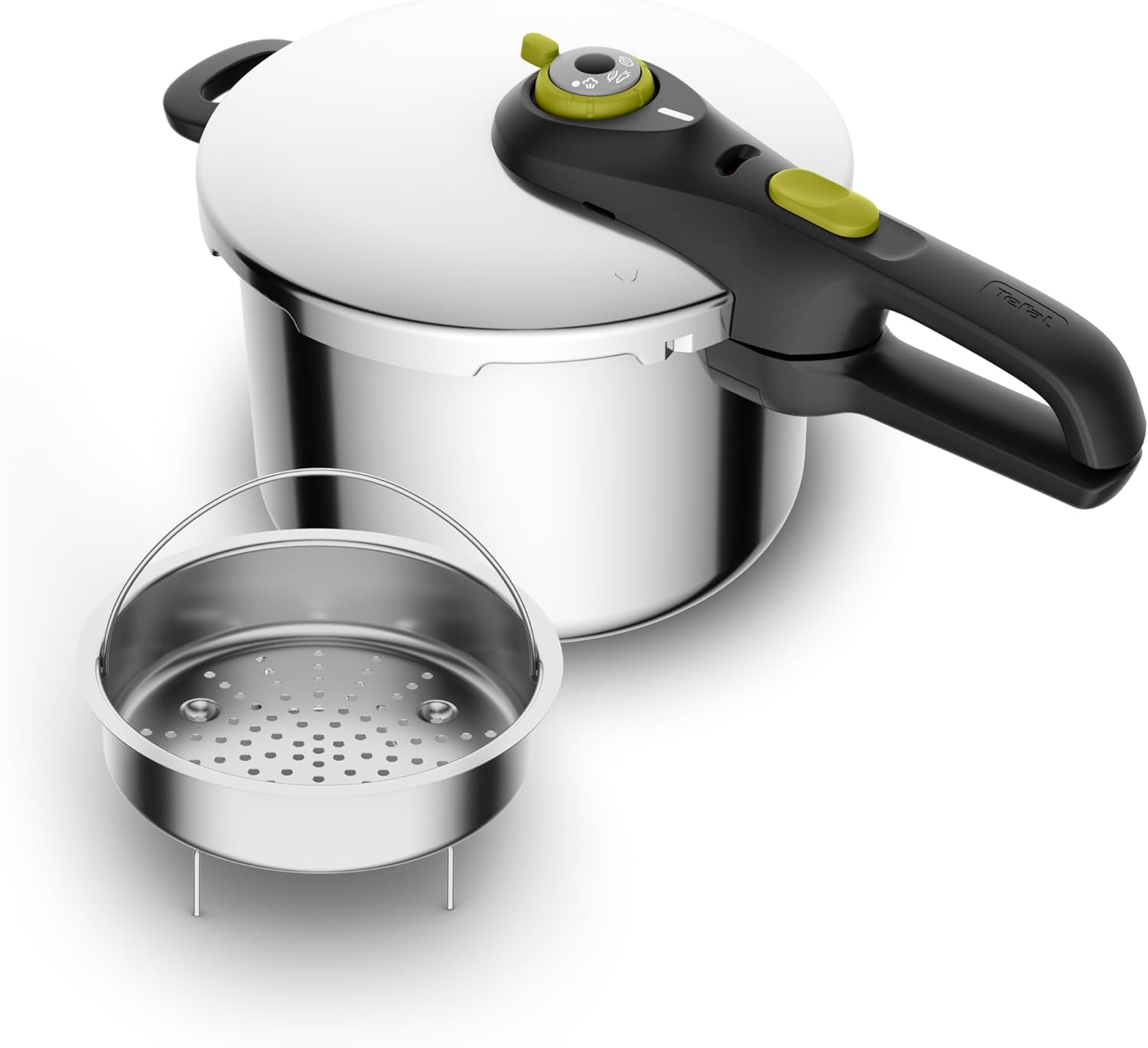
| Capacity | 6.3 quarts |
|---|---|
| Material | Stainless steel |
| Control Method | Touch |
| Operation Mode | Manual |
The T-Fal Secure 6.3-qt pressure cooker is a stainless steel stovetop cooker built for everyday family cooking and induction compatibility. It uses two dedicated pressure programs—one tuned for vegetables and one for meats—to speed recipes and help retain nutrients, and it includes a steam basket to expand steaming and side-dish options. The lid uses a rotating open/close mechanism with an audible click and a five-point safety locking system, which makes sealing and unlocking straightforward and gives confidence when working with pressure. The polished stainless body is dishwasher-safe for easier cleanup and is designed to handle regular use on glass-top and induction ranges. Practical buyers will appreciate the simple touch controls and the cooker's even heat distribution, though it is heavier than lightweight aluminum models and lacks multi-step digital programming found on electric pressure cookers. For those who want a durable, stovetop induction-ready cooker that speeds meals and focuses on straightforward operation, this is a solid choice.
Best for: Buyers who want a durable, induction-compatible stovetop pressure cooker that shortens cook time and simplifies common recipes with preset modes and straightforward controls.
Less Ideal for: Those who prioritize lightweight portability or need advanced programmable timers and multi-stage cooking sequences found in electric models.
- Compatible with all stovetops including induction, so it works on glass-top ranges
- Two pressure cooking programs tailored for vegetables and meat to simplify timing and preserve nutrients
- Five-point safety locking system and audible seal for safer pressure cooking
- Durable stainless-steel construction and dishwasher-safe body for easy cleaning
- Heavier unit compared with thin-clad or aluminum models, which may be less convenient to lift when full
- No advanced digital timer or multi-step programming like electric multicookers
Verdict: Choose this T-Fal stovetop pressure cooker if you want a rugged, induction-ready pot that speeds family meals with simple preset programs and strong safety features.
KOCH SYSTEME CS 6.3 Qt Pressure Cooker

| Capacity | 6.3 quarts |
|---|---|
| Material | 18/10 stainless steel |
| Pressure settings | 100 / 60 / 0 kPa |
| Compatible cooktops | Induction, gas, electric, ceramic |
| Included components | Sealing ring, glass lid, pressure lid, steamer rack |
This KOCH SYSTEME CS pressure cooker is a 6.3 quart stainless steel stovetop pot designed to speed up everyday cooking while working on induction and other glass‑top stoves. It offers three pressure settings (high, medium, and zero) for tougher cuts, everyday stews and rice, or gentle steaming, and includes a steaming rack plus a glass lid so you can use it as a steamer or simmer pot as well. The triple‑layer stainless steel base promotes even heating and resists warping on induction and ceramic cooktops, and the one‑press locking lid with an 8‑point safety system helps prevent accidental opening under pressure. For budget buyers you get durable 18/10 stainless construction and useful accessories like an extra sealing ring without premium-brand pricing. Expect a bit more weight and a mechanical knob control rather than digital precision, and the 6.3 qt size is aimed at small families rather than large batches.
Best for: Home cooks on a budget who want a durable, induction‑ready stovetop pressure cooker that speeds everyday meals and doubles as a steamer for 2–4 people.
Less Ideal for: Those who need digital controls, programmable cooking profiles, or larger capacity for frequent big‑batch meal prep should consider different options.
- Induction‑compatible triple‑layer stainless steel base for even heating and warp resistance
- Three adjustable pressure settings for flexible cooking of meats, rice, and delicate foods
- Includes steaming rack and glass lid so it doubles as a steamer and simmer pot
- 18/10 food‑grade stainless steel construction for corrosion resistance and longevity
- Multiple built‑in safety features including auto‑lock and overpressure venting
- Mechanical knob control lacks precise digital timers or programmable presets
- 6.3 quart capacity may be small for large families or batch cooking
Verdict: A practical, budget‑friendly 6.3 qt stainless steel pressure cooker built for induction glass‑top stoves that delivers solid safety and flexible pressure control.
Presto 23-Quart Pressure Canner 01784

| Capacity | 23 liters |
|---|---|
| Material | Aluminum, Stainless steel |
| Special Features | Induction Compatible Base; Electric and Gas Compatible |
| Included Components | canning/cooking rack |
The Presto 23-Quart Pressure Canner is a large-capacity canner built for serious home canning and heavy-duty stovetop use, including induction ranges. It heats evenly thanks to a stainless steel-clad base bonded to heavy-gauge aluminum and includes a deluxe pressure gauge and an air vent/cover lock that prevents the lid from opening until pressure is safely reduced. You can process vegetables, meats, poultry, and seafood at recommended USDA pressures and also use the unit as a boiling water canner for fruits and jams or as a roomy pressure cooker for soups and large roasts. The canner comes with a cooking/canning rack and a recipe/instruction booklet to help with safe processing. It is fairly large and requires a roomy range and storage space, and its aluminum body means you need to follow Presto care guidance to maintain the finish and sealing parts, but for home canners who value precise pressure control and induction compatibility this model is a reliable, well-built choice.
Best for: Home canners who prioritize a dependable, USDA-approved pressure canning tool that works on induction and other stovetops and who often process large batches.
Less Ideal for: People with very small kitchens, limited storage, or those who only need occasional small-batch pressure cooking and prefer compact electric multicookers.
- Induction-compatible stainless steel-clad base for fast, even heating on induction, gas, and electric ranges
- Deluxe pressure gauge and air vent/cover lock provide accurate pressure readings and enhanced safety
- Large 23-quart capacity holds many jars for batch canning or doubles as a sizable pressure cooker
- Constructed from heavy-gauge aluminum for good heat conduction and durable everyday use
- Includes canning rack and an 80-page instruction/recipe book to support safe processing
- Large footprint requires significant stovetop and storage space
- Aluminum construction needs proper care to prevent discoloration and maintain long-term appearance
Verdict: Choose this Presto canner if you need a durable, induction-compatible, full-size pressure canner built for reliable, USDA-approved home canning and large batch cooking.
T-fal Clipso 6.3 Quart Pressure Cooker

| Capacity | 6.3 quarts |
|---|---|
| Material | Stainless steel |
| Control Method | Touch |
| Operation Mode | Manual |
| Voltage | 110 volts |
The T-fal Clipso 6.3 Quart is a stainless steel stovetop pressure cooker built for faster family cooking and compatibility with glass-top induction ranges. It shortens common braises, stews, and beans by a large margin compared with conventional methods while preserving nutrients, and the included steam basket and recipe booklet make multi-level steaming and batch cooking straightforward. The one-hand opening and secure locking system reduce fiddly steps when releasing pressure, and the adjustable steam-release valve gives you control during pressure reductions. The encapsulated base is designed for even heat distribution and explicit induction compatibility, and the pot is dishwasher-safe for easier cleanup once you remove the valve and gasket. Important practical limits are its manual control design, which lacks electronic presets, and the unit is fairly heavy when full, so handling hot contents requires care.
Best for: Buyers who prioritize proven safety and verified performance on induction or glass-top stoves and want a durable, traditional pressure cooker for family meals and batch cooking.
Less Ideal for: If you want programmable, electric pressure-cooker convenience or very lightweight camping gear, this stovetop model is not the best fit.
- Compatible with all stovetops including induction, so it works well on glass-top ranges
- One-hand opening and secure locking system improve safety and convenience
- Adjustable steam-release valve provides precise pressure control
- Stainless-steel construction with encapsulated base for even heat distribution
- Includes steam basket and recipe booklet for versatile cooking options
- Manual controls only, no electronic presets or timers
- Relatively heavy when filled, requiring caution when lifting and pouring
Verdict: A durable, induction-compatible stainless-steel pressure cooker that delivers reliable, safety-focused stovetop performance for family and meal-prep cooking.
Denali Canning The Tanker 23-Quart

| Capacity | 23 quarts |
|---|---|
| Special Features | Induction Compatible Base |
| Wattage | 1000 watts |
| Control Method | Touch |
The Tanker is a large-capacity pressure canner made for home canning and stovetop pressure cooking, and it is built to work on induction glass-top ranges. In everyday use you heat the pot to build steam, lock the outer lid, bring it to pressure using the included 10 lb and 15 lb weights or the pressure gauge, then process jars with the removable canning rack. Notable features include a heavy-gauge aluminum body with stainless steel parts, an induction-compatible base, a factory pressure gauge, and two pressure weights that let you run standard canning pressures. Practical benefits are the roomy 23 quart capacity that handles multiple quart jars at once and the extras like 24 lids and a rack to get started right away. Important limitations are the pot size and weight which demand a strong glass-top cook surface and careful handling when hot, and the manual operation means you must monitor pressure rather than rely on automatic electronic controls.
Best for: Buyers who prioritize safe, tried-and-true pressure canning on induction or glass-top stoves and want a ready-to-use, high-capacity unit for batch preserving.
Less Ideal for: People who prefer fully automatic, electric pressure canners or who need a lightweight pot for frequent, single-pot cooking and easy one-handed handling.
- Large 23 quart capacity fits multiple jars for efficient batch canning
- Induction compatible base works on glass-top and induction cooktops
- Includes pressure gauge plus 10 lb and 15 lb weights for standard canning pressures
- Comes with a canning rack and multiple lids so you can start canning immediately
- Manual controls require active monitoring of pressure during processing
- Heavy build can be awkward to lift and maneuver when full
Verdict: If you want a reliable, induction-ready canner that handles full batches and includes the gauge and weights you need, The Tanker 23-Quart is a practical choice.
Choosing the Right Induction Pressure Cooker for Glass-Top Stoves: Key Factors to Consider
Base Flatness and Surface Finish
A perfectly flat base ensures full contact with the smooth glass-top surface, distributing heat evenly and preventing hotspots that can warp cookware or leave scorch marks on the cooktop. Equally important is the finish: a smooth, polished bottom reduces friction and the chance of scratching during sliding or repositioning.
When assessing bases, look for minimal machining marks and a circular or multi-ply construction that is clearly machined flat. Even small degrees of cupping or rough finishes can concentrate pressure at contact points and increase the risk of surface damage over time.
Induction Responsiveness and Heat Control
Induction cooktops heat via magnetic coupling, so a cooker that responds quickly to power changes gives you better control over pressure buildup and release. Fast responsiveness helps prevent overshooting target temperatures, which is especially useful for delicate recipes and when you need to drop to a simmer after reaching pressure.
Check for heavy-gauge ferromagnetic bases or multi-ply constructions that transfer energy efficiently without long lag times. A well-matched cooker will come up to pressure predictably and allow stable low-power maintenance without cycling on and off excessively.
Pressure Regulation and Safety Systems
Reliable pressure control protects both the cooktop and the user. A pressure cooker intended for glass-top stoves should have clear, redundant pressure indicators and a smooth, controlled release mechanism to avoid sudden force that might shift the pot on a slippery surface.
Safety systems to prioritize include secure lid locks that prevent opening under pressure, slow-release options that avoid rapid steam ejection, and pressure relief vents positioned so steam is directed away from the cooktop surface to minimize staining or thermal shock.
Handle Design and Stability
Handles affect how safely you move a hot pressure cooker across a glass-top. Stable, ergonomically designed handles reduce lateral movement and the risk of scratching when lifting or setting the pot down. Wide, heat-resistant grips also help you maintain secure control when transferring the cooker between the burner and a trivet.
Look for handles that sit well clear of the base so you do not accidentally drag them across the cooktop. Fold-down or low-profile handles can be handy for storage but must not compromise a secure grip during normal use.
Gasket Access, Cleaning, and Maintenance
The sealing gasket needs routine inspection and periodic replacement. Designs that allow easy removal and reinstallation of the gasket without special tools simplify maintenance and reduce the time pots are out of service. A gasket that traps food or is hard to clean increases the odds of odors and seal failure.
Also consider interior finishes that tolerate regular scrubbing and lids with few crevices that trap residue. Easy-to-clean surfaces reduce the need for abrasive scrubbing that could harm polished bases used on glass-top stoves.
Weight and Capacity Relative to Stove Surface
Heavier cookware can sit firmly on a glass-top stove, reducing the chance of sliding, but excessive weight combined with frequent sliding increases the risk of micro-abrasions. Balance capacity needs with manageable weight so you can lift and adjust the cooker safely.
Choose a capacity that suits typical meal sizes and makes handling predictable when the pot is full. Avoid repeatedly sliding a heavy, full cooker across the glass surface; instead, lift and place to minimize contact abrasion.
How Induction Works With Glass-Top Stoves
Induction creates heat directly in the cookware via magnetic fields, so the condition of the cookware base determines how efficiently energy transfers to the food. A flat, ferromagnetic base maximizes surface contact and minimizes energy loss, which is why induction-compatible pressure cookers matter for glass-top stoves.
Because the cooktop itself does not get as hot as conventional elements, risks to the glass-top come primarily from uneven contact, trapped debris, and mechanical abrasion from sliding or dragging cookware. Proper cookware selection reduces those risks while delivering the speed and control benefits of induction cooking.
- Flat base maximizes contact and efficiency
- Smooth finishes reduce chance of scratching
- Rapid induction control helps avoid overheating spots
Safe Ways to Move and Position Heavy Cookware
When a pressure cooker is full, avoid sliding it across the glass-top. Lift with help if needed and place it gently onto the burner. If the pot must be shifted slightly, use a soft trivet or silicone mat under the cookware to protect the surface.
Use consistent placement to avoid repeated lateral movement over the same area. Repeated sliding, even with smooth bases, causes micro-abrasions that accumulate over time and reduce the glass-top's visual and structural integrity.
- Lift, do not slide, whenever possible
- Use trivets or silicone mats for small adjustments
- Keep the cooktop surface clean to avoid grit abrasion
Maintaining a Glass-Top When Using Pressure Cookers
Wipe the cooktop clean after each use once it has fully cooled. Small food particles or grit trapped beneath cookware are a common cause of scratches. Use nonabrasive cleaners and soft cloths designed for ceramic glass surfaces.
Inspect the base of the cooker frequently for burrs, nicks, or machining marks that could contact the glass. If you find rough spots, address them before continued use or consider replacing the cookware to protect the stove.
- Cool the surface fully before cleaning
- Use only nonabrasive cleaners and soft pads
- Check cookware base regularly for damage
Cooking Techniques That Reduce Stress on the Surface
Bring the cooker up to pressure on medium power rather than blasting high heat to shorten the time at maximum element output. Once at pressure, reduce to the lowest power setting that sustains pressure. This approach minimizes thermal cycling and reduces localized heating.
Avoid high, sustained element settings that force cookware to cup or warp over time. For browning or searing tasks, use a dedicated pan and avoid doing aggressive searing in the same pot that you routinely place on glass-top burners.
- Use moderate heat to reach pressure; then lower power
- Avoid sustained maximum element settings
- Use separate pans for heavy searing when possible
When to Replace Seals or Stop Using a Pressure Cooker
If the sealing gasket shows signs of cracking, stretching, or persistent odors, replace it promptly. A compromised gasket affects pressure control and can increase steam leakage that leaves mineral deposits on the cooktop surface.
Stop using any pressure cooker that develops a warped base or exposed sharp edges on the bottom. Continued use risks scratching and can degrade the efficiency of induction heat transfer.
- Replace cracked or misshapen gaskets immediately
- Retire cookware with warped or damaged bases
- Address persistent steam or residue buildup to protect the cooktop
How We Chose the Best Induction Pressure Cooker for Glass-Top Stoves
We filtered candidates for flat, induction-ready bases and materials that minimize abrasion on glass-top stoves. Primary selection criteria included base construction and finish, temperature responsiveness on induction elements, and pressure regulation accuracy. We also prioritized user safety features such as secure locking lids, reliable pressure-release systems, and cool-touch handles that reduce the risk of accidental contact with hot surfaces while moving cookware on a smooth ceramic cooktop. Durability and maintenance were evaluated next: corrosion-resistant interiors that stand up to regular use, gasket design that is easy to clean and replace, and lids that avoid exposed metal edges that could scratch a glass surface during cleaning or handling. Ease of use and ergonomics were part of the mix, factoring in lid operation, readable pressure indicators, and lid alignment cues that matter when maneuvering cookware on a fragile cooktop. Exclusions: we excluded any pressure cooker without a verified flat, induction-compatible base or ones with external features that could damage a glass-top surface. We also excluded designs lacking basic safety interlocks. The result is a shortlist focused on safe daily use, predictable heat transfer on induction elements, and practical upkeep.
Our full evaluation process is outlined in our review methodology.
FAQ
Can I use any induction pressure cooker on a glass-top stove?
Not necessarily. The cooker must have a flat, induction-compatible base and a smooth finish to avoid scratching. Also check for secure handles and stable footing to prevent accidental sliding.
Will a pressure cooker damage the glass-top if it gets very hot?
Glass-top damage usually results from uneven contact, thermal shock, or mechanical abrasion rather than peak temperature alone. Using flat, well-finished cookware and avoiding sudden temperature changes reduces the risk.
How should I clean the cooktop after using a pressure cooker?
Allow the surface to cool completely, then remove debris with a soft cloth and a nonabrasive cleaner formulated for ceramic glass. Avoid steel wool or abrasive pads that can scratch the surface.
Are there handle features that make pressure cookers safer on glass-top stoves?
Yes. Heat-resistant, wide handles that keep hands clear of the base and provide a secure grip reduce the need to slide cookware. Handles that do not protrude or scrape the cooktop are preferable.
How often should I inspect the pressure cooker base for damage?
Inspect the base before regular use and at least every few weeks with frequent cooking. Look for burrs, dents, or rough spots and address any damage before placing the pot on the glass-top.
Final Verdict
Choose an induction pressure cooker with a flat, polished base and reliable pressure controls to get the best combination of speed, safety, and glass-top protection. Prioritize secure handles, easy gasket maintenance, and a design that allows predictable heat responsiveness on induction elements. Balance weight and capacity so you can lift and place the cooker rather than sliding it, and follow maintenance steps to keep both cookware and cooktop in good condition. With those priorities in mind, you can confidently pick a pressure cooker that performs well on a glass-top stove.