
Note: This article contains affiliate links. If you click on these links and make a purchase, we may earn a small commission at no extra cost to you. This helps support our research and content. Read our full affiliate disclosure here.
If you need hot water quickly at a sink, shower, or other point-of-use, an inline water heater can make the difference between a frustrating wait and immediate comfort. Choosing the right inline unit matters because capacity, flow compatibility, and energy use determine how consistently and economically you get hot water in real-world use. This guide presents our shortlist of the best inline water heaters, selected for common home and small-commercial installs. We evaluated units for flow rate, temperature control, energy efficiency, and installation practicality to help you pick an option that matches your plumbing and hot water needs. Read on to see the top picks and what to consider before you buy.
Top Picks at a Glance
| Best Overall The best all-around choice for most situations | WINTEMP WN18 18kW Tankless Water Heater |  |
| Best Quality Built to a higher standard if you want something more solid | Hydro-Quip Pure Heat PH101-10UP |  |
| Best Value The sweet spot between price and what you get | ThermoMate Tankless Water Heater ET045CAN4 |  |
| Best Budget The cheapest option that still gets the job done reliably | xwdzswgs 3000W Tankless Water Heater |  |
| Top Rated A top-rated pick with lots of positive feedback | thermomate ET060 6000W Tankless Heater |  |
| Most Popular A crowd favorite that many people choose with confidence | Rheem RTEX-18 Tankless Electric |  |
| Best Seller A high-volume bestseller chosen again and again | Rheem RTEX-04T 3.5 kW Tankless Heater |  |
WINTEMP WN18 18kW Tankless Water Heater

| Wattage | 18000 watts |
|---|---|
| Voltage | 240 volts |
| Flow Rate | 4.3 gpm |
| Maximum Temperature | 140 °F |
| Maximum Pressure | 130 psi |
The WINTEMP WN18 is a wall-mounted 18 kW electric tankless heater aimed at providing continuous hot water for residential uses. It uses self-modulating control to adjust power based on incoming water temperature and flow, which helps keep output temperature stable and improves efficiency. Typical use is for point-of-use or small whole-house applications like showers, sinks, and laundry where flow demand stays within the stated 4.3 GPM maximum. Notable features include an LED display, WiFi remote control for temperature adjustments, and built-in protections such as overheat, leakage, and dry-fire protection with ETL certification. Installation requires a 240 V supply and substantial electrical capacity (two 40 A breakers and 2×8 AWG wiring) so professional electrical work is recommended. Practical benefits are compact wall mounting that saves space, near-instant hot water without a storage tank, and lower standby energy loss versus tanks. Limitations include the 4.3 GPM ceiling that may not support simultaneous high-flow fixtures in larger homes and the need for a high-amperage electrical circuit which can raise installation cost.
Best for: Buyers who want a compact, energy-efficient inline heater to supply continuous hot water for showers and everyday household needs while prioritizing steady temperature and space savings.
Less Ideal for: Large households that frequently run several high-flow fixtures at once or properties without the recommended high-amperage electrical service.
- Self-modulating control for stable output temperature and improved efficiency
- WiFi remote control and LED display for easy temperature adjustments
- Multiple built-in safety protections and ETL certification
- Compact wall-mounted design that saves space compared with tank heaters
- Requires significant electrical capacity and professional installation (2 x 40 A breakers)
- Maximum flow of 4.3 GPM may not support multiple simultaneous high-flow fixtures
Verdict: Choose the WN18 if you want a compact, WiFi-enabled, energy-efficient tankless heater that delivers stable on-demand hot water for small to mid-sized residential use.
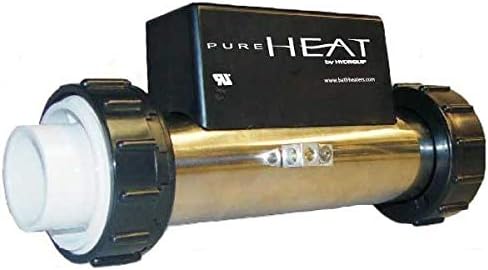
Hydro-Quip Pure Heat PH101-10UP
| Voltage | 120 volts |
|---|---|
| Heat Output | 1000 watts |
| Power Source | Electric |
| Special Features | Noise, On Off Timer, Overheat Protection |
The Hydro-Quip Pure Heat PH101-10UP is an inline, pressure-activated heater built to slide into tight plumbing runs for jetted tubs and whirlpool baths. It runs on 120 volts and delivers 1.0 kW of heat through a slim stainless steel tube that adapts to 3/4 to 1-1/2" PVC plumbing and can be reverse-mounted for flexible installation. The unit includes an automatic smart thermostat, an indicator light, and safety features such as overheat protection and a timer, so it maintains set temperature without constant babysitting. Because it is compact and pressure-activated it is well suited to retrofits and installers working in confined equipment bays. Limitations are its modest 1000-watt output, which favors maintaining temperature rather than rapid recovery on very large tubs, and the product is intended for indoor plumbing applications only. Installation still requires basic plumbing familiarity and proper electrical hookup for safe operation.
Best for: Buyers who need a compact, factory-quality inline heater to maintain tub temperature and who prioritize straightforward integration into existing jetted tub plumbing.
Less Ideal for: Those seeking high-power, fast-recovery heaters for very large whirlpools or commercial installations should consider higher-capacity hardwired units.
- Slim stainless steel form factor fits compact equipment bays and most jetted tub plumbing.
- Pressure-activated design integrates with circulating pump operation for automatic heating.
- Automatic smart thermostat and on/off indicator light simplify temperature maintenance.
- Built-in safety features include overheat protection and an on/off timer for controlled use.
- Only 1.0 kW heat output so recovery and rapid warming on very large tubs is limited.
- 120V single-phase power limits use to compatible household circuits and smaller installations.
Verdict: Choose the Hydro-Quip Pure Heat when you want a compact, plug-in inline heater that reliably maintains water temperature in jetted tubs within a residential setup.
ThermoMate Tankless Water Heater ET045CAN4

| Wattage | 4500 watts |
|---|---|
| Power Source | ac |
| Maximum Temperature | 131 °F |
| Special Features | Self-modulating Power, Cast Aluminum Heating Element, Stainless Steel Water Tube, Touch Control Panel, Waterproof |
This compact ThermoMate tankless unit is built for point-of-use installs where quick hot water at a sink is needed. It heats on demand with a 4,500W element and self-modulating control that adjusts power to match flow, so you get usable hot water across low flow rates without wasting energy. The touch control panel and digital display let you set temperature in 1°F increments between about 85°F and 131°F, which is handy for precise tasks like handwashing or salon work. Construction features a cast aluminum heating element isolated from the water path and a 304 stainless steel water tube to reduce scale and corrosion, and the IP25 rating gives splash resistance for under-sink locations. Installation requires a dedicated 120V hardwired circuit with a 40A double-pole breaker and 8 AWG wiring, so plan for an electrician. Flow is limited to roughly 0.26–1.0 GPM and 0.85 GPM at a 35°F rise, making this best for single-sink use rather than whole-house supply.
Best for: Buyers who want a compact, energy-conscious inline heater for a single sink or small point-of-use location and value precise temperature control and durable components.
Less Ideal for: Homes seeking instant hot water for multiple fixtures or whole-house supply should choose a higher-capacity unit instead.
- Self-modulating power improves energy efficiency by matching output to flow
- Digital touch panel with 1°F adjustment for precise temperature control
- Compact footprint fits tight under-sink or behind fixtures
- Cast aluminum heating element and 304 stainless steel tube resist scale and corrosion
- Requires a dedicated 120V, 40A double-pole circuit and 8 AWG wiring for installation
- Low maximum flow rate limits use to single sinks or low-demand fixtures
Verdict: A compact, energy-efficient point-of-use tankless heater that delivers precise, on-demand hot water for a single sink.
xwdzswgs 3000W Tankless Water Heater

| Wattage | 3000 watts |
|---|---|
| Voltage | 110 volts |
| Flow Rate | 0.5 gpm |
| Maximum Temperature | 131 °F |
| Mount Type | Wall |
This compact 3000W tankless unit is designed for point-of-use installs under sinks and in small spaces where instant hot water is needed. It heats quickly and can raise water temperature substantially at very low flow rates, with a digital LED display and touch controls for monitoring set temperature. The unit includes multiple safety protections such as dry-burn protection, leakage protection, automatic shutoff on over-temperature, and an IPX4 rating for splash resistance. Installation is wall-mounted and vertical only, with a standard 1/2-inch NPT inlet and premade screw holes to simplify mounting; the product recommends specific wiring and a 32A trip switch for safe operation. Practical limits are its low maximum flow rate and power requirement—it delivers best performance at modest flow (spec'd 0.3 to 0.5 gpm ranges), so it is suited to a single faucet rather than whole-house use, and it requires proper electrical sizing to meet the 3000W load on 110V circuits. For compact spaces that need quick hot water, it is a straightforward, safety-minded option at the point of use.
Best for: Buyers looking for an affordable, space-saving point-of-use heater for a single sink, RV, or small apartment who prioritize quick hot water and safety over high flow capacity.
Less Ideal for: Homes or users who need hot water for multiple fixtures, showers, or higher flow rates should choose a larger point-of-use or whole-house solution.
- Fast heating with 3000W output for quick on-demand hot water
- Compact wall-mounted design saves under-sink space
- Built-in safety features including dry-burn protection, leakage protection, and over-temperature shutoff
- Digital LED display and touch controls for clear temperature monitoring
- Low flow rate (0.5 gpm) limits use to a single faucet or light tasks
- Requires proper 110V wiring and a 32A trip switch which may need electrical upgrades
Verdict: A compact, safety-focused 3000W tankless unit that delivers instant hot water at a budget-friendly point-of-use for a single sink or small space.
thermomate ET060 6000W Tankless Heater

| Wattage | 6000 watts |
|---|---|
| Voltage | 240 volts |
| Flow Rate | 1.07 gpm |
| Maximum Temperature | 131 °F |
| Maximum Pressure | 150 psi |
The thermomate ET060 is a small, wall-mounted tankless unit built for point-of-use hot water like kitchen or bathroom sinks. It heats on demand with a 6000W self-modulating element that adjusts power to maintain the set temperature and provides roughly 1.07 GPM at a 35°F rise, which is suitable for handwashing, dish rinsing, and light sink tasks. The unit separates the heating chamber from the water path and uses a stainless steel water tube and cast aluminum heating element to reduce corrosion and scale buildup, helping long-term reliability. Controls include a touch panel and digital temperature display adjustable in 1°F increments for precise output up to about 131°F. Installation requires a 240V hardwire and a 30A circuit, and the compact footprint allows mounting under sinks or in tight spaces. Expect modest flow limits—this is not for showering or simultaneous multi-fixture use—and installation needs appropriate electrical capacity and plumbing fittings. For straightforward sink-level hot water without a storage tank, the ET060 is a durable, space-saving option.
Best for: Buyers who need a reliable, low-maintenance point-of-use heater to deliver consistent hot water at a single sink and who prioritize longevity and compact installation.
Less Ideal for: Homes that need higher flow for showers, multiple fixtures, or where a 240V dedicated circuit is not available or practical.
- Self-modulating 6000W element maintains temperature efficiently under varying flow
- Cast aluminum heating chamber separated from water line to reduce scaling and corrosion
- Compact wall-mount design fits under sinks and in tight spaces
- Digital touch controls with 1°F increment temperature display for precise adjustment
- Flow rate around 1.07 GPM limits use to single-sink tasks and not suitable for showers
- Requires 240V hardwiring and a dedicated 30A circuit, which may need electrical work
Verdict: A compact, durable point-of-use tankless heater that delivers efficient, precisely controlled hot water for a single sink with low maintenance construction.
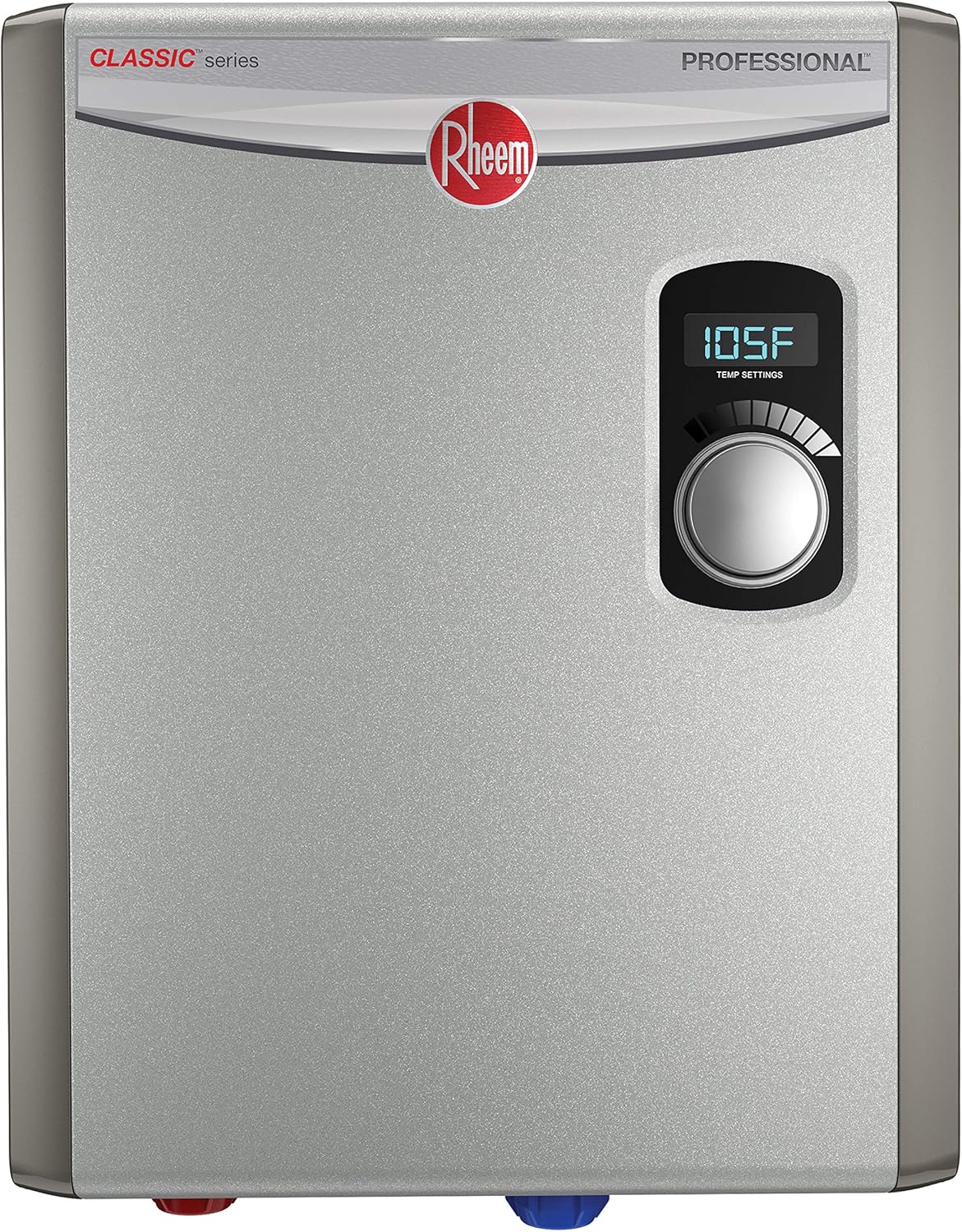
Rheem RTEX-18 Tankless Electric
| Wattage | 18000 watts |
|---|---|
| Voltage | 240 volts |
| Flow Rate | 4.4 gpm |
| Maximum Temperature | 140 °F |
| Efficiency | 99.8% |
The Rheem RTEX-18 is a wall-mounted tankless electric heater built to provide on-demand hot water for mid-size homes or single-shower whole-home use in moderate climates. It uses 18 kW of heating with self-modulating electronics and two field-serviceable copper heating elements, so it adjusts power to match flow and temperature needs while displaying setpoint on a front LED thermostat. Installation is straightforward with bottom 3/4 inch NPT water connections and no venting required, and the compact stainless steel body saves space compared with storage tanks. Expect continuous hot water up to about 4.4 gpm, making it suitable for one or two fixtures running together in warmer inlet conditions. Important limitations are electrical requirements and reduced flow/temperature rise in cold groundwater regions, so confirm breaker capacity and expected gpm for your climate before sizing. For buyers seeking a compact, efficient inline solution that saves space and energy versus a tank, the RTEX-18 is a practical choice.
Best for: Buyers who prioritize compact, energy-efficient on-demand hot water for a mid-size home or single-shower whole-home setup and who check electrical capacity and climate when sizing a unit.
Less Ideal for: Homes with very cold incoming water or households that routinely run multiple showers and appliances simultaneously without upgrading electrical service should consider higher-capacity options.
- Self-modulating 18 kW output adjusts power to match hot water demand
- Digital LED thermostat with +/-1 degree accuracy for easy temperature control
- Compact wall-mounted stainless steel design saves space and requires no venting
- Field-serviceable copper heating elements simplify maintenance
- Flow rate limited to about 4.4 gpm, which may not support multiple high-demand fixtures in cold climates
- Requires substantial dedicated 240V electrical circuits and breakers
Verdict: A compact, energy-smart inline electric heater that delivers reliable on-demand hot water for mid-size homes when correctly sized to your electrical supply and climate.
Rheem RTEX-04T 3.5 kW Tankless Heater

| Wattage | 3500 watts |
|---|---|
| Voltage | 120 volts |
| Flow Rate | 0.9 gpm |
| Maximum Temperature | 140 °F |
| Capacity | 0.9 gallons |
The Rheem RTEX-04T is a point-of-use tankless electric heater intended to supply hot water to one sink or similar low-flow application. It heats on demand with a 3.5 kW element on 120V, features digital thermostatic temperature control adjustable in 1°F increments, and installs on the wall close to the fixture to reduce wait time and water waste. The unit is stainless steel, requires no venting, and is small enough to fit under a sink or in a closet. In practice it delivers reliable warm water at very low flow rates (listed up to about 0.9 gpm), so it is best where a single faucet or small-sink use is expected rather than multiple simultaneous fixtures. Installation requires a dedicated 30 A breaker and #10 AWG copper conductors, so confirm your electrical panel capacity before buying. For buyers wanting a compact, factory-quality point-of-use solution that saves space and energy compared with a tank, this Rheem model is a sensible pick; buyers needing higher flow or whole-home service should choose a larger model.
Best for: Buyers who want a reliable, compact on-demand heater for a single sink or small fixture and prioritize straightforward installation and energy savings over flow capacity.
Less Ideal for: Homes that need hot water for multiple fixtures at once or whole-home coverage should choose a higher-capacity tankless or tank-style heater.
- Compact point-of-use design saves space and reduces wait time for hot water
- Thermostatic digital control with 1°F increments for precise temperature setting
- No venting required, simplifying indoor installation
- Stainless steel construction suitable for residential and light commercial use
- Very low maximum flow rate (around 0.9 gpm) limits use to a single faucet or low-flow fixture
- Requires a dedicated 30 A breaker and appropriate household electrical capacity
Verdict: A small, factory-quality point-of-use tankless heater that delivers precise, on-demand hot water for a single low-flow fixture while saving space and energy.
Choosing the Right Inline Water Heater: Key Factors to Consider
Flow Rate and Temperature Rise
Flow rate determines how much hot water the heater can deliver at a target temperature. Higher flow ratings let you run a faucet or shower with less drop in output temperature. When sizing an inline heater, match the unit's flow-versus-temperature specifications to the fixture demand and the incoming groundwater temperature.
If you underestimate required flow or temperature rise, water will come out lukewarm at higher demand. Conversely, oversizing for a low-use point increases cost and may complicate installation. Understanding both peak and typical flow needs ensures the heater you choose supplies reliable hot water without unnecessary energy use.
Power Source and Electrical Requirements
Inline electric heaters can draw significant amperage at higher flow rates and temperature rises. Confirm your electrical service can support the heater's voltage and breaker requirements. For larger units, you may need dedicated circuits or higher-voltage wiring.
Proper electrical capacity affects safety and long-term reliability. Undersized wiring or shared circuits can cause breaker trips and reduce performance. Planning wiring and breaker upgrades ahead of purchase avoids costly rework during installation.
Mounting, Plumbing Connections, and Space
Inline heaters must fit into the available space and align with existing plumbing. Check mounting orientation options, required clearances, and the size and type of inlet and outlet connections. Some units offer compact, wall-mounted profiles that suit tight under-sink cavities, while others need more clearance for service panels.
Ease of access for maintenance and clear labeling of flow direction simplify installation. If your plumbing uses nonstandard fittings or tight bends, factor in adapter requirements and potential extra labor for retrofit installs.
Control Options and User Interface
Control systems range from simple fixed thermostats to precise digital temperature control with diagnostic displays. Accurate, easy-to-use controls help you maintain a comfortable outlet temperature and reduce energy waste. Look for models with straightforward adjustment, clear temperature readouts, or thermostatic mixing compatibility if precise setpoints are important.
Advanced controls can also include features like proportional power modulation to stabilize output under varying flow. While these add cost, they improve comfort and energy performance in variable-use settings.
Durability and Serviceability
Material choices and service access impact how long an inline heater will function without major repairs. Corrosion-resistant housings, replaceable heating elements, and accessible terminals make routine maintenance or part replacement simpler. Durable components matter when the unit is exposed to hard water or frequent cycling.
Serviceability reduces total ownership disruption. Consider whether a unit allows element replacement without removing the entire assembly and whether diagnostic indicators are provided to speed troubleshooting.
Safety and Compliance
Safety features protect users and the building's plumbing system. Look for over-temperature cutoffs, pressure relief compatibility, built-in ground-fault protection where required, and compliance with relevant domestic electrical and plumbing codes. These features reduce the risk of scalding and equipment damage.
Confirm that the chosen unit's safety systems match your installation scenario, especially if the heater will serve a bathroom or other high-use wet area. Properly rated protective devices and documented compliance simplify inspections and ensure safer operation.
Matching an Inline Heater to Fixture Demand
Estimate the flow requirement for each fixture you plan to serve. Typical lavatory faucets, kitchen faucets, and low-flow showers have different expected flow rates. Combine those demands when one heater will serve multiple points, and account for lower incoming water temperatures in colder climates.
Use the heater's flow-versus-temperature chart when available. That chart shows the outlet temperature you can expect at different flow rates and makes it straightforward to predict performance during simultaneous use.
- Measure or estimate fixture flow in gallons per minute or liters per minute
- Check local groundwater temperature to determine required temperature rise
- Allow margin for simultaneous uses when sizing a single unit
Electrical Planning and Circuit Needs
Review the electrical ratings of candidate units before purchasing. High-capacity inline electric heaters can require dedicated circuits and higher-amperage breakers. Coordinate with an electrician to confirm panel capacity and whether conduit, wire gauge, or breaker upgrades are needed.
For installations in remodels or tight spaces, factor in run length from the electrical panel to the heater. Voltage drop and accessibility for future service are practical considerations that affect long-term reliability.
- Confirm voltage and breaker size requirements
- Plan wiring runs to minimize voltage drop
- Budget for electrician time if panel or circuit upgrades are needed
Installation Tips to Reduce Callbacks
Keep the inlet and outlet clearly labeled and oriented to match your plumbing layout. When retrofitting, use flexible connectors where appropriate to avoid stress on fittings. Secure mounting to a solid surface to reduce vibration and noise.
Apply proper sealing methods on plumbing joints and test for leaks at operating pressure before closing cabinetry. Provide a small service access panel if the unit will be concealed behind built-in fixtures.
- Use flexible hoses for tight alignments
- Pressure-test plumbing after installation
- Leave clearance for future element or control access
Hard Water Considerations and Maintenance
Hard water increases scale buildup on heating elements and inside flow passages, reducing efficiency and flow capacity over time. If you have hard water, choose a unit with removable elements or serviceable flow paths to allow descaling.
Establish a maintenance routine based on local water hardness and manufacturer guidance. Simple periodic checks and cleaning can extend service life and maintain energy efficiency.
- Consider water treatment or periodic descaling in hard-water areas
- Schedule element inspection frequency based on usage and hardness
- Keep installation accessible for maintenance
Temperature Stability Under Variable Demand
Temperature stability matters most when flow varies, such as in shower use or when another faucet opens. Units with proportional power modulation or responsive controls maintain a steadier outlet temperature during transient flows. If you expect highly variable demand, prioritize models with finer control.
Thermostatic mixing valves downstream can help prevent scalding when temps fluctuate. Combine mechanical mixing with a stable inline heater to balance comfort and safety.
- Look for units with power modulation for improved stability
- Use thermostatic mixing valves where scald risk is a concern
- Match control precision to expected flow variability
How We Chose the Best Inline Water Heater
We prioritized attributes that directly affect how an inline water heater performs in day-to-day use. Our evaluation focused on measurable, installation-relevant criteria: rated flow capacity at usable temperature rises, element type and heat response time, energy efficiency and standby losses, controls and temperature accuracy, and installation flexibility including mounting and plumbing connections. We also assessed safety features such as overheat protection and pressure compatibility. We excluded products intended for whole-house heating or integrated into large boiler systems, plus any units lacking clear flow- and temperature-rated performance data. Our shortlist favors units with documented flow-versus-temperature curves or clear manufacturer specifications so buyers can match capacity to fixture demand. Durability factors like corrosion-resistant materials and accessible service points were also considered. The result is a set of inline water heaters that fit common point-of-use scenarios and offer predictable performance across the evaluation dimensions most relevant to homeowners and installers.
Our full evaluation process is outlined in our review methodology.
FAQ
Can an inline water heater serve multiple fixtures?
Often yes, but it depends on the unit's rated flow capacity and the combined demand of the fixtures. Sum the expected flows and compare to the heater's flow-versus-temperature specs to determine if a single unit can maintain the desired outlet temperature.
What electrical upgrades might be needed for installation?
Many inline electric heaters require dedicated circuits and specific breaker sizes. Higher-capacity models may need larger gauge wiring or a higher-voltage supply. An electrician can assess panel capacity and the required wiring for safe operation.
How does incoming water temperature affect performance?
Colder inlet water increases the temperature rise the heater must provide, reducing the maximum achievable flow at a set outlet temperature. Use local groundwater temperature as a baseline when sizing to ensure the heater meets expectations in winter.
Are inline heaters suitable for outdoor or unheated spaces?
They can be, but you must choose units rated for the ambient conditions and protect electrical connections from moisture and freezing. Insulation and proper mounting reduce risk in unheated environments.
How often should I service an inline water heater?
Service intervals depend on water hardness and usage. In soft-water areas, annual visual checks may suffice. In hard-water regions or high-use installs, inspect and descale elements every 6 to 12 months to preserve flow and efficiency.
Final Verdict
Choosing an inline water heater comes down to matching capacity and controls to the real-world demands of the fixtures you plan to serve. Prioritize accurate flow-versus-temperature ratings, appropriate electrical provisioning, and safety features to ensure reliable, comfortable output. Balance installation complexity and maintenance needs against desired performance. If you size the unit to the expected flow and account for incoming water temperature and electrical requirements, you will end up with a compact, efficient point-of-use solution that delivers consistent hot water where you need it most.