
Note: This article contains affiliate links. If you click on these links and make a purchase, we may earn a small commission at no extra cost to you. This helps support our research and content. Read our full affiliate disclosure here.
If you need continuous hot water without the space and standby loss of a tank, an indoor tankless water heater can be a smart upgrade. Choosing the right unit affects delivery temperature, peak flow, and installation complexity, so picking poorly can leave you short on hot water or facing costly retrofits. This guide shortlists the top indoor tankless water heaters across common household demands and plumbing setups. We evaluate flow capacity, energy efficiency, and installation requirements so you can match a unit to your home and hot-water habits. Read on to find the options that fit your flow needs and mechanical constraints.
Top Picks at a Glance
| Best Overall The best all-around choice for most situations | Rheem RTG-70DVLN-3 Tankless Water Heater |  |
| Best Quality Built to a higher standard if you want something more solid | Rinnai RXP199iN Tankless Water Heater |  |
| Best Value The sweet spot between price and what you get | thermomate Tankless Water Heater 4500W |  |
| Best Budget The cheapest option that still gets the job done reliably | xwdzswgs 3000W Tankless Water Heater |  |
| Top Rated A top-rated pick with lots of positive feedback | Mount Steel Pioneer MST-TLS18A |  |
| Most Popular A crowd favorite that many people choose with confidence | EcoSmart ECO 27 Tankless Heater |  |
| Best Seller A high-volume bestseller chosen again and again | Rheem RTEX-04T 3.5 kW Tankless Heater |  |
Rheem RTG-70DVLN-3 Tankless Water Heater

| Power Source | Natural Gas |
|---|---|
| Flow Rate | 7 gpm |
| Maximum Temperature | 140 °F |
| Heat Output | 160000 BTU/h |
| Wattage | 132 watts |
The Rheem RTG-70DVLN-3 is an indoor, non-condensing natural gas tankless water heater designed to provide continuous hot water for whole-house use. It delivers up to 7.0 gallons per minute and 160,000 BTU/hr, which is typically enough for two to three simultaneous showers or mixed laundry and dishwashing cycles. The unit includes an integrated digital display with precise temperature control, Hot-start Programming to reduce cold-water bursts between uses, and LeakGuard leak detection for added protection. Its compact wall-mount design saves floor space and the reduced clearance requirement simplifies replacement of older tank systems. Energy efficiency is a selling point here, with a reported 0.82 UEF and claims of lower energy use and reduced water waste via a water-saving setting. The main compromises are that it is a non-condensing model, so it does not reach the highest possible efficiency of condensing units, and proper installation requires a compatible venting system and 1/2 gas line compatibility, which may increase installation complexity or cost. For buyers who want reliable on-demand hot water and a proven feature set, this Rheem model is a sensible option.
Best for: Buyers who want a reliable, whole-house natural gas tankless heater that balances efficiency, space savings, and practical safety features for everyday family use.
Less Ideal for: Homes seeking the absolute highest efficiency should consider condensing models, and properties without compatible venting or gas-line capacity may need a different solution.
- Continuous on-demand hot water up to 7.0 GPM suitable for 2–3 simultaneous water uses
- Integrated digital display with ±1°F temperature control for precise settings
- Built-in LeakGuard leak detection and Hot-start Programming to reduce cold-water bursts
- Compact wall-mount design saves floor space and easier replacement of tank units
- Energy-efficient operation (0.82 UEF) and water-saving setting to reduce waste
- Non-condensing design is less efficient than condensing tankless units
- Requires correct venting and gas-line considerations during installation
Verdict: Choose this Rheem RTG model if you want a compact, reliable indoor natural gas tankless heater that delivers steady whole-house hot water with useful safety and efficiency features.
Rinnai RXP199iN Tankless Water Heater

| Power Source | Natural Gas or Propane |
|---|---|
| Flow Rate | 11 gpm |
| Maximum Temperature | 140 °F |
| Heat Output | 199000 british thermal units |
| Wattage | 98 watts |
The Rinnai RXP199iN is a compact, high-output condensing tankless water heater intended for homes that need large simultaneous hot water demand. It delivers up to about 11.1 gallons per minute and up to 199,000 BTU, supports Smart-Circ intelligent recirculation via an internal pump to reduce wait time at fixtures, and can be converted to run on natural gas or propane. The unit is Energy Star qualified with a very high UEF (0.98), includes a Quick Flush feature to simplify maintenance, and can be connected to the Rinnai app with an optional Control-R Wi‑Fi module for diagnostics and setup. Practical benefits include near-endless hot water for multiple fixtures, reclaimed space compared with tank systems, and lower operating energy for many households. Important considerations are that professional installation is recommended because of gas conversion, venting options, and plumbing integration, and the unit requires the optional module for Wi‑Fi control and may be overkill for small households with low peak demand.
Best for: Buyers who prioritize peak hot-water performance and long-term energy efficiency for large households or homes with multiple simultaneous fixtures and who are comfortable investing in professional installation.
Less Ideal for: Those with very small households, minimal hot-water demand, or who want a simple plug-and-play replacement for a small tank heater should consider smaller, lower-capacity alternatives.
- High maximum flow rate (~11.1 GPM) suitable for multiple fixtures at once
- Condensing design with very high UEF (0.98) for improved energy efficiency
- Built-in Smart-Circ recirculation pump to shorten hot water wait times
- Convertible to natural gas or propane and installable indoors or outdoors with Versa Vent
- Quick Flush feature simplifies periodic maintenance
- Professional installation required for safe gas conversion and venting
- Wi‑Fi control requires an optional Control-R module that is sold separately
Verdict: If you need reliable, high-volume on-demand hot water with excellent energy efficiency and built-in recirculation, this Rinnai condensing unit is a top choice.
thermomate Tankless Water Heater 4500W

| Wattage | 4500 watts |
|---|---|
| Power Source | ac (120V hardwired) |
| Maximum Temperature | 131 °F |
| Flow Rate | 0.26–1.0 GPM (0.85 GPM at 35°F rise) |
This compact 4500W tankless unit supplies on-demand hot water for a single sink or other point-of-use locations, heating water to between 85°F and 131°F with a claimed flow range of about 0.26 to 1.0 GPM and 0.85 GPM at a 35°F rise. It is intended for hardwired 120V installations and uses self-modulating power to match heater output to water flow, which improves efficiency and reduces wasted energy during low-flow use. The housing is slim and made to fit under or over a cabinet and the control panel provides a digital temperature readout with 1°F adjustments for precise tuning. Construction highlights include a cast aluminum heating element separated from the stainless steel water tube to reduce scale and corrosion and an IP25 splash-resistant rating for damp locations. Important practical limits are its low maximum flow—suitable for one fixture at a time—and the requirement for a 40A double-pole breaker and appropriate wiring for safe installation.
Best for: Buyers who want an efficient, space-saving point-of-use heater to supply a single sink or small workstation and who prioritize precise temperature control and lower standby energy use.
Less Ideal for: Homes needing hot water for multiple fixtures or higher-flow applications; properties where running a dedicated 40A circuit is impractical.
- Compact, low-profile design fits in tight under-sink or cabinet spaces
- Self-modulating power adjusts energy use to flow for better efficiency
- Digital touch control with 1°F increments and temperature display
- Cast aluminum heating element and stainless steel water tube resist scale and corrosion
- Maximum flow rate is low and only suitable for a single fixture at a time
- Requires hardwiring to a 40A double-pole breaker and heavy-gauge wiring for installation
Verdict: A highly compact, energy-efficient point-of-use tankless heater that gives precise temperature control for a single sink or small hot-water station.
xwdzswgs 3000W Tankless Water Heater

| Wattage | 3000 watts |
|---|---|
| Voltage | 110 volts |
| Flow Rate | 0.5 gpm |
| Maximum Temperature | 131 °F |
| Mount Type | Wall |
This 3000W 110V tankless unit is a budget-friendly point-of-use heater designed for under-sink or small-space installs where fast hot water is needed. It heats water on demand and the LED display shows temperature in Celsius or Fahrenheit, while touch controls let you switch units and power the unit. The unit includes safety features such as dry-burning protection, leakage protection, IPX4 splash resistance, and automatic shutoff for over-temperature conditions, which makes it suitable for kitchens, small bathrooms, RVs, or workshop sinks. Installation is wall-mounted and vertical only, using a standard G1/2 (1/2 inch NPT) inlet and predrilled holes; the maker recommends a circuit with a 32A trip and heavier gauge wiring. Expect modest flow rates (listed at 0.5 gpm) and a maximum outlet temperature around 131°F, so this is best for single fixtures rather than whole-house use. The compact ABS body and included mounting screws keep setup simple, but buyers should plan electrical work to meet the recommended wiring and safety requirements.
Best for: Buyers wanting an inexpensive point-of-use heater for a single sink, RV, or small apartment who prioritize space savings and quick hot water over high flow.
Less Ideal for: People needing hot water for multiple fixtures at once or whole-house service should choose a higher-capacity unit instead.
- Compact under-sink design fits tight spaces and mounts vertically
- Fast on-demand heating with 3000W power and LED temperature display
- Multiple safety features including dry-burning protection and automatic shutoff
- Standard 1/2-inch fitting and included mounting hardware simplify plumbing connections
- Low flow rate (about 0.5 gpm) limits use to a single faucet or light tasks
Verdict: A low-cost, space-saving point-of-use tankless heater that delivers quick hot water to a single fixture with basic safety protections.
Mount Steel Pioneer MST-TLS18A

| Power Source | Electric |
|---|---|
| Heat Output | 18 KW |
| Voltage | 240 volts |
| Efficiency | 99% |
| Mount Type | Wall |
The Mount Steel Pioneer MST-TLS18A is a point‑of‑use electric tankless heater designed for steady hot water delivery with adjustable peak power between 12 kW and 18 kW on a 240 V supply. It uses a dry heating architecture and aluminum heating elements to reduce mineral buildup and corrosion, while built‑in sensors and self‑modulating control keep outlet temperature stable as demand changes. Typical installation is wall mounted close to the sink or shower to minimize lag and heat loss, and the compact 3.3 inch depth helps fit it into tight utility spaces. Notable practical benefits include high reported thermal efficiency and configurable power settings so it can be matched to a home's electrical capacity, plus overheat protection for added safety. Limitations are inherent to a single‑unit, point‑of‑use electric design: it is sized for localized use rather than supplying a whole household of simultaneous high‑flow fixtures, and it requires a 240 V circuit and appropriate amperage wiring. For buyers prioritizing dependable, low‑maintenance hot water at one or two fixtures, this model offers a solid balance of precision control and durability.
Best for: Buyers who want a dependable, low‑maintenance electric tankless unit to supply one or two fixtures with consistent hot water and predictable performance.
Less Ideal for: Homes that need whole‑house simultaneous hot water for multiple showers and appliances or those without adequate 240 V electrical capacity should look at larger solutions.
- Adjustable peak power (12 kW–18 kW) lets installers limit draw to match electrical capacity
- Self‑modulating control and precise sensors provide stable outlet temperature under varying flow
- Dry heating design and aluminum heating element reduce mineral buildup and corrosion
- Compact, wall‑mount profile fits tight utility spaces
- Designed as a point‑of‑use unit, not intended to serve multiple high‑demand fixtures simultaneously
- Requires a dedicated 240 V circuit with sufficient amperage for higher power settings
Verdict: Choose this compact, adjustable electric tankless heater if you need a reliable, low‑maintenance point‑of‑use solution with precise temperature control.
EcoSmart ECO 27 Tankless Heater
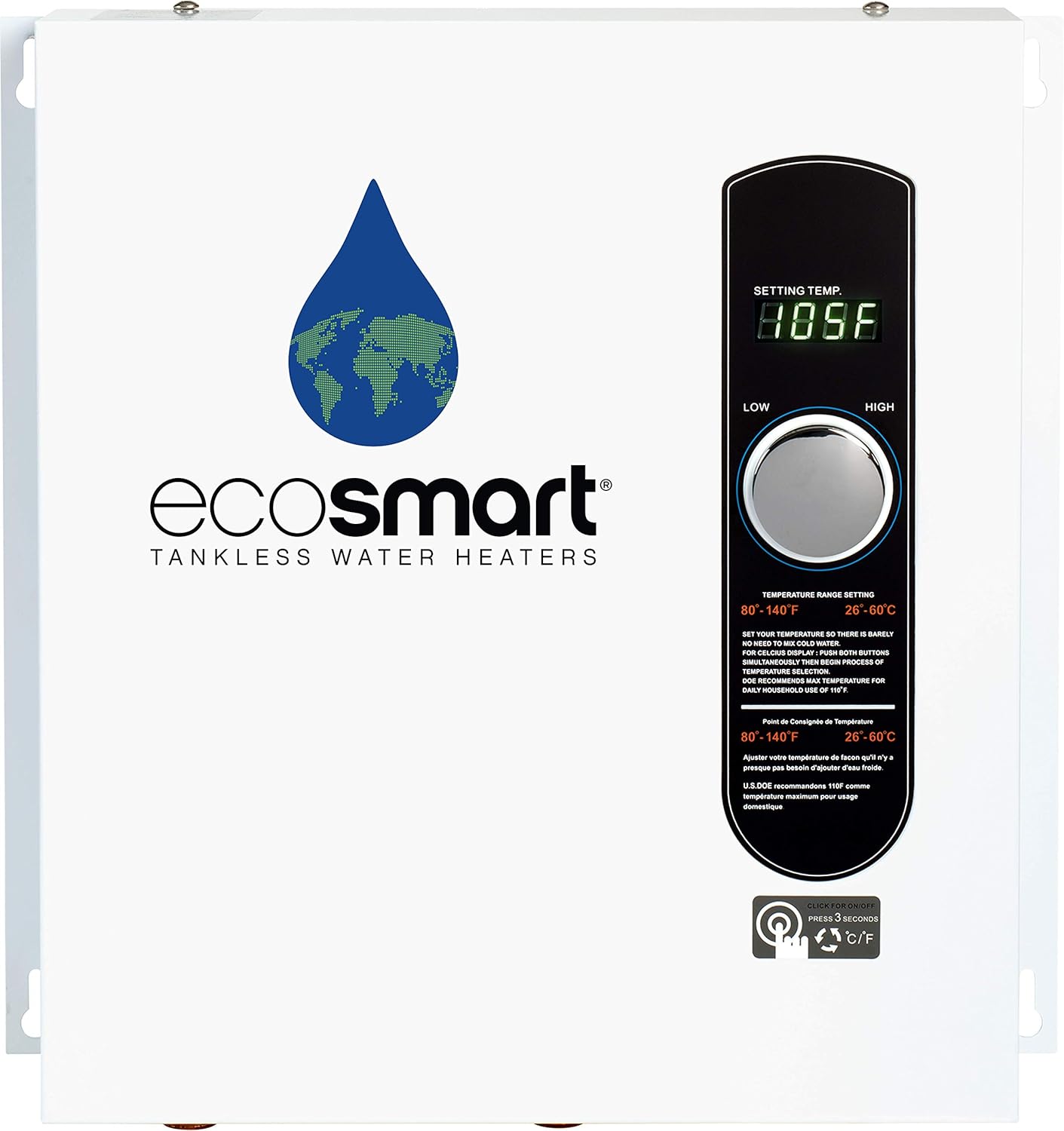
| Wattage | 27 KW |
|---|---|
| Voltage | 240 volts |
| Flow Rate | 6.6 gpm |
| Maximum Temperature | 120 °F |
| Maximum Pressure | 150 psi |
The EcoSmart ECO 27 is a wall-mounted electric tankless heater that heats water on demand using self‑modulating technology to match power output to flow and temperature needs. It is intended for larger homes or whole-house use in warmer climates and can deliver up to about 6.6 gpm under favorable inlet temperatures and roughly 2.7–3 gpm in colder inlet conditions. Installation is fixed‑mount and requires three 40A double‑pole breakers and three 8 AWG conductors, so professional electrical work is common. The unit offers digital temperature control with 1 degree increments, a compact footprint that saves floor space, and certifications for safety and lead‑free compliance. Expect consistent endless hot water when sized correctly, but plan for the electrical service upgrade and the lower flow rates at very cold inlet temperatures. The ECO 27 works well as a central solution where moderate simultaneous demand exists, while its power requirements and flow limits are the key installation considerations.
Best for: Buyers who prioritize continuous on‑demand hot water for larger households or high‑use fixtures and who want a compact, energy‑efficient electric solution and are prepared to handle the electrical requirements.
Less Ideal for: Those without sufficient home electrical capacity or who need very high simultaneous flow in cold climates should consider gas models or larger multi‑unit electric setups instead.
- Self‑modulating 27 kW output that adjusts to demand for efficient on‑demand heating
- Digital temperature control with 1°F increments for precise setpoint control
- Compact wall‑mounted design frees floor space compared with tank heaters
- ETL listed and lead‑free certified for safety and potable water use
- Requires significant electrical capacity and three 40A double‑pole breakers, often needing panel/work upgrades
- Flow rate drops with colder inlet water so capacity for multiple fixtures depends on local groundwater temperature
Verdict: Choose the ECO 27 if you need a compact, factory‑quality electric tankless that delivers continuous hot water for larger homes and you can meet its heavy electrical requirements.
Rheem RTEX-04T 3.5 kW Tankless Heater

| Wattage | 3500 watts |
|---|---|
| Voltage | 120 volts |
| Flow Rate | 0.9 gpm |
| Maximum Temperature | 140 °F |
| Mount Type | Wall |
The Rheem RTEX-04T is a small, wall-mounted point-of-use electric tankless heater built for single-fixture applications like a basement sink, garage sink, or wet bar. It supplies hot water on demand by heating only when a tap is opened, which reduces standby energy use compared with a conventional tank. Controls include a digital thermostatic dial with 1-degree increments up to 140°F, so you can set and maintain a consistent outlet temperature. Installation is simplified by the lack of venting and the unit's compact stainless steel body that fits under sinks or in tight closets. Practical limits are its 3.5 kW/120 V electrical rating and low flow output — listed around 0.5 to 0.9 GPM depending on conditions — so it will not support showers or multiple fixtures at once and requires a dedicated 30-amp breaker and #10 AWG wiring. For buyers wanting a safe, space-saving heat source for a single low-flow fixture, the RTEX-04T is straightforward and reliable, but it should be sized carefully to match local incoming water temperature and fixture demand.
Best for: Buyers who prioritize low-risk, reliable on-demand hot water for a single sink or small fixture and want a compact, easy-to-install indoor unit with stable temperature control.
Less Ideal for: Homes needing hot water for showers, multiple fixtures, or whole-house service should choose a higher-capacity model or a professionally sized solution.
- Compact point-of-use design saves space and installs near the fixture to reduce water waste
- Digital thermostatic control with 1-degree adjustments for stable outlet temperature
- No venting required, simplifying indoor installation
- Stainless steel construction suitable for residential and light commercial use
- Low maximum flow rate suitable only for single, low-flow fixtures
- Requires a dedicated 30-amp breaker and specific wiring despite 120V supply
Verdict: Choose the RTEX-04T when you need a compact, easy-to-install, thermostatic point-of-use electric heater that reliably supplies hot water to a single low-flow fixture.
Choosing the Right Indoor Tankless Water Heater: Key Factors to Consider
Flow Rate and Simultaneous Fixtures
Flow rate is the most immediate determinant of how many fixtures you can run at once. Tankless units are rated in gallons per minute at a given temperature rise; matching that capacity to your peak household demand prevents drops in temperature when multiple outlets run. Consider your typical simultaneous usage patterns such as shower plus dishwasher or two showers at once.
If your household often uses multiple fixtures at once, choose a unit with higher rated flow at the temperature rise you need. If usage is light or staggered, a smaller-capacity model will be more efficient and easier to install.
Required Temperature Rise
Temperature rise is the difference between incoming water temperature and the hot water temperature you want. Colder climates and incoming ground temperatures raise the required temperature increase and reduce effective flow. Check local winter ground or supply water temperatures to estimate the realistic flow a unit can deliver.
A unit that looks adequate on paper may not meet expectations if rated at a minimal temperature rise. Prioritize models with clear performance curves showing flow at different rises so you can choose based on your local conditions.
Venting and Installation Constraints
Indoor tankless units often require dedicated venting, combustion air, or clearances that affect where a unit can be located. Some units accept direct-venting through an exterior wall, while others need more complex coaxial or vertical vent runs. Physical footprint, gas supply capacity, and access for servicing should also influence placement decisions.
Before buying, measure your available space, review required clearances, and verify that your gas line, electrical supply, or flue routing can meet the unit's needs. Installation complexity can significantly change total cost and feasibility.
Fuel Type and Efficiency Ratings
Indoor tankless water heaters are available in different fuel types, and each has distinct efficiency and operating characteristics. Look at energy-efficiency metrics and certification ratings to estimate running cost relative to your local fuel prices and usage patterns. Higher efficiency lowers operating cost but may increase upfront complexity.
Efficiency matters most if you have high hot-water demand or long-term ownership plans. For sporadic use, prioritize installation simplicity and reliable flow over marginal efficiency gains.
Controls and Temperature Stability
Controls determine how accurately a unit can hold set temperatures and respond to changing flow. Models with electronic modulation and precise thermostatic control deliver steadier output and faster recovery from sudden demand spikes. Poor control can cause temperature swings when a second fixture opens or when water pressure fluctuates.
If consistent shower temperature is important, look for units with digital control and proven modulation. Simpler mechanical controls may be adequate for low-demand situations but can produce noticeable temperature variation.
Maintenance and Serviceability
Tankless units require periodic maintenance such as descaling, filter cleaning, and inspection of venting and combustion components. Ease of access to service points and availability of replacement parts affects long-term reliability. Consider units with straightforward access for flushing and part replacement to reduce maintenance time and cost.
Homes with hard water should plan for more frequent descaling and choose units with accessible heat exchangers or manufacturer guidance for local service. Factor in the implied maintenance cadence when comparing options.
Sizing the Right Model for Your Home
Sizing a tankless water heater requires combining expected peak flow with the temperature rise needed at your location. Start by listing simultaneous fixture use and estimating flow for each fixture. Use conservative flow estimates for fixtures like showers and dishwashers to avoid undersizing.
Next, determine the incoming water temperature during the coldest months and calculate the temperature increase required for comfortable hot water. Cross-reference that temperature rise with the unit's performance curves to pick a model that meets your peak flow without hitting its limits.
- Estimate simultaneous fixture flows rather than average per-person use
- Use winter inlet temperatures for conservative sizing
- Account for future changes like additional bathrooms or higher-flow showerheads
Common Installation Considerations
Indoor tankless units have varied venting and clearance needs that affect where they can be mounted. Check whether the unit supports direct venting, coaxial venting, or requires vertical flues and plan routes accordingly.
Gas supply and electrical requirements can also govern feasibility. Verify existing gas line size and available electrical circuits before purchase. Factor in access for maintenance and any local code requirements that might affect vent termination locations.
- Confirm venting type and maximum vent length
- Verify gas-line capacity and electrical hookup
- Plan for service access and condensate drainage if applicable
Hard Water and Corrosion Risks
Hard water accelerates scale formation inside heat exchangers, reducing efficiency and potentially causing failures. Homes with hard or mineral-rich water should consider a descaling plan and units with accessible or replaceable heat exchangers.
Corrosion protection and the materials used in the combustion chamber and plumbing connections influence longevity. Review recommendations for water treatment or inline filtration when placing a tankless unit in a high-mineral area.
- Plan regular descaling intervals for hard-water areas
- Consider inline filters or water softening for extreme hardness
- Inspect material compatibility for plumbing connections
Controls, Smart Features, and User Convenience
Modern units may include digital thermostats, remote control, or diagnostics that simplify setup and troubleshooting. These features can reduce installer time and make it easier to fine-tune output temperature and monitor performance.
Decide whether remote monitoring or programmable schedules are worth the extra complexity. For some households, simple temperature control is sufficient; for others, energy-saving scheduling and alerts can add real value.
- Digital controls improve temperature consistency
- Diagnostic readouts aid maintenance and troubleshooting
- Remote access can help optimize schedules and detect faults early
Permits, Codes, and Safety
Local codes often dictate venting materials, combustion air provisions, and permit requirements for installing indoor gas appliances. Confirm code requirements early to avoid surprises during installation.
Safety features such as automatic shutoff, flame failure protection, and proper vent termination are essential. Ensure the chosen unit meets applicable safety standards and that the installer follows required inspection steps.
- Check local permitting and inspection rules before buy
- Confirm required vent materials and clearances
- Verify built-in safety features and installation checklist
How We Chose the Best Indoor Tankless Water Heater
We focused on selection criteria that matter most for indoor tankless water heaters and the real-world challenges homeowners face when replacing or upgrading a water heating system. Primary evaluation dimensions included continuous flow capacity at realistic temperature rises, fuel type efficiency and ratings, and the venting and clearance needs that affect installation complexity. We also weighed build and component quality, including heat exchanger materials and control accuracy, and customer service or warranty terms that influence long-term ownership costs. We excluded units designed solely for outdoor use, combination space-heating appliances, and models lacking clear specification data. Products that require specialized retrofit work or impossible venting in typical indoor installations were deprioritized. The final shortlist emphasizes reliable flow delivery, sensible installation footprints, and documented efficiency and safety features. These criteria align with the scoring labels used on each product card, helping you compare units on the attributes that drive day-to-day performance and installation feasibility.
Our full evaluation process is outlined in our review methodology.
FAQ
How do I know what flow rate I need for a tankless unit?
Estimate the gallons per minute for each fixture you expect to run simultaneously, then add them together to get peak flow. Compare that total to a unit's rated flow at the temperature rise you expect to need, using winter inlet temperatures for a conservative estimate.
Can a tankless heater be installed in any indoor location?
Not always. Indoor installations must meet venting, clearance, and combustion-air requirements. Verify that the proposed location allows the required vent runs and clearances and that gas and electrical supplies meet the unit's specifications.
How often do indoor tankless water heaters need maintenance?
Maintenance frequency depends on water quality and usage. Typical servicing includes periodic descaling and filter checks; homes with hard water may need service every 6 to 12 months, while soft-water homes can often extend intervals.
Will a tankless unit save money on energy bills?
Tankless units reduce standby losses compared with storage tanks, which can lower energy use for intermittent hot-water demand. Actual savings depend on usage patterns, fuel costs, and the unit's efficiency ratings.
Do tankless heaters deliver instant hot water at every fixture?
They provide continuous hot water once flow starts, but there can be a short delay for hot water to travel through plumbing. Flow rate and temperature stability under simultaneous use determine how effectively multiple fixtures are served.
Final Verdict
Choose an indoor tankless water heater by prioritizing realistic flow capacity at the temperature rise you experience, and by confirming venting and installation feasibility for your space. Balance efficiency and control features against the complexity of installation and maintenance needs. For reliable long-term performance, favor units with clear performance curves, accessible maintenance points, and the safety and venting features that match your home. With those tradeoffs in mind, you can select a unit that delivers dependable hot water and sensible operating costs.