
Note: This article contains affiliate links. If you click on these links and make a purchase, we may earn a small commission at no extra cost to you. This helps support our research and content. Read our full affiliate disclosure here.
If you drink green juice or rely on fresh carrot juice for daily nutrients, choosing the right juicer matters. Celery and carrots are fibrous, stringy produce that need a machine capable of efficient extraction without wasting juice or clogging. The right juicer will get more liquid and nutrients out of each stalk and root, require reasonable prep and cleanup time, and hold up to frequent use. This guide shortlists seven top juicers selected for their ability to handle celery and carrots reliably. We evaluated machines for extraction efficiency, ease of cleaning, and durability so you can pick the best fit for regular juicing. Read on to find the key tradeoffs and the features that matter most before you decide.
Top Picks at a Glance
| Best Overall The best all-around choice for most situations | Breville Juice Fountain Plus JE98XL |  |
| Best Quality Built to a higher standard if you want something more solid | Hurom H70 Slow Juicer |  |
| Best Value The sweet spot between price and what you get | MEGAWISE Pro Slow Masticating Juicer |  |
| Best Budget The cheapest option that still gets the job done reliably | Juilist Centrifugal Juicer AMR526 |  |
| Top Rated A top-rated pick with lots of positive feedback | VMIXBLE Cold Press Juicer |  |
| Most Popular A crowd favorite that many people choose with confidence | Mueller Ultra Juicer MU-100 |  |
| Best Seller A high-volume bestseller chosen again and again | EanOruus 3-in-1 Cold Press Juicer E-18 |  |
Breville Juice Fountain Plus JE98XL

| Wattage | 850 watts |
|---|---|
| Number of Speeds | 2 |
| Power Source | Corded Electric |
| Blade Material | Stainless Steel |
| Capacity | 1 liters |
The Breville Juice Fountain Plus JE98XL is a straightforward centrifugal juicer built for fast everyday use. It handles hard produce like carrots and fibrous items like celery well thanks to its 850W motor and stainless steel titanium-reinforced cutting disc paired with a micro mesh filter basket for efficient extraction. The 3-inch feed chute significantly reduces prep because many fruits and veggies can be fed whole or with minimal cutting, and the integrated froth separator in the included juice jug delivers clearer pours with less foam. Two speed settings let you choose low for leafy greens and soft fruits and high for denser vegetables. Cleanup is aided by a detachable pulp container and dishwasher-safe parts, though centrifugal juicers typically produce more foam and slightly less yield than slow masticating machines. Its footprint and cord storage keep the unit tidy on a counter, but it is a basic juicer without cold-press quieting or the highest nutrient retention of slower models. For those after quick, reliable juices from carrots and celery, it is a practical everyday option.
Best for: Buyers who want a fast, no-fuss juicer for daily use and value quick prep and easy cleanup for vegetables like carrots and celery.
Less Ideal for: Those who prioritize maximum nutrient retention, highest juice yield, or very quiet operation should consider a slow masticating or cold-press juicer instead.
- 3-inch extra-wide chute reduces prep time by accepting larger pieces or whole produce
- 850W motor and titanium-reinforced disc with stainless mesh basket for efficient extraction
- Two speeds allow appropriate settings for leafy greens versus hard vegetables
- Included juice jug with integrated froth separator yields clearer pours
- Dishwasher-safe detachable parts and cord wrap simplify cleaning and storage
- Centrifugal design produces more foam and typically lower juice yield than slow masticating juicers
- Can be louder during operation compared with cold-press models
Verdict: A fast, user-friendly centrifugal juicer that saves prep time and reliably handles carrots and celery for everyday fresh juice.
Hurom H70 Slow Juicer

| Wattage | 150 watts |
|---|---|
| Power Source | Corded Electric |
| Material | Plastic |
| Special Features | Easy to Clean |
The Hurom H70 is a single-auger cold-press juicer built to maximize juice yield while minimizing cleanup and prep time. It uses a strainer-free Easy Clean chamber and two-part auger that separates pulp without a mesh filter, so parts rinse quickly and you get smooth, low-pulp juice—useful when juicing fibrous produce like celery and carrots. The large self-feeding hopper accepts larger pieces and lets you add ingredients while running, which speeds up busy mornings. At 150 watts the motor is powerful enough for hard root vegetables with a slow squeeze action that preserves nutrients and reduces foam and heat. Its compact footprint makes it easy to keep on the counter, and the front-facing gauge helps monitor juice volume. Expect minimal assembly and straightforward hand-washing of plastic components, but note that blade and main parts are plastic rather than metal. For anyone focused on extracting the most juice from celery and carrots with little mess, the H70 delivers efficient, quiet cold-press performance with fast cleanup.
Best for: Buyers who prioritize high juice yield and low-pulp texture from hard, fibrous produce and want a quick, low-fuss juicing routine for daily use.
Less Ideal for: People seeking all-metal professional machines or fully dishwasher-safe parts should consider other models aimed at commercial or heavy-duty use.
- Strainer-free Easy Clean chamber reduces clogging and rinses clean in under a minute
- Large self-feeding hopper accepts bigger produce and reduces chopping
- Slow masticating action yields more juice with less foam from fibrous vegetables
- Compact design fits on countertops and is easy to store
- Major parts and blade are plastic rather than metal
- Requires hand washing rather than dishwasher-safe components
Verdict: The H70 is a performance-focused cold-press juicer that squeezes maximum juice from celery and carrots while keeping cleanup fast and simple.
MEGAWISE Pro Slow Masticating Juicer
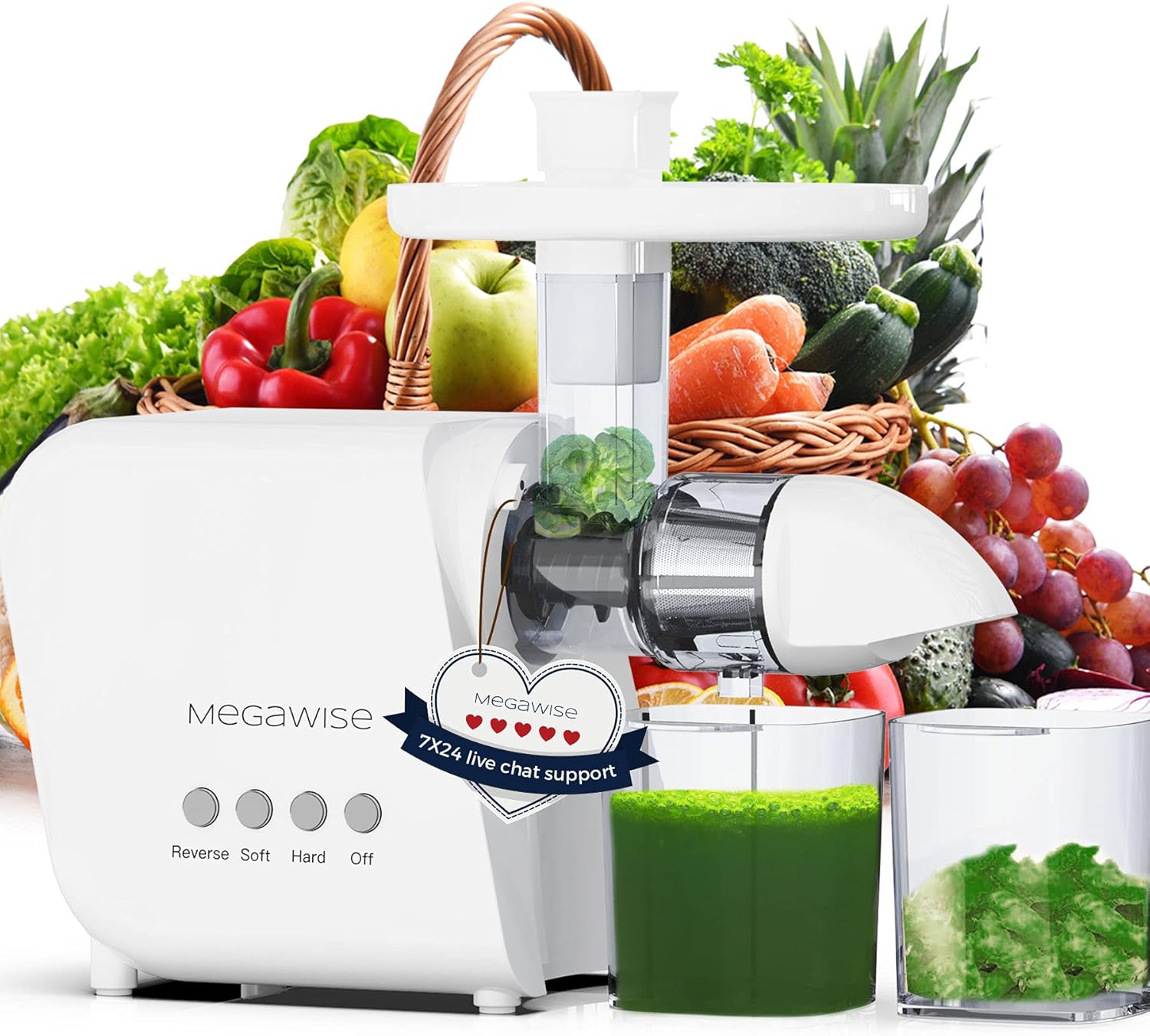
| Wattage | 150 |
|---|---|
| Power Source | Corded Electric |
| Voltage | 120 |
| Number of Speeds | 2 |
| Capacity | 2 liters |
The MEGAWISE Pro is a cold press masticating juicer aimed at maximizing juice yield and preserving nutrients when processing produce like celery and carrots. It uses a 9‑segment spiral auger and low‑speed operation (soft and hard modes) to crush and press ingredients, which reduces foam and heat so juice keeps more vitamins and a smoother texture. Two speed settings let you swap between soft fruits and tougher items such as carrots and celery, and the wide chute accepts larger pieces to speed prep. The unit is lightweight with plastic construction and a titanium blade, and parts are dishwasher safe for easier cleaning. Expect very good yield and quieter operation compared with centrifugal machines, but the low speed means juicing takes longer and the plastic body is less heavy‑duty than metal alternatives. Capacity and included brush help batch juicing, but users preparing large daily volumes may find the pace limiting. Overall this is a practical choice for anyone focused on maximum extraction and nutrient retention from fibrous vegetables.
Best for: Buyers who prioritize getting the most juice and nutrition from fibrous vegetables and want a quieter, low‑heat juicer for regular home use.
Less Ideal for: People who need very fast throughput for large daily volumes or prefer a heavy metal build for long commercial use should consider different designs.
- High juice yield thanks to 9‑segment spiral for efficient extraction
- Low‑speed masticating action preserves nutrients and reduces foam
- Two speed settings tailored for soft and hard produce like celery and carrots
- Dishwasher‑safe parts and included brush simplify cleanup
- Slower processing speed than centrifugal juicers, so batch jobs take more time
- Plastic exterior may feel less durable than metal‑bodied models
Verdict: Choose this juicer if you want maximum extraction and nutrient retention from celery and carrots in a quiet, easy‑to‑clean home machine.
Juilist Centrifugal Juicer AMR526

| Maximum Power | 800 watts |
|---|---|
| Wattage | 400 watts |
| Feed Chute | 3" |
| Number of Speeds | 3 |
| Material | Stainless Steel |
The Juilist AMR526 is a budget-friendly centrifugal juicer built for fast extraction of common kitchen produce like carrots and celery. It uses a high-speed motor with a listed maximum of 800W and a working power of 400W, plus three speed settings so you can match rpm to soft or harder produce; a visible window and one-button controls make operation straightforward. The 3" wide feed chute reduces prep by allowing larger pieces and the stainless steel cutting disc with a micro-mesh filter is designed to boost yield for firm vegetables. Cleanup is eased by dishwasher-safe accessories and the included cleaning brush. Important limits to note are typical of centrifugal designs: they run fast but can produce more foam and slightly lower nutrient retention than slow masticating juicers, and very high-fiber or frozen items are not recommended. For everyday juicing of carrots and celery the Juilist delivers quick results in a compact footprint, but users seeking quieter operation or maximum yield from leafy greens may prefer a different style.
Best for: Buyers looking for an affordable, quick juicer to make regular carrot and celery juice without lengthy prep will appreciate this model.
Less Ideal for: If you prioritize maximum nutrient extraction from leafy greens, very quiet operation, or juicing frozen items, consider a masticating or cold-press juicer instead.
- 3" wide feed chute reduces chopping and speeds prep
- Three speed settings let you adjust for soft fruits or hard root vegetables
- Visible window and one-button controls simplify operation
- Dishwasher-safe parts and included brush make cleaning easier
- Centrifugal design can create more foam and slightly lower nutrient retention than slow juicers
- Not recommended for very high-fiber or frozen produce
Verdict: A cost-conscious centrifugal juicer that delivers fast, easy carrot and celery juices with minimal prep and simple cleanup.
VMIXBLE Cold Press Juicer

| Maximum Power | 300 watts |
|---|---|
| Wattage | 300 watts |
| Voltage | 120 volts_of_alternating_current |
| Number of Speeds | 1 |
| Capacity | 100 fluid ounces |
The VMIXBLE Cold Press Juicer is a single-auger masticating machine designed for home use and larger-batch juicing. It squeezes produce at low speed (about 57 RPM) with a 300W motor and a wide 5.8-inch feed chute, so you can push in whole apples, carrots, and long stalks like celery with less prep. The unit emphasizes high juice yield and low oxidation, making it good for leafy greens and fibrous roots; the included reverse function and anti-clog design help clear jams. Most removable parts are dishwasher-safe and the machine disassembles in a few steps, which keeps routine cleaning quick. Safety features include a lid sensor that stops the motor if opened and overheat protection. Expect typical single-speed masticating performance: quieter and more nutrient-preserving than centrifugal juicers, but slower throughput and not suited to frozen items or very soft-only blends. For everyday juicing of carrots, celery, and similar produce this model offers reliable, easy operation and efficient extraction for family use.
Best for: Buyers who want a dependable, low-noise masticating juicer that reliably extracts high yields from fibrous produce like celery and carrots and minimizes prep and cleanup time.
Less Ideal for: People who need very fast throughput, multi-speed control, or a machine that accepts frozen ingredients and sugarcane should consider other styles of juicers.
- Wide 5.8-inch feed chute accepts whole fruits and long vegetables, reducing prep time
- 300W motor with slow 57 RPM masticating action preserves nutrients and yields more juice
- Dishwasher-safe removable parts and simple 3-step assembly for fast cleaning
- Safety lid sensor and overheat protection reduce risk during regular use
- Single-speed operation means slower processing compared with centrifugal juicers
- Not suitable for frozen fruit, sugarcane, or very soft items used alone
Verdict: A quiet, easy-to-clean masticating juicer built to reliably extract high yields from celery, carrots, and leafy greens for everyday home use.
Mueller Ultra Juicer MU-100

| Wattage | 850 watts |
|---|---|
| Maximum Power | 1100 watts |
| Number of Speeds | 2 |
| Included Components | 34 oz Juice Container, 68 oz Pulp Container, Anti-Slip Silicone Feet, Filter with Stainless Steel Blades, Grounded Power Cord, User Manual |
| Special Features | Auto Off Function, Safety Locking Arm, Mesh Filter |
The Mueller Ultra Juicer is a budget-friendly centrifugal machine built for quick daily juicing of fruits and firmer vegetables like carrots and celery. It uses a dual-speed motor so you can choose lower RPMs for softer produce and higher RPMs for harder roots, and the 3-inch feed chute reduces prep time by taking larger pieces or halved produce. Juice is separated into a 34 fl oz jug while a large 68 fl oz pulp container collects solids, which makes continuous juicing easier and cleanup faster. Practical touches include a safety locking arm, anti-slip silicone feet, an overload auto shut-off for protection, and a small brush for cleaning the stainless steel filter and blades. Expect typical centrifugal results: fast extraction and higher yield speed, but a thinner juice with more foam compared with slow masticating machines, and some noise during operation. For everyday users wanting fast carrot and celery juices without a steep price or complicated setup, this model is a straightforward choice.
Best for: Buyers who prioritize quick, no-fuss juicing of carrots and celery and want a safe, easy-to-clean machine backed by many user reviews for reassurance.
Less Ideal for: People who want the maximum nutrient yield and minimal foam from leafy greens or want the quietest, slow-press extraction should consider a masticating juicer instead.
- 3" feed chute accepts larger pieces and reduces chopping
- Two speed settings for soft and hard produce
- Separate juice jug and large pulp container for continuous juicing
- Safety locking arm and auto shut-off protect against jams and overheating
- Centrifugal design produces thinner, foamier juice than slow masticating juicers
- Can be relatively noisy during high-speed operation
Verdict: A fast, easy-to-use centrifugal juicer that handles carrots and celery with minimal prep thanks to its wide feed chute and dual-speed control.
EanOruus 3-in-1 Cold Press Juicer E-18

| Capacity | 100 fluid ounces |
|---|---|
| Maximum Power | 250 watts |
| Power Source | ac |
| Voltage | 110 volts |
The EanOruus E-18 is a single-auger cold press juicer built for high-volume home use and meal prepping. It uses a slow-speed auger and a high-torque 250-watt AC motor to crush fibrous produce like carrots and celery while preserving nutrients, and the 6.5-inch wide chute and 100 oz hopper let you load whole fruits and vegetables with minimal chopping and fewer refills. Two strainers expand functionality so you can switch from juice to nut milk or frozen-fruit sorbet, and the unit includes a detachable pulp outlet for easier cleaning. Safety-minded features such as auto-reverse and overheat protection reduce the chance of jams and motor stress during heavy runs. Because many parts are plastic and require hand washing, cleanup takes some time despite being designed to disassemble. The motor-forward design is quieter than some centrifugal models, but the unit is fairly large and heavier than compact juicers, which is worth noting if counter space is limited.
Best for: Buyers who prioritize reliable, low-speed extraction for nutrient-rich juice and want a high-capacity, safety-focused machine for regular family or meal-prep juicing.
Less Ideal for: Those who need a compact, lightweight juicer for occasional single-serving use or who prefer dishwasher-safe parts for minimal cleanup.
- Large 6.5-inch chute reduces prep by allowing whole fruits and many vegetables to be fed without chopping
- 100 oz hopper supports batch juicing for families or meal prep
- 250W AC brushless motor provides steady torque for extracting juice from fibrous produce like carrots and celery
- Auto-reverse and overheat protection help prevent jams and protect the motor
- Most removable parts are plastic and require hand washing, so cleaning is more hands-on than dishwasher-safe options
- Unit is relatively large and heavy, which may make storage or moving it between counters inconvenient
Verdict: Choose the EanOruus E-18 if you want a high-capacity, torque-driven cold press juicer that handles fibrous produce like celery and carrots with minimal prep and built-in safeguards.
Choosing the Right Juicer for Celery and Carrots: Key Factors to Consider
Extraction Efficiency
How much juice the machine yields from celery and carrots is crucial because these vegetables contain less free liquid than many fruits. Higher extraction means you use less produce for the same volume of juice, which affects both cost and convenience.
Extraction efficiency depends on the juicer type, screen or press design, and operating speed. Machines that separate pulp cleanly and leave drier fiber typically provide better nutrient and juice recovery. When comparing devices, look for documented pulp dryness or manufacturer information on yield, and factor that into your assessment.
Ease of Cleaning
Fibrous strands from celery and grated carrot residue can cling to screens, blades, and chute walls, so cleaning time is a major daily burden for regular juicers. A model with removable parts that rinse easily, or dishwasher-safe components, will reduce upkeep and increase the likelihood you actually use the machine frequently.
Also consider how accessible the strainer and interior surfaces are for brushing out trapped fibers. Designs that allow quick disassembly without tools are preferable for routine cleaning and reduce long-term frustration.
Prep Time and Feed-Chute Size
Prep time affects how often you will juice. Narrow chutes require trimming and chopping celery stalks and carrots into small pieces, adding several minutes per session. Wider chutes or vertical feed designs can accept longer stalks or whole carrots, saving time and making juicing more convenient for daily routines.
Consider whether the juicer requires peeling or trimming certain produce and whether pusher accessories accommodate long items. Less prep translates to higher daily use and a smoother habit-building experience.
Durability and Build Quality
Regular juicing with fibrous vegetables places mechanical stress on motors, bearings, and cutting screens. Machines with robust housings, quality metal components in critical areas, and good warranty coverage are likelier to maintain consistent performance over time.
Look for reinforced feed chutes, stainless steel strainers, and motors rated for continuous duty. Durable construction reduces maintenance interruptions and preserves extraction efficiency as the unit ages.
Pulp Management and Waste
How a juicer handles pulp affects cleanup and potential secondary uses. Some models eject relatively dry, compact pulp that is easier to compost or repurpose, while others produce wet, loose pulp that can be messy.
Consider the location and capacity of pulp containers and whether the machine pauses or stops when full. Efficient pulp management reduces interruptions during larger batches and keeps the countertop cleaner.
Noise Level and Motor Protection
Noise can be a deciding factor if you juice early in the morning or in shared living spaces. Higher-speed centrifugal units often run louder than slow-speed or masticating machines. Motor thermal protection and automatic shutoff features prevent overheating during extended use.
If you plan to juice multiple batches back-to-back, look for motors designed for continuous or heavy-duty cycles and clear guidance on duty cycles to avoid undue wear.
Types of Juicers and How They Handle Fibrous Vegetables
Juicers generally fall into categories based on their extraction method, and each handles celery and carrots differently. High-speed centrifugal machines slice and spin produce against a screen to separate juice quickly, which can work well for carrots but may leave wetter pulp with celery. Slow-speed or masticating juicers crush and press produce, typically producing drier pulp and higher nutrient retention for fibrous greens.
Consider how the mechanism affects both yield and fiber handling. Slow auger designs usually cope better with stringy stalks and reduce clogging, while centrifugal units can process larger volumes faster but often require more cleanup.
- Centrifugal: fast, good for quick batches, may need more cleanup
- Masticating/auger: slower, higher extraction, better for stringy celery
- Triturating/twin-gear: highest extraction, more complex maintenance
Prep Tips for Celery and Carrot Juicing
Proper prep reduces strain on the juicer and improves extraction. Trim tough ends and remove visible dirt or thick outer layers on carrots. Celery does not usually need peeling, but remove leaves if you prefer a milder taste.
If your juicer has a narrow chute, cut stalks and roots into pieces that feed through easily. For machines with wide chutes, you can often feed longer sections or whole carrots, saving prep time.
- Rinse thoroughly to remove soil from celery ribs and carrot crevices
- Cut produce to match the feed-chute diameter to avoid jamming
- Alternate celery and carrot pieces to mix fiber and improve flow
Maintaining Your Juicer for Long-Term Performance
Regular maintenance keeps extraction steady and prevents premature wear. Clean the strainer and blades immediately after use to prevent fibers from drying and bonding to surfaces. Inspect gaskets and seals periodically for wear and replace them when they show deterioration.
Follow manufacturer guidance on duty cycles and allow the motor to rest during extended sessions. Store the unit assembled or partially disassembled as recommended to protect fragile parts and speed the next use.
- Brush strainers after each use to avoid fiber buildup
- Rinse pulp containers immediately to prevent staining
- Check for loose screws or fittings every few months
Using Pulp: Composting and Culinary Ideas
Pulp from celery and carrots can be repurposed rather than discarded. Drying and composting pulp returns nutrients to the garden. In the kitchen, carrot and celery pulp can be added to soups, stocks, vegetable patties, or baked goods for fiber and flavor.
If you plan to reuse pulp regularly, choose a juicer that produces relatively dry, compact pulp to simplify handling and reduce additional drying steps.
- Compost wet pulp or dry it in a low oven before storing
- Mix pulp into doughs or meatloaf to add moisture and fiber
- Use pulp in vegetable stock to concentrate flavor
Countertop Space and Kitchen Workflow
Consider where the juicer will live on your countertop and how it fits your kitchen routine. Some units are tall and narrow while others are wide with multiple components that require storage space. If you have limited room, a compact vertical model with easy disassembly is preferable.
Think about where you will place the pulp and juice containers during operation and cleanup. A tidy workflow reduces friction and makes daily juicing more sustainable.
- Measure available counter and cabinet space before buying
- Estimate storage needs for attachments and cleaning tools
- Position near the sink to simplify rinsing and cleanup
How We Chose the Best Juicer for Celery and Carrots
We focused on attributes that directly affect daily juicing with celery and carrots. Extraction efficiency was central because these vegetables yield differently than soft fruits; we prioritized designs and mechanisms that consistently deliver high liquid output and minimal dry pulp. Ease of cleaning mattered next since fibrous produce can clog screens and make maintenance time-consuming; we favored models with accessible parts and simple rinsing or dishwasher-safe components. Durability and build quality were evaluated to ensure machines tolerate repeated use without performance drop. Feed-chute design and prep requirements were considered because larger chutes save time when processing long celery stalks or whole carrots. Noise level and motor thermal protection were included for buyers who juice frequently or in shared living spaces. Lastly, warranty and replacement-part availability were considered as proxies for long-term ownership cost and serviceability. We excluded appliances primarily designed for soft fruits, citrus-only squeezers, and multipurpose blenders that lack a true juicing function. The shortlist reflects machines that balance extraction, maintenance, and durability for fibrous vegetables specifically.
Our full evaluation process is outlined in our review methodology.
FAQ
Is a slow masticating juicer better for celery than a centrifugal model?
Often yes. Slow masticating juicers tend to extract more liquid from stringy vegetables and produce drier pulp, which can mean higher yield and less clogging. Centrifugal units can still work but may require more frequent cleaning and produce wetter pulp.
Do I need to peel carrots before juicing?
Usually peeling is optional if carrots are clean and from a trusted source. Peeling can reduce bitterness and remove surface residues, but it also removes some nutrients found in the skin. Rinse thoroughly at minimum.
How often should I clean the strainer and blades?
Clean strainers and blades immediately after each use to prevent fiber buildup. A quick rinse and brush after juicing is typically sufficient; deeper inspection and detergent washing can be done periodically or if residue is visible.
Can I juice large batches back-to-back?
It depends on the juicer. Check the motor duty cycle guidelines; some machines are rated for continuous use while others need rest intervals to avoid overheating. Models designed for frequent or commercial use handle longer sessions better.
What should I do with leftover pulp from celery and carrots?
Leftover pulp can be composted, dried for later use, or incorporated into recipes like soups, stocks, vegetable burgers, and baked goods. Dry, compact pulp is easier to handle and store.
Final Verdict
Choosing the right juicer for celery and carrots means balancing extraction efficiency, cleanup time, and how much prep you are willing to do. Prioritize machines that deliver a drier pulp and straightforward cleaning if you plan to juice daily, and favor larger chutes if you want minimal prep. Keep an eye on motor duty ratings and build quality for long-term reliability. Ultimately, decide which tradeoffs matter most to your routine so you can pick a juicer that fits your schedule and delivers the consistent results you need.