
Note: This article contains affiliate links. If you click on these links and make a purchase, we may earn a small commission at no extra cost to you. This helps support our research and content. Read our full affiliate disclosure here.
If you want more vitamins and minerals from leafy greens and fibrous vegetables, the right juicer makes a big difference. A juicer optimized for greens extracts delicate chlorophyll and nutrients with minimal foam and waste while handling tougher stems and roots without clogging. This guide presents seven top juicers shortlisted for vegetable and leafy-green juicing, chosen for efficiency, yield, and day-to-day practicality. We evaluated extraction performance, cleaning time, machine durability, and noise among other factors to help you pick a machine that fits your routine. Scroll on to compare the leading options and find the one suited to how you plan to use it.
Top Picks at a Glance
| Best Overall The best all-around choice for most situations | Breville Juice Fountain Plus JE98XL |  |
| Best Quality Built to a higher standard if you want something more solid | NAMA J2 Cold Press Juicer |  |
| Best Value The sweet spot between price and what you get | TUUMIIST Cold Press Juicer TM-580SJ |  |
| Best Budget The cheapest option that still gets the job done reliably | Floisdace Cold Press Juicer PT-033A |  |
| Top Rated A top-rated pick with lots of positive feedback | Breville Juice Fountain Cold XL |  |
| Most Popular A crowd favorite that many people choose with confidence | EanOruus 3-in-1 Masticating Juicer E-18 |  |
| Best Seller A high-volume bestseller chosen again and again | Juilist Centrifugal Juicer AMR526 |  |
Breville Juice Fountain Plus JE98XL

| Wattage | 850 watts |
|---|---|
| Number of Speeds | 2 |
| Feed Chute | 3 inch extra wide |
| Capacity | 35.2 fl oz Juice Jug |
| Power Source | Corded Electric |
The Breville Juice Fountain Plus JE98XL is a centrifugal juicer built for fast, everyday juicing of whole fruits and many vegetables. It uses an 850 watt motor with two speeds so you can run softer produce and leafy greens on low and harder items on high, and the 3-inch feed chute cuts prep time by letting you juice many items without pre-cutting. A titanium-reinforced disc and fine stainless steel mesh filter aim to maximize extraction while an integrated froth separator in the included 35.2 fl oz jug helps pour clearer juice. The pulp container detaches for disposal and many parts are dishwasher safe, which keeps cleanup straightforward after frequent use. As a centrifugal unit it delivers speed but will produce more foam and less yield on very leafy greens compared with slow masticating juicers, and it can be a bit louder during operation. For buyers who want quick, convenient vegetable and fruit juice with minimal prep, it strikes a practical middle ground; if you prioritize maximum yield from wheatgrass or heavy leafy blends, a slow juicer is a better choice.
Best for: Buyers who want fast, low-prep juicing of a mix of fruits and vegetables and value convenient cleanup and quick daily use.
Less Ideal for: People whose priority is maximum juice yield from lots of leafy greens, wheatgrass, or long runs of vegetable-only juicing should consider slow masticating juicers instead.
- Extra-wide 3-inch feed chute reduces prep time by allowing larger pieces or whole fruits
- Two speed control adapts to soft fruits and harder vegetables
- 850W motor provides strong, fast extraction for quick juicing
- Integrated froth separator in the juice jug yields less foam when pouring
- Many removable parts are dishwasher safe for easier cleanup
- As a centrifugal juicer it produces more foam and typically lower yield on leafy greens compared with slow masticating models
- Operation can be noticeably loud during use
Verdict: A fast, convenient centrifugal juicer that minimizes prep and cleanup for regular fruit and vegetable juicing.
NAMA J2 Cold Press Juicer

| Wattage | 200 watts |
|---|---|
| Power Source | Corded Electric |
| Voltage | 120 |
| Number of Speeds | 1 |
| Capacity | 30 fluid ounces |
The NAMA J2 is a slow, single-auger cold press juicer built to extract high-yield juice from fruits, vegetables, and leafy greens while running quietly. Its self-feeding wide hopper lets you load a whole recipe and walk away, which speeds up batch juicing and reduces prep fuss, and the 200 W motor runs at about 50 RPM to minimize heat and preserve nutrients. Included strainers, juice and pulp containers, and a cleaning brush make assembly and cleanup straightforward, and the stainless steel and Tritan construction feels durable. The J2 is optimized for leafy greens and fibrous produce, producing less waste and drier pulp than many centrifugal machines, but it only has one speed so tougher items may require occasional halting and feeding. Capacity is moderate and the unit is relatively heavy, so it suits kitchen counters where you'll do regular juicing rather than the occasional single glass. If you prioritize nutrient retention and steady yields for vegetable-forward recipes, the J2 delivers consistent results with low noise and convenient hands-free feeding.
Best for: Buyers who prioritize juice yield and nutrient retention from vegetables and leafy greens and who plan to juice regularly enough to justify a dedicated, hands-free masticating machine.
Less Ideal for: People who want a tiny, ultra-light travel-friendly juicer or who need multiple speed settings for variable-texture processing.
- Self-feeding wide hopper enables hands-free batch juicing
- Low-speed masticating action (around 50 RPM) preserves nutrients and runs quietly
- 200 W motor provides consistent torque for leafy greens and fibrous produce
- Includes strainers, juice and pulp containers, and cleaning brush for easy cleanup
- Single-speed operation limits control for very tough produce
- Moderate capacity and heavier weight make it less ideal for ultra-compact kitchens
Verdict: Choose the NAMA J2 if you want a quiet, hands-free masticating juicer that maximizes yield and preserves nutrients from vegetables and leafy greens.
TUUMIIST Cold Press Juicer TM-580SJ
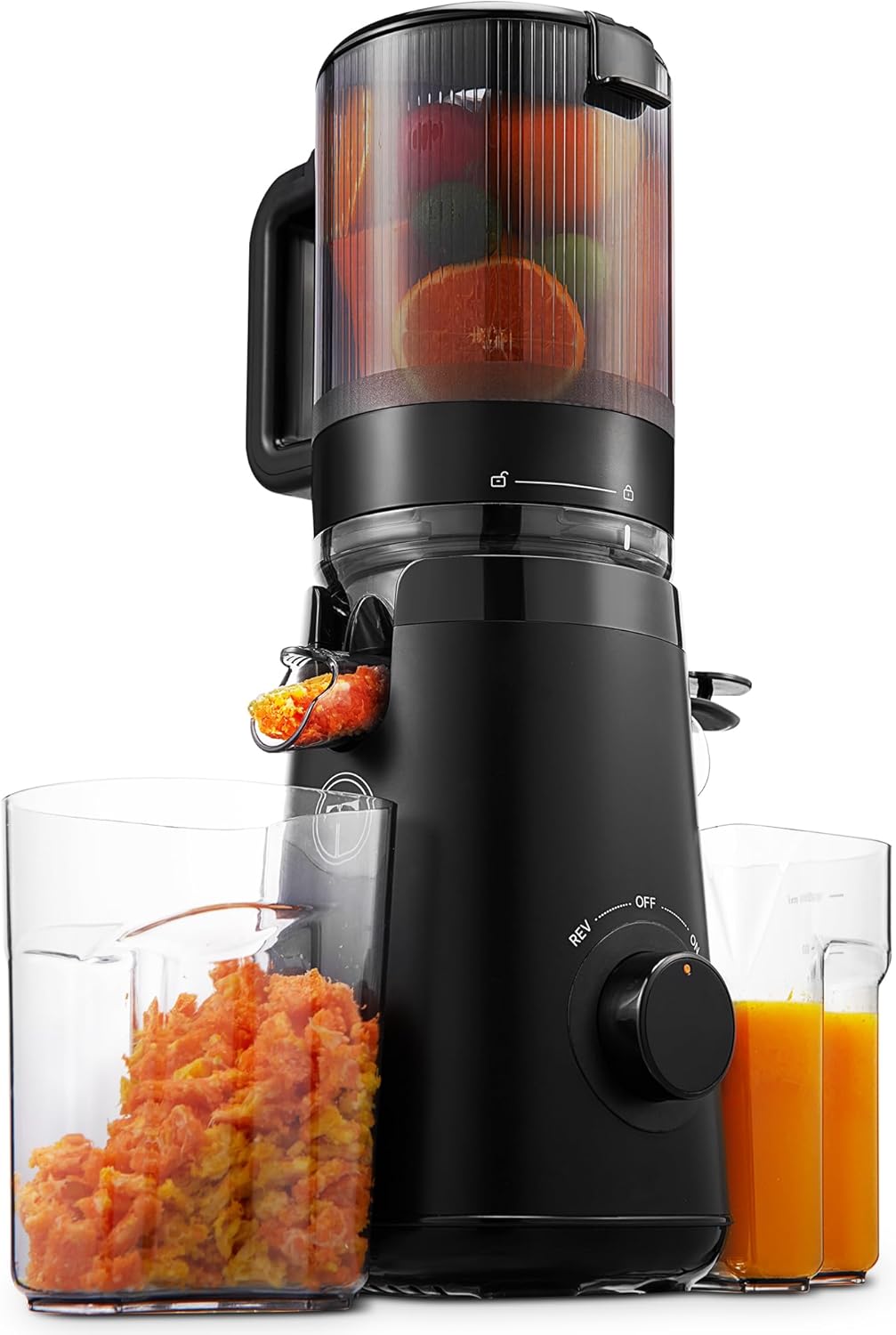
| Wattage | 300 |
|---|---|
| Number of Speeds | 55 |
| Power Source | AC |
| Special Features | No Mesh Filter, Whole Fruit Processing |
| Included Components | Cleaning Brush, Fruit Residue Cup, Juice Cup |
The TUUMIIST TM-580SJ is a slow-speed masticating juicer built to extract juice from whole fruits, vegetables, and leafy greens without a mesh filter. It uses a 300 W motor and a 55 RPM auger to press produce gently, which preserves nutrients and yields more juice with less foam compared with high-speed centrifugal models. The extra-large 5.8 inch feed chute reduces prep by fitting many whole items, and the one-piece-style assembly plus included cleaning brush aims to make cleanup straightforward. Practical features include BPA-free construction and simple knob control for reliable everyday use. Limitations include a modest motor size that may struggle with very fibrous batches over long runs and a primarily plastic ABS construction that is less robust than metal alternatives. Expect slower processing times than centrifugal juicers and occasional need to nudge leafy piles through the auger for continuous flow.
Best for: Buyers who prioritize maximizing juice yield from vegetables and leafy greens and want a low-speed, low-foam extractor that minimizes prep time and cleaning overhead.
Less Ideal for: Users who need heavy commercial throughput, very fast single-serving juicing, or prefer metal-bodied, long‑duty machines for daily high-volume use.
- Large 5.8" feed chute accepts whole fruits and vegetables to reduce prep time.
- Slow 55 RPM masticating action preserves nutrients and increases juice yield.
- No mesh filter design reduces clogging and simplifies cleaning.
- Includes cleaning brush and simple assembly for easier maintenance.
- ABS plastic construction is less durable than metal-bodied juicers.
- 300 W motor may be slower or strain with very fibrous or heavy continuous use.
Verdict: A practical slow‑speed juicer that extracts high yields from vegetables and greens while cutting prep and cleanup time for everyday home use.
Floisdace Cold Press Juicer PT-033A
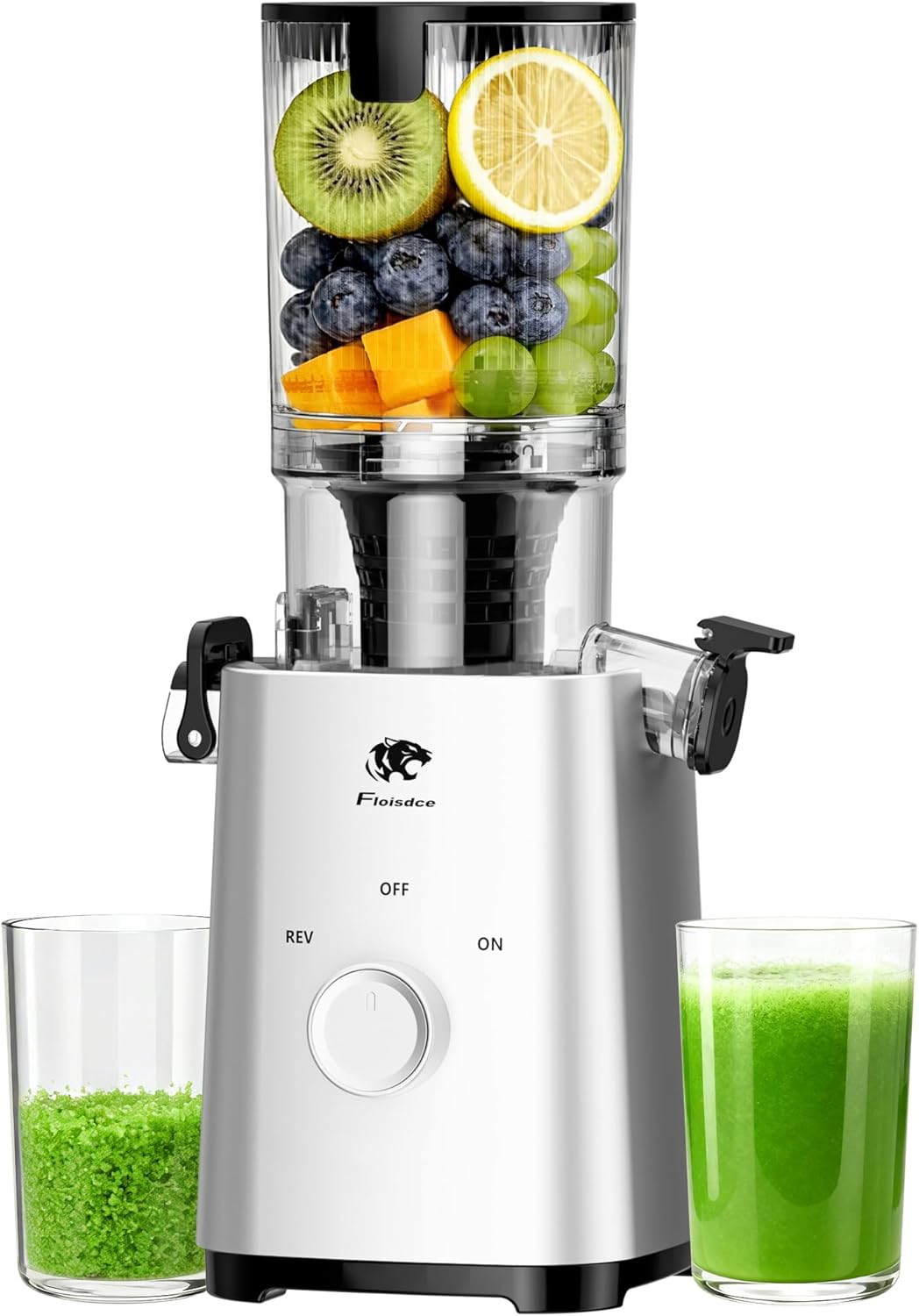
| Special Features | Quiet Operation, Easy to Clean, Large Feed Chute, Safety Design, Dishwasher Safe |
|---|---|
| Wattage | 200 |
| Power Source | Electric |
| Capacity | 2 liters |
This Floisdace cold press juicer is a single-auger masticating machine built to handle whole produce with minimal prep thanks to its 5.3-inch reversible wide chute and 2 liter hopper. It uses a brushless AC motor tuned for low noise and long life, and the slow dual-force spiral with a patented filter aims to maximize juice yield for leafy greens and hard vegetables. Typical use is simple: load larger pieces or whole fruit, press one-touch self-feeding, then separate juice and pulp; the included extra strainer and cleaning brush speed routine maintenance. Notable benefits include very quiet operation for morning use, high extraction efficiency that reduces waste, and a safety stop if the lid opens. Limitations are that its plastic construction may feel less durable than higher-end metal-bodied models, and claims about 99% yield come from internal data so real-world results will vary by produce and prep. It is a practical budget-focused choice for anyone prioritizing quiet, high-yield vegetable and green juicing over premium materials or commercial-grade build.
Best for: Buyers seeking an affordable masticating juicer that minimizes prep and runs quietly for regular vegetable and leafy green juicing in a home kitchen.
Less Ideal for: Those who want a heavy-duty, commercial-grade machine or prefer metal-bodied premium appliances should consider higher-end models.
- Extra-wide 5.3-inch chute accepts whole fruits and reduces chopping time
- Brushless AC motor provides quiet operation and longer expected lifespan
- Slow masticating extraction and patented filter improve juice yield from leafy greens
- Large 2 liter hopper holds more produce for fewer refill cycles
- Includes an extra replacement strainer and cleaning brush for easier maintenance
- Plastic construction may feel less robust than metal-bodied machines
- Real-world juice yield may be lower than the manufacturer’s 99% claim
Verdict: If you want a budget-friendly masticating juicer that handles whole produce, runs quietly, and maximizes vegetable and leafy-green yield, this model is a sensible choice.
Breville Juice Fountain Cold XL

| Power | 1200 watts |
|---|---|
| Feed chute | 3.5 inch extra-wide |
| Capacity | 70 fluid ounces |
| Speeds | 2 speeds |
The Breville Juice Fountain Cold XL is a high-throughput centrifugal juicer built for frequent use and larger batches. It accepts whole fruits and many vegetables through a 3.5-inch extra-wide chute so prep time is minimal, and the powerful motor plus Cold Spin technology aims to reduce heat buildup to protect vitamins while spinning out juice quickly. The XL 70 fl oz seal-and-store jug and detachable juice nozzle make it easy to collect and refrigerate juice for up to three days, and a quiet setting cuts mechanical noise for less disruption during use. Practical touches include a roomy pulp bin hidden behind the base for a compact footprint and a cleaning brush included for maintenance. Limitations are typical of fast centrifugal machines: it will produce more foam and may not match slow masticating juicers for maximum yield from leafy greens and wheatgrass, and some parts require hand washing.
Best for: Buyers who prioritize a reliable, fast juicer for regular vegetable and mixed-fruit batches and want minimal prep time and durable, consistent performance.
Less Ideal for: People whose primary goal is maximum yield from leafy greens, wheatgrass, or who prefer the lowest-foam, slow-extraction method should consider a masticating juicer instead.
- Extra-wide 3.5-inch feed chute reduces prep by allowing many fruits and vegetables to be juiced whole
- Cold Spin Technology reduces heat transfer during extraction to help preserve nutrients
- Large 70 fl oz seal-and-store jug lets you batch juice and refrigerate for up to three days
- Noise reduction quiet setting lowers mechanical noise for more pleasant operation
- As a centrifugal juicer it typically yields less juice from leafy greens compared with slow masticating models
- Several removable parts are hand-wash only which adds cleaning time
Verdict: Choose this model if you want a dependable, high-speed juicer that minimizes prep and handles large vegetable and fruit batches with consistent, fridge-ready results.
EanOruus 3-in-1 Masticating Juicer E-18

| Capacity | 100 fluid ounces |
|---|---|
| Maximum Power | 250 watts |
| Power Source | ac |
| Voltage | 110 volts |
The EanOruus E-18 is a masticating single-auger juicer designed for heavy household use and batch juicing. It accepts large produce through a 6.5-inch wide chute into a 100 oz hopper so you can feed whole apples, carrots, and leafy greens with minimal prep, and the included juice and sorbet strainers let you switch between clear juice, nut milk, and frozen fruit sorbet. The 250 W AC brushless motor runs quietly while applying steady low-speed pressure to extract juice and preserve nutrients, and an auto-reverse plus overheat protection help when leafy or fibrous material clogs the auger. Most removable parts are hand-washable which simplifies cleanup, though the unit is fairly heavy and takes some counter space. Practical benefits include large-capacity batching for families and a motor built for continuous use, while limitations are the need to hand-wash parts and the juicer's substantial footprint and weight for smaller kitchens.
Best for: Buyers who want reliable, high-yield cold-press extraction for vegetables and leafy greens and who value social proof and risk-mitigation from a well-reviewed, feature-rich machine.
Less Ideal for: People with very limited counter space or those who need a compact, ultra-light juicer for occasional single servings.
- Extra-wide 6.5-inch chute reduces prep by allowing whole fruit and larger pieces
- Large 100 oz hopper supports batch juicing for families or meal prep
- Low-speed 250 W AC brushless motor preserves nutrients and runs quietly
- Auto-reverse and overheat protection reduce jams and protect the motor
- Interchangeable strainers enable juice, nut milk, and sorbet preparation
- Removable parts require hand washing rather than dishwasher-safe cleaning
- Relatively heavy and sizable, which may be awkward for small countertops
Verdict: Choose this EanOruus if you want a quiet, high-capacity masticating juicer that handles whole produce and leafy greens for regular batch juicing.
Juilist Centrifugal Juicer AMR526

| Maximum Power | 800 watts |
|---|---|
| Wattage | 400 watts |
| Number of Speeds | 3 |
| Capacity | 400 ml |
| Material | Stainless Steel |
The Juilist centrifugal juicer is a countertop extractor designed for fast, everyday juicing of common fruits and vegetables. It uses a high-speed motor (400W nominal, 800W max) and a 3-inch wide feed chute so you can juice larger pieces with less prep; three speed settings let you dial back for soft produce or push harder for firmer items. The stainless steel cutting disc and micro-mesh filter aim for decent yields, and included cleaning brush plus dishwasher-safe components make cleanup straightforward. Safety features such as a visible juicing window, safety lock arm, overheat protection, and non-slip base make it reassuring to use. As a centrifugal model it processes leafy greens and very high-fiber vegetables less efficiently than slower masticating machines, and it can be louder and produce more foam and oxidation than low-speed alternatives. For home users who want quick, low-effort juice from common veggies and fruits, this is a convenient option; if you prioritize maximum yield from kale, wheatgrass, or very fibrous produce, a slow masticating juicer will perform better.
Best for: Buyers who want a straightforward, low-effort countertop juicer for everyday vegetables and mixed fruit blends and who prioritize ease of use and cleaning over absolute maximum yield.
Less Ideal for: Users focused on extracting the highest possible juice from leafy greens, wheatgrass, or very fibrous produce should consider a slow masticating juicer instead.
- 3" wide feed chute reduces prep by fitting larger pieces
- Three speed settings for soft, hard, and pulse juicing
- Dishwasher-safe parts and included brush simplify cleaning
- Visible window and safety lock with overheat protection enhance safe operation
- Centrifugal design is less efficient on leafy greens and high-fiber vegetables
- Higher speed extraction can produce more foam and oxidation than slow juicers
Verdict: A user-friendly centrifugal juicer that delivers quick, easy vegetable and fruit juices with minimal prep and cleanup, ideal if you value speed and convenience over maximum leafy-green yield.
Choosing the Right Juicer for Vegetables and Leafy Greens: Key Factors to Consider
Extraction Efficiency for Leafy Greens
How well a juicer extracts juice from delicate leafy greens determines how much nutrition you actually get per serving. Machines with slow-turning augers and precision screens compress leaves and stems to release chlorophyll and soluble vitamins rather than shredding them into pulp. Higher extraction efficiency reduces waste and means fewer raw ingredients are needed to reach the same nutrient target.
When assessing extraction, consider how the machine handles both soft leaves like spinach and tougher stalks like celery or kale. Look for features that minimize foam and oxidation, since less foam preserves flavor and slows nutrient degradation during short storage periods.
Clog Resistance and Feeding Throughput
Vegetable and green juicing often mixes soft and fibrous items that can quickly form dense pulp and clog screens. A juicer with a well-designed feed path, anti-clog screens, or a larger-diameter auger reduces the need to stop and clear jams. Faster throughput matters if you plan to make multiple servings or prepare juice for a household each morning.
Consider whether the unit allows longer continuous runs and whether its design eases pulp ejection. Some machines process in small batches better, while others tolerate steady feeding without overheating. Higher throughput can save time but must be balanced against motor stress and cleaning demands.
Ease of Cleaning and Maintenance
Daily juicing becomes unsustainable if cleaning is long and complicated. Machines with fewer parts, widely spaced screens, and dishwasher-safe components shorten cleanup time. Also evaluate how easy it is to dislodge compacted pulp from screens and augers without special tools.
Routine maintenance includes checking seals, trimming worn brushes or gaskets, and occasionally cleaning small crevices. Choose a unit whose regular upkeep matches how often you will juice; easier maintenance encourages consistent use and reduces the chance of bacterial buildup.
Motor Strength, Heat Management, and Duty Cycle
Processing fibrous vegetables and leafy greens can challenge a motor. Look for machines with adequate torque rather than just high RPM. Good thermal protection and sensible duty-cycle guidance help ensure the motor survives repeated morning sessions. Units designed for continuous or longer intervals are better for batch prepping.
Motor construction and cooling pathways affect how hard you can push the machine before performance drops. Durable motors paired with proper ventilation and built-in overload protection decrease the likelihood of sudden stops or burnout.
Noise Level and Vibration
Noise and vibration matter if you juice early in the morning or in a shared living space. Masticating-style juicers are generally quieter than high-speed centrifugal types, which can be important for households with different schedules. Excess vibration can also shift the appliance or cause increased wear on components.
Consider where you will place the juicer and whether you need a quieter model to avoid waking others. Sound level is often a tradeoff with throughput and speed, so weigh how much silence matters relative to processing time.
Pulp Texture and Secondary Uses
The texture of expelled pulp varies significantly and can influence how you use leftovers. Finer, drier pulp indicates efficient extraction and is easier to repurpose in cooking or baking. Coarser, wetter pulp may still retain usable fiber but usually signals lower yield.
Think about whether you want pulp that is easily composted, used in recipes, or stored. Some juicers produce pulp suitable for pet treats or garden compost, while others yield wetter pulp that needs additional processing. The secondary utility of pulp can affect perceived value and reduce waste.
Why Slow Masticating Juicers Often Beat High-Speed Models for Greens
Slow masticating machines operate at lower RPMs and rely on pressure and shear rather than sheer speed. That method gently crushes leaves and stalks, which reduces heat and oxidation that can degrade sensitive nutrients. Lower-speed extraction also produces less foam, which improves mouthfeel and juice clarity.
High-speed centrifugal units can be faster for large fruit loads but often struggle to unclog with leafy or stringy vegetables. If your routine centers on greens, a slow-extraction design typically yields more juice per bunch and a cleaner end product.
- Lower RPM reduces heat-related nutrient loss
- Less foam and clearer juice appearance
- Better handling of fibrous stems and wheatgrass
Prep Tips to Improve Yield and Reduce Clogging
Proper prep minimizes jams and boosts extraction. Trim thick stems into smaller lengths and alternate hard vegetables with softer leaves when feeding the machine. Removing large seeds and hard cores from produce prevents unnecessary blade strain and extends component life.
Using a gentle tamping motion rather than forcing large chunks helps maintain steady throughput. For very leafy loads, folding or loosely rolling the greens before feeding them can help the auger or chute pull material evenly without creating dense bundles.
- Cut thick stalks into 1- to 2-inch pieces
- Alternate soft leaves with denser vegetables
- Avoid overpacking the feed chute
Managing Oxidation and Short-Term Storage
Freshly made green juice oxidizes faster than fruit juice due to higher chlorophyll and enzyme content. To slow oxidation, fill storage containers to minimize air contact and refrigerate immediately. Use opaque, airtight bottles when possible as light can accelerate breakdown of some nutrients.
Drink within 24 to 48 hours for best flavor and nutrient retention. If you need longer storage, freezing in small portions preserves most nutrients but changes texture and mouthfeel once thawed.
- Store in airtight, full containers
- Refrigerate promptly and consume within 48 hours
- Freeze portioned juice for longer-term storage
Pulp Uses and Reducing Waste
Leftover pulp still contains fiber and some nutrients, so consider repurposing it rather than discarding. Drying pulp in a low oven or dehydrator creates a fiber-rich base for crackers, soups, and baking. Fresh pulp works well mixed into veggie burgers, fritters, or compost for the garden.
Keep the pulp texture in mind when planning recipes. Machines that produce drier pulp are easier to reuse without additional straining or drying steps.
- Mix pulp into baked goods or savory patties
- Dry and powder pulp for use as a fiber boost
- Compost fresh pulp to return nutrients to the soil
Noise, Kitchen Footprint, and Where to Install Your Juicer
Consider noise and counter space before committing to a machine. Masticating juicers often require more countertop depth but operate quietly. Centrifugal models can be bulkier vertically and louder. Think about where you store the unit and whether it will stay out for daily use or be stored between sessions.
Vibration can move a lightweight machine during use, so place the juicer on a stable surface, ideally with rubber feet or a mat. If you prepare juice in the morning, choose a quieter machine to avoid disturbing others in the household.
- Measure available counter or cabinet space
- Prefer rubber feet or a stable base to reduce movement
- Choose quieter units for early-morning routines
How We Chose the Best Juicer for Vegetables and Leafy Greens
We prioritized machines that deliver high yields from leafy greens and fibrous vegetables while remaining practical for daily use. Primary evaluation criteria emphasized extraction efficiency for soft leaves and hard stalks, cleaning and maintenance time, motor longevity and thermal protection, and feeding-chute design and throughput. We inspected durability features such as heavy-duty augers, reinforced screens, and warranty coverage language to ensure the picks would handle repeated green-juice use. Noise level and vibration were considered because many green-juice users operate machines early or in shared spaces. Finally, we checked safety features and the clarity of removable parts for routine cleaning. We excluded models that are optimized only for citrus or pulpy fruits with poor leafy-green performance, as well as compact blenders that do not separate fiber. We also left out units without clear user-serviceable parts or those with inconsistent claims about yield. The resulting shortlist focuses on machines that balance high extraction for greens with manageable cleaning and long-term reliability. The scoring criteria reflect these priorities and guided our editorial selection.
Our full evaluation process is outlined in our review methodology.
FAQ
Can any juicer handle leafy greens?
Not all juicers handle leafy greens equally. Slow masticating-style juicers generally extract more juice from soft leaves and fibrous stalks, while many high-speed centrifugal machines struggle with stringy produce and may require more prep and clearing.
How often should I clean my juicer when juicing greens daily?
If you juice daily, clean removable parts after each session to avoid buildup and odors. Wipe nonremovable surfaces and perform a deeper clean weekly to prevent residue that can harbor bacteria or clog screens.
Will juicing greens remove all the fiber?
Juicing separates most insoluble fiber into the pulp, so the liquid contains less fiber than whole produce. Some soluble fiber and nutrients remain in the juice, but if you want full fiber intake, combine juicing with whole-food servings or use smoothies instead.
Is it better to juice stems or just leaves?
Including stems like celery and kale stalks often increases yield and adds nutrients, but very thick or woody stems may need trimming. Alternating stems with leaves and cutting them into smaller pieces helps machines process them without clogging.
How can I tell if my juicer is clogged versus just slow?
A true clog will typically cause the machine to stall, throw back pulp, or stop feeding despite steady input. Slower processing often feels consistent but takes longer per batch. If the motor labors, emits a burning smell, or the unit repeatedly stops, power it down and clear any compacted pulp.
Final Verdict
Choosing the right juicer for vegetables and leafy greens comes down to balancing extraction yield, cleaning effort, and how often you will use the machine. Prioritize extraction efficiency and clog resistance if you juice mostly greens, and favor easier-to-clean designs if you plan daily use. Accept tradeoffs between throughput and quiet operation depending on whether speed or low noise is more important. Ultimately, a reliable green juicer will fit your kitchen routine, offer consistent yield from leafy items, and be straightforward to maintain. Use the criteria in this guide to select a machine that matches how you prepare, store, and consume green juice so you can juice confidently and sustainably.