
Note: This article contains affiliate links. If you click on these links and make a purchase, we may earn a small commission at no extra cost to you. This helps support our research and content. Read our full affiliate disclosure here.
If you regularly juice fruits and vegetables, a juicer that leaves less waste makes a big difference to yield, cleanup time, and how often you need to discard pulp. You want a machine that extracts more liquid from the same produce, handles leafy greens and hard roots reliably, and keeps cleanup simple so you actually use it. This guide covers the top shortlisted juicers with less waste, chosen for extraction efficiency, pulp dryness, and day-to-day usability. Below you will find concise explanations of what matters, followed by our top picks and practical buying guidance to help you pick the right low-waste juicer.
Top Picks at a Glance
| Best Overall The best all-around choice for most situations | Ninja NeverClog Cold Press Juicer JC151 |  |
| Best Quality Built to a higher standard if you want something more solid | NAMA J2 Cold Press Juicer |  |
| Best Value The sweet spot between price and what you get | SUSTEAS Cold Press Juicer MP802K |  |
| Best Budget The cheapest option that still gets the job done reliably | EXREIZST Cold Press Juicer MP-802E |  |
| Top Rated A top-rated pick with lots of positive feedback | anybear Cold Press Juicer SJ054C |  |
| Most Popular A crowd favorite that many people choose with confidence | EanOruus 3-in-1 Cold Press Juicer |  |
| Best Seller A high-volume bestseller chosen again and again | YPONE Masticating Juicer SJ-057 |  |
Ninja NeverClog Cold Press Juicer JC151

| Maximum Power | 150 watts |
|---|---|
| Number of Speeds | 2 |
| Capacity | 24 fluid ounces |
| Power Source | Corded Electric |
The Ninja NeverClog JC151 is a masticating cold press juicer built to handle fibrous fruits and vegetables without frequent clogging. It uses a 150-watt high-torque motor and a slow-turning auger to extract juice from ingredients like celery, kale, carrots, and apples while minimizing foam and preserving nutrients. Two interchangeable pulp filters let you choose less pulp for smoother juice or lots of pulp for thicker, fiber-forward blends, and a reverse function helps clear jams. The kit includes a 24 oz juice jug and a 36 oz pulp container so you can make larger batches without stopping, and an anti-drip lever reduces mess when pouring. Parts that contact juice are dishwasher-safe, and the unit is compact enough for typical countertop use. Limitations include a modest motor compared with commercial machines, so very large-volume users may prefer a heavier-duty model, and the low-speed design means longer run times than centrifugal juicers. For everyday home juicing focused on yield and minimal waste, the JC151 balances performance and cleanup convenience well.
Best for: Buyers who want a reliable home cold-press juicer that maximizes juice yield from fibrous produce while keeping cleanup and countertop mess to a minimum.
Less Ideal for: People who need very high-volume or rapid juicing for commercial use or who prioritize speed over nutrient-preserving slow extraction.
- High-torque 150W auger extracts juice from fibrous produce with less clogging
- Two interchangeable pulp filters for customizable pulp level and texture
- Large 24 oz juice jug and 36 oz pulp container reduce interruptions for batch juicing
- Reverse function helps clear jams and improve extraction yield
- Dishwasher-safe juice-contact parts simplify cleanup
- Lower-power motor than commercial masticating juicers, so long continuous runs may be slower
- Not the best choice when you need very fast single-serving juices due to slower extraction speed
Verdict: Choose the Ninja JC151 if you want a countertop cold-press juicer that squeezes extra juice from fibrous ingredients while keeping cleanup and waste low.
NAMA J2 Cold Press Juicer

| Maximum Power | 200 watts |
|---|---|
| Power Source | Corded Electric |
| Voltage | 120 |
| Number of Speeds | 1 |
| Capacity | 30 fluid ounces |
The NAMA J2 is a slow, masticating cold-press juicer built for people who want maximum yield with minimal fuss. It uses a 200 W motor turning at about 50 RPM and a self-feeding wide-mouth hopper so you can load a full recipe and walk away while it gently crushes and presses produce to separate juice from pulp. In everyday use the J2 handles leafy greens and hard produce steadily, producing relatively dry pulp and more juice per batch compared with basic centrifugal machines. The included strainers, juice containers, and spinning brush simplify collection and cleanup, and most removable parts rinse clean or scrub with the supplied brush. Noise is low during operation, and the single-speed design keeps things simple, though it limits control for delicate or frozen items. The unit is hand-wash only and moderately bulky on a countertop, so plan storage accordingly. For anyone prioritizing juice yield and low waste over multi-speed bells and whistles, the J2 is a practical, efficient choice.
Best for: Buyers who prioritize getting the most juice from fruits and vegetables with minimal waste and hands-off operation during batch juicing.
Less Ideal for: People who want a compact, travel-friendly juicer or who need adjustable speeds and dishwasher-safe parts for faster cleanup.
- Self-feeding wide-mouth hopper lets you load a full recipe for hands-free juicing
- Masticating action at low RPM extracts higher juice yield with drier pulp
- Quiet 200 W motor suitable for regular use
- Includes strainers, juice and pulp containers, and cleaning brush for easier cleanup
- Single-speed design offers no speed control for different produce types
- Parts require hand washing rather than dishwasher-safe cleaning
Verdict: Choose the NAMA J2 when your priority is high-yield, low-waste cold-pressed juice with hands-free batch processing.
SUSTEAS Cold Press Juicer MP802K

| Wattage | 300 watts |
|---|---|
| Voltage | 110 volts |
| Capacity | 1.5 liters |
| Special Features | Auto-Reversing, Easy to Clean, Whole Fruit Processing |
The SUSTEAS MP802K is a slow masticating juicer built to process whole fruits and vegetables with minimal prep thanks to its 5.3-inch feed chute and single-auger design. It runs on a 300-watt motor and uses a slow press action to separate juice from pulp, producing a higher juice yield and preserving more nutrients than fast centrifugal units. The unit includes an auto-reverse function to clear jams, a safety lid lock that prevents operation unless assembled correctly, and streamlined parts that rinse cleanly; a small brush is included for the strainer. Practical touches like a 550ml juice cup and a 470ml pulp cup let you collect larger batches between emptying. Limitations include the manual hand-wash care instructions and a warning not to juice highly acidic fruits such as lemons to avoid rotor corrosion, which reduces versatility. For buyers focused on extracting more juice with less waste and less chopping, this model offers an efficient, straightforward solution with easy maintenance in everyday use.
Best for: Buyers who want to minimize prep and waste while maximizing juice yield for daily fresh juices and who prefer a straightforward, easy-to-clean slow juicer.
Less Ideal for: People who need to juice highly acidic fruits frequently or who prefer fully dishwasher-safe components for cleanup.
- Large 5.3-inch feed chute accepts whole fruits to reduce prep time
- Slow masticating auger yields higher juice extraction and drier pulp
- Auto-reverse function helps clear clogs without disassembly
- Safety lid lock prevents accidental starts and improves safe use
- Streamlined juicing bowl and included brush make rinsing easier
- Not suitable for highly acidic fruits which may corrode the rotor
- Requires hand washing rather than dishwasher-safe parts
Verdict: Choose this juicer if you want a practical slow-press machine that minimizes prep and squeezes more juice with less waste.
EXREIZST Cold Press Juicer MP-802E

| Wattage | 250 watts |
|---|---|
| Controller Type | One-button Operation |
| Included Components | 2 Upgraded Metal-free Filters, Brush |
| Material | Metal-free Filters |
This EXREIZST cold press juicer is a budget-friendly masticating machine that squeezes juice slowly to maximize yield and reduce foam and oxidation. Its 4.2" feed chute accepts larger pieces and can take whole fruit in many cases, cutting prep time for quick morning juices. The unit ships with two metal-free filters — a coarser gray screen for soft, high-moisture produce and a finer black mesh for harder items — so you can tune pulp levels and extract more liquid. One-button operation, a reverse function for de-clogging, and an automatic safety stop make it simple to use, while included brushes and a largely rinseable design keep cleaning straightforward. Limitations include a modest 250W motor that recommends avoiding extremely tough items like sugarcane or ice, and the plastic construction may feel less durable than pricier metal-bodied models. For buyers focused on minimizing pulp waste and getting decent juice yield on a tight budget, this offers strong value, but expect some compromises in long-term robustness and heavy-duty performance.
Best for: Buyers on a tight budget who want a compact cold-press machine that minimizes prep time and pulp waste while delivering higher juice yield for everyday fruit and vegetable juices.
Less Ideal for: Users who need a heavy-duty commercial or long-lasting metal-built juicer for frequent extraction of very hard produce should look at more robust, higher-powered options.
- Wide 4.2" feed chute reduces chopping and speeds prep
- Two upgraded metal-free filters let you control pulp level and improve juice yield
- One-button operation with reverse function and safety auto-stop for easy, safer use
- Includes brushes and mostly removable parts for quick rinsing and cleaning
- 250W motor is not suited for very hard items like sugarcane or ice
- Predominantly plastic construction may be less durable than metal-bodied juicers
Verdict: A wallet-friendly cold-press juicer that maximizes juice yield and reduces pulp waste for everyday home use.
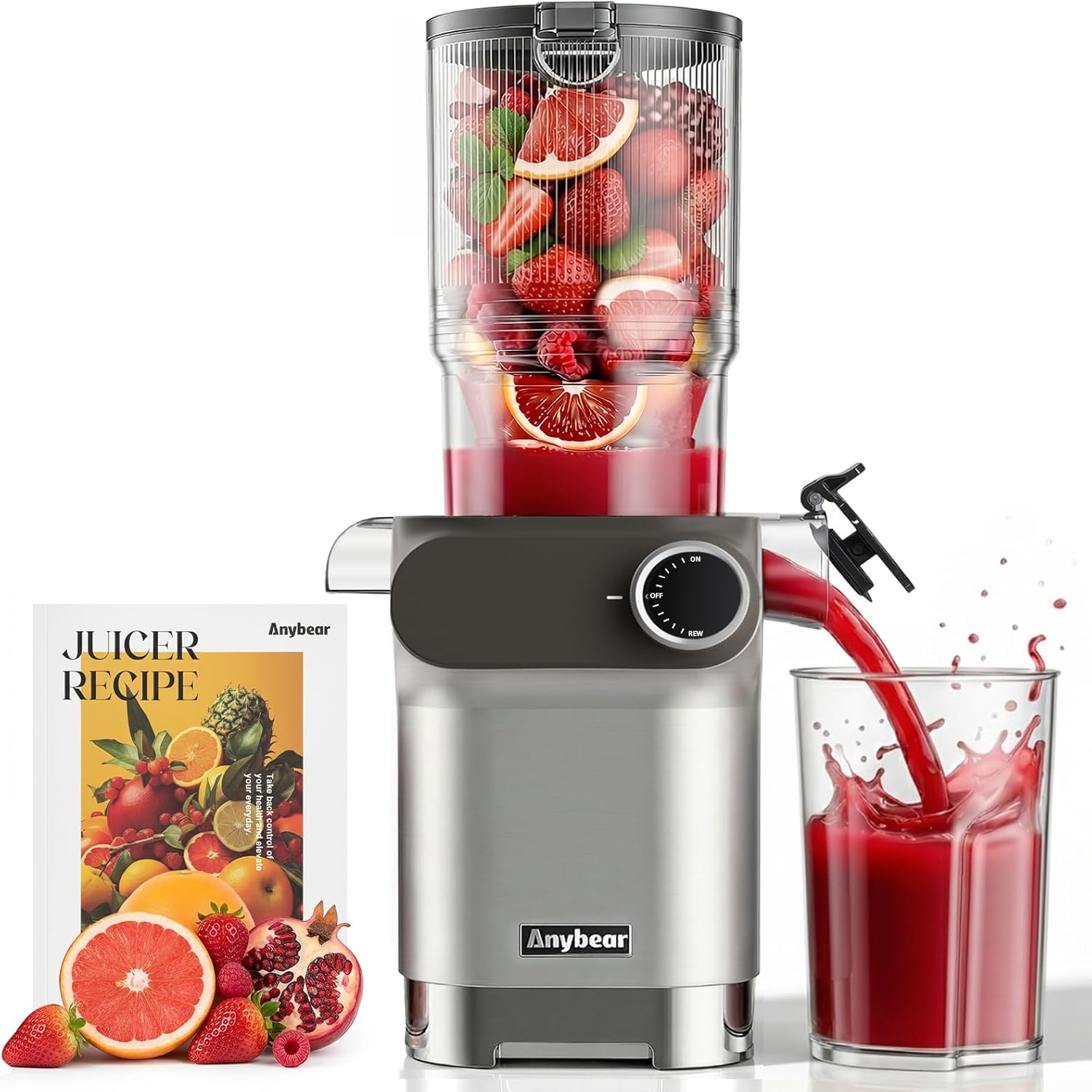
anybear Cold Press Juicer SJ054C
| Maximum Power | 200 watts |
|---|---|
| Wattage | 200 watts |
| Voltage | 110 volts |
| Special Features | Easy to Clean |
The anybear Cold Press Juicer is a single-auger masticating machine built to extract juice slowly to reduce oxidation and preserve flavor. It runs at about 65 RPM with a 200W, high-torque motor that the manufacturer says improves yield, and the 4.3-inch feed chute accepts larger fruits and vegetables so you spend less time pre-cutting. The unit uses Tritan and stainless steel components in contact with juice and disassembles into a few main parts that rinse clean; the included brush and simple filter design make cleanup straightforward for daily use. Practical benefits include higher juice yield from leafy greens and softer produce, quieter operation compared with centrifugal models, and the wide chute speeds up prep. Expect a hand-wash routine rather than dishwasher-safe parts and a relatively compact footprint that still requires countertop space. If you plan heavy commercial use or need fully dishwasher-safe pieces, this model may not meet those demands, but for home users seeking efficient, low-oxidation juicing with minimal prep and easy cleaning, it is a solid option.
Best for: Home cooks who prioritize consistent, low-oxidation juice and want a reliable machine that maximizes yield with minimal chopping and straightforward cleaning.
Less Ideal for: Buyers who need a commercial-duty juicer or fully dishwasher-safe components should consider other models designed for heavy continuous use or easier machine cleaning.
- High-torque 200W motor for steady low-speed extraction and improved yield
- 4.3-inch feed chute fits larger produce to reduce chopping time
- Tritan and stainless-steel contact parts retain juice flavor and are BPA-free
- Simple one-piece filter design and included brush make rinsing and cleaning easy
- Parts are hand-wash only, not dishwasher-safe
- Not intended for continuous commercial use
Verdict: Choose this masticating juicer if you want a reliable, low-speed machine that squeezes more juice with less prep and easy daily cleaning.
EanOruus 3-in-1 Cold Press Juicer

| Capacity | 100 fluid ounces |
|---|---|
| Maximum Power | 250 watts |
| Power Source | ac |
| Voltage | 110 volts |
The EanOruus 3-in-1 Cold Press Juicer is a single-auger masticating machine built for batch juicing and alternative preparations like nut milk and sorbet. It accepts whole fruits and vegetables through a 6.5-inch feed chute into a 100 oz hopper so you can load multiple ingredients at once and run longer cycles with less topping up. The 250 watt AC motor and auto-reverse help extract juice from fibrous produce while the included interchangeable strainers let you switch between juice and sorbet or nut-milk modes. Removable parts and a detachable pulp outlet simplify cleaning compared with enclosed designs, and overheat protection adds reassurance during heavy use. Practical limitations are its hand-wash-only parts and plastic auger components, which may feel less premium than metal alternatives, and the unit is relatively heavy and large for countertop storage. For buyers focused on minimizing food waste, the machine's whole-fruit processing and dedicated pulp outlet make it easy to capture high yields and repurpose pulp for cooking or composting.
Best for: Buyers who value high-yield, low-waste juicing and want a versatile machine that handles whole fruits and produces usable pulp for recipes or composting, supported by lots of owner feedback and practical safety features.
Less Ideal for: If you need a compact, lightweight unit for small kitchens or prefer fully dishwasher-safe or all-metal internals, this heavier, hand-wash model is not the best fit.
- Extra-large 100 oz hopper reduces refill frequency for batch juicing
- 6.5-inch wide chute handles whole fruits to cut prep time
- Interchangeable strainers for juice, sorbet, and nut milk increase versatility
- Auto-reverse and overheat protection improve reliability during heavy use
- Detachable pulp outlet and removable parts make cleanup and pulp removal easier
- Key removable parts require hand washing rather than dishwasher-safe cleaning
- Plastic auger and many plastic components may feel less durable than metal alternatives
Verdict: Choose this juicer if you want a batch-friendly, whole-fruit cold press that maximizes yield and lets you make juice, nut milk, and sorbet with minimal refills.
YPONE Masticating Juicer SJ-057

| Maximum Power | 400 watts |
|---|---|
| Power Source | Corded Electric |
| Voltage | 120 volts |
| Number of Speeds | 1 |
The YPONE SJ-057 is a 2-in-1 cold-press masticating juicer built for regular home use and higher-yield extraction. It runs at 55 rpm to limit heat and oxidation, and the single-auger design with dual 0.3 mm mesh strainers aims to squeeze more liquid from produce, nuts, and soy for nut milks. The 5.8-inch feed chute accepts whole fruits and vegetables, reducing prep time, and a safety lock stops the motor when the lid is opened. The unit ships with basic accessories and a cleaning brush and disassembles into a few main parts for rinsing or dishwasher-safe cleaning of approved pieces. Practical benefits include quieter operation, a high claimed juice yield that cuts pulp waste, and simple one-speed operation that keeps use straightforward. Limitations are the single speed which reduces flexibility for very soft or very hard ingredients, plastic components that may wear faster than metal alternatives, and a relatively heavy footprint that needs counter space. For buyers focused on consistent, low-waste juice extraction, this machine delivers predictable results but is not targeted at commercial use.
Best for: Buyers who want a reliable at-home cold-press juicer that prioritizes nutrient preservation and high juice yield with minimal prep and straightforward operation.
Less Ideal for: People who need variable speed control for delicate or very hard ingredients or who want a commercial-grade metal-bodied extractor.
- 55 rpm masticating action preserves nutrients and reduces oxidation for longer-lasting juice
- 5.8-inch feed chute accepts whole fruits and vegetables to minimize prep time
- Dual 0.3 mm mesh strainers and single-auger design aim for high juice yield and low pulp waste
- Includes cleaning brush and disassembles into a few parts for quicker cleaning
- Only one speed limits control over different ingredient textures
- Plastic components and PVC materials may wear sooner than metal parts
Verdict: Choose this juicer if you want a quiet, easy-to-use cold-press machine that maximizes juice yield and minimizes pulp waste for everyday home use.
Choosing the Right Juicer with Less Waste: Key Factors to Consider
Juice Yield Efficiency
Higher yield means you get more juice from the same amount of produce, which lowers per-glass cost and reduces leftover pulp to dispose of. Yield varies by mechanism: slow-masticating and twin-gear designs often extract more liquid from leafy greens and wheatgrass, while centrifugal units can do well with hard, dense roots but sometimes leave wetter pulp. Consider how you plan to use your juice; if you frequently juice expensive greens or wheatgrass, prioritize a design proven to squeeze out moisture and oils. Higher yield also affects how often you need to buy produce and how much kitchen waste you create.
Look for machines with documented pulp dryness or consumer measurements of output. A juicer that separates juice cleanly and compresses remaining fiber will produce drier pulp, which is the clearest indicator of efficiency.
Pulp Dryness And Management
Drier pulp indicates a thorough extraction process and reduces the volume of waste you must handle. If pulp is still wet, you are leaving usable liquid behind. Some models include a secondary pressing stage or adjustable screens to squeeze fiber more completely. The dryness of pulp also affects how easy it is to compost or discard; nearly dry pulp is lighter and less messy.
Think about how you will manage pulp day to day. Machines with integrated pulp ejection into a container let you run longer without stopping, while designs that require manual scraping increase cleanup time. If you want minimal handling, choose a design that consistently produces dry, compact pulp and routes it to an easily emptied bin.
Ease Of Cleaning And Maintenance
A low-waste juicer only helps if you actually use it often, and that requires a machine that is simple to clean. Components that are dishwasher-safe, have smooth surfaces, and allow quick disassembly reduce friction between uses. Fine mesh screens and tight crevices trap fibers and can require brushes or soaking to remove; consider models with fewer small parts or accessible filter shapes.
Maintenance also includes how often seals or gaskets need replacement and whether the motor tolerates repeated uses without overheating. Prioritize designs with clear cleaning procedures and replacement parts availability to keep performance high and waste low over time.
Versatility Across Produce Types
Different produce requires different extraction approaches. If you juice a mix of leafy greens, soft fruits, and hard roots, you need a machine that handles that range without leaving excessive waste on any category. Twin-gear and low-speed masticating designs generally excel with leafy items and soft fruit pulps, while high-speed centrifugal models can handle apples or carrots quickly.
Versatile machines reduce the need for multiple devices and lower aggregate waste by extracting well across ingredient types. Check whether the juicer comes with adjustable settings, multiple screens, or a gear configuration that supports varied produce.
Throughput And Continuous Use
How quickly you can process batches affects how often you are likely to use the juicer and how much produce sits waiting to be processed. Some low-waste designs require slower feeding and intermittent stops to remove pulp or unclog, which increases prep time. Others support continuous feeding with auto-ejecting pulp containers and wider feed chutes to speed up large runs.
If you often juice for several people or batch-process produce for the week, choose a model that balances extraction thoroughness with a reasonable throughput so you do not sacrifice yield for convenience.
Build Quality And Longevity
A sturdy juicer keeps parts aligned and seals intact, which preserves extraction efficiency over time. Lower-quality plastic components can warp or abrade, increasing gaps that reduce pressure on the pulp and lower yield. Metal gears or reinforced augers resist wear and maintain consistent pressure during extraction.
Consider warranty coverage and the availability of replacement parts when judging longevity. A durable machine that continues to produce dry pulp and high yields over years will reduce long-term waste both in terms of food and equipment replacement.
How Different Juicing Mechanisms Affect Waste
Juicers use distinct mechanical approaches that influence how much juice they extract and how much pulp remains. Slow-masticating and twin-gear systems press produce at low speed to minimize heat and squeeze out liquid, often leaving drier pulp. Centrifugal units rely on high-speed spinning to separate juice, which is faster but can leave wetter pulp with certain ingredients. Some hybrid or multi-stage designs combine shredding with secondary pressing to improve yield while preserving throughput.
- Masticating: Low speed, higher yield for greens and soft fruit.
- Twin-Gear: Very thorough extraction, compact pulp, best for leafy items.
- Centrifugal: Fast processing, better for hard fruit, may leave wetter pulp.
Preparing Produce To Minimize Waste
How you prepare fruits and vegetables affects extraction efficiency. Cutting very large items into uniform pieces helps feed chutes and prevents clogging, while removing thick peels or pits that the machine struggles with can improve flow. Leafy greens can be bundled or mixed with firmer items to help the auger or blades pull them through. For wheatgrass or very fibrous greens, a twin-gear or specialized attachment often produces the best dryness of pulp.
- Trim thick rinds that can clog screens.
- Feed soft fruit slowly to avoid foam and improve separation.
- Alternate greens with denser items to help continuous feeding.
Cleaning Tips That Preserve Performance
Routine cleaning keeps filters and screens efficient and preserves yield. Rinse components immediately after use to prevent fiber from drying into fine mesh screens. Use the included brush or a soft nylon brush to clear trapped fibers from filters before they harden. For stubborn pulp, soak removable parts briefly in warm, soapy water rather than applying force that can warp plastic parts.
- Rinse within minutes to prevent drying.
- Use manufacturer-recommended brushes for screens.
- Disassemble fully at least weekly for a deeper clean.
When To Choose Compact Or High-Throughput Models
Compact low-waste juicers are appropriate for single-person use or kitchens with limited counter space. They often have smaller feed chutes and smaller pulp bins, which can mean more frequent stops but still good extraction for small batches. High-throughput models suit families or those who batch-prep juice for several days; they combine larger chutes and bigger pulp containers with mechanisms designed to maintain extraction quality during longer runs. Balance your typical batch size against available storage and cleanup tolerance when selecting a size.
- Small models: better for occasional juicing and tight spaces.
- High-throughput: better for batch processing and larger households.
- Consider kitchen storage and cleaning time alongside capacity.
Minimizing Oxidation And Preserving Flavor
Oxidation affects taste and nutrient retention after juicing. Low-speed extraction methods reduce heat and air incorporation, producing juice that can taste fresher and hold up longer in the refrigerator. If you plan to store juice for a day or two, favor machines and practices that limit foam and air exposure, such as pouring slowly into airtight containers and filling to minimize headspace. This is particularly relevant if you are optimizing for minimal waste, since better-preserved juice means less spoilage.
- Low-speed juicing reduces heat and oxidation.
- Strain foam if you plan to store juice.
- Store in airtight, full containers to extend freshness.
How We Chose the Best Juicer with Less Waste
We selected products based on measurable extraction performance and practical kitchen use. Primary criteria included juice yield from common produce categories, how dry the expelled pulp was, and the consistency of extraction across soft fruits, hard roots, and leafy greens. We also evaluated how easy each design made cleaning and pulp removal, since a low-waste juicer that is hard to maintain reduces real-world use. Build quality and durable materials were considered to estimate long-term reliability under frequent use. Noise and motor strain were reviewed to ensure a balance between power and gentleness; overly aggressive high-speed designs often sacrifice juice clarity or increase oxidation. Finally, we prioritized designs with features that reduce clogging and allow continuous feeding to limit interruptions during juicing. Items excluded from consideration were machines primarily designed as blenders or citrus-only presses, units lacking specifications for pulp separation or those with unclear extraction claims. The result is a shortlist that favors machines proven to extract more juice per pound of produce while minimizing cleanup friction.
Our full evaluation process is outlined in our review methodology.
FAQ
Does a low-waste juicer always mean a slower machine?
Not always. Many low-speed masticating designs extract more thoroughly at slower speeds, but some multi-stage or hybrid units combine effective pressing with faster feed systems. Throughput varies by design, so you can find machines that balance speed and yield.
How can I tell if the pulp is too wet?
If the pulp feels noticeably damp and leaves liquid when pressed, the machine is leaving usable juice behind. Drier, fibrous pulp that holds its shape usually indicates better extraction. Measuring juice yield per pound of produce is the most objective way to compare.
Is it worth composting wet pulp from juicing?
Yes. Even wetter pulp contains fiber and nutrients valuable to compost. If minimizing landfill waste is a priority, composting reduces disposal impact and returns organic material to your garden, though drier pulp is easier to handle.
Will a low-waste juicer handle wheatgrass and leafy greens well?
Many low-waste designs, particularly twin-gear and some masticating units, handle leafy grasses better than standard centrifugal models. Look for machines specified to process wheatgrass or with slow auger action for best results.
How often do parts need replacement on a juicer optimized for low waste?
Replacement frequency depends on usage and build quality. Wear-prone parts include screens, gaskets, and auger components. Choosing a durable design and following cleaning guidance extends part life, and checking the availability of replacement parts helps long-term ownership.
Final Verdict
When choosing a juicer with less waste, prioritize extraction efficiency, how dry the expelled pulp is, and how easy the unit is to clean. Match the mechanism to the types of produce you juice most often and balance throughput against convenience if you batch process. Expect tradeoffs between speed and yield, and pick a design that fits your typical routine so you actually use it. A well-chosen low-waste juicer will increase juice per pound, reduce kitchen waste, and simplify cleanup, making juicing more practical and sustainable over time.