
Note: This article contains affiliate links. If you click on these links and make a purchase, we may earn a small commission at no extra cost to you. This helps support our research and content. Read our full affiliate disclosure here.
As a butcher you rely on consistently sharp blades for clean cuts, safer handling, and faster portioning. Choosing the right knife sharpener for butchers matters because it affects how long edges last, how quickly you can restore a dull blade, and how much steel you remove each session. This guide shortlists the top options built for heavy use, highlighting models suited to frequent sharpening, coarse edge repair, and finishing a razor edge. Below you will find our top picks and a clear explanation of the performance, durability, and usability factors we judged when selecting these sharpeners.
Top Picks at a Glance
| Best Overall The best all-around choice for most situations | Chef'sChoice Trizor 15XV |  |
| Best Quality Built to a higher standard if you want something more solid | Work Sharp Ken Onion MK2 |  |
| Best Value The sweet spot between price and what you get | Intelitopia Dual Grit Whetstone Set |  |
| Best Budget The cheapest option that still gets the job done reliably | KitchenIQ Edge Grip 2-Stage Sharpener |  |
| Top Rated A top-rated pick with lots of positive feedback | Work Sharp Guided Field Sharpener |  |
| Most Popular A crowd favorite that many people choose with confidence | KITCHELLENCE 3‑Stage Knife Sharpener |  |
| Best Seller A high-volume bestseller chosen again and again | Sharp Pebble 1000/6000 Whetstone |  |
Chef'sChoice Trizor 15XV

| Sharpening Stages | 3 |
|---|---|
| Abrasive Material | 100% Diamond |
| Edge Angle | 15 degrees |
| Compatible Knives | Straight-edge and serrated |
The Chef'sChoice Trizor 15XV is a three-stage electric sharpener built around 100 percent diamond abrasives and guided angle slots to quickly convert or restore a precise 15-degree edge. You run a straight-edge or serrated blade through stages 1 and 2 to shape and hone with medium and fine diamond abrasives, then finish in stage 3 where patented stropping disks polish the edge for a razor-like finish. It is easy to use thanks to spring-loaded guides that center the blade and remove guesswork, and first-time sharpening takes about a minute with touch-up runs taking only seconds. For butchers this model delivers repeatable, aggressive sharpening suitable for daily resharpening of kitchen and boning knives and for converting factory 20-degree edges to a narrower 15-degree bevel for cleaner slicing. The unit is focused on straight edges and serrations rather than specialty heritage steels and it is a countertop appliance that requires a small footprint and electric power, so some users who prefer manual control or custom bevel geometry may want an alternative.
Best for: Butchers and home pros who want a reliable, easy-to-use electric sharpener that produces a consistently acute, razor-like 15-degree edge for frequent resharpening and efficient slicing.
Less Ideal for: Users who need wider or custom bevel angles for very heavy chopping tasks or who prefer full manual control with stones and guided systems should consider other options.
- Uses 100% diamond abrasives for fast, durable material removal
- Three-stage system shapes, hones, and stropps for a polished 15-degree edge
- Spring-loaded precision guides ensure consistent angle and reduce user error
- Effective on both straight-edge and serrated knives
- Designed for a 15-degree edge profile which may be too acute for some heavy-duty butcher tasks
- Electric countertop unit offers less manual control for custom bevels
Verdict: If you need a low-effort, repeatable electric sharpener that converts and maintains a razor-sharp 15-degree edge, the Trizor 15XV is a top practical choice for butchers and pros.
Work Sharp Ken Onion MK2

| Brand Name | WORK SHARP |
|---|---|
| Item Type Name | Knife Sharpener |
| Model Number | WSKTS-KO2-ATL |
| Manufacturer Warranty Description | 3 Year Warranty |
| Grit Type | Fine |
The Work Sharp Ken Onion MK2 is a benchtop sharpening system built for users who want repeatable, very sharp edges with minimal setup. It uses flexible abrasive belts and a guided sharpening platform so you can sharpen straight and curved blades, serrations, and even scissors and small tools. Variable electronic speed control and a selection of abrasive belts let you remove metal quickly or refine to a fine edge, and the guided platform helps keep angle consistency during longer sessions. In practice it is fast and easy to use for butcher work where you need to restore a keen, working edge on a range of kitchen knives; belts are simple to swap and the motor handles frequent use. The unit is work-focused rather than compact, so it takes bench space and generates dust and metal filings that need containment. It also relies on consumable belts, so ongoing cost and the need to choose the right grit are part of using it well. For someone sharpening many knives to a high standard, it delivers professional results; casual users may find it more than they need.
Best for: Butchers and professional home cooks who need fast, consistent sharpening for many knives and value control over edge angle and finish.
Less Ideal for: People who only sharpen a knife occasionally or need a highly portable field solution should choose a simpler manual or pocket sharpener instead.
- Delivers professional-level, repeatable edges using flexible abrasive belts and guided platform
- Variable electronic speed control for controlled material removal and finishing
- Able to sharpen a wide range of blades including straight, curved, serrated edges, scissors, and small tools
- Durable benchtop build suited for frequent sharpening sessions
- Requires bench space and produces metal filings and dust that need cleanup
- Ongoing cost for replacement abrasive belts and choice of grits
Verdict: Choose the Ken Onion MK2 when you need a professional, benchtop sharpener that quickly produces consistent, razor-ready edges for heavy daily use.
Intelitopia Dual Grit Whetstone Set

| Included Components | Sharpening Stones |
|---|---|
| Material Type | Stone |
| Grit Type | Coarse |
This Intelitopia set bundles two dual-sided corundum whetstones (400/1000 and 3000/8000 grit) with a flattening stone, leather strop, angle guide, bamboo base and non-slip pads to create a full sharpening workflow. In use you start on the coarse 400 grit to restore damaged or very dull edges, move to the 1000 grit to refine the bevel, then finish on the 3000/8000 faces for a polished, razor edge; the flattening stone keeps the whetstones true and the strop removes burrs and polishes. The included bamboo base and rubber feet help stabilize the stones on a counter, and the angle guide can accelerate learning consistent sharpening angles for repeatable results. For butchers who need to re-establish and maintain working edges on kitchen and cleaver-style knives, the kit supplies the essential tools for both aggressive repair and fine honing. It does require time and some practice to get consistent results compared with pre-set guided sharpeners, and wetstone maintenance such as soaking and flattening adds routine steps, but the control and edge quality are superior once you learn the technique.
Best for: Butchers and meat prep pros who want hands-on control over edge repair and finishing and are willing to learn wetstone technique to get factory-quality, long-lasting edges.
Less Ideal for: Users who need a fast, foolproof solution for occasional touch-ups or who prefer motorized or preset guided systems that require minimal skill.
- Covers full sharpening progression with coarse to extra-fine grits (400/1000 and 3000/8000)
- Includes flattening stone and leather strop for maintenance and burr removal
- Stabilizing bamboo base and non-slip pads improve safety during use
- Angle guide helps achieve consistent bevel angles while learning technique
- Requires soaking, flattening, and practice to produce consistent professional results
Verdict: This kit gives butchers a complete, hands-on wetstone workflow for rebuilding and polishing knife edges to a professional standard when you invest the time to master the technique.
KitchenIQ Edge Grip 2-Stage Sharpener

| Material Type | Plastic |
|---|---|
| Grit Type | Fine |
| Included Components | Complete |
| Model Number | 50009 |
The KitchenIQ Edge Grip 2-Stage Sharpener is a simple, budget-friendly pull-through tool that brings dull blades back to usable condition with just a few pulls. It uses a carbide coarse slot to reset edges on very dull or nicked blades and crossed ceramic rods in the fine stage to polish and refine the edge for everyday cutting tasks. The patented V-shaped edge grip and non-slip rubber feet let you use it on a countertop edge or flat surface to stabilize longer blades, and the soft-grip handle makes it easy to hold while pulling the blade through one direction. Its compact plastic body stores easily in a drawer and works quickly for routine touch-ups in a butcher or home kitchen. Limitations include fixed sharpening angles that are not suitable for precision angle setting and a plastic housing and manual pull-through design that cannot replace a skilled grinder for heavily damaged or specialty blades.
Best for: Butchers or home meat processors looking for an inexpensive, easy-to-use tool to keep everyday knives reasonably sharp between professional grinds.
Less Ideal for: Professional sharpers or users who need precise angle control, advanced re-profiling, or a tool that can handle heavily damaged or very wide butcher knives.
- Two-stage design with carbide coarse slot for edge setting and ceramic fine rods for polishing
- V-shaped edge grip and non-slip feet provide stability on countertop edges
- Compact, lightweight design stores easily in a drawer
- Easy to use with preset angles for quick sharpening without expertise
- Fixed preset angles limit precision and professional re-profiling
- Not appropriate for restoring severely damaged or very thick butcher blades
Verdict: A low-cost, compact two-stage pull-through sharpener that quickly restores everyday butcher knives to working sharpness between professional grinds.
Work Sharp Guided Field Sharpener

| Material Type | Diamond and Ceramic Sharpener |
|---|---|
| Grit Type | Coarse, Fine |
| Included Components | WSGFS221 |
The Work Sharp Guided Field Sharpener is a portable guided sharpening system built to deliver consistent edges for knives used in the field or the shop. It uses removable diamond plates for rapid material removal and a rotating ceramic rod with coarse, fine, and grooved surfaces for honing and fish-hook work, while a leather strop polishes the final edge. The guided design holds 20 and 25 degree angles so less experienced users can reproduce a reliable bevel quickly, and all components store inside the unit for transport without tools or setup. For butchers who need dependable, repeatable sharpening away from a bench, its combination of abrasive types covers everything from reshaping to finishing. The unit is compact and rugged, but it is not an electric system so achieving very fast heavy stock removal requires more time and effort than a powered sharpener, and very large butcher knives may need additional passes because of the smaller abrasive plates.
Best for: Buyers who prize a reliable, repeatable manual sharpening method for on-site or shop use and want a durable, all-in-one kit they can trust over time.
Less Ideal for: Those who need ultra-fast stock removal or who prefer a motorized bench sharpener for frequent heavy-duty butcher work should consider a powered system instead.
- Includes diamond plates, ceramic rods, and leather strop for full sharpening progression
- Guided angle system (20° and 25°) produces consistent bevels with minimal skill
- Compact, self-contained design is easy to carry and use in the field
- Ceramic rod has a grooved surface for fish hooks and serration maintenance
- Smaller abrasive plates and manual operation make heavy stock removal slower than powered sharpeners
- May require more passes to sharpen very large butcher blades evenly
Verdict: A dependable, portable guided sharpener that gives butchers a repeatable, full sharpening progression without needing power.
KITCHELLENCE 3‑Stage Knife Sharpener
| Brand | KITCHELLENCE |
|---|---|
| Material Type | Plastic |
| Model Number | KS37 P |
| Included Components | Yes |
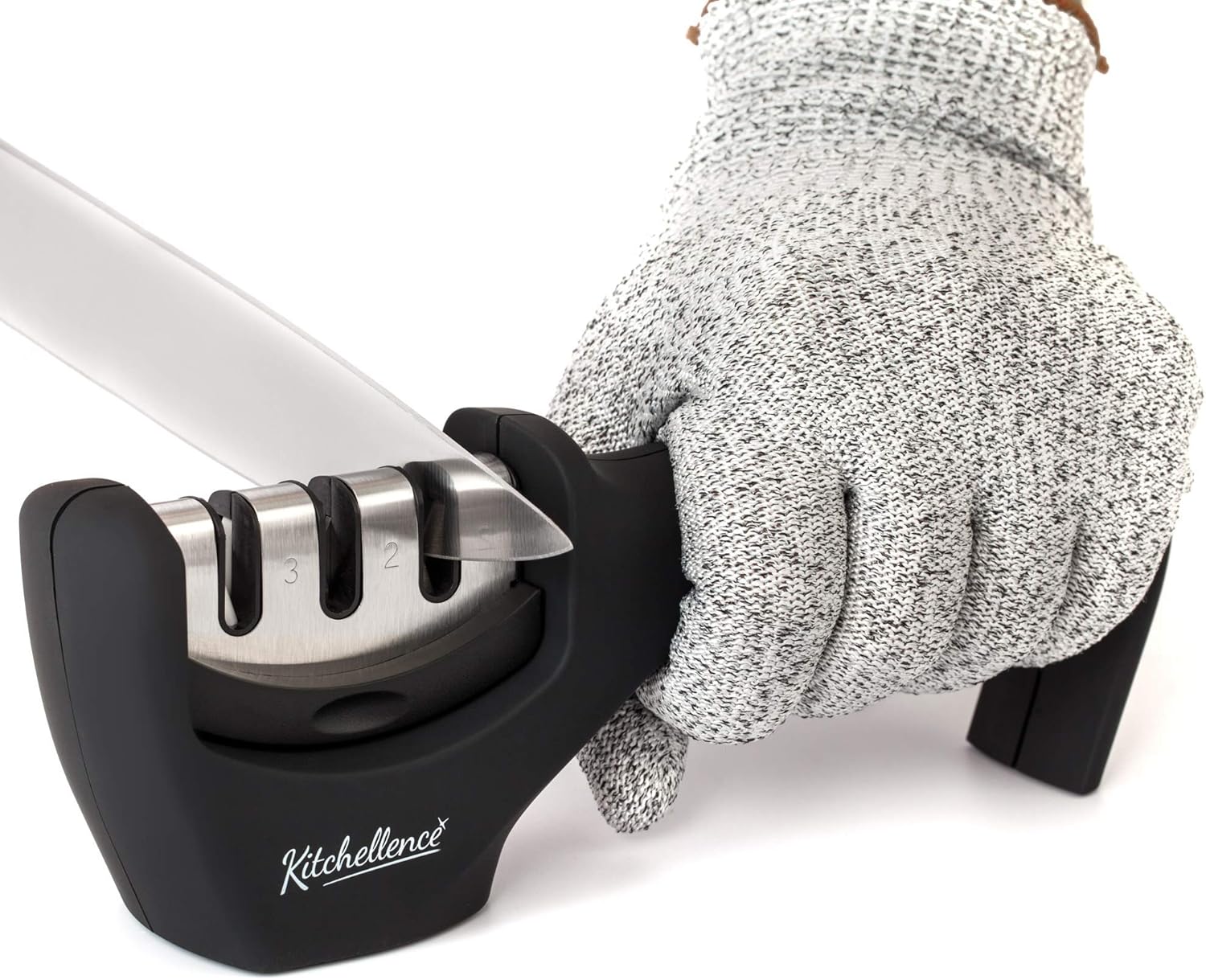
This compact 3-stage sharpener is built for quick touch-ups and basic blade repair in a busy kitchen. The first diamond rod straightens damaged edges, the second slot restores the V-bevel, and the third fine-tunes and polishes for a smoother cutting edge, making it useful for a butcher needing fast maintenance between heavy tasks. Its ergonomic handle and non-slip base give decent control when pulling blades through, and the included cut-resistant glove adds a precaution that suits higher-risk environments. Made from ABS plastic the unit is lightweight and portable, so it is easy to store or keep at a prep station, but it is not a substitute for professional sharpening machines for very dull or chamfered butcher knives. For repeated heavy use you may notice slower results versus bench grinders or whetstones, and angle control is fixed rather than adjustable, so it works best for standard chef and butcher blade profiles.
Best for: Butchers and home users who want a safe, fast way to restore everyday cutting performance between professional sharpenings and prioritize proven user safety features.
Less Ideal for: Professional shops that require precise, adjustable angles or frequent heavy re-profiling should rely on bench grinders or whetstones instead.
- Three distinct sharpening stages (diamond repair, bevel restoration, polishing) for progressive edge work
- Ergonomic handle and non-slip base for secure one-handed operation
- Includes a cut-resistant glove to reduce injury risk during sharpening
- Lightweight and compact for easy storage or use at a prep station
- Fixed sharpening angles limit use on uncommon or heavily damaged butcher blades
- Plastic construction may wear faster under heavy commercial use
Verdict: A convenient, safety-minded 3-stage sharpener that delivers quick edge restoration for butchers who need fast, reliable touch-ups on standard blades.
Sharp Pebble 1000/6000 Whetstone

| Grits | 1000 / 6000 |
|---|---|
| Abrasive material | Corundum |
| Included base | Bamboo non-slip base |
| No oil required | Water-based sharpening |
The Sharp Pebble 1000/6000 whetstone is a two-sided waterstone kit aimed at restoring and polishing kitchen and workshop blades. You soak or wet the stone and use the 1000-grit face to remove nicks and reprofile an edge, then switch to 6000 grit for a fine polish and razor finish. The kit includes a non-slip bamboo base and a clamp-style angle guide that holds the blade steady, which removes much of the guesswork for beginners and helps produce consistent bevels. The corundum abrasive is designed to cut quickly and resist rapid dish or chipping, and the kit ships with printed instructions and an ebook for technique guidance. This is primarily a manual sharpening solution, so it demands time and basic technique compared with an electric sharpener, but it yields a finer, longer-lasting edge when used correctly. Heavy-duty or very large butcher blades may require more time and repeated passes, and you will need to flatten the stone occasionally to keep it true. For butchers who want control over edge geometry and pro-level results without outsourcing, this whetstone is a practical choice.
Best for: Butchers and meat processors who prioritize precise, professional-quality edges and want a reliable manual sharpening method that reduces guesswork and delivers consistent results.
Less Ideal for: Users who need very fast, repeatable sharpening for high-volume production or who prefer a push-button powered system should consider motorized sharpeners instead.
- Dual 1000/6000 grits cover edge repair through final polishing
- Angle guide simplifies maintaining a consistent sharpening angle
- Non-slip bamboo base stabilizes the stone during use
- Corundum abrasive formulated to cut efficiently and resist chipping
- Includes instructions and an ebook to help beginners learn technique
- Manual sharpening requires time and practice to master
- Larger butcher blades may need many passes compared with powered systems
- Stone will require occasional flattening to maintain a true surface
Verdict: A compact dual-grit whetstone kit that gives butchers precise, pro-level edges with guided, low-risk manual sharpening.
Choosing the Right Knife Sharpener for Butchers: Key Factors to Consider
Abrasive Type and Grit Range
The abrasive material and available grit sizes determine how quickly and how cleanly a blade can be reshaped. Coarse grits remove metal fast to fix chips and reprofile edges, while medium and fine grits refine the bevel and polish the edge for cutting performance. Ceramic, diamond, and bonded abrasives behave differently under frequent professional use: diamonds cut fast with minimal loading, while high-quality water stones produce very fine finishes but need more maintenance.
For butchers who sharpen multiple times each day, a system offering a coarse starting surface plus a fine finishing stage reduces total time spent while preserving edge geometry. Consider how easy it is to swap abrasives or access different grits when planning long shifts of recurring sharpening.
Angle Control and Repeatability
Consistent bevel angle is critical for edge longevity and predictable cutting behavior. Tools that lock a blade at a set angle or provide a jig with clear degree markings help maintain uniform angles across multiple knives and sharpening sessions. Repeatability matters particularly in team environments where several people may touch the same tool.
If your knives have a specific bevel geometry for slicing or heavy cutting, choose sharpeners that either match that geometry or allow precise adjustments. Poor angle control forces rework and shortens time between regrinds.
Stability and Clamping
A secure, non-slip base and reliable clamping mechanism reduce slip-related injuries and ensure consistent contact with the abrasive. Bench-mounted or clamp-style systems that hold the blade rigidly let you apply even pressure and maintain the chosen angle without hand fatigue. Portable sharpeners should still provide rubberized feet or suction to prevent movement on wet or oily surfaces.
Stability also influences finish quality. Movement during strokes can create uneven bevels and require extra passes to correct, wasting time and shortening blade life.
Speed Versus Material Removal
In a butcher shop you often need to balance fast edge restoration against conserving blade steel. Aggressive tools remove material quickly but can change blade geometry or shorten service life if overused. Conversely, gentle finishing tools preserve metal but take longer to correct serious damage. Choose a system that gives you access to both ends of that spectrum so you can rapidly reprofile when necessary and then refine the edge for longevity.
Understanding how much pressure and how many passes are appropriate with each abrasive helps avoid unnecessary regrinds and keeps blades in service longer.
Cleaning and Maintenance
Sharpening equipment in a food-preparation environment must be easy to clean and resistant to rust or contamination. Abrasives that trap metal particles or food residue complicate sanitation. Look for systems with replaceable or washable components and materials that tolerate frequent washing and sanitizing procedures.
Maintenance also affects long-term cost and availability. Consumable stones, belts, or plates should be easy to source and replace, and any mechanical parts should accept straightforward lubrication or service to avoid downtime.
Skill Needed and Training
Different sharpening systems require varying levels of technique. Freehand stones and some honing methods depend on operator skill to maintain a consistent angle, while guided or mechanical systems reduce the learning curve. For shops with multiple employees, a tool that gives consistent results with minimal training increases throughput and reduces blade damage from inexperienced users.
Consider how much time you can invest in training and whether the tool's operation fits your workflow. A slightly slower but foolproof method can be preferable to a fast, technique-dependent process when staff turnover is high.
Preparing Blades and Workspace
Before sharpening, clean blades to remove food residue and inspect edges for chips or corrosion. Small defects should be identified so you can choose the correct abrasive sequence rather than guessing and risking excessive material removal.
Set up on a stable, well-lit surface with firm footing. Keep a towel or non-slip mat beneath the sharpener, and have a safe rest area for finished knives. In busy shops, designate a single sharpening station to centralize maintenance and sanitation processes.
- Wipe blades clean and dry before starting
- Inspect for chips, bends, or rust
- Use a stable work surface and anti-slip mat
- Keep a separate towel for wiping metal filings
Sharpening Workflow for High-Volume Shops
Establish a consistent workflow: coarse reprofiling only when needed, followed by progressively finer abrasives and a final stropping or polishing step. Doing too much coarse work on every knife wastes steel and increases how often full regrinds are necessary.
Schedule periodic heavier maintenance during slower production hours to avoid interruptions. Regular quick touch-ups during shifts keep blades performing without the need for long regrinds.
- Triage knives by condition before sharpening
- Use coarse grit only for chips or dull profiles
- Finish with a fine grit or strop for daily use
Safety Best Practices
Follow safe handling procedures: always pull the blade away from your body, secure loose clothing, and wear cut-resistant gloves when appropriate. Keep bystanders clear of the sharpening station and use protective eyewear if grinding or using powered systems that produce sparks.
Maintain a distraction-free environment while working on edges. Proper lighting and a consistent stance reduce slip risk and improve sharpening results.
- Pull blades away from your body on each stroke
- Use cut-resistant gloves and eye protection when needed
- Keep children and untrained staff away from the station
Maintaining Stones, Belts, and Plates
Regular maintenance of abrasive surfaces preserves performance. Flatten water stones periodically, clean diamond plates to remove metal swarf, and track belt wear. Replacing worn abrasives before they damage blades saves time and prevents inconsistent edges.
Store abrasives properly to prevent contamination and warping. Wet stones should be dried and kept flat; belts stored loosely to avoid creases will last longer and cut more predictably.
- Flatten stones and clean diamond plates often
- Replace belts when grit is exhausted
- Store consumables to prevent contamination or warping
When to Send Blades for Professional Regrind
Even with regular sharpening, knives eventually need a professional regrind to restore correct geometry or remove deep damage. If repeated repairs fail to restore edge life or the bevel geometry has shifted significantly, schedule a regrind during low-volume periods.
A regrind resets the blade profile and can extend overall service life, but it also removes more steel than routine sharpening. Balance regrind frequency with the cost of replacement blades in your operation.
- Regrind when bevel geometry is inconsistent across the blade
- Choose regrinds for deep chips or repeated edge failure
- Plan regrinds during slow shifts to avoid downtime
How We Chose the Best Knife Sharpener for Butchers
We prioritized tools that meet the demands of professional butchery: fast material removal for repairing nicked blades, repeatable angle control to keep edges consistent across many knives, and robust construction that tolerates frequent use and cleaning. We evaluated devices for edge retention by considering abrasive type and grit range, and for speed by measuring how quickly a blunt edge can be restored to working sharpness. Ease of use was judged on setup, angle guides, and whether a tool requires specialized technique. Durability covered handle and base materials, corrosion resistance of contact parts, and whether replaceable components are available. We excluded lightweight consumer hobby sharpeners and any tools intended only for honing without coarse abrasive options. Our shortlist emphasizes practical features: coarse to fine progression, secure clamping or stable bases, clear angle control, and surfaces that are serviceable in a professional kitchen. The criteria reflect what butchers actually need: fast reprofiling, consistent angles, reliable finishes, and daily durability.
Our full evaluation process is outlined in our review methodology.
FAQ
How often should butchers sharpen their knives?
Frequency depends on use, butchers often touch up edges daily and perform more thorough sharpening weekly or as needed. High-volume tasks may require more frequent light honing to keep edges performing between full sharpening sessions.
Is a coarse abrasive safe for regular shop use?
Coarse abrasives are safe when used appropriately for repairing or reprofiling. They remove more metal, so limit their use to when blades are chipped or have lost geometry and follow with finer abrasives to restore a proper cutting edge.
Can staff with minimal training use guided sharpeners effectively?
Yes, guided systems reduce the skill barrier and produce consistent angles with minimal practice. They are a good choice in shops with multiple operators, though some training on pressure and stroke technique is still beneficial.
How do you sanitize sharpening equipment in a butcher shop?
Remove loose metal particles and clean surfaces with a food-safe sanitizer. Use materials that tolerate washing and drying to prevent corrosion. Replace consumables that are difficult to sanitize or that trap residue.
Does using a sharpener shorten blade life?
Any sharpening removes some steel, so aggressive or overly frequent reprofiling will shorten total blade life. Using the correct grit progression and limiting coarse work to necessary repairs minimizes metal loss and extends service life.
Final Verdict
Choose a knife sharpener for butchers that matches your shop's workload and staff skill level. Prioritize systems that offer a coarse-to-fine abrasive progression, reliable angle control, and a stable setup to reduce injury and time spent on maintenance. Balance speed against material removal to preserve blade life while keeping knives consistently effective. The best choice is the one that integrates with your workflow: easy to clean, durable under heavy use, and forgiving enough for multiple operators. Focus on repeatability and maintenance support to ensure consistent performance over time.