
Note: This article contains affiliate links. If you click on these links and make a purchase, we may earn a small commission at no extra cost to you. This helps support our research and content. Read our full affiliate disclosure here.
A good diamond knife sharpener makes quick work of dull blades and preserves edge geometry so you can cook with confidence. Whether you keep a small set of kitchen knives or maintain a larger collection, the right sharpener reduces the risk of over-grinding and extends blade life. This guide presents six shortlisted options that cover different grit ranges, user skill levels, and maintenance routines. We evaluated each choice for abrasive performance, ease of setup and use, durability, and how gently it treats common kitchen steels. Read on for the selection criteria and practical advice to pick the best diamond knife sharpener for your needs.
Top Picks at a Glance
| Best Overall The best all-around choice for most situations | Chef's Choice AngleSelect 1520 |  |
| Best Quality Built to a higher standard if you want something more solid | Chef'sChoice Trizor 15XV |  |
| Best Value The sweet spot between price and what you get | Lansky D-Sharp Diamond Sharpener |  |
| Top Rated A top-rated pick with lots of positive feedback | DMT DuoSharp FWFC 8-Inch |  |
| Most Popular A crowd favorite that many people choose with confidence | KitchenIQ Diamond Deluxe 2-Stage Sharpener |  |
| Best Seller A high-volume bestseller chosen again and again | KITCHELLENCE 3-Stage Knife Sharpener KS37 P |  |
Chef's Choice AngleSelect 1520

| Sharpening angles | 15° and 20° |
|---|---|
| Sharpening stages | 3-stage |
| Abrasive material | Diamond |
| Voltage | 120V |
| Wattage | 125W |
The Chef's Choice AngleSelect 1520 is a compact 3-stage electric knife sharpener that uses 100% diamond abrasives and precision angle guides to restore and polish kitchen knives. You run the blade through stage one for a 15-degree edge or stage two for a 20-degree edge, then finish in the stropping stage for a polished, burr-free edge; first-time sharpening takes about a minute and resharpening about 10 seconds. It handles a wide range of blades including straight-edge, serrated, Santoku, and many Asian and Western styles, so it is practical for an everyday kitchen that mixes blade types. The diamond abrasives cut quickly and consistently, and the built-in angle guides remove guesswork for repeatable results. Trade-offs are typical of electric systems: you cannot micro-adjust angles beyond the preset 15 and 20 degrees, and the unit is best for established blade geometries rather than custom bevel work. Overall it is a fast, reliable tool for keeping household knives sharp with minimal skill required.
Best for: Buyers who want an easy, repeatable way to keep a mixed set of kitchen knives sharp without learning manual sharpening techniques.
Less Ideal for: Enthusiast sharpeners who need fully adjustable angles, custom grinds, or professional-level reprofiling should look at dedicated sharpening systems.
- 100% diamond abrasives sharpen quickly and maintain cutting speed
- Three-stage system (15°, 20°, stropping) produces a long-lasting, polished edge
- Precision angle guides eliminate guesswork and deliver consistent results
- Works on straight-edge and serrated knives as well as many knife styles
- Limited to factory-set 15° and 20° angles so not suited for custom bevels
Verdict: A fast, user-friendly electric sharpener that reliably restores and polishes a broad range of household knives to 15° or 20° edges with diamond abrasives.
Chef'sChoice Trizor 15XV

| Material Type | Diamond |
|---|---|
| Grit Type | Fine |
| Stages | Three |
| Edge Angle | 15-Degree |
The Chef'sChoice Trizor 15XV is a three-stage electric sharpener designed to convert standard factory edges to a fine 15-degree Trizor edge using 100 percent diamond abrasives. You run the blade through Stage 1 to create the primary bevel with medium diamond abrasives, Stage 2 to hone the edge with finer diamonds, and Stage 3 for a polished finish with patented stropping disks that also handle serrated knives. Built-in precision angle guides and flexible spring guides remove guesswork and make it easy to sharpen consistently along the full blade. In practice it delivers very sharp, long-lasting edges quickly — initial sharpening takes about a minute and touch-ups only seconds. The unit is focused on performance rather than portability or minimal footprint, and its motorized process removes the skill barrier of manual stones, but it does permanently reshape edges when converting 20-degree blades to 15 degrees so users should be intentional about edge geometry. For cooks who demand fast, repeatable, razor-sharp results the Trizor 15XV is a strong choice.
Best for: Buyers who prioritize professional-level cutting performance and want a fast, repeatable electric sharpener that produces a fine 15-degree edge with minimal skill required.
Less Ideal for: People who prefer to preserve original factory edge geometry, those who want a compact travel tool, or users who want full manual control with whetstones.
- Uses 100 percent diamond abrasives for fast, durable material removal
- Three-stage system (sharpen, hone, stropping) produces a polished 15-degree Trizor edge
- Precision angle guides and flexible spring guides ensure consistent alignment
- Can sharpen both straight-edge and serrated knives
- Converts edge geometry when changing 20-degree factory edges to 15 degrees, which may not suit all knives or preferences
- Not designed for portability or travel use
Verdict: If you want fast, repeatable, pro-quality 15-degree edges with minimal effort, the Trizor 15XV delivers consistent diamond sharpening and a polished finish.
Lansky D-Sharp Diamond Sharpener

| Sharpening Angles | 17°, 20°, 25°, 30° |
|---|---|
| Diamond Grit | 400 grit (medium) |
| Ceramic Grit | 800 grit (mini benchstone) |
| Case Material | Metal |
The Lansky D-Sharp is a pocket-friendly pull-through sharpener built for quick field and kitchen maintenance. It provides four preset angles (17°, 20°, 25°, 30°) via hardened guide slots and uses 400-grit diamond surfaces for material removal plus an 800-grit ceramic benchstone for polishing and serrations. Typical use is a few controlled strokes through the selected slot to re-establish a bevel, then finishing on the ceramic surface for a smoother edge; the compact metal housing makes it durable for outdoor use or a drawer. Its strengths are speed, repeatable angles for consistent results, and the ability to address both plain and serrated edges with the mini ceramic stone. Limitations are that it is a pull-through tool rather than a full guided stone system so it is optimized for sharpening and touch-ups rather than reprofiling extremely damaged blades, and the fixed angles limit customization for specialty chisel grinds. For routine maintenance and on-the-go sharpening it delivers reliable, repeatable edges in a small package.
Best for: Buyers who want a rugged, no-fuss sharpener for regular maintenance and fast touch-ups at home or outdoors, prioritizing repeatable angles and portability.
Less Ideal for: Those seeking a full sharpening workbench for reprofiling, mirror finishes, or custom bevels should choose a multi-stone guided system instead.
- Four preset angle slots for consistent, repeatable bevels
- 400-grit diamond slots remove metal quickly for fast sharpening
- 800-grit ceramic benchstone polishes edges and addresses serrations
- Durable metal casing and compact shape suited to field or kitchen carry
- Fixed angle slots limit ability to set nonstandard bevels or perform major reprofiling
- Pull-through design is less versatile than a multi-stone guided system for advanced sharpening tasks
Verdict: A tough, pocket-ready pull-through sharpener that delivers fast, repeatable edges for routine maintenance and on-the-go use.
DMT DuoSharp FWFC 8-Inch

| Material Type | Micronized Monocrystalline Diamond |
|---|---|
| Grits | Coarse 45 micron / Fine 25 micron |
| Included Components | Double Sided Diafold |
| Unit Count | 1 Count |
The DMT DuoSharp FWFC is a compact, double-sided diamond whetstone built for quick, repeatable sharpening both in the shop and on the go. It pairs a coarse 45-micron face to rapidly reshape dull or nicked edges and a fine 25-micron face to hone a razor finish, and the continuous monocrystalline diamond surface cuts faster than conventional stones. The unit folds into protective plastic handles for safe storage and portability and can be used dry or with water, so there is no need for oils. In real-world use it excels at restoring kitchen knives, pocket blades, garden tools, and chisels with minimal setup time, and the durable diamond surface will hold up to frequent use. The main limitations are its narrow 1-inch stone width, which makes long blades take more passes, and the folding plastic handle is convenient but less stable than a full benchstone setup for precision flattening work.
Best for: Buyers who prioritize a dependable, fast-working sharpener for regular maintenance and occasional field use will appreciate this durable, no-mess diamond solution.
Less Ideal for: Users seeking a wide benchstone for high-precision flattening or single-stroke sharpening of long blades should consider a full-size benchstone instead.
- Two-grit diamond surfaces (coarse 45 micron and fine 25 micron) for fast restoration and fine honing
- Monocrystalline micronized diamond surface sharpens faster than conventional stones
- Foldable handles protect the stone and make it portable for field or travel use
- Works dry or with water so no oil is required
- Narrow 1-inch stone width makes sharpening long blades slower
- Folding plastic handles provide less stability than a full benchstone base
Verdict: Choose the DMT DuoSharp if you want a rugged, fast diamond sharpener that reliably restores and hones edges with minimal fuss.
KitchenIQ Diamond Deluxe 2-Stage Sharpener

| Included Components | Sharpener |
|---|---|
| Material Type | Plastic |
| Grit Type | Coarse,Fine |
| Model Number | 50825 |
The KitchenIQ Diamond Deluxe Edge Grip is a small, user-friendly two-stage sharpener that sets and hones edges for straight and serrated knives. Use the diamond-coated coarse slot to quickly reestablish a bevel on dull or nicked blades, then finish in the ceramic fine slot to refine and polish the edge. The patented V edge grip and soft rubber handle let you stabilize the tool on a countertop or table edge so longer knives clear the surface while sharpening, and the non-slip feet keep it steady on flat surfaces. Its preset angles make it approachable for users who do not want to learn freehand sharpening techniques, and the plastic housing keeps the unit lightweight and easy to store. Limitations include a lack of adjustable angles for specialty blades and the small compact form is less suitable for heavy workshop use or wide chef knives that benefit from guided rod systems or stones.
Best for: Buyers who want a reliable, easy-to-use sharpener for everyday kitchen knives and who value proven performance and straightforward operation over fiddly setups.
Less Ideal for: Specialists, professional chefs, or hobbyists who need precise angle control or who regularly restore very large or high-end blades should look at guided systems or whetstones instead.
- Diamond-coated coarse rods quickly reestablish edges on very dull blades
- Ceramic fine stage provides consistent final honing and edge polishing
- Patented V edge grip and non-slip feet allow safe sharpening on a countertop edge
- Compact, lightweight design stores easily in a drawer
- No adjustable sharpening angles for custom bevels
- Plastic body limits heavy-duty or professional workshop use
Verdict: A compact, approachable two-stage diamond-and-ceramic sharpener that reliably brings everyday kitchen knives back to a usable edge.
KITCHELLENCE 3-Stage Knife Sharpener KS37 P
| Material Type | Plastic |
|---|---|
| Number of Items | 1 |
| Included Components | Yes |
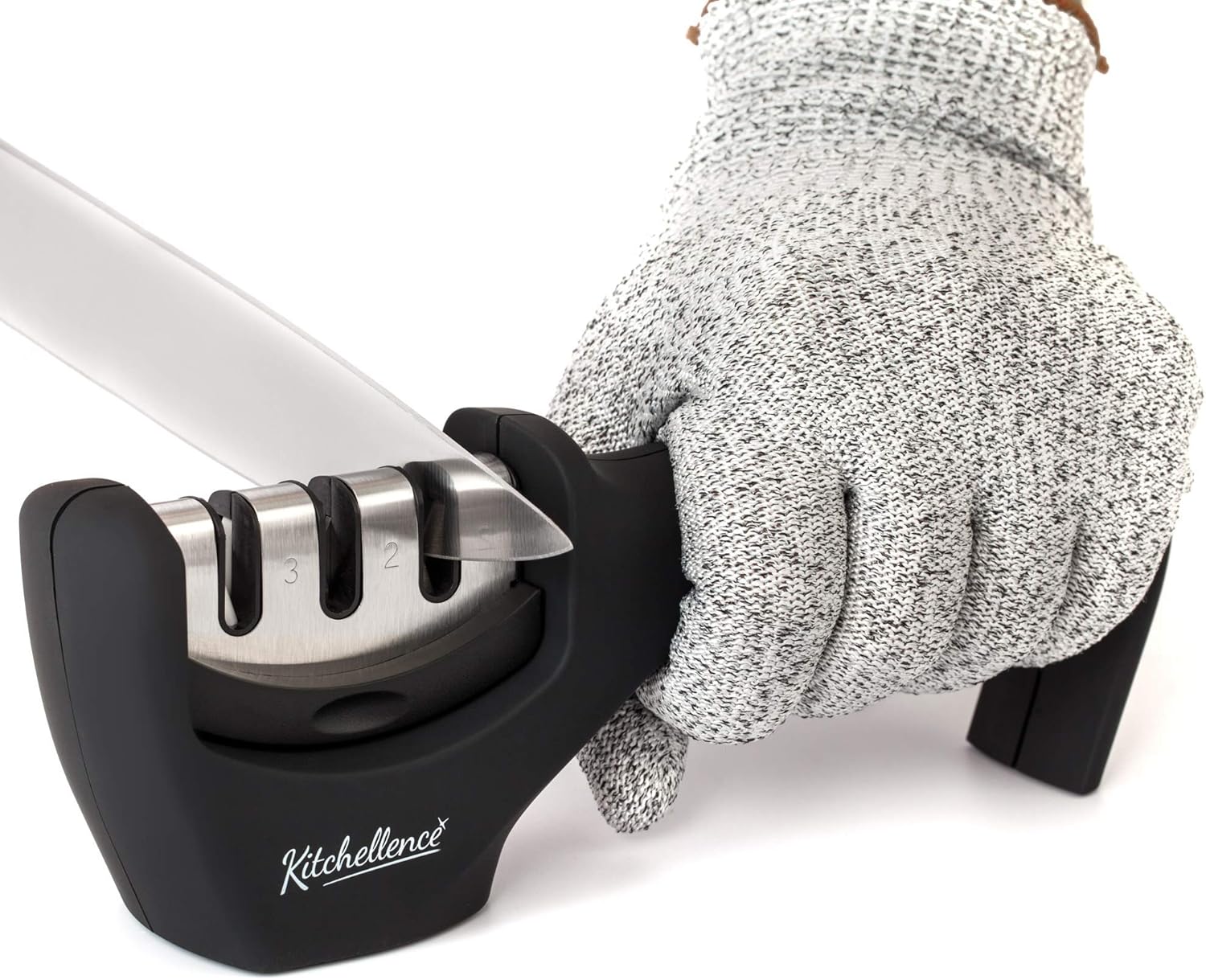
This compact 3-stage sharpener repairs, sharpens, and polishes kitchen knives at the countertop without power tools. Use the diamond rod slot first to realign and remove nicks, then pass the blade through the coarse sharpening slot to reestablish the bevel and finish with the fine polishing slot for a cleaner edge. The unit has an ergonomic handle and nonslip base to steady the sharpener while you draw the blade through the slots, and the included cut-resistant glove adds an extra safety layer for casual home cooks. Construction is molded ABS plastic, so it is lightweight and easy to store but not as heavy-duty as metal-bodied bench sharpeners. It works quickly for routine maintenance and dull-knife rescue, but it does not replace professional sharpening for high-end or very damaged blades. For buyers who want a safe, affordable way to keep everyday knives functional, this kit delivers straightforward results with minimal learning curve.
Best for: Home cooks who want a low-risk, easy-to-use tool to quickly restore and maintain everyday kitchen knives without specialized skill.
Less Ideal for: Sharpening specialists, professional chefs, or anyone looking to fully restore heavily damaged or premium high-hardness blades should consider a pro service or a dedicated bench sharpener instead.
- Three distinct sharpening stages (diamond rod, coarse, fine) for progressive edge repair and polishing
- Ergonomic handle and non-slip base for stable, one-handed sharpening
- Includes cut-resistant glove to reduce the chance of accidental cuts during use
- Lightweight ABS construction that is easy to store and move around the kitchen
- Plastic body is less durable and stable than metal or bench-style sharpeners
- Not intended for professional reprofiling of very damaged or premium blades
Verdict: A safe, easy, three-step diamond-equipped sharpener that reliably refreshes household knives for risk-averse home cooks.
Choosing the Right Diamond Knife Sharpener: Key Factors to Consider
Abrasive Grit Range
The available grit sizes determine what the sharpener can do. Coarser grits remove metal quickly to repair chips or reprofile an edge. Medium grits establish the working bevel. Fine grits or diamond strops create the final polish that improves cutting performance and reduces burrs.
Choose a sharpener that offers at least two distinct grit levels if you need both repair and finishing capability. If you expect to do only light touch-ups, a combination of medium and fine grits can be sufficient. The incremental grit progression matters because too-large jumps can leave scratches that require extra work to remove.
Cutting Consistency
Consistent material removal across the length of the blade produces straight, predictable bevels. That depends on the quality and uniformity of the bonded diamond surface and the stability of the sharpening platform.
Inconsistent cutting leads to uneven edges and takes longer to correct. For knives you use frequently, prioritize sharpeners with well-bonded abrasive surfaces and a flat reference plane. Consistency also reduces heat and stress on the steel, which helps maintain temper and edge toughness.
Angle Control and Guides
Accurate angle control is essential for repeatable edges. Slight differences in angle change cutting performance and edge durability. Fixed-angle guides are simple and fast, while adjustable-guide systems let you tune the bevel for different knife types.
Consider what knives you own and whether you want to learn freehand sharpening. If you have specialty blades with narrow or very acute bevels, choose a system that provides precise, stable angle settings. For casual home cooks, an intuitive guide that prevents accidental oversetting reduces the chance of damaging the edge.
Ergonomics and Safety
Sharpening involves pressure and repetitive motion, so ergonomics affect both comfort and result quality. A secure, non-slip base prevents movement that could cause inconsistent strokes or accidents. Comfortable handles and reachable grips matter when working larger blades.
Safety features like blade guards, stable clamp systems, and clear hand placement cues reduce the risk of cuts during use and when changing abrasive stones. Consider how the sharpener stores and whether components lock together to avoid accidental disassembly.
Build Durability and Materials
A rigid frame and corrosion-resistant components ensure the sharpener keeps its alignment over time. Flexible or porous materials can allow the abrasive surface to flex under pressure, which degrades accuracy. Metal components or reinforced composites typically offer better long-term stability than thin plastics.
Look for replaceable abrasive elements and robust mounting points. Durable construction reduces the frequency of replacement and helps maintain consistent sharpening geometry through years of use.
Maintenance and Consumables
Diamond abrasives are long-lived, but their performance still depends on cleaning and occasional resurfacing or replacement. Some bonded diamond plates can be rinsed and wiped, while others require flattening with a dressing stone.
Understand the availability and cost of replacement plates if you plan heavy use. Easy-to-remove plates and straightforward cleaning procedures reduce downtime and keep results consistent. Consider whether the sharpener accepts aftermarket consumables or proprietary parts when planning long-term ownership.
Types of Diamond Sharpeners and How They Differ
Diamond knife sharpeners come in several forms, each suited to different users. Bench-mounted guided systems use a clamp and rod with attached diamond stones; they excel at precise angle control and reprofiling. Handheld rods are fast for quick touch-ups and portable work. Flat diamond plates or stones offer a simple reference surface for freehand sharpening and flattening ceramic stones.
- Guided rod systems: Precise bevel control, better for reprofiling
- Handheld diamond rods: Portable, good for quick maintenance
- Flat diamond plates: Versatile for freehand and stone maintenance
Preparing Knives and Work Area
Proper preparation saves time and prevents mistakes. Clean and dry blades before sharpening to remove debris and oil. Secure the sharpener on a stable, non-slip surface and ensure adequate lighting so you can see burrs and scratch patterns clearly. If using a guided system, check that clamps and guides are tightened but not over-stressed. For bench and plate systems, stabilize the knife with a comfortable grip and use controlled, even passes to avoid gouging. Take regular breaks to inspect the edge rather than overworking a single spot.
- Wipe blades clean and inspect for chips
- Stabilize sharpener and work surface
- Use consistent pressure and check progress often
Common Mistakes to Avoid
Rushing through grit stages or skipping necessary finishing steps is a frequent error. Removing large amounts of metal without moving to finer abrasives can leave coarse scratches and a poor cutting edge. Applying uneven pressure, changing angle mid-stroke, or using a flexible platform often creates an inconsistent bevel. Another mistake is neglecting maintenance. Clogged or glazed diamond surfaces cut less effectively and increase friction. Finally, attempting to sharpen damaged steels without proper coarse abrasives and technique can make chips worse rather than repairing them.
- Do not skip progressive grits
- Avoid changing angle during strokes
- Keep abrasives clean to maintain cut efficiency
Maintaining Diamond Surfaces and Replacements
Cleaning diamond plates is usually simple: rinse under water and scrub with a soft brush to remove metal filings. For bonded diamond stones that glaze, a light dressing or use on a lapping plate can restore cutting action. Track wear patterns; while diamonds last a long time, uneven wear can signal alignment or pressure issues. Plan for eventual replacement of consumable plates. Systems that allow quick plate swaps minimize downtime. When replacing, match grit and plate thickness to preserve established angles and the sharpener's geometry.
- Rinse and brush plates after use
- Use a lapping or dressing plate for glazed surfaces
- Inspect wear and replace plates before alignment degrades
Edge Finishing and Stropping Options
Diamond finishes vary from toothy to very fine polish. After diamond stages, many users follow with a leather strop or a fine abrasive paste to remove the last burr and improve cutting feel. Stropping can also help align microscopic teeth and produce a razor-like sensation without removing more metal. If you prefer a satin rather than mirror finish, choose a finer diamond or a compound with moderate abrasives. Match the finishing method to the knife's intended use: chopping and daily kitchen tasks often benefit from a slightly toothier edge, while slicing or delicate prep may call for a higher polish.
- Strop with leather and polishing compound for final polish
- Choose finish level based on cutting tasks
- Use stropping to align rather than remove metal
How We Chose the Best Diamond Knife Sharpener
We focused on attributes that directly affect sharpening results, repeatability, and long-term blade care. Primary evaluation points included abrasive grit range, so a sharpener can remove nicks and then refine an edge; abrasive quality and bonding method, which influence how consistently the diamond cuts; and guide accuracy, since stable angles are critical for predictable bevels. We also considered ergonomics and user safety features, including non-slip bases, comfortable grips, and secure blade support. Durability factors such as frame rigidity and corrosion resistance were included to reflect long-term ownership. Ease of use and maintenance were assessed by how straightforward the setup, cleaning, and replacement procedures are. Products were excluded if they rely solely on coarse abrasives without fine grits for finishing, if guides offered no meaningful angle control, or if construction appeared likely to flex during use. The shortlisted sharpeners met practical standards for producing repeatable edges across popular kitchen steels and for being serviceable over time.
Our full evaluation process is outlined in our review methodology.
FAQ
How often should I sharpen kitchen knives with a diamond sharpener?
Frequency depends on use. Home cooks who use knives daily often sharpen or touch up the edge every few weeks, with light stropping between sessions. Heavier use or dulling from hard foods may require more frequent sessions.
Can I use a diamond sharpener on stainless and carbon steels?
Diamond abrasives cut both stainless and carbon steels effectively. Carbon steels may develop finer polish more quickly, while harder stainless grades can take longer to abrade. Use appropriate grit progression to avoid overheating or over-grinding.
Will diamond sharpeners remove chips or reshape an edge?
Coarse diamond grits can remove metal fast enough to repair small chips and reprofile a bevel. Larger chips or significant damage may require more aggressive grinding before moving to finer grits for finishing.
Is it better to use a guided system or freehand on a diamond sharpener?
Guided systems provide consistent angle control and are easier for repeatable results, which benefits less experienced sharpeners. Freehand on a flat plate offers flexibility and speed for skilled users who can hold a steady angle.
How do I know when a diamond plate needs replacement?
Replace when cutting performance noticeably drops despite cleaning and dressing, or when wear becomes uneven and affects angle consistency. Plates that crack or delaminate should be replaced immediately for safety and performance.
Final Verdict
Choosing the right diamond knife sharpener means balancing repair capability, repeatability, and long-term upkeep. Prioritize a grit progression that matches how aggressively you need to remove metal, and favor rigid angle control if you want consistent bevels across many knives. Think about how often you will maintain blades and whether quick touch-ups or full reprofiling is your priority. With the right sharpener and a consistent technique, you will restore edges efficiently while preserving blade life and performance.